Whitestone REIT
NNYSE:WSRQ4 FY2025 · Earnings Call TranscriptFebruary 26, 2026
Operator
Greetings, and welcome to the Whitestone REIT fourth quarter 2025 earnings conference call. At this time, all participants are in a listen-only mode.
A question-and-answer session will follow the formal presentation. If anyone should require operator assistance, please press star zero on your telephone keypad.
As a reminder, this conference is being recorded. It is now my pleasure to introduce David Mordy, Director of Investor Relations.
Please go ahead.
David Mordy
Good morning, and thank you for joining Whitestone REIT's fourth quarter 2025 earnings conference call. Joining me on today's call are Dave Holeman, Chief Executive Officer; Christine Mastandrea, President and Chief Operating Officer; and Scott Hogan, Chief Financial Officer.
Please note that some statements made during this call are not historical and may be deemed forward-looking statements. Actual results may differ materially from those forward-looking statements due to a number of risks, uncertainties, and other factors.
Please refer to the company's earnings news release and filings with the SEC, including Whitestone's most recent Form 10-Q and 10-K, for a detailed discussion of these factors. Acknowledging the fact that this call may be webcast for a period of time, it is also important to note that this call includes time-sensitive information that may be accurate only as of today's date, February 26th, 2026.
The company undertakes no obligation to update this information. Whitestone's fourth quarter earnings news release and supplemental operating and financial data package have been filed with the SEC and are available on our website in the Investor Relations section.
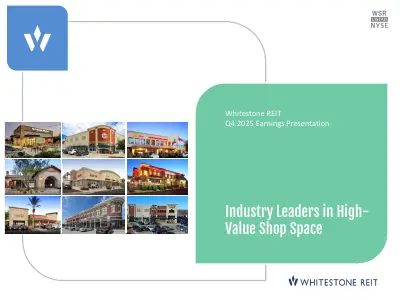
We published fourth quarter 2025 slides on our website yesterday afternoon, which highlight topics to be discussed today. I will now turn the call over to Dave Holeman, our Chief Executive Officer.
Dave Holeman
Thank you, David. Good morning, and thank you for joining Whitestone's fourth quarter 2025 earnings conference call.
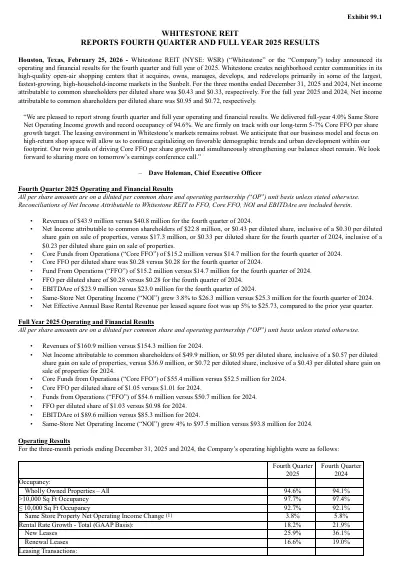
I'll get right into the key results, and then spend a little time on our long-term focus. For 2025, we delivered $1.05 core FFO per share.
This is up from 86 cents in 2021, which was the year prior to my appointment as CEO and reshaping of the leadership team. That represents a 5% CAGR, and we did that while strengthening our balance sheet as evidenced by our debt-to-EBITDA metric improving from 9.1 times for the full year 2021 to 7.0 times for the full year 2025.
In addition, we overcame interest rate headwinds with an 11 cents per share step-up in interest expense between 2022 and 2023. Given that we have interest rates fixed on the bulk of our loans and minimal debt maturities until 2029, one of the strongest leasing environments I have ever seen, and a great team, we have very good visibility into the next 3 years, and are very confident in our ability to generate long-term 5% to 7% core FFO per share growth.
Today, we'll talk about some non-FFO benefits we plan on delivering for investors, primarily gaining scale and enhancing the long-term value of our real estate. Know that delivering consistent core FFO growth is our North Star.
For 2025, we delivered 4% same-store NOI growth. We delivered this through a combination of strong contractual escalators in excess of 2%, leasing success with straight-line leasing spreads in excess of 19%, and targeted redevelopment with projects typically delivering double-digit yields.
We're issuing same-store NOI growth guidance of 3% to 4.75% for 2026, and we expect to deliver with the same combination of drivers that allowed us to deliver in 2025. During the fourth quarter, we acquired World Cup Plaza in Plano, a highly affluent Dallas submarket, and one where we are gaining synergies from our concentration of properties there, with World Cup Plaza in close proximity to our Starwood and Lakeside properties.
In addition, in the fourth quarter, we acquired Ashford Village, anchored by Houston's largest Japanese grocer, and in close proximity to the Ashford Yard development, a mixed-use project currently underway on the former Schlumberger campus. We also disposed of Kempwood Plaza, another of our legacy properties, during the fourth quarter.
Kempwood Plaza is located in Houston. Whitestone's acquisition and disposition strategy is designed around identifying and then remaining cognizant of the gap between neighborhood strength and tenant strength.
We identify properties where that gap is significant, and then our leasing team goes to work to close that gap. If we feel that that gap no longer exists, especially if it is the result of a neighborhood demand growth slowing, a property becomes a candidate for disposition.
You may notice we've significantly increased our Green Street TAP Score over the past 4 years, which is an indication that we're going after higher-end neighborhoods with greater discretionary spending capability. We anticipate this will serve investors well in various economic cycles, and it's more manageable as we scale.
However, the biggest value to be gained is not because of the overall level of our TAP Score, but rather our ability to identify and acquire properties where we can improve a tenant base that lags that TAP Score. Over the past 3 years, we've acquired approximately $213 million in properties, which provides our leasing team with great opportunities to generate earnings growth.
We're capable of increasing that volume, handled both by our acquisitions and our leasing teams, and we'll look for ways to increase that volume while achieving both our core FFO per share long-term growth target and continuing to strengthen our balance sheet with continued improvement in our debt-to-EBITDAre ratio. Our focus on shop space delivers two additional primary benefits.
Shop space requires less capital spend versus the bigger boxes, allowing us to deliver same-store NOI growth while being at the low end of the spectrum on capital spending. In addition, when paired with robust tenant selection and underwriting, our nearly 1,500 tenants provide greater durability of cash flow and greater risk dispersion.
Supply-demand conditions within our footprint remain strong, with a limited supply of neighborhood centers coming onto the market, and with demand continuing to increase. Foot traffic to our centers was up 3.9% year-over-year, and our leasing pipeline remains robust.
Our team remains very engaged at looking in ways to generate shareholder value, and continue to outperform the market the way we've done over the last several years. With that, I'll turn things over to Christine to share more specifics on results and our focus on increasing the value of our real estate.
Christine?
Christine Mastandrea
Good morning. We delivered strong, consistent results for 2025.
We hit a record occupancy of 94.6% and delivered same-store NOI growth of 4% for the year. Combined straight-line leasing spreads for the fourth quarter were 18.2%: 25.9% for new leases, and 16.6% for renewals.
This is our 15th consecutive quarter with leasing spreads in excess of 17%. One of the key initiatives this management team focused on immediately after the 2022 transition was our quality of revenue initiative, pushing to make sure that we had high-quality, fast-growing businesses throughout the portfolio.
We're already renewing many of the leases from 2022, and re-leasing rates we are achieving are a testament to the strength of the businesses we've matched to the neighborhoods that surround our centers. Our consistently high leasing spreads reveal the competitive advantage of our model and the expertise of our leasing team.
We drove bad debt down to 0.55% for 2025, less than half the rate versus the years prior to the pandemic. Getting down to these levels represents a combination of our tenant selection, our underwriting, and the expectation we've set with our tenants.
We believe we have one of the lowest bad debt levels for shop space across the peer set. Over the past 4 years, we set out to prove that our geography and focus on actively managing a very high percentage of shop space allows us to outperform our larger peers.
Accordingly, we focused a lot on the annual financial metrics and continuing to deliver for investors on those metrics. This morning, I want to stress that delivering those results go hand-in-hand with a strategy that is enhancing the long-term value of our real estate.
We have a plan for every property in our portfolio, and the plan for each property incorporates anticipated demographic changes and expected nearby urban development with a re-contracting plan that is designed to bring tenants up to speed with the demand generated by the surrounding neighborhood. When we acquire properties, we look for properties with a large delta exists between the strength of the neighborhood and in-place tenants.
Earnings growth is accelerated as we close the gap. Let me be clear: we're able to close that gap more quickly and effectively as a result of how we do business because of the team we built.
At times, redevelopment is a tool to help close the gap, but the overarching goal in terms of long-term value creation is upgrading the tenant base to match the neighborhood, to successfully serve our customers and our clients. A prime example of pursuing a property plan and creating value is Heritage Trace Plaza in Fort Worth.
We purchased Heritage Trace in 2014, recognizing the rapid growth of the Alliance corridor in north Fort Worth. In 2022, H-E-B, the second-largest private employer in Texas and a grocer with the most dominant brand loyalty in the state, announced they were opening an H-E-B across from Heritage Trace.
H-E-B made this decision in large part because the increasingly dense concentration of young, upwardly mobile families in the area, something we discovered early on when we acquired the property. Accordingly, we refocused our plan for the center in order to take advantage of the increased traffic from H-E-B, as well as the demographic changes that were taking place in the neighborhood.
The center developed a very strong traffic from parents returning home from work. Consequently, we took back a larger space in 2024 from a challenged fitness studio that had been in the center since acquisition, and created seven spaces in its place.
Six out of seven of those spaces were leased immediately in 2025, doubling the base rental rate for the space at approximately $34 per square foot. Overall, we anticipate we will increase the center's NOI by 30% between 2022 to 2026.
Our work is nowhere near done as we've got nearly 50% of the center's leases coming due within the next 3 years, and we will continually review each, every tenant to ensure they're keeping up with the speed of the growth in the area and the demography it represents. As I said, this type of plan exists for every center in our portfolio, whether it's upgrading the type of restaurant space, creating a pad when there's none that existed before, or moving and increasing the visibility of a key space in the center, or such as setting up rooftop pickleball as we relentlessly pursue enhancing the value of our centers.
Two acquisitions I'll call out that have rapid development similar to Heritage Trace are Arcadia Town Center in Phoenix and Garden Oaks in Houston. Arcadia is anchored by the Paradise Valley, one of the 50 wealthiest suburbs in the United States, with home values increasing at double-digit rates.
The former Paradise Valley Mall is being redeveloped into a $2.2 billion mixed-use development, and Arcadia is not only anchored close to Paradise Valley, growth is spreading and enveloping the center. The Tempe Waterway and the bike trail pass by the backside of Arcadia, and we anticipate creating a pad site they'll capitalize on associated traffic in the neighborhood.
Similarly, in Houston, Garden Oaks is benefiting from the expansion of The Heights, redeveloped as Houstonians recognize the value of larger plots of land in the area with excellent proximity to downtown for work. Rapid development occurring on Shepherd Drive is expanding northward, and Target anticipates opening a new store next to Garden Oaks in early 2027.
We are evaluating pad site options and tenant candidates for that pad, as well as remerchandising that center. Let me expand a bit on the record 94.6% occupancy we hit at the end of 2025.
This included very strong activity right up to the end of the year. When I say that, I mean I signed a lease at 11:23 p.m.
on the 31st. Our redevelopment CapEx in 2025 was approximately $5 million, with redevelopment projects complete at Williams Trace, La Mirada, and Lion Square.
We've added redevelopment projects to the list, including at Garden Oaks, and so we'll have a multi-year forecast of $20 to $30 million in redevelopment spend in addition to the pads that we add every year. Last year, we added several pads.
We anticipate continuing to do that over the next few years. We will look to accelerate some of that work, and so we'll estimate the timeframe for that spend over the next 3 years.
I'd like to thank the leasing, redevelopment, and property management teams for everything they delivered in 2025. Our teams continue to elevate the performance every year, sharpening their plans for our center, adapting to change, and making sure tenants see the value in operating from a Whitestone property.
Their success is our success. In addition, the hard work not only allowed us to deliver in 2025, but lines up the company for continued growth the years ahead.
Scott?
Scott Hogan
We delivered very strong results for both the fourth quarter and for the year. We delivered $1.05 in core FFO per share versus $1.01 in 2024, representing 4% growth.
In 2024, we had above-average termination fees, which is part of the reason we grew core FFO per share by 11% in 2024. Those termination fees were at a normal level for 2025, 2 cents less than 2024.
The by-quarter breakdown for 2025's core FFO was 25 cents, 26 cents, 26 cents, and 28 cents. That's about what we anticipated in terms of seeing growth during the year, with some additional revenues in Q4, including percent of sales clauses that typically help accelerate things in the fourth quarter.
You should anticipate a similar distribution in 2026. We delivered same-store NOI growth of 3.8% for the fourth quarter, and 4% for the full year.
Our 3% to 4.75% same-store NOI growth forecast is a ground-up, tenant-by-tenant forecast for 2026 that incorporates what we're seeing in terms of macroeconomic conditions. Meanwhile, the longer 3% to 5% growth is based upon what we've been able to achieve historically and incorporates the longer-term benefits of redevelopment projects we have underway.
Same-store NOI growth is the primary driver for our core FFO per share growth, and gives us the confidence to lay out our 5% to 7% growth target in 2026 and the longer term. Occupancy came in at 94.6%.
As a reminder, we only include tenants in our occupancy when they take possession, not when the contract is signed. Both our process and our heavier mix of shop space tenants equates to a much lower signed-not-open list, and we view the quicker turnaround as one of our competitive advantages.
This is record occupancy for Whitestone, and we were able to move it to that level by having a long-term vision for our properties rather than taking short-term occupancy wins. Christine covered our redevelopment capital.
We've underwritten double-digit unlevered IRR on those outlays, and we generally view the redevelopment as low-risk, high-return investments. On the balance sheet front, we finished the year with debt-to-EBITDAre at 7 times despite acquisitions being greater than dispositions in 2025 by approximately $56 million.
In terms of Whitestone's liquidity, we have $7.4 million in cash, and $220 million available under the credit facility. In 2025, cash flow from operations was $50.8 million, and dividends were $27.8 million, leaving strong cash flow after dividends to fund growth.
We have no maturities in 2026, and $80 million in maturities in 2027, we have a very clear runway in terms of our need to access the debt markets over the next 2 years. We've increased our dividend by 5.6% for the first quarter of 2026.
Our intent is to continue growing the dividend in line with core FFO growth. Whitestone's dividend remains one of the most secure, highest-growing dividends within the peer group, and we believe we have the right plan in place to continue the growth trajectory while maintaining our payout ratio.
With that, we'll open the line for questions.
Operator
Thank you. We will now be conducting a question-and-answer session.
If you would like to ask a question, please press star one on your telephone keypad. A confirmation tone will indicate your line is in the question queue.
You may press star two to remove yourself from the queue. For participants using speaker equipment, it may be necessary to pick up your handset before pressing the star keys.
Your first question comes from Mitch Germain with Citizens. Please go ahead.
Mitch Germain
Good morning. You guys had the final settlement with Pillarstone in the back part, I guess it was the kind of last week of the year.
Just maybe kind of talk about how that payment impacted your balance sheet, and what are the different inputs or takes we need to be aware of in terms of maybe pro forma what changes occurred so late in the year?
Scott Hogan
Hi Mitch, it's Scott. Day one, we took those proceeds, we paid down the credit facility.
Going forward, we'll evaluate acquisitions and dispositions as the opportunities become available. I would think about it as just an improvement to the balance sheet, improvement to leverage on day one.
Then as we always do, we'll make capital allocation decisions based on the opportunities as we proceed through '26, '27, and beyond.
Mitch Germain
Gotcha. Okay.
What's G&A guide for the year?
Dave Holeman
Hey Mitch, it's Dave. Make sure I understood your question, could you say that one more time?
Mitch Germain
G&A, you didn't include that in your guidance this year. Historically, you have.
Any idea of kind of where things can shake out over the course of 2026?
Dave Holeman
Sure. Obviously we look at the guidance we give and the underlying metrics, I think we've discontinued to redeem that a little bit.
I think you should expect G&A to be similar levels, no major changes there other than normal course. I don't know if Scott wants to add anything there, but there always is with G&A some volatility with certain items like legal costs.
Right now we expect a similar G&A level with normal kind of cost of living increase probably.
Scott Hogan
Mitch, we just haven't been as granular as our earnings have become more predictable, and so I would expect similar level with some kind of CPI increase.
Mitch Germain
Gotcha. Okay.
Last one for me. Obviously, in-line quarter, congrats with that.
Your guidance was $1.03 to $1.07. Your result came in at the low end of that range.
All of the various assumptions that you provided—same-store, occupancy, G&A, interest—you kind of hit the midpoint on all of them. I recognize your comments, Scott, about the cadence of earnings per share increasing as the year went on.
Is 28 the starting point now? Are we growing from that level, or is it really some of the occupancy came on late quarter and you didn't really get the full benefit of that?
I'm just trying to understand about how we should be thinking about kind of 1Q and beyond.
Scott Hogan
You lost me a little bit there, Mitch, because it sounded like you were talking about the '25 guidance coming in at the low end, and I think we came in at the midpoint, $1.05. The '26 guidance is $1.10 to $1.14.
Did I not understand correctly?
Mitch Germain
No, actually you're right. It's the $1.05, my apologies.
Let's start at 28. Am I growing from 28?
Is that the way to think about it in terms of how I should be thinking about the cadence for 2026?
Scott Hogan
Our long-term growth, we feel very confident that it's going to be 5% to 7%. How it's distributed between each year is a little tougher to determine because of the timing of some of the redevelopment projects, and just acquisitions and dispositions.
Longer-term, we're very comfortable with 5% to 7%.
Dave Holeman
Then, hey, Mitch, it's Dave. On a quarterly cadence, I think Scott gave some indication.
The fourth quarter does tend to be a little higher because we have percent of rent clauses come in. If you look at the cadence this year, it was increasing.
I think you would expect to see similar in '26, I don't know if it's completely accurate to say you're just jumping off the 28 in the fourth
Scott Hogan
quarter.
Dave Holeman
I think you're jumping off the annual amount with normal quarterly cadence.
Mitch Germain
Gotcha. That
Scott Hogan
helps. I thought you were talking about 2028 when you said 28.
Mitch Germain
No. Dave got it.
I appreciate it, guys.
Dave Holeman
Thanks, Mitch.
Operator
Floris van Dijkum with Ladenburg. Please go ahead.
Floris van Dijkum
Hey, guys. Thanks.
Could you maybe quantify what your signed-not-open pipeline is? I know you report physical occupancy unlike peers who tend to report leased occupancy and then provide what the physical occupancy is.
If you could give us a sense of what your leased occupancy is, and in terms of percentage and maybe also in terms of the value of the ABR that you've got signed.
Dave Holeman
Hey, Floris. It's Dave.
Hope you're doing well. Thanks for the question.
I think we historically have not reported signed-not-open because our model is different in that we're moving a little bit quicker than some of our peers. We typically have the smaller spaces, shorter leases, and are able to commence leases very quickly.
We just haven't reported it because it's not a number that is huge for us because we get tenants in very quickly. I also, just on an editorial level, feel like people report signed-not-open, but always there's a sign, but there's a moving-out list as well that nobody reports.
For us, we report our commenced occupancy, and really at any point in time or with the smaller tenants have leases that we're signing and moving in quickly.
Floris van Dijkum
Would you say that based on the leasing demand today that your leased occupancy is probably, I think if I recall correctly, your typical SNO pipeline is about 50 basis points. Is that higher today than it has stood historically?
Dave Holeman
I think the leasing environment is very good. Our leasing traction is improving.
I think the general answer would be, if anything, it's growing or getting better, although we are moving very quickly. The signed-not-open is just a status of the process.
We're moving quickly to get those folks commencing and paying rent. I think your point is our signed-not-open pipeline would be, if anything, growing because we are having great progress.
Floris van Dijkum
Thanks, Dave. Maybe another question in terms of the fourth quarter average rents that you signed of $32.58, when I compare that to your average ABR of the whole portfolio, there's about 28% delta.
Now, I know quarterly things can be tricky, but is that sort of what people should think about in terms of mark-to-market if the portfolio were to be marked to market today?
Scott Hogan
Hi, Floris, it's Scott. As Dave said, the leasing pipeline is strong.
We've got great demand in our markets. I think the best place to look just in terms of what to expect in increases is our leasing spreads.
Our overall leasing spreads for the fourth quarter were 18.2%, and I think we've said that for 15 quarters they've been 17% or higher. Strong leasing demand.
There's always a mix issue. I think in the fourth quarter we may have had more smaller tenants than you have throughout the rest of the year, so that would explain why it's a bit higher than our average rents.
I would look to the leasing spreads for an indication of what you would look for going forward.
Floris van Dijkum
Thanks, Scott. Maybe my last question, in terms of what is your shop occupancy today, and how is that relative to historical levels, and how does that compare to your anchor occupancy today?
Dave Holeman
We're flipping here, it's on the first page of the earnings release. I think we doing this by memory, I don't have it in front of me, but we are, Scott may have it, I think we're 50 or 60 bips up on the small space year-over-year, as well as about similar amount on the larger spaces.
Scott, if you got those actual numbers?
Scott Hogan
Okay.
Dave Holeman
Oh, thanks. We're at 90 97.7% on the larger spaces versus 97.4% a year ago.
The smaller spaces, 92.7%, up 60 bips from 92.1% a year ago. We're continuing to see good movement in both of our spaces.
Floris van Dijkum
Are both of them, you mentioned overall occupancy, physical occupancy is at record levels. Both of those would be at physical, that's what I was trying to get at.
Apologies, I probably wasn't very clear. Are both of those at record levels, or is there more upside?
Where and how much higher do you think you can push occupancy?
Dave Holeman
I think we can get to the averages of our peers, but I continue to say this: I'll take back space where I can and put it back to work for more profitability wherever I'm able to. I will say that probably over the last couple of years I've been actively being able to do that in the portfolio.
As we strengthen the quality of revenue, there's less opportunity to do so. Our renewals and, again, new leasing spreads I think are going to continue going out the next couple of quarters, and really into the next couple of years, just because there's no new product being built into the markets that we're in.
I think the small space that are the ones where we're going to continue to see the ability to move. Historically, as Floris, people always talked about small spaces and lower occupancy.
I think that paradigm is shifting. I think you're going to see the small spaces bumping up to the larger space kind of occupancy levels as we move forward.
That's one that will continue to move up. We do think there's opportunity.
There's no reason to have a significant amount of vacancy in your small spaces. We're making progress there, and I think that's one we'll see moving.
Obviously, the larger spaces are closer to 100%, 98% or so, so that's a little more difficult.
Floris van Dijkum
Thanks, guys. Appreciate it.
Dave Holeman
Thank you.
Operator
Next question, Gaurav Mehta with Alliance Global Partners. Please go ahead.
Gaurav Mehta
Yeah. Thank you.
Good morning. I wanted to ask you on the two acquisitions that you made in the quarter.
Can you maybe talk about any upside in those properties, maybe on mark-to-market rent or on the occupancy side?
Christine Mastandrea
Yeah. I'd say with Ashford, that's an area where it's in the path of growth.
This is not that far from I-10 in the Energy Corridor, and it's a very healthy neighborhood that has good housing stock, and as what we've been watching is seeing the improvement in the homes in the area. I think for that, that's going to be just trading space into a rising income.
Then if I look at World Cup Plaza, that's more of a remerchandising effort. I think this is one where we can really reposition that property just because it's along the highway, and it has such a high VPD count compared to others.
That'll be more of a remerchandising. Same thing, we're already starting that process now with that property versus Ashford will be a natural, I think, in the natural path of growth, and so you'll just every time a lease turns, we'll be able to do a renewal at a much higher rate.
Gaurav Mehta
Okay. A second question I have is on the same property expenses that you reported in this quarter.
It seems like they were up 30% on the property operations and maintenance side. Can you provide some color on what drove the expenses higher?
Christine Mastandrea
Yeah. There's always some timing in there.
At the portfolio level, we recover about 93% of property expenses, those were just planned maintenance, painting properties, parking lot repairs, those sorts of things. Sometimes you have more in one quarter than the other, but I don't think it would be indicative of a run rate for the portfolio.
It's just a timing thing in 2025.
Gaurav Mehta
Okay. All right.
Thank you. That's all I had.
Christine Mastandrea
Thank you.
Operator
Next question, Jay Kornreich with Cantor. Please go ahead.
Jay Kornreich
Hey. Good morning.
Just wanted to follow up on the comments around the record occupancy levels, which is clearly showing the strength of your shopping centers. I guess I wondered, just with the high occupancy, does that imply maybe some of the shopping centers are closer to maxing out kind of what their occupancy limits are, and maybe some of these centers are more ripe for value creation, asset recycling, or do you feel like there's just enough leasing power and still some occupancy lift that you're happy with the kind of current portfolio you have?
Christine Mastandrea
We always look at assets as we purchase them to where we get to maturity with them. In the beginning, you've seen the capital recycling that we've been doing, especially when I talk about this when we're doing a remerchandising effort or buying an asset that's in the path of growth, they may have a higher occupancy level, but I have the opportunity to raise rents even based on an asset that's in place or in a remerchandising, and then also, like I said, at points in time we'll take space back.
I don't see it topping out yet, really for the next couple of years, and I also think because there's just really these are all in infill markets, there's not a lot available for competition, I think we still have room to go.
Dave Holeman
Hey, Jay, it's Dave. The only thing I might add is I think in our remarks we talked about how we look at the surrounding neighborhood really is the biggest driver.
I think when we look at acquisitions and dispositions, that's kind of one of the huge factors is looking at the surrounding neighborhood. We think that even the properties that are 100%, as Christine said, we see growing neighborhoods, we see areas where you're seeing household incomes grow, discretionary spending grow, and the ability to move rents.
We will look at, just like we've done, we'll look at our portfolio and look for candidates to dispose and recycle capital. I think in our investor deck, on page 10, we've got a lot of detail we provide to the investment community about what we're selling and what we're buying.
We'll continue to look for those opportunities. Largely, our properties are in great growing areas where we see, even with high occupancy levels, the ability to move rents.
Jay Kornreich
Great. Appreciate that color.
Then just one follow-up, you've outlined the $20 to $30 million for redevelopment opportunities that I think five potential pad sites. Is there any possibility of any of those coming online in 2026?
Christine Mastandrea
Yeah. We're always doing about two to three pads a year, and I think we're right on track this year with doing three.
We look for double-digit yield on incremental capital for those. That's just more or less getting the approvals, depends on the cost for utilities and adjust for grade on the site.
Those are really easy to pop out. With the larger developments, and this is something that we're starting to project out for in the sense that we've gotten the approvals for additional GLA in a number of sites, and we already have gone in for design and permitting on some of these, and it's really a question of making sure that we strike when the returns are in the right place with construction costs.
How we look at this is that we do this in phases, that way we can horizontally manage the risk because, again, it's an expansion of a property with additional GLA. I don't see that coming on necessarily this year, but if some of it does, it'd be later in the year.
Jay Kornreich
Great. Thanks very much.
Dave Holeman
Thank you.
Operator
Next question, Craig Kucera with Lucid Capital Markets. Please go ahead.
Craig Kucera
Hey. Good morning, guys.
Scott, you kind of touched on this a few times, but I'd be curious to hear sort of the breakout in the fourth quarter of some percentage rent, and maybe were there any lease terminations as well? Just because your base rent was a little higher than we were looking for.
Scott Hogan
I'm sorry, what was a little higher?
Craig Kucera
Basically, your rent was a little higher. I'm just trying to figure out how much of that was percentage rents, were there any lease terminations, any other one-timers?
Scott Hogan
There's always some lease terminations. We didn't have any large lease terminations in the fourth quarter of '25 like we did in '24.
There's normally somewhere around $1 million of percentage rent in the fourth quarter. I don't have the number in front of me, $800,000, $900,000, $1 million in the fourth quarter, a penny or two of percentage rent normally in the fourth quarter.
Craig Kucera
Okay. That's helpful.
Ballpark is good enough. I guess, based on your commentary, it doesn't sound like there's a lot of anticipation for additional occupancy, but I'd be curious, in the guidance, how much of that is further occupancy gains or is that pretty much the strength of sort of rent growth and leasing?
Scott Hogan
It's primarily the strength of rent growth and leasing, not occupancy gains.
Craig Kucera
Okay. That's helpful.
Just one more from me. Clearly you had a pick-up in acquisitions this year.
I'd just be curious to hear about the volume of deals you're seeing, and maybe the appetite you have given the existing liquidity you have, or you mentioned, Dave, you might be recycling some capital later this year.
Dave Holeman
Yeah. Hey, thanks, Craig.
We did see a bit of a pick-up. I think we did close to $100 million in acquisitions this year, which is slightly up, did that largely with recycling and then obviously putting some of the Pillarstone settlement proceeds to work.
We are seeing opportunities in our markets. I think one of the comments I made in my earlier remarks was looking forward to opportunities to scale and grow the platform.
We are seeing a little bit more activity in the market. It continues to be a very tight market with limited supply of retail.
We are out there looking for opportunities, looking in the current markets we're in. We look for assets that are a little different.
If you look at what we've bought versus some of our peers, tend to say a little smaller assets. We'd love to find assets with hair.
Those are harder and harder to find, but we're finding ones where we can move the rents largely from a re-tenanting and remerchandising. I would say what we're seeing in the market is slightly positive and slightly up.
I think our appetite for growth is there, but what will always guide us is disciplined capital allocation and growing earnings and growing the value of the properties. We do think there's opportunities to grow and scale and look at different ways to do that, but we're always going to be guided with our target to grow earnings and grow value, not just to grow for growth's sake.
Craig Kucera
Okay. Thanks.
That's all my questions.
Dave Holeman
Thank you.
Operator
Next question, John Massocca with B. Riley Securities.
Please go ahead.
John Massocca
Good morning.
Dave Holeman
Morning, John.
John Massocca
Maybe looking at the redevelopment slide in the investor deck a little more, you kind of mentioned there's potential for 1% kind of boost to same-store NOI growth from redevelopment. Is much of that already kind of flowing in the expectations you have for 2026 same-store NOI growth, or could that be additive, particularly if we use your 2026 guidance as a run rate for a longer-term portfolio level growth?
Scott Hogan
Hey, John, it's Scott. I think it would be mainly beyond '26 that we're going to see the benefit of those redev opportunities.
Christine Mastandrea
Hold on, I can clarify that. There's development and redevelopment, we do a number of redevelopments every year, usually about two to three a year.
The redevelopments do flow into this year and to next year. Development's a little different, that just has a little more future, right, because it just takes a little more time to get it out of the ground.
John Massocca
Okay. Is that 1% that's kind of being talked about in the deck more on maybe the full ground-up pad site level, or is that including some of the things that are a little more
Christine Mastandrea
It's both, just like it has in the last couple of years. Like I said, we do usually two to three pads a year, and then in addition to that, we do two to three redevelopments, and then with that, we get a much larger bump in rents whenever we do a redevelopment.
We just finished Lion Square, we're starting into Garden Oaks, we've finished La Mirada. All that starts flowing into this year, and then I would anticipate that Garden Oaks would flow into 2027 and so on.
John Massocca
Okay. I guess with something like Lion Square or even Garden Oaks, you mentioned it a little bit, but does that kind of kick on relatively immediately after the redevelopment spend is completed, or does it take a couple of leasing cycles for you to see the full uplift from that spend?
Christine Mastandrea
It depends on each one. An example, with Lion Square, we actually got the grocer in there before we started the redevelopment, and so it can be, as we start into the process of the redevelopment, if there's a significant remerchandising that goes with it, we actually started even before the redevelopment takes place.
It depends. I do think that's a key component of our timing of redevelopment.
We look for a center that's got the ability to move the rents when the maturities are coming. It's not immediate, but we look for the ability to move it pretty quickly to time that with where we have the ability.
We're not doing redevelopment where you have tenants locked down for multiple years and you can't move the rent.
Dave Holeman
We're looking for it. Yeah.
No, that's helpful.
Christine Mastandrea
Right. An example of that is with Garden Oaks is that we wanted to see that the Target was coming online before we started that move.
Now with the Target coming in, we'll start the redevelopment process and we'll start the re-tenanting. We keep the in-place cash flow, reduce the risk, and then bring it alongside either.
In this case, we did the same thing with Lakeside 2, where we waited for the H-E-B to come online, started the spend just before the H-E-B came online, then started re-tenanting while the H-E-B was coming out of the ground. We try to time these things the best so we can get the best IRRs.
John Massocca
Okay. Then in terms of occupancy, should we expect some I guess seasonality in 1Q?
I just know it tends to be when some of the re-tenanting in the in-place portfolio is in full swing. Just kind of curious what the expectations are on a super short-term basis for occupancy.
Christine Mastandrea
I think this goes the same way. The last couple of years we were more active in taking back space because it was the right time to do in the portfolio and there was I think, again, a significant upside with improving the revenue on some of the poorer performing tenants.
I see that less so, but it might still be, the end of the year is just the season of leasing and how things get executed. That the end of the year always seems to have a heavier uplift, but that's because of the leasing activity that's taking place in the first and second quarter.
We know what it's going to look like towards the end of the year because of the timing, but just the same, leasing just has a seasonal factor to it.
John Massocca
Okay. Appreciate the color.
That's it for me. Thank you.
Dave Holeman
Thanks, John.
Operator
I would like to turn the floor over to Dave Holeman for closing remarks.
Dave Holeman
This is Dave. Thank you, guys, again for joining us on the call today.
We're very pleased with the progress and performance of the business and the strength of our markets and tenants. I would tell you I think we're off to a great start in '26, and we look forward to seeing many of you over the coming months.
With that, I think this concludes our call, and thank everyone and have a great day.
Operator
This concludes today's teleconference. You may disconnect your lines at this time, and we thank you for your participation.