Mirum Pharmaceuticals, Inc.
Q3 FY2026 · Earnings Call TranscriptNovember 3, 2026
Operator
Good afternoon and welcome to Mirum Pharmaceuticals third quarter 2026 earnings conference call. My name is Joel and I will be your operator today.
All lines are currently in a listen-only mode, and there will be an opportunity for Q&A after management's prepared remarks. I would now like to hand the conference over to Andrew McKibben, SVP of Strategic Finance and Investor Relations.
Please go ahead.
Andrew McKibben
Thank you Joel, and good afternoon everyone. I'd like to welcome you to Mirum Pharmaceuticals third quarter 2026 conference call.
I'm joined today by our Chief Executive Officer Chris Peetz, our President and Chief Operating Officer Peter Radovich, our Chief Medical Officer Rob Myers, and our Chief Financial Officer Eric Bjerkholt. Earlier today Mirum issued a press release announcing the company's results for the third quarter of 2026.
Copies of the press release and our SEC filings are available on the investor section of our website. Before we start, I'd like to remind you that during the course of this conference call we will be making certain forward-looking statements based on management's current expectations, including statements regarding Mirum's programs and market opportunities for its approved medicines and product candidates, and financial guidance.
These statements represent our judgment and knowledge of events as of today and inherently involve risks and uncertainties that may cause actual results to differ materially from the results discussed. We are under no duty to update these statements.
Please refer to the risk factors in our latest Form 10-Q and subsequent SEC filings for more information about these risks and uncertainties. With that, I'd like to turn the call over to Chris.
Chris?
Chris Peetz
Thanks, Andrew. The third quarter was another strong period for Mirum, both commercially and across our clinical programs.
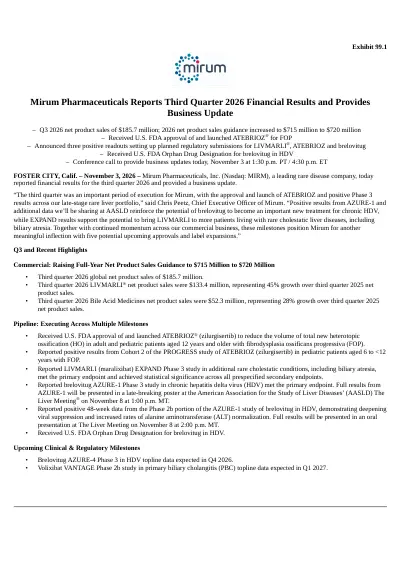
We generated $186 million in third quarter net product sales, and we are increasing our full-year net product sales guidance to $715 to $720 million. We've also had great progress across the portfolio since our last earnings call: positive Phase 3 Azure 1 data for brelovitug, positive EXPAND data for Livmarli, the approval and launch of Atelviro, and another positive Atelviro readout in younger patients.
Our recent progress feels quite meaningful as Mirum approaches its eighth anniversary. It's remarkable to think about what this team has accomplished in eight years.
We started Mirum around a simple idea: that by identifying important opportunities in rare diseases, combining great medicines with relentless execution, we could have a meaningful impact for patients and build an enduring company. Eight years later, we now have four approved medicines, a commercial business approaching three quarters of a billion dollars in annual net product sales, and a late-stage pipeline with multiple opportunities to drive our next phase of growth.
Coming up, we have two more potentially registrational readouts approaching, with the brelovitug Azure 4 study in HDV expected this quarter and the volixibat VANTAGE study in PBC expected in the first quarter of next year. Together, these are part of five potential approvals and label expansions ahead of us as we work towards realizing the greater than $4 billion peak revenue potential of the Mirum portfolio.
Eight years in, we're entering our next phase from a position of real strength, and we're excited to touch on some highlights and updates today. With that, I'll turn the call over to Peter.
Peter?
Peter Radovich
Thanks, Chris. The third quarter was another excellent quarter for Mirum's commercial business, with $186 million in net product sales.
Livmarli continues to be the primary growth driver, with third quarter net product sales of $133 million, including $100 million in the United States. Our bile acid medicines also provided steady growth, generating $52 million in net product sales for the quarter.
Continued growth across Livmarli and our bile acid medicines has allowed us to increase that outlook throughout the year, and based on our performance through the first nine months, we are increasing full-year guidance today to $715 to $720 million. This is a testament to our high-impact medicines and the high-performing team dedicated to getting them to patients.
For a little more color on Livmarli, in Alagille syndrome, uptake remains steady and durable, supported by new patient starts, persistence on therapy, and weight-based dose increases. PFIC continues to be an important driver, particularly among adults, where we believe there are at least 2,000 addressable patients in the United States, though the substantial majority of these patients remain undiagnosed.
Greater awareness of later-onset PFIC and increasing use of genetic testing will continue to help improve diagnosis rates. We are expanding our commercial efforts on this front, which should lay a strong foundation for 2027.
This expansion will also enable our other upcoming potential launches for Livmarli, volixibat, and brelovitug. I'm also happy to say that our fourth medicine, Atelviro, was approved in September for adult and pediatric FOP patients ages 12 and older, and our US launch commenced in October.
Atelviro is a natural addition to our rare genetic disease business. The FOP community is uniquely engaged, and their response to approval to date reinforces our belief that Atelviro can address a significant unmet need for patients and families living with FOP, with the convenience of oral dosing and a mechanism designed to address the underlying cause of the disease.
Our near-term focus is on patient identification and access, and we're encouraged by the strong early engagement from patients, caregivers, and healthcare professionals. Overall, I'm very happy with the progress we made this quarter.
We are growing our existing medicines, launching our fourth medicine, and laying a strong foundation for multiple new potential indications and launches in 2027 and beyond. With that, I'll turn it over to Rob.
Rob?
Rob Myers
Thanks, Peter. It's been an exciting couple of months for Mirum: significant clinical progress across rare liver and rare genetic diseases.
We are now working towards five potential regulatory submissions across the portfolio: NDAs for volixibat in PSC and PBC, a BLA for brelovitug in hepatitis delta, a label expansion for Atelviro in FOP, and an sNDA for Livmarli based on the EXPAND study. Starting with volixibat in PSC, we continue to make progress toward our planned NDA submission in the first half of 2027.
We remain confident in the strength of the VISTAS results and the potential for volixibat to address important unmet need for patients with PSC and pruritus. We look forward to submitting our NDA and will provide an update if there's any material change in our plans or in FDA's prior feedback.
We've also recently reported positive results from three important studies across the portfolio. In FOP, Cohort 2 of the pivotal PROGRESS study extended the encouraging Atelviro results into children ages 6 to under 12.
The results were consistent with Cohort 1, with reductions in heterotopic ossification, encouraging improvements in joint mobility, and a safety profile consistent with that observed in older patients. The mobility findings are particularly encouraging in a progressive disease like FOP, where preserving function by intervening early is especially important.
Our next step is a planned sNDA submission in the first half of 2027 to potentially expand Atelviro to children ages 6 to under 12. Cohort 3, evaluating ziligurtert in even younger children, continues to enroll.
Now turning to the liver portfolio, EXPAND was another positive Phase 3 study for Livmarli, meeting its primary endpoint and all pre-specified secondary endpoints, with particularly encouraging results in biliary atresia. These findings further strengthen the body of evidence supporting IBAT inhibition for pruritus across a range of underlying cholestatic liver diseases.
In hepatitis delta, the positive Phase 3 Azure 1 results provide important validation for brelovitug, demonstrating meaningful improvements across key measures of virologic and liver disease activity. We'll build on this momentum at AASLD later this week, where we will present new data across our rare liver disease portfolio, including the full Azure 1 results and longer-term brelovitug data, as well as additional analyses from VISTAS and Livmarli data in rare cholestatic liver disease.
Without getting ahead of these presentations, we're particularly excited by the growing body of evidence with brelovitug showing deepening virologic suppression and continued improvements in ALT normalization and liver stiffness with longer treatment, including in patients with cirrhosis, a population with particularly urgent unmet medical need. Looking beyond AASLD, we expect the Azure 4 readout this quarter, an important next milestone for the brelovitug program and our planned BLA submission in the first half of 2027.
Overall, these recent clinical successes, together with the regulatory milestones ahead, give us strong confidence in the potential for our portfolio to deliver meaningful new treatment options for patients. With that, I'll turn it over to Eric to discuss the financials.
Eric?
Eric Bjerkholt
Thanks, Rob, and good afternoon, everyone. Our third quarter financial performance reflects our ongoing operating priorities: continued top-line growth with focused investment in bringing our late-stage programs through several potential approvals and launches.
As Peter mentioned, net product sales for the third quarter were approximately $186 million, compared with $133 million in the third quarter last year. Through the first nine months of the year, net product sales were approximately $522 million, which I'm excited to point out already equals full-year 2025 revenue.
In the third quarter, the cash contribution margin from our commercial business was in the high-50s percent of sales, and cash used in operations was approximately $4 million. Total operating expenses for the quarter were approximately $245 million: cost of sales of approximately $28 million, SG&A expense of approximately $70 million, R&D expense of approximately $94 million—all on a cash basis—in-process research and development of $13 million, and stock-based compensation, depreciation, and amortization expense of $40 million.
Our investment in R&D reflects the breadth of activity across our expanded late-stage pipeline, as well as the planned manufacturing expenses for our HDV program. On a cash basis, R&D was approximately 50% of revenues, as expected.
We expect this level of R&D spend to continue for approximately two more quarters. In total, revenues this quarter exceeded expectations, while expenses are on plan.
We also took steps this quarter to improve our capital structure. In September, we repurchased $20 million in aggregate principal amount of our 2029 convertible notes for approximately $62 million in cash, thus further reducing both future dilution and ongoing interest expense.
This follows the financing we completed in the second quarter, when we issued $690 million of zero-coupon convertible notes due in 2032 and settled 75% of the outstanding 2029 notes. Together, these transactions have reduced the outstanding balance of our '29 notes by over 80%, while preserving substantial financial flexibility.
As of September, cash, cash equivalents, and investments were approximately $500 million. Our commercial business continues to scale, and our balance sheet gives us the resources to support our upcoming launches and late-stage clinical programs.
With that, I'll turn the call back to Chris.
Chris Peetz
Thanks, Eric. Taking stock of where we are today, Mirum is at a strong inflection point.
The commercial business continues to outperform, driving an increase in our full-year guidance. We've launched Atelviro as a fourth commercial medicine, and including the Atelviro supplemental NDA for younger patients, we have five upcoming approval opportunities to further accelerate the commercial business.
The strong performance commercially, paired with our pipeline advancements, positions us to be cash flow positive next year. As we wrap up our prepared remarks, I want to direct attention again to the upcoming brelovitug data sets being presented at AASLD this weekend.
With data maturity now out to two years from the early program, we'll be able to share more of a complete picture of what brelovitug can achieve for patients with hepatitis delta. As we approach our eighth anniversary, I'm incredibly proud of what this team has built, but even more excited about what's ahead as we enter a unique period of commercial growth, multiple launch opportunities, and strong financial performance.
Finally, as always, I want to thank the entire Mirum team for their exceptional execution and the patients, families, and physicians whose partnership keeps us focused on what matters most. We have a lot to look forward to.
With that, operator, please open the call for questions.
Operator
We will now begin the question-and-answer session. If you would like to ask a question, please press *1 to raise your hand.
To withdraw your question, press *1 again. We ask that you pick up your handset when asking a question to allow for optimum sound quality.
If you are muted locally, please remember to unmute your device. Please stand by while we compile the Q&A roster.
Your first question is from Josh Schimmer with Cantor Fitzgerald. Your line is now open.
Please go ahead. Hi,
Josh Schimmer
great. Thanks for taking the questions.
Just a couple of quick ones. First, were there any Takeda purchases of Livmarli this quarter or expected in the next quarter as part of the revised guidance?
Then second, for the Chenodal and or the Cholbam, Sutepxli franchise, at least combined, you're starting to get to levels that I think historically you've suggested might attract generic interest or competition, not necessarily breaking out the relative contribution of each, but how should we be thinking about modeling the exclusivity of that franchise?
Chris Peetz
Josh, thanks for the questions. First, I can hit on the bile acid franchise, and we are really excited with how these have grown.
Just as a quick reminder on the backdrop on exclusivity, for Cholbam, that is beyond its orphan exclusivity time period, but Sutepxli does have orphan protection. They're both contributors here, and for both of them, we've not seen an entrant.
That's really all we have visibility to at this point to speak to, see the trends we're seeing for the near term, in any case, to roll forward. I'll ask Eric to maybe speak to Takeda dynamics.
Eric Bjerkholt
Thanks, Chris. We had very minimal revenues from Takeda this past quarter, and we don't really expect any new orders in Q4.
Josh Schimmer
All right, thank you.
Chris Peetz
Thanks for the questions.
Operator
Your next question is from Kalpit Patel with Wolfe Research. Your line is now open.
Please go ahead. Hi there, Kalpit.
Your line is now open. Please go ahead with your question.
We will move on to the next question. Your next question is from Brian Skorney with Baird.
Your line is now open. Please go ahead.
Hi team. Could you provide a little more color on your confidence in the timing of the planned PSC submission?
What's the next regulatory touchstone we should be looking for here? This is Luke, by the way.
Thank you.
Chris Peetz
Hi Luke, thanks for the question. On the PSC situation, for the time being, really nothing changed in what we can speak to in the status of the program.
Strategy is underway, and as we spoke about previously, multiple different touch points as we work towards a potential submission in the first half of next year. I'd say we're really confident in the data sets.
Rob's called out some of the abstracts at AASLD that touch on IBD safety, for example, some of that work coming out of our prep for that NDA submission. Just kind of come back to, we feel really confident in our guidance to submit an NDA in the first half of next year.
Beyond that, no material updates to what we've seen or heard.
Great. Then on Atelviro, I guess has there been any difference in the early launch experience thus far as compared to your expectations going into it?
Chris Peetz
It's early days. I'll hand over to Peter to get some color.
Peter Radovich
Luke, as Chris mentioned, early days, just launched in October, we're a couple weeks in, but really positive feedback from patients, caregivers, physicians. I think high receptivity to the value proposition we see with Atelviro.
We're really excited, but obviously early days to get into more detail than that.
All right, thanks, team.
Operator
Your next question is from Gavin Clark-Gartner with Evercore ISI. Your line is now open.
Please go ahead.
Yesha Patel
Hi, this is Yesha for Gavin. We were just wondering if, ahead of the Q1 VANTAGE readout for PBC, there were any blinded baseline or trial conduct metrics you're expecting to share, in particular maybe like baseline itch severity, background therapies, discontinuation rates, anything along that realm.
Thank you.
Chris Peetz
Thanks Yesha for the question. I think maybe Rob can speak to a little bit of the trial design, but not planning on too much on the actual data to speak to at this point.
Rob Myers
Really not much to report at this point. We're still tracking towards reporting the data in the first quarter of next year, and premature to talk about baseline characteristics, and aspects of study conduct at this point.
Yesha Patel
Thanks so much.
Operator
Your next question is from Kalpit Patel with Wolfe Research. Your line is now open.
Please go ahead.
Kalpit Patel
Hey, good afternoon and thanks for taking the questions. Two from us.
For the guidance raise, is most of that related to the adult PFIC patients that are growing for Livmarli, or are there other areas that are contributing to that growth? Then for the second question, for the PSC-IBD subgroup data that you'll be presenting, can you comment if those data have been submitted previously to the FDA, or are these new analysis that need to be assessed?
Thank you.
Chris Peetz
Thanks for the question. I can just touch on the PSC one briefly and then hand the guidance question over to Peter.
These are new analyses, kind of more in-detail review of data that FDA had not seen previously.
Peter Radovich
Kalpit, on the guidance question, we do see strength across the portfolio, continued growth in Alagille syndrome, bile acid products doing very well. Adult PFIC is the biggest driver, and we have line of sight now after several quarters of this cadence of $10 to $15 million quarter-on-quarter step-up for that to persist through this year and through next year as well.
Kalpit Patel
Thank you.
Peter Radovich
Thanks for the question.
Operator
Your next question is from Ryan Deschner with Raymond James. Your line is now open.
Please go ahead. Yeah.
Hi.
Ryan Deschner
Thanks for the question and congrats on the quarter. I'm curious on sort of your expectations for the relative launch trajectory for Atelviro, and if you would expect, at least early on, any signs of a bolus kind of coming in for that to sort of slow down later on in the early launch.
Just curious on your thoughts there. Thanks.
Chris Peetz
Ryan, thanks for the question. I'll let Peter speak to that, and probably even speak to the kind of broader portfolio as we roll into next year.
Peter Radovich
Yeah. The Atelviro early adoption and inbound interest has been really really strong, and we're excited about that.
I think if I were to compare the Atelviro launch trajectory and adoption curve to Livmarli, it probably will be faster. I think you take Livmarli, we're in Alagille syndrome, it's been about five years since the original FDA approval, and about 50% of addressable patients with Alagille syndrome have gone on Livmarli, and we're still seeing growth quarter-over-quarter.
I think if you were to think about that as a comparator, we would expect Atelviro to be faster adoption dynamics at this point.
Chris Peetz
One thing I'd add on is, as you look at Q4 and even into next year, the cadence of growth we've seen for total revenue in this kind of $10 to $15 million a quarter, we fully expect that to continue throughout next year.
Ryan Deschner
Thank you very much.
Chris Peetz
Thanks for the question.
Operator
Your next question is from James Condulis with Stifel. Your line is now open.
Please go ahead.
James Condulis
Hey, thanks for taking my question. Maybe just one on PSC, and appreciate there's only so much you can say, but I think you've mentioned in the past that in the discussion with the FDA, there was nothing really new you felt was new that wasn't already in the original VISTAS study.
Just curious if that's still the case, from your perspective. Then just in general, do you expect there to be a sort of formal alignment here, kind of ahead of filing, or is it just sort of TBD in terms of how the discussion evolves?
Thanks a lot.
Chris Peetz
James, thanks for the follow-up there. Overall, because this situation, we're seeking multiple different interaction points, multiple meetings, we're not providing kind of meeting-by-meeting updates.
Really what I can say is we're pointing towards that first half NDA. To kind of remind on the goal here is, given that the data set is so robust and there's a lot to review, the goal of the interactions we're having is to give more familiarity with the data set before submission, not necessarily, in all cases, complete alignment.
James Condulis
Makes sense. Thank you.
Chris Peetz
Thanks for the question.
Operator
Your next question is from Jessica Fye with JP Morgan. Your line is now open.
Please go ahead.
Jessica Fye
Hey guys, good afternoon and thanks for taking my question. I was looking at the press release, and it looks like there is a lot of regulatory submissions going in the first half of 2027.
I was curious if you could just speak to kind of the organizational bandwidth to bring in additional assets via business development during what seems like a really busy time. Basically, should we expect a little breather on the BD side in the near term while you get all these things into the FDA?
Chris Peetz
Jess, thanks for the question. It is a very busy first half of the year for submissions.
You're absolutely spot on with that. We saw this coming, we've done a lot to organize for it, and we're in really good shape from a team standpoint on having these efforts staffed and expect that we'll be able to manage through it without issue.
In terms of what it means for BD, we continue to be opportunistic. If the right opportunity comes, we want to be able to pursue it.
However, more of an earlier clinical-stage opportunity would be a little easier to add in at this point, but that doesn't mean we're not continuing to have an opportunistic lens on all opportunities.
Jessica Fye
Does that include commercial stage?
Chris Peetz
Absolutely. I can pass over to Peter to kind of talk about our lens on, again, more broadly on BD scope and targets that we like.
Peter Radovich
As Chris mentioned, I think our philosophy is you always have to be active. We look clinical stage through commercial stage.
We think about rare disease as a capability in the therapeutic area in and of itself, sort of have the know-how to be successful with rare disease medicines, whether it's development, regulatory, patient finding, patient access. Feel really good about the capabilities we've built there, and kind of look broadly for underappreciated rare disease assets where we think we could potentially add value.
Jessica Fye
Great. Thank you.
Chris Peetz
Thanks for the question.
Operator
Your next question is from Yigal Nochomovitz from Citi. Your line is now open.
Please go ahead.
Yigal Nochomovitz
Hi guys, thank you for taking the questions and congrats on the strong quarter. I just wanted to switch topics onto HDV and the Azure 4 readout.
Obviously, that's a second Phase 3 trial, which is good, but can you just speak to what additional nuances or additional learnings you might glean from Azure 4 to further drive the strength of the BLA? Then with regard to the HDV market, could you just talk to what you're watching for in terms of HDV diagnosis rates potentially expanding as you get closer to a launch?
Thank you.
Chris Peetz
Thanks for the question, Yigal. I'll ask Rob to maybe recap some of Azure 4 design and rationale, and then let Peter speak to the market question.
Rob Myers
Thanks, Chris. Azure 4 is an important part of the registrational package for brelovitug in the US, and just as a reminder, it's designed very similarly to Azure 1, with the exception of patients in the delayed treatment arm crossing over at 12 weeks instead of 24 weeks.
In terms of our expectations, of course, we expect to see complementarity in the consistency in the virologic responses and ALT normalization, as well as safety to that we observed in Azure 1.
Peter Radovich
Then, in terms of the question on HDV diagnosis rates and kind of how we see this undeveloped market developing over time, we actually have a small team that's pretty active now doing disease state education, awareness with the providers across the country who manage hepatitis B patients and in areas where they likely have undiagnosed Delta patients as well. I think one of the things we've learned as we've been out in the field is there's really been very little testing to date.
There's papers that show low single-digit percentages of hep B patients have ever received a Delta test. I think one of the big pushbacks from providers historically has been lack of therapies for this condition, and I think we're seeing that change now.
Look to see increased interest in testing over time and excited about the early trends we're seeing now.
Yigal Nochomovitz
Thanks.
Chris Peetz
Thanks for the question.
Operator
Your next question is from Mike Ulz with Morgan Stanley. Your line is now open.
Please go ahead.
Mike Ulz
Good afternoon. Thanks for taking the question and congratulations on the strong quarter as well.
Maybe just a follow-up on volixibat in the upcoming VANTAGE data next quarter. Can you just remind us what the bar is on pruritus, and then what you think is sort of a meaningful benefit there?
Thanks.
Chris Peetz
Thanks Mike for the question. I can make a couple of observations, and ask Rob to maybe speak to expectations.
The one thing that I'd point towards is, for this study, we have the interim readout, we kind of know what's possible for volixibat. Really substantial improvements versus placebo, over a 2-point placebo-adjusted difference.
That is really compelling and competitive for anywhere in the ballpark of what we saw in the interim. Rob, you have anything to add on to that?
Rob Myers
No, just that the interim data were quite compelling, as mentioned, we see over a 2-point placebo-adjusted improvement in the volixibat arms. We've done a bit of work to validate the adult itch PRO to show that this magnitude of a reduction is actually clinically important.
Feel very confident going into the readout next quarter.
Mike Ulz
Great. Thank you.
Chris Peetz
Thanks for the question.
Operator
Your next question is from Lisa Walter with RBC Capital Markets. Your line is now open.
Please go ahead.
Lisa Walter
Oh, great. Thanks for taking our question and congrats on the quarter.
Maybe just given the recent challenges with the FDA in PSC, just curious if the same group of regulators will also be reviewing your filings for biliary atresia as part of the EXPAND study as well as a potential filing for PBC. If so, what gives you confidence that the FDA will understand those rare diseases a little bit better and your trial designs better versus what we have seen for PSC?
Any color here would be helpful. Thanks so much.
Chris Peetz
Thanks, Lisa, for the question. From a simple standpoint, these are all with the liver division.
However, in knowing who's assigned to the review is something we don't have visibility to at this point in time. What I would say is, for VANTAGE and for EXPAND, really clear dialogue along the way on study design, all of the choices we made in those studies, and some of it quite recent interactions.
Do feel confident in our position heading into those submissions. The one thing I'd add on is what the contrast of that to PSC is that interactions with PSC were really mostly in 2019, 2020, a bit more distant just from a time standpoint.
Operator
Your next question is from Joe Schwartz with Leerink Partners. Your line is now open.
Please go ahead.
Joe Schwartz
Thanks very much. Can you talk about what we should watch for at AASLD for brelovitug in terms of the full Azure 1 presentation, what our focus should be?
Will any updates from the Phase 2 trials be presented too? Then we noticed that the brelovitug BLA is now described as subject to supportive Azure 4 results.
Is that new caution or just standard language? Can you talk about what counts as supportive, and given that Azure 4's control group waits only 12 weeks, would you file on Azure 1 plus the Phase 2b data if Azure 4 were more mixed?
Chris Peetz
Thanks for the question, Joe. On that last point, this nothing new here.
Azure 1 and 4 have always been the proposed Phase 3 package for brelovitug. The simple way to think of it is that study was designed with FDA before orphan designation was granted, they were looking for two pivotals.
Really nothing different from patient population, overall dynamics here that would suggest a big difference between the two. It's just about having two pivotals.
Now we do have orphan designation, so, hindsight, hard to say how that would have been treated, but that's the case and has always been the plan for the submission. I'll ask Rob to maybe give the highlights and directions for AASLD.
Rob Myers
We have some exciting data on brelovitug at AASLD. As you mentioned, we'll present the Azure 1 results in full, 24-week data, Phase 3 data, and as well, the 48-week Phase 2b component.
Then lastly, we have a abstract on patients with cirrhosis from the original Phase 2 study who've been treated out to two years. Really the data package, it's really robust.
It tells us that we do see excellent rates of virologic suppression and ALT normalization as early as week 24, but that with prolonged treatment, greater virologic suppression, greater rates of ALT normalization, including in patients with advanced disease, like cirrhosis and quite significantly elevated ALT. Think the brelovitug package is quite strong, looking forward to our Azure 4 data by the end of this year.
Joe Schwartz
Thanks for the color.
Rob Myers
Thanks for the questions.
Operator
Your next question is from Jon Wolleben with Citizens JMP. Your line is now open.
Please go ahead.
Jon Wolleben
Hey, thanks for taking the question. Was hoping to get some more color on how you guys are thinking about your peak sales guidance in HDV and then PBC, PSC, just given the relative prevalence and moving dynamics in those markets.
What's underlying that billion dollars, or is that just a simple guidepost to think of as a starting point? Just wondering how granular you guys have gotten internally there.
Chris Peetz
Thanks for the question, Jon. One thing I'd say is overall meant to be an approach in how we give these on giving kind of greater than a certain target, an important lens to put on it as you're thinking about it, but Peter can speak a little bit to some of the color on how we came to these numbers.
Peter Radovich
Yeah. Thanks, Jon.
I think in Delta, the guidance of greater than a billion, there's a lot of ways to get there, quite frankly. Even if you just looked at the US market, today, about 15,000 patients diagnosed with insurance under management, you'd only really need to get a few thousand of those on therapy chronically to get towards that greater than a billion guidance.
Obviously, we know this is a underdiagnosed disease, and as we commented, very low rates of testing have happened historically in the US. Then not to mention, there's a substantial international opportunity for brelovitug as well.
I think say the theme there is a lot of ways to get to greater than a billion. As you move over to volixibat, PSC, PBC, similar, addressable patient population US for PSC, about 20,000 patients with PSC and pruritus,
Chris Peetz
no competition there, and then PBC, a larger addressable market with about 50,000 addressable patients in the US, but a bit more competition. I think you could kind of do the math a number of different ways to get to the kind of numbers you'd need to get to the greater than a billion.
Jon Wolleben
Real helpful. Thanks, guys.
Chris Peetz
Thanks for the question.
Operator
Your next question is from Charles Wallace with H.C. Wainwright.
Your line is now open. Please go ahead.
Charles Wallace
Hi, thanks for taking my questions. This is Charles on for RK.
For my first question, I was wondering how should we think about the R&D spend going forward, fourth quarter and then also 2027, with the placebo-controlled portion of Azure 1 and 4 studies completing? I'll come back with my second question.
Chris Peetz
Thanks for the question. Speak to some of those trends.
Eric Bjerkholt
We like to measure it both in absolute terms and also as a percent of revenue. As I alluded to in my comments, a couple quarters will be around 50% of revenues.
We think that's going to continue at about that pace for two more quarters, and then subsequently decrease quite rapidly, I think, as a percent of revenue, and that should be true longer term as well.
Charles Wallace
Great. Then for my second question, beyond the Azure 4 results, what additional items remain before you can file the BLA in the first half?
Thank you. For brelovitug.
Chris Peetz
Thanks for the question on that. For brelovitug, it really just comes down to pulling together the submission.
All of the work streams from both the clinical studies and the CMC submission, all tracking towards being ready first half. All that's a lot of document prep and write-up that's left to do.
Charles Wallace
Great. Thanks for taking my questions.
Chris Peetz
Thanks for the questions.
Operator
Your next question is from Joseph Thome with TD Cowen. Your line is now open.
Please go ahead.
Joseph Thome
Hi there. Good afternoon.
Thank you for taking my questions. Maybe another one on HDV.
We might have several agents approved for HDV, I guess currently or over the next couple years here. What do you see as sort of the main differentiating features of brelovitug based on the data you have in hand that will drive adoption of brelovitug over some of these others?
Then second, when we think about the potential cadence of BA coming online for Livmarli, obviously the FDA did kind of ask you to do this based on requests. Is there a pocket of patients ready to come on therapy rapidly, or will it be gradual, kind of how should we think about the cadence of that launch?
Thank you.
Chris Peetz
Great. Thanks for the questions, Joe.
I'll make a couple of observations on HDV and let Peter add to it and speak to BA as well. The one thing I'd say is, when we put together the transaction with Bluejay around brelovitug, what we found really exciting about this program is that you had a fully human antibody that was single treatment that could drive continued improvement over time to some really impressive response rates, both on normalizing liver inflammation and on controlling and lowering viral levels.
A lot of that data is what we're looking forward to sharing this weekend at AASLD to show updates on what that can get to at two years. That kind of gives the answer to how we think about our positioning with HDV.
Pass over to Peter to touch up and add the BA comments.
Peter Radovich
I think it's very well stated on HDV. On the BA question, these patients are at the same centers with the pediatric liver docs that prescribe Livmarli today for pediatric PFIC and Alagille patients.
The patients are there, as you noted in your question, the study was really started as a response to inbound interest from clinicians to kind of use the product in this way. It's a pretty captive audience who are very familiar with the product, who have these patients in their clinic and under management now.
Joseph Thome
Great. Thank you.
Chris Peetz
Thanks for the questions.
Operator
There are no further questions at this time. I will now turn the call back to Chris Peetz, CEO, for closing remarks.
Chris Peetz
Great. Thanks everyone for joining today's call.
Looking forward to a strong end of the year and a busy 2027. Good afternoon, everyone.
Operator
This concludes today's call. Thank you so much for attending.
You may now disconnect.