Applied Optoelectronics, Inc.
Q3 FY2026 · Earnings Call TranscriptNovember 5, 2026
Lindsay Savarese
This call is being recorded and webcast live. A link to the recording can be found on the Investor Relations section of the AOI website and will be archived for 1 year.
Joining us on today's call is Dr. Thompson Lin, AOI's Founder, Chairman, and CEO, and Dr.
Stefan Murry, AOI's Chief Financial Officer and Chief Strategy Officer. Thompson will give an overview of AOI's Q3 results, and Stefan will provide financial details and the outlook for the fourth quarter of 2026.
A question-and-answer session will follow our prepared remarks. Before we begin, I would like to remind you to review AOI's safe harbor statement.
On today's call, management will make forward-looking statements. These forward-looking statements involve risks and uncertainties, as well as assumptions and current expectations, which could cause the company's actual results, levels of activity, performance, or achievements of the company or its industry to differ materially from those expressed or implied in such forward-looking statements.
In some cases, you can identify forward-looking statements by terminology such as believes, forecasts, anticipates, estimates, suggests, intends, predicts, expects, plans, may, should, could, would, will, potential, or thinks, or by the negative of those terms or other similar expressions that convey uncertainty of future events or outcomes. The company has based these forward-looking statements on its current expectations, assumptions, estimates, and projections.
While the company believes these expectations, assumptions, estimates, and projections are reasonable, such forward-looking statements are only predictions and involve known and unknown risks and uncertainties, many of which are beyond the company's control. Forward-looking statements also include statements regarding management's beliefs and expectations related to the expansion of the reach of its products into new markets and customer responses to its innovations, as well as statements regarding the company's outlook for the fourth quarter of 2026, for the full year of 2026, and for 2027.
Except as required by law, AOI assumes no obligation to update these forward-looking statements for any reason after the date of this earnings call to conform these statements to actual results or to changes in the company's expectations. More information about other risks that may impact the company's business is set forth in the risk factors section of AOI's reports on file with the SEC, including the company's annual report on Form 10-K and quarterly reports on Form 10-Q.
Also, all financial results and other financial measures discussed today are on a non-GAAP basis unless specifically noted otherwise. Non-GAAP financial measures are not intended to be considered in isolation or as a substitute for results prepared in accordance with GAAP.
A reconciliation between our GAAP and non-GAAP measures, as well as a discussion of why we present non-GAAP financial measures, are included in the company's earnings press release that is available on AOI's website. Before I move into the financial results, I'd like to note that AOI management is attending the Raymond James TMT and Consumer Conference on December 9th.
This discussion will be webcast live, and a link to the webcast will be available on the Investor Relations section of the AOI website. Lastly, I'd like to note that the date of AOI's fourth quarter and full year 2026 earnings call is currently scheduled for February 25th, 2027.
Now, I would like to turn the call over to Dr. Thompson Lin, AOI's Founder, Chairman, and CEO.
Thompson?
Thompson Lin
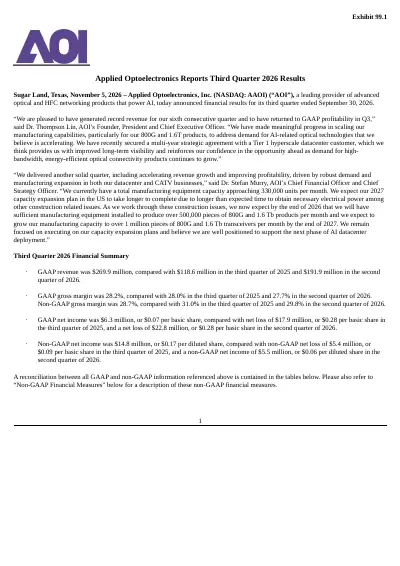
Thank you, Lindsay, and thank you for joining our call today. We are pleased to deliver strong third quarter results, driven by robust demand in both our data center and CATV business.
Our third quarter revenue more than doubled compared to the third quarter of last year, and marked our sixth consecutive quarter of record revenue. We also returned to GAAP profitability in the quarter, while continuing to grow our non-GAAP profitability.
In October, we signed a multi-year long-term agreement, or LTA, with a tier 1 hyperscale data center customer. We believe this agreement provides meaningful long-term revenue and demand visibility, supporting our ability to expand capacity, allocate capital, and invest in next-generation technology with greater confidence.
The LTA reflects our technology leadership, differentiated capabilities in advanced optics, and important role in the AI infrastructure ecosystem. This agreement also reinforces our confidence in the long-term opportunity ahead, as demand for high-bandwidth, energy-efficient optical connectivity products continue to grow.
We are well-positioned to scale our manufacturing capability and support the next phase of AI data center deployment. On that front, I'm very proud of what our team have already accomplished, as we have rapidly and deliberately scaled our manufacturing capacity to meet this unprecedented demand.
Our phase 1 expansion is set to begin operation in December at our new facility in Sugar Land. However, our phase 2 capacity expansion plan is now expected to be delayed by several months due to anticipated longer than expected time to obtain necessary electrical power, among other construction-related issues.
We believe our goal of a revenue run rate of $471 million per month is achievable towards the end of 2027, which reflect this delay, and expect our US-based manufacturing capability to increase as this new facility come online. We continue to anticipate a significant revenue ramp in Q4 and for the next several quarters, as we continue to see the benefit of our expansion in Taiwan as well expansion in our laser manufacturing capacity in Sugar Land.
While we are disappointed by the anticipated phase 2 construction delay, demand fundamentals remain strong, and we remain committed to grow our revenue and profitability, albeit on a slightly delayed schedule. Turning to the third quarter, we delivered record revenue of $269.9 million, in line with our expectations, and non-GAAP gross margin of 28.7%, slightly below our expectations due to product mix, which Stefan will discuss in more detail.
Our non-GAAP earning per diluted share of 17 cents was also in line with our expectations. Importantly, the volume ramp of our 800G products continued in Q3, with 800G revenue nearly quadrupling sequentially to $47.5 million.
Our 400G revenue also nearly doubled sequentially, building on a strong Q2. Finally, demand for our 1.6 terabit product is robust, and our new LTA is entirely for 1.6 terabit transceivers.
With that, I will turn the call over to Stefan to review the details of our Q3 performance and outlook for Q4. Stefan?
Stefan Murry
Thank you, Thompson. We are pleased to deliver strong third quarter results, driven by robust demand in both our data center and CATV businesses.
Our third quarter revenue more than doubled compared to the third quarter of last year, and marked our sixth consecutive quarter of record revenue. We also returned to GAAP profitability in the quarter, while continuing to grow our non-GAAP profitability.
In Q3, we delivered record revenue of $269.9 million, which was within our guidance range of $255 million to $290 million. We recorded non-GAAP gross margin of 28.7%, which was slightly below our guidance range of 29% to 30.5% due to product mix, which I'll discuss in more detail in a moment.
Non-GAAP earnings per diluted share of 17 cents was within our guidance range of 11 cents to 26 cents per share. Our performance continues to be anchored by robust demand across both our data center and CATV businesses, underscoring the strength of our dual-growth strategy and diversified revenue streams.
As Thompson mentioned, in October, we signed a multi-year long-term agreement, or LTA, with a tier 1 hyperscale data center customer. We believe this agreement provides meaningful long-term revenue and demand visibility, supporting our ability to expand capacity, allocate capital, and invest in next-generation technologies with greater confidence.
This agreement is entirely concerning a multi-year commitment for 1.6 terabit transceivers. We have made meaningful progress in scaling our manufacturing capabilities to address accelerating demand for AI-related optical technologies.
This agreement reflects our technology leadership, differentiated capabilities in advanced optics, and important role in the AI infrastructure ecosystem. I'd like to share some additional details about this agreement.
The customer is an existing customer, and the LTA covers 1.6 terabit transceiver products exclusively. We recently successfully qualified our first 1.6 terabit product with this customer.
Subject to certain conditions, including our ability to supply, this customer has agreed to purchase a minimum of 10% of its required 1.6 terabit transceivers from AOI over the 3-year period from June 2026 through May 2029. We currently expect this LTA to result in between $1 billion and $1.5 billion in revenue during this time period, although it could vary from this amount significantly depending on the customer's actual demand for 1.6 terabit products.
In turn, AOI has committed to supplying this volume and to agreed pricing, including some price reductions over the period. The customer made no commitment of capital as part of this LTA.
With our automated manufacturing capabilities and in-house laser technology, we believe we are well-positioned to support this customer and others as 1.6 terabit deployments accelerate. During the quarter, we also continued to make progress on our key priorities, which included: 1, scaling our next-generation data center products, including our 800G and 1.6 terabit solutions, by expanding our production capacity in a disciplined manner; 2, diversifying our revenue base; and 3, strengthening operational execution to improve our margins and position us for long-term profitability.
Turning to our third quarter results in more detail. Total revenue of $269.9 million increased 127.5% year-over-year and 40.6% sequentially.
During the third quarter, 58% of revenue was from our data center products and 41% was from CATV products. In our data center business, Q3 revenue of $155.6 million increased 254% year-over-year and 45% sequentially.
As Thompson noted, 800G revenue nearly quadrupled sequentially to $47.5 million, and 400G revenue nearly doubled sequentially to $93.4 million. We also continue to see robust demand for our 1.6 terabit products, and as I mentioned, our new LTA is entirely for 1.6 terabit transceivers.
In the third quarter, 7.5% of data center revenue was from 100G products, 60.2% was from 200G and 400G transceiver products, 30.5% was from 800G transceiver products, and 1.4% was from 10G and 40G transceiver products. While 800G growth was strong, it was somewhat below our expectations, primarily because our LTA customer shifted its demand from 800G to 1.6 terabit more quickly than we had anticipated.
We expect this shift to continue in Q4. We expect our fourth quarter data center revenue to be between $270 million and $300 million, representing 281% year-over-year growth at the midpoint.
While we continue to see exceptionally strong demand for our data center products, we expect fourth quarter data center revenue to be somewhat below our earlier expectations because, as I just mentioned, our LTA customer is shifting its orders from 800G to 1.6 terabit faster than we had anticipated. We believe this shift is positive for us in the long term because 1.6 terabit carries higher pricing and margins than 800G.
However, the accelerated timing has left us without sufficient 1.6 terabit raw materials in Q4 to fully meet the increased demand. As we expected, this customer returned as a greater than 10% customer in Q3, and we expect it to remain one throughout the term of the LTA.
Looking ahead, we expect demand for 800G and 1.6 terabit modules to exceed our production capacity throughout 2027. We are continuing to add capacity and to secure the key components needed to meet this demand.
During the quarter, as Thompson mentioned, we made significant progress on ramping our data center production capacity. As a reminder, our US manufacturing footprint is anchored in Sugar Land, just outside of Houston.
We have more than 1.6 million square feet in the greater Houston area in various stages of development, all of which will be dedicated to expanding our production capacity for 800G and 1.6 terabit transceivers, ELSFP modules, and lasers necessary to manufacture these products. The first of these major expansion projects is the 210,000 square foot facility, which is just a few hundred yards away from our headquarters facility.
As a reminder, this facility is entirely dedicated to the manufacturing of 800G and 1.6 terabit transceivers. We expect to begin initial operations there in December, which is consistent with our plan to begin operations by the end of 2026.
We plan to move existing transceiver production from our current headquarters facility to this new facility, which will free up space to expand our indium phosphide laser capacity at our headquarters. As we continue to expand our footprint in Texas, our in-house laser manufacturing positions us well to support both near-term customer needs and longer-term growth.
We believe that, in the future, CPO and related technologies will continue to drive increased demand for high-power lasers. We plan to further expand our laser manufacturing capacity in Texas to support these future growth drivers.
During the quarter, we received positive preliminary testing results from several CPO customers on our laser performance, and are continuing to work with these customers for full qualification of our lasers and, eventually, ELSFP modules. Our total manufacturing capacity is now approaching 330,000 units per month, up from approximately 200,000 units per month at the end of Q2.
By the end of this year, we now expect to be capable of producing more than 500,000 units of 800G and 1.6 terabit products per month, compared with our previous expectation of 650,000 units per month, due to the construction delays which I will discuss in a moment. By the end of 2027, we now expect to be capable of producing more than 1 million units of 800G and 1.6 terabit products per month, up from our previous expectation of 930,000 units per month, reflecting additional demand from our customers.
We expect nearly 30% of that production to be manufactured in Texas. These production figures are projections for our qualified production equipment capacity.
Actual output will vary from these figures based on factors including customer qualification schedules, staffing levels, raw material inputs, manufacturing cycle time, and other factors. These capacity expansion plans reflect measured scaling of our manufacturing footprint, aligning with strong and growing customer demand and qualification progress across both 800G and 1.6 terabit products.
As a reminder, our 800G and 1.6 terabit products can be manufactured on the same production line with the same process. While our 1.6 terabit products require a different final test, our 800G automated manufacturing lines have been developed with an architecture that will allow us to support future high-speed products as customer demand materializes and evolves over time.
Our automated manufacturing lines are engineered to scale efficiently from 800G to 1.6 terabit with minimal incremental investment. This structural flexibility provides a powerful dual advantage, accelerating our time-to-market for AI customers while expanding our long-term margin potential.
Looking ahead, we expect 800G to remain the largest driver of our near-term data center ramp, with 1.6 terabit on track to begin contributing to revenue in the fourth quarter and a larger ramp beginning in 2027. We also expect to see continued growth in 400G revenue, driven by our manufacturing capacity additions.
As we had expected and discussed on our last quarterly earnings call, we saw a decline in revenue from 100G transceiver sales during the quarter because one of our customers has been unable to source enough 100G switches to meet its initial forecast. We believe that this shortage of switches is related to the industry-wide memory shortage, and we continue to expect that 100G weakness will persist until the memory supply recovers.
Even with this temporary weakness in 100G, we expect our fourth quarter data center revenue to increase materially, both sequentially and year-over-year. To summarize our expansion plans, our phase 1 capacity expansion in Sugar Land remains largely on schedule, although we expect to fall somewhat below our earlier expectation for production readiness at year-end, as we mentioned earlier.
We continue to expect to begin operations at this facility by the end of 2026. As Thompson mentioned, we now anticipate that phase 2 will be delayed by several months, and we believe our goal of a monthly revenue run rate of $471 million is achievable towards the end of 2027.
In the meantime, we expect a significant revenue ramp in Q4 and over the next several quarters as we benefit from our expansion in Taiwan and our phase 1 US expansion. We continue to believe our revenue level is limited by our production capacity and supply chain, not market demand.
Turning to our CATV business, we saw record CATV revenue in Q3 of $110.9 million, which was up 57% year-over-year and 37.6% sequentially, slightly above our guidance range of $100 million to $110 million. As in recent quarters, we shipped a significant quantity of 1.8 gigahertz amplifiers to our largest CATV customer in Q3.
At the SCTE TechExpo in Atlanta at the end of September, we celebrated an important milestone: the shipment of our 1 millionth 1.8 gigahertz amplifier. Furthermore, we showcased our vision for the future of connectivity with a live 3 gigahertz network demonstration, alongside the successful debut of our dual-mode QuantumWave 25G tunable module, and new AI-driven autonomous capabilities within our QuantumLink software.
Customer response has been very positive, and we are excited about the potential of these new technologies. Looking ahead to Q4, we expect our CATV revenue to be between $105 million and $115 million.
While amplifiers will account for the vast majority of our Q4 CATV revenue, we anticipate generating some revenue from our software solutions beginning next year. For the third quarter, our top 10 customers represented 99% of revenue, compared to 97% of revenue in Q3 of last year.
We had three greater than 10% customers: one in the CATV market, which contributed 41% of total revenue, and two in the data center market, which contributed 28% and 23% of total revenue respectively. As I mentioned, one of these data center customers, a large US-based hyperscale customer, returned as a 10% customer this quarter.
In Q3, we generated non-GAAP gross margin of 28.7%, which was slightly below our guidance range of 29% to 30.5%, compared with 29.8% in Q2 of 2026 and 31% in Q3 of 2025. The shortfall versus our guidance reflects a higher mix of 400G within our data center business, which, in turn, resulted from the customer demand shift from 800G to 1.6 terabit that I discussed earlier.
We remain committed to our long-term objective of returning non-GAAP gross margins to around 40%, and believe that this goal is achievable as our revenue mix shifts towards higher-margin products and as we capture additional efficiencies across our operations. The revenue figures I have discussed are net of contra-revenue related to the accounting for warrants issued to certain customers.
As a reminder, this amounts to approximately 2.5% of revenue from the customers to whom AOI has issued warrants. In Q3, this contra-revenue amount was $1.93 million.
Total non-GAAP operating expenses in the third quarter were $70.3 million, or 26% of revenue, compared with $47.1 million, or 39.7% of revenue, in Q3 of the prior year. Looking ahead, we expect non-GAAP operating expenses to be in the range of $68 million to $75 million per quarter.
Non-GAAP operating income in the third quarter was $7.2 million, compared to an operating loss of $10.3 million in Q3 of the prior year. GAAP net income for Q3 was $6.3 million, or 7 cents per diluted share, which compared with a GAAP net loss of $17.9 million, or a loss of 28 cents per basic share, in Q3 of the prior year.
On a non-GAAP basis, net income for Q3 was $14.8 million, or 17 cents per diluted share, which was within our guidance range for non-GAAP net income of $10.1 million to $24 million, or non-GAAP income per share in the range of 11 cents to 26 cents. This compares with a non-GAAP net loss of $5.4 million, or 9 cents per share, in Q3 of the prior year.
The weighted average fully diluted shares outstanding used for computing the earnings per share in Q3 were 87.8 million. Turning now to the balance sheet.
We ended the third quarter with $621.5 million in total cash, cash equivalents, short-term investments, and restricted cash. This compares with $508.8 million at the end of the second quarter of 2026.
We ended the third quarter with total debt, excluding convertible debt, of $148.1 million, which compared to $92.8 million at the end of last quarter. As of September 30, we had $378 million of inventory, which compared to $278.8 million at the end of Q2.
The increase primarily reflects purchases of additional raw materials and higher work-in-process to support our expected revenue growth. We announced in early October that we completed our previously disclosed $600 million at-the-market equity offering program.
This marks the successful completion of our third ATM program this year. We intend to use these proceeds to continue to make strategic investments in the business, including new equipment and machinery for production and research and development use, as we continue to scale our advanced manufacturing capacity.
We made a total of $501 million in capital investments in the third quarter, including $142.8 million in prepayments on equipment we have on order. These expenditures are mainly for manufacturing capacity expansion for our 400G, 800G, and 1.6 terabit transceiver products.
We expect capital expenditures to increase in Q4 compared with Q3, and to increase further in 2027. Our capital investments are guided by customer demand and supported by purchase orders and long-term agreements.
We are directing capital towards investments to scale our advanced manufacturing footprint and enable our path towards sustained profitability. We continue to expect to finance these investments through a combination of cash on hand, cash generated from operations, equity issuance, and additional debt.
Moving now to our Q4 outlook. We expect Q4 revenue to be between $385 million and $420 million, representing approximately 200% year-over-year growth at the midpoint.
We expect non-GAAP gross margin to be in the range of 29.5% to 31%. Non-GAAP net income is expected to be in the range of $45.9 million to $60.4 million, and non-GAAP earnings per share between 48 cents and 63 cents per share, using a weighted average diluted share count of approximately 96 million shares.
With that, I will turn it back over to the operator for the Q&A session. Operator?
Operator
Thank you, sir. Everyone, if you have a question today, please press *1 on your telephone keypad, and we'll take our first question today from Simon Leopold from Raymond James.
Simon Leopold
Thank you very much. Appreciate you taking the question.
The first thing I wanted to check on was to really get an update of sort of what's built into that 4Q 800-gig and 1.6T, given that the customer transition you talked about, as well as the delays in the manufacturing capacity. I know this is something we talked about last quarter, and I just want to get refreshed on what's built into your expectations for 4Q, and then I've got a follow-up.
Stefan Murry
Right. As we mentioned, we expect to see continued growth in 800G, continuing that trend that we've seen the last several quarters.
We do expect meaningful contribution from 1.6T. The commentary that we talked about with the 1.6T was simply that we have a lot more orders for 1.6T than we can supply in this quarter due to material limitations.
When the customer switched from 800G to 1.6T faster than we'd expected, we couldn't turn on a dime and just create those additional materials. We had what we had and maybe a little bit more, but that's the revenue shortfall that we were discussing in the prepared remarks.
Simon Leopold
Thanks. Then, I understand the delay from construction issues.
Looking for a better sense of maybe the linearity of capacity, because we were previously thinking that roughly $471 million of capacity would be mid-year, now sounds like end of the year. Could you give us an update of what you think you'll be at the mid-year point?
Stefan Murry
I would sort of linearize that growth throughout the year, basically. We're going to be adding additional capacity throughout the year.
We anticipate being able to bring some of that capacity online even with the construction delays. It's not a binary, on-off sort of type of thing.
I would kind of linearize that revenue throughout the year, perhaps.
Thompson Lin
Basically, if you take in Q4 data center revenue close to about $100 million per month of revenue to $470 million monthly revenue by end of next year, roughly you can say the expansion of capacity will be the linear function, because as we can emphasize, the customer demand is really strong. The really limitation is the manufacturer capacity and the key material supply.
Like the 1.6T, right now I think we already got, I don't know, much more than $400 million order in hands. Right now I think that due to the manufacturing cycle time and I think the key material supply, I think that's why we can deliver maybe, I don't know, less than $100 million revenue in 1.6T in Q4.
We're still working with the supplier to work on the supply issue.
Simon Leopold
Appreciate that. Then maybe just one last kind of open-ended is, obviously, the whole AI ecosystem trade has been ugly, and fears about the election, and fears about data centers.
I know it hasn't been a lot of time, but just wondering your take on this, as well as any discussions with your customers that would suggest they're having any second thoughts about their own investments. Thank you.
Stefan Murry
Right. I'll take that second question first.
No, we haven't had any conversations with customers that would indicate that they have any second-guessing going on of their investment plans. If anything, we're continuing to hear that they just can't get enough material fast enough, right?
Now, there are shifts in that demand, like we talked about, from 800G to 1.6T and things like that, there's movement under the hood. The overall demand, as we emphasized several times in our prepared remarks, remains really strong.
As far as the election itself and the aftermath, if you will, it's really early to say, and I can't really comment too much on that. I think taking a hard look at what makes sense in terms of data center build makes sense.
I think the ultimate conclusion is that data centers still need to get built. AI is a fantastic tool to facilitate more efficiencies in the workplace and all sorts of scientific and engineering advancements.
I think those investments are going to get made. Certainly, our customers will make them.
Whether they'll get built in the same locales as they had originally planned or how much of that will be remains to be seen. I think it's also significant to note that our customers are exclusively the large hyperscale operators.
We're not dealing with the tier 2 operators in the data center space, for example. I think those large guys pretty much have their projects for the next several years already in play, and they obviously have the capital to make those investments.
I tend to think that the hyperscalers, the largest hyperscalers that we're dealing with, will probably be less affected or not affected at all by these changes politically. That's just a guess at this point.
It's very early.
Thompson Lin
Oh, let me say that. Okay.
Even really there'll be some kind of delay or reduction due to some I don't know, the government issues. You need to understand, even by end of next year, not only AOI, including Lumentum, Coherent, and other key suppliers, okay, especially AOI, we can only meet in less than 80% of customer demand.
Even really in case there's some kind of reduction, the demand is still bigger than our future capacity, even we are expanding as fast as possible in the next I think what, 12 months or even 18 months. That means I don't see any effect to our revenue, at least in the next 18 months.
Simon Leopold
Thank you for taking the questions.
Operator
The next question comes from George Notter, Wolfe Research.
George Notter
Hi, guys, thanks very much. Stefan, I was just curious about your perspective on financing the business.
I heard what you said in the monologue about using both equity and debt, but obviously these ATMs you've used to great effect. I'm just curious with the share price where it is now, if this persists, does it change your view on how to finance the business going forward, any sort of contingency plans?
Thanks a lot.
Stefan Murry
I think we're always looking, as we've said repeatedly, at the most efficient way to finance the investments that we plan to make. Obviously the share price is one of those variables that we look at, and so, that may affect to some extent our decision-making process there.
Post-quarter, we took a debt facility, which we talked about in the subsequent events section and issued an 8-K on, you could read the details there. As we've discussed repeatedly, we are leaning more on debt than equity than as we have in the past.
We're going to take a continued look at what mix of debt and equity makes sense moving forward.
Thompson Lin
As you can see, we just signed a $1.2 billion of the bank loan in last week. Actually, if necessary, I think we will increase the US bank loan to even bigger, like $400 or $500 million in the next 12 months.
At the same time, I think in this year, we will increase the bank loan too in all Asia operation to support our capacity expansion. Don't forget, we start to be profitable.
Based on this next year, I think the revenue of the projection, we should have quite a lot of profit. If you calculate really, the data center will go from I think less than $100 million in this quarter to $470 million by end of next year and higher gross margin, so that means the profit margin will be almost like what, 20% by end of next year.
I think we can produce quite a lot of profit by ourself. That will support our operation, too.
George Notter
Any opportunity to go back to customers and get prepayments? I know that you didn't do that on this most recent LTA, but is there an opportunity to kind of push some of this on your customers?
Then the other question was just on CapEx for next year. You mentioned it's going to be higher, but any sense of the magnitude would be great.
Thanks.
Thompson Lin
Next year, no, next year would not be higher. We said Q4 will be higher than Q3, but we never said next year will be higher.
The next year CapEx will be based on customer demand. As we say, because in US there are several months of delay due to the electricity, a lot of issues.
For sure, we will delay the payment, too. We never say the CapEx will be much higher next year.
Actually, I think it could be lower.
George Notter
Got it. Okay.
Stefan Murry
As far as your question on customer financing, that's always a part of the discussions that we have with customers, I won't ever say that it's impossible. I would say, as customers' balance sheet themselves come under question, that's been a huge part of the sort of commentary around the data center trade recently.
They're also looking hard at how they deploy that capital, I think it's probably less likely than it would have been in the past, but it's certainly not off the table. I think it's probably more likely around some of the newer technologies, like CPO and NPO type of technologies, than around 800G or 1.6T transceivers.
George Notter
Thank you.
Stefan Murry
Yep.
Operator
As a reminder, everyone, it is *1 if you have a question today. Next up is Ryan Koontz, Needham & Co.
):
Ryan Koontz
Great, thanks for the question. Want to ask Stefan about supply and how you're feeling there as far as indium phosphide substrates and DSPs.
I imagine the 1.6T DSPs, which you mentioned previously, are challenging. Are those kind of at the top of your list as far as supply concerns and focus goes for the company, or anything else you'd point out?
Stefan Murry
As we've said before, indium phosphide, we're fine through 2027 on indium phosphide. That's not really a current limitation.
We're obviously doing what we can to secure supply downstream, especially when we start to focus on CPO and NPO and ramping that. That uses a lot more indium phosphide than what we're using today.
The indium phosphide is not a current issue. It's just something on our radar screen for the future.
The DSP constraints that we have are real, especially at 1.6T. However, it has more to do with the shifting of priorities and changing customer demand expectations than an absolute shortage.
In other words, if we would have had a few months of notice with some of these customer shifts, we probably would have been able to secure additional DSPs. It's tight.
We do expect it to resolve, or at least improve dramatically, in the first quarter of next year. For now, the DSP is a significant limitation on 1.6T.
Thompson Lin
For the 1.6T DSP, I think we are qualified two supplier. I think we are working with the third supplier right now.
Because I think DSP will be one of the risk factor for the next years, especially in the next few months. I think we understand the issue, we are qualified more supplier right now.
Good news is our customer accept the qualification. That's very important, because as I have said many times, the problem sometimes is not up to AOI.
It's the customer need to approve and willing to do the qualification of the new supplier, okay? ):
Ryan Koontz
Makes sense. Thanks, Thompson.
On the power issue with the new facility, anything we can glean from that with regards to Texas and ERCOT and just the political shifts? What's the environment there like?
Is this more of a logistics challenge, or is this kind of a macro challenge with regards to the power? No.
Stefan Murry
This predates anything with the election. Nothing to do with that, and we're not derisking it anything or changing our viewpoint on it post-election.
This is just logistics of how you get transformers and cables and all the stuff that has to go to provide that power. Obviously, we are at some level competing with all the data centers that are out there.
I guess there could be a little bit of a silver lining, if you will, in the sense that if Texas does enact some sort of moratorium or slow down data center growth, that may allow us to get that power a little faster than we earlier anticipated. That's certainly not part of our planning at this point.
Whether that happens or not will be seen over the next 3 to 6 months or something. So.
):
Ryan Koontz
That makes sense. Maybe another quick one just to finish up.
Any high-level thoughts on industry implications for Lumentum and Marvell combination there? How do you think about that impacts the next several years?
Stefan Murry
Look, I think it highlights the scale of the opportunity that we're talking about with optics and data centers, and especially with AI data centers. I think the consolidation that it represents in the industry and bringing semiconductor companies and optics companies closer together is something that the industry is kind of dabbled in over the years.
I think this is a very big testament to that. It highlights the value of both sides of the equation, right, the DSP, the silicon side, as well as the optics.
Being one of the remaining independent suppliers of optics, I think puts us in a good position as consolidation, whether that speeds up or continues, I think it's a good position to be in. ):
Ryan Koontz
That's great. Thanks so much, guys.
Stefan Murry
Yep.
Operator
The next question is Michael Genovese, Rosenblatt Securities. Hi,
Michael Genovese
thanks very much. It sounds like this is an existing customer and kind of an existing known about 1.6T customer that's doing the LTA.
We typically think about LTAs having trade-offs, good features and bad features versus just stock supply agreements. Can you just talk more about what makes this an LTA and why this has been beneficial to you guys?
Stefan Murry
That's a good question. I was actually kind of debating this question earlier with somebody.
I'm not sure there's a universal definition of what an LTA is or isn't. For us, an LTA is a multi-year commitment, right?
That I think is the defining feature. LT, long-term agreement.
The defining feature for us is that it's a multi-year agreement, which is unusual, very unusual for us, and I think for most companies in this industry. Now, that being said, you're correct.
There always are, like any other agreement, none of them are typically one-sided, there's some good things and some less good things. In our case, we highlighted those, I think, already in the prepared remarks, but certainly the 3-year duration and the significant percentage of the customer's business that we're attracting, at a minimum, is a very good thing for us.
It gives us visibility into long-term demand. It gives us the ability to more comfortably scale and invest the CapEx that's necessary to develop the needed manufacturing infrastructure for this customer and other customers.
Those are the good things. The other side of it, of course, is that there's some pricing concessions that we make there.
There's defined pricing, and if market pricing were to meaningfully expand, then we'd lose out on some of that incremental opportunity because of the LTA, because that price is locked in. Those are the trade-offs.
Michael Genovese
Great. Then, even though you've had this a little bit of a delay in adding capacity at the end of the year and sort of mid next year, by the end of the year, I think your target's a little bit higher.
You said 1 million a month, I think it was 950,000 before. I guess I just want to kind of get more of a temperature check on the confidence that the demand is there, and that you can sell whatever you make.
How are you feeling about that now?
Stefan Murry
We've said it several times in the prepared remarks, the demand is exceptional, unprecedented. I don't know what kind of superlatives to use to describe the amount of demand that we're seeing out there in the industry.
Don't know how to say it other than that, it's very, very strong. We're not going to be able to meet that demand.
As Thompson mentioned, perhaps maybe only 80% of that demand, even through next year. The implication of that is we could do probably 1.2 million or even more units a month by end of next year if we could build that fast, and still just barely be keeping up with customer demand.
That's the demand that we see today, right? There could be further changes in that demand.
Demand is good. Our revenue growth is gated by our ability to add capacity, and specifically add capacity here in the US, which is turning out to be a little bit more challenging from the power perspective than what we had earlier forecast, and that's the nature of this push out, if you will, in terms of the schedule.
As you also noted, by the end of the year, we expect to be at a higher run rate than what we'd earlier forecast for the middle of the year, net-net, while there's a bit of a delay, I think it's still a very positive and bullish sentiment out there.
Michael Genovese
Then finally for me, one of the things we'd like to do on this side, the investors, is kind of rank what we know about lasers, about ultra high power, 400-milliwatt lasers, and who has good lasers and who doesn't have good lasers. You guys are kind of a mystery.
Is there any kind of testing feedback or anything, or just confidence that you can express on how far along you are on that product, and how it compares to the ones that we have out there right now? If you were competing in that market, sort of competitively how you would be doing at this point?
Thompson Lin
Then you are talking about maybe for the CPO and NPO market.
Michael Genovese
Correct.
Thompson Lin
It's maybe 100-milliwatt to 200-milliwatt laser for NPO laser, or it's a 300-milliwatt to 350-milliwatt laser for CPO market. Based on the customer feedback, right now AOI has the best power efficiency among all the supplier.
Now you know the other two supplier very well, I don't need to name them. I think we are working with them, not only the 1310, including next generation of the 8-wavelength, the CW-DM high-power lasers.
Right now it's going pretty smooth. As I said, we already doing the qualification with I think four or five customer already for quite a long time.
That's why we invest so much money on the laser expansion. That's where the money go.
As I can emphasize, it take more than 18 months, almost 24 months, all right, from the day one you pay the prepayment until the day you can start to deliver laser in volume to the customer, okay? Good news is the laser is very good gross margin, okay?
More than 60% gross margin with very few competitor, with a very big market, especially for NPO and CPO market. The other thing I forgot to mention is beside the first LTA, I think the second LTA in the final stage.
We expect to sign within a few weeks. The size will be much, much bigger the first one.
Could be even 5 times bigger, or even more than that.
Michael Genovese
Thanks very much.
Thompson Lin
That will including 800G and laser and other stuff for the second customer.
Operator
Everyone, as a reminder, if you have a question, please press *1 on your telephone keypad. We'll go to Tim Savageaux from Northland Capital Markets.
Tim Savageaux
Hi there. Sorry about that.
Hi there, good afternoon. A couple of questions, and congrats on the ramp here.
You announced an agreement for substrates, I think it was earlier this week. Could have been a month ago, the way things are going here, but
Stefan Murry
long time, doesn't it?
Tim Savageaux
My question was, it's pretty substantial quantity. It's like 15,000 wafers a month, and is that enough to support your target, kind of run rate level exiting '27 of up near $500 million a month?
Or, seems like it could support something higher than that, just that substrate agreement alone. I'd like your comment on that, and then, when that agreement kind of goes into effect, when you expect to start purchasing those substrates.
Thompson Lin
It'll be much, much bigger. Actually the agreement is more for 2028, because the supplier still expanding the capacity.
Let me give you a quick example, okay? For the newest MOCVD, the Aixtron G10 MOCVD, every month, every MOCVD, you need about 600 4-inch substrate.
It depends on how many substrate, okay? Then you know how many substrate you need per month, okay?
Number two, for every good wafer, you can produce about more than 8,000 to 9,000 the good 100-milliwatt laser, okay, per substrate. Or for high-power laser, for sure the size is much bigger, then you divide by factor 5 or even 6.
You can figure it out. Yeah.
Right now, as we emphasized, we have six supplier for substrate, but we are working with all of them. To make sure we have enough supply, including in our inventory, because of the potential risk factor, that's why we signed the LTA with this supplier.
Actually, we are working with other supplier at the same time, too, including the two in Japan and one in Germany.
Tim Savageaux
Great. Appreciate the color there.
A couple more questions. One, I guess how many customers, hyperscale customers, are you shipping 800-gig to currently?
Then, I don't know if you touched on this before, but do you have kind of revenue targets in mind for Q4 for 800-gig and 1.6T?
Thompson Lin
Right now we have two major customer, but we have three, four other customer, too. You're talking about the hyperscale data customer?
Yes, right now I think we have two two major one. We have other smaller customer, four, five four, five of them.
As I said, right now we have a lot of order in hand. Just like 1.6T, as I emphasized, right now the 400 1.6T right now we have, I don't know, 400, I don't know, $450 million, something like that.
Even by Q4, we can only deliver, I don't know, only $15 to $17 million. Customer is not very happy, but we are trying everything we can.
We are working very close with the DSP supplier. I think one of the bottleneck.
Tim Savageaux
It looks like I don't know if we're going to see any sharp ramp in 400 from here, but should we assume that 800-gig's going to be responsible for most of what you're projecting as a near doubling in data center revenue in Q4?
Stefan Murry
There'll be some incremental increase in 400G, but most of the growth is going to come from 800G, and then, as Thompson mentioned, 1.6T will add
Thompson Lin
$15 to $17
Stefan Murry
million. Meaningful amount.
$15,
Thompson Lin
$15 to $17 million, depending on material supply, or even more.
Tim Savageaux
Great, thanks very much.
Stefan Murry
Yep.
Operator
Everyone, at this time, we have no further questions. I would like to turn the conference back to Dr.
Thompson Lin for any additional or closing remarks.
Thompson Lin
Thank you for joining us today. As always, we thank our investors, customers, and employees for their continued support.
It is exciting time for our industry and for AOI. As we continue to see accelerating demand needed to support the next phase of AI data center deployment, we look forward to seeing many of you at upcoming investor conferences, as well as the next facility tour that we are planning for mid-December.
Thank you.
Operator
Once again, everyone, that does conclude today's conference. Thank you all for your participation today.
You may now disconnect.