ABN AMRO Bank N.V. Depositary receipts
Q3 FY2026 · Earnings Call TranscriptNovember 11, 2026
Operator
Welcome to ABN AMRO's Q3 2026 analyst and investor call. Please note this call is being recorded, and for the duration of the call, your lines will be on listen-only.
Sell-side analysts will have the opportunity to ask questions after the presentation. This can be done by pressing pound key 5 on your telephone keypad.
I will now hand the call over to the speakers. Please go ahead.
Marguerite Bérard
Good morning, and welcome to ABN AMRO's Q3 '26 results presentation. I am joined today by our CFO, Ferdinand Vaandrager, and our CRO, Serena Fioravanti.
I will cover the key messages, our progress on strategy, and our financial results for the quarter. After the presentation, as usual, we will open the line for your questions.
Let me begin with the key third-quarter highlights on slide 2. ABN AMRO delivered another strong quarter, supported by solid commercial momentum, net impairment releases, and further strategic progress.
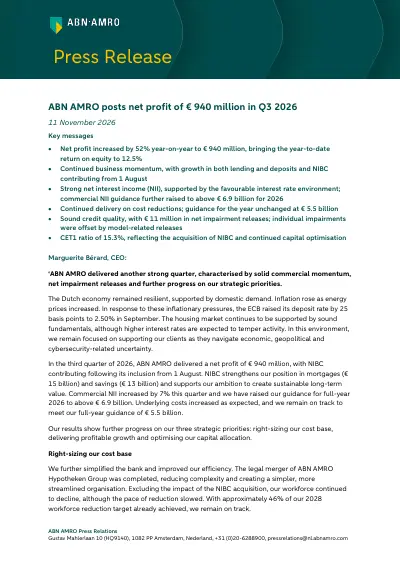
Net profit increased by 52% year-on-year to 940 million, bringing the return on equity year-to-date to 12.5%. Business momentum was positive, with both lending and deposit growth.
Commercial net interest income increased by around 7% quarter-on-quarter, and we have raised our full-year guidance to above 6.9 billion. We continued to deliver on cost savings, and our full-year '26 guidance is unchanged at around 5.5 billion.
Credit quality remains sound. Model-related releases more than offset impairments on individual files, resulting in net releases of 11 million.
Our pro forma CET1 ratio was 15.3%, reflecting the acquisition of NIBC and continued capital generation. The progress on our strategic ambitions and the interest rate outlook provide the solid basis for updating our financial targets, which we will present together with our Q4 results.
Let me now address each of our strategic priorities in turn. Starting with our growth ambitions for personal and business banking.
The inclusion of NIBC as of August 1st has strengthened our position in both mortgages and deposits. We also added two new savings products, which give clients more choice besides regular savings accounts and time deposits.
Quarterly savings rewards clients who keep their balances until quarter-end, while time lock savings offers more attractive rates with 45 days' notice for withdrawals. Wealth management brought in more than 2 billion of core net new assets this quarter and continues to focus on entrepreneurs, next-generation clients, and female clients for its growth.
The Hauck IT integration is progressing well, while this quarter, we also completed the sale of Hauck's real estate investment management portfolio. Corporate banking showed further growth in focus sectors.
To support clearing's Asia-Pacific growth ambitions, we opened a new branch in Hong Kong. We are meeting our client onboarding targets for clearing, and in addition, we added actually two exchanges to our membership list.
Now, turning to our progress on the cost base. We have completed 46% of the planned workforce reduction, keeping us on track for 2028.
External FTEs have fallen substantially over the past year, while we continue to invest in IT and cyber security. The sale of Alpam and the legal merger of ABN AMRO Mortgage Group marked two key milestones in simplifying our organization.
At the same time, we continue to simplify our IT landscape and are expanding the use of AI to improve operational efficiency. Far, we have delivered around 350 million of our roughly 900 million cost savings ambition for '28.
Progress on cost saving and FTE reductions will not be linear, and we remain on track to deliver our '28 cost savings ambitions. Now, turning to capital optimization.
Since our Capital Markets Day, we have achieved almost 10 billion of RWA reductions, of which more than 7 billion was in corporate banking. This reflects the improvements we made in our data quality and winding down activities that were structurally below our return hurdles.
Corporate banking's share of capital is already around our '28 target of 50%, down from 58% at year-end '24. The removal of the Dutch mortgage floor is expected to reduce RWAs by around 7 billion next quarter.
This was not known at the time of our CMD, this reduction is in addition to our original plans. Overall, we have made substantial progress on capital optimization and are well-positioned against our '28 ambitions.
Before I discuss our financial performance for the third quarter, I will briefly update you on the Dutch economy. Dutch economic growth remains resilient, supported by domestic demand and stronger-than-expected first half of the year.
GDP is expected to grow by 1.8% this year before moderating to 1.5% in '27. At the same time, inflation remains elevated at just above 3%, reflecting higher energy prices and broader price pressures.
Interest rates have also moved higher, and the ECB deposit rate is expected to reach 3% in Q1 next year. The Dutch housing market remains supported by income growth and persistent shortage of supply, with house prices expected to rise by around 4% this year and 2.5% next year.
Higher mortgage rates and affordability constraints are expected to reduce housing transactions, while unemployment and bankruptcies remain relatively low. Overall, resilient domestic demand and healthy household and corporate finances continue to provide a supportive operating environment, although inflation and geopolitical uncertainty remain elevated.
I will now turn to client assets and deposits. NIBC added 13.2 billion to our deposit base, split evenly between demand and time deposits.
Excluding NIBC, deposits fell by 2 billion, mainly due to seasonal spending and a shift into securities. Wealth management clients moved around 3 billion from current accounts and demand deposits into higher-yielding time deposits.
Market movements had a modest positive effect on client assets this quarter. Core net new assets exceeded 4 billion year-to-date, which keeps us on track for our annual growth ambition of 5 to 7 billion.
Now turning to commercial net interest income. Commercial NII increased by 110 million to around 1.8 billion, up by 7% compared with the previous quarter.
The main drivers were higher deposit margins and the inclusion of NIBC. Higher yields on our replicating portfolio supported deposit margins, leading to 8 basis points higher liability margins compared to Q2.
Average deposit volumes were broadly stable quarter-on-quarter. On the asset side, mortgage volume growth is increasingly from capital-light state-guaranteed mortgages.
This leads to a gradual decline in overall asset margins. NIBC made a good start, contributing 63 million in net interest income since its consolidation on August 1st, and this is reported with other commercial NII.
Clearing's NII remained broadly in line with Q2, exceeding expectations. Higher liability margins and stronger-than-expected other commercial NII allow us to raise our full-year commercial NII guidance to above 6.9 billion.
Let me now move to the NII sensitivity based on the current rate environment. At current forward rates, future investments of our replicating portfolio will further improve its performance.
How that improvement translates into higher NII depends on deposit migration, volume developments, and how margins develop. Today, around 50 billion of current account volume is managed using our replicating portfolio.
Assuming this volume stays constant, current interest rates lead to an incremental benefit of around 20 million for Q4. This rises to around 215 million in '27 and 350 million in '28, compared with projected full-year '26.
These are illustrative amounts; this is not a guidance. Lower rates or clients moving into interest-bearing products could reduce the benefit.
When we discuss future NII developments, we generally assume constant margins on savings and time deposits. However, saving margins have improved over the past few quarters and are now above historical levels.
A sustained change of 10 basis points in our saving margin, up or down, would change annual NII by around 125 million. We intend to provide NII guidance for '27 with our Q4 results.
Now turning to fee and other income. We are demonstrating structurally higher fee income levels; for the third quarter in a row, our fees ended above 600 million.
Personal and business banking benefited from higher payment and card service fees and higher asset management fees, while NIBC also added 7 million. Wealth management fees were broadly stable when ignoring some non-recurring M&A-related fees.
Last quarter, corporate banking fees benefited from strong corporate finance deal activity, and this activity slowed down during the summer. Clearing fees remained strong, driven by volatile market, though slightly lower overall volatility as not all months sustained a high volatility level.
We show other operating income here excluding the 85 million badwill from the NIBC acquisition. The increase to 133 million in Q3 reflects higher equity participation results and better ALM results.
Now turning to costs. Underlying operating expenses increased around 65 million in Q3, of which 30 million is due to NIBC.
IT costs increased due to planned investments in the new data center and expanding our capacity in payments and cyber resilience. Lower average internal staffings this quarter helped contain personal costs.
Q4 will include the Dutch banking tax, and we expect some higher seasonal expenditures. The negotiations on a new collective labor agreements have not yet led to an agreement, the impact is still uncertain.
Nevertheless, we remain fully on track for our cost guidance of around 5.5 billion this quarter, excluding incidentals and restructuring costs. We will start '27 with a higher cost run rate, reflecting IT investments and the full NIBC cost base.
After the legal merger of NIBC, which is expected around the summer of next year, we can begin to realize the planned cost synergies. Now turning to credit quality.
Credit quality remained strong, with a cost of risk of -2 basis points, bringing the year-to-date cost of risk to 3 basis points. Portfolio quality continues to be supported by our highly collateralized portfolio and also a robust Dutch economy.
NIBC further contributed to this with their low-risk mortgage portfolio. This quarter, model-related releases on corporate loans more than offset impairments on individual files across several sectors.
This resulted in net releases of 11 million. Given continued geopolitical uncertainty, we have kept the weighting of our negative macroeconomic scenario at 55%.
For full-year '26, we expect the cost of risk to remain below our through-the-cycle range of 10 to 15 basis points. Overall, our credit quality remains strong, reflecting the strength of our loan book, prudent risk management, and strong collateral across our portfolios.
Turning now to our capital position. The NIBC acquisition reduced our CET1 ratio by 70 basis points at the low end of our guidance.
Our regulatory CET1 ratio is now 14.5%. This figure excludes all profit contributions to capital, equivalent to assuming a 100% payout of these profits.
The pro forma ratio I mentioned earlier is 15.3%. NIBC added 6.6 billion RWAs, bringing the total to 143 billion.
RWAs remain broadly stable when you exclude NIBC. Business growth was largely offset by lower RWAs from applying the updated EBA loss rate data for immovable property.
As I indicated before, next quarter, the Dutch mortgage floor will be removed, reducing mortgage RWAs by around 7 billion. The sale of Alpam will reduce RWAs by around 1 billion.
We will update you on our annual capital assessment with our Q4 results. Let me now close with the key takeaways for the quarter.
Today's results demonstrate continued execution against our strategic commitments. We are delivering on our priorities of profitable growth, right-sizing our cost base, and capital optimization.
Good business momentum continued across our core products and all our client segments. We raised our full-year '26 commercial NII guidance to above 6.9 billion, and we are on track for our cost guidance of around 5.5 billion.
The good progress we made on our strategic ambitions and the improved interest rate outlook give us confidence in achieving our '28 targets. Therefore, we intend to update our financial targets and extend the horizon to 2029.
We will provide the full details with our Q4 results. That concludes our Q3 results, and we will now open the line for your questions.
Thank you.
Operator
Thank you. If you wish to ask a question, please press pound key 5 on your telephone keypad.
If you wish to withdraw your question, please press pound key 6 on your telephone keypad. The next question comes from Tarik El Mejjad from BofA.
Please go ahead.
Tarik El Mejjad
Hi, good morning. Thanks for taking my questions.
I have two, please. First on the costs.
You're pointing to higher costs from '27, including IT investments and NIBC integration. If you look a bit big picture, you are a bank which is actually mostly Dutch mortgages, wealth management, Western Europe with the corporate, and the cost/income guidance currently is 55%.
Consensus is much lower than that, but do you think the next plan will be actually a big focus on this? Because do you think you are a bank that should be having costs down in absolute terms in the medium term, while now consensus and your kind of guidance suggests that costs will continue to go up, ex even incidentals?
This first question. Second one is on the net interest income.
Could you remind us the assumptions underneath your guidance for 6.9 above 6.9 billion, and the way you look at your sensitivity in terms of pass-through, but also what do you expect in terms of deposit growth from here? Q3 was seasonally weaker, ex-NIBC.
What do you see in Q4, and what do you assume in your outlook? Thank you very much.
Marguerite Bérard
Thank you very much. I will take your question on cost, and Ferdy will answer on NII.
On cost, first, let me remind you that this year, we have improved twice our cost guidance, huh? If I may remind you, we started at 5.6 billion, we lowered it to 5.5, and then at Q2, we said 5.5 including NIBC, and we are absolutely well on track to achieve this cost guidance.
You can be fully, fully, I would say, certain about cost discipline and our focus on this topic and on delivering all the cost synergies we have committed for the current plan. We're still early in the plan, if I may say; this is one year in a three-year plan.
I'm not already working on the next plan. Nevertheless, do our ambitions stop with the current plan?
Absolutely not, and as you can see, we are, I think moving at pace in delivering on our ambitions. Yes,
Ferdinand Vaandrager
Tarik, specifically on NII, we only have one and a half month left in the year, we're comfortable with the current, hè, underlying momentum with our upgraded guidance above 6. 6.9 billion, and that's really on the back of the tailwind of the replicating portfolio, as you see in the expansion we've seen in the liability margin.
In general, but that's also in earlier quarters, we assume constant margins on interest-bearing deposits. Hè, what we try to do here on the sensitivity slides is providing some better insights in the split of liabilities and the potential tailwind on the current accounts.
Hè, the only note I want to make here, as already said by Marguerite during her presentation, we are above historical margin on interest-bearing deposits, and also the forward rate we base this on, this was based on the end of October. If you look at the forward rate today, the forward rate of today is lower.
Yes, we try to extrapolate the effects specifically on the current accounts because that's normally a stable base, but overall, if you look at the outlook, you need to consider that currently, on the interest-bearing deposit, we're above historical margins, and you've also seen some migration over this quarter into terming out. Overall, comfortable with the tailwind remaining of the replicating portfolio, but also some caution not to just try extrapolating the current trends.
Tarik El Mejjad
Thank you. And
Ferdinand Vaandrager
Last point was deposit growth, underlying deposit growth. Sorry, Tarik.
I'm just looking, underlying deposit growth, we said at the CMD that is a 3 to 4 percent underlying, so that would translate in our expectations of roughly 10 billion per year.
Tarik El Mejjad
Thank you. In terms of the higher NII coming from rates, and you mentioned the clearing NII, could you give us a bit of the split there, and how much clearing NII has contributed to the upgrade?
Now,
Ferdinand Vaandrager
overall, we said, if you currently look at clearing, Marguerite said during the presentation, it was slightly lower this quarter, hè, because there was one month with less volatility. Overall, hè, we provided last quarter an indication of 600 million for other commercial NII, but we expect in the guidance that clearing will remain around current levels.
Tarik El Mejjad
Thank you very much.
Operator
The next question comes from Shrey Srivastava from Citi. Please go ahead.
Shrey Srivastava
Hi, and thank you very much for taking my questions. My first is again on this mix shift point that you noted.
I would think in the Netherlands, given your lower proportion of non-interest-bearing balances in the first place, there'd be less scope for mix shift, but any sort of signs that you've seen on a more structural basis that mix shift could continue or anything you could point us to from previous cycles would be very interesting. My second question is on the net new assets in wealth management.
Your target of 5 to 7 billion, when you translate into a rate, screens lower than both the rate of sort of wealth growth in financial asset growth in the regions you operate, and also below some of your private banking peers. Can you just elaborate on how much exits of existing relationships are included within that, and what you think the scope is to outperform that?
Thank you.
Marguerite Bérard
Ferdy, I will let you take the NII question, and I will answer on wealth management.
Ferdinand Vaandrager
Yes, to start on NII migration, as said, we introduced new savings products, a time lock and quarterly savings, and also we just announced, I think earlier this week, that we offer also short-term time deposits below one year. This is really being meant for the more price-sensitive clients, also in wealth management, to offer attractive rates as an alternative.
Hè, most of the migration, but we said that already, we have seen over the past two years, if you look underlying here, the migration was still limited, hè, overall for this quarter. It was roughly 3 billion, but specifically from wealth management clients.
Marguerite Bérard
On wealth management, we are fully in line with the developments we had shared at our CMD regarding the growth of this business. As you remember, for wealth management, our ambition is for '28 to have a total of 335 billion of client assets.
The underlying growth, indeed, if you take it on a yearly basis, is the 5 to 7 billion I referred to. As you also know, there is some seasonality in the wealth management business for us, because usually, the fourth quarter is the strongest one.
The reason is that we have more than 35% of market share in the Netherlands in wealth management. This is our primary market, and we are the house bank for clients.
Usually at Q1, they pay their taxes from their ABN AMRO account when they have several banks. This is why you observe some seasonality, but all in all, we're comfortable with the commercial momentum we have in this business.
It is true in the Netherlands; it is actually also true in Germany, where I feel commercial momentum has been very strong, even though our colleagues at Hauck and Bethmann had to also go through an IT merger. I'm very happy that they remain very client-focused while going into this integration.
Shrey Srivastava
Thank you very much. Just a final one on the net interest income.
On your main client savings rate, which is the main driver, when ECB rates initially went down, am I correct in assuming you didn't pass on the vast majority of those rate cuts to your customers? In terms of the competitive dynamic and the need to pass on higher rates, any further commentary would really be appreciated there, too.
Thanks.
Ferdinand Vaandrager
We clearly do not comment on expectations of pass-through or our rate expectations here. Clearly, it was completely different when we went into negative rates, where we compensated clients with 0% up until 100,000, but so far, we've seen a disciplined market.
As said earlier, we're happy where we are today, and we're offering competitive products for clients outside just the base savings accounts.
Shrey Srivastava
Thank you very much.
Operator
The next question comes from Delphine Lee from J.P. Morgan.
Please go ahead.
Delphine Lee
Yes, thank you for taking my questions. Just a few quick follow-ups.
On net interest income, for those new products that you have kind of offered to clients, you're saying that the market has been quite disciplined. What drove your commercial push?
Are you trying to anticipate competition here or just trying to kind of understand a little bit the dynamics? Is that intensifying as sort of the rates are going to continue to increase?
Are you planning more of these products to achieve your targets in terms of sort of 10 billion of deposit growth? At what cost does that come to your NII?
Then a second question is just a quick one on fees and commissions. I think you mentioned in Q2 that there were some sort of non-recurring fees, I think in wealth management.
I think so if you do not mind just quantifying what was maybe a little bit exceptional in your Q2 numbers? Then a really last one on the cost side, just going back to Tarik's question.
Are you flagging for '27, sort of a start Of course, because of full consolidation of NIBC, you're going to have a higher base, but considering your current targets for '28 that there should be, and considering your progress as well on cost, there should be more scope for further improvement in absolute terms in terms for the cost base, or is the intention to invest more, because you also mentioned quite a bit the IT investments? Thank you very much.
Marguerite Bérard
Thank you very much. I'll take your question on new products, and Ferdy will respond on fees and cost.
We are an innovative bank, part of what we do, because that's in our DNA, is to actually launch new products, and this is what we've done with this, two new savings products launched this quarter, because we feel that it offers to our clients a broader scope of solutions and optionality that caters to all their needs. We do that in savings, but I would say we do that in all parts of the game.
For instance, if you look at what we've been doing with Buurt, which I'm very happy with the progress, we are the only bank in the Netherlands to offer such a solution for teenagers and their families. Innovating is just not a function of how we anticipate the market will move, but also what we feel may be the best way to respond to our client needs.
This being said, we always considered the Dutch market to be on savings, as in all products, a market that is competitive and very transparent. Ferdy, on fees, the exceptional elements that we have in Q2?
Ferdinand Vaandrager
Delphine, maybe we were not as explicit last quarter, but number one, what you always see over the summer quarter, that you see lower capital markets, corporate finance transaction deals, so that is an impact quarter-on-quarter you will see in the corporate bank. Marguerite said already, clearing is elevated, but slightly lower in Q3.
Number three is there were some non-recurring, but that is mainly related to M&A fees within wealth management. There were a few elements in there, but what I would really look at, if you look overall at fees, fees still shows 6% growth year-over-year, excluding M&A.
That is still quite a bit above our 3 to 4% that we provided at the CMD. Then on cost,
Marguerite Bérard
I'm sorry. Go ahead.
You had a Ferdy on the cost question, yeah.
Ferdinand Vaandrager
No, maybe specifically on the cost outlook, hè, Marguerite was very firm, hè, we stand with our cost target of 5. 5 billion, but what you will see for next year, hè, the NIBC effect, it's not only the seven additional months, but you're also going to see the integration costs.
Overall, NIBC effect next year will be around 150 million. Yes, IT investments, we expect them to remain in '27 at a higher level, really reflecting further investments in areas such as cyber security and data center.
Then at the same time, you will also see the impact of inflationary pressures, hè, impacting existing contracts, and as well as a potential impact from the CLA. At the same time, we continue to deliver on our savings initiatives.
We're fully committed, despite a higher inflation environment, on the 5.5 billion in 2028, but we also clearly want to flag you're going to see an increase in absolute cost in '27 versus '26.
Delphine Lee
Great, thank you very much.
Operator
The next question comes from Giulia Aurora Miotto from Morgan Stanley. Please go ahead.
Giulia Aurora Miotto
Hi, good morning. Thank you for taking my questions.
I have two. First, just to be clear on this cost discussion, could you clarify how much restructuring costs exactly you plan to take next year?
Also, consensus has got cost basis of 5.674 in 2027, which is already quite an increase in '26, I think you're flagging that costs are going up next year, but I think this is already reflected, or am I not understanding and your goal is probably to push that 5.674 number higher? That's on costs.
Then secondly, on NII on slide 10, I hear a lot of caution in your remarks, but I think this slide is actually quite conservative because and I know the curve is now lower, I get that, but these columns are only on current accounts. There is no benefit here on the rest.
I hear you that probably the savings rate will go up, I get that, but still, there will be some benefit on that part of the NII of your replicating portfolio as well. I was just curious to confirm that I understand this correctly, i.e., that this, let's say, 250 million is only limited to 50 billion of current accounts, which is less than half of your replicating portfolio, in fact, it's a partial disclosure of a bigger benefit, I guess, that you see.
Thank you.
Marguerite Bérard
Thank you very much.
Ferdinand Vaandrager
Let's start, Giulia, on cost. Yes, I see consensus, indeed, what was shared, reference to the 5.674, as you mentioned, but that includes 144 million in restructuring charges.
I read this as, but correct me if I'm wrong, excluding incidentals, consensus has 5.5 billion. As I just said, the elements of the full-year inclusion of NIBC, inflation, higher run rate in IT, and then you can go on potential higher levies as well with NIBC, that will have an impact.
I just want to be clear, if you look at the restructuring charges overall, year-to-date, we booked 110 million. We don't expect a lot residual for the rest of the year.
As we said at the CMD, it will be roughly 100 million annually in restructuring charges, we stick to that. Then if you go to NII, I get you in saying, why are you just showing your current accounts?
Hè, the reason that we're just showing the current accounts, that we just want to provide a better insight in what the tailwind is if this stays constant. Hè, the earlier liability margin potential we showed was really based on extrapolating the underlying margin trends.
As said, currently, we're quite a bit above historical margin, if you are going to see price action in the market, it will have an impact on that. It's just the reflection of the sensitivity of the current accounts, and you do take into account that interest rates, migration, competition all will have effect on the rest of the part of the total NII.
In general, we just assume constant margins on interest-bearing deposits, but, hè, that assumption has become more optimistic now we're a quarter further than last quarter.
Giulia Aurora Miotto
All right, thank you.
Operator
The next question comes from Benoît Pétrarque from Kepler Cheuvreux. Please go ahead.
Benoît Pétrarque
Yes, good morning. The first question is on the extension of the time horizon to '29.
Will that be purely an update on the financial targets, or can we expect also some update on the strategy? Strategy presented last year was a very good one, obviously, but you had more time to develop that strategy.
Any strategy consideration we should expect, also maybe looking at the commercial and the corporate bank developments, any update we should expect there? Then sorry to come back on the couple of questions on the NII.
It will be very useful if you could provide a bit more details on where you stand on the margin on savings accounts versus historical average, whether it's 10, 20% higher. That would be very useful.
Do you expect some normalization of savings account margin in '27? Is that your current base case?
I know that in the slide you show basically everything stable, but purely from a management standpoint, do you expect more normalization from current levels or further expansion? That's the question.
Then maybe on clearing NII, because clearly, I think, Ferdy, you said that it's going to stay at current level also in the fourth quarter, but what about '27? I was trying to understand what the clearing NII could do next year versus the current level.
Thank you.
Marguerite Bérard
Thank you, Benoît. I will start with a question on our time horizon, and Ferdy will take the two other ones.
At Q4, we will indeed provide you with a financial update for 2029. This is not going to be a new CMD or full strategic update.
Of course, everything we are presenting, because we only commit on things that we can deliver, everything we will be presenting will be firmly grounded in business cases that we will have. All our assumptions for '29 will be indeed firmly grounded in what we see, but this is not a full strategic update.
Ferdy, on NII?
Ferdinand Vaandrager
Benoît, for 2027, as Marguerite already said, we will make it transparent and provide absolute guidance at Q4. Hè, specifically on where we currently are and how far above historic margins we are on savings margins, we don't disclose that, but we've also said, over time, we expect a gradual normalization.
Does that mean an immediate normalization next year? That would not be my current assumption.
Then if you look at clearing, elevated level clearly this year on the back of higher volatility, but also underlying commercial momentum in clearing is positive, where we launch new products and where we onboard new clients. We are always a bit more prudent and would expect some normalization next year in terms of volatility, in being prudent for now, I would not extend the momentum we've seen in the past two quarters directly for full year in 2027.
We don't split, but as we will provide a quarterly report, annual report on clearing mid-next year. If you look last year over 2025, it was around 350 million in NII, but this year is clearly higher than that number.
Benoît Pétrarque
The 3 350 still stands or on a normalized basis, or it's going to be a bit higher than that?
Ferdinand Vaandrager
On a normalized basis, specifically for clearing? Yeah.
Benoît Pétrarque
Yeah.
Ferdinand Vaandrager
That is an indication on a normalized level, but as said, this has been a very good year for clearing, and it depends on what is structural versus what is cyclical, hè. Overall, we're confident.
Benoît Pétrarque
Great. Thank you very much.
Operator
The next question comes from Benjamin Goy from Deutsche Bank. Please go ahead.
Yes, hi.
Benjamin Goy
Good morning. Just one question left, just to double-check on the NIBC asset quality.
Now you had a couple of months to look in very much detail. Seemingly, there was no need to book anything, but just double-checking because historically they had some corporate client exposures that were more volatile, wondering how you think about potential top portfolios like fiber or anything that keeps you awake at night.
Thank you. Just
Marguerite Bérard
I will answer your question, but pass it on also to Serena. We carried thorough due diligence, of course, when buying NIBC.
As all the part that we considered non-core was actually sold at the time of the acquisition. That was part of the deal we had with Blackstone.
We are very comfortable with everything that came with NIBC, and we're also making sure that the provisioning framework is in line with ABN AMRO's prudent habits and ways of doing things. Serena, maybe you want to elaborate.
Serena Fioravanti
No, thanks, Marguerite. As you can see, we have circa 70 bps capital impact, based also on our PPA, and this is incorporated up to Q3.
In Q3, we had a net impairment release, and that includes also our review of NIBC, has been a good quarter and largely, therefore, we have confirmed what we have seen in the due diligence, there's been no material items as part of IFRS 9 alignment.
Benjamin Goy
Thank you.
Operator
The next question comes from Anke Reingen from RBC. Please go ahead.
Anke Reingen
Good morning. Thank you for taking my questions.
The first is on costs, just following up on Giulia's question. In the past, you always indicated that higher inflation, you think you would be able to offset with additional initiatives.
Do you think your 20 your 2028 guidance, the 5.5 billion of costs, is that now at risk from more headwinds than you expected? Then on net interest income, just on the lending margin, just confirming that the decline is in line with your expectations, and we should continue to see a trending downwards from the Q3 level?
Then sorry, just a small follow-up on your liability margin. You talked about we're running above sort of normalized levels.
Where do you see your sort of normalized level? Thank you very much.
Marguerite Bérard
Thank you. On costs, let me be very clear.
We absolutely confirm our 2028 ambition of 5.5 billion. There is no question on this commitment.
On the lending margin, I will pass it on to Ferdy, but just bear in mind, as we flagged, that on mortgages, we see a higher share of what's called NHG mortgages that benefit from state guarantees, these mortgages come with lower margin, but at the same time, no capital requirement, basically, these are still profitable loans, but they have an impact on the overall asset margin, given what they represent in our mortgage portfolio. This was in line with our expectations.
On liability margin, Ferdy?
Ferdinand Vaandrager
On liability margin, hè, we have said so far, we don't want to provide any sort of levels, what is normalized or not, I really want to stick to the disclosures we provided here in the presentation, where we really show what the sensitivity is of a stable base of current accounts. Hè, you can start translating that to the 7.2 billion we provided at the CMD, but for now, I don't want to provide any sort of deltas versus normalized liability margins, Anke.
Anke Reingen
Thank you very much.
Operator
The next question comes from Alberto Artoni from Intesa Sanpaolo. Please go ahead.
Alberto Artoni
Good morning. Thank you for taking my questions.
I have two follow-ups. The first is on other income, I would like to have a little bit more color on what is driving the good performance over the last two quarters.
In previous quarters, the performance has been more subdued, and it seems that something has changed. Is there any particular trend, any particular macro development that is helping this line in the P&L?
The second is just a follow-up on the cost of risk. Seems to me that even if we exclude the positive model contribution of this quarter, the underlying level of the cost of risk was very low.
I was wondering, and also in the past quarter has been very low, perhaps the normalization that we were expecting is not materializing, and is it fair to assume that the benign environment will last longer than we probably had anticipated before?
Marguerite Bérard
I will take your question on other income and pass it on to Serena on cost of risk. As other income is volatile by nature; therefore, we do not provide specific guidance, though historically, other income, on average, has been around 100 million per quarter.
What you see in this quarter's other income of 280, you see mainly the reflection of NIBC, and excluding NIBC, the improvement is primarily due to higher equity participation results and, as I mentioned, also improved ALM results. This is how you should read that line.
Serena, on cost of risk? No,
Serena Fioravanti
you are spot-on on cost of risk. Even if we were to exclude model-related and overlays releases, we would be about 5, 6 bps cost of risk, so far below our through-the-cycle expectations.
This is across all business lines. We have seen relatively mild additions, and we had even some releases, therefore, you're right.
The normalization is expected more slowly than we had predicted at the time of the CMD. We still think, though, that we shall be back towards the low end of our through-the-cycle as we move towards the coming years.
Marguerite Bérard
Yep.
Alberto Artoni
Thank you.
Operator
The next question comes from Chris Hallam from Goldman Sachs. Please go ahead.
Chris Hallam
Good morning, and thank you for taking my questions. First, on CLA, when do you expect to conclude the CLA negotiations, and does the outcome have a significant bearing on where you end up on OpEx next year versus the 5.67 billion of consensus OpEx?
Or are there levers you could pull elsewhere to offset perhaps a higher CLA outcome? Second question, then.
The size of your excess capital position, I guess, naturally points you perhaps further towards M&A. You're not going to get to 13.75% with a 100% payout alone.
My question is, how far through the integration of NIBC would you need to get, and how far through the front-loaded self-help elements of your plan would you need to be before you'd consider another deal? I.e., how quickly would you be able to stack up one deal after another?
As part of any deal, would you see a chance that the NLFI stake in ABN goes up again, rather than trending lower? Thank you.
Marguerite Bérard
Thank you very much for your question. On our CLA, so as our negotiations on the collective labor agreement are ongoing.
We will resume discussions with the unions on November 19th, and we remain focused on reaching a good CLA through constructive dialogue with the unions. What I mean by a good CLA is a good CLA for all colleagues and also a good CLA for the future of our bank, I believe in a balanced outcome.
I'm not going to comment here any further, because I believe that the CLA negotiations belong to the negotiating table, and so this is where I want to keep them. On M&A, first, how have we progressed with NIBC?
We're progressing at pace, the same way we have progressed with the Hauck integration at pace, we are delivering on the timelines and the budget we had in mind for NIBC. We expect the legal merger to happen next summer.
When it comes to M&A, we have always reached a very clear criteria we have to consider in organic growth. Basically, it has to fit with our strategic priorities, the five ambitions that we had outlined.
Typically, Hauck fits definitely with our ambition for wealth management, and NIBC fitted with our ambition of bringing scale to our retail business in the Netherlands. The criteria are very clear.
Second, we look at M&A that will be accretive, huh? If you look at the return on invested capital, for instance, with the Hauck acquisition, that was roughly 15%, and with NIBC, roughly 20%.
We look at accretive acquisitions, and we also always consider execution risk, because we want integrations to be successful. Good M&A is one thing, and then really the success comes with the quality of the integration.
These are our criteria. On the last item of your question, I cannot speak, of course, on behalf of the NLFI, but my understanding is that the intention of the state has always been to fully return ABN AMRO to the market.
I think this is the only comment I could make on this.
Chris Hallam
Thank you.
Operator
The next question comes from Farquhar Murray from Autonomous. Please go ahead.
Farquhar Murray
Morning, all. Just two questions, if I may.
Firstly, please, can you just outline the approval process and timeline from here to the capital return update at 4Q? Within that approval discussion, will you fold in the refresh targets you expect to outline at 4Q reporting?
Then secondly, might you be able to quantify your credit exposure to data centers and broader kind of hyperscaling trend? More broadly, what's your approach been in terms of underwriting and lending around that area?
Thanks. Absolutely.
Marguerite Bérard
I will give your question on our exposure on data center to Serena, but it is a very moderate exposure; she will elaborate on that. When it comes to assessing our capital position, we will do it with our Q4 results, and there, we will also basically provide you with an update on our distribution for '26.
Basically, we've been very clear that our policy is up to 100% of our net results. On data centers?
Serena Fioravanti
On data center, obviously, top of mind, we have limited exposure in our case. It's below 3 billion, including NIBC, we're talking about 1%, 1.1% of our total book.
We have concentration limits in place, we have controls in place, and the quality of the portfolio is really strong, covered by long-term leases. I also would like to add that the AI-related exposure is minor.
We also take, and especially, cloud kind of financing. We have really a tight risk management on the topic, and we consider the risk manageable.
Marguerite Bérard
To be very clear, our exposures are only in Europe, on prime locations, and as Serena mentioned, related to cloud needs and not directly related primarily to AI, huh, just to be clear on what we finance.
Farquhar Murray
Thanks.
Operator
The next question comes from Juan Pablo Lopez from Santander. Please go ahead.
Juan Pablo López Cobo
Yes, good morning. Thank you for taking my questions.
I got two, probably they are related. First one is on other commercial NII.
We are seeing a good progress there. It's more than €100 million third Q versus third Q last year.
The second question is regarding your sovereign portfolio. The size is more than €30 billion, if I'm not wrong.
If you could refresh us the strategy of this sovereign portfolio, duration, yield potential, higher contribution from the maturities, that would be helpful. Thank you.
Marguerite Bérard
Thank you very much. Ferdy will take your question on other commercial NII; Serena will take the one on our sovereign exposure.
Basically, what you should have in mind is that our sovereign exposure is primarily related to our liquidity reserves, and our sovereign exposure is basically primarily Dutch, German sovereigns, but I will let Serena comment on this. Ferdy, you want to start maybe with
Ferdinand Vaandrager
other commercial NII? On the other commercial NII, yes, indeed, it's very good, hè.
At the CMD, we said it is around 350 to 400 million, and related back to the question asked earlier, that was excluding, hè. The main part of that is clearing, but it's also interest-related fees.
What we have added now is the impact of NIBC, so that is the main delta you see here of around 150 million expected for the full year. What you see here, we currently book all NII from NIBC in other commercial NII, and we will change that upon further integration.
Hè, the reason for this is that NIBC treated deposits purely as funding source, with the full margin reflected on the asset side, whereas we clearly split the margin between asset and liability NII, with the replicating portfolio in between. For now, it's booked in other commercial NII.
That's why you will see the significant delta in there compared to previous quarter, but we will change this and split it in asset and liability once we're further down the integration.
Serena Fioravanti
On sovereign exposure, I think Marguerite said already quite a lot. I want to remind everybody that we don't take market risk and we don't have material trading books, we don't have proprietary P&L exposure.
We do take a certain sovereign risk in our liquidity investments and liquidity buffers that do impact our OCI, and the impact in Q3 has been really a very minimal. When we look at the concentrations, I think Marguerite already commented on that, we don't have material concentration on France or other states, and the credit spread widening impact is also subdued.
For the time being, no worries on our side.
Juan Pablo López Cobo
Thank you.
Operator
There are no more questions at this time. I will now hand the word back to the speakers for any closing remarks.
Marguerite Bérard
We want to thank you very much for your questions, and well, at the latest, we will see you again for our Q4 presentation. Have a great day.