AMG Critical Materials N.V.
Q3 FY2026 · Earnings Call TranscriptNovember 6, 2026
Operator
Good day everyone and welcome to the AMG Q3 2026 earnings conference call. At this time, all participants are in listen-only mode.
Later we'll conduct a question-and-answer session. You may register to ask a question at any time by pressing *1 on your phone.
Please note this call is being recorded and I'll be standing by for assistance. Now I'll turn the call over to your host, Thomas Swoboda.
Please go ahead.
Thomas Swoboda
Thank you Elvis, and good day everyone. Joining me on this call is the entire AMG Management Board, namely Dr.
Heinz Schimmelbusch, the Chairman of the Management Board and Chief Executive Officer; Mr. Jackson Dunckel, the Chief Financial Officer; and Mr.
Michael Connor, the Chief Corporate Development Officer. We published our third quarter 2026 earnings press release yesterday along with a presentation for investors, both of which you can find on our website.
They include our disclaimers about forward-looking statements. Today's call will begin with a review of the third quarter 2026 business highlights by Dr.
Schimmelbusch. Mr.
Connor will comment on strategy, and Mr. Dunckel will comment on AMG's financial results.
At the completion of Mr. Dunckel's remarks, Dr.
Schimmelbusch will comment on outlook. We will open the line to take your questions thereafter.
Dr. Schimmelbusch, I'm turning the call over to you.
Heinz Schimmelbusch
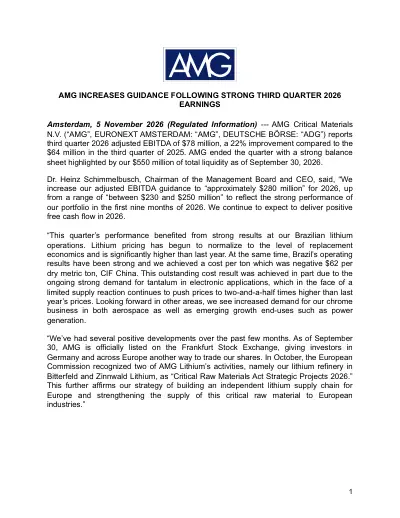
Thank you Thomas. Ladies and gentlemen, during Q3 we achieved $78 million of adjusted EBITDA, 22% higher than the $64 million in Q3 '25.
This quarter we benefited from strong results at our Brazilian lithium operations. Lithium pricing has been favorable compared to last year.
In addition, we achieved a cost per ton of negative $62 per dry metric ton CIF China. This outstanding cost result was achieved in part due to the ongoing strong demand for tantalum in electronic applications, which in the face of the limited supply reaction continues to elevate prices to 2.5 times higher than last year.
We are also seeing increased demand for our chrome business in aerospace as well as in emerging new power generation technologies. We have had several positive developments in recent months.
As of September 30, AMG is officially listed on the Frankfurt Stock Exchange, giving investors in Germany and across Europe another way to trade our shares. Last month the European Commission recognized two of our lithium activities as Critical Raw Materials Act Strategic Projects 2026.
By combining significant European lithium resources with advanced processing capabilities, AMG is uniquely positioned to support Europe's growing demand for critical battery materials while reducing its dependence on foreign supply chains. I will now hand over to Mike Connor.
Mike?
Michael Connor
Thank you Heinz, and greetings to everyone joining us today for the call. Q3 was another strong quarter for AMG, highlighted by exceptional performance at our Mibra mine in Brazil and continued progress across our strategic growth initiatives, including the completion of two important transactions.
In July we acquired the remaining 71% of Zinnwald Lithium, securing full ownership of one of Europe's largest lithium resources, which we intend to develop leveraging AMG's mining expertise and processing technologies. Also in July we completed the sale of Graphit Kropfmühl, streamlining our portfolio and strengthening our financial flexibility to pursue higher growth opportunities.
Beginning with lithium, our Mibra mine delivered outstanding operational and financial results. Strong production volumes, improved efficiencies, and favorable lithium and tantalum pricing drove exceptional profitability.
Producing both lithium and tantalum from the same resource provides a significant structural cost advantage, reinforcing Mibra's position as one of the world's most competitive lithium operations. In Germany our Bitterfeld lithium hydroxide refinery continues to increase production and advance customer qualifications.
Delays in commissioning at our customers' cathode active material facilities have extended the qualification process, but our teams continue to work toward final approvals. Importantly, the refinery continues to generate sales of non-qualified battery-grade lithium hydroxide during this period.
Additionally, the European Commission recently designated both Bitterfeld and Zinnwald as strategic projects under the Critical Raw Materials Act, validating our strategy of building an integrated European lithium supply chain. The rapid growth of battery energy storage systems is emerging as a major driver of lithium demand, complementing the continued expansion of electric vehicles and creating another powerful source of long-term growth for the lithium industry.
Turning to vanadium, we continue to advance our molybdenum expansion following the acquisition of Aura earlier this year. Engineering is progressing to expand production of high-purity recycled molybdenum for the catalyst industry.
Strong customer interest and attractive market fundamentals provide significant opportunities to scale this platform and establish another source of high-margin growth for AMG. Despite geopolitical challenges, construction of our Shell & AMG Recycling Supercenter in Saudi Arabia continues to progress, with the first phase now more than 50% complete.
This investment will significantly expand our global vanadium recycling and processing capabilities. Turning to chrome, the third quarter marked the first full quarter of operations at our new chrome metal facility in Pennsylvania.
We continue to pursue opportunities to expand production capabilities in both the US and UK. Customer interest in chrome is growing, supported by strong structural aerospace demand and emerging power generation applications.
These trends reinforce the strategic importance of expanding our global production capacity for this critical material. In AMG Technologies, our engineering business continues to perform well, supported by a strong order backlog and growing demand from the aerospace and industrial sectors.
We are also advancing opportunities to expand our engineering capabilities and commercial presence in the United States, positioning us to better serve customers in this strategically important market. With our leading technologies and strong market position, we see significant opportunities for continued growth.
Together, these developments demonstrate AMG's ability to deliver significant growth with relatively modest capex investment, leveraging our unique metallurgical expertise, proprietary technologies, and strategic investments. As governments and industries increasingly prioritize secure and diversified critical materials supply chains, AMG is exceptionally well-positioned to capitalize on these structural demand trends and create long-term shareholder value.
With that, I'll turn the call over to Jackson Dunckel, our CFO.
Jackson Dunckel
Thank you Mike. Starting on page 4 of our investor presentation that we posted, you can see that Q3 2026 adjusted EBITDA increased 22% versus the same period last year.
This was mainly due to the very strong profitability from our lithium segment, partially offset by the decline in profitability by AMG Antimony versus Q3 last year. On page 5, you can see the volume and price movements for our key products represented by arrows, which underscore our segmental results.
I'll cover these price and volume movements for the individual segment comments. AMG Lithium results are shown on page 7.
On the top left, you can see that Q3 2026 revenues increased by $65 million versus the prior year. This was mainly driven by higher lithium and tantalum sales prices, as well as increased sales volumes of lithium concentrate, tantalum, and unqualified battery-grade lithium hydroxide from our Bitterfeld plant.
Q3 '26 adjusted EBITDA was $37 million compared to $3 million in Q3 '25. The current period benefited in three ways: first, from strong production of lithium concentrate; second, from the lower production cost; and third, from higher lithium and tantalum prices.
AMG Vanadium results are shown on page 8. Revenue for the quarter increased by 28% compared to Q3 '25, largely due to increased volumes of ferrovanadium, chrome metal, and titanium alloys, as well as higher sales prices in ferrovanadium.
Q3 '26 adjusted EBITDA of $16 million for our vanadium segment decreased by $3.5 million compared to Q3 last year, which benefited from a $5 million compensation payment for an equipment failure at our Zanesville plant. In the current quarter, we experienced higher production costs of vanadium and higher fixed costs in chrome as we ramped our US plant.
The sequential decrease in EBITDA versus Q2 '26 is due to the one-time increased availability of spent catalyst from a bankrupt competitor and the benefits of the integration of Aura in the second quarter. The results for AMG Technologies are shown on page 9.
The Q3 '26 revenue of $177 million was 29% lower than Q3 of last year, primarily due to lower antimony prices in the current period. Adjusted EBITDA during Q3 '26 was $25 million compared to the $41 million in the same period last year.
AMG Technologies' adjusted EBITDA decreased due to the drop in antimony profitability, partially offset by very strong results from AMG Engineering. AMG Engineering signed $85 million in new orders during Q3 '26, achieving a book-to-bill ratio of 0.8 times.
Moreover, the business achieved a very strong order backlog of $366 million as of September 30th. Page 10 of the presentation shows our main income statement items.
The key change on this page is regarding taxes. The tax expense increased from $7 million in Q3 '25 to $18 million in the current period, primarily driven by an improvement in operating results.
Our cash tax payments of $19 million in Q3 '26 were largely due to significantly higher profitability in Brazil versus last year, and payments for our German fiscal group following the finalization of the assessment for tax in the tax year of 2023. Also, our net finance costs increased due to a $5 million non-cash reclassification of cumulative foreign exchange losses associated with the sale of Graphit Kropfmühl.
Page 11 of the presentation shows our cash flow metrics. The use of $6 million of cash during the current period reflects the usual adverse seasonality of working capital, and we expect this to reverse in the fourth quarter and result in positive free cash flow for the year.
We ended the quarter with $469 million of net debt, and as of September 30th, 2026, we have $350 million in cash and cash equivalents. With the $200 million available on our revolving credit facility, the resulting $550 million of total liquidity demonstrates the enhanced strength of our balance sheet.
That concludes my remarks. Dr.
Schimmelbusch?
Heinz Schimmelbusch
Thank you Jackson. In Q3, the production run rate in our lithium business in Brazil has further improved, and the backlog in our engineering business continues at very high levels.
Based on the demonstrated strength of our portfolio in the first nine months of the year, we increase our 2026 adjusted EBITDA guidance to quote "approximately 280 million" unquote, up from a range of between 230 and 250 million. We continue to expect to deliver positive free cash flow for the year.
Operator, we would now like to open the line for questions.
Operator
Certainly. If you'd like to ask a question, please press *1 on your phone now and you'll be queued in order.
Once again, *1 for questions, and we'll pause briefly to form the queue. Our first question today comes from Frank Claassen of Degroof Petercam.
Frank Claassen
Yes, good day to all of you. Frank Claassen of Degroof Petercam.
Two questions, please. Can you update us on the supply situation for the vanadium North American spent catalyst plants for the vanadium recycling?
What is roughly the utilization rate and, yeah, what is the supply situation for the spent catalyst? What do you expect going forward on that?
That's my first question. Then secondly, on the capex, I presume that the guidance for this year of the 70 to 90 million still stands, but what can we expect for '27?
Will it be going up, going down, and what are the main projects for next year? Thank you.
Heinz Schimmelbusch
The vanadium supply situation in the United States and globally is robust, and we don't publish percentages of capacity utilization. Then
Jackson Dunckel
on capex, you are correct. Our capex guidance remains the same.
Then 2027, we're still working through our projections, no update on that front.
Frank Claassen
Thank you.
Operator
Next we have Martijn den Drijver of ABN AMRO.
Martijn Den Drijver
Yes, good day gentlemen, and thanks for taking my questions. I have four, and I'll take them one by one if you'll allow me.
On ALD Engineering, you've announced an expansion plan. Could you maybe share your initial thoughts about how we should think about capacity and the timetable?
That
Heinz Schimmelbusch
it is a critical growth project of AMG to establish an assembly center ultimately comparable to our big assembly center in Hanau in the United States, given the volume of sales to the aerospace, primarily aerospace sector, and its value chains in the United States. We have sales in excess of 200 million per year in sales to that sector from one plant in Hanau, Germany.
It is absolutely critical that we establish a US assembly center. We have done site selections studies.
We have opened administrative and corporate development offices for this purpose, and this is a high-priority project for obvious reasons.
Martijn Den Drijver
Just a follow-up. In terms of overall capacity, the addition of this assembly center, would that add 20%, 30%, 10% to the overall capacity for ALD Engineering?
How should we think about that?
Heinz Schimmelbusch
I don't think you should think about that in that way. This is a project which will not come overnight.
It is critical to qualify a US supplier network. The technological superiority of our engineering services to a certain large extent depends on the highly qualified and proven supply network of our equipment engineering.
The supply network is, of course, traditionally centered in Germany. When you move to the United States, the suppliers partly move with you, and new suppliers in the United States are being qualified to replace whatever has to be replaced because of regional and transport considerations.
This is a very complex project. It is sustaining our growth in America given the fact that local value chains are on the rise, and the priority of this particular sector is obvious.
Now as regard to growth, this has nothing to do with a plant. The growth is a function of the growth of the aerospace sector and related sectors such as space technologies.
That, of course, is a vibrant, long-term sector in the United States. When you want to define critical materials, then the center of the definition of critical materials as regard to its metal part is the aerospace engine.
It's probably the element which is the highest single demand element of critical materials, metallic critical materials in general. Since the aerospace sector, including its various subsectors, is, of course, most vibrant in the United States, the whole thing is logical.
Martijn Den Drijver
Understood. I have a second question about ALD Engineering.
If you recalculate sales in the quarter based on the book-to-bill ratio and the order intake, you get to a sales level of $108 million or thereabouts. If I look at the last three years and the quarterly sales, that is a significantly higher number.
Is this, particularly given what you just said, is this higher level of sales structural? If so, how should we think about the EBITDA margin?
Has that also moved up?
Michael Connor
The quarterly sales, certain of our contracts are percentage of completion and certain contracts are completed contract. Depending on the type of contract and the finalization of a specific contract, it can cause some variability in the quarterly revenue levels.
Our production capacity hasn't changed. Obviously, as Heinz described, we're adding additional capacity in the United States going forward, but I wouldn't expect a significant volume change in annual revenues based on the current quarter.
Martijn Den Drijver
Got it. The EBITDA margin would also revert to the more normal level?
Michael Connor
Yes.
Martijn Den Drijver
Okay. Moving on to lithium.
Mike, this one is for you, I guess, as well. Could you update us on the phasing of the qualified volumes in 2027?
How we should think about that given what's happening at Beijing, E-Spring, and the upgrade at EcoPro? That would be very helpful.
Thank you.
Michael Connor
Thank you for the question. There has been very public announcements around the delays of our customers.
Obviously, that impacts us in the timeline of qualifications. We continue to produce unqualified battery-grade lithium, we continue to sell that material, and we continue to aggressively advance our qualifications, but we are, to a certain degree, at the mercy of our CAM-producing customers.
As we move forward, we will advance them as aggressively as possible and we will continue to produce and sell battery-grade material, but the qualifications will be defined by our customers and not by essentially our progress.
Martijn Den Drijver
Does that also mean that AMG Lithium Bitterfeld will remain as excluded from adjusted EBITDA or will it be included in adjusted EBITDA?
Michael Connor
We'll take a look at it year-end when we do the budget for next year, and we'll include that in our guidance when we give it in February.
Martijn Den Drijver
Understood. Then another question for Dr.
Schimmelbusch probably. The chrome plant is scaling up.
There was already strong demand for aerospace. You now mention power generation as an additional demand factor.
It's early days, I understand, but does this impact how we should think about total capacity, pricing, and therefore also profitability, and perhaps even in the future further expansions? Or am I being a bit too ambitious here?
Heinz Schimmelbusch
No, not at all. You're not at all.
We were the first in reacting to the signs of expansion of the demand by building a plant in Pittsburgh. You have to see that plant as a multi-aerospace alloy center.
We started there with aluminum vanadium-aluminum alloys and related alloys for the aerospace industry, where we are one of two producers. We added the chrome plant to that center.
By the way, the next diversification, or this in our portfolio, is happening in Pittsburgh as we speak. This is a high-growth operation.
As regard to chrome, we follow the market. The market is growing particularly strong in the United States.
You have a Western world production of 40,000 tons roughly, of which we are half or so in order of magnitude terms. That has been growing moderately and is now growing strongly and accelerating.
That poses a lot of challenges, but we can react capacity utilization-wise in the UK very quickly. We constructed the plant in Pittsburgh in such a way that we can double capacity very quickly.
We are even considering further capacity expansions. It's a situation where critical materials has one particular feature.
When you're always sold out. That's happening now in particular ways in chrome.
Martijn Den Drijver
Clear. Understood.
Thank you for that. My final question is for Jackson if I may.
What's the $9 million of other income in Q3? What does that relate to, please?
Jackson Dunckel
It relates to a variety of different, as always is the case when you have these numbers, you have a lot of different aspects. For instance, we have gains associated with our Zinnwald holding.
We held the shares at a certain price and we got a gain. We had some lithium income that also is reflected in there that's not normal course income.
It's a variety of different things. You should not think about it as recurring income.
Martijn Den Drijver
No, no, no. Definitely not.
I have some more questions, but I'll move back into queue. Thank you very much, gentlemen.
Operator
Next we'll hear from Dario Dickmann of MPCM.
Dario Dickmann
Hi, thanks for taking my question. I've got one on the lithium production in Q3.
During the last call, you indicated that Brazil already ran at 11 kilotons in June, and now you mentioned that it's running well. In Q3 you sold roughly 24 kilotons, but gave no production figure.
How should we think about tons sold in the next quarters?
Michael Connor
The expansion of Brazil has been running at the projected levels for recent quarters and recent months. We're still working on stabilizing.
There's a little bit of variability, but essentially we're running very close to the forecasted 130 right now.
Dario Dickmann
Okay. Also tons sold should get closer to 30 kilotons per quarter, right?
Michael Connor
Yes.
Dario Dickmann
Then one on the vanadium segment. Could you put some color on how much the New Castle ramp cost is in EBITDA in Q3?
When do you expect the plant to run at full capacity?
Michael Connor
It did not contribute meaningfully in the third quarter. It was ramping, and it will contribute, I would say, really consider it next year for 2027.
It'll run at full capacity.
Dario Dickmann
Okay. Was it at breakeven already in Q3?
Michael Connor
We don't necessarily want to disclose plant-by-plant profitability, but it was in a ramp procedures. You can think about the implication of that.
Dario Dickmann
Thank you. That's it for me.
Operator
Next we'll hear from Michael Kuhn of Deutsche Bank.
Michael Kuhn
Good morning. Thanks for taking my questions.
I'll also ask them one by one, and I'll start with lithium. We have seen prices coming down quite a bit for especially the Chinese quotes as of late.
Do you see those price declines in your deals already, and what is currently the time lag between spot prices and you feeling the effect and what would be the implications, yeah, into the next, let's say, two quarters?
Michael Connor
Thank you Michael for the question. We price a few months ahead, you should start thinking about 2027 when thinking about the implications of the recent price changes.
I think the important thing to highlight here is despite the significant variability in the spot pricing, which is a relatively illiquid market, we continue to see exceptional demand growth in the physical market. Extremely strong growth rates in demand outpacing supply growth rates.
When we look at that, it doesn't necessarily align with what we're seeing in the short-term pricing in the spot markets. I think that's an important factor to consider when looking at the price movements.
I would say as far as your question on timing, we've given the guidance for Q4 and for the full year, you can look at that and understand the implications for our current year profitability. Then, obviously, we're going to take into account the price movements when we finalize our guidance for 2027 in February.
Michael Kuhn
All right. Maybe as a follow-up, how would you explain, let's say, this divergence between supply-demand on the one hand and price pressure on the other hand?
Heinz Schimmelbusch
We don't know.
Michael Connor
Anything would be speculation.
Michael Kuhn
Okay. You spoke about chrome already and about potential expansion plans.
I remember your remarks, Dr. Schimmelbusch, at a fireside chat recently that this plant is effectively sold out already.
Those potential expansion steps, would that be pretty imminent, and at what cost would those steps come?
Heinz Schimmelbusch
As I mentioned, we have spare capacity in the UK. The capacity utilization there will go up.
We always focused on the aerospace sector, and we can now, given the expansion of the market, we can really squeeze the capacity utilization upwards in the UK plant. That's number one.
That's short term. That's quickly.
We can expand Pittsburgh. We are prepared for that and all preparations are ongoing.
That also coincides with negotiations with large buyers, additional new buyers for the material, which I also mentioned in my walkthrough in Pittsburgh to the news agencies there. That's a vibrant picture.
I would say that chrome metal will become a significant new source of earnings for AMG in the context of vanadium and lithium. Vanadium, lithium, tantalum, that's a new major element.
We see that already in the projections nearby of the growth of the market. Shortly behind there comes molybdenum, high-purity molybdenum.
The family of growth in critical materials, we in general have seen growing markets, of course, volatility, and signs of an increasing volatility and an increasing of the growth. We have to follow that.
Now in chrome, that's a typical example. That is entering a high-growth phase.
We need to fasten our seatbelts here.
Michael Connor
Michael, I think it's important to highlight here that these are relatively low capex numbers because we're expanding our existing capacities and very quick return. A very attractive expansion opportunity for us and won't cause us to incur significant additional capital expenditures beyond sort of our normal investment rate.
Heinz Schimmelbusch
Since we are prioritizing short-term incremental EBITDA potential projects in these times, this is a typical example of a fast implementation and very good ratios between capex and EBITDA.
Michael Kuhn
Understood. Thank you.
Then one more on free cash flow. Jackson, you mentioned the let's say typical seasonal working capital build-up.
With the expected decline in Q4, would you be able to give a rough estimation of how free cash flow could evolve in the fourth quarter? One topic, I think we have discussed four a few times on the calls already, what about the 45X taxes and the repayment?
Is that something that you could expect maybe before year-end, and maybe a reminder how big that would be?
Jackson Dunckel
The answer is yes, we would expect it. As we've said in the past, it's running at roughly, depending on capacity utilization, running at roughly $20 million a year.
There will be a multi-year catch-up that we would hope to have, but we're obviously at the whim of the IRS. Being able to put a number on it is a little difficult, but we do expect to see significant cash from that in the fourth quarter.
You said decline in the fourth quarter. What were you referring to?
Michael Kuhn
The seasonal working capital decline.
Jackson Dunckel
Yeah. That is pretty much always what happens in our business, right?
So 12/31, our customers wind down their operations, and we see the benefit as they pay us. That fourth quarter result has been very consistent for the last three or four three or four fourth quarters.
We're pretty confident about that, and that is what is leading us to free cash flow positive for the entire year.
Michael Kuhn
Understood. Thank you, very clear.
Operator
As a reminder, press *1 for a question. We have a follow-up question from Martijn den Drijver.
Martijn Den Drijver
Yes, thank you, operator. It's question for Dr.
Schimmelbusch if I may. You mentioned the molybdenum project.
Could you update us on a few of these critical projects? The molybdenum Aura, the carbonate-to-hydroxide conversion plants, and updates on planning, your thoughts?
That would be very helpful.
Heinz Schimmelbusch
As regard to molybdenum, we are establishing a full value chain from the collection of HDS catalysts to high-purity molybdenum. That is a very interesting development because it's an open space, frankly, to be covered by technology.
We have that technology. We developed it.
Our technology is key for HDS upgrading in a first step, and then comes a high-purity step where the technologies of AMG Titanium are absolutely market leading. When you combine all of that with relatively low capex, we are expanding this in Europe step one, and then in the United States step two, you can expect relatively high levels of molybdenum, high-purity molybdenum production.
Now we have a Chief Corporate Development Officer. You are more qualified, Mike, for answering the multitude of expansion projects which are happening.
Michael Connor
I think we touched on the chrome project, obviously that's a great project for us because, like I said, low capex and a quick return. I would say that that's a high-priority project.
The Aura project, as Heinz noted, that we really look at that as a platform. It's a technology advantage that we have, and we intend to deploy both in Europe and in the US.
It is in the engineering phase, but the one big benefit here is that once we engineer the plant, we can then utilize that engineering for a very quick expansion into the US. Once we design the plant line for Europe, we can then utilize the engineering and plant design to expand very quickly into the US.
We're excited about that opportunity and that technology really is a platform for, as Heinz said, when we think about our leading products as far as profitability, chrome and molybdenum are joining that group as a result of these big expansion projects. Then, I think you asked about—
Heinz Schimmelbusch
Don't forget tungsten.
Michael Connor
Tungsten, yeah, so that the technology that can be used for the recycling of HDS can be dual-purposed for both molybdenum and tungsten-bearing catalysts. Big opportunities there, especially considering the implications for geopolitics with regards to tungsten.
Additionally, you asked about the recycler. It is still in the engineering phase, but we are continuing to advance that project.
It's a relatively small volume, but it combines very nicely with the production levels from Brazil to fully feed Bitterfeld. We're continuing to advance the engineering phase there and we'll start construction in 2027.
Martijn Den Drijver
Just on the timing, it would be probably more reasonable to think about these projects impacting the P&L '28, '29? Is that the way to think about it?
Michael Connor
Yes.
Martijn Den Drijver
Understood. Then my final question is on the supercenter recycling plant in the Middle East.
You mentioned 55% completion. In terms of operating fees, license fees, equity income, should we also think about that as a '28, '29 type of impact for the P&L or can it be earlier?
Heinz Schimmelbusch
No, but it is essentially in line with our time projections, original time projections. It is so far proceeding well.
We completed our project financing work, the project financing for the project is signed, which under the circumstances in the Middle East is a very good piece of news. We monitor this practically continuously, and we expect, subject to force majeure, unexpected force majeure things, when you exclude that, we expect that to be in line with the original time schedule.
In '29 we will produce.
Martijn Den Drijver
Aha. Understood.
Thank you. Those were my questions.
Operator
Thomas, we have no further questions at this time. I'll turn the program back over to you for any additional or closing comments.
Thomas Swoboda
Thank you so much for the interest in AMG. We are looking forward to see many of you on the upcoming conferences.
That concludes today's call. Bon weekend, everyone.
Operator
That concludes our meeting today. You may now disconnect.