Bayer AG
Q3 FY2026 · Earnings Call TranscriptNovember 3, 2026
Jana Ackermann
Good afternoon and good morning, everybody. Welcome to our conference call to discuss Bayer's third quarter 2026 results.
I'm Jana Ackermann, and it's a pleasure to welcome you today as Bayer's new Head of Investor Relations. Thank you for taking the time to be with us on the call.
I look forward to engaging with you and working closely with the investor community going forward. For today's presentation, Bill will provide an update on our year-to-date business performance and strategic priorities.
Judith will then walk you through the key drivers of our results and the outlook. After the prepared remarks, they will be joined by the presidents of our three divisions for the Q&A session.
Before we begin, please note the cautionary language in our safe harbor statement. With that, over to you, Bill.
Bill Anderson
Hey, thanks, Jana. Really great to have you all with us.
Hi. We posted our results for the third quarter earlier today.
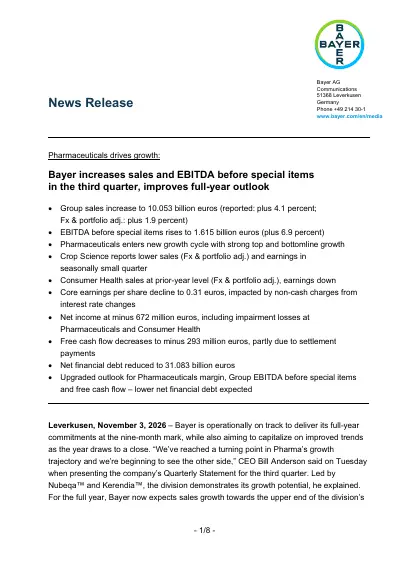
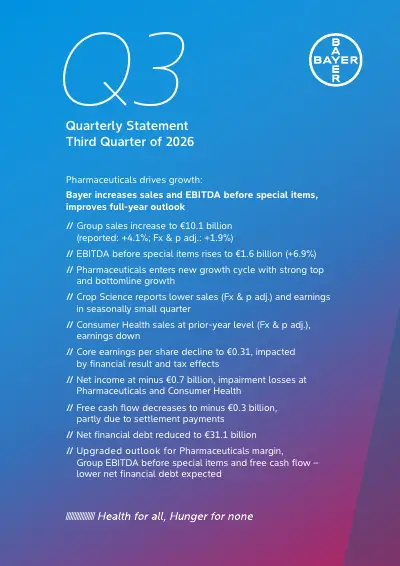
Nine months into the year, we're on track to deliver our commitments with a strong operational performance, and we're even upgrading our outlook in several areas. Sales grew 3% organically, or currency and portfolio adjusted, which we'll refer to throughout today's call.
Core EPS is at €3.97, which is in line with our guidance despite some effects on the corporate lines. As expected, free cash flow is at -€3 billion due to known litigation-related payments.
On the whole, our businesses demonstrated operational resilience and underlying potential. Crop Science and Consumer Health are performing in line with targets while navigating market pressures, and our Pharma business, led by Nubeqa and Kerendia, demonstrated its growth potential.
Now let's take a closer look. In Crop Science, the third quarter is always our smallest.
Year to date, the business is growing about 3.5%, with the EBITDA margin coming in at 24.6%. Our Seeds and Traits business is growing double-digit, supported by innovation lift and market share gains, most notably on corn globally and soy in the U.S.
Our core crop protection business is down on the year due to expected portfolio exits, regulatory impacts, and increased generic pressure. This was further compounded by a historic drought in Europe and a strong El Niño.
Now looking forward, LatAm is off to a strong start the season, and we feel well positioned to deliver our 2026 outlook. Pharma continues its momentum.
Year to date, the business is growing at 2% with an EBITDA margin of 26.8%. Nubeqa is up 60% year to date, and Kerendia is growing 76% in the same timeframe.
We continue to strengthen product profiles and growth prospects of both brands. Our newer launches are also progressing well.
In Q3, Beyontra entered our top 15 pharma products in terms of revenues for the first time. Xarelto and Eylea continued to decline in line with our expectations, but we've reached a turning point in pharma's growth trajectory and we're beginning to see the other side.
For the full year, we now expect sales growth toward the upper end of our guidance range, and on the back of our strong performance year to date, we are also upgrading our margin outlook to 25% to 27%. To support the future growth trajectory of our Pharma business, we announced our plans to build a state-of-the-art production facility in New Albany, Ohio, in Q3.
The facility will support our growing portfolio in oncology, cardiovascular, and renal care, and it'll complement our global site network in pharmaceuticals, which we'll continue to invest in as appropriate. Finally, Consumer Health.
We're growing 2% so far this year, and our EBITDA margin is at 22.9%. Our dermatology and digestive health businesses continue to grow, led by contributions from Bepanthen across all regions and MiraLAX in the U.S.
Allergy and cold is our only category that's down, due to a weaker season so far. We continue to see challenging market dynamics, particularly in North America, but we remain focused on achieving our 2026 commitments and delivering for the consumers that are counting on us.
Overall, we remain confident in our 2026 targets for the group. We expect our Pharma business to continue its momentum and to come in better than previously projected, and we're upgrading our outlook for adjusted EBITDA, free cash flow, and net financial debt.
Operationally, Bayer continues to make good progress, and we will stay focused on strengthening our performance 90 days at a time. Now let's move on to our strategic priorities.
First, the pharma pipeline. I mentioned Nubeqa's growth momentum.
At the recent ESMO Congress, we presented interim results that bolster this medicine's potential. This analysis showed an impressive 58% reduction in the risk of metastasis or death in prostate cancer patients with a very high risk of recurrence.
We're pleased with this data. Of course, we're cognizant of market dynamics like competitor genericization and pricing pressures, but we feel that these results reinforce Nubeqa's overall potential.
The biggest news out of our pipeline came at the beginning of last week when we received the first approval for asundexian in secondary stroke prevention in China under the brand name Shanhabo. Asundexian is now the first approved Factor XIa inhibitor worldwide, and we're focused on obtaining additional approvals.
Now here I want to congratulate the Bayer team that got asundexian to this point. Our scientists in Wuppertal invented this molecule and have worked on it for more than a decade.
Even after a big setback in November 2023, they hadn't lost sight of what asundexian could mean for stroke survivors. They've embraced our operating model and artificial intelligence, which allowed them to substantially compress the timeline, getting this medicine to patients a year early.
That's incredible impact. Now regarding Crop Science profitability, we continue to address pressures on crop protection through actions under our five-year framework.
In Q3, we further consolidated crop protection production activities and we reduced costs, and we're going to continue to monitor the market closely and take actions as necessary. We're also advancing differentiated innovation in seeds and traits as well as crop protection.
Last month, we introduced the new insecticide Plenexos to the Mexican market, while the Vyconic soybean stack advanced into the final stage of EU import approval, bringing us one step closer to launching this key blockbuster. On the Roundup litigation, we remain focused on our objective of significant containment, and we're on track.
In September, the class settlement between plaintiffs' class counsel and Monsanto reached the final approval hearing. The company remains confident in the proposed class settlement.
We appreciate that it's getting a thorough review and we await the judge's ruling. Why is this important?
As we've said before, the path to resolving mass litigation in the U.S. almost always involves a settlement, and we reached a deal with plaintiffs' class counsel.
Together with the Supreme Court's June ruling, the class settlement offers the company the best path to significant containment. That's what we committed to, and that's what we aim to deliver.
Now as we move toward that goal, there will still be a much smaller number of individual cases pending against the company. One case was just decided in the company's favor.
We take that as a strong sign that our containment work is advancing. Last week's Aretino case was important because it was the first case that went to trial after the Supreme Court's 7-2 decision, which struck down the failure-to-warn legal theory.
Now in this case, plaintiffs had to present a legal theory based on design defect and negligence claims, and the fact that all 12 jurors sided with the company should be informative for those seeking to pursue claims in the court system. We'll continue to handle cases in the best interest of the company, and we're awaiting an important decision on the settlement.
Now I also want to mention PCBs, which differ from the glyphosate cases in terms of the multifaceted nature of the claims. Our legal strategy accounts for this, and we'll continue to defend these matters vigorously or pursue settlements.
We expect legal proceedings in the coming quarters and we'll act in the company's best interest. Now looking ahead, we're focused on closing 2026 strong and achieving our targets.
The ag season is underway in Latin America. Pharma has strong momentum with existing launch assets and potential new medicines reaching the market.
Consumer Health is going to embrace our operating model to navigate a softer market and deliver the year. We see an exciting future for Bayer, a future in which the company is viewed differently than in the past.
We're focused on improving revenues, increasing productivity and cash generation through our operating model and with our rollout of artificial intelligence. We want to sharpen our capital allocation with resources focused on the biggest mission impact while continuing to deleverage.
Now we're going to continue to update you on our progress, and we have the next opportunity with our full-year results in February next year. Now over to you, Judith.
Judith Hartmann
Thank you, Bill. Hello to all of you.
It's been a pleasure to meet many of you in person since the first half year results. I'm looking forward to continuing our conversations.
After the first nine months of the year, we see very good momentum and are happy to be able to upgrade our full-year group outlook for adjusted EBITDA, free cash flow, and net financial debt. Year to date, we delivered organic sales growth of 3% and adjusted EBITDA growth of 7% compared to last year.
In Q3, Pharmaceuticals was the key driver of group performance, supporting organic sales growth of 2% and adjusted EBITDA growth of 7%. Foreign exchange effects were a year-on-year tailwind on reported results in Q3, contributing approximately €250 million to net sales.
This was primarily driven by the weaker euro against the U.S. dollar, Brazilian real, and Chinese renminbi.
On a year-to-date basis, however, currency effects continue to weigh on results, reducing sales by around €700 million and adjusted EBITDA by approximately €360 million. Year to date, core earnings per share of €3.97 benefited from stronger operational contributions, particularly from Crop Science and Pharma, offset by both a weaker core financial result and higher core taxes.
In Q3, strong adjusted EBITDA in Pharma contributed positively to core EPS. However, we saw softer performance in the other divisions.
We also saw pressure from non-cash effects in the financial result, mainly driven by interest-related fair value changes in some of our employee benefit and pension instruments. Turning to free cash flow, we reported -€3 billion for the first nine months of the year, largely driven by €3.7 billion of litigation-related payments.
This was slightly better than expected. Excluding these payments, underlying operational cash flow is ahead versus prior year, driven by improved trade working capital as well as licensing resolution income.
In Q3, free cash flow was -€300 million, including the second payment into the class settlement fund. Finally, net financial debt decreased to €31.1 billion, reflecting a notable improvement versus both Q3 '25 and Q2 2026.
This was primarily driven by the successful closing of the Apollo equity investment, which generated proceeds of €3 billion. We had announced this transaction in the second quarter.
Let's now take a closer look at the performance of our businesses. In Crop Science, disciplined execution of our five-year framework supports resilience in a dynamic ag environment.
On a general note, the third quarter for Crop Science is usually small, given that the Northern Hemisphere season wraps up while the Southern Hemisphere season is only starting. Q3 is not very telling about the full-year performance, and we can see it here.
Total Crop Science sales declined 2% as headwinds in crop protection were partially mitigated by Seeds and Traits growth. However, year to date, we see an increase of 3.6%.
The decline in core crop protection is more than offset by strong double-digit growth in Seeds and Traits in the first nine months. In fact, we expect to outpace the market in '26, supported by market share gains across several key crops.
For the quarter, Seeds and Traits were up 3%. Soybeans grew 5% in Q3, driven by strong performance in Latin America.
Year to date, sales were up 45%, or 10% excluding the first-quarter licensing resolution income. Growth was driven by increased acres as well as higher pricing and market share gains in North America following the return of the U.S.
dicamba label. This performance positions us well for the full year, even as growth is expected to moderate in the fourth quarter.
Corn sales were stable in Q3. Year to date, sales increased by 4%, supported by price and volume growth across regions.
Adjusting for the prior-year licensing resolution income, we expect underlying corn growth in Q4, led by Latin America. Core crop protection declined 6% in Q3 and year to date, reflecting additional weather and generic pressures alongside regulatory and portfolio headwinds.
Adverse weather in Europe and El Niño-related effects limited crop protection applications. We have taken targeted actions to address challenging market conditions, supporting volume growth in Latin America in Q3.
We expect this momentum to continue in Q4. Glyphosate sales declined 5% in the quarter, primarily due to weather conditions in EMEA, and were down 2% year to date.
On profitability, adjusted EBITDA was approximately €100 million in Q3, with margins moderating as expected. Importantly, year-to-date margin remained above prior year at 24.6%.
This was a result of a favorable sales mix, continued execution of our five-year framework, and the licensing resolution. Our Pharma business continued to execute on its strategic priorities and is starting a new growth cycle.
This is a major milestone and turning point worth pausing to acknowledge. We're now seeing stronger growth momentum as we have entered the second half of the year.
In Q3, net sales increased by 6%, bringing year-to-date sales to €13.4 billion, up 2% year on year. This performance positions us well to finish 2026 at the upper end of our full-year sales outlook for Pharma.
Nubeqa sales increased by 58% in Q3 to roughly €1 billion, with growth across regions and a particularly strong performance in the United States. Year to date, Nubeqa is now at €2.6 billion.
Kerendia sales grew by 65% in Q3, mainly driven by the United States and China. Year to date, Kerendia sales are close to €1 billion.
Based on this strong performance, we now expect Kerendia to grow by around 60% for the full year. The launch of Beyontra continues to perform ahead of our expectations.
It has made it into our top 15 pharma products in Q3, and we remain focused on driving uptake through 2026 and beyond. As expected, Xarelto and Eylea declined 31% and 24% in Q3, respectively, due to the loss of exclusivity and biosimilar competition.
Importantly, the pace of decline is beginning to moderate. For the first nine months, the sales development is in line with our expectations for the full year.
Eylea 8 mg continued to show good volume growth, now accounting for 60% of total Eylea sales. Finally, our base business remained a solid contributor to pharma performance with 3% year-to-date growth.
In Q3, sales grew 5%, driven by continued momentum in radiology and women's health alongside a solid recovery of Adalat and Aspirin Cardio in China. Adjusted EBITDA for Q3 was up 24% with EBITDA margin expansion to 27.6%, mainly driven by top-line growth.
This was further supported by lower write-offs for inventory, a tail-end product divestment, and operational efficiency. At the same time, we continue to invest into future growth.
Year to date, the margin is at 26.8%, leading to an upgrade of our margin outlook for the full year. Turning to Consumer Health, sales increased by 2% in the first nine months, with growth across all non-seasonal categories.
In the third quarter, sales were broadly stable in a market environment that remained mixed across geographies and categories. Particularly in the U.S., market conditions remained challenging.
Despite this, we continue to see solid momentum in key parts of our portfolio. Digestive Health grew by 5%, led by MiraLAX, while Dermatology increased by 3%, primarily driven by continued momentum from Bepanthen.
Both categories also delivered solid growth year to date, with Dermatology up 5% and Digestive Health up 3%. This reflects our focused allocation of resources behind the brands, categories, and markets where we see the strongest opportunities for sustainable growth.
We experienced softer allergy and cold sales, reflecting cautious retailer inventory build in the United States ahead of the season. Nutritionals also declined in the quarter, given the competitive environment in the U.S.
and EMEA. Despite this, nutritionals remain an important contributor to our year-to-date growth, supported by e-commerce and brands such as Elevit.
Turning to profitability, the adjusted EBITDA margin was 24% in the third quarter and 22.9% year to date, well within our full-year guidance corridor. We continue to invest behind our brands and innovation to support future growth.
These investments and foreign exchange headwinds weighed on margins. Productivity gains and disciplined cost management provided a partial offset while preserving our ability to invest in our growth priorities.
Let's move on to the group outlook. With the strong pharma performance, we now expect adjusted EBITDA for the group between €9.8 and €10.3 billion at constant currencies, up from our initial guidance range of €9.6 to €10.1 billion.
We reiterate our current guidance range for core EPS. Core financial result and core taxes are expected to remain within the modeling ranges, including the non-cash effects we saw in Q3.
On free cash flow, we continue to work on all cash flow levers, including profits, working capital, and capex. We are raising our full-year outlook by €1 billion to -€1.5 to -€0.5 billion.
The previous forecast had been between -€2.5 and -€1.5 billion. The improved free cash flow performance is anticipated to result in a lower net financial debt at year-end, which we now expect to be in the range of €28 to €29 billion at constant currencies.
This compares to the previous range of €29 to €30 billion. Finally, on currencies, we have updated the foreign exchange estimate based on September month-end spot rates, which remained rather stable compared to our last estimate.
I will close with the divisional outlook. In Crop Science, our performance through the first nine months keeps us on track to deliver within our full-year guidance ranges.
Strong Seeds and Traits performance is expected to offset additional core crop protection headwinds. Looking ahead to the fourth quarter, we expect continued momentum in Latin America.
The year-on-year comparison for Crop Science will be impacted by prior-year licensing income. For our Pharma business, Q3 marked the starting point of a sustainable return to growth.
Based on the current performance, we expect to finish 2026 at the upper end of our organic sales growth outlook. While we remain committed to investing in our launches and advancing our pipeline in Q4, top-line growth is expected to further support full-year margin expansion.
We therefore upgrade our full-year outlook for the adjusted EBITDA margin to between 25% and 27%, up from 23% to 25% previously. For Consumer Health, the performance in the first nine months supports our full-year guidance.
Based on the development year to date and our current projections for the fourth quarter, we expect full-year growth in the lower half of the guidance range. Market conditions remain mixed, especially in the United States.
Competitive dynamics in nutritionals and the development of the cough-cold season remain important factors for the fourth quarter. Our focus remains clear: invest behind our strongest brands and innovation while allocating resources towards our most attractive growth opportunities.
Looking ahead, we will of course provide our 2027 outlook with our full-year 2026 results, but I want to highlight some trends we are seeing. Firstly, Crop Science will face a tougher year-on-year comparison in the absence of licensing resolution income.
We continue to monitor a mixed agricultural environment with pressured farmer economics, generic competition, and weather uncertainty, but believe that underlying demand remains resilient. We will respond with appropriate measures as we execute our five-year framework.
Secondly, the U.S. tariffs on patent-end pharmaceuticals have been considered in our guidance for this year.
On drug pricing, we continue to evaluate what U.S. most favored nation policies may mean for our pricing and launch strategies.
I want to end my remarks by reiterating that we remain firmly focused on our financial priorities: strengthening our balance sheet, improving productivity and cash generation, and building financial flexibility to invest into next-generation growth. With that, over to you, Jana, for the Q&A.
Jana Ackermann
Thank you very much, Judith, and thank you, Bill. We will now begin with the Q&A session.
Before we start, just a few housekeeping comments. If you have a question, please raise your hand and follow the instructions provided in the chat.
To allow as many participants as possible to join, please limit yourselves to two questions. Our first question today comes from Richard Vosser, J.P.
Morgan. Richard, over to you.
Richard Vosser
Hi, thanks for taking my questions. Maybe one question on Crop Science and the comments you just made, Judith.
Just thinking about that five-year framework, I think that five-year framework had margin expansion up to sort of mid-20s, but just maybe you could talk a little bit about how the shape of that might be in '27. I think at the Crop Day, there was an idea of just some improvement, but not linear, some improvement in '27.
Just thoughts on '27 a little bit more, in a little bit more detail around EBITDA margins and maybe the top line as well. Then second question on Nubeqa for Pharma.
Perhaps you could talk about the potential for growth going forward in a little bit more detail. You mentioned the [Dazal-HiCAP?]
trial, maybe the thinking on the impact of that, maybe a little bit more on the impact we should expect for Xtandi generics maybe in '27, and then beyond there's probably a little bit of IRA and other things. Just bringing it all together, how we should think about growth of Nubeqa going forward.
Thanks so much.
Bill Anderson
Great. You want to go or you, Rodrigo, on the margins for Crop Science?
Judith Hartmann
Sure, maybe I'll start, Rodrigo, and then you put in some color. We're not giving '27 guidance obviously, but you're right to ask, Richard, on do we see any trends going forward.
What I feel is very important is that we are committed to beat market conditions, and I think we're seeing it this year, and that's what the team is also projecting for next year. Don't forget about the licensing income.
Obviously you have it in mind that we're seeing this year that is not going to repeat next year. On margin, lots of work going on.
I'm sure Rodrigo is going to have many examples here ranging from factories consolidation, renegotiation of contracts, all sorts of things. The team is keeping a good work up on improving the margin there.
Rodrigo Santos
Again, you summarized very well, Judith. Richard, if I just use your question, because you finished with the top line and the margin, just to use the about '27, let me give you deep dive on these three elements that was mentioned by Judith.
The first one, the market conditions. We are expecting with El Niño, with the geopolitical, the recent developments in Ukraine and the Black Sea restrictions, a lot of uncertain and volatility about the market, the farmer's economics that were mentioned as well, even expecting probably a reduction of corn area in U.S.
The market conditions, as you heard from other companies as well, remains challenged for '27. That is the first element.
The second one is important, is what Judith mentioned. We had the licensing resolution impacting Q4 of '25 in corn, Q1 '26 in soybean, and that will not recur in '27.
On reported sales, you're going to have a moderation on top line and margin because of that. That brings me to the underlying business.
The underlying business continue on track on the five-year framework. We are expecting to perform above market next year.
We have our Seeds and Traits continue to perform as we see very strong performance this year. Also in our Crop Protection, just to mention some of examples that was mentioned by Bill as well, we had Plenexos in Mexico next year.
We're expecting in U.S. and in Brazil, a very important market.
We are also expecting Sivanto to continue to expand, Covintro also Brazil and U.S., and other products that we have. The underlying business, both on the top line and on the margin, we continue on the path towards our midterm ambition that you mentioned.
These three elements are very important for '27, and we're going to provide much more details in February as mentioned by Judith. Thank you for your question.
With that, Stefan.
Stefan Oelrich
Hi, Richard, and thanks for the Nubeqa question. Of course we're excited about the results that we're seeing and adding new indications prospectively because we have to see with the [Dazal-HiCAP?]
, first what the regulatory pathway is for it. Then in terms of the future growth profile, of course we're not guiding '27 here or following years, but I think we can be optimistic obviously, as we're going to expand our user base.
We've said that currently we cover about 60% and we're going towards covering 80% of all eligible ARI potential patients. That helps us drive volume share.
On Xtandi, we'll have to see. There's certainly a pricing headwind coming.
When you look at the growth, we're not necessarily defending our percentage growth, but our base is increasing so that we continue to see continued growth for Nubeqa, and everything else we'll inform in more detail at the beginning of next year. Thank you.
Jana Ackermann
Thanks, Richard. Second question comes from Sachin Jain, Bank of America.
Sachin, over to you.
Sachin Jain
Hi there, thanks for taking my questions. One for Stefan and then one for Bill.
Stefan, for you on asundexian, you've referenced the recent China approval. The label was solid, sort of allowed prevalent, and safety was well reflected.
Should we be thinking about that as a rough proxy for the U.S. label or any commentary you can make around how those discussions are going?
Then, given that Bristol milvexian data is coming, would you just update us on how you're thinking about your commercial scenarios depending on their data? Then just one for Bill.
Thanks for the commentary on the glyphosate class settlement. Wondering if you'd just update us on how you think about when we should hear back on that, any color you're willing to give on opt-outs, and your level of comfort with the debate on the future cases, which seem to be a bit of a sticking point in the debate.
Thank you.
Stefan Oelrich
Sachin, thanks. We're very pleased with the Chinese label, and I think it's noteworthy, because in my career I don't recall ever having a new class of medicines being approved first in China.
That's really something to remember. We're waiting for the FDA label.
We haven't reached PDUFA date, there's a little bit of time left. At this point it's speculative if it's going to be the same label.
I think you characterized it correctly. The Chinese label is very solid, with no significant restrictions that I could see.
We're in intensive discussions with the FDA and let's see what comes out of it. As to what this means compared to milvexian, I think this at this point is not very helpful to speculate too much.
Obviously we believe that we have an extremely solid data set when it comes to secondary stroke prevention, where I think whoever comes there will come up with something really, really good if they want to beat us. We feel very strong there.
We also have most likely about a year advantage over the second follower. Then I think that will help us.
We'll have to see about milvexian. They have multiple studies, as going for multiple indications, as you know.
At this point, I think it's purely speculative.
Bill Anderson
Great. Thanks, Stefan, and, Sachin, good to see you, or good to hear from you anyway.
Regarding the ruling from the judge on the settlement, we expect an answer, well, we've said before Christmas, and so that's coming in the near future, it should be in the next several weeks. Then on the question of opt-outs, let me explain the process a little bit.
There was an opt-out date in early June. That was the time when people had the opportunity to opt out.
Now, this is kind of a special case because since that time there've been three events. One event was the Supreme Court ruling, which was very strong in our favor.
Second event was the fairness hearing, which we think went pretty well. The third event was this trial that happened, or that read out last week, which was the first trial to test these sort of other legal theories, which ended in a unanimous defense verdict.
You can imagine there might be quite a few plaintiffs and plaintiffs' counsels who had opted out in early June, but who would reconsider that decision in light of subsequent events. That in fact is the case, and there's actually a lot of interest from those lawyers and plaintiffs to actually get into the class.
There is a mechanism for that to happen and that is going on at kind of a fast pace. It's actually, there's just like there's some administrative burden in opting out, there's also an administrative burden in getting back in, and it's also subject to the approval of class counsel, and us.
Now, when the judge rules, there will be some declaration of the number of opt-outs, but keep in mind that after that date, if there are existing opt-out requests in process or new ones coming in, those can still be allowed back into the class, again, subject to the approval of class counsel, the company, and the judge. Whatever number that is will be probably a moving number because it's on its way down and it'll likely continue to go down.
Hopefully that gives you a little help in deciphering that.
Jana Ackermann
Thank you, Sachin. Next in line is James Quigley, Goldman Sachs.
James, the microphone is yours.
James Quigley
Great, thank you very much for taking my questions. I've got two on Pharma, two for Stefan, please.
Firstly on Kerendia, did I hear correctly that the growth for the full year is anticipated to be 60%, 6-0 percent? We've seen 76% in the first nine months, which suggests a sequential decline in absolute revenues as well as growth.
Are there any headwinds, etc., that we need to factor in when we're modeling for the full year? Then just an update on how the launch is going across the three different indications as well as the geographical rollout, that would be great.
Thank you. Secondly, following up on Richard's question on Nubeqa and IRA.
Obviously now with the drug annualizing at about €4 billion, what does this mean in terms of potential for IRA negotiations? What is your base case for when you could be included in the negotiations?
Do you have any sense of, based on what you've seen so far with other drugs, what the potential price hit could be in the impact on growth? Thank you.
Stefan Oelrich
Thanks, James. On Kerendia, as the base is growing, percentage growth is going to come somewhat down in the fourth quarter.
Overall, we're still seeing positive momentum on both indications. We are predominantly a Europe play, which is unfortunate because of very low pricing that we have in Europe.
We're looking into an overall year picture. There may be some rebate considerations that we need to add.
That's why we've taken this 60% choice, but it's a really good question. On Nubeqa, IRA negotiations we expect to get started in '27, so that we will have an impact of IRA sales start in as of '28, and so it's coming.
We'll have to see if we can negotiate at similar price levels as competition has, and it certainly is a clear headwind going forward. Great,
James Quigley
thank you.
Jana Ackermann
Thank you, James. The next question comes from Charles Pitman from Barclays.
Charles, over to you.
Charles Pitman
Hi, hopefully you can hear me okay. Two questions, please.
Firstly, just on pharma margins, I was wondering if you could give us a little bit more detail just on the 3Q dynamics and how we should read these going forward, noting the expected investment into preparing for an asundexian launch, just thinking about kind of is the 3Q gross margin and SG&A, R&D levels suitable bellwethers for going forward, and also on D&A, just noting that crept up in the quarter. Then just secondly for Judith, thinking about the dividend and noting that Bayer's been paying the €0.11 per share since '23, but litigation remaining on track, how can we think about the capital allocation decision framework for FY26, '27 dividends?
Thank you. Let's see.
Bill Anderson
Stefan, you want to comment on the Pharma margin dynamic?
Stefan Oelrich
Thanks for the question. First, before I get to that, let me correct an answer I just gave to James on the previous one.
I said '28, and I meant '29 is the impact from the IRA negotiation, I need to stand corrected there. On pharma margins for this quarter, we had a couple of pluses and minuses here, including some divestitures, which has driven margin up.
When you look at the very positive margin for Q3, you probably have to take about 20 basis points down to come to where we really are operationally, which still is a significant improvement, which is linked to our strong growth in the third quarter. Against that, you will see now coming online in the coming quarters more and more additional sales expenditures from the asundexian launch, or I should better say now, Shanhabo launch, that is going to get underway starting with the first quarter in the U.S.
and in hopefully and certainly in China. That's going to weigh on the margin.
Our midterm guidance stands, which is what we've given to you at the beginning of this year, is that we see for the coming year a stable outlook, maybe or even a little bit more in terms of margin pressure because of the investments, and then gradual margin improvement towards 30% in the following years till 2030. Then,
Judith Hartmann
Charles, on dividend and capital allocation, it's a little early to talk about '27 and beyond, but I can talk about my philosophy and how I look at it. Really when you look at the results we've just presented, we do expect that we will have higher cash in over the years to come.
Crop Science is working on the five-year plan. You've just heard the amazing Pharma success.
Consumer Health has a very solid base of close to a billion of cash flow. With the containment of litigation that Bill mentioned, we should have lower outflows, and so really I feel confident that we will be able to do several things.
We'll be able to materially increase our investment into the future, we will be able to pay down debt, and yes, of course, over time, we will also start paying a higher dividend again.
Charles Pitman
Thanks so much.
Jana Ackermann
Thank you, Charles. Next in line is Vincent Andrews from Morgan Stanley.
Vincent, floor is yours. Hi.
Vincent Andrews
Thank you very much. A quick question for Rodrigo first.
There's been some volatility in corn prices since the end of the summer, wondering if we can just talk about how that has been impacting the order books for the North American 2027 season. Then secondarily in Crop Protection, it seems like the results are sequentially weaker than you'd anticipated, 2Q to 3Q.
Is that the case again, 3Q to 4Q? Within that, could you just talk about what's happening to raw material costs in Crop Protection, if that's getting worse and what you can do about it?
Thank you.
Rodrigo Santos
Thank you very much, Vincent. Let me start with corn and the U.S.
You saw that this year the reduction on area came, but probably end up with 97, around 97 million acres in U.S., what is was a little bit higher than probably was anticipated in the market. For next year, what we are seeing now, and again, there is a lot of developments right now and we're going to learn more in the next weeks and months, potentially we are seeing a reduction to more close to the historical level of corn area in U.S.
That is a little bit of what we are seeing. Our order books is strong because also we are bringing a lot of new-generation hybrids to the market, and the package that we have is strong.
We are expecting a lower area for next year as of for now, and we're going to need to close lookly to that one. On the Crop Protection, for the full year, of course, we projected the impact of the regulatory and the product exits that was mentioned by Judith on the script here, and that was big part of that.
What I think Q3 came was the weather impact, right? Especially the dry season, the hot season in Europe and Asia, we had an impact on our fungicide applications and herbicide.
That is the impact that it had in Q3. We are coming now to Latin America.
We are in strong performance in Latin America, as you know. We have a very strong portfolio with Fox Xpro, Fox Ultra on the fungicide side together with Luna.
We had a very strong portfolio on fungicide side. Also on the insect side, we had a Verango Prime expansion.
We have LatAm in Q4 performing well and we are hoping for that one for the full year as well. I think the Q3 core element to call out was the impact of the weather.
That's probably the one piece, and we are managing our portfolio and our platforms here to deliver, and that's why we are very confident on delivering the guidance for '26. Thank you for your questions.
Jana Ackermann
Thank you. The next question comes from Matthew Weston, UBS.
Matthew Weston
Thank you very much. My questions are about asundexian and the launch trajectory, Stefan, if I can.
Clearly we all have high expectations. I know you do too, but can you try and help us frame some of those?
Can you give us an expected split of Medicare, Medicaid versus commercial in the U.S. that you would anticipate?
Then really just help how to frame that first year. Should we expect a significant phase of free drug and bridging programs at the beginning of the launch, or are you confident that we can see some element of meaningful revenue ramp with commercial access relatively early?
Stefan Oelrich
Great question, Matthew. That's the question I'm asking my team as well.
There's no clear answer because we don't have too many precedents for this. This is most likely going to be a heavily protocolized indication.
For the acute cases, we expect people to leave the hospital with a one-month supply, and I think this is going to put considerable pressure on payers to go for continuing these prescriptions. That would speak for a good uptake dynamic.
Then we'll have to see really what's in the label, because I think the label is going to inform us if there's any limitations that could be thrown in by payers or not. At this point, it's really speculative.
When it comes to Medicare, this is obviously a population that has a high level of patients that are covered through Medicare. Medicare is going to be important, and you know that we have some limitations in terms of our promotional penetration when it comes to Medicare, whilst for commercial plans, we're going to be very supportive to patients in the beginning so that they can continue the treatment as they get discharged from the hospital.
Nothing more to share on Medicaid at this point. I think this is something that we'll have to see how it goes.
We're going to be focusing our efforts on hospital to get started so that we can get into this protocolized setting as soon as we can, so that patients get discharged with the right treatment based on our very strong data set.
Jana Ackermann
Thank you, Matthew. We have Joel Jackson from BMO coming next.
Joel, over to you.
Joel Jackson
Can you hear me?
Bill Anderson
Yep.
Joel Jackson
I'm going to ask two questions one by one if it's okay. First question is, and it could be for Rodrigo or Bill, we've seen in the Crop Protection industry a discussion about rebates, especially in the U.S., rebate models changing, gross-to-net spreads.
Could you talk about what's happening in CP from Bayer's business, the gross-to-net spreads, pricing, how that's changed, how you've adapted?
Rodrigo Santos
Joel. I will.
Thank you for your question. Just using the opportunity here, I didn't mention, Vincent, you asked also about the impact of the raw materials, right?
There is an impact, but we are managing with the actions that we are taking also in terms of sourcing, renegotiating, some of the things that was mentioned as well. I just want to call that one.
On the CP piece, Joel, just to go deeper here, we have a very clear plan and since many years we are managing sell-out and sell-in on our Crop Protection with a very high discipline in terms of pricing, inventories on the channel, in terms of gross-to-net. We have different gross-to-net strategy depending on the product itself, the regions itself.
We are not seeing any significant change. We are just products that are needed because of generics, but there is no massive change for us on that side right now.
We are always adjusting our plans and acting according to the market, but there's no massive impact for us on that one. Your second question?
Joel Jackson
Okay. My second question would be, and this would be for Bill I'm guessing, is, what have you learned from the separation of Evonik and Corteva over the last month?
I'm sure, Bill, every day you've had this job, you've been asked, are you going to ever split off Crop Science one day? What have you learned from watching that operation?
If you get to a more comfort level and look into portfolio down the road, and you were maybe to make a choice to split off Crop Science, would you think about maybe splitting off the two parts, seeds and crop chems definitely separately, or what have you learned from that experience the last month of Evonik and Corteva?
Bill Anderson
Joel, thanks for the question. I'd also be interested to hear Rodrigo's thoughts on it, because he's obviously the closest to the Crop Science business.
I would say, first off, it's one month in, I'm not sure we can learn a lot from it yet. I think, time will be a more important factor in really assessing how that goes.
I think, for us, the main factor that keeps us focused on what we're doing now, which is really still pressing hard on kind of our five key opportunities, but also on going all out with AI implementation across Bayer, is just the opportunity cost of sort of structural adventures, because when I think about the 88,000 people of Bayer and how hard they've been working to drive these kind of results, like getting asundexian to market a year before our competitor has their Phase 3 data, that doesn't happen just sort of on its own. That's about people being laser focused on the business, on the operations, on simplifying every process.
We've taken out almost 70% of management in the last three years. We've put a whole new way of operating in.
You can't do that and be doing that kind of company dividing. We like this focus that we have.
We feel like it's driving better results, and I think I speak for all of us that we don't think we're anywhere close to done with this in terms of the improvements that we can make, in terms of driving faster action, higher productivity, better customer satisfaction. That's kind of our main thinking.
We're not particularly focused on the competitors. We're focused on beating ourselves and delivering a better result every quarter.
I think that's probably our main outlook. Rodrigo, maybe you have some specific insights on the Crop Science field and how's that shaping up?
Rodrigo Santos
Just to add, I think, Joel, we talk a lot about that in Huxley. For me, it's a lot about performance, and driving performance on our business in the next years.
In our industry, that performance is highly connected with innovation and how we are operating. This is what really matters for us is that we perform every platform that we have, as we say.
I'll give just some examples of this year, right, that was mentioned. I'm very glad that we are on the Seeds and Traits platform, as an example.
We are at 12% year-to-date performance. Even if you exclude the licensing resolution, it's a 5.4%.
That means 4% in corn, 10% in soybean year to date, 16% on cotton, 25% on the other seeds and traits, especially in canola. We need to perform.
On Crop Protection, if you compare to the market, if you compare to the competitors already released, the discipline that we are executing our Crop Protection is very important. We plan this year to moderate sales because of our margin expansion focus that we have, we account for the regulatory and the product exits.
I mentioned the weather was probably a bigger impact, but that's how we manage ag, right? This is particular normal to our process.
For me, the question that will remain is about performance, and this is the focus that we have in the organization. Very clear.
The entire organization are very aligned on our five-year framework and how we drive that in the next year. That's the goal that we have, to drive innovation growth, margin expansion, and cash generation, and that's what we're going to continue to do.
Jana Ackermann
We have three more in line, and the next one is Christian Faitz from Kepler Cheuvreux. Christian, over to you.
Christian Faitz
Yes, thanks. Good afternoon everyone.
Good morning, wherever you are. Two questions, please.
On Crop Science, are you seeing weather-related channel inventories that could weigh on '27 in crop protection products, I guess particularly in Europe? Or are you handling that already this year by rebuying some of the volumes?
Second, in the settlement timing context, and given that we are already well into Q4, would you still expect a significant portion of the flagged €5 billion cash outflow to happen this year? Thanks very much.
Rodrigo Santos
Thanks, Christian. On the inventory, I was mentioning we have a very high discipline on managing sell-out and sell-in.
As the minute that we see any effect on the sell-out where there's a market impact, we reduce our sales, we're managing inventory, so that's what we do global-wise. We don't see that in a different way.
Of course, when you had a weather event like you had in Europe, you may end up with one specific country or application that you could have a little bit of that you were expecting a fungicide application and there's so dry that you don't do that, but we manage that as well. We don't see a massive issue with inventory.
I think we are managing that to the right level, to keep low inventory in the channel to be able to manage the business as it should be. I think we are on track on that one.
Bill?
Bill Anderson
Actually, I think Judith going to take the one on the settlement.
Judith Hartmann
On the settlement payments, we had talked about €5 billion this year. We're about 60-ish percent in, I would say.
Right now we're keeping that as a forecast. There is a certain likelihood that some of it is going to slip into next year.
Christian Faitz
Great. Thanks very much, both.
Congrats on the results, by the way.
Judith Hartmann
Thank you.
Jana Ackermann
Thanks, Christian. Next one, Thibault Boutherin from Morgan Stanley.
Thibault,
Thibault Boutherin
the floor
Jana Ackermann
is yours.
Thibault Boutherin
Thank you very much. Just on pharma tariffs, limited impact this year, how should we think about next year and the margin?
You announced a large investment in U.S. manufacturing.
Could you confirm that discussion with the administration are ongoing as well in that context? Just a clarification.
You mentioned the impact of MFN on pricing and launch strategy. Just to confirm that these kind of considerations are related to actually striking a deal.
As you don't have a deal at the moment, are you still constrained on launch and pricing? Thank you.
Stefan Oelrich
I'll take it. Thibault, thank you.
Let me first start by the Ohio investment. The Ohio investment clearly is a sign of our strategy of renewed focus of the U.S.
market really coming through. That includes bringing also manufacturing to where our biggest markets are in the world that we live in now.
I think it makes all the sense in the world. That's one thing.
The second one is about MFN and about tariffs going forward. At this point, I'm not in a position to give you a precise, pinpointed guidance.
These are ongoing discussions. You're right, we're one of the companies that has not signed a deal on this.
Right now that would mean we would be exposed to a potential tariff impact and potential guard and globe impact, and this is something that we're currently discussing still. Stay tuned.
You will get an update with the first quarter and our guidance for next year.
Jana Ackermann
Good. I think we have two more now, and so the next one is Rajesh Kumar from HSBC, and then we have one more before we conclude.
Rajesh, over to you.
Rajesh Kumar
Thank you very much. My first question is a clarification on cost base and run rate.
Appreciate there were quite a few technical elements in the quarter, like inventory moves, maybe some litigation gains on discount rate changes, non-strategic brand sale, etc. It's a bit difficult to work out what's the run-rate cost base based on SG&A.
If you could help us with, on a run-rate basis, how do you see the cost base going into '27? That would really help, especially because if you were to take the third quarter run rate and extrapolate on '27, you would start seeing margin increase in pharmaceutical, which seems contrary to what you might be saying.
That's the clarification question. The second one is, I know you obviously don't want to speculate what milvexian competition in SSP might do to asundexian uptake and pricing, but if we were to consider the scenarios, there could be one scenario where milvexian succeeds as similar to what we have seen in case of asundexian.
It could fail in SSP, or it could be better. That data we'll get this year.
The AF data comes out next year. Just on the scenario that SSP is a hit, miss, or maybe compared to where you are, how do you see that impacting or benefiting your uptake curve, pricing discussions, etc.?
If you could talk to those scenarios, I'm 100% sure like everyone else you also don't know the answer, just how you're thinking about the problem would really help.
Bill Anderson
Stefan, I think the first question, maybe it wasn't totally clear, but I think, Rajesh, you're talking about the Pharma margin in Q3, is that right?
Rajesh Kumar
Yeah.
Bill Anderson
Yeah. Maybe just to paraphrase, I think, Stefan, you were saying that, yeah, you wouldn't put too much stock in the Q3 margin because you don't have the bigger spending for asundexian kicking in yet, and there was a couple of other things that were a little lumpy.
I think you got to probably go more with the longer-term guidance that Stefan been providing rather than focusing in on Q3 and seeing Q3 as a new normal. Is that fair, Stefan?
Stefan Oelrich
That's exactly what I said previously. We're obviously very happy to see that margin is improving based on growth, but again, some of the additional costs is yet to come in next year, and it's going to be sort of balancing out to some degree or maybe even overbalancing with that.
We also had a relatively low R&D expenditure in Q3. Don't expect that to stay at the same level.
There's some gives and takes, I think our previous guidance stands. As on asundexian, let's be clear about two things.
One, we have, as someone at an investor meeting said to me the other day, it's a rare data set in cardiology. I think we sometimes don't give ourselves enough credit for how good our data set really is.
26% reduction in secondary stroke with no additional important bleeds is something that we surprised everyone with, so that needs to be beaten or at least reached by competitor. I feel very confident about the data set.
Secondly, we have first-mover advantage, and let's not underplay this. We're strong in cardiology.
We've been building our cardiology presence in the United States over the last few years, and our performance on Kerendia, which, by the way, on moving 12 month has already passed the billion billion level. As a reminder, many people were seeing this to be in its peak a much smaller product, we've proven that we have marketing capabilities and we have a strong label there too.
A lot will be riding on our label. In China, we are strong anyway, and for Europe, we'll have to see where it lands.
Whether milvexian has both indications, one indication, I think what matters for us is our own strength, and I'm also telling our teams to not look so much into the rearview mirror of who may be coming there, but rather look ahead. We're going to continue to build on our strong differentiation that we already have at this point.
We're establishing a new standard of care in secondary stroke prevention, and so we feel very good. Maybe one last word on margin.
I understand that you're all asking this because what is clear that Pharma has turned a corner, and that we're coming out of what we call the resilience phase and we're now into growth. Expect continued growth in the quarters to come.
There will be sequentially sometimes some bumps, but I think we can expect with that guidance that we've given to clearly hold. We want to grow mid-single digits, ideally of course above, but mid-single digits in the coming years until 2030, and start margin improvement as of '27.
Thank you.
Rajesh Kumar
Thank you.
Jana Ackermann
Thank you. The last question for today comes from Tony Jones from Redburn.
Tony, floor is yours.
Tony Jones
Good afternoon everyone, thanks for taking my two questions. I'll try and be quick.
First one for Rodrigo. Could you just confirm the technology licensing income is still around €2 billion, excluding the Corteva agreement?
Are there likely to be any pluses and minuses on that for 2027? Then secondly, one quick one for Judith on cash.
Is there likely to be any significant growth capex in '27 and '28, growth investments, or any other cash costs which might impact free cash flow? Thank you.
Rodrigo Santos
Tony, let me address your question. The license resolution on Q1 this year was €450 million.
Overall, our licensing business, as you said, is over €2 billion, and it's correct. Far majority of that is based on small and regional companies.
We are projecting on the course of our five-year framework with the new launches that we have, Vyconic, Preceon Smart Corn, corn rootworm 4, that we're going to continue the licensing strategy to develop that business. You have a right number there.
Tony Jones
Thank you. Then,
Judith Hartmann
Tony, on investments for the future years, what I would say is we have to earn the money first before we start investing it. Like you said earlier, we're very positive looking at these results and what it means for the future in terms of there will be higher cash flows from profits.
We're also working on measures around trade working capital, and so we'll come back in '27 with no projected investments in that year. Over time, we feel confident that investments will go up.
Tony Jones
Thank you very much.
Jana Ackermann
Thank you very much for your questions and interest. This concludes our Q3 2026 earnings call.
Have a great day.