Rheinmetall AG
Q3 FY2026 · Earnings Call TranscriptNovember 5, 2026
Operator
Ladies and gentlemen, welcome to the Rheinmetall AG Q3 2026 conference call. I am Youssef, the Chorus Call operator.
I would like to remind you that all participants will be in listen-only mode and that this conference is being recorded. The presentation will be followed by a question and answer session.
You can register for questions at any time by pressing star followed by 1 on your telephone. For operator assistance, please press star followed by 0.
The conference must not be recorded for publication or for broadcast. At this time, it's my pleasure to hand over to CFO Klaus Neumann.
Please go ahead, sir.
Klaus Neumann
Good afternoon, ladies and gentlemen, and welcome to Rheinmetall's third quarter conference call. Before I start, please kindly take note of the disclaimer shown here.
As you are probably aware, we adjusted yesterday our full-year 2026 guidance. I will come later back to it in our outlook section.
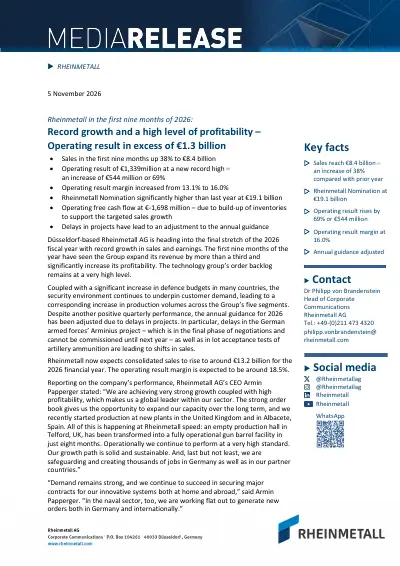
Our third quarter 2026 delivered again very satisfactory financials. Our top line grew year-on-year by 36% to more than €3.1 billion.
The operating result increased by 62%, resulting from our positive operating leverage effect. The operating result margin in the third quarter even exceeded that of the second quarter and came in at 17.5%.
That is a very impressive improvement of 270 basis points year-on-year. Our operating free cash flow improved significantly compared to the second quarter and was only marginally negative at -€82 million.
Unfortunately, we did not receive some of the advance payments for the Romanian package until early October. That would have pushed cash flow into the positive range.
At the end of September, the Rheinmetall backlog was, with €78 billion, on a similar level as at the end of our second quarter. I will elaborate on this a little bit later.
CapEx spending was at 7.1% of sales and in line with the adjusted level that we announced as part of our Q2 communication. We continue with our expansion strategy and important projects like the UK gun hall and the Albacete medium-caliber production saw their recent opening.
Lastly, we continue to see very strong interest on the job market. Until the end of September, we received more than 250,000 CVs worldwide.
It shows that the defense industry and Rheinmetall in particular are seen as highly attractive employers. We are very confident that we will be able to hire all the talents that we need to achieve our ambitious growth path going forward.
Allow me now to walk you through some of our operational highlights on page 4. If we look at what happened in the third quarter, there are some projects that really stood out.
Let's start with the United States. We successfully began handing over the first of eight XM30 prototypes to the US Army.
These vehicles will undergo rigorous customer testing with a formal decision or clear indication expected in 2027. Based on the positive feedback received to date, we remain optimistic regarding our chance of winning this tender for 3,000 infantry fighting vehicles with a total program value of around $45 billion.
Furthermore, we expanded our engagement with the US Armed Forces. The US Marine Corps selected our autonomous Mission Master SP platform for testing.
We have successfully delivered 12 of these unmanned ground vehicles under this contract. While modest in initial value at just over $7 million, this deployment serves as an invaluable operational reference and underscores the promising ramp-up in demand we foresee ahead for our autonomous systems in key allied markets.
Next up, Germany and the Netherlands exercised an option for 69 additional Jackal infantry fighting vehicles on top of the existing contract for 222 placed in 2025. On the space front, we started the production of the first SAR satellites together with ICEYE at our converted site in [Minois?]
. The targeted production run rate is several dozen satellites per year as we continue to see strong demand for the SAR technology.
On top of that, with fulfilling the initial operational capability, we reached a key milestone in the new SPOCK 1 satellite program for the German army in October. For ammunition, we booked a significant contract for 155 from an international customer in the low triple-digit million euro range.
Our capacity expansions for weapon and ammunition are well on track. Just last month, our subsidiary Rheinmetall Expal Munitions successfully commissioned our new, highly automated medium-caliber production facility in Albacete, Spain.
With a targeted annual capacity of roughly 3 million components, covering projectiles and cartridge cases from 20 to 35, this facility marks another key milestone under our group-wide firepower project. Financially and operationally, this project underscores our disciplined capital allocation.
We invested around €20 million with a short time-to-market execution while expanding the local workforce by nearly a third from 210 to 300 employees. It directly supports our long-term targets to reach 4 million rounds of medium-caliber capacity by 2030.
Turning to our naval systems division, we are seeing continued strong momentum and customer trust, underscored by recent high-level announcements. During the keel-laying ceremony for the third Type 424 class fleet service vessel at our Peene shipyard in Wolgast, the German Defense Minister Boris Pistorius announced the government's intention to order a fourth signals intelligence vessel before the close of the year.
This prospective order reinforces our long-term partnership with the German Navy and provides good visibility into our future order intake and backlog within our naval portfolio. Building upon this momentum and expanding our international maritime footprint, I'm also pleased to report that Rheinmetall, together with our partner MSC, has successfully secured the bid to acquire the Mangalia shipyard in Romania.
With a joint purchase price of €138 million, this strategic acquisition establishes a robust dual-use production hub for both civil and military shipbuilding in Southeast Europe. Beyond expanding our industrial capacity, the Mangalia site will play a pivotal execution role directly supporting the delivery of four recently commissioned naval vessels for the Romanian government, including offshore patrol and dive support vessels, while creating a scalable foundation for future defense programs in the region.
All in all, Q3 reflected meaningful operational progress as well as our disciplined performance in execution. Ladies and gentlemen, let me dive into the financials.
Looking at the performance across our five segments, we are seeing a very strong operating leverage across all segments, with air defense and weapon and ammunition leading the way. Vehicle systems sales increased by 9.6% to nearly €1.5 billion.
This increase was mainly driven by a high sales share of logistical vehicles to the German customer. In addition, our service business and sales from tactical vehicles contributed positively.
The operating result margin improved to 13.0% year-on-year due to more favorable product mix effects. In the weapon and ammunition segment, we have seen a continued strong demand and robust revenue growth of 37%.
The operating profit margin remained at a high level of 22.9%. A key factor here was the change in the product mix due to a significantly higher growth in the direct fire segment, coupled with the expected ramp-up costs for the expansion of our new plants, as well as headwinds from currency and derivatives.
In the air defense segment, we saw excellent operational performance with a significant increase in turnover of around €100 million. The main drivers of this growth were sales to the MENA region and Western Europe.
Earnings benefited from public funding in the area of research and development. The segment thus demonstrated strong scalability whilst maintaining disciplined cost management.
Digital systems sales were up by 39% to €509 million. Here, the main contributors were TaWan and the further ramp-up of the F-35 fuselage production, which pushed the operating margin to 10.7%, an increase of 1.5 percentage points.
Naval systems sales came in at €345 million. The main drivers here were the contracts with Germany on a fleet service vessel, the corvette K130, as well as the repair and service business.
The operating result reached €38 million, which resulted in an operating margin of 11.1%. To wrap up the segment view, sales in our non-divisional consolidation line showed an increase from -€243 to -€374 million as inter-segment sales intensified.
The operating result from the non-divisional consolidation line improved to -€8 million due to the positive contribution from at-equity investments. Let's turn to page 7.
When we look at our Rheinmetall nomination in Q3, we see a slight decline compared to prior year. This is mainly because, as was the case over the last years, we expect to receive the majority of our orders in the final quarter of the year.
The Rheinmetall nomination for the third quarter was €2.9 billion. One point that really stood out was a lion's share of the Rheinmetall nomination figure was attributable to fixed order intakes.
The main orders were the previously mentioned Jackal/Bokser for Germany and the Netherlands, the GCAP modular camp for the German brigade in Lithuania, and an artillery ammunition order for an international customer. At the end of September, the Rheinmetall backlog rose by 38% compared to the previous year and came in at €78 billion with a 70% fixed order share, up from 58%.
This figure is reflecting the adjustment of the F126 contract of €2.1 billion that we already reported during our Q2 call. Let's move on to page 8 for a detailed look at our cash flow and working capital development.
The operating free cash flow and working capital developments reflect our preparations for a strong year-end rally. Working capital continued to rise and was nearly €2.2 billion at the end of Q3.
Here, weapon and ammunition and air defense account for most of the increase in working capital. With order and delivery momentum increasing, we expect this to reverse in the fourth quarter.
The Q3 operating free cash flow figure came in at -€82 million. This figure included customer prepayments from orders that we signed in the second quarter.
Unfortunately, we did not receive part of the advance payments for the Romanian package until early October. Had we been able to recognize this advance payment in third quarter, cash flow would have been positive.
Following our CapEx plan for 2026, the Q3 CapEx is in absolute terms on previous year level. Let's move to page 9.
We successfully renewed our syndicated credit facility ahead of schedule and doubled its size from €750 million to €1.5 billion. This additional financial flexibility supports our continued growth trajectory and further strengthens our financial position following the successful bond issue in May of this year.
At the end of September, the net financial position totaled -€2.9 billion and the equity ratio was at 28.3%. As said before, we revised our 2026 full-year guidance.
Previously, sales were expected to range between €13.7 and €14.2 billion. Following likely postponements for the signing of the Arminius Boxer project as well as in acceptance tests for 155 ammunition, we are now expecting to reach a sales level of around €13.2 billion.
Hence, our operating margin is expected to adjust by 50 basis points to 18.5%, which is on prior-year level and still leading among the European primes. On the cash flow side, we are now guiding to a positive operating free cash flow after previously expecting a cash flow conversion rate of at least 40%.
This updated guidance does not include any prepayments from the Arminius program. Ladies and gentlemen, that wraps up my presentation for today.
Many thanks for your kind attention. Let me now open up the floor for our Q&A session.
Operator
We will now begin the question and answer session. Anyone who wishes to ask a question may press star and 1 on their touchtone telephone.
You'll hear a tone to confirm that you have entered the queue. If you wish to remove yourself from the question queue, you may press star and then 2.
Participants are requested to only use handsets while asking a question. In the interest of time, please limit yourself to two questions at a time.
Anyone who has a question may press star 1 at this time. Our first question comes from Alessandro Pozzi, Mediobanca.
Please go ahead.
Alessandro Pozzi
Hi there. My first question is about, more broadly, on guidance in general.
We all appreciate that you guys are going much faster than almost anyone else of your size, and it is going to be always difficult to provide precise guidance on revenues, also given the lumpiness of some of your revenues as well. When you look back at 2026, of course, you've changed guidance twice now.
Do you think it's just one-offs or do you think that there is a need to be a bit more conservative with the guidance going forward? I'm thinking about when you go out eventually with the 2027 and whether you need to have more contingencies there or it's just the nature of the business that makes revenues more unpredictable.
Then, if you can give us maybe an update on where we are with regards to any target for backlog and timing also of the Boxer contract, when you expect to have that finalized, whether it's going to be in the first part of Q1 or it's going to be later on next year? Thank you.
Klaus Neumann
Okay. Thank you for your questions.
Let's start with the guidance. The adjustment that we announced in July this year was definitely a one-off event.
The customer basically not continuing with one of the biggest naval programs in its history is a really unusual event and that's something we definitely did not foresee. The situation at the end of 2026 now is somewhat different.
We have the delay or the likely delay of the signing of the Arminius contract. I will come back to the situation a little bit later.
Then the issue with basically final approval and acceptance of already produced ammunition lots. As of today, we don't see that this will all happen or it's still in 2026, and for that reason, we had to adjust the 2026 guidance.
It does not change that we have produced it, that we have the orders, it's just that we will not, from today's perspective, be able to deliver and recognize the associated revenue. Regarding the update going forward, I will have to ask your patience.
We will communicate more guidance on the 2027 and future years during our Capital Markets Day later this year. Today is not the time to basically be more specific for those years.
Concerning the Arminius contract, our team is currently in final negotiations with the customer. The customer has decided to go through in a phase of price audits and challenge the calculation in detail.
This may take, and is likely to take, longer than would allow an approval by the German Bundestag by the end of this year. As of today, we expect that it will be pushed into the fourth quarter.
Alessandro Pozzi
Into the fourth quarter of—
Klaus Neumann
First quarter 2027.
Alessandro Pozzi
First quarter 2027, yeah. I think my first question on guidance was, I was not really looking forward for the '27 guidance, but whether maybe there is a change in the way you are approaching the guidance and perhaps you will provide maybe a guidance with more contingencies to flag the fact that some revenues can sleep between quarters and between years as well?
Klaus Neumann
The guidance that we provide for 2026 is our best assessment as of today for what we can achieve this year. In terms of basically generally adjustment, I wouldn't say that that is different in a way than guidance we provided before.
What we are trying to do is to basically, when we see that things have significantly changed to guidance before, that we update the market as soon as possible.
Alessandro Pozzi
Okay. On Q4 revenues, is there any element that potentially could sleep into Q1 on the new guidance?
Klaus Neumann
You are rightly highlighting that we are in a situation with some lumpy businesses and some lumpy deliveries. The guidance that we provide basically it has evaluated all the risks and opportunities that we still have for the end of the year and gives you the best midpoint that we currently have.
Alessandro Pozzi
All right. Thank you very much.
Operator
The next question comes from Sam Burgess, Goldman Sachs. Please go ahead.
Sam Burgess
Thanks very much for taking the question. Good afternoon.
Klaus Neumann
Can you just help us
Sam Burgess
Can you just help us split the €500 million reduction in weapons and ammunition sales guidance between that artillery acceptance delay, Destinus, or any other factors, just help us get a sense of the the the moving parts there? On the artillery ammunition acceptance, just to be clear for investors, is this an existing contract that has had a timing issue rather than a delay to a government call-off?
That would be very helpful to know, thank you.
Klaus Neumann
Yeah. No, and thank you for the question.
Let's start with the second question. It's not in relation to any delay in call-offs.
It's all in relation to existing contracts. What is happening, and I think maybe this is an important tool to explain, we are building up new facilities and we are ramping up production at several sites.
That also impacts the way we basically structure our supply chain. The customer has now asked us to go through more rigorous testing, depending on the structure of each individual basically supply chain going into a single lot.
That is now taking more time than anticipated and is also somewhat limited due to limited availability on the customer side of doing this kind of tests. It's really just a timing issue, and the production for the products has already happened, but the acceptance and the final approval by the customer is what is still pending.
We are now assuming that for a significant amount, and this is in the three-digit range for artillery ammunition, this will be delayed into future periods. This is also one part of the answer to your first question.
Destinus, we did anticipate revenues in the lower three-digit range as a potential, and that is as of today also definitely not happening in 2026, as discussions have not yet reached a stage where we can basically take and execute orders. Then there are some other issues that we otherwise would have been able to compensate, but basically the mix of all the different elements together forced us to reduce the guidance for 2026.
Sam Burgess
Okay. Thank you, that's very helpful.
If I could just have one quick follow-up on the ammunition timing points. Does this higher threshold for government certification or acceptance have implications for next year or the year after, or is it something you expect to be able to address?
Klaus Neumann
No, this is now basically quite an intense process because we are starting new production sites in new ways of production. The tests by the customer are at the moment all more rigorous than it will be in the future once production has stabilized.
Sam Burgess
Understood. Thank you very much, that's very helpful.
Operator
The next question comes from the line of Sebastian Growe, BNP Paribas. Please go ahead.
Sebastian Growe
Yeah. Hi, Klaus.
Hi, Dirk. Thanks for taking my questions.
The first one is a quick follow-up to the sales guidance question, and firstly, on the artillery ammunition. From your earlier comments, I would take that it's fair to assume we can add that very sort of slippage back to '27, right?
Similarly here for the Arminius-related PoC revenue delays, is there any risk of a spillover to outer years? Then I have one more on free cash flow, please.
Klaus Neumann
I will not comment specifically on 2027. I think this is a discussion we will have later this month.
It's important that this is all, in terms of the artillery, it is contracts that we already have, that we're in the process of execution. In terms of Arminius, yeah, the situation is that we basically pre-ordered and started production or preparatory works for the program, basically relying, as we've done with some limited contracts in the past, on basically the customer executing the order.
Technically, that will basically then be revenue in 2027, but in terms of giving a total number for 2027 and future years, I will need to ask you to be patient for our Capital Markets Day.
Sebastian Growe
Okay. Let's move on to free cash flow then.
You still see, apparently, a free cash flow positive in '26, so that would require €10 billion or more in the fourth quarter. At the same time, as has been said before, you're no longer providing an order intake bridge, given the importance of down payments to achieve the target, I was hoping for at least a bit more color around what you have baked into that bridge.
What are the working capital tailwinds that you would assume here, and how should we think about order wins and also CapEx in particular for the fourth quarter, please?
Klaus Neumann
The cash flow that we provide does not include the Arminius contract and any prepayment on that contract. I think that's quite clear.
We do see a lot of payments coming from contracts that are already in execution, it's some large level of payments for contracts that we already have. About overall, higher three-digit number we anticipate from contracts that we anticipate to sign in the fourth quarter.
As mentioned earlier, we did already receive a significant prepayment from the Romanian package of around €150 million that is not included in the cash flow as of the end of September. We did not provide a more detailed guidance or information for the end of the year because it will be difficult to really pinpoint it to the end of the year.
Some information on the contracts that we still see coming towards the end of the year, whether with prepayments or not, we're very optimistic on the signal intelligence boat that basically the German Defense Minister himself basically wants to push through this year, as he has commented publicly. We are working on an additional order for trucks and some Boxer programs for European countries.
There's a number of larger programs, but the cash flow does not to a large extent depend on new contracts.
Sebastian Growe
Understood. Finally, can you just quickly say something around CapEx, how to think about this particularly with quarter 4?
Klaus Neumann
We have updated our cash flow guidance in July during our Q2 call. As of today, we don't see any change to that guidance, above €1 billion for the full year.
Sebastian Growe
All right, thank you.
Operator
The next question comes from Sven Weier, UBS. Please go ahead.
Sven Weier
Good afternoon. I have two questions, please.
I'll ask them one at a time. The first one is just coming back to Destinus.
Obviously, the company has now teamed up also with Helsing, and I was just wondering how you see the future of the joint venture with Destinus. Is this still going concern, or should we kind of not assume this JV to go ahead anymore?
Klaus Neumann
No, yeah, you're absolutely right. Destinus has now set up arrangements with Helsing.
This is one of the reasons why basically conversations we still have with Destinus have not resulted in any concrete agreement. Those discussions continue.
Obviously, with this situation, we can be less certain that it will come into fruition than before, but it is not finally decided where it's going.
Sven Weier
The other question I had was just coming back to the first question on your guidance approach, right? Because I guess we've now seen in quite a number of years that there are always delays, mostly customer-induced, and some eventualities there.
Isn't that a lesson learned for you in terms of how you approach guidance in general to make a bigger kind of safety discount when you guide? Regarding the 2030 targets, at the moment, you have a point value target of €45 billion organic.
Would it not make sense to have a range and suppliers also with the building blocks of this guidance, what you need in terms of projects to get there? Should we expect something along these lines from the CMD?
Klaus Neumann
For the CMD, definitely, yeah. We basically have heard this feedback on several occasions, and I fully understand it.
It will be one key part of the presentation to explain not just what the number is, but also how we want to get there, yeah, to really the building blocks as you mentioned. In terms of 2026, I can only say I don't want to have another profit warning this year or next year, this is really the best assumptions that we currently have based on all the opportunities and risks that we see.
Sven Weier
Because you would probably also agree that things like on the ammunition side can always happen without this having a greater meaning whether Germany still wants to buy ammo or not. I guess if you build in contingencies from the outset, we don't need to have this discussion, I guess.
Klaus Neumann
Yeah. The guidance that we presented earlier this year was also based on production programs and production schedules, contracts that we had already booked and some that we were anticipating to sign during the year.
There is a situation for 2026 that, unfortunately, two extremely big programs did either not come like F126 or are now likely to be delayed as Arminius, and that then has an impact that we did not plan ahead for. Maybe going forward, that's something to think about how to deal with such big events, how to also in terms of the guidance, but that's what happened this year.
As of today, the information we provide is to our best knowledge.
Sven Weier
I guess the shortage on staff on the client is also something that happened on the truck side, it seems that German customer isn't growing as fast on the staff side as you guys.
Klaus Neumann
That is also one issue that basically increased production and basically increased deliveries to customers also hitting limits on the acceptance side of the customer. I think while for trucks, it is an ongoing issue, here as I explained earlier, it's driven by the one-time ramp-up of new production facilities that also come with basically a broader supply chain than what we had in the past.
All basically happening in a short period of time. I think that kind of issue will not appear again in future years.
Sven Weier
Understood. Thank you, Klaus.
Klaus Neumann
You're welcome.
Operator
The next question comes from the line of George McWhirter, Berenberg. Please go ahead.
George McWhirter
Good afternoon. Thank you very much for taking my questions.
I've got two, please. I may have missed it.
Can you please outline what you expect on the ammunition contracts in Q4? For instance, on the medium-caliber, smart ammunition, and artillery ammunition.
The second question is on the newer parts of your business. Can you just give an outline on how these are progressing more broadly, apart from Destinus?
For instance, the Lockheed Martin joint venture and the space partnerships. Thank you.
Klaus Neumann
Yeah. In terms of ammunition, I assume that you're referring to order intake.
We still are in discussions and have put out offers to the German customer and other countries for all different kinds of ammunition types, including smart, medium-caliber, and artillery. We won't go into more detail about the size and the scale and the timing of these contracts.
These contracts do not significantly that we have not yet signed impact significantly any results for 2026. In terms of rockets and rocket artillery cooperation with Destinus and Lockheed Martin, I explained that in terms of Destinus the discussions are continuing, but have not resulted in either a go or no-go final decision.
In terms of Lockheed Martin, discussions are also progressing and are continuing, but we are not in the stage to make any more detailed announcements.
George McWhirter
Thank you very much.
Operator
The next question comes from the line of Sash Tusa, Agency Partners. Please go ahead.
Sash Tusa
Oh, thank you very much, indeed. I'd just like to follow up on the delayed artillery lots, just to make sure that we understand.
Have you been mixing supplies from different suppliers, maybe of powder or explosives or fuzes, into the same lots for delivery to your customers? Or is the customers' worry more that you have had a quality escape and that they can't—
Klaus Neumann
I can explain that. We have not mixed lots, but now we are basically producing more lots from the same facility because, as you mentioned, we are using basically material from different sites that go into the final product.
We're not mixing these products into a single lot, but we now have more lots coming out of the same facility, and that creates more work in their acceptance. Yeah?
Sash Tusa
Right. Thank you very much, indeed.
Klaus Neumann
You're welcome.
Operator
The next question comes from Marie Riggio, Morgan Stanley. Please go ahead.
Marie Riggio
Hi, Klaus. Thanks for taking my question.
The first one is on the Boxer contracts. You mentioned that basically you had a one €100 million cut linked to the Boxer contracts this year because you expected to recognize percentage of completion revenue if signed in December 2026.
Just doing basic math, and I reckon that it's not perfect, but is it fair to assume a run rate of €100 million revenue per month for '27, or probably just to frame it in a different way and taking a bare approach here, what could be the impact per month of delay from now? That's the first question on Boxer.
The second question is on your '26 backlog target, because until now, it's still above €100 billion. When we look at your nine months order intake, it would imply a Q4 above €25 billion.
Probably what's your level of confidence to achieve that, and what are the main contracts you expect to bridge the target? Thank you so much.
Klaus Neumann
Okay. I don't think that we will reach €100 billion order backlog by the end of the year without the Arminius contract suddenly, or against our current assumption, still being signed in 2026.
I mentioned earlier that we have some orders that also for the German customer that may also find it hard to be on the agenda for approval this year. That's why we're not providing more specific guidance, yeah?
We see a strong interest in our products. We have lots of discussions reaching the final stages, but without Arminius suddenly still being signed in 2026, we won't reach €100 billion.
Does that
Marie Riggio
Probably just a quick follow-up on this one before moving to the Boxer contract. The €100 billion included the Arminius, without that, let us assume a guidance between 85 or
Klaus Neumann
80 to 85 is
Marie Riggio
okay? Yes, this is Correct.
So 80 to 85. Thank you.
Klaus Neumann
The 100 Correct. That always included some part of the Arminius contract.
In terms of the Boxer, yeah, it's the rate that you consider is in terms of scale, it's makes sense because we are in the ramp-up phase. We started acquiring and procuring products, and also started preparatory work so that we could achieve the deadlines and timelines that the customer is still requesting.
That we would have been able, given upon signing the contract, really starting bringing this into production, and achieving a lower three-digit million revenue before the end of the year. That requires, obviously, a contract being signed, and not being signed on the last day, but at least a few weeks before the year-end.
That now seems unlikely to happen.
Marie Riggio
Just to confirm, you said that the scale of basically lower triple-digit per month, it's quite a fair assumption?
Klaus Neumann
For the Boxer. The rough size is makes sense because deliveries, real final deliveries at scale would only start in 2028.
Marie Riggio
Going forward in 2027. In 2027, assuming a lower triple-digit revenue per month, it's probably right assumption, just to confirm that I understood correctly.
Klaus Neumann
We never really provided it in more detail, but I think, in terms of when to model it, it's not too far off.
Marie Riggio
Perfect. Amazing.
Thank you so much, Klaus. You're
Klaus Neumann
welcome.
Operator
The next question comes from Afonso Osório, Barclays. Please go ahead.
Afonso Osório
Klaus, hi. Thank you for your time.
Can I just follow up on this margin guide, please? Looking at the implied guidance for Q4, it looks like vehicles margin is lower sequentially and also versus last year.
If you look at the recent track record, margin has been going up sequentially and year-over-year in all the quarters this year. Just wondering if there is any particular reason for that Q4 dip.
Then the second quick one is on air defense as well on margin. Were there some one-off benefits in Q3 that we should know?
I think the new guide implied margin being lower again year-over-year in air defense, I think it's quite unlikely, just curious to hear your thoughts. Thank you.
Klaus Neumann
Yeah. Let's start with air defense.
We did increase the guidance for air defense on revenue, but not yet on profitability. We will see whether there is some potential to basically be more on the upper end of the implied range.
In Q3, we did see support from basically R&D programs that we have signed with the Italian government, and that provided an additional benefit to profitability. That is not a program that is consistent over time, whether it will provide the same benefit in Q4, we don't yet know for certain.
Afonso Osório
Now that a quick follow-up, if I have you on the line.
Klaus Neumann
The benefit, I think maybe that helps, it's in the range of €10 million.
Afonso Osório
Okay. Euros.
That's super helpful. Thank you, Klaus.
One final one for me, if I can. I know it's still price negotiations and all is still going through for the Boxer next year, but can you comment more broadly on the articles in the press talking about €20 billion fixed price for this Boxer contract initially, of which €10 billion roughly go to you?
That's below what you said previously. Is there any comment you can tell us at this point on that?
Klaus Neumann
I can tell you as much that the €20 billion is not evenly split between KNDS and Rheinmetall. We would get a larger share.
Afonso Osório
Perfect. Thank you so much, Klaus.
Operator
The next question comes from Christoph Laskawi, Deutsche Bank. Please go ahead.
Christoph Laskawi
Good afternoon, thank you for taking my questions. Two follow-ups only, really.
The first one on the lot acceptance tests, and sorry to come back to that, is this relating to several customers or essentially one? Just wondering because if it's only one, then once it's resolved, you could obviously generate the revenues quite quickly.
If it's several, that might spread over a couple of quarters. Then just on your comment that Germany basically moved to more detailed price analysis or pricing checks on the Boxer, do you see this as general behavior of the customer also on other contracts, which slows down the approval and signing, or is this basically because it could be the largest contract they will ever sign, or at least to date, and it's more specific to this one contract?
Yeah.
Klaus Neumann
Let me comment first on the second question. Now, the one key element, it's the biggest contract that they basically have ever awarded for the army.
There is more scrutiny, and we always expected that there would be more scrutiny on the contract. What we also see, and whether that is important here, we don't know, is that the customer is now looking more at value for money, and he wants to be certain that he gets a good product and at the right price.
That's what's happening. I think the main driver is definitely that it's the largest program that is being negotiated.
The other point, in terms of the lots, it is mostly one customer, but it's, as I explained earlier, the several lots due to basically different structure of the supply chains going into the final product. That basically requires several acceptance tests, even if it's just one customer.
Christoph Laskawi
Could those be done relatively soon after one another, or does it generally require more preparation before one can follow the other? No,
Klaus Neumann
it depends on the availability of shooting ranges and staff and people on the customer side to basically be present and approve the testing. It is not that you can do everything on one day, even with the same customer, yeah.
Christoph Laskawi
Helpful, thank you very much.
Operator
The next question comes from the line of David Perry, JPMorgan. Please go ahead.
David Perry
Hi, Klaus. I'll ask three questions.
I'll ask three questions. If you don't want to answer them all, you can choose which one to drop.
Klaus Neumann
They're
David Perry
all a bit philosophical. The the first one, just curious about the overall relationship with the German government.
It's one customer, big customer, but lots of different contracts. I just wondered, philosophically, whether every contract is negotiated in isolation.
What I'm essentially asking is, does the conversation ever go like this: "Oh, offer us we'll pay this much for the Boxer, but we want you to charge us less for the ammunition." Or are these discussions always separate?
That That's the first question. The second Shall I
Klaus Neumann
Shall I let you answer that? I know from all I know that many customer contracts are negotiated by different departments at the procurement agency.
If further detail can be answered better by people who are really involved in sales. I'm in no position to give you more specific information on that.
David Perry
Okay. The second question is, I may have missed some, but based on all your announcements, I think you've announced 21 JVs since October '24.
I just wondered, roughly how many of these JVs are actually up and running? How many of them do you think might not get to fruition?
Are they a meaningful contribution to the guidance you gave us at the CMD last year?
Klaus Neumann
I don't have now the exact number, but the 21 joint ventures that you mentioned is a mix of different kinds of cooperations. Some is where we basically are in a fully consolidated working relationship where basically the former owner is still a minority shareholder, others are actual joint ventures and that are already in place, and others are basically in the process of being put into action.
Overall, yeah, one of the ones that basically contributes most significantly is basically the Blackned acquisition where they still have a joint venture partner in and we only earlier this year basically took over the majority, that contributes already significantly. We acquired Doking, as an example, in the summer, is still a joint venture company that is now starting to provide lower million numbers in terms of revenue, but we see great potential due to their capabilities in the autonomous vehicle area.
The biggest contribution by far is Blackned. The others are areas where they either are still in the build-up mode, yeah, for example, also the joint venture with ICEYE is only now starting to generate significant contributions, but they will provide technology and basically a foundation for the growth in coming years.
David Perry
Maybe you'll update us at the CMD. My last one, if I may, is this year now with the new guidance, if we take out the naval acquisition, your organic growth is probably 22%, last year it was 25.
As the companies get bigger, most companies struggle to have accelerating growth rates, it's just difficult. You've still got this guidance of 25% to 35% organic growth through to 2030.
Just given that customers will always want to inspect things, you're growing, you're diversifying, supply chains more complex, are you still comfortable with this framework of 25% to 35% organic growth over 5 years?
Klaus Neumann
I won't comment on that. I also beg your patience for the upcoming CMD for more clarity on our expectations for the years to come.
David Perry
All right. Thank you, Klaus, appreciate it.
Klaus Neumann
You're welcome.
Operator
The next question comes from the line of Benjamin Heelan, Bank of America. Please go ahead.
Benjamin Heelan
Yes, afternoon, Klaus. I hope you're well.
I had a couple, just to follow up. The first one on Arminius, there have been some comments, I think Armin made some comments in the past couple of months as well about changes in scope of the contract, and there've obviously been some news articles indicating lower pricing for Arminius.
Could you give us a bit of an update, where are you seeing the scope of the contract, and is that potentially one of the things that has caused the decision to be pushed to the right? That would be the first one.
Then the second one on this artillery slowdown, you've mentioned these increased supplier investigations, but similar to the comments that you made on Arminius where the customer is looking for more value for money, the question I have is, is the customer starting to look at artillery and discuss more value for money, and that's part of what these supplier assessments are about as well?
Klaus Neumann
No.
Benjamin Heelan
I
Klaus Neumann
can answer that quickly. The artillery is based on audited prices and agreed prices for long-term framework contracts, and the customer has always looked basically to structure them, make sure that he gets a good price.
That the delay that we talk about has nothing to do with scrutiny or new scrutiny on prices whatsoever. It's really down to basically the mechanics of getting the required testing done and that just takes more time than we anticipated.
Benjamin Heelan
Fine. Go on, sorry, Klaus, I'll follow up after.
Klaus Neumann
In terms of the Arminius contract, the discussion in terms of the scope that Armin hinted, it was mostly in terms of how to structure basically the options and additional packages that are part of the negotiations that do not relate to the main package that is being, as the fixed contract, the scope has over the last months changed only minimally, yeah, there's some fine-tuning. In terms of the pricing, whether that there are audits, whether there are some findings and some elements adjusting the final price, is something to wait until these negotiations have concluded.
Benjamin Heelan
One quick follow-up and then my third question. Back on artillery, the order momentum has slowed a lot in the last 12 months.
Could you talk a little bit about how you see the pipeline for artillery and what the kind of opportunity set is that you see today? Then my final question is coming back to a similar sort of question that David just asked, but my view of the JVs when they were being announced at the time was that it's a way of companies like Destinus or Lockheed, etc., leveraging Rheinmetall as a way to get in to Germany, and that's what a lot of the joint ventures were kind of engaged at.
Do you feel that part of the reason some of these joint ventures are taking a lot longer to materialize or just aren't materializing at all is that companies are getting opportunities to just sell into the German customer on their own, on a standalone basis? I was just wondering if you could comment on that angle.
Thank you.
Klaus Neumann
Let's start with the joint ventures. I don't see this being a driver for the delays, and in all these discussions, it's not just we basically are the people bringing into the market in Germany and just opening the door.
What we are offering in this context, well, is that, yeah, the partner brings in technology. We basically provide not just the access, but also the capability to produce and scale up production in Germany together with existing production and technological capabilities that we already have.
We don't see that it makes sense for many sides to basically say, okay, I go directly to the German customer and sell. I don't see that as a feasible alternative for most of these arrangements.
Benjamin Heelan
Okay. Then on the artillery pipeline?
Klaus Neumann
The artillery pipeline, we have long-term contracts or framework agreements for artillery with many customers in Germany and in Europe. What was correct that we would like to see faster drawdowns on the existing frameworks.
That's something that we are highlighting towards our German customer because the need to basically restock and procure the product is still there. Yeah?
It may not be at the same level as maybe 2 years ago, but it still is an intense need to restock and replenish inventory with the product that is still being used, yeah.
Benjamin Heelan
Very clear. Thank you, Klaus, appreciate it.
Operator
The next question comes from the line of Joe [unclear], Rothschild & Co. Please go ahead.
Joe Orchard
Good afternoon. Thank you for taking my question.
Klaus, I've got one about the acquisition of the shipyard in Romania. It seems that Damen is challenging the sale process and there'll be a court hearing about that in December.
My first question is that correct? Then the kind of the follow-up to that is I guess sort of why did you kind of decide to announce the acquisition publicly when there is still this legal process that needs to play out?
Klaus Neumann
Yes, there have been legal challenges, whether they will come to any it's a different matter. We don't see that they have a basis, but that's for Romanian legal institutions to decide.
We were not the first to announce the result. We basically acquired, or basically got the award in an auction, and the company who ran the auction announced the result basically the same day.
We basically followed in order to explain to the market why we entered into the process, why we acquired the business, and what we intend to do with it together with our partner.
Joe Orchard
Thank you.
Operator
The next question comes from the line of Rory Smith, OxCAP. Please go ahead.
Oh,
Rory Smith
afternoon, it's Rory from OxCAP. Thank you for taking my questions.
I've just got one, please, and it's related to David questions on the JVs. I guess what I'd like to know more of is what kind of processes and controls do you actually have in place when you sort of go out to do your diligence on some of these JVs and partnerships?
Because I've been to quite a lot of defense tech companies and to be rather blunt about it, they are all quite immature in terms of, or some of them certainly are, in terms of their own internal processes, manufacturing capabilities, etc., etc. Is there anything that you can tell us from the inside, things that we can't see that gives us a little bit more confidence around the kind of outlook for that kind of JV partnership piece on, I guess, maturity?
That would be really helpful, thank you.
Klaus Neumann
Yeah. Any acquisition or any joint venture is goes through a due diligence process on our side.
We look at all the different aspects: legal, production, technology, tax, all the different aspects before we enter any contract. In some cases, yeah, you're right, the level of maturity of the organization is not where we want Rheinmetall entities to be, but these entities may have technology or production capabilities, ideas that can benefit us.
For that reason, we factor in the cost to bring the organization to our standard into our business case before we decide.
Rory Smith
Thank you so much.
Klaus Neumann
You're welcome.
Operator
The next and last question for this call is a follow-up question from Sven Weier, UBS. Please go ahead.
Sven Weier
Sorry, just one quick follow-up on the Boxer, actually. What I was wondering because on the truck side, right, when we had the delays, I think you were still producing the trucks even before you had the official call-off.
Could we imagine you do the same with the Boxer, right, that's even before the official decision is being made that you start production, or would you definitely wait until you have the final order?
Klaus Neumann
Now, for contracts on armored vehicles, we generally do not start before we have the contract in production. What we sometimes do is to start procuring products if basically we are in the final stages of negotiations and we have to order components that we can use also for other programs.
In case of the Arminius contract, due to the kind of desired timeline of the customer, we went further than we would otherwise do for any other customer. That's why we basically were in the position to really generate progress upon directly after signing a contract for in 2026.
Now that it is likely that the signature of the contract is delayed, we will not be able to generate revenue from basically preparatory work that we have started.
Sven Weier
There's further work you do from here, I guess the number that you generate as a revenue once the contract is being signed is then bigger than what you would have had in 2026. Is that right?
Klaus Neumann
There's a limit of how much we will do without the contract, and that's something we have made quite clear to the customer. Yes, yeah, the work that we have already started doing our preparation work would basically add to the revenue we would otherwise generate on a run rate.
Sven Weier
Understood. Thank you, Klaus.
You're
Klaus Neumann
welcome.
Operator
Ladies and gentlemen, that was the last question. I would now like to turn the conference back over to CFO Klaus Neumann for any closing remarks.
Klaus Neumann
Ladies and gentlemen, thank you for joining our Q3 earnings call today. If you have any further questions or remarks, please get in touch with Dirk and his team.
Have a great day and I hope to see many of you at our Capital Markets Day in Hamburg later this month. Take care and goodbye.
Operator
Ladies and gentlemen, the conference is now over. Thank you for choosing Chorus Call and thank you for participating in the conference.
You may now disconnect your lines. Goodbye.