K+S AG
Q3 FY2026 · Earnings Call TranscriptNovember 10, 2026
Operator
Welcome to the K+S third quarter 2026 earnings call. I will now hand over to Julia from K+S for some technical notes.
Julia Bock
Ladies and gentlemen, also from my side, welcome to our call. We hope you've had a chance to read through our posted slides as well as our Q3 documents available on our website.
After the opening remarks by our CEO, Christian Meyer, we will jump directly into the Q&A session. Some technical notes as always.
Please refer to our disclaimer on page 2 of the presentation. Then, a note on data privacy.
Please be aware that the Teams session will be recorded, webcast, and be available as an audio replay on our homepage afterwards. People who ask a question in the Teams session should be clear that by switching on their camera and microphone, they agree to the recording and replay of video and audio sequences.
Now, I'd like to hand over to Christian Meyer for the opening remarks.
Christian Meyer
Thank you, Julia. Welcome from my side as well.
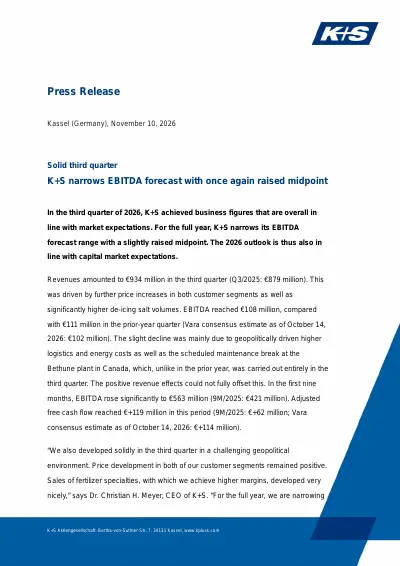
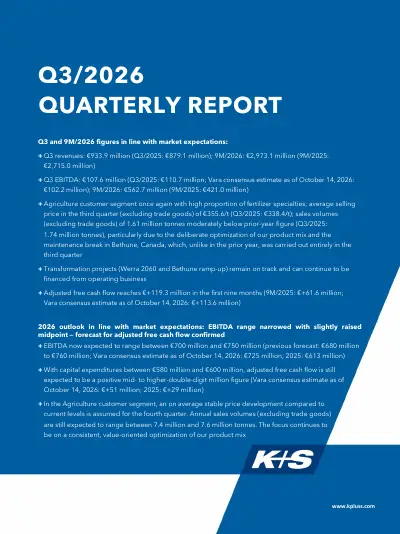
Let's start with the quarter. Our Q3 results are in line with market expectations.
EBITDA in our maintenance quarter, Q3, was at €108 million after €111 million in Q3 2025. On the one hand, revenues increased due to higher prices in both customer segments and a good de-icing salt pre-buying.
On the other hand, we had to face higher logistics and energy costs driven by geopolitical factors despite our continuous cost discipline. Additionally, we had our scheduled maintenance shutdown at our Bethune site in Canada, which unlike in the previous year, took place in the third quarter entirely.
Adjusted free cash flow reached €18 million in the quarter. As expected, it decreased versus last year's numbers due to higher CapEx.
Let's look to our full-year guidance. We got more precise on our 2026 EBITDA forecast and raised the midpoint slightly, which is in line with Vara consensus.
We now expect full-year EBITDA to range from €700 to €750 million compared to €680 to €760 million before. We increased the lower end by €20 million, as the demand scenario previously assumed for the lower end is losing relevance due to supply-side constraints in the global potash market.
At the same time, the upper end of the range has only been reduced by €10 million, as the previously anticipated potential increases in overseas prices has not materialized until now. The midpoint of the EBITDA range assumes an oil price of $100 per barrel for logistics costs, a gas price of €90 per megawatt hour, and an on-average stable potash price development compared to current levels in Q4.
As always, the final EBITDA within the range will depend on several factors. These include the winter weather in the fourth quarter, sales volumes, average selling prices in the agriculture customer segment, also with regard to FX developments, as well as gas and oil prices.
We confirmed our free cash flow guidance to reach a mid to higher double-digit million-euro amount with CapEx between €580 and €600 million, which is also in line with Vara consensus. After this brief introduction, I am now looking forward to answer your questions together with my colleague, Jens, and Julia.
With this, I hand over to the operator to start the Q&A session, and I also already see a lot of hands raised.
Operator
Thank you, Christian. At this time, we will conduct the question-and-answer session.
If you'd like to ask a question, please click the raise hand icon at the top of your screen to enter the queue. Once selected, please start by stating your full name and research house.
K+S would like to answer your question one by one. If you have multiple questions, please ask one question at a time, and K+S will answer it first.
After that, you will have the opportunity to ask further questions. Pausing here briefly for some questions.
Our first question comes from the line of Christian with Kepler. Christian, if you can ensure to unmute your line and announce again your name and your research house, please.
Christian Faitz
Yes, thank you. Good morning.
I hope everyone can hear me. Christian Faitz, Kepler Cheuvreux.
Good morning, Christian, Jens, Christian, Julia, and team. Two questions, please.
I'll start with the first one. Can you please elucidate a bit your expected costs into 2027/cost increases?
Jens Keuthen
Sure, Jens. As we have an elevated cost situation currently due to geopolitical influences, we assume that at least to some extent we will see it next year as well.
This is reflected with regard to freight costs. There you have to keep in mind that this is normally a fact that, yeah, is reflected by all competitors and so passed to the customers, to say.
Then with regard to energy costs, we have an elevated level even if you look at the forward rates, we have hedged 50%. I would say, the effect is to some kind limited.
Then if you look at our personal costs, just if you take the increases that we saw in the past, for instance 2%, that would be a low double-digit million euro amount. Then we could also have some elevated costs with regard to material.
With our current cost discipline, we try to counteract this as good as possible. As you are aware, we issue our guidance next year March, and then we will have more clarity on that.
Julia Bock
Just one addition to that, always keep in mind when you look at energy cost developments, Christian, that the US dollar was always moving in the other direction the last weeks, yeah, into the stronger direction, which definitely should help us then. Also if you look at 2027 numbers, don't forget that we go back to a normal winter, yeah.
We benefited in EBITDA this year quite nicely. Consensus has also baked that in, but just that everyone has heard it again.
Christian Faitz
Great. My second question is Bethune.
What is the current run rate of Bethune production annualized, and by when do you believe we can see an annual production of, let's say, 2.5 million tons or so with your 4 million goal?
Christian Meyer
Yeah. We are on a good way to our goal.
As we explain every year, step by step we increase our production volumes by round about 100 to 150,000 tons. Currently, we produce round about 2.3 million tons, and the total ramp-up is in time.
Also, we are also in budget, we are looking forward to step by step will be able to increase our volumes by 100 to 150,000 tons per annum.
Christian Faitz
By year-end '27, we would be at that 2.5 million tons or so roughly?
Christian Meyer
2.4, 2.5 round about, depending on the winter conditions for secondary mining.
Christian Faitz
Yeah. Thanks very much.
Very helpful, both.
Christian Meyer
Thanks, Christian.
Operator
Thank you, Christian, for your question. Our next question comes from the line of Michael.
Michael, if you can ensure your line is unmuted, and Michael is with ODDO.
Michael Schäfer
Thank you very much. Good morning, everyone.
Michael Schäfer from ODDO BHF. Two questions also from my end.
The first one, on the supply side, you briefly mentioned this in your prepared remarks. Your peers have been rather outspoken on the supply situation, and I wonder whether you can shed a bit more light on how you see basically global supply-demand evolving fourth quarter and then into next year, what kind of restrictions you see, and how we should think about kind of also underlying demand situation into '27 in the global potash market?
Christian Meyer
Yeah. Good morning, Michael.
What you hear in the market is that especially Russia and Belarus has reduced their production volumes due to repairs and maintenance. Then, due to the situation in the Black Sea, they have some logistical challenges, there are some volumes missing this year.
For the next year, step by step, we expect that they will come back to normal volumes. On the other hand, we still expect a strong demand also in the next year with a slight increase like we see nearly every year, an average of 1.5% to 2%.
The market situation will be pretty close to the current year, and we will expect especially in spring, due to the constraints that we see in Q4, a good demand in the spring season next year.
Michael Schäfer
Okay. Second one is on mix and specialties.
It has been a very strong mix year for you in '26, I guess. Obviously, we all know the reasons, and what we have seen though in the past couple of weeks with sulfur prices coming down.
How should we think about kind of your mix or your specialty products and pricing capabilities looking into '27?
Christian Meyer
We every time optimize our product mix based on the netbacks that we can realize with MOP or specialties. With regard to the specialties, for the others, you are very familiar with this, that we have magnesium and sulfur in our raw salt at our Werra site, we are able to produce SOP in a range between 700 and 900,000 tons depending on the SOP prices.
On the other hand, if we produce MOP, we have the sulfur-magnesium product kieserite. SOP and kieserite, they have really good netbacks currently.
SOP, we have pretty high premium of round about €350 a ton. Currently, we don't see that it will maybe become slightly down if there are some more sulfur in the market.
As long as the energy costs are pretty high, the other competitors that use the Mannheim process, they have to buy the sulfur on the one hand and it's very energy-intensive, their production, that will take some time that they will come back to normal volumes. Also with the next year, we are already in the mid of November, even if there's some kind of peace in the Near East, the production must ramp up again, so that the sulfur volumes will be not as fast back in the market as someone sometimes expects.
Michael Schäfer
Thank you very much.
Christian Meyer
You're welcome.
Operator
Thank you, Michael, for your question. Our next question comes from David.
David is from BNP Paribas. David, if you can please ensure that you announce again your name and your research house, and you may proceed.
David Symonds
Thanks for the opportunity to ask questions. It's David Symonds from BNP Paribas.
Can I ask on farmer buying behavior? There's a lot of focus on US crop prices in the press, but obviously European prices are still quite attractive for some crops, especially wheat, and that have opened some spreads up to the US.
Could you just talk about what you see in terms of farmer buying behavior in Europe?
Jens Keuthen
In the US?
Julia Bock
In Europe.
Jens Keuthen
In Europe, sorry. Yes, in Europe, we see also a good demand.
We expect that the level will be on the same level like in the pre-war situation. Europe is a little bit special that you see in a very short period really strong demand.
That was the same in this year, as we already announced in Q2. The affordability of the farmers, there are some challenges due to the input costs, but in general you see slightly higher ag commodity prices.
Also for the next year, we expect normal demand in Europe on the current level.
David Symonds
Thank you. Then, could you help us to bridge to your Q4 implied guidance, because at the top end, I think you'd be down year on year in EBITDA terms.
I'm not totally clear on why that is. It may be that there's some healthy conservatism baked into there.
I can see that the FX rate that you're using is quite a long way off the current rate, for example. Is there a big energy cost price coming in Q4 that explains that, or is it sort of true to form continued conservatism?
Jens Keuthen
Jens. I would say it's a mixture of all.
For our guidance, we have assumed €90 per megawatt hour, and you see the prices currently are fluctuating around this number. With regard to the costs, I would say we have elevated costs compared to last year's fourth quarter, and this is reflected.
Even if we have a slightly higher average price, we see cost headwinds also from the logistics side, from material side, and this taken all together leads to this guidance. This are our assumptions for the midpoint, and we will see how this turns out at the end.
David Symonds
Thank you.
Operator
Thank you, David, for your question. Our next question is from Tristan.
Tristan is from Deutsche Bank Security. If you can ensure to introduce again yourself, announcing your research house.
Tristan Lamotte
Hi, thanks. Tristan Lamotte from Deutsche Bank.
Two questions, please. Do one at a time.
The first one, I was interested to read the report where you said the price level remained attractive in the quarter. Could you maybe elaborate on what you mean by that and what that implies for your pricing outlook, maybe first?
Thanks.
Jens Keuthen
You address this to the fourth quarter and for the guidance for the rest of the year. We expect that the average sales price for potash should be on the current level, and then that's the assumption for the midpoint.
If we are higher or lower, then could effect that we will be up or down compared to the midpoint.
Tristan Lamotte
Sorry, just to clarify that, the phrasing says the price level remained attractive. I think it was a comment on Q3.
Julia Bock
The price level for what remains attractive?
Tristan Lamotte
For ag. For ag?
Julia Bock
I think it is probably with regards to the agriculture prices like wheat and corn. I don't know which phrase you are referring to, but to make it clear again, we assume stable prices on average compared to current levels.
Not the Q3 ASP, but compared to current levels and on average. That is important because, for example, the last time when we said that, we saw a decrease in prices in Brazil, but we saw increasing prices in specialties.
On average, we saw a stable price level, and this is what we also assume from today onwards in Q4.
Tristan Lamotte
Thanks a lot. Then maybe second question, I was wondering if you could just run through the current inventory level that you see in the key regions.
I think I saw that some of the inventories are quite high, but maybe you could elaborate on that. Thanks.
Jens Keuthen
You address the inventory levels, port stocks in China, they are currently on the level of round about 4.5 million tons, coming a little bit down currently. That was the last information that was presented to the market.
We still see a good demand, domestic demand in China, and some lower domestic production due to the challenges with the Salt Lake that we have in China. That's more or less in line that they have a higher stock at the ports.
The demand now will start in the domestic area in China in the wintertime. With regard to Brazil, there you have to differentiate between the port stocks and along the, yeah, logistical channel to the farmer.
In the ports, it's a little bit higher. In the domestic market, a little bit lower.
What we already saw, that in October in Brazil, there was an increase of the imports compared to last year of 20%. Finally, this reflects that we still are, with our assumptions, it's in line that we still expect a record import for the total year in Brazil.
In the other areas globally, we expect more or less normal levels.
Tristan Lamotte
Got it. Thank you.
Jens Keuthen
You're welcome.
Operator
Thank you, Tristan, for your question. Our next question comes from Angelina.
Angelina is from J.P. Morgan Security.
If you can ensure you reintroduce yourself to the team, and you may proceed.
Angelina Glazova
Good morning. Thank you very much for taking my questions.
This is Angelina Glazova from J.P. Morgan.
I have two questions. The first one, I wanted to ask is on SOP prices and outlook.
What we saw earlier this quarter is another increase at the beginning of the quarter, and you have given us some comments during this call already that the sulfur supply from the Middle East may not return to the market as quickly, even if we have the conflict concluding. At the same time, already, are seeing that the sulfur price benchmarks have started to correct.
Do you think that we could see another increase in SOP prices in Europe, or because of the fact that sulfur prices are already correcting, that this may not be the case?
Christian Meyer
You should keep in mind that we have currently a more or less record premium for SOP of €350 per ton. As you just mentioned, there the sulfur prices are coming down a little bit, but we still think that the current level will last a little bit longer as the production of sulfur has to start, the challenges that the Mannheim process producers have to finally get the sulfur to their production sites, still facing high energy cost, and then we will see when energy cost and the sulfur prices come down a little bit more, then that will be reflected.
Currently, we are very happy with the situation. Even if we are not producing SOP, we still have our kieserite, our sulfur-magnesium product, and there we have also a good netbacks currently.
Angelina Glazova
Right, thank you. My second question is on Industry+, and specifically the de-icing business.
We saw a slight increase in the volume guidance after Q3, suggesting that the trends were quite good in the third quarter. I wonder how you're thinking about further developments maybe into 2027 as well, because the results on that business through the whole period of 9 months this year have been quite good and above seasonal.
I understand that you have already said we should expect some normalization next year, but my question is more as to whether it should be just returning to normal levels or maybe even correcting slightly below that. Are you convinced still that there is no excessive inventory build?
I remember in the second quarter when we discussed this, you were quite clear, you don't think this is the case. Do you still think that, and why is that?
Christian Meyer
As everybody is aware, we had a real strong winter in Q1, lasting until March. Now, there's a refill of our customers, but they're not building up a lot of inventories, also due to their financial challenges.
They are just building up that they are back on normal levels. They are also calculating this normal winters, and we don't see a build-up of inventories at our customer sites.
That's the basis why we think if the winter is normal, then there should be a normal demand. Currently, we have at least 2.7 million tons for the current year.
For the next year, if you calculate a normal winter, it's round about 2 million tons. We are expecting that will be at least 2 million tons in the normal winter conditions.
No
Angelina Glazova
build-up of inventories. Right, very clear.
Thank you very much.
Christian Meyer
You're welcome.
Operator
Thank you, Angelina, for your question. Our next question comes from the line of Setu at Barclays.
Setu, if you can please ensure to introduce yourself, and you may proceed.
Setu Sharda
Yeah. Hi, Setu Sharda from Barclays, and thanks for taking my questions.
I have two questions. The first one is on the agriculture volumes.
The Q3 agriculture volumes were 1.61 million tons and was partly reflecting your Bethune maintenance and value over volume management. What's required in Q4 to deliver the unchanged 7.4 to 7.6 million-ton guidance?
Should we expect the value over volume strategy to continue into 2027?
Christian Meyer
Yes, in Q4, we expect 1.9 million tons. You should keep in mind that Q3 is our maintenance quarter, so that's realistic that the volumes will increase in Q4.
In total, we expect, and that's our calculation, between 7.5 and 7.6 million tons.
Julia Bock
7.4 to 7.6.
Christian Meyer
Sorry, 7.4 to 7.6, midpoint 7.5. From our perspective, as of today, and the good demand that we see in the market, that's a good calculation.
Setu Sharda
Thank you. Again, going on the energy question, you have given a bit of reference there.
Higher energy and logistics costs were a material headwind in Q3. How much of that should we consider temporary geopolitical disruption versus anything higher structural cost base?
What is the potential benefit or headwind entering into 2027?
Jens Keuthen
Yeah. I think for the time being, it's kind of hard to estimate it for next year.
Just to give you some feeling for it, we have hedged 50% at, I would say, quite favorable price of below €40 per megawatt hour. The current forward course is around or between €50 and €60 per megawatt hour.
If you take that, then there could be a potential headwind of mid double-digit million-euro amount, more lower than higher, I would say. We will see how this turns out.
If there would be a ceasefire, would be peace, and everything comes back to normal, then with this spot price, we would definitely then profit from lower prices. For the fourth quarter, we see obviously the elevated costs.
We have fixed 70% at below €40, so that's good for us, it's on a good side. For the remainder, we have now the assumption of €90.
As I already explained, the values are where the current trading is around that figure, yeah?
Setu Sharda
Nice. That's really clear.
Julia Bock
For 2027, again, don't forget, if elevated energy costs, then probably also tailwinds from a strong US dollar.
Jens Keuthen
That is what at least we saw in the past, and so that's what should help us in the future. Makes sense.
Setu Sharda
Sure. Thank you.
Operator
Thank you, Setu, for your question. Our next question comes from Sebastian at Berenberg.
Sebastian, if you can please ensure to introduce yourself to the team, and you may now proceed.
Sebastian Bray
Hello, everybody, and thank you for taking my question. I'd have two, please.
The first is on the performance of the salt business and potential normalization in '27. I think team you had alluded to the fact that volumes are pretty good this year for de-icing.
Can I dissect that a bit further? Is there anything one-off or unusually helpful in nature on the pricing side as opposed to just the volumes?
Can you give any indication of how the K-Metica salt business has been performing year-to-date, is that going to be cheaper, quote-unquote, than the implied 25 EBITDA would suggest, i.e., better in '26? I'll pause there, and I'll ask my second question after that.
Yeah.
Christian Meyer
Welcome, Sebastian. As I already mentioned, for the next year, if we have a normal winter conditions, we also expect normal salt volumes.
We just see a refill due to the low inventory levels of our customers to be prepared for the winter. The German winter or the Northern European winter, the refill program is until end of November.
Sometimes you see some, yeah, de-icing needs on the streets in December, but the main winter time is in January, February. That finally will be refilled from our customers till the end of the year, and then we will see how the winter weather will be in the first quarter.
In total, we expect if we have a normal winter, there will be normal volumes, no additional refill nor any inventory stock that are built up. With regard to K-Metica, currently, the closing, we are still waiting for the closing, expecting in Q1.
The figures of the current year, we are not aware of the figures, but we had the figures for the last year that was the basis for the transaction and signing the contract. These figures that we published that we expect currently should be added to our salt business after the closing.
Sebastian Bray
That's helpful. The second question I had was on CapEx.
Is the group broadly comfortable with where consensus is sitting for '27, and what exactly is going to be completed and invested in the year as part of the efforts to improve the Werra site and the investments in the rest of the group?
Jens Keuthen
Yeah. You're talking already about 2027?
Sebastian Bray
Yes.
Jens Keuthen
Yeah. As we already or always mention is that as long as we are, yeah, busy with our two strategic projects, the ramp-up of Bethune and Werra 2060, we have this elevated CapEx.
The estimate for this year is between €580 and €600 million, and I think it's a fair assumption to have this also as a basis for next year. I think that is pretty close to the consensus, Julia, right?
A
Julia Bock
little bit above, but- A
Jens Keuthen
little bit above, but, yeah. Then after 2027, in 2028, CapEx should go down as we then have, yeah, really executed the Werra 2060 project.
Sebastian Bray
That's helpful. Thank you.
You're
Jens Keuthen
welcome.
Operator
Thank you, Sebastian, for your question. Our next question is a follow-up from David at BNP Paribas.
David,
David Symonds
you may proceed. Thanks very much.
Just two quick clarification questions. The first one, if we are restocking on salt until the end of November, is that accounted for in the guidance, as I would assume that puts you ahead of normal winter volumes?
No,
Christian Meyer
no. We expect a normal winter, but the restocking to refill the volumes, that's why we expect at least 2.7 million tons de-icing for this year.
That's reflected.
David Symonds
Understood. Then the second one, could you say how close you came to having to close the Werra production in Q3 given the river levels?
Julia Bock
No volume impact happened, luckily.
Christian Meyer
There were water temperatures of the Werra River, but we were able to solve the problem. What's very important, the water temperature of the Werra that we need for cooling down our production process, this problem won't be existing anymore after realizing Werra 2060.
David Symonds
That's clear. Thank you very much.
Christian Meyer
You're welcome.
Operator
Thank you, David, for your question. As a gentle reminder, ladies and gentlemen, if you'd like to ask a question, please click the raise hand icon at the top of your screen to enter the queue.
We'll pause here briefly for any additional questions.
Christian Meyer
Thanks for having your questions, and hope to see you soon. The first roadshow, you will start with Julia this week, and then we wish us a wonderful wintertime, a nice Christmas or winter holidays, good de-icing business, and but especially a peaceful time.
Thanks a lot.
Julia Bock
Thanks.
Operator
Thank you. This concludes today's call.
Thank you, everyone, and have a great day.