XPLR Infrastructure, LP
NNYSE:XIFRQ2 FY2026 · Earnings Call TranscriptJuly 28, 2026
Operator
Hello, and welcome to the XPLR Infrastructure Q2 2026 earnings webcast call. All lines have been placed on mute to prevent any background noise.
After the speakers' remarks, there will be a question-and-answer session. If you would like to ask a question during this time, simply press * followed by the number 1 on your telephone keypad.
If you would like to withdraw your question, simply press *1 again. I will now turn the conference over to Kang-Hee Zhang, Director of Investor Relations.
Please go ahead.
Kanghee Jeon
Good morning, everyone, and thank you for joining our second quarter 2026 financial results conference call for Explorer Infrastructure. With me this morning are Alan Liu, President and Chief Executive Officer of Explorer Infrastructure, and Jessica Geoffroy, Chief Financial Officer of Explorer Infrastructure.
Alan will walk through our business highlights, and Jessica will provide an overview of our financial results. After that, our executive team will be available to answer your questions.
On this call, we will be making forward-looking statements based on current expectations and assumptions, which are subject to risks and uncertainties. Actual results could differ materially from our forward-looking statements if any of our key assumptions are incorrect or because of other factors discussed in today's earnings news release, in the comments made during this conference call, in the risk factor section of the accompanying presentation, or in our latest reports and filings with the Securities and Exchange Commission, each of which can be found on our website, www.xplr-infrastructure.com.
We do not undertake any duty to update any forward-looking statements. Today's presentation also includes references to non-GAAP financial measures.
You should refer to the information contained in the slide accompanying today's presentation for definitional information and reconciliations of historical non-GAAP measures to the closest GAAP financial measure. With that, I'll turn the call over to Alan.
Alan Liu
Thank you, Kang-Hee. Good morning, everyone.
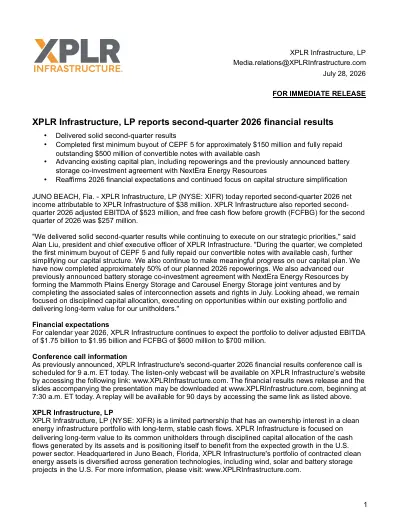
During the second quarter, the Explorer team continued to execute well and achieved key financial and operational objectives. On the financial front, Explorer completed the first minimum buyout of SEPIF 5 for approximately $150 million and fully repaid $500 million of convertible notes with available cash.
These actions serve to further simplify our capital structure and, through the SEPIF 5 buyout, increase our equity ownership in assets within the existing portfolio, all while maintaining balance sheet strength. The team also continued to make steady progress on the existing capital plan, starting with repowering.
Execution remains on track. To date, we have completed approximately 50% of our planned repowerings for 2026.
The remaining program is progressing as planned and is expected to enhance the long-term value of our portfolio. We are also advancing the previously announced battery storage and co-investment agreement with NextEra Energy Resources.
In July, we formed the Mammoth Plains Energy Storage and Carousel Energy Storage joint ventures and completed the associated sales of interconnection assets and rights. We believe these battery storage investments, enabled by our existing surplus interconnections and by NextEra Energy Resources' development expertise, will generate attractive returns and incremental long-term contracted cash flows.
With improvements in power market fundamentals, we continue to believe re-contracting could be a key driver of value enhancement for Explorer's portfolio over time. While we believe the majority of opportunities will come in the 2030s and beyond as legacy contracts expire, we are actively evaluating contract optimization opportunities where market conditions support value-enhancing outcomes.
In summary, we remain focused on strong execution and disciplined capital allocation to enhance financial and strategic flexibility as we seek to maximize the value of our portfolio. With that, let me turn it over to Jessica.
Jessica Geoffroy
Thank you, Alan, and good morning, everyone. Turning to our second quarter results, Explorer's portfolio generated approximately $523 million in adjusted EBITDA and $257 million in free cash flow before growth.
Second quarter results for existing projects were affected by approximately $42 million higher net operating expenses compared to the prior-year period, primarily driven by an approximately $45 million higher benefit in 2025 associated with certain vendor credits for unplanned O&M expenses. On a full-year basis, we anticipate total O&M expenses to be roughly $500 million, which is consistent with the historical average over the last few years.
These impacts were partially offset by improved year-over-year wind resource, which was approximately 102% of the long-term average compared to 97% in the prior-year period. Repowered assets continued to enhance generation and cash flow across the portfolio.
The second quarter results were also impacted by asset dispositions completed in 2025. For 2026, we continue to expect adjusted EBITDA of $1.75 to $1.95 billion and free cash flow before growth of $600 to $700 million.
As always, our expectations assume our usual caveats, including normal weather and operating conditions. That concludes our prepared remarks, and we will now open the line for questions.
Operator
Thank you. If you have a question, please press *1 on your telephone keypad.
If you wish to remove yourself from the queue, simply press *1 again. One moment, please, for your first question.
Your first question comes from the line of Nelson Ng of RBC Capital Markets. Your line is open.
Nelson Ng
Great, thanks, and good morning, everyone. The first question just relates to your first two battery storage projects.
I think Alan, you mentioned that the JVs are formed. When do you expect shovels to be on the ground for the first two projects?
Alan Liu
Sorry, Nelson, could you say that again? You cut out for a second.
Nelson Ng
Sorry. When do you expect construction to start on the first two battery storage projects?
Alan Liu
We would expect and anticipate earliest start is call it Q4 of this year, but work could start there and then it's, as we've mentioned before, mostly the construction activity is going to be in 2027.
Nelson Ng
Got it. Okay.
Then maybe a question for Jessica. The free cash flow before growth metric, are there any one-time items to call out in the quarter?
I just noticed that I think the contribution from existing facilities were a bit higher than last year. In that bridge you provide between adjusted EBITDA and free cash flow, there's less tax credits subtracted from EBITDA.
I'm not sure whether that's just something that we should just expect going forward.
Jessica Geoffroy
Hi. Good morning.
I wouldn't call it one-time, but what you should think about is the contribution from the repowered assets and the way that the tax credits are monetized as they're being generated from those assets. When I look at the quarter and I look at existing projects, I see that the repowering assets are delivering economics that are consistent with what we previously disclosed.
These are strong investments and they're delivering strong results. There are more repowerings in the portfolio this year than there were last year, and the tax credits for those new repowered assets are being monetized through transferability.
When you look at the free cash flow versus the adjusted EBITDA, adjusted EBITDA is also going to be impacted by the absence of higher tax credit amounts that were reflected in the prior-year period through tax equity structures that have since matured or been bought out. That's some of the dynamic you're seeing in the difference between the two metrics.
Nelson Ng
Thanks. Then just one last question.
In terms of you're roughly sitting on about $500 million of cash and I'm sure a lot of that are in reserves at the project level, but is the plan to potentially bring forward I think there's $470 million of minimum SEPIF buyouts for next year? Then I think you also have roughly $550 million of corporate debt that matures next year.
If you had the available capital, is one option that you're closely looking at is bringing that forward to this year and paying some of that down a bit earlier?
Alan Liu
Nelson, I'll address your question, this is Alan, in two parts. One is, as you look at that cash balance, you're correct, right?
A portion of that sits at the project level, normal course kind of project-level working capital accounts. There is a portion of that.
I would also remind you, right, we've got capital that we've already committed in terms of CapEx that would also have to be paid for in the second half of the year as well as additional CapEx. That will eat into that cash balance.
You've got to factor that into your calculation as you're looking at the balance sheet. If there is available cash and excess cash flow, would we pull ahead SEPIF buyouts or debt, that is your question.
We have a plan for SEPIFs and debt. The SEPIFs have certain buyout windows, and as we've explained before, think of them as a series of call options.
When the buyout window opens, we then have the ability to go exercise those call options. We've laid out the schedule in which we intend to or we would expect to buy out SEPIF 4, which is sometime next year.
With respect to debt, our plan is to refinance those notes at some point either early part of next year. If there is opportunities to pull ahead that refinancing, let's say the market window opens, we will certainly be open to that.
Sorry, I made a mistake. I said it was SEPIF 4, it's SEPIF 5 next year, not SEPIF 4.
Nelson Ng
Great. Thanks for the clarification, Alan.
I'll leave it there.
Operator
Your next question comes from the line of Mark Jarvi of CIBC Capital Markets. Your line is open.
Mark Jarvi
Thanks for taking the question. Just on the re-contracting opportunity, can you just sort of outline how much that's outbound efforts from your side, how much that is interest from the counterparties, and maybe just from the table sort of roughly the scope of megawatts that you're actively pursuing at this point?
Alan Liu
Hey, Mark. Just as a reminder, as we've said, the majority of our projects are under existing long-term contracts, right?
The contracts, bulk of them don't expire until you get into, call it, the early to mid-2030s and beyond. We would certainly anticipate that the majority of these conversations would happen, call it one or two years ahead of expiration of those contracts.
That leads us to saying, hey, sometime in the early 2030s bulk of those conversations are going to happen. Conversations today can be a combination, right?
Customers' demand and they're RFPs and things happening in the marketplace and us responding to it, as well as us actively engaging and thinking through other contracts extensions, other renegotiations of existing contracts that would be favorable to Explorer. They're relatively limited, but those are opportunities that we are certainly actively pursuing.
I'm not going to put those in terms of megawatt-hours given the commercial sensitivity around those activities today.
Mark Jarvi
Okay. Anything else you can update us in terms of opportunities, different things you can do on the SEPIFs?
Talked about SEPIF 3 before, now that you're doing the minimum buyout on SEPIF 5, is it assumed that this just kind of goes as planned or is there opportunities to work with the counterparties around different options?
Alan Liu
As we said, the investments contractually have certain buyout rights, right? We have call options that give us rights to buyout during certain windows.
Any deviation from that would require negotiations with the SEPIF investors. To do anything other than what we've laid out would require us to get to a point that would make sense for us holistically, right, both from the standpoint of we're doing it at a value point that makes sense and is accretive to what we've laid out already, but also from the perspective of us financing those buyouts in a way that makes sense given our existing balance sheet and our existing capital commitments.
Mark Jarvi
Are there any active dialogue going around different options at this point?
Alan Liu
We're always open to opportunities. I won't comment on that.
Mark Jarvi
Okay. Thanks for the time.
Operator
Again, if you have a question, please press *1 on your telephone keypad to join the queue. Your next question comes from the line of Christine Cho of Barclays.
Your line is open.
Christine Cho
For SEPIF decisions around buyout or flip, can you just remind us what the protocol is if you do decide to do a flip, just sort of what sort of notice do you need to give to the SEPIF owners? With the SEPIF payments usually being over multiple years, would the whole thing flip or just a portion if you decide to not buy out at the time of the first payment?
I guess how should we think about the long-term leverage goals for the company, maybe by 2030?
Alan Liu
Yep. I'll address the SEPIF question and then long-term leverage second.
With respect to the SEPIFs, as you recall, they are securities in which we hold the Class A interest in the partnership, right, the SEPIF partner holds the Class B. If there is a flip, the majority of the cash flows would flip to the partner, it's not just a portion.
Think about it as effectively if we don't exercise our buyout, right, any of the buyouts in the series, then the cash flows would flip to the SEPIF investor.
Christine Cho
Okay. Then the long-term leverage?
Alan Liu
Our anticipation and our goal is to continue to maintain our leverage levels as consistent with today and prudently operate this business. We've said before a lot of it depends on our contract profile and the cash flows that we're generating.
If there is ability to extend contracts, if there is ability to add to cash flows, then we would certainly feel comfortable with the leverage that we're at today.
Jessica Geoffroy
Christine, hi, it's Jessica. I would just add in our fourth quarter materials, we gave that picture through 2030 that I think you're asking for, in part to kind of be responsive to these conversations that we've had with you and others.
It shows, even though we're growing the portfolio, we're adding repowerings, we're adding storage, our leverage levels remain consistent from the year-end 2025 capital structure through 2030. That should give you an indicator of what we're managing toward.
Christine Cho
Great. Thank you.
Then just my last question. As you bring on these storage assets at Mammoth and Carousel, how should we think about the tenor of these contracts?
The accompanying wind assets have been on for more than 10 years. I think they were both repowered last year, and I'm not sure what the remaining contract life is on those.
Is there potential mismatch here with remaining life on wind contracts, there's only 5 years left on the wind and then the storage contract is something like 10 years? If so, is there a chance to re-contract the wind assets so they're aligned more properly?
How should we think about that, just especially as I would think that wind and storage together is worth more than each of those separately?
Alan Liu
I think you're thinking about it the right way. The tenor of the battery storage projects are quite long, and generally there's a desire to extend wind contracts as well to match.
Christine Cho
Great. Thank you so much.
Operator
Your next question comes from the line of Rue Jia of Mizuho. Your line is open.
Rue Jia
Hi, good morning. Thank you for taking my question.
Just a follow-up on the battery storage projects. Can you talk a bit more on how you're thinking about just the overall contracting structure of these assets, for example, your expectation on project-level return, and perhaps your thinking process when it comes to determining which interconnection assets will be marked for sale?
Thank you.
Alan Liu
With respect to returns, I think we've talked about it before. These are very attractive equity returns, at least double digit, very attractive from infrastructure perspective.
We haven't given exact percentages, but we find them very attractive. The interconnection sales, I think, was your second question.
Again, as we had agreed to with the battery storage JV that was announced previously, there is an agreement to work with NextEra Energy Resources to identify additional interconnections to be sold to help fully fund the equity contributions into the storage JV. We are working with Energy Resources.
I think the specific projects it depends on a number of factors. One obviously is the surplus interconnects are they in markets that have demand for development projects, right?
Are there viable projects there? Then ultimately the economics.
Specifically, the economics of that development project will dictate the value of the interconnect, and then that becomes a negotiated value between us and NextEra Energy Resources on how we set the price for the surplus interconnect. Did that answer your questions?
Rue Jia
Yes. Thank you so much for the color there.
Operator
Thank you. With no further questions at this time, this concludes our Q&A session and today's conference call.
We thank you for your participation. You may now disconnect.