Chiron Real Estate Inc.
Q3 FY2026 · Earnings Call TranscriptNovember 5, 2026
Operator
Good morning, ladies and gentlemen, and welcome to the Chiron Real Estate Inc. Third Quarter 2026 Earnings Conference Call.
At this time, all lines are in a listen-only mode. Following the presentation, we will conduct a question-and-answer session.
If at any time during this call you require immediate assistance, please press *0 for the operator. This call is being recorded on Thursday, November 5, 2026.
I would now like to turn the conference over to Jamie Barber, General Counsel. Please go ahead.
Jamie Barber
Good morning, everyone, and welcome to Chiron Real Estate's third quarter 2026 earnings conference call. My name is Jamie Barber, and I'm Chiron Real Estate's General Counsel.
On the call today are Mark Decker Jr., Chief Executive Officer; Matthew Whitlock, Chief Investment Officer; Bobby Zeiller, Chief Development Officer and Head of Seniors Housing; and Bob Kiernan, Chief Financial Officer. Statements or comments made on this conference call may be forward-looking statements.
Forward-looking statements may include, but are not necessarily limited to, financial projections or other statements of the company's plans, objectives, expectations, or intentions. These matters involve certain risks and uncertainties.
The company's actual results may differ significantly from those projected or suggested from any forward-looking statements due to a variety of factors which are discussed in detail in our SEC filings. Additionally, on this call, the company may refer to certain non-GAAP financial measures.
You can find a tabular reconciliation of these non-GAAP financial measures to the most currently comparable GAAP numbers in the company's earnings release and in filings with the SEC. Additional information may be found on the Investor Relations page of the company's website at www.chironre.com.
I would now like to turn the call over to Mark.
Mark Decker, Jr.
Thank you, Jamie, and good morning. Chiron's made incredible progress this year.
We've now closed over $430 million of proprietary seniors housing investments and built a fantastic team. In the third quarter, we continued to move from developing our strategy to execution.
That transition is supported by a management team with the investment, operating, and financial experience necessary to build a differentiated healthcare real estate platform. You'll hear from each of Bob, Matthew, and Bobby in a few minutes regarding the ways we've advanced our strategy.
Before that, I want to take a moment to speak to what our team views as our highest priority: the disposition of our legacy outpatient medical portfolio. As we discussed during last quarter's earnings call, we've engaged a broker and are in the process of finding the optimal solution for this portfolio.
We continue to advance that process and are encouraged by the level of interest we've received. Because the process is ongoing, we can't provide incremental detail regarding potential counterparties, structure, valuation, or timing.
We continue to make progress on the repositioning of our business and will provide an update as soon as we have something definitive to share. Bob, could you please take us through the quarter?
Bob Kiernan
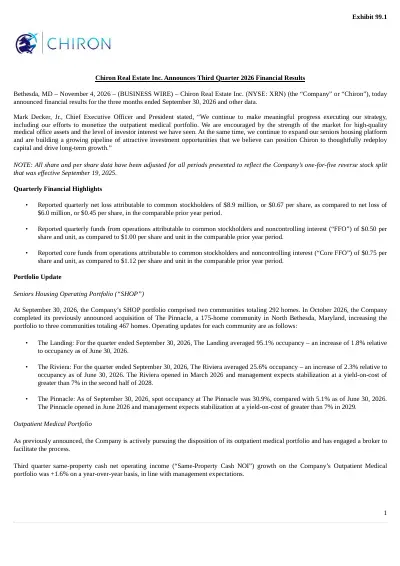
Thanks, Mark. During the third quarter, Nareit-defined FFO per share and unit was 50 cents, and our core FFO was 75 cents per share and unit.
Outpatient medical same-store cash NOI increased 1.6% on a year-over-year basis, consistent with the expectations we established at the beginning of the year. Third quarter cash G&A of $5.3 million was impacted by $1.2 million of severance and transition costs attributable to changes to our senior leadership team.
Absent these changes, cash G&A would have totaled $4.1 million. Non-cash stock compensation also included $800,000 of accelerated vesting associated with these changes.
We ended the quarter with $231 million in unutilized borrowing capacity under the credit facility and a leverage ratio of 41%, as defined by our credit agreement. Net debt to adjusted EBITDAre was 7.1 times for the quarter.
As a reminder, net debt to EBITDA will fluctuate in the near term as The Riviera and The Pinnacle progress through lease-up and stabilization. Bobby, could you please provide an operating update?
Bobby Zeiller
Thanks, Bob. I'll begin with The Landing in Alexandria, Virginia, where third quarter occupancy averaged 95.1%.
The Landing serves as a great example of why we're so excited about the foundation of our seniors housing portfolio. It's well-occupied, the real estate is highly relevant, and we've been able to drive financial performance through disciplined pricing, resident retention, and expense management.
At The Riviera, our independent living community adjacent to The Landing, quarterly occupancy averaged 25.6%. Progress has been steady, but we are mindful of the fact that lease-up is rarely linear.
As a result, we won't put too much emphasis on any single month. Rather, we're focused on the underlying indicators that support a durable growth profile.
That would be lead generation, move-in conversions, resident satisfaction, and the quality of the revenue we are creating. We are seeing very encouraging progress on those measures.
Third quarter lead generation, for example, increased 20% from the second quarter, while initial prospect tours increased a healthy 14%. As a reminder, we expect The Riviera to generate a yield on cost of greater than 7% during the second half of 2028.
We're also excited to have completed the acquisition of The Pinnacle in October. The Pinnacle is a newly constructed, 175-home community in North Bethesda that is located across the street from Federal Realty's Pike & Rose mixed-use development.
This investment brings our seniors housing portfolio to three communities and 467 total homes. Our conviction in The Pinnacle begins with the quality of the underlying real estate.
It is a brand new, institutional-scale community offering independent, assisted living, and memory care in one of the most attractive submarkets in the Washington region. The community welcomed its first residents in June and ended the third quarter at 31% occupied.
As with The Riviera, The Pinnacle's current earnings do not reflect the community's stabilized potential. Our focus is on converting the quality of the real estate and the depth of the local market into durable occupancy and NOI growth.
We expect The Pinnacle to generate stabilized yield on cost greater than 7% in 2029. Overall, we remain extremely confident in the quality of our portfolio.
Our job is to now demonstrate that quality through consistent operating execution. Matthew, could you please discuss how we're approaching the investment pipeline?
Matthew Whitlock
Absolutely, and I'm happy to. Thank you, Bobby.
Having been here only a short while, I couldn't be more excited for our opportunity to build a differentiated seniors housing portfolio that's positioned to meet the demands of today, as well as those of tomorrow. I won't use my time today to re-emphasize the incredible supply-demand imbalance in our seniors housing created by the wave of baby boomers reaching their 80th birthdays.
Rather, I'd like to talk a little bit about what we see as relevant real estate and what we are targeting within the broader seniors housing marketplace and the opportunities to invest in them. Out of the 1.9 million or so seniors housing units in the United States, we believe over half of them will not satisfy the demands placed on them by the incoming seniors population.
Our team is focused on investment opportunities that will satisfy these demands. More specifically, we're pursuing modern, private-pay communities delivering outstanding care in markets capable of supporting pricing power and long-term occupancy.
Our best investments will be ones where the real estate is relevant, the operator is aligned, and we can identify multiple paths to long-term value creation. These paths can include occupancy gains, margin expansion, renovation or modernization, and the economies of scale gained through geographic concentration.
We've developed a meaningful pipeline of potential investments that meet these criteria. It is a curated opportunity set designed around our investment thesis and objective of assembling a portfolio of relevant, high-demanded communities.
We do not feel compelled to bid on assets that do not fit this criteria, and the majority of our pipeline consists of assets not currently marketed for sale in the larger transaction marketplace. We evaluate each opportunity not only against our investment criteria, but also in light of our available liquidity and the expected sequencing of our broader capital recycling strategy.
We are excited by the macroeconomics of seniors housing continuing to support our thesis and, perhaps even more so, the opportunities we have and will identify. We are equally excited by the prospect of converting our outpatient medical portfolio into meaningful investment capacity to pursue these opportunities.
Mark, I'll turn it back to you.
Mark Decker, Jr.
Thanks, Matthew. As we've discussed throughout the year, Chiron's in the middle of a significant transition.
Our progress will ultimately be measured by execution and long-term value creation. In the near term, we're focused on realizing value from our outpatient medical properties and investing capital with discipline into seniors housing.
Our team is aligned around these priorities, and we look forward to reporting on our progress along the way. Operator, please open the line for questions.
Operator
Thank you. Ladies and gentlemen, we will now begin the question-and-answer session.
Should you have a question, please press the * followed by the number 1 on your touch-tone phone. You will hear a prompt that your hand has been raised.
Should you wish to decline from the polling process, please press the * followed by the number 2. If you are using a speakerphone, please lift the handset before pressing any keys.
One moment, please, for your first question. Your first question comes from the line of Juan Sanabria with BMO Capital Markets.
Your line is now open.
Juan Sanabria
Hi. Great.
Thank you for the time. Recognizing it's a fluid situation on the MOB dispositions, hoping you could talk a little bit about how the pricing environment is maybe changing, given the interest rate volatility we've seen, and kind of what sort of timeframe is a reasonable expectation for when a process could be completed in your minds.
What would mean success for the team?
Mark Decker, Jr.
Thanks, Juan. Great question.
Pricing is definitely eroded in light of the Treasuries moved, and so I would say it's probably 25 to 50 basis points for medical, and probably more specifically our portfolio. From a timing perspective, really hard to talk about timing.
I'd love to have a good update by the time we're on our next call.
Juan Sanabria
Fair enough. Then just on the eventual redeployment of those proceeds in that capital, Matthew, you mentioned over half of the stock won't meet the boomer demand.
I guess, what do you think is maybe obsolete product, and what is kind of the most appealing or appropriate unit mix or asset type or price point that you think is going to be relevant with the seniors? How do you align the operators more specifically to have that alignment with Chiron's shareholders?
Matthew Whitlock
Those are great questions. Generally, we define relevance from a couple of different perspectives.
Number one, the location of the asset within a specific MSA, the architecture and design of the buildings, and that includes both the amenitized space, things like the dining room, the arts and crafts room, parts of the public areas that are relevant to the incoming baby boomer population, and then we also look at the architecture, design, and layout, as well as the unit mix of the individual residential units. Currently, [cough] there is a demand for larger units that are more amenitized than that type of product that was typically built 10 to 15 years ago.
Of the 1.9 million units nationwide in seniors housing, about half of them were built before 2012. Generally speaking, most of the product built before 2012 was designed to meet the demand criteria of the Silent Generation and the Greatest Generation.
The incoming baby boomers are the first generation in American history to really force their demands on products built for them. We're looking for units and communities that will appeal to the baby boomer generation.
How we develop alignment of interest with our operators is really a question of geographic concentration and the experience of our operators within the targeted MSAs. For example, if we were operator-aligned in the Pacific Northwest and an opportunity was brought to us east of the Mississippi, just by way of example, we would probably not pursue that acquisition with our geographically focused operator in the Pacific Northwest, but would pursue an operator alignment who had more experience within the MSAs where that targeted acquisition is.
That answer your question?
Juan Sanabria
Yes, sir. Thank you.
Matthew Whitlock
Thanks, Juan.
Operator
Your next question comes from the line of Wes Golladay with Baird. Your line is now open.
Wes Golladay
Hey. Good morning, everyone.
I guess there was a big divergence in pace between Riviera and The Pinnacle, and I know we don't want to look too much into one quarter, but is there anything that I guess is going really well at The Pinnacle and anything that you would change at The Riviera? Was the price too high, too low?
Just a little more color on that.
Matthew Whitlock
Good morning, Wes. Bobby will speak to that.
Bobby Zeiller
Sure, Wes. Thank you very much.
I think the lease-ups that I've been involved in, which has been dozens, there is a nonlinear process to lease-up. There are ups and downs with each community as they go for varying factors, both around the community, it could be factors that are differentiated by location, seasonality, etc.
We have seen both highs and lows in months, which is why we don't focus particularly on months. As an example, we had the largest move-in month of my career at The Pinnacle in August.
There is really no correlation to that other than just an aberration. We look at the process as a process that'll take a couple years.
We look at the fundamentals of lead generation, of initial and subsequent tours, and both at The Pinnacle and at The Riviera, and frankly at The Landing as well, those fundamental indicators are all very strong. In fact, we had great growth in those numbers at both The Riviera and The Pinnacle.
We're very confident in the long haul that these will be well-performing assets. Their locations, the markets around them, the supply-demand dynamics in each of these markets is exceptional.
We believe both will happen. There's going to probably be a high at The Riviera and a low at The Pinnacle in one month, and I think at the end of the day, our focus is on the long term.
Wes Golladay
All right. Appreciate the color.
Thank you.
Matthew Whitlock
Thanks, Wes.
Operator
Your next question comes from the line of Austin Wurschmidt with KeyBanc Capital Markets. Your line is now open.
Austin Wurschmidt
Thanks. Good morning, everyone.
Just going back to the lease-up, can you discuss how we should think about flow-through at The Riviera and Pinnacle as occupancy continues to ramp and whether you are offering concessions today and at what occupancy point maybe we start to see those burn off a bit?
Matthew Whitlock
Sure. Go ahead, Bobby.
Bobby Zeiller
Sure. We do invest in occupancy, and by that, I mean we do offer incentives or concessions.
We do use the levers to ramp those down over time. The ideal scenario is that as the occupancy grows, we can ramp those down so they burn off concurrently.
We also use them as a near-term kind of urgency incentive. For example, in areas of the month or areas of the year that are generally slower, we'll offer some urgency incentives.
Our view on those is that we want to grow occupancy first and foremost, and so we do that with real-time input from the sales teams and the manager.
Austin Wurschmidt
That's helpful. Then just going back a little bit to how you're thinking about shaping the portfolio on the seniors housing side, given your size, range of available proceeds from OM sales, is there a target number of operators you're focused on aligning with, and is that sort of by either regional focus or acuity?
Just curious how you think about that.
Matthew Whitlock
This is Matthew. I'll take that question.
Ultimately, we'd like to have a lower number of operators that are truly aligned with our investment pursuits as opposed to a lot of one-offs. Where we look in specific geographic regions and where we look for investment opportunities, a lot of thought process goes into who our operating partner would be, and we diligence pretty significantly the experience of that operator within a specific geographic footprint and whether or not we've got proper alignment.
Generally speaking, when we look back on this in a couple of years and we've got 50 or 60 buildings, it would be my hope that we have 5 operators as opposed to 50. We would like to have alignment with multiple properties and a lower number of operators.
Then just to put a little more color on that, geographic concentration is very important to us. We think that there are boundaries upon which an operating partner may lose efficiency as it relates to our portfolio, we're very mindful of that.
Bobby, anything you might want to add?
Bobby Zeiller
No, I think that's exactly right.
Austin Wurschmidt
Thanks for the time.
Matthew Whitlock
Sure.
Operator
Your next question comes from the line of Rob Simone with Compass Point. Your line is now open.
Rob Simone
Hey, guys. Morning.
Thanks for taking the question. Just kind of switching over to the senior side or the SHOP side for a second.
I was wondering if you could just kind of talk about maybe the velocity or the volume of transactions that are kind of out there or coming across your desk and kind of how you filter that, right? If you were to kind of look at X dollars per quarter per month, how much of that actually qualifies as within your parameters, how much do you pass on, how much do you bid on, and kind of just what's the run rate that you're underwriting quarter to quarter, I guess?
Matthew Whitlock
I'll take that. We're looking at a tremendous amount of opportunities across the entire landscape of seniors housing.
As I mentioned in our opening comments, a lot of those opportunities don't fit our buy box from a relevance perspective. It would not surprise you to suggest that the current market is absolutely a seller's market.
There's been a tremendous amount of acquisition activity over the last two years. We have seen that transaction activity slow somewhat.
In answer to your question, of the 10 or so opportunities per month that we're seeing, we're going to be interested in probably 10% of those. A lot of the opportunities are end-of-fund-life dispositions, non-relevant real estate dispositions, things that really wouldn't attract us or fit into our buy box.
I will tell you, though, that we're in active discussions on off-market transactions ranging from single-asset transactions to multiple portfolios, and there's a tremendous amount of activity in the off-market side of the investment landscape.
Mark Decker, Jr.
Only thing I'd add there is just to say we have a lot more opportunities than capital that we think makes sense.
Rob Simone
Got it. Okay.
That's really helpful, guys. Thank you.
Operator
Your next question comes from the line of Rich Anderson with Cantor Fitzgerald. Your line is now open.
Rich Anderson
Hey, thanks. Good morning, and I'm happy to be here on my first Chiron call.
Mark, I know you're not going to talk about the MOB sale process in specifics, but is there a short-term outcome where you sell a big chunk of it all at once or all of it all at once, and then you have this dip in sort of the earnings profile of the company and then a bounce back up once you deploy it? Could there be sort of an EKG type of thing that happens to earnings over the next couple of years?
Is that a reasonable way to think about the transformational process of the company?
Mark Decker, Jr.
An earnings heart attack. I could read the headline now from you, Richard.
Good to have you on. Yes, that is possible.
I think, as we've talked about with investors on prior calls, there's sort of the absolute last-dollar value maximization might be selling 180 buildings to 180 different buyers. The best capital markets answers probably don't go for every last dollar, but move quickly, and I would say we're biased towards that.
I don't think that those two outcomes are 10% apart. They're probably a couple hundred basis points apart, but we definitely believe there is value in speed.
That's possible, for sure.
Rich Anderson
Okay. Then it was interesting observation around the market for seniors housing units, half of which are in your breadbasket or could be.
The baby boomers are just now turning 80, right? If average first year in a seniors housing home is 83, isn't it really 10 years from now or 5 years from now where you really start to see that demand start to pick up from that generation?
Because the range of baby boomer, I just Googled this, 62 to 80 right now. Anyone who's 62 is probably not moving in in the next 20 years.
I'm just curious about how you view the cadence of demand for that business and how it aligns with what you're doing as a company.
Matthew Whitlock
I'll take that. Demand for the units is part of it, but the supply imbalance is a very significant portion of it.
Largely, I would tell you that there's an incredibly low new development, the supply of new product has really been constrained, and that's a function of construction debt in the marketplace, yield on cost for a developer, and the risk associated with building new. Now, I don't think that's forever, but it certainly has been for the last three or four years a really curtailed development pipeline.
The other part of that is while this is the leading edge of the baby boomers, it's important to realize that there's not a gap. The tail end of the Silent Generation is still coming.
It's an incredibly wealthy demographic subset. As you Googled, there's 10,000 people turning 80 every single day.
While the baby boomer is a massive wave of new prospective residents, the tail end of the Silent Generation is still coming. We feel that overall, the national occupancy is above 90%.
It's above that which it was prior to COVID, there's never-ending demand for seniors housing product. There's a very limited supply of new product coming on.
We do feel very strongly that there's current demand, and that demand will only grow as the baby boomer wave moves into their 80s.
Rich Anderson
Great color there. Just real quick, I like the 5-operator focus for 50 buildings.
Nice, easy: 5 for 50. How much more can you get out of the Greystone/Silverstone arrangement in your mind?
Thanks.
Matthew Whitlock
They're certainly an operating partner of ours, and we have a specific geographic focus with Greystone here in Metro DC. They are absolutely a candidate for us as we look at other opportunities in this geographic region.
I would also mention that they're not the only operating partner that we could align with, but right now, we have full confidence in their ability to lease up the assets that we've acquired.
Rich Anderson
Thanks very much. Appreciate it.
Matthew Whitlock
Thanks, Rich.
Operator
Your next question comes from the line of Dave Rodgers with Raymond James. Your line is now open.
Dave Rodgers
Good morning, everybody. Wanted to ask about acuity in terms of the lease-up of the existing assets.
Are you seeing anything interesting, different, unique with regards to the lease-up acuity levels? Then maybe the same question with respect to where you're thinking about for acquisitions.
Do you have targeted acuity levels that you'd like to kind of hit over time? Any additional thoughts there would be helpful.
Bobby Zeiller
Sure. This is Bobby, let me take that for a second, and Matthew can add.
I think what we've seen, one of the key visions of Chiron is that we are investing in full-continuum assets that have both independent, assisted, and memory care, which gives us an opportunity to seek out both early baby boomers, those that are younger, and also be able to respond to those with additional care needs. One of the things and the phenomenons that we've seen and we like and really support our communities is that as care needs change, they matriculate in the community.
This is an age-in-place model, and I think we see that in terms of the lease-up of the communities. One of the reasons why we are so bullish on both The Pinnacle and The Riviera is that it is an IL community, it brings people in earlier, healthier, and then they can matriculate to additional care when they need it.
We have seen a little longer lead cycle and timing to bring independent living residents in. It's more of an elective decision.
On the assisted living and memory care side, it tends to be a little shorter and more needs-based, but we think having full-continuum assets that have all of those care levels gives us the opportunity to respond to all the different needs in seniors housing.
Matthew Whitlock
I think that's exactly right, Bobby, and what I would add is that baby boomers in the tail end of the Silent Generation are looking to go to a place to live rather than going to a place to die. Their research into what community they want to move into has a lot to do with the programmable space in the community, the size and layout of their residential unit, and, as Bobby said, their ability to receive care as they age in place.
In terms of acquisition criteria, very rarely do we look at a single level of care opportunity, and we're much more focused on a continuum of care. In a perfect world, we can present an opportunity for a prospective resident to move in independent living and handle their needs all the way through the end of life.
Dave Rodgers
Great. Thank you for that.
Maybe a follow-up on your comments about development and not enough assets out there. You do have a chief development officer and a parcel of land.
Any updates on kind of what you're thinking there is, understanding that the transition here is early, but just kind of curious if you're getting more comfortable with moving forward?
Bobby Zeiller
We had an opportunity to acquire a very strategic piece of land, which we did. We've had some very interesting and exciting conversations about that piece of land, and I think we're not in a position to kind of go into full details, but certainly will soon.
It's an interesting opportunity for us to continue to build in our portfolio.
Dave Rodgers
Thank you. Last question for me, maybe for Mark and Bob together.
Wanted to think about the transition away from OM and into SHOP. I guess I'm curious about the balance sheet, right, with the preferred leverage kind of approaching 10 times, and you're switching out of a 60% margin business into a 25% margin business that grows faster.
How are the banks, how are the lenders kind of thinking about what that transition needs to look like as you sell OM, how much do you have to put into the leverage component of the company to make sure that everybody's happy on the lending side?
Mark Decker, Jr.
You want to start, Bob? Or do you want to try to do it together?
All right. Look, the banks have been very supportive, as they liked our business before and were very supportive in terms of pricing and terms and all of that.
We actually had a bank update meeting about 6 weeks ago, and I think the feedback we got coming away from that was a lot of support for the team. It's a strong team.
That was evident to all of them, and we had our entire bank group plus a few folks that aren't currently lending money to us at this time. Look, I think they're excited about a business that can really grow, and I think they see our vision as another good provider to operators of real estate partnership is one that can be meaningful for their business as well.
They've been very positive. We've also shared with them, as we've shared with you and others, our intent to run at lower leverage overall.
If that's available to us, we'll absolutely do that, and I think that is appealing to them as well.
Dave Rodgers
Thanks for the time.
Mark Decker, Jr.
Thank you.
Operator
Your next question comes from the line of Rob Stevenson with Huntington. Your line is now open.
Rob Stevenson
Good morning, guys. Can you talk about the current leasing activity and any upcoming known move-outs of significance in the OMF portfolio?
Mark Decker, Jr.
Bob, you want to take that, Bob?
Bob Kiernan
I can start. You saw occupancy tick down a little bit in the third quarter.
Again, that was, I think, expected. As we talked about, same-store running at 1.6% and where it's trending for the full year.
From an occupancy perspective, there's no significant move-outs. Again, retention is around 70% for the quarter, and it's really been running as expected at this point.
Rob Stevenson
Okay. That 70%, 75% retention is reasonable to assume on the sort of call it $14 and change of that leases by ABR that are rolling in '27.
I'm just trying to figure out where occupancy is heading both in terms of earnings contribution and also the impact of vacancy of potential value in a sale.
Bob Kiernan
That's that's that's that's fair, Rob. There's nothing, again, it's it's not again, there's not it's not that volatile.
It should be in that in that same range with, again, we we we talked about it in that range, but, with the potential upside from from there.
Rob Stevenson
Okay. Then just given the comments of the last couple of questions revolving around sort of leverage and capital, etc., how much liquidity, dry powder, however you want to term it, do you guys have today to even do sort of a smaller SHOP acquisition versus really needing to at least sell a decent chunk of OMF assets before your next meaningful SHOP buy?
Mark Decker, Jr.
I would think about it as currently pretty modest, but we have, call it, a billion and a quarter-ish of seed corn in the form of the outpatient medical. We've been able to so far kind of match buys and sells, and hopefully, we can continue to do that.
Rob Stevenson
Okay. Thanks, guys.
Appreciate the time.
Mark Decker, Jr.
Thanks, Rob.
Operator
Your next question comes from the line of John Massocca with B. Riley Securities.
Your line is now open.
John Massocca
Good morning. Maybe with that last question in mind, is the move in cap rates for outpatient medical impacting the return threshold or hurdles you're looking for in seniors housing investments?
Are you kind of matching those one-for-one, or is it because it's strategic shift, you're a little bit more agnostic around how those kind of yields are trending?
Mark Decker, Jr.
In my opinion, we're talking about pretty fine-motor kind of adjustments: a quarter basis point or 25 basis points or a half a point. Brass tacks, the outpatient medical business is a high-single-digit unlevered IRR business, and the seniors housing is low-double-digit unlevered IRR, there's a couple hundred basis points of real spread there.
I think the demographic forces are real and good for both. Again, we've talked a lot about outpatient medical.
There's nothing wrong with that business. It's just to try to have earnings growth at sub-40% leverage with that active economic picture at our size is just a game that we'd like to have someone else play.
I think our ability to be more meaningful in seniors housing is clearly evident to us. I would say over the last 6 to 9 months, we've grown in conviction around that.
I feel better about it today than I've ever felt about it. Then,
John Massocca
going back to the rise in interest rates, has that impacted meaningfully the velocity of transaction activity in the outpatient medical space? Has it also changed your thinking or influenced your thinking at all as to a focus on larger portfolio transactions versus kind of individual sales or even the pace of disposition activity and reinvestment?
No.
Mark Decker, Jr.
I would say no, not really. We're not kind of sellers of convenience.
We're focused on strategy. We've been very clear about that to the market kind of in every direction.
We're going to be thoughtful and measured and try to maximize the outcome as best we can. I would say there's still a very strong bid.
There are people who have been in the medical space for 20-plus years, like our partners at Heitman, who feel like this is a great vintage, and they're very excited about medical. There's groups that are relatively new to the space and looked at the Sila and have looked at NHP, looked at some of these assets that have traded in volume and thought we'd like the underlying thesis, and we want to get in that.
I'd say there's sort of old reliable players, and there's lots of newcomers and generally a very positive outlook on the space. That's good news for us in terms of the weather, I guess, to speak, that we're kind of out in, and so, all positive there.
Cost of money changed 25 to 50 basis points like we said. That's a real thing, but I would say most people's thesis on the space is intact.
That's all about the demographics, discounts to replacement cost, current marks on rents versus what's possible, and I think that's a strong thesis.
John Massocca
Okay. I appreciate all that color.
That's it for me. Thank you.
Mark Decker, Jr.
Thank you.
Operator
There are no further questions at this time. I will now turn the call over to Mark Decker.
Please continue.
Mark Decker, Jr.
Thank you so much. Listen, we appreciate everyone's time and interest, and hopefully, we'll see some of you guys at Nareit in a couple weeks.
Thanks so much, and we'll talk soon.
Operator
Ladies and gentlemen, this concludes today's conference call. Thank you for your participation.
You may now disconnect.