Yesway, Inc.
NNASDAQ:YSWYQ1 FY2026 · Earnings Call TranscriptJune 2, 2026
Operator
Welcome to the Yesway, Inc. First Quarter 2026 Earnings Conference Call.
At this time, all participants are in listen-only mode. After the speakers' presentation, there will be a question-and-answer session.
To ask a question, you will need to press *11 on your touch-tone telephone. We ask that you limit yourself to one question and a follow-up.
Please be advised that today's conference is being recorded. I would now like to turn the call over to Lauren Scott, Investor Relations representative.
Please go ahead.
Lauren Scott
Thank you, operator, and thank you all for joining us today for Yesway's first quarter 2026 earnings conference call. With me on today's call are Tom Trkla, Chairman, President, and Chief Executive Officer, and Ericka Ayles, Chief Financial Officer.
Before we begin, a reminder that today's discussion will include forward-looking statements within the meaning of the Private Securities Litigation Reform Act of 1995. Any forward-looking statements made today are based on management's current expectations, assumptions, and beliefs about our business and the environment in which we operate.
These statements involve known and unknown risks, uncertainties, and other factors that could cause our actual results, performance, or achievements to differ materially from what is expressed or implied. These risks include, but are not limited to, volatility in global oil prices, general economic conditions, our ability to execute our growth strategy, and changes in consumer demand and fuel consumption trends.
For a more detailed discussion of risks, please see our final prospectus dated April 21st, 2026, as filed with the SEC on April 23rd, 2026, and our other filings with the SEC. Our forward-looking statements made on this call represent our outlook only as of today, June 2nd, 2026, and we disclaim any obligation to update these statements, except as may be required by law.
In addition, during this conference call, we may make reference to certain non-GAAP financial measures, including adjusted EBITDA and store contribution. Reconciliations of these non-GAAP financial measures to the most directly applicable GAAP measures are available on the Investor Relations section of our website and in our first quarter 2026 earnings press release, which was issued earlier this morning.
A replay of today's call will also be available on the same website shortly after we conclude the Q&A session. With that, I'd like to turn the call over to Tom Trkla.
Tom?
Tom Trkla
Thank you, Lauren. Good morning, everyone, and thank you for joining us today.
As this is our first quarterly earnings call as a public company, I would like to begin by taking a step back and providing a brief overview of Yesway's history, our business, and the key attributes that we believe set us apart in the convenience retail industry. Yesway was founded in 2015 with a clear vision to build a scaled, customer-focused convenience store platform serving attractive rural and suburban markets across the United States.
Since that time, we've grown rapidly and deliberately. As of March 31, 2026, we operated 449 stores, making Yesway the 15th-largest convenience store operator in the country.
The convenience store industry is large, growing, and highly resilient, having demonstrated durability across market cycles, supported by consumers' ongoing needs for fuel, food, beverages, and everyday essentials. Within that environment, Yesway has built a differentiated platform anchored by two strong and complementary brands, Yesway and Allsup's.
Both brands have deep roots in the communities they serve and benefit from strong customer loyalty. We offer a unique food service platform, positioning us as a true destination convenience store rather than simply a stop for fuel or basic necessities.
Allsup's is especially well known for its iconic deep-fried burrito, a signature product that has become closely associated with the brand and serves as an important driver of customer traffic, repeat visits, and loyalty for our combined store base. More broadly, our stores offer a compelling and convenient mix of freshly prepared food, grocery items, beverages, snacks, and higher-margin private label products.
This assortment allows us to serve multiple customer occasions throughout the day, from coffee and breakfast in the morning to lunch and dinner options, snacks, beverages, and household essentials later in the day. By combining a recognizable food service identity with everyday convenience, we have established ourselves as a go-to destination for customers seeking quality, speed, and value.
Our stores are strategically located in attractive rural and suburban markets across the Southwest and Midwest. In many of these communities, our stores play a role that goes beyond traditional convenience retail.
We are often the convenient retail destination of choice, and in certain markets effectively the local grocer. That position gives us a meaningful connection with our customers and communities, and it reinforces the recurring nature of traffic across our network.
Over the past decade, we have established a strong track record of growth and operational improvement, driven by a combination of new store developments, strategic acquisitions, and disciplined execution across our store base. Since inception, we have completed 27 acquisitions, including the transformational acquisition of Allsup's in 2019, helping expand our footprint, strengthen our market position, and build density in attractive geographies.
Supporting this growth is a seasoned leadership team with deep expertise across both real estate and convenience retail. Notably, our real estate expertise is critical in identifying the right markets, the right sites, and the right formats for long-term value creation.
On that note, we primarily operate under a company-owned, company-operated model and own approximately 65% of the real estate underlying our store base. This approach provides operational flexibility, strong site control, and the ability to reinvest through new store developments, remodels, and raze-and-rebuild projects.
Across our stores, standardized operating procedures, training, and uniform technology supports consistency and efficiency across the platform, with many of our stores able to operate with just a single employee during non-peak hours. Additionally, our sites are typically located on oversized lots with strong visibility and traffic patterns, with our newer stores featuring expanded forecourts and dedicated high-flow diesel lanes designed to support long-term fuel growth.
We also continue to invest in technology and tools to support smarter decision-making across merchandising, pricing, labor, fuel, food service, and capital allocation. These capabilities are vital to our ability to proactively evaluate growth opportunities, integrate acquisitions, improve store performance, and drive profitable growth over time.
For example, the first-party data generated through our Yesway Rewards program helps enhance customer engagement through more targeted promotions, driving more frequent visits and larger basket sizes. Yesway's growth has been rapid and strategic, culminating on April 22nd with the successful completion of our initial public offering.
The IPO was an important step for the company and provides us with additional resources and flexibility as we enter our next phase of growth. Inclusive of the full exercise of the greenshoe option, we raised approximately $322 million in net proceeds, which we have used to fully redeem our preferred equity and to repay $10 million of debt.
An additional $20 million of debt repayment was made following the close of the offering. The IPO has positioned us well to execute on several key priorities.
First, we plan to continue accelerating our growth through organic initiatives and selective expansion. This includes new store developments, investments in innovation, technology, and product expansion that will enhance the overall customer experience.
We believe these initiatives will help drive traffic, strengthen loyalty, and improve same-store sales and store-level productivity over time. Second, the IPO proceeds provided us with an opportunity to further optimize our balance sheet and strengthen our financial position.
Maintaining flexibility is important as we continue to grow, particularly in an industry where scale, disciplined capital allocation, and operational execution matter. Finally, we will continue to evaluate selective and opportunistic M&A.
Acquisitions have been an important part of our growth story to date, and we believe the convenience store industry remains highly fragmented. Our approach will remain very disciplined.
We will focus on opportunities where we can create value, build density, strengthen our brand presence, and apply our operating model effectively. Before turning to our first quarter results, I want to recognize the people who made this progress possible.
Yesway's success is directly tied to the hard work, commitment, and consistent execution of our tremendous employees, from our store teams who serve customers every day to our field leaders and corporate teams who support the platform. Our people are the foundation of this company.
On behalf of the leadership team and our board, I want to thank all of our employees for everything you've done to bring Yesway to this important milestone, and for everything you continue to do as we begin this next chapter as a public company. Turning now to our financial performance.
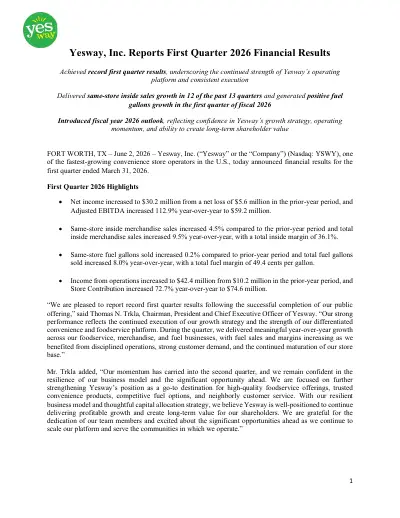
We are pleased to deliver record first quarter results, driven by broad-based strength across our food service, merchandising, and fuel platforms, with fuel sales and margin materially higher year-over-year. Most notably, our profitability reached an all-time high, with adjusted EBITDA increasing 112.9% year-over-year to over $59 million.
Same-store inside merchandise sales increased 4.5%, continuing a positive trend of growth in 12 of the past 13 quarters. Same-store fuel gallons sold increased 0.2%, with total fuel margin increasing 48.5% year-over-year to 49.4 cents per gallon.
At a higher level, we believe our fuel business maintains structural advantages supported by strong local refinery partnerships, our strategic rural footprint, and a higher diesel mix, which now represents approximately 38% of total fuel volume. These attributes continue to position us as a preferred fueling destination across our target markets.
Given we now are approximately two months into the second quarter, we are also pleased to report that the positive momentum in our business has continued, with same-store sales and gallons positive through the end of May. Looking ahead, we remain confident in the long-term growth opportunity for Yesway.
We operate in a large, resilient, and highly fragmented industry, benefiting from consumer preference for faster, convenient, and affordable options. Within this environment, we believe Yesway is well positioned as a go-to destination for customers in the markets we serve.
Our differentiated food service offering, best-in-class operating standards, strong service culture, flexible and value-generating real estate strategy, and proven M&A capabilities all support our continued growth. With that, I will now turn the call over to Ericka to discuss our quarterly results and financial outlook in more detail.
Ericka?
Ericka Ayles
Thanks, Tom. Good morning, everyone.
As mentioned, we delivered a record first quarter marked by continued same-store sales growth, strong margin performance, and profitability at an all-time high. Inside merchandise sales increased 9.5% year-over-year to $213.7 million, or 4.5% on a same-store basis.
The increase was driven primarily by pricing initiatives taken during Q4 2025 and Q1 2026, which we expect to continue to favorably impact same-store inside sales for the remainder of the year. In our fuel business, Yesway is executing well in the current environment and maximizing fuel gross profit.
In the first quarter, fuel sales increased 16% year-over-year to $464.3 million, with fuel margin increasing 48.5% year-over-year to 49.4 cents per gallon. To provide more context, the geopolitical developments in the Middle East have increased fuel price volatility across the industry, benefiting retailer profitability.
As a rule of thumb, retail prices generally increase as wholesale costs rise, protecting retailer CPG margins. Historically, when wholesale costs have eased, retail prices have tended to lag, which has supported ongoing strength in CPG margins.
As a result, volatile pricing environments can benefit both CPG margin and fuel gross profit dollars. Moving on to our same-store performance, total same-store gross profit increased 21.8% year-over-year, driven by strength across both our fuel and inside merchandise businesses, with same-store fuel gross profit and same-store inside merchandise gross profit increasing 38.5% and 9.8%, respectively, from the prior period.
We effectively controlled costs in the quarter as same-store operating expenses declined by 2.8% year-over-year. At the beginning of last year, we rolled out a labor efficiency initiative and have since seen same-store labor hours reduced in the previous four quarters, including a 3.5% decline in Q1 2026.
Store contribution increased 72.7% year-over-year to $74.6 million, driven by higher fuel margin and increased fuel volumes and merchandise sales. We also have had more stores opened compared to last year and a higher contribution of new stores.
Net income increased to $30.2 million compared to a net loss of $5.6 million in the prior-year period. Adjusted EBITDA increased 112.9% year-over-year to $59.2 million, primarily attributable to higher fuel margin.
During the quarter, we opened one new store, ending the period with 449 stores. As a reminder, our current store count includes 29 stores operating in Iowa and Kansas that we have agreed to sell as part of our strategy to sharpen operational focus, simplify our supply chain footprint, and reinforce our concentration in core operating regions.
We expect the sale to close by the end of fiscal 2026. Turning to the balance sheet, we had cash and cash equivalents of $56.5 million and total debt of approximately $649.5 million as of March 31st, 2026.
Net cash provided by operating activities was $48.4 million compared to $13.6 million in the prior-year period. Capital expenditures totaled approximately $11 million compared to $26.3 million in the prior period.
Turning to our guidance, our outlook for fiscal 2026 reflects the strength of our first quarter performance and the momentum we have carried into the first two months of Q2. That said, we recognize the geopolitical environment is fluid.
While we feel we are well positioned given our value proposition for customers and our favorable diesel exposure, we will continue to monitor the impact of fuel price volatility over the coming months. As such, we've introduced fiscal year '26 guidance as follows: same-store inside merchandise sales growth of 1.25% to 3.25%, adjusted EBITDA of $210 million to $220 million, and capital expenditures of $85 million to $95 million.
Assumptions within our CapEx guidance include three stores in our pipeline that we moved from build-to-suit to self-funded, as we leverage the recent performance of the business and maintain strategic flexibility. Lastly, we expect to open 6 to 8 new stores in 2026, inclusive of the one store we opened during Q1.
Please note that our guidance excludes the 29 operating stores in our Iowa and Kansas portfolio, which we expect to sell before year-end. With that, I'll turn the call back over to Tom for closing remarks.
Tom Trkla
Thank you, Ericka. To close, we are very pleased with our record first quarter performance and the strong start to our journey as a public company.
By continuing to strengthen our differentiated customer offering and maintaining a disciplined approach to capital allocation, Yesway is well positioned to continue delivering profitable growth and long-term value for shareholders. Thank you again for joining us today.
Operator?
Operator
Thank you. As a reminder, to ask a question, please press *11.
If your question has been answered and you like to remove yourself from the queue, please press *11 again. We ask that you limit yourself to one question and a follow-up.
Our first question comes from Bobby Griffin with Raymond James. Your line is open.
Bobby Griffin
Good morning, everybody. Thanks for taking my questions, and congrats on a good first quarter as a public company.
I guess first I wanted to follow up kind of customer behavior here, following kind of two months of higher gas prices. You noted quarter-to-date positive same-store sales, which is encouraging.
Tom, can you dive in? Have you seen anything noticeable out of your customers as gas prices have gone up the last call it 8 weeks or so?
Any shifts, trade-downs, or any shifts inside the store that's interesting that'd be worth calling out just for us to kind of gauge how the business is handling or how the consumer's handling that for your business?
Tom Trkla
Thank you, Bobby. Appreciate the question.
Slightly. We obviously are cognizant of what's going on with the consumer both with higher gas prices, as well as higher merch prices.
What we've found, we've had very strong baskets and very strong prices as well holding, as you've seen we've had positive gallons. We attribute it to the fact that we've got a very strong rural focus and that our customers are basically less susceptible to some of these.
We are seeing it. Ericka and I watch it very closely.
We also attribute the fact, we've talked about this before, that we are already a value shop. We're already known as a value chain.
Our price points have $4 and $5 and $6 meals. Other retailers and QSRs are trying to find that balance again.
We're already there. We've been pretty sticky.
We're obviously watching it like everyone else is. We're obviously watching the impact of gas price.
We're under $4 now, which is great. We're now $3.83 as of yesterday.
That's kind of our trigger to look at that price at $4 in the past, back in 2022. Ericka, you can add into this, we're basically seeing a little bit, but not a lot.
We've basically been holding our own. We're pleasantly surprised with the fact that our customers are very sticky, very resilient, even with higher costs of fuel and higher costs of merchandising.
Anything you want to add, Ericka?
Ericka Ayles
Yeah. I would just add from a data perspective, on the fuel side of the business, we do see some trading down from premium to mid-grade, mid-grade to regular.
Obviously, as you can imagine, the margin on that trade-down is far exceeding anything to do with that trade-down. That feels very good.
Inside transactions were positive for the quarter, and the merch basket was up as well. To Tom's point, we feel very good about our value proposition as it relates to sort of the wider concern about the consumer.
Bobby Griffin
Thank you. That's helpful.
Then I guess secondly for me, just, Ericka, diving inside the inside gross margins, up 190 basis points year-over-year in the quarter. Just unpacking a little the drivers and the, I guess, longevity of some of those drivers, cuz that's pretty impressive performance.
Ericka Ayles
Thanks, Bobby. Appreciate the question.
A lot of that inside margin growth continues to come from our new stores coming into the reporting period. Those new stores are generally operating at a higher food service contribution and lending themselves to a stronger product mix that sort of leans towards those higher-margin items.
As we mentioned in the prepared remarks, we did take some price in the latter half of 2025 and into 2026, and have seen very very good results from that, as I've just mentioned, transactions being up, units are up in the quarter as well, we feel good about those takes.
Bobby Griffin
Very good. Appreciate the details.
Best of luck here in 2Q.
Tom Trkla
Thank you.
Operator
Thank you. Our next question comes from Simeon Gutman with Morgan Stanley.
Your line is open.
Simeon Gutman
Hey, Tom. Hi, Ericka.
Can you first talk about CPG, how it's trending if you can even in second quarter? Then, can you talk about what you are thinking about for full-year CPG and the shape of it throughout the year within the EBITDA guidance?
Thanks.
Ericka Ayles
Sure. We'd be happy to just talk sort of high-level on what we're seeing post quarter-end.
You can imagine, as the conflict continues to add volatility in the fuel market, April and May generally high 40s, low 50s. As far as looking beyond that, I think we just believe it is too early right now to predict.
Obviously, if this continues and the volatility continues, there's certainly some upside for outsized margin. We're continuing to see that margin be strong to date in Q2.
Simeon Gutman
Okay. Then my follow-up, now that you've done so well on inside gross, at least in the first quarter, it looks like we are modeling a step-down.
Is there any reason it should step down, or do you think we can stay at this higher, above-average rate of, I guess, margin expansion?
Ericka Ayles
Sure. Great question.
What I would point to is just our guidance for the full year. We did have in Q1, obviously, a very strong same-store sales number.
We do think at least some portion of that was helped by weather. We had three major weather events in our portfolio in the comparative period versus only one major ice storm in Q1 of 2026.
We think we'd probably be about 2.6% ex-weather. Certainly benefited also from some groupings of SKUs that have a strong correlation to weather like packaged bev, etc.
I think we're certainly not modeling that same same-store sales growth. Again, to the extent this conflict continues, we certainly understand that there could be some concerns on stress inside the store.
Simeon Gutman
Great. Thanks.
Good luck.
Tom Trkla
Thank you.
Operator
Thank you. Our next question comes from John Heinbockel with Guggenheim.
Your line is open.
John Heinbockel
Hey, Tom. Want to start out, can you talk about what does the pipeline look like now for '27 openings in terms of kind of where we are in the process of site approvals and I guess construction won't be starting for a little bit?
Then, I know you've got the first two coming in Arizona. What do you think the opportunity in that state is, say, relative to maybe New Mexico?
Tom Trkla
A great question. As our model has a 6 to 8 this year and about 26 next year.
We have well over that in terms of land either under contract or being negotiated in the pipeline. We always keep a very strong pipeline of a multiple of needed deliveries for the year.
We've accelerated that in terms of people in the field. We feel very good about '26 and very good about '27.
We're actually working right now and moving things up in outer years utilizing some of our excess cash generated by the fuel margins, which I know we get a lot of questions on. We feel very good about our deliveries in '26 and very good about deliveries in '27.
To your second question, we're very excited about Arizona. It's got traditionally higher fuel margins, even higher than our New Mexico and West Texas fuel margins, which are also very high to begin with.
The market itself is very strong in terms of its receptivity, the type of customer. As we're going across right now in the southeastern portion of the state first and moving up.
We've got a very strong pipeline right now. In fact, the majority of the things we have in that pipeline that I referenced before about '26 and '27, really '27, '28, are in Arizona.
We're going to go very hard in Arizona. We've already had one grand opening in terms of just the announcement of a ground-breaking.
We'll actually have our first grand opening of the store sometime in the late summer, early fall right now. I think that's the date.
I'll double check that date. We feel very good about Arizona.
It's got a very strong customer, very strong receptivity to our food service program, very good demographics that are very similar to New Mexico and West Texas. We think it's a great state for us.
We've talked a lot about growing very large in that state. As we're basically concentrating in four states right now: Oklahoma, New Mexico, West Texas, and Arizona.
Arizona will probably be our highest-growth state of those four states in the foreseeable future. Then
John Heinbockel
maybe my follow-up, right, the labor hours down 3.5%, which is a pretty sizable reduction. You said you've been at this for four quarters.
Are we sort of nearing the end of this wave? Then how sustainable do you think about sort of the gift that keeps on giving that with technology and the like, you can maybe hold labor hours flat to down for an extended period of time?
Ericka Ayles
Sure. No, great question.
We have right now a very efficient labor model, right? Our average shift is about 2.
just over 2.5 people per shift. I would not expect long-term, wide reductions.
We would think of this as sort of continued efficiency, getting better data in the hands of the operators so that they can make better decisions. We think that there may be some continued upside, but I would not expect this level every quarter from here on out for the next couple years, obviously, because we already have a fairly efficient model.
John Heinbockel
Okay. Thank you.
Tom Trkla
Thank you, sir.
Operator
Thank you. Our next question comes from Kelly Bania with BMO Capital Markets.
Your line is open.
Ben Wood
Hey, good morning. This is Ben Wood on behalf of Kelly and BMO.
Thank you for taking our questions. I just wanted to step back.
Now that you guys have formally introduced guidance here, can you just talk about what is your approach to the EBITDA range? What are some of the drivers you think about that would get you towards the low end or the high end?
What are the key puts and takes as you're looking at your outlook here?
Ericka Ayles
Good morning, Ben. Thanks for the question.
I'll just first start with the higher end. Obviously, as I've just talked about some of the continued momentum on fuel margin as it relates to the first two months of Q2, to the extent that this does not resolve itself in fairly short order, there's obviously a potential upside that could be sizable here for fuel margin.
We certainly think that would be overall a benefit to the profitability of the company. Certainly, as Tom mentioned in our prepared remarks and as I mentioned, we recognize that could be offset from some stress inside the store.
Again, we think overall that would be overwhelmingly positive from a profitability standpoint, but want to recognize that very long-term, sustained higher fuel margins could put some stress on our customers.
Ben Wood
Great. That's helpful.
Then just as a follow-up to that, I know you called out moving some of the stores from build-to-suit versus self-funded. As we think about potential upside and your growth plan, should that be how we should think about your reinvesting the growth, or is there opportunities to accelerate the overall square footage or store growth or other priorities you might reinvest some of this upside?
Tom Trkla
It's a great question. In fact, it's the one we're dealing with most often right now because of the excess cash being generated by the higher fuel margin.
We're fortunate to not have a whole lot of deferred maintenance in our portfolio. We've done a very good job over the years of not investing in stores, shedding stores that we don't want, and so really focusing on those income-producing things.
Obviously, first and foremost, it's accelerating new builds. As we have 15% to 30% returns on those, very consistent ROICs.
You can't just plop a store down, and so it takes some time. We're accelerating the outer years in terms of land to tie up, we think we can go ahead.
I can't quantify what it's going to be, but certainly the direction is there. We're still looking at additional fuel expansions, diesel lane extensions.
They're few and far between, but they've been some of our highest-returning initiatives of the past couple years. There are a few left, some technology upgrades.
We're also starting now, as we started out by being an acquirer, 27 M&A deals for our first five years, including a very large transaction of just under a billion dollars of Allsup's in 2019. We're much more active right now in looking.
It's not in our model, but we're certainly looking at acquisitions as well from small to large acquisitions, because obviously that could move our dial much more quickly in the next couple of years from a growth standpoint. Primarily it's going to be on building, but I will say that we're now much more open than we have been the past couple years.
As we built 92 stores really since five years, and really kind of stopped buying, I think, but for one small portfolio a few years ago we bought. I would say those two things: primarily still building, but we are starting to look at more M&A opportunities as well as a good use, as a quicker use, to generate EBITDA with our excess cash.
Operator
Thank you. Our next question comes from Thomas Palmer with JP Morgan.
Your line is open.
Thomas Palmer
Good morning, and thanks for the question. Ericka, in one of your responses earlier, you noted that $4 fuel prices have been kind of a trigger point in the past.
The detail on trends remaining positive through May was helpful, but I was curious, when fuel prices did go over $4 this time around, did you see behavior changes, or were maybe trends a bit more resilient than in past periods?
Ericka Ayles
Sure. Good question.
As we mentioned, we have seen some trading down on the fuel side of the business. Again, overall positive from a gross profit dollars perspective, obviously.
As we talked about, inside the store, we've seen not much trading down, not a big increase or measurable increase in private label penetration, for example. We have seen continued momentum with packaged bev throughout.
I would say nothing meaningful other than, again, the first two months being, to my earlier point, not quite as strong on a same-store sales basis, and we don't have final numbers to share on that perspective, but not continuing at the 4.5%, obviously, that I mentioned for first quarter.
Thomas Palmer
Okay. Thank you for that.
Then on the price increases, you mentioned as one contributor to inside same-store sales growth, where were these price increases most focused? Kind of given the evolving environment, are there any contemplated changes in pricing either way, right, increased maybe promotions to help traffic or increased prices just to reflect the more inflationary environment?
Thanks.
Ericka Ayles
Sure. I think it's the latter, really, that to reflect the inflationary environment.
I would say that the price increases were not specified in one particular category. This was really about strategic pricing analysis to look at where we thought we were potentially out of market, what products we thought were a little bit more inelastic, but not necessarily focused on one specific area.
Thomas Palmer
Understood. Thank you.
Operator
Thank you. Our next question comes from Seth Sigman with Barclays.
Your line is open.
Seth Sigman
Hey, good morning, everyone. Nice quarter.
Can you just update us on loyalty? Where is penetration today?
What are some of the opportunities you're finding to use that and perhaps monetize that? Thanks so much.
Ericka Ayles
Great. Good question.
For the quarter, we were at actually about 18.5% of sales inside the store and about 15-ish percent on gallons transactions. That has been fairly rich from us from a penetration perspective in our more recent history, which has been great.
As we think about it moving forward, the team is really thinking about strategic marketing to our loyalty. Again, if this conflict, obviously, continues, ways where we can incentivize our loyalty members to transition into the store for potentially some vendor-funded marketing efforts.
That's really how we would sort of think about this as we continued into the remainder of the year.
Seth Sigman
Great. Thank you for that.
Then just a follow-up on food service. Maybe just update there, any changes that you guys are testing, any promotions or marketing that we should be paying attention to in the upcoming quarters here?
Then I guess back to the point earlier, guidance doesn't really assume that inside margins remain at this elevated level necessarily. Maybe just talk about some of the scenarios that we can think about for the rest of the year.
Thank you.
Tom Trkla
Thanks, great. Thank you very much for the question.
Let me answer there were two things we're looking at. We are a strong focus right now on both continued ideation on food service and we'd say at the margin.
We're not going to transform our food service operations. We sold 41 million proprietary food service items, but 24 million of which are our world-famous burritos.
We're not going to become a QSR, as we've talked about before. There are some things we're looking to ideate in the third and fourth quarters, additional things, but at the margin.
You mentioned quite the question before that was asked, we keep the pricing and the promotions around our burrito is kind of sacrosanct to our customers. That kind of drives our value in the stores.
We're also looking at doing further enhances to our private label. We now have about 170 for 175 proprietary products.
That's also big initiatives right now to look at really refining that, expanding that. Heretofore, we've kind of alternated between Yesway and Allsup's as private-label products inside the stores.
We're looking at creating kind of our own, kind of Kirkland to a Costco type of a concept, which we ideated years ago. Both of those things are very important to us.
We've got a very good signature food service item that makes us a destination, obviously, in the burrito and the things that are derivative to it. We will add some things derivative to it.
We're also doing one thing, too, which a lot of our brethren are doing, which is just we call SKU optimization. With our FP&A group, we're looking at all of our categories and simplifying our menu and even simplifying some of the merch inside the stores as well, trying to simplify just the product offering, making the whole operation much simpler.
Obviously, everything is around our burrito. We are looking at two things.
We actually sell a lot of chicken as well, but we're actually looking at doing some ideation, but as I said, the most important point to make is at the margin, but nothing specific. I don't have a big announcement of a new product, though we are looking at some things.
Like I said, we'll keep adding to and strengthening the offering around the burrito.
Seth Sigman
Great. Thank you both.
Operator
Thank you. Our next question comes from Brad Thomas with KeyBanc Capital Markets.
Your line is open.
Brad Thomas
Thanks. Good morning, Tom.
Good morning, Ericka. I wanted to first ask about some of the underlying merchandising trends in the business.
Obviously, the industry overall has been benefiting from alternative nicotine, energy drinks. Just wondering if you could speak to any smaller trends that you're seeing as tailwinds for the business.
Ericka Ayles
We had certainly some outsized performance in Q1 from three categories, one being packaged beverage that I mentioned already that does have a high correlation to the warmer weather or better weather that I mentioned already in Q1. The other category being candy and snacks, we saw some really great performance in Q1.
Then to your point, nicotine. We did benefit from some additional vendor funding in the quarter that actually closed the gap between a lower-tier level of cigarettes that actually allowed folks to trade up, which was certainly a benefit in the quarter as well.
Those would be the three categories that I would call out.
Brad Thomas
That's great. If I could ask a follow-up on fuel margins, I know that none of us really know when this current situation in the Middle East is going to end.
At a high level, is there a good way to think about how much of the fuel margin is temporary versus maybe more structural in this continued upward trend that we've been seeing in the industry for decades, and just maybe how much might be appropriate to think of as sort of a mean reversion as we go into 2027? Thanks.
Ericka Ayles
Yeah. I would think about that a few different ways.
In 2025, obviously, well in advance of this conflict, we delivered a CPG in the low 40s. Our trailing 12 months through Q1 2026 was a 43.8.
I think structurally we are likely to be in the low 40s today. I would just say, obviously, I think as you're aware, the new builds that we have been bringing and opening are generally operating at a higher diesel percent, historically that typically comes with a higher margin, which is interesting that higher margin is actually converged at the moment because gasoline margins are so high right now.
Generally that has been a few-cent differential for us, and there's been periods over our history where that's closer to a double-digit benefit. We think in the more recent terms, structurally 41, but again, the types of stores that we have been building will just naturally push that up.
Brad Thomas
Great. Thank you so much.
Operator
Thank you. Again, to ask a question, please press *11.
Our next question comes from Bonnie Herzog with Goldman Sachs. Your line is open.
Bonnie Herzog
All right. Thank you.
Good morning. I had a follow-up question on your inside sales.
I guess I was curious to hear how same-store inside sales have been trending in April and May versus Q1. I think you mentioned, Tom, they were trending positive, but should we assume a decent sequential deceleration from Q1?
I guess I'm asking the context of your full-year guidance, which is 1.3% to 3.3% for same-store inside sales, which suggested deceleration for the rest of the year. I just wanted to make sure I understand what the drivers are behind this.
Ericka Ayles
Yeah. We do think Q1 was outsized for our expectation for the remainder of the year, and I think we've probably covered the reasons for that for Q1 in particular.
We would expect to see a deceleration in Q2 on a same-store basis, which we've seen at least in the first two months of the year. Again, I don't have exact numbers just yet, but what we can see is that we're positive quarter-to-date here.
I don't know exactly what that will be, but I think that the guidance will support that deceleration coming off of Q1.
Bonnie Herzog
Okay. Then maybe just a quick follow-up on diesel.
I believe diesel supply has been pressured recently, just curious to hear from you how you view the supply landscape currently. Then, maybe remind us how your diesel business really is advantage versus peers, and what you're maybe going to do to even drive bigger diesel fuel mix over the long term.
I think you touched on this, that it has stepped up in Q1 as a percent, I think you mentioned 38%. Thanks.
Ericka Ayles
That's right. Yeah.
Sure. Yep, we are at 38% penetration in Q1.
Again, as those new builds continue to come into our reporting period, I would expect that to continue to increase slightly. On the legacy portfolio, we've also been taking advantage of adding diesel where we've been able to.
On the bigger projects where we've been able to put diesel islands out back or to the side for the high-flow diesel lanes, we've done that. We continue to look for adjacent land where we think it makes sense to be able to do that, but have generally grabbed the low-hanging fruit in the portfolio.
We've also been adding diesel to the forecourt where we had not previously had diesel there, so that wouldn't be high-flow, but certainly picks up some of the local lighter trucks. Think about landscapers, plumbers, all of those types of smaller businesses that we can take advantage of.
Being in about a 38%, I think the industry as a whole operates in the 20s as far as a percentage. I don't have the exact figure, but so certainly higher from a total industry perspective.
From a supply perspective, we feel very good. We've actually had some nice strong gains on diesel gallons in the quarter as well, despite inflationary pressures on, although volatility on the street price of diesel continuing to go up, we've actually been continuing to grow those diesel gallons at a clip that we've experienced in prior years as well.
We feel very good about that.
Bonnie Herzog
Okay. Thank you.
Tom Trkla
Thanks, Bonnie.
Operator
Thank you. I'm showing no further questions at this time.
This does conclude the question-and-answer session, and you may now disconnect. Good day.