Zepp Health Corporation
NNYSE:ZEPPQ2 FY2026 · Earnings Call TranscriptSeptember 2, 2026
Operator
Hello, ladies and gentlemen. Thank you for standing by for Zepp Health Corporation's second quarter 2026 earnings conference call.
At this time, all participants are in listen-only mode. Today's conference call is being recorded.
I will now turn the call over to your host, Miss Grace Song, Director of Investor Relations for the company. Please go ahead, Grace.
Grace Zhang
Hello, everyone, and welcome to Zepp Health Corporation's second quarter 2026 earnings conference call. The company's financial and operating results were issued in a press release via the Newswire Services earlier today and are posted online.
You can also view the earnings press release and slides referred to on this call by visiting the IR section of the company's website. Presenting today are Wang Huang, our Founder and Chief Executive Officer, and Leon Deng, our Chief Financial Officer.
Joining us today, we also have Mike Yan, Chief Operating Officer and General Manager of North America, and Eric Flemming, Vice President of Capital Markets of North America. Before we continue, please note that today's discussion will contain forward-looking statements made under the safe harbor provisions of the US Securities Litigation Reform Act of 1995.
Forward-looking statements involve inherent risks and uncertainties. As such, the company's actual results may be materially different from the views expressed today.
Further information regarding this and other risks and uncertainties are included in the company's annual report on Form 20-F for the fiscal year ended December 31st, 2025, and other filings as filed with the US Securities and Exchange Commission. The company does not assume any obligation to forward-looking statements except as required under applicable law.
Please also note that Zepp's earnings press release and this conference call include discussions of unaudited GAAP financial information as well as unaudited non-GAAP financial information. Zepp's press release contains a reconciliation of the unaudited non-GAAP measures to the unaudited most directly comparable GAAP measures.
I will now turn the call over to our CEO, Mr. Wang Huang.
Please go ahead.
Wang Huang
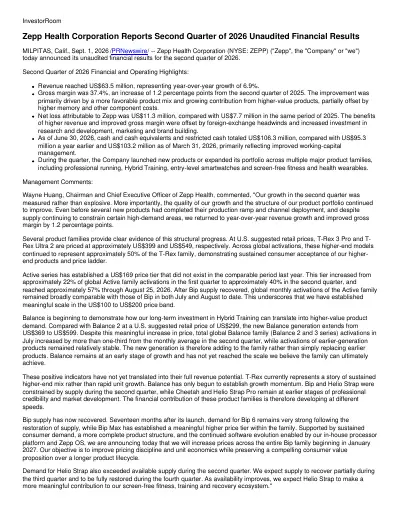
Hello, everyone, and thank you for joining Zepp Health's second quarter 2026 earnings call. In the second quarter, revenue reached $63.5 million, representing year-over-year growth of 6.9%.
Gross margin was 37.4%, improving by 120 basis points from the same period last year. This was measured rather than explosive growth.
However, the quality and direction of the improvement are important. Before all of our new products have fully completed their production ramps and channel expansion, we have already returned to year-over-year revenue growth while improving gross margin.
This improvement was achieved despite higher memory and other component costs. During the first half of this year, and partially and particularly during the second quarter, we launched or expanded products across our major families, with each family serving a distinct strategic role.
I would therefore like to use this opportunity to explain how our major product families are developing, and more importantly, how they are collectively changing the quality and the longer-term growth potential of our business. The first clear development is that our product mix is moving toward higher-value products.
Within the T-Rex family, we have established a mature and stable higher-end product structure. T-Rex 3 Pro and the T-Rex Ultra 2 have US suggested retail prices of approximately $399 and $549, respectively.
These higher-end models have continued to account for approximately 50% of recent global T-Rex family activations. The important point is that this higher-end mix has been sustained at approximately half of the family, demonstrating durable consumer acceptance of both our higher-end products and the broader T-Rex price ladders.
The Active family demonstrates our ability to create and expand a new price tier. Using a strict definition that includes only Active 3 Premium and Active Max, both positioned at a US suggested retail price of $169, this tier increased from approximately 22% of global Active family activations in the first quarter to approximately 40% in the second quarter.
It reached approximately 49% in July and approximately 57% through August 25. There were no US -- no $169 Active products in the comparable period last year.
This therefore represents genuine adoption of a new higher price tier rather than a reclassification of existing products. The overall scale of Active is equally important.
Following the recovery in Bip supply, total global monthly activations of the Active family remained broadly comparable with those of Bip in both July and August to date. This comparison is particularly meaningful because Bip itself has returned to a strong scale and continued to experience strong consumer demand.
It demonstrates that Active, a family centered largely in the $100 to $200 price range, can now sustain approximately the same global activation scale as Bip family, our family anchored in the sub-$100 segment, even after the supply constraint on Bip was removed. Together with the growing contribution of our $169 Active products, this provides strong evidence that our overall volume mix is moving toward higher-value product bands.
The Balance family provides more than another example of premiumization. It is also important evidence that our strategic focus on hybrid training is beginning to translate into product adoption and growth.
Balance 3 was designed around the core needs of hybrid training users, athletes who combine strength, endurance, and recovery within a single training system. Together with Balance Ultra and Helio Strap Pro, it supports our goal of building a differentiation position in hybrid training rather than competing only as another general-purpose wearable brand.
Our sustained engagement with the the HYROX and hybrid training communities has given us a deeper understanding of these athletes and their training needs. Balance also entered this product cycle with the benefit of several generations of accumulated product credibility and user trust.
Another increasingly important source of that competitiveness is the product design language and aesthetic capability we have established across our higher-end portfolio this year. The most direct way to understand this progress is to experience the products themselves, to see, touch, and wear them, and to appreciate not only their performance, but also their materials, form, and finish.
Achieving both objectives at the same time requires significant engineering investment. The broader use of metal, more refined materials, and more sophisticated industrial design can affect antenna performance, wireless connectivity, positioning signals, and sensor sensitivity if they are not careful engineered.
Our ability to improve materials, craftsmanship, and design while maintaining a high level of GPS, connectivity, sensor, and sports performance is therefore not simple, an aesthetic achievement. We believe it is an important and increasingly differentiated technology capability.
This capability is particularly visible in the new Balance generation. Balance 2 has a US suggested retail price of $299.99, Balance 3 starts at $369.99, Balance 3 Titanium is priced at $499.99, and Balance Ultra at $599.99.
Despite this meaningful step-up in price, adoption of the new generation has developed quickly. Balance 3 and Balance Ultra together increased from approximately 3% of global Balance family activations in the second quarter to approximately 26% in July and approximately 30% through August 25.
This was not simply a mix shift caused by the replacement of the earlier-generation products. In July, total global Balance family activations increased by more than one-third compared with the monthly average in the second quarter, while activations of the earlier-generation Balance products remained relatively stable.
Balance 3 and Balance Ultra were announced in early June, with production and channel deployment ramping through July and August. Initial supply of certain titanium models began only in August.
The early momentum we have observed validates our product direction and high and hybrid training strategy. However, the new generation has not yet reached the scale or made the financial contribution that we believe it ultimately can.
Taken together, these three families demonstrate different but complementary capabilities. T-Rex shows that we can sustain in a mature higher-end structure.
Active shows that we can establish a new price tier and scale the overall family. Balance shows that our strategic investment in high hybrid training, product design, and engineering can support sustained, sorry, higher prices, incremental demand, and a differentiated market position.
Bip provides the other side of our product strategy: a strong entry-level foundation combined with improving pricing discipline. Bip is our entry-level product family anchored by Bip 6 and the in the sub-$100 segment at a US suggested retail price $79.99.
Bip 6 was launched 17 months ago. Although its availability was constrained during the second quarter, demand remained very strong after supply recovered.
This reinforced our confidence in the product's competitiveness and its ability to sustain a meaningful longer life cycle. The longevity of Bip 6 is also supported by our vertically integrated technology stack.
Our in-house processor platform was designed with meaningful computational headroom for continued optimization, while Zepp OS continues to become more capable and intelligent. Together, these capabilities allow us to continue improving Bip 6 through software after launch without relying solely on a new hardware cycle.
This strengthens the product's long-term value proposition and supports our confidence in a longer product life cycle. At the same time, Bip Max, which began contributing during the second quarter, has recently represented approximately one-third of global Bip family activations.
This creates a more complete internal price ladder, while Bip 6 continues to provide a strong volume foundation. The recovery in supply, the sustained strength of Bip 6, its continued software evolution, and the growing contribution from Bip Max give us confidence to move from rebuilding scale towards stronger pricing discipline and healthier unit economics.
Higher memory and component costs have created pressure on the profitability of entry-level products. However, the pricing decision we are announcing today is supported by enduring consumer demand and the continued competitiveness of the Bip family.
Therefore, today we are announcing that we will increase prices across the entire Bip family beginning in January 2027. Our objective is to preserve Bip's compelling consumer value proposition while supporting healthier and more sustainable unit economics over a longer product life cycle.
We also see growing strategic relevance in screen-free wearables. Google's recent launch of Fitbit Air further validates the screen-free wearable category that Amazfit entered last year with Helio Strap.
Helio Strap provides screen-free, subscription-free fitness, sleep, and recovery tracking within the broader Amazfit and the Zepp App ecosystem. Demand exceeded our available supply during the second quarter.
We expect supply to recover partially during the third quarter and to be fully restored during the fourth quarter. As availability improves, we expect Helio Strap to make a more meaningful contribution while continuing to strengthen our broader training and recovery ecosystem.
Building on Helio Strap, Helio Strap Pro serves a more specialized role. It is designed specifically for HYROX and high-intensity hybrid training, with additional capabilities continuing to be developed through software updates.
At this stage, its role is to serve as a professional and technological spearhead, allowing us to develop advanced training and recovery capabilities with highly demanding athletes, and then expand mature capabilities across the broader Amazfit ecosystem. We are also building professional credibility in running through Cheetah.
Unlike Balance, Cheetah does not yet benefit from the same multigenerational product foundation. Its professional credibility must therefore be earned progressively through product development, athlete adoption, and real-world performance.
Over the past several months, we have begun to see increasingly visible evidence of this progress. After joining Amazfit as an athlete partner, Josh Kerr broke the world record for the one mile.
Amazfit athlete Ben Dhiman won this year's UTMB Mont-Blanc. Yomif Kejelcha finished second in the London Marathon in under two hours, and later, wore Cheetah 2 Pro when he set the half marathon world record.
Yomif is not a contracted Amazfit athlete, making his choice to use our product during a world record performance a strong validation of our credibility among elite runners. We recognize that the credit belongs to the athletes, while their choice to compete with Amazfit reflects growing trust in our products at the highest level of sport.
These positive product indicators should not be interpreted to mean that every family is already contributing all at full scale. T-Rex currently represents a story of sustained higher higher-end mix rather than rapid unit growth.
Active has delivered clear growth in both scale and the product mix, while the higher-priced Balance generation has only begun to establish initial momentum. Bip and Helio Strap were constrained by supply during the second quarter, and Cheetah and Helio Strap Pro remain at an early stage of professional credibility and market development.
As a result, the strategic progress across our portfolio has not yet translated into its full revenue potential. The product direction is increasingly clear, but the financial contribution is developing at a different speed across the portfolio.
At the same time, higher memory and component costs affected profitability across multiple multiple product families, with a greater relative impact on entry-level products. This cost pressures particularly offset the benefit of our improving product mix.
The fact that gross margin still improved by 120 basis points year-over-year despite these headwinds provides further evidence that the underlying mix improvement is real. Looking ahead to the third quarter, based on our current outlook, we expect revenue to be between $68 million and $73 million.
This would represent a year-over-year decline of approximately 4% to 10%. The comparison base is important.
Revenue in the third quarter of last year grew by 78.5% year-over-year to $75.8 million. Against that higher base, the activation trends we observed in July and August indicated continued improvement in both product mix and consumer demand.
The normal production ramp and channel deployment cycle means that these improvements will not all be reflected in reported revenue immediately, and our guidance incorporated that timing. We will remain disciplined in how we manage pricing, product positioning, and gross quality.
Our priorities are to expand the contribution of higher-value products, improve the unit economics of our entry-level portfolio, restore supply for products where demands remain strong, and build deeper and more durable brand credibility through professional products, athletes, and the sports communities. We believe these changes are establishing a higher-quality, more resilient, and more sustainable foundation for Zepp Health's future growth.
With that, I will now turn the call over to our Chief Financial Officer, Leon Deng, to discuss our financial results and outlook in greater detail. Leon, please go ahead.
Leon Deng
Thank you, Wayne. Greetings, all.
Let me walk you through our financial performance for the second quarter. Starting with top line, our revenue came in at $63.5 million, in line with the guidance we provided.
Total revenue grew approximately 7% year-over-year, primarily driven by the new product launches we introduced during the first half of the year, including, among others, Active 3 Premium, Active Max, and Bip Max. As Wayne mentioned, our revenue this quarter was impacted by the timing of product launches and product availability, namely the Balance 3 series and the Helio Strap.
While underlying consumer demand remained healthy, the timing of product availability affected the quarterly revenue contribution from certain new products, resulting in a temporary impact on near-term revenue growth. Turning to gross margin, our performance continue to reflect a combination of factors, including product mix, launch timing, and normal product life cycle dynamics, such as model upgrades.
In Q2, our gross margin was 37.4% compared with 36.2% in the same period last year, and broadly in line with the first quarter of 2026. The year-over-year improvement continued to reflect the structural strengthening of the Amazfit brand, driven by a stronger contribution from new products with premium pricing and healthy margins, as well as continued ASP expansion supported by growing brand recognition and consumer adoption.
At the same time, we continued to navigate certain cost headwinds, including higher memory component prices and foreign exchange fluctuations, particularly the appreciation of RMB. These factors partially offset the benefits from our improved product mix and margin expansion.
Looking to the second half, we are managing the headwind of higher memory costs that are putting downward pressure on our gross margin. As the semiconductor industry is in the middle of a transition from DDR4 to DDR5 and High Bandwidth Memory, driven by AI and data center demand.
That is tightening supply for the memory chips we use, and increasing costs across consumer electronics industry. Our global operations team has been focused since 2025 on securing sufficient supply to support our manufacturing demands.
This means pursuing supplies through multiple channels. We're also leveraging our engineering expertise to optimize memory requirements across different and future designs, all without compromising product performance or customer experience.
With regard to the effect of higher memory prices, we have a variety of levers to mitigate and the impact. Our focus is on managing the headwind thoughtfully without losing sight of the large opportunities to drive top-line growth alongside increased profitability.
On the topic of tariffs, we have filed refund of prior duties paid. The benefit could be another meaningful offset to the higher memory costs.
While memory headwinds are real, we're managing them from a position of preparation and expertise. We remain confident in the long-term margin opportunities of our business.
As our product portfolio continues to shift towards premium products and our brand positioning strengthens, we expect to continue improving the quality of our gross margin over time. Turning to operating expenses, we remain committed to the prudent cost management discipline we initiated in 2020 and invest on opportunities where we see fit.
Total adjusted operating expenses for the second quarter were US$34.8 million compared with US$26.4 million in the second quarter of 2025 and US$35.7 million in the first quarter of 2026. The year-over-year increase of US$8.4 million was primarily attributable to two factors: approximately US$2.7 million was related to foreign currency expense impacts, while the remaining US$5.7 million was mainly driven by higher selling and marketing investments.
On a sequential basis, operating expenses decreased slightly. Looking ahead, we will cautiously manage the overall expense level, especially when the pace of the new product launches in the second half moderates.
Adjusted R&D expenses were US$10.8 million compared with US$10.3 million and US$11.9 million in the second quarter of 2025 and first quarter of 2026, respectively. Excluding approximately $0.7 million of foreign currency headwinds, R&D expenses were slightly lower year-over-year.
We continue to invest selectively in cutting-edge products and emerging technologies, including AI, to further strengthen our competitive position. At the same time, we maintain a disciplined approach to R&D resource allocation, continuously improving efficiency and optimizing returns on our investments.
Adjusted selling and marketing expenses were $18.2 million compared with $12 million and $16.4 million in the second quarter of 2025 and first quarter of 2026, respectively. The $6.2 million year-over-year increase was primarily driven by investments supporting new product launches and brand building, including $2.9 million in launch campaigns, as well as $1.6 million in e-commerce platform fees, which increased in line with revenue growth.
The remaining increase reflected strategic brand-building initiatives, including $0.7 million in athlete sponsorships, $0.5 million related to our HYROX partnership, and another $0.5 million in physical retail and event activations. These events are designed to further enhance brand awareness, strengthen consumer engagement, and support our long-term growth.
Adjusted G&A expenses were $5.8 million compared with $4.1 million and $7.4 million in the second quarter of 2025 and first quarter of 2026, respectively. The majority of the year-over-year increase were attributed to foreign currency impacts.
In addition, we continue to make targeted investments to protect our intellectual property rights and support certain legal and regulatory matters. During the quarter, we also achieved a favorable income outcome with respect to the lifting of the Section 337-related exclusion order in the US.
Beyond this strategic investments, we continue to streamline our overhead structure and maintain disciplined cost control while improving operating efficiency. Turning to profitability, we remain focused on gradually improving operating leverage as we scale the Amazfit brand business, while maintaining sufficient investment behind product innovations, software development, and brand awareness.
With higher revenue and improved year-over-year gross margin partially offsetted by higher operating costs and unfavorable foreign exchange translation differences, our adjusted operating loss was $11.1 million compared with $4.9 million in the second quarter of 2025. Net loss was $31 million in the first half of 2026 compared with $27.5 million a year ago, including approximately $4.5 million in foreign exchange headwinds, primarily due to the appreciation of the RMB against the US dollar.
Moving on to working capital, we continue to manage inventory carefully during the quarter. We recorded inventory of $62.4 million for Q2 2026, which was flat compared with Q1 2026 and decreased by $17.5 million compared with the same period last year.
Inventory remained under tight control, reflecting our continued focus on improving inventory efficiency and aligning production and procurement more closely with actual market demand. Turning to cash, we ended the quarter with a solid liquidity position.
As of Q2 2026, cash and cash equivalents were $106.3 million, increased by $11 million and $3 million each compared with Q2 2025 and Q1 2026. The cash balance increase was primarily driven by enhanced working capital efficiency, which more than offset the net loss recorded during the period.
The cash position provides ample runway for the company to invest and seize potential market opportunities in the future. We continue to actively manage our debt profile and overall financing structure.
Long-term and short-term debt levels increased by $6.2 million as of Q2 compared with Q1 2026. The increase was entirely attributable to a rise in long-term debt with a corresponding decrease in short-term debt.
We remain committed to prudently managing our debt profile. Our primary objective is to maintain overall debt levels broadly stable while actively extending the maturity profile by replacing short-term borrowings with long-term debt.
During the quarter, we successfully converted $13.3 million of short-term debt into long-term obligations, and we expect to continue this trajectory in the coming quarters, supported by sufficient financial headroom and liquidity capacity. Since the beginning of 2023, the company has cumulatively retired $40.2 million of debt, and will continue to optimize the capital structure going forward.
We'll continue to take a disciplined approach to capital allocation, maintaining a healthy balance sheet and strong liquidity. Our first half performance demonstrates our ability to grow the Amazfit business while sustaining gross margins meaningfully above historical levels.
Looking ahead, we remain focused on strengthening our product portfolio, expanding our global brand presence, developing the Zepp ecosystem and hybrid training experiences, and maintaining disciplined cost and working capital management. We also remain committed in our share repurchase program.
As of Q2 2026, we had repurchased $17.6 million under the $20 million authorization. Overall, we remain focused on sustainable, high-quality growth, supported by a healthier product mix, disciplined cost management, and continued operational improvements.
With that, I will hand the call back to operator for Q&A. Operator, please go ahead.
Operator
Thank you. We will now begin the question-and-answer session.
To ask a question, please press star, then one. To remove yourself from queue, please press star, then two.
Once again, that's star, then one if you have a question. We will pause for just a moment to assemble our roster.
Today's first question comes from Sid Rajeev with Fundamental Research Corp. Please go ahead.
Sid Rajeev
Hi. Thank you for the details.
I have two questions if I may. First one, on the supply bottlenecks affecting Bip and Helio Strap, when do you expect these issues to be fully resolved, and how confident are you that supply will be sufficient to meet Q4 demand?
Leon Deng
Hi, Sid. Good, good, good evening.
On your question, I think we have explained earlier, for Bip, we are almost we have almost removed all the restrictions or supply bottlenecks by now. On Helio Strap, we are gradually working on fully restore the supply bottleneck.
In Q3, you will still see the impact of the supply constraint a little bit, but that has already been reflected in the guidance which we have provided. In Q4, we're expecting the Helio Strap to be in full supply.
Sid Rajeev
Okay. Thank you.
Second question, selling expense increased significantly in Q2. Where do you see the biggest opportunities to reduce OpEx, and should we expect selling expenses to remain at similar levels in Q3?
Leon Deng
No, obviously not. I think if you look at my explanation towards selling expenses, you will see majority of the increase around $2.9 million link to the new product launches which we have launched in Q2.
Obviously Q2 is it was a busy quarter that we launched a a lot of new products if you can recall, right? I think to name a few, we probably have around six or seven new products launches in Q2 in this quarter, compared with one or two in the previous year.
Each product are attached to certain amount on marketing efforts, activation budgets, etc., etc. If you simply multiply by seven or six, that will be a sizeable number.
As as I mentioned, we are almost done with new product launches for the year by now. Maybe there's only one or two in the second half of this year, but those are minor product launches compared with the ones we had in the first half of the year.
You will see the selling expenses moderates when the activity kind of moderates.
Sid Rajeev
In total, how many products were launched this year, to be exact?
Leon Deng
I think if I'm correct in so far, we probably launched 9 to 10 products, and there's still 1 to 2 in the pipeline. There's going to be, yeah, it's a lot of new products.
Sid Rajeev
So, 10 to 12 products this year. Last year, I remember, it's nine, is that a fair assumption?
Leon Deng
I think last year it's less, but I can come back to this number later on.
Sid Rajeev
Thank you so much, Leon. Appreciate it.
Operator
Thank you. Our next question comes from Frank Duggan at Brooks Investments.
Please go ahead.
Hi, Leon. Congratulations on the second quarter performance.
My first question is around your outlook for the third quarter of 2026. Can you walk us through the main reasons for the expected revenue decline in Q3, and also how do your profitability and cash flow look against current guidance?
Leon Deng
I think as I have explained and also Wayne explained before, the Q3 outlook actually incorporates a few things. Number one, I would say you're looking at macroeconomic situations around the world.
There's inflation, everybody is pressed on the discretionary income, and the consumers are kind of squeezed because of the higher oil price, etc., etc., right? Naturally the the macroeconomic and on the demand side, people are more or or less keen to buy new things.
That is the macro situation for consumer electronics. Number one, that's number one.
Number two, we have explained that a lot of the the the the the impact which goes into the Q3 guidance are linking to supply issues or supply constraints, which I just answered the question from Sid, namely Helio Straps, Balance 3, and and Bip series. Then we're working towards resolving them, and and some of them will be resolved fully in Q3, some of them will be resolved in Q4.
Holiday season for Q4 would be a good quarter with full supply compared with what we have experienced in Q1 and Q2 to some extent. Number three, I think it's linking to the new product launch windows and also on the the process and and the speed we can actually get the trade in selling them.
For example, Balance 3, that's the situation. Number one, it's a beautiful piece of it's a piece of art of watch which we developed for the hybrid training, but we just couldn't manufacture them good enough.
It's it's it's it it has a lot of difficulties in building them, which we believe that we're resolving them as we speak. Linking to the supply constraints, linking to the new product launch windows, and linking to the bigger macroeconomy situation, we have come up with the Q3 number as you see right now.
Mind you, last year Q3, the base was $75.8 million, and that was a year-on-year growth over 2024, if I remember correctly, of more than 75%, right? Obviously, yeah, we we we we're doing our best, but it's a few of those factors which I just mentioned has been taken into account in the guidance of Q3 which we put forward.
Yes. For the longer-term period, do you have any a longer long-term strategy to get the business back to growing year-over-year?
Leon Deng
I think on on on if if if if my calculation is correct, I mean first half of the year, we are still growing by more than 17%, 18% year-over-year. If you account for even the low end of the guidance for Q3, we are still growing.
Then if you you heard us correctly, Q4, we we are pointing or we're aiming to deliver a growth or at least go back to the growth trajectory. Altogether, if you add it all up, I think on a full-year basis, we're still working or you're still looking at a growth trajectory for the for the top line.
Lastly, my question would be around the market performance, especially Balance 3 and do you have plans to develop a subscription model for the business?
Leon Deng
Yes and no. I think we are having in our current Zepp App a subscription functionality, but it's more towards your sleep quality on how to get you relax better, changing your stress levels, etc., etc.
We are we believe that the the the by providing all those professional functionalities for free to the user at this moment of time is also one of our key competitive edge against the competitors. For now, I think except for the services which which I just mentioned, in a short term, we don't have any subscription charges ideas on Balance 3 at this moment.
Okay. Thanks.
Thanks, Leon.
Leon Deng
Thank you.
Operator
Thank you. As there are no further questions, now I'd like to turn the call back over to the company's IR Director, Grace Song, for closing remarks.
Grace Zhang
Thank you once again for joining us today. If you have further questions, please feel free to contact Zepp Health's Investor Relations department.
Thank you.
Operator
Thank you. This concludes the conference call.
You may now disconnect your lines. Thank you.