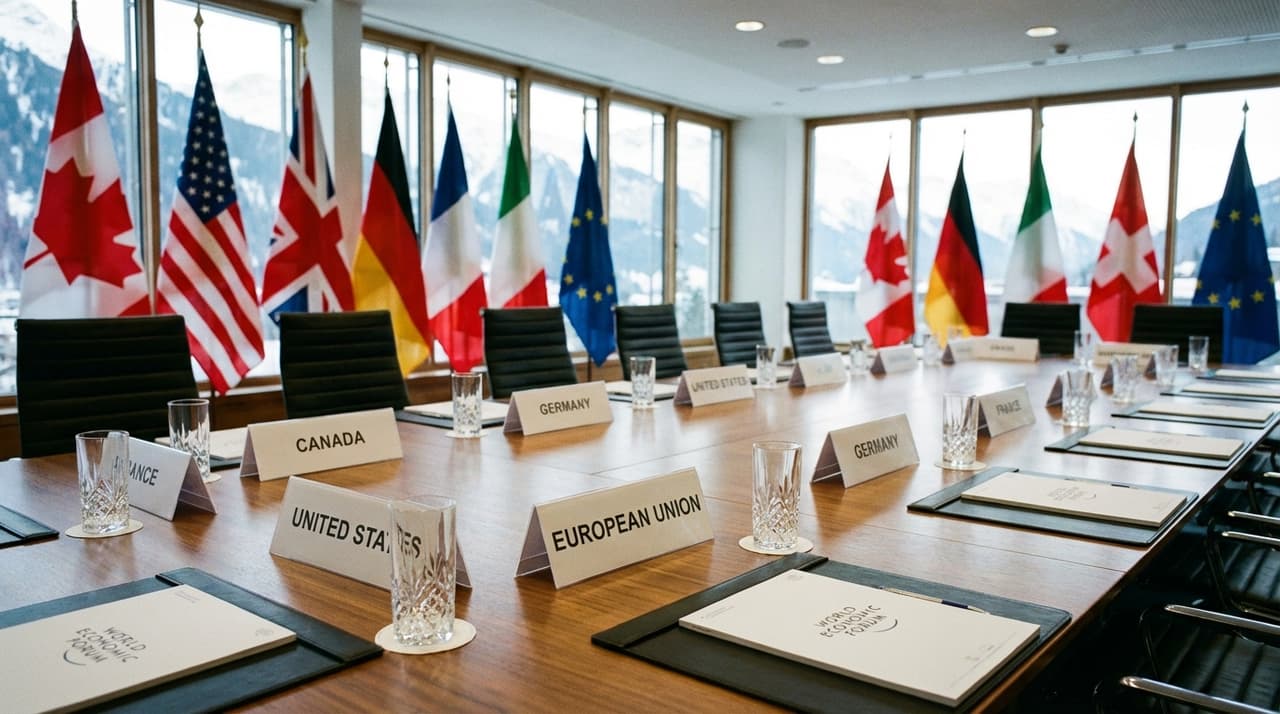
- Canada's Prime Minister Mark Carney strongly opposes U.S. tariffs targeting allies over Greenland, calling it a "serious escalation" that undermines sovereignty and NATO ties.
- The tariffs—10% starting February 1, rising to 25% on June 1—target Denmark, Norway, Sweden, France, Germany, the Netherlands, Finland, the UK, and implied extensions to Canada unless the U.S. gains "complete and total" ownership of Greenland.
- EU leaders schedule an emergency summit, with France pushing the Anti-Coercion Instrument against U.S. firms, while Carney plans to raise concerns with Trump at Davos.
Canada's Prime Minister Mark Carney has taken a firm stance against what he describes as a "serious escalation" in trade tensions, directly challenging U.S. President Donald Trump's announced tariffs aimed at pressuring Denmark to sell Greenland. Speaking in Doha on January 18, Carney reiterated Canada's unwavering support for Danish-Greenlandic sovereignty and committed to Arctic defense through NATO channels, according to people familiar with his remarks. The move comes just a day after Trump announced via Truth Social escalating tariffs on goods from eight European nations and implied extensions to Canada, with no executive order detailing specific products or exemptions yet released.
Efforts to de-escalate the situation have hit a snag, as Trump's demands for "complete and total" ownership of Greenland—a self-governing Danish territory—have been flatly rejected by both Denmark and Greenland's government. Without a deal, the targeted nations face increased costs in the U.S. market, potentially unraveling recent EU/U.S. trade deals critical for exporters like Ireland. Ireland's finance department had previously called such agreements a "shield" against higher tariffs, highlighting the stakes involved.
Market analysts note that the tariffs could generate additional revenue under the International Emergency Economic Powers Act (IEEPA), which has already brought in over $140 billion since 2025, but this faces an imminent U.S. Supreme Court review that might lead to refunds if overturned. Meanwhile, separate pauses on 2026 tariff hikes for items like kitchen cabinets keep some rates at 25%, signaling selective flexibility in Trump's approach. "This is a dangerous downward spiral," said one European trade official, who requested anonymity due to the sensitivity of ongoing negotiations. "We're seeing unprecedented tariff coercion on allies, and it risks fracturing NATO bonds at a time when Arctic resource competition is heating up."
In response, eight targeted European nations issued a joint statement condemning the tariffs and affirming solidarity with Denmark and Greenland, with EU Council President Antonio Costa calling an extraordinary meeting. French President Emmanuel Macron has rejected trade threats, vowing a united response, while UK Prime Minister Keir Starmer deemed tariffs on NATO allies "completely wrong." Carney, for his part, emphasized NATO's role in Arctic security and plans to raise concerns directly with Trump at the upcoming Davos meetings, according to sources briefed on his itinerary.
On the ground, protests have erupted in Nuuk, Greenland's capital, with the largest-ever demonstrations chanting "Greenland is not for sale," and solidarity rallies have spread to Canadian Inuit communities in Iqaluit, Nunavut. Exporters in the targeted nations now face higher U.S. market costs, and consumers may see price hikes as global supply chains remain vulnerable with no exemptions likely. Historical context adds weight to the situation: Trump revived his 2019 push to buy Greenland, framing it as vital for U.S. security amid Arctic competition, but this marks an unprecedented use of tariff coercion on allies, echoing past U.S. territorial interests like 1940s WWII base expansions.
Looking ahead, the EU summit this week may activate the Anti-Coercion Instrument, potentially restricting U.S. foreign direct investment, intellectual property, or market access, mirroring tools used in prior U.S.-China disputes. Davos meetings between Trump, Carney, and European leaders could either escalate or de-escalate the standoff, with experts warning of sustained U.S. pressure unless sovereignty is upheld. Carney's push for an Arctic defense buildup underscores the long-term risks, including potential NATO fractures and broader trade wars. As one former Canadian UN ambassador put it, "This aggression risks global security, and we must stand firm." Attempts to reach the White House for comment were unsuccessful at press time.
Correction: An earlier version misstated the timing of the EU summit; it is scheduled for this week, not next.