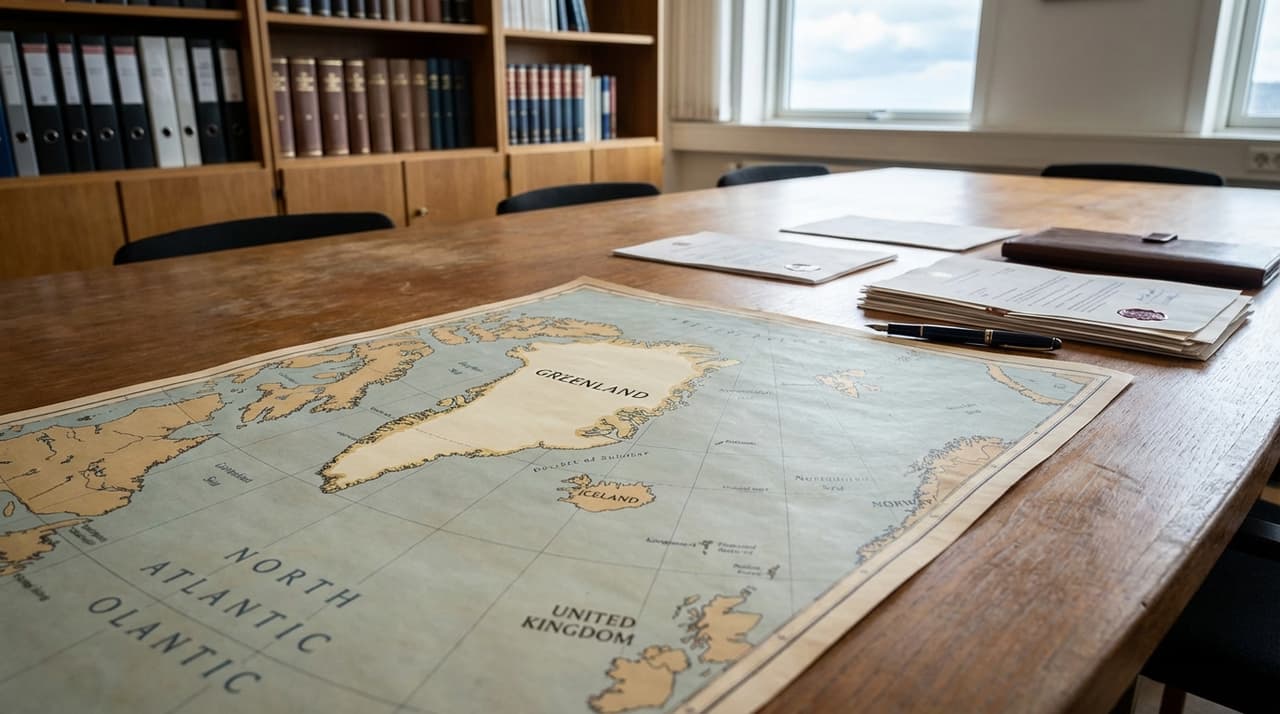
- President Trump declines to say whether he would use U.S. military force to seize Greenland, while threatening 10% tariffs on eight NATO allies starting February 1.
- European nations issue joint statement reaffirming support for Denmark's sovereignty, with France preparing to request EU trade retaliation measures.
- Trump links the dispute to not receiving the 2025 Nobel Peace Prize, claiming Norway controls the decision, which Norwegian officials have rejected.
President Trump has intensified pressure on Denmark and NATO allies to relinquish control of Greenland, combining military threats with economic coercion in a move that risks significant transatlantic trade escalation and alliance strain. In an interview with NBC News, Trump refused to rule out using U.S. military force to seize the territory, responding "No comment" when asked directly about potential military action.
Simultaneously, the administration has announced a 10% tariff on goods from Denmark, Norway, Sweden, France, Germany, the U.K., the Netherlands, and Finland, scheduled to take effect on February 1. According to people familiar with the matter, these tariffs are set to escalate to 25% on June 1 and remain in place until the U.S. acquires Greenland. The tariffs were triggered partly by NATO allies' deployment of small military contingents to Greenland for Operation Arctic Endurance exercises, though European officials have characterized this as routine alliance activity.
Trump claims that only complete U.S. control of Greenland can prevent the Arctic island from falling under Chinese or Russian influence and ensure American security. "Denmark is incapable of protecting the territory from these threats," Trump stated in recent remarks. However, U.S. lawmakers from both parties have rejected these security arguments. Senator Mark Warner, Democratic vice chairman of the Senate Intelligence Committee, characterized the Russian and Chinese threats as "fictitious" in comments to reporters on Thursday.
European NATO allies have united in opposition, with all eight targeted nations issuing a joint statement reaffirming support for Denmark and Greenland's sovereignty. They emphasized that decisions about Greenland's future should be determined by its people and Denmark, and warned that tariff threats undermine transatlantic relations. British Prime Minister Keir Starmer stated he does not believe Trump will actually use military force, but emphasized that "alliances endure because they're built on respect and partnership, not pressure." He characterized using tariffs against allies as "completely wrong" and called for "calm discussion."
Trump also linked the dispute to not receiving the 2025 Nobel Peace Prize, stating in a message to Norway's Prime Minister that this decision means he no longer feels "an obligation to think purely of Peace." Norwegian officials have rejected the claim that they control the Nobel decision and reaffirmed support for Denmark's sovereignty over Greenland.
The European Union is mobilizing response measures. European Council President Antonio Costa called an "extraordinary meeting" of all 27 EU nations to address the crisis, according to diplomatic sources. France has indicated it will request activation of the EU's "trade bazooka"—an anti-coercion mechanism that could impose severe restrictions on U.S. goods and services, including limitations on investment, public procurement access, and intellectual property protections.
Greenland has been a Danish territory for centuries and is a self-governing territory of the Kingdom of Denmark. The U.S. has maintained military presence there since World War II and has had formal defense access since a 1951 defense agreement. NATO allies argue that Greenland's security is already protected through the transatlantic alliance and shared NATO responsibility. Denmark has demonstrated commitment to Arctic defense, announcing a $6.5 billion Arctic defense package in response to earlier U.S. criticism.
The situation presents significant risk as diplomatic channels struggle to resolve the disagreement before the February 1 tariff implementation. Trump's continued refusal to rule out military action suggests minimal near-term resolution, with European officials privately expressing concern about the potential for broader U.S.-EU trade conflict. Efforts to reach the White House for additional comment on the military implications were unsuccessful.