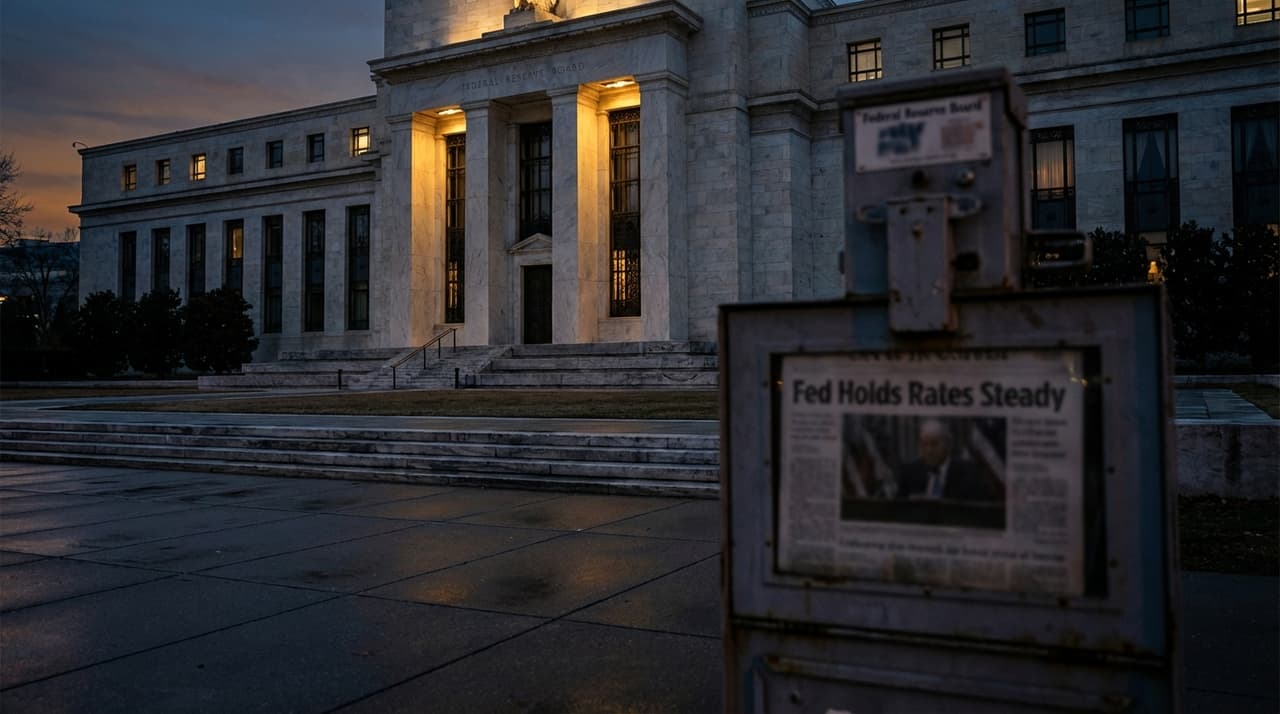
- Federal Reserve maintains federal funds rate at 3.5%–3.75%, pausing easing cycle that began in late 2025
- Decision comes despite President Trump's public pressure for deeper rate cuts, highlighting tensions over Fed independence
- Mixed economic signals—solid growth but low job gains and persistent inflation—justify hold, though two FOMC members dissented
A Pause in the Easing Cycle
The Federal Reserve completed its January 2026 meeting on January 28, holding the federal funds rate steady at 3.5%–3.75%, rejecting President Trump's calls for rate cuts. This decision reflects a pause in the easing cycle that began in late 2025 with three consecutive rate cuts, signaling a cautious approach amid economic crosscurrents.
Trump has publicly pressured the Federal Reserve to lower interest rates significantly, arguing the U.S. should maintain the lowest rates globally. However, Fed Chair Jerome Powell has consistently stated that monetary policy decisions are data-driven, not politically motivated, a stance reiterated in a January 11 statement where he emphasized the Fed must "set interest rates based on evidence and economic conditions—or whether instead monetary policy will be directed by political pressure or intimidation."
Economic Rationale and Internal Divisions
The Fed's decision to pause rate cuts reflects mixed economic signals. The central bank noted that economic activity has expanded at a solid pace, but job gains have remained low and inflation persists above the Fed's 2% target. The December projections signaled only one 25-basis-point rate cut for all of 2026, underscoring the cautious outlook.
Two FOMC governors—Stephen Miran and Christopher Waller—voted against the hold, advocating for another 25-basis-point cut, indicating internal disagreement over the appropriate policy stance. This dissent highlights the delicate balance the Fed faces in navigating political pressures while adhering to its dual mandate of price stability and maximum employment.
Broader Implications and Leadership Uncertainty
The rate hold means borrowing costs will likely remain stable in the near term. However, rates on several loan types are already at their lowest levels in years following 2025's cuts, providing some relief for consumers amid ongoing affordability concerns. If the Fed maintains rates steady, individual consumers may not feel immediate impact from this decision, but the broader debate reflects tension between Trump's affordability agenda—which includes proposals to cap credit card rates at 10% and restrict institutional investors from purchasing single-family homes—and the Fed's independence.
Political pressure on the Fed has intensified beyond rate policy. The Department of Justice opened an investigation into Powell related to the central bank's building renovation project, which Powell characterized as "a pretext for weakening the Fed's independence." Additionally, the Supreme Court is weighing whether to allow Fed Governor Lisa Cook to retain her position after Trump sought her removal.
Looking ahead, Trump is expected to announce a successor to Powell, whose term expires in May 2026. Top candidates include National Economic Council Director Kevin Hassett, Federal Reserve Governor Christopher Waller, former Federal Reserve Governor Kevin Warsh, and Rick Rieder, BlackRock (BLK)'s chief investment officer, adding another layer of uncertainty to the central bank's future direction.
Correction: An earlier version of this article misstated the timing of the Fed's meeting; it was completed on January 28, 2026.