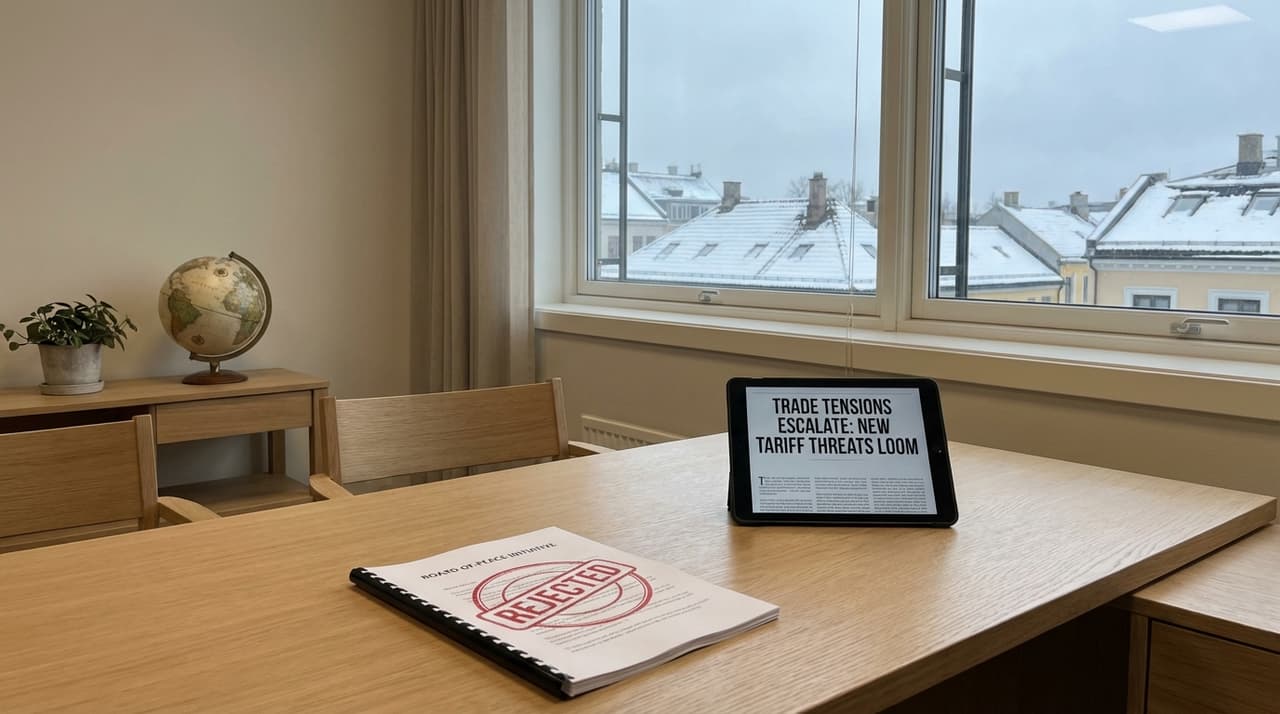
- Norway's Deputy Foreign Minister states the country cannot participate in President Trump's 'Board of Peace' initiative as currently presented, citing escalating U.S.-Nordic tensions.
- President Trump threatens 10% tariffs on imports from eight NATO allies, including Norway, starting February 1, 2026, rising to 25% by June 1, unless the U.S. gains control of Greenland.
- The dispute ties Trump's push for Greenland to a perceived Nobel Peace Prize snub, with Norway affirming support for Denmark's sovereignty and NATO allies issuing a joint condemnation.
Norway has formally declined to join President Trump's newly proposed 'Board of Peace' initiative, with Deputy Foreign Minister telling Daily Aftenposten that the country 'cannot participate as it is presented today.' This rejection comes amid rapidly escalating tensions between the U.S. and Nordic nations, primarily driven by Trump's renewed demand for U.S. control of Greenland and linked to frustrations over the 2024 Nobel Peace Prize.
According to people familiar with the matter, the situation intensified over the weekend when Trump sent a message to Norwegian Prime Minister Jonas Gahr Støre, criticizing Norway for not awarding him the Nobel Peace Prize—which was actually decided by an independent committee and given to Maria Corina Machado—and declaring he no longer prioritizes peace exclusively. In response, Støre's office affirmed Norway's support for Denmark's sovereignty over Greenland, a stance echoed in a joint statement from eight NATO allies condemning the tariff threats as undermining transatlantic relations. Efforts to reach the White House for comment were unsuccessful.
Trump's tariff threats, targeting imports from Denmark, Finland, France, Germany, the Netherlands, Norway, Sweden, and the UK, pose immediate economic risks. Starting February 1, 2026, tariffs would begin at 10%, escalating to 25% by June 1 if a purchase deal for Greenland is not reached. This move risks disrupting trade in critical resources like Norwegian oil, gas, and seafood, with stakeholders already bracing for cost hikes. 'Without a deal, the company would be forced into bankruptcy,' one industry insider noted, highlighting the potential fallout for Nordic exporters.
The political context adds layers to the conflict. Norway's government has clarified it has no role in Nobel decisions, emphasizing Greenland's status within Denmark's kingdom and NATO's Arctic security role. This dispute revives Trump's 2019 Greenland purchase proposal, now framed with national security rhetoric questioning Denmark's historical claims. It strains U.S.-NATO ties at a sensitive time, with European leaders pushing for de-escalation. Denmark's decision to skip the World Economic Forum in Davos this week signals the gravity of the situation.
In terms of societal impact, stakeholders range from Greenlanders facing sovereignty threats to Danish and Norwegian citizens confronting economic tariff risks. Public reactions have included social media mockery, such as Jon Stewart's quips on colonial claims, sparking broader debates on U.S. imperialism and Arctic militarization. The historical context traces back to Trump's first Greenland proposal in 2019, which was rejected by Denmark, and ties into the 2024 Nobel Peace Prize—awarded to Machado for prior achievements, who symbolically gave it to Trump last week for actions in Venezuela.
Looking ahead, the short-term outlook hinges on whether tariffs escalate into a full-blown trade war by February 1, with NATO rifts deepening if de-escalation fails. Long-term, heightened Arctic militarization risks loom as the U.S. pushes for Greenland control amid resource and geopolitical stakes. Joint European statements signal unified resistance, but no expert predictions were available in sources. Related developments include European leaders urging tariff reversal, citing a Greenland exercise as defensive, and Trump's Truth Social posts framing Greenland as unprotected from Russia and China. This broader U.S.-Europe tariff threat parallels past steel and aluminum disputes, adding to the complexity.
Correction: An earlier version misstated the timeline for tariff increases; they are set to rise to 25% by June 1, 2026, not immediately.