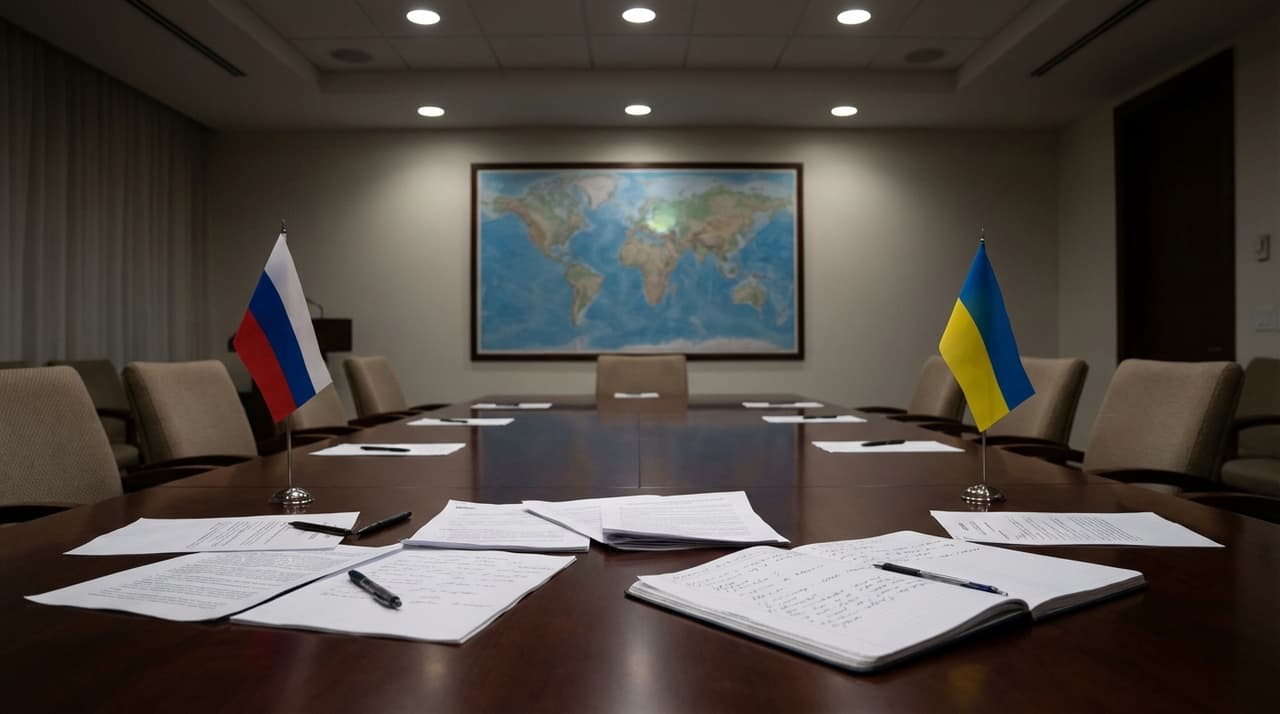
- Russian Foreign Minister Sergey Lavrov states via TASS that any deployment of foreign military forces or infrastructure in Ukraine would be viewed by Russia as direct foreign intervention, amid ongoing peace talks and Western security guarantee discussions as of late January 2026.
- US President Trump announced Putin agreed to a week-long moratorium on strikes against some Ukrainian targets as of January 29, while negotiations include Russian concessions like freezing frontlines in Zaporizhzhia and Kherson and allowing Ukraine a 600,000-800,000 troop army.
- European proposals for postwar military presence in Ukraine risk derailing talks, as Russia views it as intervention—aligning with Lavrov's warning, with Russia demanding permanent NATO bar and rights protections for Russian-speakers.
Russia has drawn a stark red line in the intensifying peace negotiations over Ukraine, with Foreign Minister Sergey Lavrov declaring that any deployment of foreign military forces or infrastructure in the country would be considered direct foreign intervention. The statement, delivered via state news agency TASS, comes as delicate talks enter a critical phase with Western security guarantees on the table.
According to people familiar with the discussions, the warning specifically targets European proposals for a postwar military presence in Ukraine, which Moscow sees as an unacceptable encroachment. "This isn't just posturing—it's a core security concern for them," one diplomatic source noted, speaking on condition of anonymity due to the sensitivity of the negotiations. Efforts to restructure the security framework have hit a snag over this precise issue, with Russia insisting on binding guarantees that exclude NATO membership or Western troops.
The backdrop to these tense diplomatic maneuvers includes a fragile battlefield moratorium. US President Trump announced that Putin agreed to a week-long pause in strikes against certain Ukrainian targets, effective January 29, providing a brief window for dialogue. Ukrainian officials, while cautiously welcoming the respite, emphasize that the ceasefire is limited and doesn't cover all frontlines. "We're using this time to assess our positions and coordinate with allies," a Ukrainian defense spokesperson said, though attempts to reach the Russian delegation for further comment were unsuccessful.
Negotiation parameters have evolved significantly since earlier stages of the conflict. Russia has reportedly conceded to allowing Ukraine a substantial standing army of 600,000-800,000 troops—a marked shift from previous demands to cap forces at 85,000. Additionally, Moscow has accepted Ukraine's Western-aligned status on approximately 80% of its pre-2014 territory, according to sources briefed on the talks. These concessions come amid Russia's own economic strains, with unsustainable military spending and persistent Western sanctions squeezing its fiscal capacity.
Financial implications loom large. The EU has committed €60 billion in military aid to Ukraine for 2026-2027, aimed at rapidly bolstering defensive capabilities. Meanwhile, Ukraine's drone production revolution is democratizing long-range weapons, enabling scaled output that could further pressure Russia's economy if Western funding continues. "The economic dimension can't be ignored," an analyst observed. "Russia's ability to sustain prolonged conflict is increasingly questionable, which may be driving their willingness to negotiate."
Human factors add complexity. Ukraine faces mobilization strains, with Defense Minister Mykhailo Fedorov reporting 200,000 soldiers AWOL and 2 million avoiding service. Public debate grows over sustaining the war versus accepting a Kremlin-favorable peace, even as Russian strikes on utilities aim to freeze civilians and spark a humanitarian crisis. On the other side, Russian troops have suffered over 1 million casualties, per analysts, with minimal territorial gains despite 2025 initiatives.
Looking ahead, the short-term trajectory hinges on compromise. Without it, Russia may intensify strikes and offensives to dictate borders, risking Ukrainian collapse. The current moratorium offers only a brief pause. Long-term, Western-funded Ukrainian drones and missiles could regain initiative, damaging Russia's economy and forcing a settlement—potentially yielding a secure, sovereign Ukraine with robust guarantees. Experts warn that indefinite war favors Russia, but a peace that leaves Ukraine strong could curb Putin's aggression, provided the security framework holds.
Correction: An earlier version misstated the timeline of the Alaska summit; it occurred in 2025, not 2024.