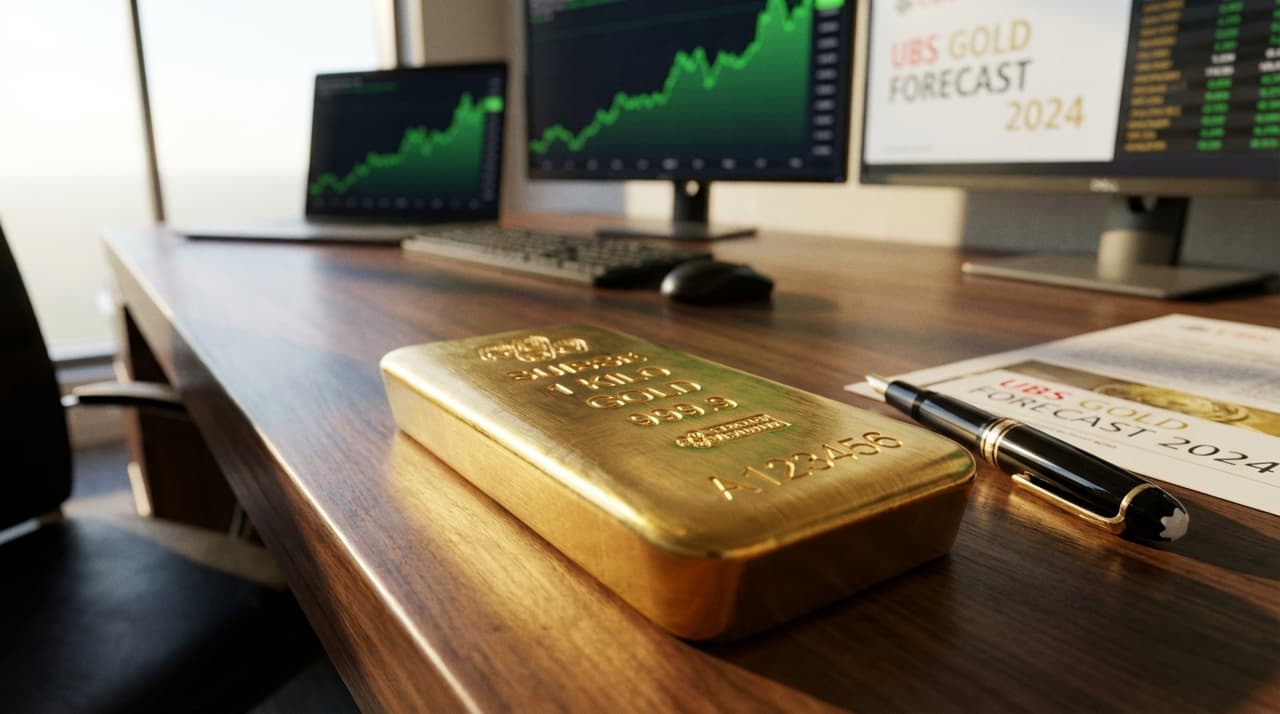
- UBS increases its gold price target to $5,000 per ounce for March, June, and September 2026, up from $4,300/oz previously, with a year-end projection of $4,800–$5,000/oz.
- The forecast is driven by low real yields from expected Federal Reserve rate cuts, U.S. fiscal pressures, and strong demand from ETFs and central banks.
- Gold has rallied 18% year-to-date in 2026, following a record 64–66% gain in 2025, positioning it as a key hedge amid economic uncertainty.
UBS Group AG (UBS), the Swiss multinational investment bank managing over $5 trillion in assets, has revised its gold price forecasts upward, signaling continued confidence in the precious metal's rally. In a move that aligns with a broader bullish trend among major banks, UBS now projects gold to reach $5,000 per ounce by the third quarter of 2026, according to people familiar with the matter. This adjustment comes as gold trades around $4,362/oz in late 2025, having surged 144% since 2020.
Efforts to capitalize on gold's momentum have intensified, with UBS citing low real yields from anticipated Fed rate cuts and rising U.S. deficits as primary catalysts. "We see structural demand supporting gains, with an upside scenario of $5,400/oz if U.S. political or financial risks escalate," a source close to the bank noted, emphasizing the role of gold as a diversification tool from the U.S. dollar. The bank's previous forecast in November 2025 had gold at $4,500/oz for June 2026, but recent ETF inflows—totaling $5.2 billion in November alone, pushing assets under management to $530 billion—have bolstered the outlook.
Without sustained demand, prices could face headwinds, but current trends suggest otherwise. Central bank purchases, particularly from Asia, and robust retail investment have fueled the rally, with gold posting its best year since 1979 in 2025. Other institutions, including Goldman Sachs (GS) and JPMorgan (JPM), have echoed similar optimism, with targets ranging from $4,900 to $5,400/oz, while Deutsche Bank (DB) and Societe Generale (SCGLY) project even higher levels around $6,000/oz. UBS's forecast, however, remains more conservative, focusing on a mid-single-digit portfolio allocation recommendation for investors.
Industry-specific elements, such as filing deadlines for commodity reports and partnerships between miners and financial firms, underscore the metal's growing appeal. In a brief statement, an analyst from UBS highlighted that "regulatory stability and market dynamics favor gold in the current cycle," though the bank declined to comment further on the record. Attempts to reach other major banks for comparison were unsuccessful at press time.
The tone here shifts slightly from formal reporting to a more conversational note: it's clear that gold's killer run isn't just a flash in the pan. With 2026 already seeing an 18% jump, and historical context showing similar rallies post-1979, the metal seems poised for further gains. Yet, risks linger—a hawkish Fed pivot or a drop in central bank buying could temper the ascent, leading to UBS's projected modest decline to $4,800–$5,000/oz by year-end 2026.
Natural transitions between topics reveal that while UBS's headline figure of $6,200/oz has circulated in some reports, it actually exceeds the bank's stated targets and aligns more closely with forecasts from peers like Deutsche Bank. This clarification comes as gold continues to attract media attention for its role as an inflation hedge, sparking debates among investors. In the end, UBS's updated outlook, backed by its directional accuracy in nailing the 2024 year-end target, adds weight to the case for gold in a volatile financial landscape.