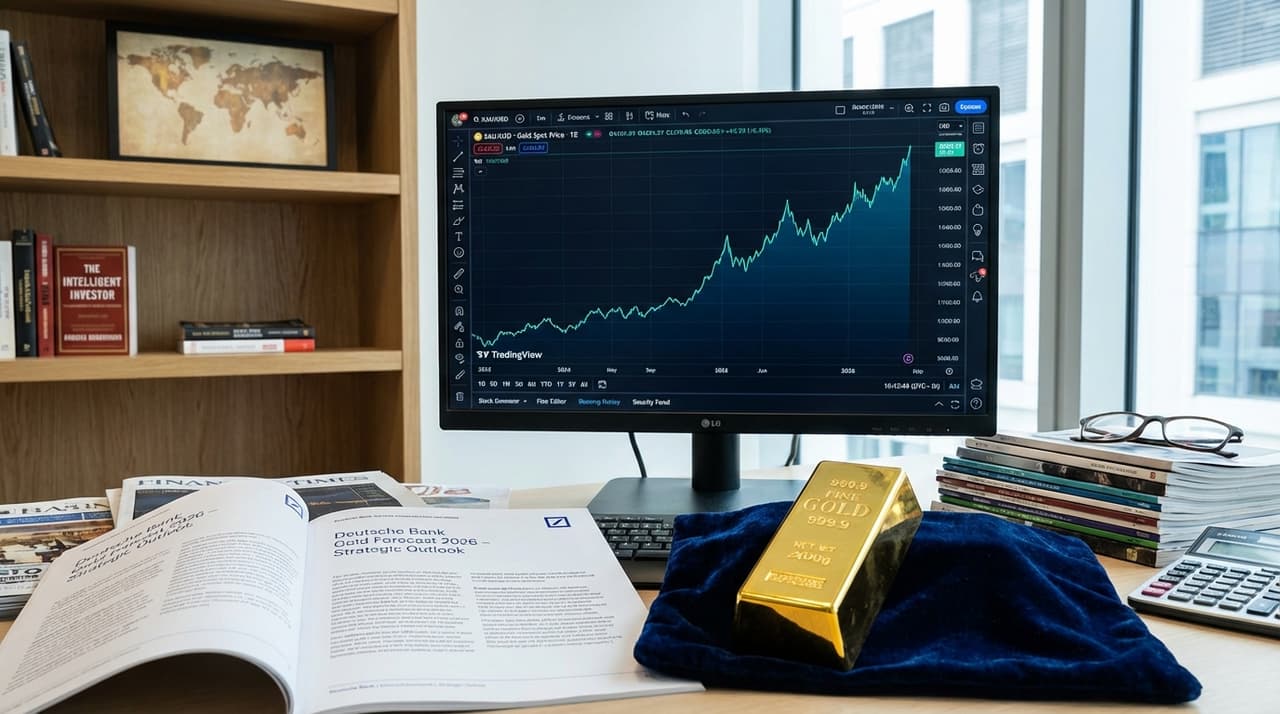
- Deutsche Bank (DB) projects gold could reach $6,000 per ounce in 2026, driven by persistent investment demand from central banks and investors shifting to non-dollar assets.
- Spot gold hit a record $5,110.50 on January 26, up over 18% year-to-date after a blistering 64% rally in 2025, with futures recently at $5,254.70 after peaking at $5,306.
- A weak U.S. dollar near a four-year low and potential Federal Reserve rate cuts as early as May 2026 are fueling the bullish outlook, with central bank buying surging to 24% of the market.
Bullish Momentum Builds
Deutsche Bank’s forecast, issued on January 27, 2026, marks a significant upgrade from earlier conservative outlooks, reflecting a structural shift in gold’s appeal as a hedge against dollar weakness and geopolitical uncertainty. The bank’s analysts point to a combination of factors: the dollar index hovering near a four-year low, rising investor demand for real assets, and central banks—particularly in emerging markets like China—diversifying reserves away from dollar-denominated holdings. “Gold’s rally is being driven by a perfect storm of monetary policy shifts and strategic reserve management,” said one source familiar with the matter, who spoke on condition of anonymity due to the sensitivity of market forecasts.
Efforts to capitalize on this momentum have intensified, with spot gold climbing for seven straight sessions and futures briefly touching $5,306 before settling at $5,254.70. Market participants note that physical supply remains tight, while ETF re-accumulation has picked up as expectations for rate cuts grow. Without sustained demand, some analysts warn, profit-taking could pressure prices, but the underlying trend appears robust. “We’re seeing a fundamental re-rating of gold’s role in portfolios,” added the source, citing increased allocations from institutional investors.
Context and Implications
Political and economic developments are adding fuel to the fire. Trump’s tariff commitments and U.S. fiscal deficits are heightening trade fragmentation and policy uncertainty, further weakening the dollar and driving demand for non-dollar assets. Meanwhile, the Federal Reserve’s ongoing two-day policy meeting is being closely watched for dovish signals, with rate cuts potentially starting in May 2026. Central bank buying has surged to 24% of the market, up from 10% in 2022, with China’s reserves increasing for five consecutive months—a trend that shows no signs of abating.
Industry-specific elements are also in play. Gold miners stand to benefit from higher margins, though jewelry and industrial users face rising costs. The rally has sparked debate over whether gold is a true safe-haven or entering speculative territory, especially after a 15% gain in just seven sessions. Historical context offers some perspective: this bull run builds on shifts that began in 2022, accelerated with a 64% gain in 2025, and now mirrors past surges during periods of dollar weakness and inflation, such as the post-2008 diversification and 2020 pandemic spike.
Looking ahead, the short-term outlook suggests gold could hold above $5,000 support, with the next milestone toward $6,000 if momentum persists. Long-term, most banks have revised forecasts higher, with Societe Generale (SCGLY) targeting $6,000 by end-2026, Goldman Sachs (GS) at $5,400, and Morgan Stanley (MS)’s bull case at $5,700. Deutsche Bank’s $6,000 projection—or an alternative $6,900 scenario—hinges on factors like non-liquidation of hedges and continued ETF inflows. Related developments include Citi (C) raising short-term silver targets and broader consensus shifting upward, as seen in J.P. Morgan (JPM)’s $5,055 per ounce average forecast for the fourth quarter of 2026.
In a brief statement, a Deutsche Bank spokesperson emphasized the forecast’s basis in current market dynamics, though the bank declined to comment on specific trading strategies. Attempts to reach other major firms for additional insights were unsuccessful by publication time. As gold’s blistering rally continues, investors are weighing the risks of a potential bubble against the backdrop of sustained demand and a faltering dollar.