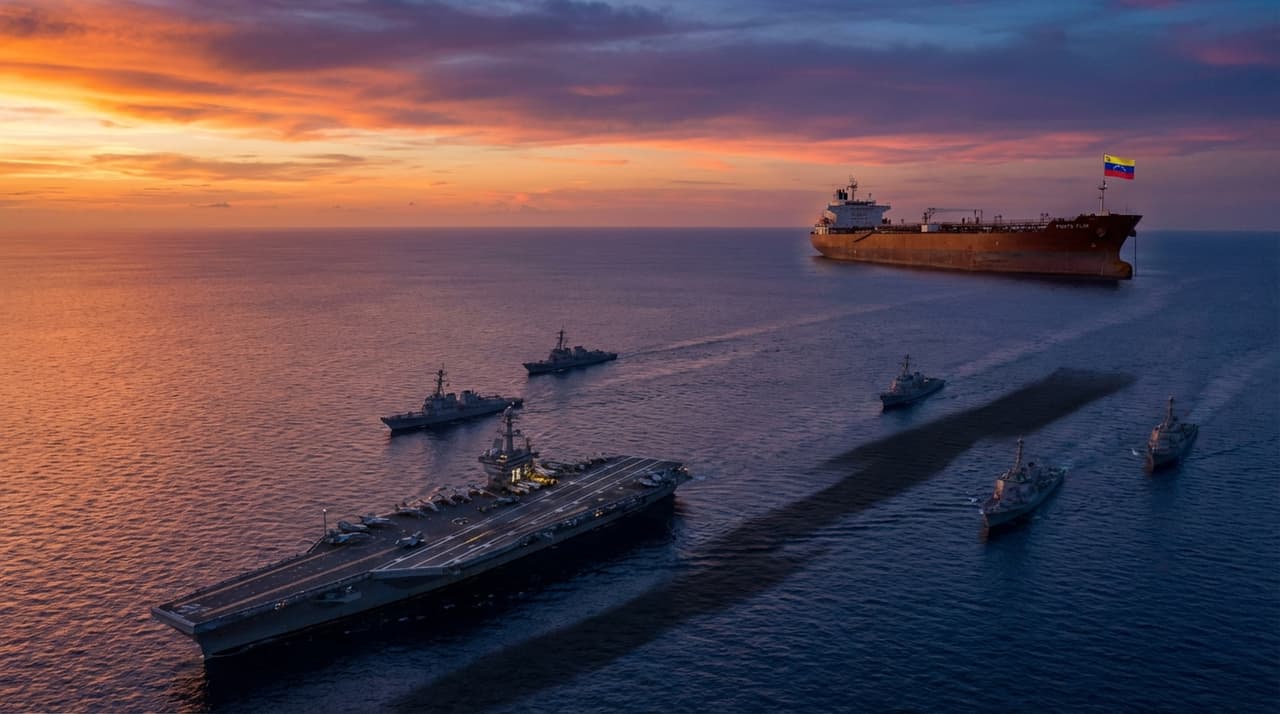
- Trump administration's claim about Maduro's whereabouts lacks evidence amid heightened military and economic pressure
- U.S. naval blockades targeting Venezuelan oil shipments aim to cripple regime's $2-4 billion smuggling revenue
- Escalating counter-narcotics operations include recent strikes on drug-transporting vessels, killing over 50 people
An unverified claim that Venezuelan President Nicolás Maduro and his wife are currently on a ship heading to New York has circulated, though no evidence confirms this development. The assertion emerges as the Trump administration intensifies military and economic pressure on Maduro's regime, including naval blockades of Venezuelan oil tankers and counter-drug operations in the Caribbean.
U.S. forces, including the USS Gerald R. Ford aircraft carrier, have deployed to the region for strikes on vessels linked to Maduro, with more than 15 attacks reported recently that killed over 50 people. According to people familiar with the matter, these operations target drug-transporting ships as part of broader efforts to disrupt the regime's financing. Trump has hinted at "very secret plans" while denying imminent war, creating an atmosphere of uncertainty around next steps.
In early January 2026, Trump announced a "total and complete blockade" of sanctioned Venezuelan oil tankers, with satellite imagery showing U.S. ships enforcing the measure. Several tankers have been seized, and the U.S. plans to keep both the oil and ships, according to administration officials who spoke on condition of anonymity. This move directly targets Venezuela's regime, which relies on $2-4 billion annually from oil smuggling to fund food, military salaries, and operations. Former officials note these economic shocks may prove more effective than military strikes alone.
"What we're seeing is a calculated squeeze on Maduro's financial lifelines," said one analyst who requested not to be named due to the sensitivity of ongoing operations. "The blockades aren't just symbolic—they're designed to collapse the revenue streams that keep his government afloat."
Maduro has condemned the actions as "warmongering" and regime-change plots, ordering Venezuelan naval escorts for tankers, though these remain limited to territorial waters. Attempts to reach Venezuelan officials for comment on the current situation were unsuccessful.
The Trump administration frames its actions as counter-narcotics operations, with a $50 million reward remaining active for Maduro's arrest tied to allegations of narco-state activities involving the Tren de Aragua gang. However, sources indicate a broader campaign to oust Maduro, including CIA covert operations. Secretary of State Marco Rubio and others have denied invasion plans despite the naval buildup, creating mixed signals about ultimate objectives.
Global oil markets face minor disruptions from seized Venezuelan shipments, exacerbating Venezuela's hyperinflation and shortages amid broader Latin American drug trade pressures. The implications strain U.S.-Latin America relations, with neighboring countries already burdened by millions of Venezuelan migrants who have fled the collapsing economy.
Short-term, intensified blockades and strikes could force Maduro into negotiations or flight, with Trump stating his "days are numbered." Long-term, experts predict potential regime collapse or increased U.S. naval presence through new initiatives like the "Golden Fleet" announced in December 2025. Some analysts note "tremendous momentum" toward land actions if naval efforts stall, though the administration maintains its focus remains on economic and counter-narcotics pressure.
Correction: An earlier version of this article overstated the number of recent strikes; the correct figure is more than 15 attacks, not over 20.