Accel Entertainment, Inc.
NNYSE:ACELQ2 FY2026 · Earnings Call TranscriptAugust 4, 2026
Operator
Hello everyone, thank you for joining us and welcome to Accel Entertainment's Q2 2026 earnings call. After today's prepared remarks, we will host a question-and-answer session.
If you would like to ask a question, please press star 1 to raise your hand. To withdraw your question, please press star 1 again.
I will now hand the conference over to Scott Levin, Chief Legal Officer at Accel. Please go ahead.
Scott Levin
Thank you, operator. Welcome to Accel Entertainment's second quarter 2026 earnings call.
Participating on the call today are Andy Rubenstein, Accel's Founder, Chairman of the Board, and current Chief Executive Officer; Mark Phelan, Accel's President, who is transitioning to Chief Executive Officer later this week; and Brett Summerer, Accel's Chief Financial Officer. Please refer to our website for the press release and supplemental information that will be discussed on this call.
Today's call is being recorded and will be available on our website under Events and Presentations within the Investor Relations section of our website. Some of the comments in today's call may constitute forward-looking statements within the meaning of the Private Securities Litigation Reform Act of 1995.
These forward-looking statements are subject to risks and uncertainties. Actual results may differ materially from those discussed today, and the company undertakes no obligation to update these statements, unless required by law.
For a more detailed discussion of these and other risk factors, investors should review the Forward-Looking Statements section of the earnings press release available on our website, as well as other risk factor disclosures in our filings with the SEC. Any projected financial information presented in this call is for illustrative purposes only, and should not be relied upon as being predictive of future results.
The inclusion of any financial forecast information in this call should not be regarded as a representation by any person that the results reflected in such forecasts will be achieved. During the call, we may discuss certain non-GAAP financial measures.
For reconciliations of the non-GAAP measures, as well as other information regarding these measures, please refer to our earnings release and other materials in the Investor Relations section of our website. Following management's prepared remarks, we will open the call for a question-and-answer session.
With that, I would now like to introduce Andy. Please go ahead.
Andy Rubenstein
Thank you, Scott, and good afternoon, everyone. Accel delivered another strong quarter.
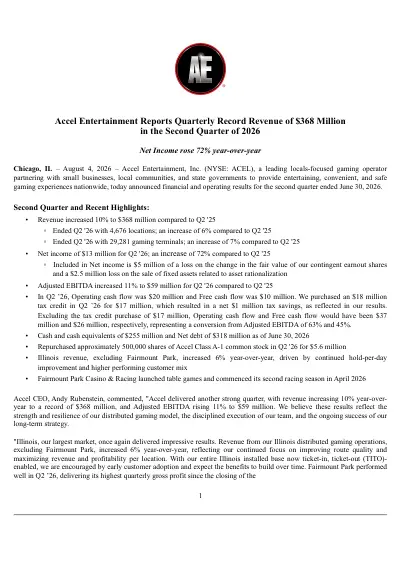
Revenue increased 10% year-over-year to $368 million, an all-time quarterly record, while net income was $13 million, compared to $7 million in the prior-year period. Adjusted EBITDA increased 11% to $59 million, also an all-time quarterly record, and we ended the quarter operating nearly 4,700 locations and more than 29,000 gaming terminals, representing year-over-year increases of 6% and 7%, respectively.
We believe these strong results reflect the durability of our distributed gaming model, the strength and ongoing growth of our largest market, and growing contributions from our developing markets. More importantly, they reflect another quarter of thoughtful execution across the business and the success of the strategy we've been following for several years, which has positioned us as an industry leader in distributed gaming.
Turning to our markets, Illinois remains the foundation of our business and delivered another impressive quarter. Revenue from our Illinois distributed gaming operations, excluding Fairmount Park, increased 6% year-over-year, driven by sustained improvement in hold per day and a high-performing customer mix, with average location hold per day increasing 9% year-over-year to $992.
Importantly, those results were achieved while both our location count and our terminal count declined modestly in Illinois. That is precisely the outcome our strategy is designed to produce.
We are not managing this business to maximize machine count. We're managing it to maximize revenue and profitability per location, and our results reflect that.
At Fairmount Park, the investment thesis is playing out as expected. Customer engagement continues to ramp, and the property delivered its highest quarterly gross profit since we acquired it, which represents 33% growth compared to the second quarter of last year.
Table games and slots continue to gain traction, and our second racing season is underway. We remain committed to developing a permanent casino at the property, and our planning around the scope and timing of that investment continues to advance.
We plan to provide additional details on this exciting development over the next quarter or two. Chicago remains one of our most significant near-term growth opportunities, and I want to provide an update on where things stand.
Beginning in June, the Illinois Gaming Board issued the first establishment licenses for video gaming locations in the city of Chicago, followed by a second round in July. Accel has already been approved for 17 of the 39, or approximately 44%, of establishments licensed in the city, reaffirming our position as the statewide market leader.
The next step is with the city of Chicago itself. The city's Department of Business Affairs and Consumer Protection has now begun accepting and processing applications for city video gaming licenses.
Once a location receives its city license, the Gaming Board permits the terminal operator to connect to the state's central communication systems and go live. There have been some delays along the way, but based on where the process stands today, we expect the first Chicago establishments could begin operating in the coming weeks.
What hasn't changed is our conviction that when this market opens, Accel is well positioned to move quickly. We already have the infrastructure, equipment, operational expertise, and long-standing local relationships necessary to capitalize on what we believe will be a meaningful opportunity.
Outside of Illinois, we continue to build momentum in our developing markets. Nebraska and Georgia both delivered exceptional double-digit revenue growth and are becoming meaningful drivers of Accel's overall earnings growth, not simply contributors to revenue growth.
Elsewhere across our footprint, in Louisiana, we completed the acquisition of Rice Palace Truck Stop Casino during the quarter, and our pipeline remains active and attractive. In Nevada, last month we announced a new route agreement with Green Valley Grocery.
This extends our relationship with Ainabi Oil, adding approximately 600 terminals across Southern Nevada, further expanding the platform we established earlier this year through our Rebel partnership. With Green Valley and Rebel, we have over 1,000 terminals with Ainabi Oil, and are excited to continue our partnership with them.
During the second quarter, we continued to execute our disciplined capital allocation strategy. We repurchased approximately 500,000 shares for $5.6 million, while ending the quarter with approximately $255 million of cash and net debt of approximately $318 million, representing net leverage of approximately 1.4 times.
At the same time, our $300 million revolving credit facility remains fully undrawn. We believe the strength of our balance sheet gives us the flexibility to continue investing organically, pursue disciplined acquisitions, and return capital to shareholders, while maintaining a solid financial profile.
As a reminder, when looking at the broader macroeconomic environment, our business is fundamentally hyper-local. Our customers visit neighborhood bars, restaurants, truck stops, and convenience stores as part of their everyday routines, and that behavior has proven resilient across a variety of economic environments.
Finally, I'd like to say a few words about our leadership transition. This will be my final quarterly earnings call as Chief Executive Officer.
Later this week, on August 7th, Mark will become CEO, while I continue on as Chairman. We also recently promoted Stan Guidroz to Chief Operating Officer.
Stan built Toucan into one of the premier operators in Louisiana, and he brings that same operational discipline, focus on growth, and leadership to our broader organization. I am very confident in the strength of our leadership team and the future of this company.
I believe Accel is strongly positioned for its next chapter, and I look forward to continuing to work alongside Mark, Stan, Brett, Scott, and the rest of our leadership team as Chairman. With that, I'll turn it over to Mark.
Mark Phelan
Thank you, Andy. From an operational standpoint, the second quarter reflects the success of our priorities: improving route quality over route size, deploying capital where it generates the highest returns, and delivering a better experience for both our players and our location partners.
That approach is producing excellent financial and operating results. I'll begin with Illinois, which remains the cornerstone of our distributed gaming business.
Consistent with our location quality optimization strategy, during the quarter our Illinois average location hold per day increased 9% to $992 per location. The improvement reflects both a stronger portfolio mix and better productivity across the route.
We have not disclosed an exact split between those two factors. The locations we added are generally higher-performing, while many of the locations that came off the route were lower-volume, unprofitable, or locations that closed independently.
We're also seeing the benefits of investments we've made in the Illinois business. The rollout of ticket-in, ticket-out technology, TITO, is complete across our installed base.
While player adoption is increasing over time, we're encouraged by the positive customer response and the operational efficiencies the technology provides. Among those efficiencies, we're beginning to see a reduction in the amount of cash held in the field, which improves our working capital over time.
We believe TITO will further enhance the player experience while supporting productivity gains for both Accel and our location partners, just as it has in other gaming markets around the country. Turning to Chicago, as Andy described, the licensing process is now actively moving and our focus is on operational readiness.
We've been preparing the market for some time and have equipment staged, routes mapped in the field, and logistics infrastructure in place to begin connecting and servicing locations as soon as they receive their city licenses. Because we already operate at scale across Illinois, the incremental cost for us to stand up Chicago is low, and we can move as quickly as the city process allows.
When these locations begin going live, we believe our existing infrastructure, service network, and deep local relationships position us to capture our share of this market efficiently. Moving on, Montana delivered another solid quarter, with location hold per day increasing 3% year-over-year.
During the quarter, Century Gaming also completed a full machine conversion at Northern Winz Casino 2 with the Chippewa Cree Tribe. An existing tribal partner choosing to deepen its relationship with Century Gaming is one of the strongest endorsements we can receive, and we believe it reflects the quality of both our technology platform and our customer service.
In Nevada, quarterly revenue increased 17% year-over-year, while locations and terminals grew 54% and 53%, respectively, reflecting both the Dynasty Games acquisition and our partnership with Ainabi Oil-owned Rebel and Green Valley Grocery convenience stores. Nevada hold per day declined 15.8% year-over-year, and I'd like to provide some additional context around that.
Our Nevada portfolio now spans two distinct customer segments. Participation bars generate materially higher hold per day than convenience stores, and we've expanded our convenience store footprint much more rapidly over the past year.
That change in business mix naturally lowers the blended hold metric, even though the underlying economics and growth prospects remain attractive. Beyond the mix shift, the Rebel and Green Valley locations themselves are early in their transition to higher-quality gaming experiences.
We've upgraded equipment, refreshed the gaming environments, added payment technology to improve convenience for the player, and introduced loyalty through our Gambler's Bonus rewards program. We currently expect this to be a 6 to 12-month process, and the early operating indicators remain encouraging.
Nebraska and Georgia once again delivered exceptional results, with revenue increasing 55% and 47%, respectively. What I think is particularly noteworthy is what's happening below the revenue line.
Both markets generated significant adjusted EBITDA growth year-over-year. Because Illinois remains a significant part of our business, it's easy to overlook just how quickly our developing markets are scaling.
They're no longer simply contributing incremental revenue. They're becoming increasingly meaningful contributors to earnings growth, and we plan to deploy additional capital behind those opportunities because we believe they offer attractive long-term returns.
Turning to our new markets, in Louisiana, Toucan completed the acquisition of Rice Palace Truck Stop Casino during the quarter, adding 50 gaming terminals, with plans to expand that location to 60. Toucan revenue increased 14% year-over-year, while terminal count increased 27%.
Our acquisition pipeline in Louisiana remains active, and we believe our operating expertise and integration track record continue to position us as the buyer of choice in that market. Finally, at Fairmount Park, the property delivered its strongest quarter to date on a gross profit basis, and we're encouraged by the continued momentum we're seeing across the operation.
Live table games have performed in line with our expectations and continue to gain traction with customers. At the same time, the additional revenue generated from gaming continues to support investments in racing, including an approximate increase of $500,000 in purses paid out over the 2026 season.
As Andy noted, we remain committed to the long-term development of a permanent casino at Fairmount. In the meantime, our focus remains on executing the fundamentals, improving the customer experience, and building a property that continues to strengthen over time.
I'd like to close with a broader thought because it's something I've spoken about before and something I'll continue emphasizing as I prepare to assume the role of Chief Executive Officer. Increasingly, we need to think of Accel less as a logistics business and more as a gaming and hospitality company.
A logistics business competes on efficiency and cost. A gaming and hospitality company competes on experience, content, relationships, customer service, and differentiation, and those businesses ultimately generate stronger economics.
Everything we're doing points in that direction: exclusive gaming content in the markets that allow it, hospitality and table games at Fairmount, continued enhancements to the player experience in Illinois, and quality upgrades across our Nevada portfolio. These investments are helping create a better experience for players, a stronger partnership for our location operators, and ultimately a more valuable business for our shareholders.
That's where we believe the next phase of margin expansion will come from, and it's what excites me most about the opportunity ahead. With that, I'll turn the call over to Brett.
Brett Summerer
Thank you, Mark. The second quarter was another record quarter for Accel.
Revenue increased 10% year-over-year to $368 million, while adjusted EBITDA increased 11% to $59 million. Operating income was $32 million compared to $27 million in the prior-year period.
Net income was $13 million compared to $7 million a year ago, and diluted earnings per share was 15 cents compared to 8 cents. Before I get to cash flow and the balance sheet, I wanted to spend some time on a few discrete non-cash items that affected reported earnings this quarter.
With the exception of a one-time item I'll cover at the end, none of them involve cash, changes to our operating outlook, or affects adjusted EBITDA. They do affect net income and earnings per share, and we think it's important to understand what reflects the underlying performance of this business and what does not.
The first is a non-cash pre-tax charge of approximately $2.5 million related to older gaming equipment in our warehouses that was no longer part of our active operating plan. As part of our decision to streamline our equipment base, we are in the process of removing these legacy units, which improves the quality of our balance sheet, eliminates associated carrying and depreciation costs, and increases the usable space in our facilities.
Importantly, this reflects a management decision to dispose of the equipment that no longer fits our operating needs, rather than a change in our depreciation policy or the useful life of our deployed gaming terminals, and represents a very small portion of our installed asset base of over 29,000 terminals. Our quarterly results also include a $5 million non-cash loss on the change in the fair value of our Class A-2 contingent earnout shares.
This liability is marked to market against our Class A-1 share price each quarter, which means a rising share price produces a charge. It's non-cash, it's a permanent non-taxable item that delutes our effective tax rate from period to period, and it's added back to adjusted EBITDA.
For context, we reported $5.7 million loss in this same line in the second quarter of last year, it's not a driver of our year-over-year comparisons. Turning to cash flow and to focus a little more into the definitions and levers driving our generation.
We define free cash flow as net cash provided by operating activities, or operating cash flow, less purchases of property, equipment, plus proceeds from asset sales. Further, as a reminder, operating cash flow has two primary components: cash generation from the business and changes in working capital.
Operating cash flow in Q2 2026 was $20 million, a conversion of 34% of adjusted EBITDA as compared to $43 million and 80% in Q1. However, we took advantage of purchasing a green tax credit in Q2, which is expected to move $17 million of operating cash out of Q2 and into Q3.
Therefore, on a comparable basis, our operating cash flow was $37 million and 63%. Similarly, our free cash flow was $10 million or 16% for Q2, but excluding the tax credit purchase, it was $26 million or 45%, about 7% above Q1.
We believe free cash flow provides investors with one of the clearest measures of the underlying cash generation strength of Accel's business, and it's a metric we intend to discuss more regularly going forward. I would offer one note of caution: working capital can move this figure meaningfully from quarter to quarter, we'd encourage you to evaluate over a longer window than annualizing any single quarter.
We continue to expect full-year capital expenditure in the range of $60 to $70 million, depending on the timing of year-end payments and Chicago license approvals and deployment timing, compared to approximately $89 million in 2025. The majority of that spending is replacement capital, deploying newer, better-performing equipment into existing locations, which carries an attractive return with a payback we generally expect to be between two and three years.
Turning to balance sheet, we ended the quarter with approximately $255 million of cash and cash equivalents and total debt of approximately $573 million, resulting in net debt of approximately $318 million. Net leverage finished the quarter at approximately 1.4 of trailing 12-month adjusted EBITDA, which remains among the lowest in our industry and reflects the conservative financial profile we've maintained.
We also maintained significant financial flexibility through our $300 million revolving credit facility, which remained completely undrawn at quarter end. That liquidity gives us considerable flexibility to continue executing our capital allocation strategy.
During the quarter, we repurchased approximately 500,000 shares for $5.6 million, bringing first-half repurchases to 1.6 million shares for $18 million. Since initiating our repurchase program in late 2021, we've repurchased approximately $201 million worth of our shares, and following the board's replenishment of the program last year, we have approximately $146 million of capacity remaining.
Our capital allocation philosophy remains disciplined and returns-focused. Every deployment of capital is evaluated against the same objective: maximizing long-term risk-adjusted returns for our shareholders.
That means maintaining a strong balance sheet, investing organically where returns are compelling, pursuing disciplined acquisitions that meet our financial hurdles, and returning excess capital to shareholders when we believe our shares trade below intrinsic value. Looking ahead, our financial priorities remain unchanged.
We will continue integrating recent acquisitions, investing in the long-term opportunity at Fairmount Park, supporting growth across our developing markets, and maintaining the financial flexibility necessary to capitalize on additional opportunities as they arise. In closing, with another quarter of record financial performance, strong free cash flow generation, and one of the strongest balance sheets in our history, we believe Accel remains well positioned to create long-term value for shareholders.
With that, operator, please open the line for questions.
Operator
We will now begin the question-and-answer session. Please limit yourself to one question.
If you have a follow-up, you can rejoin the queue. To ask a question, please press star 1 to raise your hand.
To withdraw your question, press star 1 again. We ask that you pick up your handset when asking a question to allow for optimum sound quality.
If you are muted locally, please remember to unmute your device. Now please stand by while we compile the Q&A roster.
Your first question comes from the line of Patrick Keough with Truist Securities. Your line is open, please go ahead.
Patrick Keough
Hey guys, how's it going? Nice quarter and congrats again on the leadership transition.
Thank you for the good news on Chicago. You stated in your release that 44% of the approved licensees are Accel locations thus far.
Small sample size, but a bit higher than your actual market share in the state. Are you finding that location operators are more inclined to partner with you given any familiarity, or you expect to be kind of closer to that 30-ish mark?
Thanks.
Mark Phelan
Hey, Patrick. It's Mark, and congrats on your next endeavor.
We're looking forward to seeing more of you in Chicago. In terms of Chicago rollout of VGTs, I'd say that we probably will have roughly close market share in the city as we do in the state.
Relationships in Chicago will roll out over time, and I wouldn't expect a big difference between the two entities.
Patrick Keough
Got it. Thanks so much.
Yes, see you around, looking forward to it.
Mark Phelan
Thank you.
Operator
Your next question comes from the line of David Bain with Texas Capital Securities. Your line is open, please go ahead.
Great,
David Bain
thank you, and congrats on the 2Q execution, and likewise, congrats on each of you, really, on the individual moves within the executive team. I guess I'll go with Chicago as well.
The go-live within weeks, that was well ahead of our model expectations. We were thinking late 4Q.
Once Chicago is live, do you believe the application and approval process accelerates from here, or could there be some final political hurdle before a ramp at a faster pace?
Andy Rubenstein
Thank you, David. It's Andy.
I think that once the doors open or the gates open, you'll have a more normal flow of applications. I think there's a lot of people kind of waiting to see what it looks like.
I don't expect additional hurdles. It's getting started, and we're really close to that starting point.
Whether it's weeks or a couple months, we don't know, but there isn't additional hurdles that we foresee at this point. This is the last hurdle.
David Bain
That's fantastic. I guess I'll hop back in.
Thank you.
Andy Rubenstein
Thank you.
Operator
Your next question comes from the line of Jordan Bender with Citizens. Your line is open, please go ahead.
Jordan Bender
Afternoon and thanks for the question. In Illinois, it's the first time you sequentially grown location count in about two years.
You've talked extensively about kind of pruning some of the locations or the units across the strict state just to become a little bit more efficient. Is it kind of fair to assume we're maybe at the end of that pruning cycle or how should we kind of think about location count from here on out?
Mark Phelan
Hey, Jordan. It's Mark.
As Andy said in his initial remarks, we really don't focus on the absolute growth of the location count. It's just the quality.
I think you see that in the numbers in this quarter. Generally, what we see is the locations that close independently, based on their own performance, their general gaming performance is lower than the locations we bring on.
Overall, the margins are increasing per gaming machine, and we continue to do that and we're optimistic that that trend will just improve over time.
Jordan Bender
Thank you.
Mark Phelan
Thank you.
Operator
Just a reminder that if you would like to ask a follow-up question, please press star 1 now to rejoin the queue. Your next question comes from the line of Max Marsh with CBRE.
Your line is open, please go ahead.
Max Marsh
Hey guys, thanks for taking my question and congrats on the solid quarter. I'd appreciate a little bit more insight into the strategic rationale of owning the Rice Palace property outright, and whether you view ownership of larger locations as a priority in markets where it's permitted.
Mark Phelan
Hey, Max. It's Mark.
Rice Palace, it's a truck stop in Louisiana. The gaming business down there is centered on truck stops.
They can host up to 60 gaming machines per location. It's just those machines, no table games.
We think right now it's definitely in our best interest to own these types of properties, manage them according to our own wishes and plans. We're really excited about this acquisition and as we stated earlier, we think there are other opportunities in that state to use our scale to improve our future earnings power.
Max Marsh
Thank you. I'll hop back in the queue.
Operator
Your next question comes from the line of Greg Gibas with Northland Securities. Your line is open, please go ahead.
Greg Gibas
Great. Andy, Mark, Brett, congrats on the quarter.
Congrats on the leadership transition here. Hey, just wanted to follow up on Chicago quickly as it relates to maybe where I guess total market size is in terms of establishments, right?
We've had the initial wave, I think it was 39 you said, licenses granted today. Maybe where that shakes out based on your estimates.
Mark Phelan
What we've said in the past, and right now we don't have any other insight to change this, is that given the population of Chicago relative to the population of the state, and kind of the trend right now in the state, it's probably worth about a billion dollars in total revenue. Then obviously the amount the different TOs get is about a third of that, and then that gets divided up amongst all the players in the industry.
Right now, we don't see that being any different in terms of the outlook that we have.
Andy Rubenstein
Greg, the timeline on that is probably 5-plus years to fully deploy. We definitely have some time to see that evolve.
Greg Gibas
Got it. Very helpful.
Thanks, guys.
Operator
Your next question comes from the line of David Bain with Texas Capital Securities. Your line is open, please go ahead.
David Bain
Awesome. Okay.
Thank you. I'm just going to slip in two now if I could.
First, Illinois statewide VGT growth has been above kind of that GDP-plus growth that we saw for a while. I guess 2Q '25 had actually jumped to between 6% and 8% from a statewide basis.
Now we've lapped that. Are trends that you're seeing so far in 3Q, are they more back in line with that GDP-plus or are we sort of staying with that same sort of growth percentage?
Mark Phelan
Hey, David. It's Mark.
David Bain
Being early in 3Q, yeah, see any trends.
Mark Phelan
As we don't provide forward guidance, but I think we could safely say that July results were relatively consistent with what we saw in the first half of the year, if that makes sense.
David Bain
Great. Yep, no, totally.
Great. Then, if you could possibly frame the opportunity in Pennsylvania.
We've heard a couple different things with regard to that potential expansion. Then maybe, outside of that a bigger picture, what would be the common denominator for the change in political will when it comes to expansion?
Is it just mostly budget shortfalls, or along with strong lobbying? What's the recipe for success?
One of the things that we've been doing is combing some of the gray area markets and trying to understand their process there of becoming more regulated, just trying to understand where you've seen success and why you've seen success in those markets that have expanded.
Mark Phelan
Hey, David. It's Mark.
In regards to the first question, it's well known that Supreme Court decided that skill gaming market there was illegal and they had 120 days to remove their games. We're still in that period.
There's a lot of sort of dynamics at stake that could influence the ultimate outcome. We're optimistic that either skill games or VGTs already legal, they get expanded, or skill games become legal.
I can't really handicap any of the outcomes. It's, like I said, multi-factor outcome.
We are optimistic that maybe there will be an expansion of regulated legal route gaming in there. Then in terms of your second question, it's a great one.
We always try to understand why it happens. Chicago is a good example of difficult it's predicting these things.
We would not have predicted that Chicago would have been the first real new market in many years. It is, and there's many reasons sort of explain why that happened.
In terms of states like North Carolina, Virginia, Missouri, these are all states that for various reasons should likely regulate gaming in terms of routes, but all you need is one person who has some influence to say no and if the bill doesn't pass. It's in my experience very hard to predict.
David Bain
Very good. Okay.
Thank you, guys. Thanks.
Operator
Your next question comes from the line of Max Marsh with CBRE. Your line is open, please go ahead.
Max Marsh
Hey guys, thanks for taking another here. With the TITO rollout now being complete, I'm curious where we stand with player adoption, how that looks, and if there are any insights into the effects there on demand and operating costs.
Thanks.
Andy Rubenstein
Thanks, Max. I would say a couple things.
One, it is fully complete. In terms of customer feedback and that sort of thing, anecdotally, it's positively received.
Obviously, we don't poll for that or anything. It's anecdotally well received.
In terms of the benefits to the business, very clearly we have a benefit to cash. It has been a reduction to total cash in the company in terms of what's on the field versus what's available.
I'm not going to quote a number on that, but that is something that we've seen kind of fall off. We want to make sure that that's consistent and trends forward, but it has been very attractive for us.
In terms of sales and revenue generation generally, it's really hard to kind of tease out what piece of incremental revenue we're getting from TITO. We do believe it lowers friction and other things.
However, putting a number on that right now, it's something that not anyone to our knowledge is able to do, and as we're looking at it ourselves, we are seeing some potential for it to be influencing, but teasing it out from every other driver is not something we're able to do at this point.
Max Marsh
Understood. Thank you.
Andy Rubenstein
Thank you.
Operator
There are no further questions at this time. I would now like to turn the call back to Andy for closing remarks.
Andy Rubenstein
Thank you, operator, and thank you for everyone who joined us today. This was another record quarter for Accel, but more importantly, it's another example of the progress we've made in building a stronger, higher-quality business.
We enter the second half of the year with momentum across our markets, one of the strongest balance sheets in our history, and what we believe remains one of the most compelling growth opportunities in the industry, with Chicago still ahead of us. As I previously mentioned, this is my final earnings call as Chief Executive Officer.
Serving in this role for the last 17 years has been an incredible privilege, and I'm immensely proud of the teams we've built and what we have accomplished together, and I'm excited about what lies ahead for the company. I want to sincerely thank all of the people at Accel for their hard work and dedication, our location partners for the trust that they've placed in us, and our shareholders for their continued confidence and support.
While my role is changing, my commitment to Accel is not. As I remain Chairman of the Board, I look forward to continuing to work alongside Mark, Stan, Brett, and Scott, as well as the entire leadership team.
Thank you again for joining us today, and I hope you enjoy the rest of your summer.
Operator
This concludes today's call. Thank you all for attending.
You may now disconnect.