ACI Worldwide, Inc.
Q3 FY2026 · Earnings Call TranscriptNovember 5, 2026
Operator
Hello, everyone. Thank you for joining us, and welcome to ACI Worldwide, Inc.
reports financial results. After today's prepared remarks, we will host a question-and-answer session.
If you would like to ask a question, please press star one to raise your hand. To withdraw your question, press star one again.
I will now hand the conference over to John Kraft. John, please go ahead.
John Kraft
Thank you for joining us. On today's call, we will discuss ACI Worldwide's third quarter 2026 results, as well as our updated financial outlook for the remainder of the year.
We will then open the line for your questions. The slides and press release accompanying this webcast can be found at aciworldwide.com under the Investor Relations tab, and will remain available after this call.
As always, today's call is subject to Safe Harbor and forward-looking statements. You can find the full text of these statements in our earnings materials and with the SEC.
Joining me this morning are Tom Warsop, our President and CEO, and Bobby Leibrock, our Chief Financial Officer. Before I turn it over to Tom, though, I'd like to highlight several upcoming conferences where members of the team will be participating: Seaport's 4th Annual TMT Conference, Monday, November 16, 2026; Stephens' Annual Investment Conference in Nashville, Wednesday, November 18, 2026; and the 30th Annual UBS Global Technology and AI Conference in Scottsdale, December 2, 2026.
We look forward to meeting with many of you at these events. With that, I'll turn it over to Tom.
Tom? Hey,
Tom Warsop
good morning, everyone. Thank you for joining us.
We delivered solid third quarter results, with revenue and EBITDA coming in ahead of our expectations. Even more importantly, we made significant progress against the strategy we've been laying out for ACI.
I'm proud to say ACI has a lot of momentum right now, and I'll give you a flavor of the specific events and trends we're seeing that make us even more confident in ACI's future than we already were. These are truly exciting times.
Operationally, we continued to perform at a high level. While some of our financial metrics were down from last year, that's not a surprise.
We told you to expect this, due to the timing of renewals, and I know you all remember we can't change the revenue recognition date of renewals no matter when we sign them. We delivered another quarter of better-than-expected financial results, and we remain on track for our full year financial targets.
Bobby going to give you some details on the quarter's performance, and as I said, I'll walk through some of the team's key accomplishments from the quarter, and provide an update on our strategic roadmap. Since our last Analyst Day, we've talked about where payments are going, and the role we think ACI can play in that future.
Payments are becoming increasingly real-time, intelligent, and multi-rail. Our customers need to support more payment types, and make smarter decisions about how transactions move, while continuing to modernize mission-critical infrastructure, without sacrificing resilience, security, or scale.
In a world where so much is changing all at once, I'm often asked about ACI's secret sauce. What is it that makes us truly special and differentiated from our other competitors?
We combine deep payments industry expertise, industry-leading software and infrastructure, unique and massive data, and neutrality in terms of payments rails and types. All this is propelling us on our strategic journey: from a leading payments infrastructure provider, to a pioneer in payments orchestration, to, in the future, a leader in payments intelligence, driving beneficial outcomes for our customers and for the industry.
This is a big vision, and I think ACI is uniquely positioned to make it real. We already play strongly in the first two legs of that journey, payments infrastructure and orchestration, and the work we're doing now to turn the huge volumes of data our software sees every day into actionable, powerful information is underway.
It's a challenging path, but one we're excited about, and positioned to take advantage of. Expect to hear more about this journey each quarter, and in upcoming investor touchpoints.
To execute the journey I just described, we must maintain our leading position in the payments infrastructure space. That's where we get the fuel for that payments intelligence: the data.
I want to share tangible evidence that our strategies in this segment, particularly with respect to ACI Kinetic and Speedpay 1, are coming together and working. First, during the third quarter, we announced two new ACI Kinetic customer signings.
Just for completeness, I remind you that ACI Kinetic is our leading-edge, cloud-native, ISO 20022-native, multi-tenant payments platform, which we've designed to support any payment type, consistently. As we announced in our press release, we successfully put Solaris into production as our first live Kinetic customer.
In addition to those developments, a few days ago, we signed up one of the largest banks in Africa. We expect that implementation to go live in 2027.
Momentum with ACI Kinetic is strong. Transactions are beginning to flow.
The pipeline continues to build. The customer list is growing.
Second, we accelerated our roadmap in card payments through the acquisition of Cranium Ventures. Cranium software now forms an important part of the ACI Kinetic ecosystem, strengthening our multi-rail card payment switching capabilities, and bringing immediate transaction volumes from important industry players onto the Kinetic platform.
Cranium also strengthens our leadership talent in the cards payment space, uniting the architects of the most significant payment switches in the world under the ACI umbrella. Third, we expanded the platform's capabilities by announcing general availability for ACI Kinetic for cards, and by embedding J.P.
Morgan's Kinexys account and payee verification into our fraud solution, to help banks stop real-time payments fraud before funds move. We also integrated with SWIFT's blockchain-based ledger, and in recent days, our collaboration with Circle to facilitate USDC stablecoin settlement alongside traditional payment rails was announced.
That's a lot of progress in a few months, and I haven't even gotten to our biller business, Speedpay. At the beginning of 2026, we began running the biller business with a more independent focus, restructuring its go-to-market approach around the vertical specialists that we have on our sales and account management team, and bringing on dedicated new leadership for both sales and account management.
We also invested in new tools and processes tailored to this business to make these functions more efficient and effective, including generative AI workflow support. The results, so far, are beyond my initial expectations.
The sales team accomplished more than its full year target before the end of the third quarter, and they're still going strong. On the product side, Speedpay 1 is our next-generation bill payment platform, providing cloud-native consumer convenience, and extensive configuration and integration capabilities for billers in all our supported industry verticals.
In the third quarter, we continued to rapidly onboard customers to Speedpay 1, and the feedback from these customers continues to be overwhelmingly positive. These customers are among our best salespeople.
In third quarter, we delivered our largest release of new capabilities for Speedpay 1 in recent memory, including in-person payments, our first disbursements client going live, and a new developer portal. The architecture and underlying technology of Speedpay 1 has allowed us to build capabilities to facilitate stablecoin, real-time, and many other payment types for billers.
Demand for these payment types is in the early stages, but we're ready, and we're partnering with our customers to find ways to make the bill payment process simpler, quicker, and more convenient. All these updates are not disconnected product announcements, nor are they simply individual customer wins.
They're strategic proof points of real progress against the strategy first laid out in 2024, and that we have been relentlessly executing against. I'll give you some examples to back all this up.
The progress I'm highlighting is really beginning to show up in the metrics and deal flow we use to track the trajectory of ACI. New ARR bookings increased 86% year-over-year, to approximately $24 million, with growth across both payments software and biller.
Let me highlight a few of the key new and expanded customer relationships which have added up to that number. These are all new since we were last together.
Our relationship with Interpag in Brazil brings together acquiring, payments intelligence, fraud prevention, and orchestration on a modern platform, leveraging our partnership with RS2, and demonstrating how our ecosystem can extend the breadth of what we deliver to customers. We expanded our bill payment partnerships with Exeter and National Grid, solidifying our leadership position in the utilities vertical of the bill payment segment.
We signed a net new customer in Malaysia, further strengthening our very strong position in the country's real-time payments ecosystem. We signed up two U.S.
financial institutions for ACI Kinetic, and as I mentioned a minute ago, early in Q4, we signed a new contract with one of the largest banks in Africa, and they'll begin their adoption of the ACI Kinetic platform next year. Beyond these signings, our pipeline of new business opportunities continues to build.
At the end of September, I was in Miami at Sibos, one of the largest global banking conferences, and the level of interest in ACI was remarkable. Our team held a record number of meetings with customers, prospects, partners, and industry leaders, more than double what we had last year at the same conference, and the tenor of those conversations has clearly changed.
A year ago or two years ago, the opening question at our booth was often, 'What does ACI do?' This year, many people came up to us asking, 'How's ACI Kinetic going?'
That change depicts the kind of interest that turns into pipeline, and our teams are already following up on many leads. All these wins underscore a key truth about the payments industry: no one knows for sure which individual payment types or rails ultimately win.
Our opportunity is to help customers operate across all of them. This is where ACI thrives, at the nexus of tremendous complexity, helping financial institutions, merchants, and billers navigate the challenges and drive business outcomes.
Our position in the middle of the payments ecosystem gives us the ammunition and standing to lead the journey I talked about before: payment infrastructure, to payment orchestration, to payment intelligence, to outcomes. As I mentioned, in addition to our strategic advancements, we are continuing to execute on our existing business and drive value for shareholders.
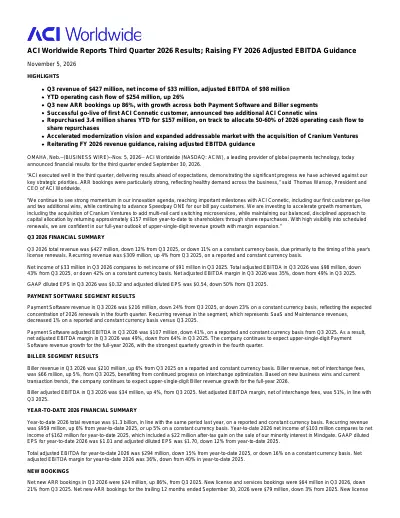
In the quarter, revenue was $427 million. Recurring revenue increased 4%, to $309 million.
Through the first nine months, we generated approximately $1.28 billion of revenue. Bobby will take you through the financial results and the year-over-year dynamics in more detail, but we're proud of what's been delivered so far.
Cash generation was particularly strong in the third quarter. We generated $119 million of operating cash flow in Q3, that's up 63% year-over-year, and that brings our operating cash flow through the first nine months to $254 million, and that's up 26%.
All of that, especially the cash generation, is giving us the flexibility to invest behind our strategy while we continue to return meaningful capital to shareholders. We repurchased approximately $50 million of ACI shares during Q3, and that brings our year-to-date repurchases to approximately $157 million, about 3.4 million shares.
We have nearly $300 million remaining on our share repurchase authorization, and we remain committed to a disciplined capital allocation strategy that balances investments to advance our growth strategy with the return of capital to shareholders. Our balance sheet is in a strong position, and it provides us ample flexibility to continue to execute on our plan.
Stepping back, our Q3 results provide further evidence that the strategy we've laid out is taking hold. There's still plenty of work ahead.
We need to convert pipeline, we need to continue to scale Kinetic beyond initial customers, we need to execute against our cards roadmap, and we need to continue strengthening Speedpay 1. I like the position we're building.
The future of payments will have more rails, more endpoints, more data, more choices about how money moves. We believe intelligence and orchestration become more valuable in that world, and ACI has the payments expertise, the technology, and the customer relationships and the scale to play an important role as this continues to evolve.
We're off to a strong start in Q4. I've already mentioned a couple of times, we recently signed one of the largest African banks as our first ACI Kinetic customer on that continent.
We also signed a very significant biller customer in the early weeks of the quarter. These are intense, exciting times in the payments industry, and ACI is making tangible progress in terms of our strategy.
We intend to remain a leader in the payments infrastructure segment, and to support the entire industry in the journey to payments intelligence. I'm proud of our performance, and I'm encouraged about the future.
I'll turn it over to Bobby now, to take you through our third quarter financial results and our full year guidance in more detail. Bobby?
Bobby Leibrock
Thank you, Tom, and good morning, everyone. We delivered another quarter of better-than-expected revenue and adjusted EBITDA.
While revenue and earnings declined year-over-year, that comparison reflects the license renewal timing we've discussed throughout the year, rather than a change in our underlying business performance. We have also made important progress against our strategic priorities, including ACI Kinetic's first customer go-live and new customer wins, expanded capabilities through the acquisition of Cranium Ventures, and continued progress on Speedpay 1.
At the same time, we generated strong cash flow and returned meaningful capital to shareholders. For the full year, we are reiterating our revenue outlook and raising our adjusted EBITDA expectations, reflecting our performance through the third quarter, and continued productivity and expense discipline, while preserving investment in our strategic growth priorities.
Third quarter revenue was $427 million, at the high end of our guidance range, and adjusted EBITDA was $98 million, above our guidance range. Revenue declined 12% year-over-year, while adjusted EBITDA declined 43%, with net adjusted EBITDA margin of 35%, compared with 49% last year.
As we discussed, these comparisons reflect the timing of our high-margin payments software license renewals, with our second half revenue profile much more heavily weighted towards Q4 this year. Recurring revenue increased 4% year-over-year, to $309 million.
Net income was $33 million, compared with $91 million a year ago. GAAP diluted earnings per share was 32 cents, and adjusted diluted earnings per share was 54 cents.
Through the first nine months, revenue was approximately $1.28 billion, essentially unchanged from the prior year. Recurring revenue increased 6% year-over-year, to $959 million.
Adjusted EBITDA was $294 million, down 15% year-over-year, with a net adjusted EBITDA margin of 36%, compared with 40% a year ago. As we enter Q4, the remaining license renewal schedule is expected to drive significant year-over-year growth in revenue and adjusted EBITDA, and margin.
Turning to Payments Software, third quarter revenue was $216 million, down 24% year-over-year. Recurring revenue declined 1% year-over-year.
Segment adjusted EBITDA was $107 million, down 41% year-over-year. Net adjusted EBITDA margin was 49%, compared with 64% last year.
Looking ahead for Payments Software, our focus is on executing our scheduled renewals, maintaining strong retention, and converting the remaining new business pipeline to deliver our full year outlook, while continuing to advance the product roadmap and customer implementations Tom described. In our Biller segment, third quarter revenue increased 6% year-over-year, to $210 million.
Revenue, net of interchange fees, increased 5%, to $66 million. Adjusted EBITDA was $34 million, and net adjusted EBITDA margin was 51%, in line with last year.
We're seeing the benefit of the investments we've made in Speedpay, with new capabilities creating additional opportunities to expand existing customer relationships and win new customers. At the same time, the gap between gross and net revenue growth narrowed in Q3, reflecting progress in improving the economics of the business.
We remain focused on reducing interchange costs through pricing initiatives and leveraging our scale in negotiations with card networks. Interchange remains an important factor in Biller's performance, and we continue to pursue opportunities to retain more of our revenue and translate growth into improved profitability.
Turning to bookings, new ARR bookings were approximately $24 million in Q3, up 86% year-over-year, with growth across both Payments Software and Biller. New license and services bookings were $64 million, down 21% from the prior year quarter.
On a trailing 12-month basis, new ARR bookings were $79 million, down 3%, and new license and services bookings were $238 million, down 22%. The strong Q3 ARR performance is encouraging, and we are seeing an increasing number of customers opt for our cloud- and consumption-based delivery versus traditional license contracts.
While these hosted contracts do not produce significant revenue upfront, they provide a long tail of ratable revenue. Our focus remains on bringing these customers into production so those bookings convert into recurring revenue.
We have a strong pipeline to close out the year, and continue to expect growth for both full year 2026 new ARR and new license and services bookings. Cash generation was also strong.
Third quarter operating cash flow was $119 million, up 63% year-over-year. Through the first nine months, operating cash flow was $254 million, up 26% from $201 million last year.
That cash generation supports our balanced capital allocation strategy: investing in our product roadmap and customer delivery, pursuing targeted acquisitions such as Cranium Ventures, and returning capital to shareholders while maintaining a strong balance sheet. We ended September with $219 million of cash and $821 million of debt, representing a net debt leverage ratio of 1.3 times adjusted EBITDA.
Total cash and available liquidity under our credit facility was $587 million. During Q3, we repurchased over 900,000 shares for $50 million.
That brings year-to-date repurchases to approximately 3.4 million shares for $157 million. We had approximately $299 million remaining under our share repurchase authorization at quarter-end.
We continue to expect to allocate 50% to 60% of full year operating cash flow to share repurchases, subject to market conditions, while maintaining flexibility to invest in our strategic priorities. Turning to guidance, we are reiterating our full year 2026 outlook for revenue and raising our adjusted EBITDA expectations.
We continue to expect revenue of $1.895 billion to $1.925 billion, and we are raising our adjusted EBITDA guidance to $550 million to $565 million, from the previous range of $545 million to $560 million. Our outlook continues to reflect a strong fourth quarter weighting from Payments Software license renewals.
Our priorities are clear: execute against the remaining license pipeline, continue customer onboarding, and maintain disciplined expense management to deliver our full year commitments. To that end, more than 95% of our full year 2026 revenue outlook is already signed and contracted, or is associated with license contracts renewing before the end of the year.
In summary, we delivered another better-than-expected quarter, with strong new ARR bookings and cash generation, and we raised our adjusted EBITDA outlook. We remain focused on delivering our full year commitments while investing in long-term growth and executing our balanced capital allocation strategy.
With that, we would be happy to take your questions.
Operator
Thank you. We will now begin the question-and-answer session.
Please limit yourself to one question and one follow-up. If you would like to ask a question, please press star one to raise your hand.
To withdraw your question, press star one again. We ask that you pick up your handset when asking a question to allow for optimum sound quality.
If you are muted locally, please remember to unmute your device. Please stand by while we compile the Q&A roster.
Your first question comes from the line of Jeff Cantwell with Seaport Research. Your line is open.
Jeff Cantwell
Hey, thanks for taking my questions. Tom, can you talk more about sales and the sales environment?
Are you meeting, missing, or exceeding expectations for sales this year? Could you tell us about Kinetic in particular, and how you're feeling about the sales momentum there?
Also, could you talk more about the pipeline there and where you're seeing opportunity, whether it's domestically or internationally, or both? I guess at some point, are you going to start showing us proof points that Kinetic client signings and implementations are translating into revenue?
Thanks.
Tom Warsop
Thanks, Jeff. In terms of the sales environment, I think the most interesting thing, I'll give you two, two points on that.
I think big picture, we are achieving what we expect and need from sales, and I think both Bobby and I mentioned the strong growth of ARR bookings in the quarter. We have a Biller team that is knocking it out of the park.
They are just hitting on all cylinders, whatever analogy you want to use. They're doing great.
They've met their full year target already, and as I said, they're still going strong. Likewise, or similarly, anyway, in terms of our Kinetic sales, we're really happy with how that's coming through.
I know that's one of the other parts of your question, is when do you start to see revenue? We have actually started to see small amounts of revenue from Kinetic, but as expected, the live customer is a consumption-based deal, SaaS deal, and so we have small amounts of revenue that will ramp over time.
These other deals that we've announced, we're up to several deals signed now, most of those will go live next year, and we'll start to see much more meaningful revenue coming through throughout the year next year. Backing up to your question, I'm pleased with the work the sales team is doing.
I think we're doing really, really well on Biller. We're doing well and as expected, I think, on the overall growth level that is being driven by our sales and account management team on the Payments Software side.
Feel good about it, generally. Bobby?
Bobby Leibrock
Hey, Jeff, it's Bobby. The only thing I'd add, one, like Tom said, we're positioned well for the year to deliver towards the high end of our high-single-digit revenue model, that's supported with, like you saw, over 80% ARR bookings in the quarter.
Like I said in my opening remarks, we see both ARR bookings and our new license and services bookings growing nicely for the full year. As you peel back Tom's comments on Kinetic, while not a material, standalone financial contributor in our model right now, it's, as we've talked about, very strategically important.
It's helping us win new customers, it's deepening existing relationships. There's a really healthy mix, as you look across our wins to date and the pipeline, of net new customers for us or net new applications, and modernizing the relationships and the products they use from us today.
We're really seeing a benefit from Kinetic across the business and that sales cycle on Payments Software, and happy with the way that that's performing.
Tom Warsop
I'll add one thing, just building on what Bobby just said. The African bank customer I just mentioned is actually a really good example.
It's an existing customer, but they've now purchased Kinetic for a new line for us. This is net new business with an existing customer, we're excited about that.
It's an example of what Bobby was saying, that strategically important for lots of reasons, and certainly not least of which is it expands the lens through which we look at the overall relationships with many of these customers.
Jeff Cantwell
Great. Appreciate all that.
Then as we look ahead to 2027, we're now in November right now, I'm curious if you guys have any thoughts for everyone here on next year. Should we be taking Q4's exit rate, for example, and extrapolate from that?
Should we take the full year revenue growth that you guys are putting up this year and use that as a proxy? What are the puts and takes of the outlook for next year, as you sit here today?
Any color there would be great. Thanks.
Bobby Leibrock
I'll jump in first, Jeff. One, really excited about the position.
I hope that came across in Tom's opening comments on the progress and that we're making. We're not going to jump into specific 2027 guidance right now.
We're in the middle of that planning process. The other part is we have a huge Q4 here that we're really focused on delivering, and we feel confident about.
If I do step back, we see really healthy underlying demand across all cylinders of our business. Tom talked about the Biller business, which we actually see really healthy net revenue, net of interchange, revenue accelerating here, and we see that continuing next year.
As you look across Payments Software, we've got two businesses with our Issuing and Acquiring and our Account to Account that are really starting to benefit from the Kinetic investments we've made across both of those, and inorganic investments like Cranium Ventures we announced last quarter. Then Tom talked a lot about some of our emerging opportunity and vision around payments intelligence, and you'll hear more about that, and that'll develop over the next year, too.
You can tell we're continuing to invest in the areas we see the strongest returns, that'll support our long-term strategy. We remain confident in the underlying health of the business and our ability to deliver against the longer-term model.
Jeff Cantwell
We'll
Tom Warsop
give you the guidance, as usual, on the year-end call in February. Understood.
Thanks, guys. Take care.
Operator
Your next question comes from the line of Brett Huff with Stephens Inc. Your line is open.
):
Brett Huff
Good morning, Tom, Bobby, and John. Thank you.
It's good to be back. Nice to speak with you guys.
One, thanks for the 95% stat on line of sight. I think the comment was 95% either is contracted from the pipe or is associated with a renewal.
Can you unpack any more of that at all? As you might expect, I think you guys have talked about this, always 4Q-loaded.
This particular 4Q is bigger than normal. Any additional commentary on that now that we're kind of halfway through, or almost halfway through, and you guys have a little more visibility?
Just any color there would be helpful.
Bobby Leibrock
I'll jump in, Brett. This is Bobby.
One, let me start with we feel really good about Q4. We've got strong visibility, like I indicated in my opening comments, on the core components for the quarter.
As you mentioned, the larger than normal Q4 is really a facet of the timing of the renewals. We're going to post super strong growth in the fourth quarter.
When you look at that on balance across Q3 and the timing there versus Q4, we're going to have a second half that's growing upper single to double-digit both on revenue and EBITDA, underneath that business. On the 95%-plus visibility we have across the component you mentioned, predominantly, the addition on top of that's going to be the strong new business that we've been generating across both of our segments.
As you get into the high or low end of our guidance range that we put out there for Q4 and the year, some of that's going to be how customers choose to contract those. As we've been working through those with customers, how much do they commit upfront versus how much do they want as more of a consumption on top of that upfront commitment?
That's kind of the high and low kind of variables that would push us towards the high end of the range, or the other side. Like I started, we take a balanced approach to guidance.
I know you and I are just starting to work together here as you've taken up coverage. I think everyone would say, Tom and I take a balanced approach to guidance.
We do what we say, we say what we're going to do. Underneath of that, we feel good about Q4, and we've got a lot of visibility and confidence in hitting these numbers.
):
Brett Huff
Great. Super helpful.
Thank you. The follow-up, Cranium Ventures, it looks like it was fairly small.
Any detail on how much rev contribution we need to think about if we're trying to get to an organic number? Any commentary on that?
Bobby Leibrock
I'll jump in on that, and maybe Tom can say a comment or two on why strategically we're really excited about it, both from the people we onboarded as ACIers, and the product that we're embedding there. It's really not material from a financial standpoint, from an organic revenue or inorganic slice there.
We see more of it out in front of us from a synergy of combining our teams and the product focus there. Really just a tuck-in of some of that IP and that team, not a financial moving needle over here.
Tom Warsop
Brett, certainly not in 2026 for sure. It's immaterial.
Strategically super important because we're always of course looking at investments in Kinetic and thinking about a build versus buy scenario, and what we get with Cranium helps us, we decided to buy, which accelerates the card aspect of what we're building for Kinetic. That's great.
Then the people, which I alluded to, we got some amazing talent as we bought the Cranium business. I'll be a little more specific about what I said.
Now the architects of all of the meaningful payment switches in the world now work for us. That's pretty exciting.
It's creating an opportunity, not only are we going to see some transaction growth from the software that we've now embedded into Kinetic, but now we have a really, really cool go-to-market opportunity because we have so much expertise and so much experience with customers and that are using our competitors' products, and it's making it even more interesting for us to go chase those opportunities. ):
Brett Huff
Great. Appreciate the color, guys.
Nice to speak with you.
Tom Warsop
Thanks, Brett.
Bobby Leibrock
Thanks, Brett. Again,
Operator
if you would like to ask a question, please press star one to raise your hand. Our final question comes from the line of George Sutton with Craig-Hallum.
Your line is open.
Logan Lillehaug
Hey guys, this is Logan on for George this morning. I wanted to start with a question on pricing on renewals.
I'm just curious if you could talk about how that has trended here over the past year or so, and are you seeing that be a good lever? You've obviously talked quite a bit about how important Kinetic is in a lot of these discussions, even with customers who maybe aren't ready to use it quite yet.
Just curious if you've seen the presence of that and sort of providing that roadmap have any impact on your ability to push price increases on renewals?
Tom Warsop
Let me start with the second part of your question, Logan. Kinetic has been a key part of not only net new sales, and we've given the example a couple of times in previous calls about the very large deal we did in Asia-Pacific, that we would never have gotten that deal without the Kinetic roadmap, because that customer, they're all about it, right?
They want the solution now, and then they're totally bought into the roadmap. That continues to be the scenario.
By the way, it works for existing customers and new customers, as we talk about that Kinetic roadmap, they're very excited about it. As you said, some of them aren't ready for it yet, but they know they need it.
It's a huge driver of our ability to qualify and move deals down the path. We're really, really excited about it.
It does have a positive impact on the pricing leverage that we have. We have pricing leverage anyway, but it is certainly helpful because customers are, they're not looking at a renewal with us in the short run, they're looking at it really long-term.
It's the next five years, sure, and hey, I know these guys have a path that I want to be on for much longer. It's good all the way around, and Bobby may have a more quantified view.
Bobby Leibrock
I'd agree with where Tom went with that, Logan. The thing I'd add is pricing is definitely something that is a part of our margin equation, too.
When you look at what we've been able to deliver and we planned to deliver for the year, we have another year positioned here where we think that EBITDA, and we've guided to EBITDA is going to go faster than revenue, then expand margin. When you look through that, that's going to flow straight to EPS, which EPS is going to end up growing twice the rate of EBITDA.
You saw the strong cash generation we had on a year-to-date basis, growing 20%, you're going to continue to see that come through for the full year, we're going to have a really good, strong cash year. If I zoom out, pricing is definitely part of the equation and part of the premium we can get across our portfolio, and it's one of the high-value reasons we're able to deliver the model we can, too.
Logan Lillehaug
Understood. Okay.
Then secondly, I just wanted to follow up on your comments about the strength in Biller sales right now. Just curious to maybe get your thoughts on the underlying drivers there relative to the market improving and customers looking to move to platforms like yours as opposed to maybe just some of the product upgrades and you guys taking share?
I guess if you think about the current sales performance, do you feel like that sort of supports a double-digit level of growth?
Tom Warsop
Let me talk about the Biller sales and why is that happening? I assume that's part of the question, which is perfectly logical.
I would say there are two main drivers for that. Number one is we continue to invest and see the improvements in the underlying technology, the experience that we can provide to billers and to consumers through Speedpay 1.
As we invest in that, that that's coming through. I think I may have said that the customers that are on Speedpay 1, the well over 100 customers now on Speedpay 1, they have become some of our best salespeople, and they're anxious to tell other potential customers that you need to see this, it's great.
That's one driver. Probably the bigger driver is the leadership changes that we've made in our sales and account management team over the last year or so.
We put, for example, the woman that's running our sales team for Biller is, she's amazing. She's hungry, she's organized, she's driven, and that permeates through the whole team.
She's put better processes in place, she's put new and better tools in place, that's all great, but I think it's more about the culture and the expectation setting, and she's someone that just doesn't take no for an answer, she's like, go get it. That attitude, that culture that's been created, I would say, is the largest driver of the improved results, and then that's being backed up with being the outcomes of the investments that we've made.
We're really excited about it. As I said, they've achieved their full year target before the end of the third quarter, what that really means is that I set the quota too low.
We'll try not to make that mistake next year.
Bobby Leibrock
The thing I'd add, Logan, is I would have started exactly where Tom did, on the first part of it is us, it's our portfolio, our execution, our go-to-market. The other part that I'd add to that is an attractive market for us.
I think there's two scaled players in this market, we're one of them, and really there's a lot of white space in that for us to go attack. I talked about it in the past, a lot of these new bookings are established relationships that we have that they're opening up a new payment type or they're opening up the corporate side of their house versus we've had more the consumer side.
The trust we've built with the platform we have gives us a lot of sole source opportunities to go in and double and triple the share of wallet that we might have from a home-grown solution or a more long-in-the-tooth legacy provider there. The market meets the same demand of the execution that we've been able to bring to bear, too.
Logan Lillehaug
Got it. Okay.
Thanks, guys.
Tom Warsop
Thanks, Logan.
Operator
There are no further questions at this time. I will now turn the call back to the company for closing remarks.
Tom Warsop
All right, well, thank you, everybody, for joining us. As we've said, we're very pleased with the way the year has gone so far.
We were very focused on delivering that strong, big fourth quarter that Bobby mentioned a minute ago, and we really appreciate your support, and we look forward to continued success together. Thanks for your time today.
Operator
This concludes today's call. Thank you for attending.
You may now disconnect.