Alpha Cognition Inc.
NNASDAQ:ACOGQ1 FY2026 · Earnings Call TranscriptMay 14, 2026
Operator
As a reminder, this conference is being recorded. I would now like to turn the conference over to your host, Henry Du, Interim CFO.
You may begin.
Henry Du
Thanks, Kate. Good afternoon, everyone, and thank you for joining us today for Alpha Cognition's First Quarter 2026 Financial Results Conference Call.
Today, after the close of market, the company issued a press release announcing these results. On the call with me today are Alpha Cognition's Chief Executive Officer, Michael McFadden, and Chief Operating Officer, Lauren D'Angelo.
Today's call is being made available via the Investor section of the company's website at www.alphacognition.com. During the course of this call, management may make certain forward-looking statements regarding future events and the company's future performance.
These forward-looking statements reflect Alpha Cognition's current perspective on existing trends and information. Any such forward-looking statements are not guarantees of future performance and involve risks and uncertainties, including those noted in the Risk Factors section of the company's latest SEC filings.
Actual results may differ materially from those projected in these forward-looking statements. For the benefit of those of you who may be listening to the replay, this call is being held and recorded on May 14, 2026.
Since then, the company may have made additional announcements related to the topics discussed. Please reference the company's most recent press releases and current filings with the SEC.
Alpha Cognition declines any obligation to update these forward-looking statements, except as required by applicable securities laws. I'll now turn the call over to Michael.
Michael?
Michael McFadden
Thank you, Henry. Good afternoon, everyone, and welcome to today's call.
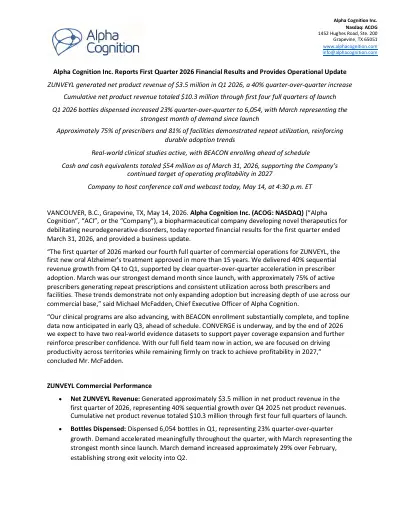
The first quarter of 2026 represents our fourth full quarter of commercialization for Zunveyl, the first new oral Alzheimer's treatment approved in more than 15 years, and the quarter was a strong one. We delivered 40% quarter-over-quarter revenue growth, acceleration in prescriber adoption, advanced strategic priorities across our clinical programs, we strengthened our intellectual property portfolio, and the company further built out our organization as we enter the expansion phase for Zunveyl.
We continue to execute with discipline and confidence, and I believe this quarter demonstrates that Zunveyl's commercial trajectory is tracking well with our internal expectations. In Q1 2026, we generated net total product revenues of $3.5 million, a 40% sequential increase over Q4 2025.
While we are very pleased with Zunveyl's trajectory, we're still at only the start of Zunveyl's commercial phase. The company remains optimistic and believe we will continue to see signs of sustained product performance and adoption within the long-term care segment.
Looking at Q1, we saw growth in the quarter with March delivering our strongest month of demand sales, and April is stronger than March. Overall, we believe we're on track with our 2026 strategic priorities, and we continue to expect to achieve operating profitability in 2027.
On the adoption side, our prescription KPIs remain strong. Our bottles dispensed grew 23% over Q4.
Our HCP writers grew 23% over year-end 2025, and we're on track to achieve our 2026 goal of approximately 2,000 prescribers. Our called-on prescribers expanded 93% quarter-over-quarter, and our nursing homes with Zunveyl prescriptions grew 25%.
Additionally, the commercial team built out a 60-person customer-facing team in the quarter. We added experienced marketing and payer engagement capabilities to the team.
Last month, we strengthened our board of directors with the addition of a new independent board member, Bethany Sensenig. We look to her experience to help build out Alpha Cognition's strategy and for her to provide financial governance for the company.
Turning to our clinical programs, we have three active real-world studies underway, which we believe will strengthen Zunveyl's positioning with payer and healthcare providers. BEACON, our real-world effectiveness study evaluating Zunveyl in long-term care residents with Alzheimer's disease, will complete enrollment this quarter.
The company will report top-line data from BEACON no later than early third quarter, an acceleration from our prior expectation of late Q4. CONVERGE, our retrospective data analysis evaluating tolerability, dosing, polypharmacy, and adverse events in long-term care, initiates in Q2 as planned, and we expect top-line data from this trial in Q3 of 2026.
We expect both BEACON and CONVERGE to provide the company numerous publication opportunities over the coming year. RESOLVE, our Phase 4 outpatient study, will also initiate this quarter.
This study will provide additional data regarding tolerability and efficacy in treating behaviors associated with Alzheimer's disease in the outpatient setting. On the intellectual property front, the US Patent Office issued two patents to provide additional protection for Zunveyl.
A new patent covering dosage regimens for benzgalantamine was given in February, and a second covering the use of benzgalantamine for treating traumatic brain injury was issued in March. Both patents extend protection of the product through 2045.
The TBI market, by the way, represents an addressable opportunity for the company estimated at approximately $14 billion. Regarding our sublingual formulation program, we will initiate a comparative pharmacokinetic study versus our tablet this quarter.
The PK data, should it show equivalence, could be sufficient to advance the sublingual formulation to the clinic. With respect to our ex-US partnership, CMS Pharma continues to advance a regulatory process across multiple countries in Asia, and we anticipate two strategic product approvals in 2026.
From a financial perspective, the company's operating spend of approximately $12 million reflects a deliberate investment in our commercial capabilities and in studies that support our positioning with healthcare providers and payers. I want to be direct about the way we're thinking about our investment phase.
Our net loss this quarter reflects the company scaling our efforts intentionally. We're deploying capital against our highest-return opportunities in the business, including expanding prescriber reach, building real-world evidence to support Zunveyl, and unlocking additional payer access.
These are investments that will drive the company to achieve operating profitability in 2027 and beyond, and we continue to remain on track with these targets. Henry will now review the financials in detail, and Lauren will provide a comprehensive commercial update after Henry concludes his comments.
Henry?
Henry Du
Thank you, Michael. Good afternoon, everyone.
As I review our first quarter of 2026 results, please refer to today's press release and 10-K 10-Q filed this afternoon. For the first quarter of 2026, we generated total net product revenues of $3.5 million in Zunveyl.
This compares to Q4 2025 net product revenues of $2.5 million, representing 40 40% sequential growth quarter-over-quarter. On a year-over-year basis, Q1 net product revenues was $347,000, representing only the final two weeks of March 2025 following our commercial launch, plus $2.6 million in licensing revenue from our CMS agreement.
The trajectory from that initial quarter to $3.5 million in Q1 2026 illustrates the significant commercial progress Zunveyl has made in just one year of commercialization. Total operating expenses, including cost of revenues, for Q1 2026 were approximately $11.6 million, reflecting our continued commercial infrastructure investment, taking into account a fully staffed 60-person customer-facing sales team, expanded payer engagement capabilities, marketing resources, and the initiation of our RESOLVE clinical study.
For context, Q4 2025 total operating expenses were $10.7 million and $6.3 million in Q1 of last year. The step-up from the aforementioned periods to Q1 2026 reflects the intentional investment decisions Michael described.
Scaling the field force, expanding our market reach, and initiating studies that will generate the real-world data needed to accelerate payer coverage and prescriber adoption. For Q1 2026, we reported a net loss of approximately $6.5 million, or 30 cents basic loss per share.
This compares to a net loss of $1.7 million, or 11 cents per share, in Q1 2025. The year-over-year increase reflects investments made in our commercial infrastructure, payer engagement, and clinical programs, all of which are core to advancing Zunveyl's long-term trajectory.
Our core operating efficiency is also improving, and we view our current investment level as appropriate for this phase of growth. As of March 31, 2026, company had approximately $54.2 million in cash and cash equivalents, compared to $66 million at December 31, 2025.
The company maintains a debt-free balance sheet. We continue to believe our current capital position is sufficient to fund operations, sustain Zunveyl's commercialization, and advance our clinical programs, as well as reaching operating profitability 2027.
While we are not providing revenue guidance at this time, we are reiterating our full-year 2026 operating expense guidance of approximately $54 million to $58 million. This is unchanged from our prior guidance.
We expect Q2 spending to increase modestly relative to Q1 as RESOLVE ramps and our peer-to-peer education programs accelerate, but the overall 2026 spending profile remains in line with our plan. We believe this reflects investments needed to support our commercial operations, three real-world clinical studies, payer engagement programs, and the advancement of our sublingual formulation.
With that, I will now turn the call over to Lauren to discuss commercial progress. Lauren?
Lauren D'Angelo
Thank you, Henry. I'm pleased to provide a detailed update on our Q1 2026 commercial performance.
This was a quarter of meaningful execution across prescriber adoption, nursing home penetration, and payer engagement, and the data tell a compelling story of durable, accelerating commercial traction. Let me start with our adoption metrics.
In Q1, the commercial team reached approximately 7,900 total healthcare providers and called on approximately 3,762 prescribers, a 93% increase over the prior quarter. This reflects the expanded reach of our now fully staffed 60-person customer-facing field team.
HCP writers, categorized as prescribers who have written at least one Zunveyl prescription, grew 23% quarter-over-quarter to 1,060. This represents approximately a 28% conversion rate from prescribers called on, a strong indicator of early commercial efficiency.
We entered 2026 with a goal of reaching approximately 2,000 prescribers, and our Q1 growth puts us on a strong trajectory for us to reach this goal. 795 of our 1,060 active writers, or approximately 75%, have placed repeat prescriptions.
Importantly, this implies not just adoption, but sustained utilization, with each writer averaging approximately five to six prescriptions in the quarter. Homes with Zunveyl prescriptions grew 25% quarter-over-quarter to 914.
This represents approximately 36% penetration of the facilities we called on, with each active home averaging over six prescriptions in the quarter. 736 have placed repeat orders, an 81% repeat rate at the facility level.
This is what durable adoption looks like. We called on 2,502 unique nursing homes in Q1, 26% more than in Q4, and we brought 110 new homes on board in March alone, our highest single-month new account total since launch.
Q1 monthly trajectory is notable because it captures how our commercial momentum built through the quarter. In March, we delivered 2,321 bottles, our highest demand month since launch.
This represents a roughly 29% increase over February and establishes a clear exit velocity as we enter Q2. Total bottles dispensed in Q1 were 6,054, a 23% increase over Q4's 4,941 bottles.
Across both prescribers and facilities, we are seeing consistent patterns of depth, not just breadth, of adoption. Conversion rates, repeat utilization, and prescriptions per account all point to a product that is not only being tried, but actively integrated into clinical practice.
We believe our ongoing real-world evidence programs will further reinforce these adoption trends over time. BEACON, CONVERGE, and RESOLVE are designed to generate clinically relevant data in the settings where Alzheimer's patients are actually treated, including long-term care and outpatient practice.
Importantly, we expect these studies to provide meaningful promotional value for our commercial organization by supporting peer-to-peer education, strengthening payer discussions, and increasing physician confidence around tolerability, polypharmacy management, behavioral outcomes, and caregiver burden. We believe these datasets will become increasingly important tools as we continue expanding market access and prescriber utilization.
During the quarter, we also implemented a 6% price increase for Zunveyl to $869.36. We believe our ability to take pricing reflects growing confidence in the product's value proposition, strong underlying demand trends, and the continued depth of adoption we are seeing both prescribers and facilities.
Payer access remains both our most significant near-term friction point and our most significant near-term opportunity. Importantly, we view this as a dynamic rather than a demand constraint, given the strength of our underlying prescription growth and repeat utilization trends.
Our team continued active engagement with national and regional plans throughout Q1. To provide context on where we stand, we have Medicare D contracts in place with two major PBMs representing approximately 45 million covered lives.
Both contracts carry no prior authorization requirements for Zunveyl. This positions us favorably from a policy standpoint once implementation expands across downstream plans.
Implementation across downstream plans' clients is currently at approximately 16% of the total contracted book of business. When our reimbursement team helps support the prior authorization submission process, our approval rate is approximately 89%.
The path to broader implementation is a waiting-and-seeing game typical of an access curve. As is common with newly launched therapies, plans are monitoring early utilization trends before fully activating formulary access across their networks.
We expect contracts to begin gaining meaningful traction in Q2 and Q3, and we are working to accelerate this through our real-world evidence program and our expanded payer engagement team. We are seeing small pockets of improvement across specific plans and regions, and our focus now is on scaling those early wins into broader system-wide adoption across large national plans.
Our full sales team of 60 customer-facing representatives and management is now in place and productive. With the team fully deployed, we are now focused on driving productivity and conversion efficiency across territories.
We are also leveraging AI-enabled commercial analytics and targeting tools to help optimize territory execution, identify high-value prescriber opportunities, and improve the efficiency of our field engagement efforts. We believe these capabilities will allow us to scale our commercial organization thoughtfully while maximizing return on investment.
In Q1, we completed our speaker training for 48 key opinion leaders and have begun rolling out our peer-to-peer educational program, an important tool for converting curious prescribers to confident Zunveyl writers. We presented new clinical data at the American Association of Geriatric Psychiatrists Conference in April, and we are presenting at the Neuroscience Education Institute Spring Congress in May.
These engagements are key components of our strategy to reinforce clinical confidence and expand awareness among high-value prescribers. These conference appearances, combined with our digital educational programs and virtual webinar series, represent a comprehensive multichannel approach to building scientific credibility and prescriber confidence for Zunveyl.
In summary, Q1 2026 was a quarter of deliberate, well-executed commercial progress. We are seeing strong underlying demand, high repeat utilization, and increasing depth of adoption across both prescribers and facilities.
We are growing our prescriber base, deepening facility penetration, building a compelling evidence base, and making steady progress on payer access. As access expands, we believe these fundamentals position us well for continued acceleration.
I'll now hand it back to Michael for closing remarks.
Michael McFadden
Thank you, Lauren. Let me briefly summarize what I believe are the key takeaways for the company for Q1 2026.
First, Zunveyl is growing. We delivered 40% sequential growth in revenues from Q4 to Q1, and our highest bottle count since launch was in March.
We continue to grow, and our commercial trajectory is accelerating. Secondly, our clinical programs are advancing ahead of schedule.
BEACON will complete enrollment this quarter. We expect top-line data reported no later than early Q3.
RESOLVE and CONVERGE will initiate this quarter. By the end of 2026, we'll have two real-world evidence datasets in hand, a powerful foundation for our payer coverage expansion and also to build prescriber confidence.
Third, we're scaling with discipline. Our Q1 operating spend of approximately $12 million reflects intentional investment in the resources needed to win in our market, and we're building very deliberately.
Full-year 2026 expense guidance of $54 to $58 million is unchanged, and we remain on track for operating profitability in 2027. Fourth, our organization's stronger than ever.
Our full field team is in place, we've added meaningful payer and marketing talent, we've strengthened our board. We're building this company to win.
We're excited about the balance of 2026, our pipeline of near-term catalysts, BEACON data, CONVERGE data both in Q3, sublingual PK data in Q3, continued ex-US milestones that will advance an ongoing payer progress. All of these things give us encouraging signs that our platform we built for Zunveyl will continue to reap rewards.
Operator, with that comment, we'll now take questions.
Operator
Thank you. We will now be conducting a question-and-answer session.
If you would like to ask a question, please press star one on your telephone keypad. A confirmation tone will indicate your line is in the question queue.
You may press star two if you would like to remove your question from the queue. For participants using speaker equipment, it may be necessary to pick up your handset before pressing the star keys.
Thank you. Our first question comes from the line of Raghuram Selvaraju with H.C.
Wainwright. Please go ahead.
Hi, thank you for taking my question. This is Jan sitting in for Ram.
I have a few questions. The first is, would you be able to tell me if there's been any notable changes in prior authorizations or step edit requirements over the past several months?
Lauren D'Angelo
Sure. Thanks for the question.
I would say that there has not been a noticeable change in terms of an increase or decrease in the number of prior authorizations since launch, really. What we have seen a change in is our approval rate.
When our reimbursement team is able to support the prior authorization with the additional resources and just experience over the past year, we know what it takes to get a prior authorization approved. You will see that we have anywhere, we say 89%, but sometimes higher from an approval rate for those prior authorizations.
No, we haven't seen any really hard restrictions put in place in terms of step edits or prior authorizations. I would say it's pretty consistent over the last three quarters.
Got it. My next question, I was wondering if you'd be able to tell me, yeah, are there any anticipated 2B key feasibility milestones that would be reached in the development of the film formulation over the remainder of 2026?
Michael McFadden
Yes. It's a great question.
We are advancing with a PK study comparing our sublingual formulation to our tablet formulation. Should that data show equivalence, we will submit an IND to FDA for that sublingual program, which we believe if approved would move us to clinic, and we anticipate delivering that IND the latter part of the year.
Thank you. I have one more if there's time.
What will be the cadence of data release from the ongoing and planned clinical studies of Zunveyl in the post-approval context? Yes,
Michael McFadden
another good question. We are completing enrollment with BEACON much earlier than we anticipated.
We anticipated enrollment and top-line data reported latter part of Q4. We're completing enrollment this quarter.
We have to analyze the data and review our tables, and we anticipate that we'll be able to release top-line data from BEACON no later than early Q3. Ahead of expectations.
The significance of this study is that this is one of the only datasets in long-term care, the segment that we participate in, that will be published and will be executed from a study standpoint. The data should give us insights in Zunveyl efficacy from both cognition and behavioral response.
It'll give us data on tolerability for Zunveyl, and it'll also give us data on polypharmacy, the increase or decrease of other agents when Zunveyl is utilized in therapy. It's a gold mine of data, and I anticipate there'll be a lot of publication opportunities from BEACON.
CONVERGE initiates this quarter. It's a retrospective data analysis, the work will be done rather efficiently, and we anticipate top-line data from CONVERGE will occur in Q3 of 2026.
We'll have our first segment of that data complete in Q3, and there'll be additional segments that will follow. All of those datasets will be publishable, and we'll be submitting for publication with both CONVERGE and BEACON.
RESOLVE initiates in Q2. We don't expect that RESOLVE will complete in 2026, it'll complete in Q2 of 2027.
Got it. Thank you so much.
Operator
Our next question comes from the line of Chase Knickerbocker with Craig-Hallum Capital Group. Please go ahead.
Chase Knickerbocker
Good afternoon. Thanks for taking the questions.
Maybe just two for me, and I'll ask them both up front. You spoke to March acceleration, helpful understanding the cadence to the quarter.
Can you just maybe speak to what extent you've seen that acceleration, that trend continue into April? Kind of what you kind of see as driving it in March, and again, what you're seeing in April?
Are you seeing your kind of lower-tenure reps starting to be more productive, etc.? Then just second, your kind of customer metrics are growing at a similar kind of rate as volume if we look sequentially.
How should we be kind of thinking about the deepening of prescribing patterns? Do you have any cohorts that are mature enough over the course of the last couple quarters that you can kind of see how that trend develops as far as a prescriber that's been writing for two or three quarters and how the deepening of their prescribing patterns occurs over time?
Thanks.
Lauren D'Angelo
Sure. Two really good questions.
I'll start with the first one. Yes, March was our biggest month since launch.
We saw the highest number of bottles dispensed, and we are seeing that continued acceleration into April. I think when we look at these key foundational factors that we put into place, we completed the increase in our sales force, our customer-facing sales force, that really completed in the early part of this quarter.
We've put our speakers in place, our speaker program execution. We've made some adjustments in our payer team and our marketing team to bring on just more power as we approach the market.
With each passing day, we are seeing continued acceleration, and we expect that acceleration to continue in a very positive momentum. As for the way that we're segmenting the market, you're absolutely right.
We've talked a lot about that over the past year. Typically a provider will try the product.
It's a very vulnerable population in the long-term care community, they'll try a couple of patients. They wait a month, two, sometimes three months to see how the drug performs, and then they'll add additional patients onto Zunveyl.
At this point, we are very in tune with that adoption pattern, how fast it takes a physician to move from one tier to the loyalist tier if you want to call them that. What we're seeing is very, very positive.
The entire commercial team is focused on this segment of physicians who have tried, they've got a few patients on, and we can move them further to the right. That's exactly how we're approaching the market.
We definitely understand the pattern, we continue to see more and more physicians move into that loyalist bucket, and we'll continue to execute our tactics with a focus on that type of segmentation. I don't know if that answers your question, but that's kind of how we are actually focusing our tactics and our activity.
Chase Knickerbocker
It does, thank you. Very helpful.
Thanks for taking the questions.
Operator
Your next question comes from the line of Dave Storms with Stonegate. Please go ahead.
Dave Storms
Evening, and thank you for taking my questions. Lauren, I want to start maybe with the AI analytics comment that you made.
Lauren D'Angelo
Could
Dave Storms
you provide maybe a little more color about how far along this is, and maybe any early results here?
Lauren D'Angelo
Sure, no, absolutely. Our team, Michael and I from the very beginning have really tried to be out in the forefront as it relates to AI capabilities, and it's not that hard to implement AI tools in today's environment.
We have actually started applying AI tools across the board, not just commercial, but really across the entire company. Most of our team members are using AI on a daily basis.
As it relates to our commercial opportunity, how we're approaching the market, how we're segmenting the market, that's really where we're leveraging the AI tools. As you can imagine, we have a ton of data, that is constantly coming in on a daily basis, and we're able to leverage those tools to really decipher the key information that we need to turn around and approach the market with a very specific tactic.
We've used it across the board from a targeting perspective, we've used it across the board for a segmenting perspective, we're using it daily just to be more efficient from an administrative perspective across the team. We really are at the point, we're not all the way, I would say we're 100% AI, but we have definitely probably adopted AI and we're using it to be more efficient, more targeted, make sure we're calling on the right customers, making sure that we're delivering the right message to the right customer.
I think we are actually pretty far above most companies in our AI technical capabilities.
Dave Storms
Understood, thank you. Maybe just a quick modeling question as well.
The R&D call out that it's going to be a little bit higher in Q2, should we expect this to kind of ramp with the studies throughout the year? Are there any variables that would make this a little more bumpy?
Michael McFadden
I think it'll depend on enrollment with RESOLVE. RESOLVE is the majority of our R&D spend in 2026.
We're initiating first patient in Q2. We should see some acceleration in Q3, Q4.
One would think that would be linear, David, but we have a lot of sites that will be enrolling in Q3, it'll depend on how fast they begin to enroll patients. There could be a little bumpiness in Q3, Q4.
Dave Storms
That's perfect. Maybe one more for me, Michael, you mentioned in your prepared remarks that you have a new TBI patent, recognizing that that's a long-term project for you guys.
Is there just maybe any more information you can give us here about kind of what the outlook is for this channel?
Michael McFadden
It's an extremely exciting opportunity for the company, $14 billion market opportunity. It affects patients from teenage years all the way to 65+, where the majority of the patients reside, across all patient age ranges.
No approved product to treat TBI, and there's nothing really off-label that's used that works to treat the cognitive impairment that happens about 1/2 of concussion or TBI patients. We're really excited about our early-phase data.
We'll roll that out this year and the fact that our drug demonstrated significant cognitive effects, neurogenesis, a decrease in inflammation, mobility improvements, etc. That data is very good preclinical data.
We'll see if it translates into the clinic, but most excited about advancing that program. From a clinical next steps, we plan to use our sublingual formulation for TBI.
We have met with the agency on pre-IND program, and we will run a tox study, a 12-week tox study, this year. We believe that is all the preclinical work left are needed for that program to advance an IND, which would move us to the clinic.
Dave Storms
That's perfect. Thank you very much.
Operator
This now concludes our question-and-answer session. I would like to turn the floor back over to Michael McFadden for closing comments.
Michael McFadden
Thank you, Operator. Thanks for everyone for joining us this afternoon.
We feel like the company is executing both with our KPIs, our clinical study expertise to support our payers and healthcare professionals, and we encourage everybody to continue to watch the company as it continues to execute in Q2. If those attending this call or reading the transcript have questions, feel free to reach out to our IR group, and we're happy to answer follow-up questions that result following this call.
Thank you for attending.
Operator
Ladies and gentlemen, thank you for your participation. This does conclude today's teleconference.
You may disconnect your lines and have a wonderful day.