Alpha Cognition Inc.
NNASDAQ:ACOGQ3 FY2026 · Earnings Call TranscriptNovember 11, 2026
Operator
As a reminder, this conference is being recorded. It is now my pleasure to introduce Henry Du, interim CFO and VP of accounting and finance.
Henry, please go ahead.
Henry Du
Thank you, Joe. Good afternoon, everyone, and thank you for joining us today for Alpha Cognition's third quarter 2026 financial results conference call.
Today, after the close of market, the company issued a press release announcing these results. On the call with me today are Alpha Cognition's Chief Executive Officer Michael McFadden and Chief Operating Officer Lauren D'Angelo.
Today's call is being made available via the investor section of the company's website at www.alphacognition.com. During the course of this call, management may make certain forward-looking statements regarding future events and the company's future performance.
These forward-looking statements reflect Alpha Cognition's current perspective on existing trends and information. Any such forward-looking statements are not guarantees of future performance and involve risks and uncertainties, including those noted in the risk factors section of the company's latest SEC filings.
Actual results may differ materially from those projected in these forward-looking statements. For the benefit of those of you who may be listening to the replay, this call is being held and recorded on November 11th, 2026.
Since then, the company may have made additional announcements related to the topics discussed. Please reference the company's most recent press releases and current filings with the SEC.
Alpha Cognition declines any obligation to update these forward-looking statements, except as required by applicable securities laws. I'll now turn the call over to Michael.
Michael?
Michael McFadden
Thank you, Henry. Good afternoon, everyone.
Welcome to today's call. The third quarter of 2026 was our strongest quarter since the launch of Zunveyl, the first new oral Alzheimer's treatment approved in more than a decade.
We delivered accelerating demand and record prescriber and facility adoption while holding our operating spend essentially flat with the second quarter. This growth, in combination with disciplined operating spend, aligns with our goal of achieving operating profitability in 2027.
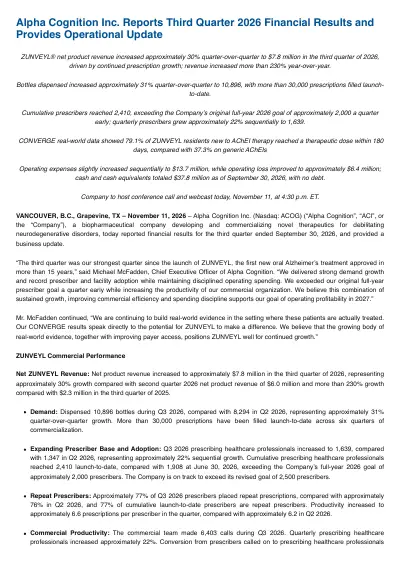
During this call, we'll emphasize four primary things: Zunveyl's growth is accelerating; growth achieved on better targeted calls; financial stewardship remains on track for operating profitability in 2027; and we'll highlight real-world evidence for Zunveyl as it continues to strengthen positioning and differentiation. In Q3, we generated net product revenues of approximately $7.8 million, representing approximately 30% sequential growth over Q2 2026.
Filled prescriptions for the quarter were up approximately 31% quarter-over-quarter. More than 30,000 prescriptions have been filled for Zunveyl across six quarters of commercialization.
We're pleased by the growth underlying these numbers with HCP writers, cumulative writers since launch, and homes with Zunveyl prescriptions, all reaching or exceeding our expectations for the quarter. Lauren will provide more color on the KPIs and our commercial progress in a moment, but I'll share that management is pleased with our KPI attainment at this point in the year.
Turning to our clinical and medical programs, we're continuing to read out real data in the setting where these patients are actually treated. We believe the data the company is generating will help us in discussions with our long-term care practitioners and with payers.
Let me start with CONVERGE. On October 1st, we announced first results from CONVERGE, our retrospective, real-world evidence program using longitudinal long-term care data.
I want to highlight two things. The first was titration data.
Among residents who were new to acetylcholinesterase inhibitor therapy or switched from a competitor, approximately 80% of Zunveyl residents reached the therapeutic dose within 180 days. This is statistically superior to all other drugs in the therapeutic class.
For three decades, the single biggest practical failure of this drug class in nursing homes has been that patients never get to an effective dose because they cannot tolerate the older medications. I'm very pleased by what this data represents about the potential for Zunveyl to make a difference.
The second is polypharmacy. Zunveyl residents on average discontinued two medication classes, producing a net decrease across all eight medication classes evaluated.
This included antipsychotics, other psychotropics, gastrointestinal medications, and sleep medications. Residents on generic acetylcholinesterase inhibitors did the opposite.
They added two more medication classes than they discontinued, with net increases across the same eight medication classes just listed. Now, in a setting where polypharmacy drives costs, staff burden, CMS quality measures, we believe this data will resonate with both our nursing home providers, the nursing homes themselves and their staff, and with payers.
CONVERGE remains ongoing. We expect additional data set updates in January and also in March, which should expand the number of Zunveyl residents available for analysis, and we expect to publish data from CONVERGE starting in the first half of 2027.
Turning to BEACON, we've completed and presented 11 abstracts at medical meetings. The analysis spanned cognition, activities of daily living, neuropsychiatric symptoms, tolerability, treatment patterns, and psychotropic medication utilization.
This data is now available for medical professionals on the Alpha Cognition website under the medical affairs tab. RESOLVE, our interventional study in patients with behavioral symptoms, continues to enroll, with over 57 patients enrolled.
We continue to anticipate study completion the second half of 2027, and we'll provide top-line data when that study completes. On the development side, we're continuing to do work with our sublingual program.
Our PK study concluded in early October, and the data was inconclusive from this study. The company believes we can resolve this with an additional study, which we're initiating in early January.
Our partner, CMS Pharma, we continue to work through the regulatory processes in Asia, where we anticipate approvals in two countries in the near term. We've responded to the Chinese regulatory authorities on their questions and inquiries about the program, and we await any additional questions they may have.
On the intellectual property front, in October, we announced that the US Patent and Trademark Office published our patent application covering proprietary manufacturing processes for benzgalantamine. Additionally, we had the benzgalantamine polymorph patent approved in Hong Kong and Russia during the quarter.
This further strengthens patent protection for benzgalantamine in the US market and around the world, and the company anticipates additional patent approvals in the coming weeks and quarters. With that, I'll turn the call over to Lauren to discuss our commercial progress.
Lauren?
Lauren D'Angelo
Thank you, Michael. This was our strongest quarter since launch, with continued demand growth and meaningful improvement in commercial productivity.
Q3 generated approximately $7.8 million in net product sales, up 30% sequentially, driven by over 11,000 filled prescriptions, an increase of approximately 40% quarter-over-quarter. Net revenue per prescription remained essentially stable at approximately $650 per bottle, demonstrating that growth was driven by prescription volume rather than price.
Just as importantly, we are becoming more productive in how we generate that demand. During Q3, our commercial team made over 7,000 calls and reached roughly 3,400 targeted prescribers.
We continue to refine both who we call on and the frequency of engagement, and we are seeing the impact of that increased focus. The number of HCP writers grew 23% sequentially to 1,654, with cumulative writers reaching 2,438.
More than half of the prescribers we called on wrote Zunveyl during Q3, compared with approximately 35% in Q2. At 2,438 cumulative writers launch to date, we have already surpassed our original full-year goal of approximately 2,000 prescribers with one quarter remaining and remain on track to exceed our revised goal of 2,500.
Importantly, we are not simply adding writers, we are seeing greater depth within our existing prescriber base. Approximately 78% of prescribers placed repeat prescriptions, while productivity increased to approximately 7 prescriptions per writer, up from approximately 6 in Q2.
We are seeing similar momentum at the facility level. We called on approximately 2,800 nursing homes during the quarter, and the number of homes with a Zunveyl prescription grew 29% sequentially to 1,400, with approximately 80% of those homes placing repeat orders.
Cumulatively, we have now reached 1,900 ordering homes, with 81% placing repeat orders. Expansion continued through quarter end, including 103 new ordering homes in September alone.
We are pleased that a significant and growing part of our business now comes from the psychiatry channel, including psychiatrists, nurse practitioners, and physician assistants practicing in long-term care. Turning to payer access, we continue to see encouraging progress.
Where our reimbursement team supports the prior authorization process, approximately 95% of prescriptions are approved, and approximately 70% of long-term care lives have access to Zunveyl with a $0 copay. What is particularly encouraging to us is that we achieved strong sequential prescription growth in Q3 without a meaningful change in formulary access.
As broader contracted access is implemented downstream, we believe payer access can become an additional driver of growth. As Michael discussed, our real-world evidence program is also beginning to support our commercial efforts in a very practical way.
One of the most common questions our representatives have heard since launch is whether frail long-term care residents can successfully be titrated to an effective dose. The CONVERGE data provide real-world evidence addressing that question and give our commercial team additional evidence to support conversations with healthcare professionals.
Stepping back, Q3 demonstrated progress across the key areas we have been focused on: accelerating demand, improving commercial productivity, expanding and deepening our prescriber base, increasing facility penetration, and advancing payer access. We exceeded our original full-year prescriber goal a quarter early and remain on pace to exceed our home goal.
With increasing depth among existing prescribers and facilities, continued customer expansion, and further payer access ahead of us, we believe Zunveyl enters the fourth quarter from a position of increasing commercial strength. I will now turn it over to Henry to discuss the financials in greater detail.
Henry?
Henry Du
Thank you, Lauren. Good afternoon again, everyone.
For the third quarter of 2026, Zunveyl generated approximately $7.8 million in net product revenues, compared with approximately $6 million in the second quarter, representing approximately 30% sequential growth. On a year-over-year basis, this compares with $2.3 million in net product revenues in the third quarter of 2025, growth of more than 230%.
GAAP gross product margin was approximately 94% for the third quarter, consistent with the prior quarter. Total operating expenses for the third quarter were $13.7 million, compared with $12.9 million in the second quarter and $5.6 million in the third quarter of 2025.
That is roughly $12.4 million of SG&A and $1.3 million of R&D expense. The important point is that our spend was relatively flat sequentially while revenue grew 30%.
We reported an operating loss of $6.4 million for the quarter, an improvement from the second quarter and a direct result of revenue growth outpacing spend. Net loss for the third quarter was $7.6 million, or 35 cents per share, compared with a net loss of $8.2 million, or 38 cents per share, in the second quarter.
The difference between our operating loss and our net loss reflects approximately $1.2 million of non-operating items, primarily a non-cash charge related to the change in fair value of warrant liabilities. As of September 30th, 2026, the company had $37.8 million in cash and cash equivalents, compared with $41.4 million at June 30th, 2026.
The company remains debt-free. Cash declined only approximately $3.6 million in the quarter, which includes approximately $1.4 million of proceeds from warrant and stock option exercises.
On a sequential basis, these numbers reflect both revenue growth and expense discipline. We are reiterating the full-year 2026 operating expense guidance we gave last quarter.
Through the first three quarters, we have spent approximately $37.5 million, which keeps us comfortably within the range of $50 to $54 million for the full year. We are not providing revenue guidance at this time.
As we indicated last quarter, we expect to provide expense guidance for 2027 either late in the fourth quarter or at the very beginning of 2027. I'll now hand it back to Michael for closing remarks.
Michael McFadden
Thank you, Henry. Let me briefly summarize what I believe are key takeaways from this quarter.
First, Zunveyl's growth is accelerating. Number two, we're achieving growth on better targeted calls and operational efficiency.
Three, we're demonstrating operating leverage and we remain on track for operating profitability in 2027. Fourth, the company remains excited about the real-world evidence we're building.
This data is both compelling and highly differentiating for our customer base and for the payers. With that, operator, let's open up the floor for questions.
Operator
Thank you. Ladies and gentlemen, if you would like to ask a question, please press star, one on your telephone keypad, and a confirmation tone will indicate your line is in the question queue.
You may press star, two if you would like to remove your question from the queue. For participants using speaker equipment, it may be necessary to pick up your handset before pressing the star keys.
Our first question comes from the line of Naz Rahman with Maxim Group. Please proceed.
Naz Rahman
Hi everyone, congrats on all the progress. It looks like Zunveyl is doing great.
Based on that and all the progress you've seen, I guess what are your thoughts about potentially expanding the sales force or the territories you've promoted in? I guess what sales milestones or what metrics would you have to see internally to consider expanding the promotional effort?
Thanks.
Lauren D'Angelo
Sure. Currently, we believe that our current commercial infrastructure is appropriately sized for where we are today.
Now, as our business grows, we'll continue to evaluate our field force capacity and the productivity, and of course, we'll invest where we believe we can generate an attractive return. The couple of the key indicators that we've talked about in previous quarters and remains consistent today is, one, formulary coverage, right?
When we look to expand outside of long-term care, we think it's really important that we have formulary coverage for those outpatient patients. We're also focused on just maximizing long-term care.
Currently, we believe we have significant opportunity to maximize where we are. We believe that our current broad adoption right now with our 2,500 writers is evidence of broad adoption, but there's a significant opportunity for us to increase the depth and the consistency of these current prescribers before we would actually expand into either additional prescribers or go outside of long-term care.
Naz Rahman
Got it. That was helpful.
Thanks for taking my question.
Operator
The next question comes from the line of Ryan Deschner with Raymond James. Please proceed.
Ryan Deschner
Thanks for the question and congratulations on the growth this quarter. What main initiatives or dynamics do you attribute the better than expected prescriber growth to?
What do you attribute the increase in prescriber conversion of 50% versus what was seen in the second quarter? How do you see this kind of evolving going forward, and have a follow-up.
Lauren D'Angelo
Sure. It's very similar to what we've shared in the past in terms of the adoption rate of an Alzheimer's therapy, especially with long-term care providers.
This is a frail patient population. They're a little slower to adopt than, let's say, the retail setting for an Alzheimer's therapy.
What we believe is really contributing to the growth is experience. Physicians need experience with the product.
Patients need to be able to move through that access and fulfillment process with a new therapy. Then of course, prescribing behavior develops over time.
When we look at our prescribers today and why we're seeing a significant increase, it's really about giving them the time to get the experience with our drug. The drug is working.
It's working far better than we thought it would. We're seeing a significant impact not just with tolerability, but obviously with the behaviors that are associated with Alzheimer's disease.
As physicians get experience, they are writing more, and you see that in the metric where, last quarter, they wrote about 6 prescriptions, we've increased that to 7. They're just getting more comfortable with the drug, and then they're adding it to additional patients.
We believe experience with Zunveyl will continue to contribute to that growth.
Ryan Deschner
Thank you. Then can you give us a little more color on the inconclusive PK study for the sublingual Zunveyl format, and also what other items need to be completed before IND submission there?
Thanks.
Michael McFadden
Yeah. We saw a signal with PK data, specifically AUC, that was inconsistent with previous data sets that we've concluded.
We've concluded four data sets with both Zunveyl, the DR tablet, which was included in this study, as well as sublingual and intranasal. The data was inconsistent with previous data that we've seen.
We feel like that could be either analysis issue from the CRO or it could be a species issue with the species that was included in the study. We are going to initiate a additional study first quarter of next year that we think will resolve those issues and allow the company to move forward.
We believe this is the only study left to advance that product with a meeting with the agency, which would move us to the clinic, and we believe no other data is needed at this time.
Ryan Deschner
Thank you very much.
Operator
The next question comes from the line of Chase Knickerbocker with Craig-Hallum Capital Group. Please proceed.
It appears Chase is disconnected. The next question will come from the line of Ram Selvaraju with H.C.
Wainwright. Please proceed.
Ram Selvaraju
Thanks so much for taking our questions and congratulations on all the progress made this quarter. Firstly, I was wondering if you could give us any additional visibility regarding what recent formulary or contracting wins have occurred since the second quarter, and what you anticipate potentially being likely to achieve on the access front between now and the end of this year.
Looking ahead to 2027, what the core objectives are for the company on that front as you look to accelerate the pace of market uptake for Zunveyl.
Lauren D'Angelo
Sure. Payer coverage has remained unchanged since the previous quarters.
Obviously, we had hoped that we would see some adoption, but we do absolutely believe that broader coverage is achievable. What we're finding, obviously, we know market access is a process, particularly for a new product, and timing is varying considerably by plan.
What we're doing, our focus is, we're continuing to engage payers, and we do believe that our growing physician experience, that increase of volume, the patient utilization, and of course, the accumulating real-world experience and evidence that we're generating will support those discussions. Right now, we don't expect any formulary win in the next couple of months through the remainder of the year, but we are very focused as we always have been with the specific plans that we're engaging with, and we do hope to see some traction early next year.
Then
Ram Selvaraju
with respect to the repeat prescribers and the productivity on a prescription per prescriber basis, are you expecting there to be significant increases in those statistics over the course of the coming quarters, or do you think, for example, now that you're in the high 70s with respect to repeat prescribers, that this has more or less reached a steady state, and the principle drivers of growth are more going to come from expansion in access, expansion in number of facilities, and expansion in the number of new-to-brand prescribers?
Lauren D'Angelo
That's something that we are focused on every single day. We absolutely believe that there is a significant opportunity to increase the depth and consistency of prescribing among existing writers.
While we do plan obviously to continue to add new writers, we add a significant amount every single month, really the more significant opportunity for us right now is to increase that depth and that consistency. We do expect repeat rates to go up across the board with our providers and our customers, and we're seeing that on a month-by-month, quarter-by-quarter basis.
It really is expansion of the writers, but also, more importantly, going deeper with our existing writers is where we're focused today. Now, of course formulary coverage— Oh, sorry, go ahead.
Ram Selvaraju
No, no, go ahead, please.
Lauren D'Angelo
Yeah. Formulary coverage is of course incremental upside for the company.
We're very pleased with the amount of progress we've made and the goals we've been able to hit with a lack of formulary coverage, we actually see formulary coverage providing significant upside for the company. Then
Ram Selvaraju
with respect to the real-world evidence and Phase 4 data that you already have and that you expect to generate in the near term, how do you expect that to feed into the ongoing promotional messaging? What impact does your market research indicate this might have, particularly the data demonstrating the ease with which Zunveyl residents reach therapeutic dose and the degree to which patients on Zunveyl can drop use of certain concomitant medications?
Lauren D'Angelo
What we've seen so far, it's very early. We obviously just announced that data.
We are actually working on that promotional messaging so far, but market research says that those are key indicators. One of the biggest issues with this class is that a majority of these patients who are on a generic acetylcholinesterase inhibitor are not able to get to the therapeutic dose due to the tolerability issues.
That's really was, obviously with the foundation of launching Zunveyl in the first place. That message highly resonates in market research with our customers, as does the polypharmacy message.
Those were two most important factors, and that's why we actually released that data and we got that data the earliest. Now, as we get RESOLVE and some of the other evidence that we're generating, we're generating this data over time, all of the information that we're putting in front of our customers in terms of what we're looking at is highly compelling from a adoption perspective.
I do want to highlight that what we have today, our current story for Zunveyl and the experience that they are actually getting with our drug, is just as good. That we're looking at all of this real-world data as upside incremental to what we already have and what we've launched with from a promotional message perspective.
Michael McFadden
Ram, I'll just add all of the polypharmacy data, dosing data, pharmacoeconomic data that we have and has not been published, but is to come, plus additional pharmacoeconomic analysis will be used with payers to enhance those discussions and will be included in dossier formulary kits, etc., with other decision makers throughout the stakeholder segment that we call on.
Ram Selvaraju
Can you just provide one quick point of clarification regarding the process patent that you announced the publication of, I believe it was last month? Can you just give us a sense of what degree of protection that is likely to afford, to what extent that might represent a meaningful and potentially unique challenge for potential generic competitors to try to overcome?
Assuming it is issued, what do you expect the potential expiration date timeframe to be without factoring in Hatch-Waxman extensions or patent term adjustments? Thank you.
Michael McFadden
I'll start with the last question first. That patent would give us patent protection through 2045 in the US.
We believe it's incremental to the additional patents that we have that cover the product, which include polymorph, which is a structural patent, composition of matter, method-of-use patents, and then we have some additional Orange Book patents that have been filed and accepted and approved by USPTO. We're building a really nice patent shield around the product to protect it in all ways.
The manufacturing product's really interesting in that the claims made provide protection on how the product is manufactured. When you're manufacturing a prodrug, there are specific processes that one needs to use.
We've identified those that are novel and had unexpected findings to provide us that patent. We believe it's protective of the product in addition to the other patents that we already have approved.
Ram Selvaraju
Thank you.
Operator
The next question comes from the line of Chase Knickerbocker with Craig-Hallum Capital Group. Please proceed.
Chase Knickerbocker
Good afternoon. Thanks for taking the questions.
Sorry about the technical difficulties there. Congrats on the great quarter.
Maybe just on formulary coverage. As we await kind of pull-through there, just trying to get a sense for how kind of frequent the friction point is there with the prior auth.
Is there a revenue level that you kind of see in an account where you start to have that friction as a result of that prior auth? I guess a better way to ask it is just have you seen any of your high-volume accounts get to levels where volume start to kind of level off specifically due to that friction from the prior auth?
Lauren D'Angelo
We're not there yet. I think we still have significant opportunity with Zunveyl in terms of driving demand and driving volume.
There used to be a certain friction point that would happen, but we're certainly not there yet. Now, as we've talked about in the past, our payer coverage is Med D, and there's four plans that matter.
We're obviously driving as much volume as we can on all four of these plans to put friction honestly on the payer so that they'll continue to engage and obviously work with us for formulary coverage. Right now, we are not at a point where it's starting to level off.
Now, what I will say is the prior authorizations are real. The great news is that our team continues to get better and better at supporting that prior authorization process, and when our team does touch a prior authorization, we get 95% approval.
Most of our writers, especially our high-volume writers, are very used to, comfortable with, and they know how to work the prior authorization process, and they're working with our team to make sure that Zunveyl is approved through the prior authorization process. I wish I could give you a specific answer, but unfortunately we are not there yet where we've hit a certain milestone.
Chase Knickerbocker
That makes sense. Understood.
Maybe kind of a lead-in to the next one there. What percentage of those prior auths are you handling right now of your overall demand?
How can you expand that further, given a 95% success rate? Then second to that, do you see higher scripts per writer in those accounts where you are handling that prior auth?
Lauren D'Angelo
Yes and yes. We are absolutely focused on increasing the number of prior auths, obviously, that our team touches.
That's a number-one focus for us. We also have some other avenues where the provider is very comfortable, they have a system set up within their own practice, within their facility, where they can process those PAs.
What we've done is we've gotten really productive with our targeting. We are very focused on those physicians who will work with our team, and we're very focused on those pharmacies that will work with our team to ensure that our effort is actually going to result in a prior authorization approval.
That's exactly what we're doing, and we're continuing to see increased support from our team month by month, and you see it growing. It's also obviously getting our representatives to pull through that process as well.
Yes, we're focused on increasing as many prescriptions as we can with our team. Now, to give you an exact number, it is pretty hard to be able to tell you, but it is significant in terms of what our team is touching.
Chase Knickerbocker
Got it. You kind of have the capacity there to do even more?
Lauren D'Angelo
Absolutely. Our team has gotten so efficient with processing these PAs, they're really, really good, and they're also working with offices now.
Offices are actually've gotten really well at doing the prior authorizations on their own as well. It's a partnership between us and our customers, and we're continuing to do that.
Chase Knickerbocker
Great. Thanks, Lauren.
Lauren D'Angelo
Sure.
Operator
The next question comes from the line of William Wood with B. Riley Securities.
Please proceed.
William Wood
Hi. Thanks for taking our questions and congrats on the quarter.
Just given that we're already a little over a month into fourth quarter, could you provide any color on how you're seeing new patient enrollment and script growth through the beginning of the quarter, and maybe how that might set up growing into year end? Then also, what are your expectations for gross-to-net through the end of the year?
Then as we get into 2027, once PBM rebates under the Part D contracts are paid, should we expect a change in gross-to-net, maybe also a change in price, and then have a follow-up.
Lauren D'Angelo
Okay. Hey, we expect the GTN to stay about the same.
As as more patients get through the end of the year with the IRA, you might see a little bit more patients come into what used to be called the donut hole, but no, we do expect a pretty consistent GTN through the remaining Q4. We don't plan to take any price as well, our price will stay the same through the end of the quarter.
Did I answer both your questions? I know you had a three-part.
Is there one more question in there? Just for
William Wood
2027, should we expect a change in early 2027 and or price or gross-to-net? Then what you're seeing potentially in terms of scripts, new patient enrollment, given that we're about a month and a half or month into the fourth quarter.
Lauren D'Angelo
Sure. Our growth continues.
I know we don't provide guidance in terms of revenue or prescriptions, but our growth is continuing into the fourth quarter. That's about all I'll say on that matter.
Then moving into Q1 of next year, we haven't made any decisions as it relates to price, but unless we see a formulary obviously win, we expect the GTN to stay the same, or consistent.
William Wood
Thank you. Then, in terms of you've obviously shown data, very nice data, from CONVERGE, BEACON so far, with RESOLVE coming up next year, I'm curious, a, on the two trials that have already read out, how has that moved the needle both on prescribers as well as payers?
Then in terms of RESOLVE, this looks to be in a open-label study with no comparator, either placebo or say just donepezil, I'm just curious on the exact takeaways that we'll be able to gain from this in terms of improvements on behavior or cognition, even tolerability, within this trial. Thanks.
Michael McFadden
I'll start with RESOLVE. For RESOLVE, primary is tolerability.
Importance of that is that trial is geared toward the outpatient patient with mild-to-moderate Alzheimer's disease. The data will be useful for physicians who treat those patient in an outpatient setting to assess what tolerability they might see when Zunveyl is initiated.
As a secondary, we have the NPI, the neuropsychiatric behavioral management by drug, and so we'll be assessing that for that trial. If that trial demonstrates some effect or signal, that would be advantageous for the company, and we'll know more when that trial reads out.
Regarding BEACON and CONVERGE, BEACON is read out. We published data.
We're starting to see some impact on that, but as it takes multiple calls and multiple touchpoints with the stakeholders within the segment that we call on for that to really build traction. Then with the payers, we've initiated some messaging with BEACON.
We just released the CONVERGE data, and they're just starting to have discussions with payer on the CONVERGE data set. Of note, the CONVERGE data set is really significant because it involves over 6,400 patients, really big patient numbers.
It's retrospective, longitudinal look at what happens when all drugs in the class are used. Very very important to build modeling that the payers look at and value when they're making a formulary assessment, and also is really important to assess some of the cost measures that payers evaluate when they're managing or looking at therapeutic class.
Of this class, it's really unique in the fact that polypharmacy is rampant in the Alzheimer's category. It's rampant from a side-effect management standpoint with GI meds, sleep meds, and other medicines that are used to try to keep patients on this medication class, and it's also rampant because 90% of patients suffer from neuropsychiatric behaviors.
When they suffer from neuropsychiatric behaviors, if they're on a drug that is not ameliorating or lessening those behaviors, they're always put on at least one and often multiple agents to manage the psychiatric behaviors. The C-data that reduces those meds with Zunveyl, while at the same time patients that are using other meds show increase, we think is going to be very persuasive data for payers, and certainly it's going to be equally persuasive to the psychiatrists who consult for treatment of these behaviors.
William Wood
Got it. Very helpful, thank you.
Operator
The next question comes from the line of Dave Storms with Stonegate. Please proceed.
Dave Storms
Evening, and thank you for taking my questions. Lauren, I wanted to ask a question around the prescriber profile.
You obviously mentioned that it's up to averaging 7 prescriptions, up from 6 last quarter. What does the high-volume prescriber profile look like?
Is this a product of them just being with the product longer, seeing more patients? Is there a timeframe where that starts to level out?
Anything there would be helpful.
Lauren D'Angelo
Oh, no, absolutely. It's hard to pinpoint an exact profile for you, but what I can tell you is some of our earlier adopters and our high-volume writers, one, they manage a lot of homes, right?
They're not a single-home doctor. They see a lot of patients.
That's one of the number-one indicators in terms of our highest-volume writers. Number two is they write a lot of donepezil.
Obviously when you're doing a targeting exercise and you're going after your high-volume writers, we've been able to see that the quicker adopters of Zunveyl are those donepezil writers. Now obviously, you'll say, okay, it's the market leader, that makes sense, but there is a specific prescription profile on those physicians who see a number of patients and they're writing a ton of donepezil, because we get a significant amount of switches from donepezil.
Those are the providers that need a treatment choice for these patients and they've had nothing else, they use donepezil. Really for us, the high-volume profile is obviously, high-volume patients and high donepezil use, and that typically we see conversion pretty quickly when we target that specific profile.
Dave Storms
Understood, that's very helpful. Thank you.
Then, Henry, I wanted to ask a question around the expense run rate. Full-year guidance implies roughly $14 million in the fourth quarter, give or take.
Just curious, how much of that spending do you think is associated with CONVERGE and RESOLVE? I know you're not providing 2027 guidance yet, but just trying to back into what maybe could be coming out in the first half of 2027 and then maybe what gets added from the PK study, just trying to work the puts and takes there.
Henry Du
Sorry, can you repeat that last part of your question? I couldn't catch that last part.
Dave Storms
Sorry, just trying to work through maybe some of the puts and takes that we might see in the early part of 2027 for the expense. If that $14 million that's implied in 4Q is a reasonable run rate, or if a lot of that $14 million is tied to maybe CONVERGE and RESOLVE that might drop off in the first half of 2027.
Henry Du
That run rate is consistent with what our expectations are for Q4. The expenses for CONVERGE should kind of taper off a bit, but there'll still be some expenses related to that.
For the most part, the cash flow will be related to commercialization and just general operating expenses.
Dave Storms
Understood. I appreciate that.
Then if I could just sneak one more in, Michael, I know earlier this year, we've talked about regulatory approvals in Asia. Just maybe any high-level updates there, anything we should keep an eye out for in the near future?
Michael McFadden
We submitted for three country approvals, products undergoing regulatory review in those three countries, one of which and the most significant being China. We've completed multiple rounds of questions from the regulatory authorities in China, and now we're waiting their responses or further questions they may have on the responses that have been submitted.
No substantive data to tell on any of those. It's in the hands of regulatory authorities, and we're awaiting their either responses with more questions or approvals of the product.
Dave Storms
Understood. Appreciate the update, thank you for taking my questions, and good luck in the next quarter.
Operator
Thank you. This concludes the question-and-answer session, and I would like to turn the call back to Michael McFadden for closing remarks.
Michael McFadden
Thank you, Joe. Thanks everybody for attending the call today.
We believe you can hear that our commercial progress is accelerating, our product data is strengthening Zunveyl's position relative to competition. We feel like the team has continued to execute with discipline and focus.
I want to thank you for attending the call today, for our investors for supporting the company, and we will talk to you next quarter. Thank you.
Operator
This concludes today's conference. You may disconnect your lines at this time, and we thank you for your participation.