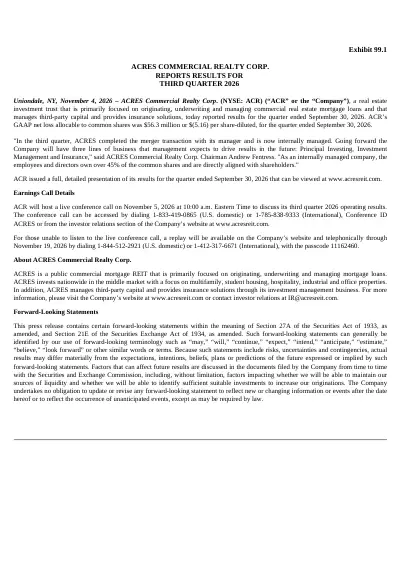
ACRES Commercial Realty Corp.
Q3 FY2026 · Earnings Call TranscriptNovember 5, 2026
Operator
Good morning, ladies and gentlemen, and welcome to the third quarter 2026 ACRES Commercial Realty Corp. earnings call.
Currently, all participants are in a listen-only mode. Later, we will conduct a question-and-answer session with instructions to follow at that time.
If anyone requires assistance during the conference, please press * then 0 on your telephone. As a reminder, this call is being recorded.
I would now like to introduce your host for the conference, Kyle Brengel, Vice President, Operations. Please go ahead, sir.
Kyle Brengel
Good morning and thank you for joining our call. We have posted our third quarter 2026 earnings presentation to our website.
It contains summary and detailed information on the company's quarterly results, including our first reported results following the closing of the merger and internalization. I'd like to remind everyone that today's call may include forward-looking statements, which are subject to risks, uncertainties, and other factors outside of the company's control.
Actual results may differ materially. For a discussion of some of the risks that could affect results, please see the Risk Factors section of our most recent 10-K and 10-Q.
We do not undertake any duty to update forward-looking statements. We will also refer to certain non-GAAP measures on this call.
For reconciliations, you should refer to the press release and 10-Q. With me on the call today are Andrew Fentress, Chairman, and Mark Fogel, President.
Kyle Brengel
I will now turn the call over to Andrew.
Andrew Fentress
Thank you, Kyle. Good morning, everyone.
I'm pleased to report that on August 6th, we completed the merger and internalization of ACRES Capital Corp. with ACRES Commercial Realty Corp.
This is an exciting milestone for ACRES, and I want to thank our board, shareholders, lenders, partners, and employees for their support throughout the process. The rationale for the transaction is to provide our investors with a company that can grow earnings while reducing leverage.
We do this by growing revenue from our two now wholly owned subsidiaries: investment management and insurance. The company has three business lines: ACRES principal investing, the investments that reside on the balance sheet.
Over time, we expect the balance sheet to become more conservative in its holdings, liability structure, and leverage. Two, ACRES investment management, our third-party investment management platform, which has served institutional clients now for over 13 years.
Three,
Andrew Fentress
ACRES insurance, our insurance business focused on delivering products and services initially to our clients and perhaps later to the broader market. As is often the case following a transaction of this nature, there are some non-recurring items that create noise in the reporting.
We have endeavored to simplify the story as best as possible in the earnings presentation. As always, I'm available, along with other members of the ACRES team, to address your questions this morning and in the days ahead.
With that, I'll turn the call over to Mark Fogel, our President, to discuss the portfolio and the quarter's activity.
Mark Fogel
Thank you, Andrew. At quarter end, our commercial real estate loan portfolio totaled $2.1 billion across 56 loans, with an average loan size of $38.3 million.
99.5% of the portfolio is floating rate, and the weighted average spread is 321 basis points over SOFR. During the quarter, we closed one new loan commitment and funded $45 million, including advances on existing loans.
We received payoffs of $36 million across two loans for a net increase to the portfolio of $9 million. Credit in the portfolio remains stable.
Our weighted average risk rating was 2.6, or the same amount as last quarter. We have 10 loans rated 4 or 5, representing 14% of the portfolio versus 10 and 17% from the prior year end.
The collateral properties on these 10 loans have, in the aggregate, achieved higher occupancy rates and better bottom lines.
Mark Fogel
A majority of our portfolio submarkets continue to demonstrate improving real estate fundamentals. During the quarter, one of our REOs received its certificate of occupancy following conversion of the property to 252 multifamily units from a Class B office building.
The property is now leasing up at rental rates ahead of initial projections and should be leased to market occupancy levels by Q3 2027. Upon stabilization, we will evaluate exit strategies, which we expect will provide for full return of our investment basis and potentially additional profit.
This project is a testament to our asset management team's philosophy of evaluating all options to recover our full principal basis and executing on an approved plan. We are in the process of duplicating this development plan with a similar REO in the same market.
Our CECL reserve was $29.4 million at quarter end, or 137 basis points of the loan portfolio, compared with $21.1 million last quarter. The change of $8.3 million was driven primarily by macroeconomic forecast inputs that are impacting the commercial real estate sector at large.
This reserve reflects a forward-looking accounting estimate and is consistent with our view that portfolio credit remains stable. We recorded depreciation and amortization of $8.4 million.
This includes $7.3 million of depreciation and amortization on two assets that were returned to held for investment from held for sale. This change was driven by an ongoing labor negotiation.
Depreciation and amortization are non-cash charges, and they do not reflect a decline in the underlying value of these assets. We had a few significant one-time accounting charges this period as a result of the transaction, totaling $38.3 million, including $13.7 million of non-cash charges.
Much of this was attributable to the acquisition price and expensed versus capitalized for accounting purposes. We expect that the noise to our financial statements will be removed in the fourth quarter, and the full picture will begin to clarify in 2027 with the new reporting structure.
We refinanced our corporate debt and extended our maturities to 2031 and beyond and have a WAL of our liabilities of 10.5 years. We also raised approximately $50 million from our preferred issuance.
We have an ATM program in place for our common and preferred, and if market volatility across the sector wanes down, this will provide an on-demand source of liquidity to the company. Not by accident, we also have a repurchase authorization of $5 million to deploy if and when the market presents us with opportunity.
For the quarter, we reported GAAP net loss allocable to common shares of $5.16 per diluted share and EAD loss of $2.64 per diluted share. Book value per share was $16.81.
Note that this book value per share figure is generally consistent with the pro forma financial statements that were issued as part of the transaction announcement in the third quarter. With that, I will turn the call back to Andrew.
Andrew Fentress
Thank you, Mark. Looking ahead, our mission is clear: optimize the balance sheet, grow the investment management business, and grow the new insurance business.
The ACRES team is focused on this mission, and we are invested side by side with our shareholders. We believe the transaction provides the correct framework and revenue diversification to grow earnings over time.
ACRES has a track record as a disciplined capital allocator. We've been strategic in our loan origination, in repurchasing our shares, and in growing the balance sheet.
We will continue to apply that discipline, and we will seek to pay dividends when they are earned. As a firm, we have set an objective of $2 to $3 a share run-rate EAD earnings.
We plan to update the market on the key drivers of progress as we work toward this objective, including balance sheet returns, investment management fee growth, and insurance contributions. Lastly, as an important reminder, the management team and directors together own 45% of our common shares.
We are directly aligned with our shareholders, and every decision we make is measured against long-term value per share. Thank you for your time and support.
Operator, please open the line for questions.
Operator
Thank you. If you would like to ask a question, press *1 on your keypad.
To leave the queue at any time, press *2. Once again, that is * and 1 to ask a question, and we'll pause for just a moment to allow everyone a chance to join the queue.
Once again, that is * and 1. We'll take our first question from Chris Muller with Citizens Capital Markets.
Please go ahead. Your line is open.
Hi, this is Allison on for Chris. I was just wondering, how should we think about the run rate for the ACC side of the business given the merger closed mid-quarter?
Andrew Fentress
Hi there, this is Andrew. Thanks for the question.
When you say the ACC, are you talking about the investment management business?
Yes. Yeah.
Andrew Fentress
We are growing the asset base consistently each quarter as we have done for the last 14 years. We've set an objective, as we've shared with the market, of the ability to pay between $2 and $3 a share in the coming years.
A lot of that growth is going to come from additional assets from that business. We're going to be sharing more detail about the progress each quarter from assets that come into our various funds and separate accounts.
We're not giving specific guidance on those metrics today.
Got it. That makes sense.
Then just one more for me. Can you talk about the expectations for the REO portfolio?
You made those investments to take advantage of tax losses, but it looks like that's becoming more of a drag on earnings.
Mark Fogel
No, I think in fact some of the REOs are actually turning the corner. I mentioned in my opening remarks that we have an asset in Chicago that's was converted to multifamily.
Property just opened up. There'll be an ability to monetize some, if not all of that investment in the coming year.
The other REO assets that we have are performing better than they have in the past. It'll give us the ability to explore other options for those assets in the coming year.
Got it. I appreciate the color on that, and thank you guys for taking my questions this morning.
Operator
Thank you. We'll take our next question from Gabe Poggi with Raymond James.
Please go ahead. Your line is open.
Gabe Poggi
Hey, good morning and thanks taking the questions. Guys, can you walk us through the post-deal tangible common equity that ACR has?
I'm trying to tie it to the business's leverage profile. What I'm trying to figure out is trying to get clarity on the capital stack between pref equity, common equity, and a significant amount of non-controlling interests, and trying to figure out the fungibility of the common equity and what that common equity is.
Eldron Blackwell
Gabe, this is Eldron. We're going to have about $300-ish million in common, about 230 so in pref, and about 500 in NCI, all of which is leverageable.
Gabe Poggi
Noted. If I think of just kind of, lack of a better phrase, the recourse to ACR common equity, right, that 300 is the common equity, and that's inclusive of the $175 million of goodwill?
Eldron Blackwell
Goodwill itself is an asset on the balance sheet. When you think about the entries for purchase accounting, you pull on assets, you pull on working capital, the offset is to goodwill.
Goodwill itself is on the balance sheet, not in the equity.
Gabe Poggi
No, I understand. I'm just trying to think of tangible book equity.
We can take this off-line. That was question one.
Then question two is, Andrew, I know it's early days with the internalization consummation, but can you just give everybody a reminder of the cadence of AUM growth over the last few quarters at ACC, how you're thinking about that in the environment we live in, which is super volatile, but how you're thinking about that AUM trajectory in 2027?
Andrew Fentress
Thanks, Gabe. Just a quick reminder.
The investment management business has been in existence now we're in our 14th year. It's a long business.
We've established great relationships in the institutional investor community over that time. We've demonstrated an ability to deliver consistent returns over that time.
We've paid out 50 consecutive quarters of positive earnings from that activity over that period of time. Just as a backdrop, it's a long-standing business, and we are operating at peak AUM relative to our history.
We have seen consistent growth there. The rationale for now including that as part of the public company is that we believe we're going to see consistent growth going forward as well.
We're in the market with new products with respect to fund and SMA offerings to serve our institutional investors. I would just say the theme or the message that we're going to our clients with is threefold.
One, we see the fundamentals in the CRE space as sound as they've been at any time in the last 7 or 8 years. When I say fundamentals, we think about the supply and demand of square footage across the various asset classes that we invest in.
Supply is declining rapidly, and hence fundamentals we believe are going to be sound and improving. That's part one.
Part two is the opportunity set or the supply of new loans coming to us is increasing every day. That's driven by assets finally coming to market that have been locked up inside of funds or on bank or other financing pools balance sheets, and then the consistent refinancing needs of our clients.
Those two sources of opportunities we believe are going to be very compelling. In many cases, our sponsors are going to be acquiring assets at or below replacement costs, and we get to finance at those new basis levels is very attractive.
Then the third reason why we're very optimistic about the next several years of investing is that the financing markets, or the ability for us to access low-cost and efficient financing, either through the CLO markets or other investment-grade-rated liabilities, has never been more robust. You take those three things together, and we believe the next several years from an investing standpoint is going to be very attractive.
That message is resonating with our clients, and hence why we are actively raising new funds and new capital today. Without giving specifics in terms of guidance on what that raise looks like, we intend to provide quarterly updates to the marketplace on our progress, each quarter, and then giving people metrics around our growth in that regard.
Gabe Poggi
Again, it would just be helpful to kind of get a cadence, and I get it, again, early days, maybe next quarter, but a cadence for projections purposes to kind of get an idea of how we get to that $2 to $3 EAD run rate you guys have talked about, right, with the fees coming from AUM being a material part of that.
Andrew Fentress
Correct. Yep, we certainly intend to do that.
Gabe Poggi
Thanks.
Operator
Thank you. We'll take our next question from Jason Weaver with JonesTrading.
Please go ahead. Your line is open.
Jason Weaver
Hey guys, good morning. Just a tail on to and clarify the last point that you were talking about with Gabe's question.
Last quarter, I think you laid out three cases of $2.24, $3.11, and $4.09 for EAD. The deck is $2 to $3.
Did something change in your assumptions, or is $2 to $3 a cleaner way of just saying that, and how should we think about a stabilized number into '27?
Andrew Fentress
$2 to $3 is a good number to use. As I said, we're going to just continue to update people on our progress toward that each quarter going forward.
The metrics that we're using to get there, and then the numbers will just show up in the EAD.
Jason Weaver
Got it. Thank you for that.
Then, with all the puts and takes that happened in this quarter with the changes, where could you say we should look for a stabilized sort of expense cost base going forward, just on equity share G&A or something?
Eldron Blackwell
Let's see. This is Eldron.
I would say somewhere between $29 and $32 million.
Jason Weaver
Okay. Got it.
Thank you for that color.
Operator
Thank you. We have no further questions on the line at this time.
I would now like to turn the meeting back to Andrew Fentress.
Andrew Fentress
Thank you, everyone, for participating. We look forward to taking any of your calls or questions in the coming weeks.
Operator
Thank you. This brings us to the end of today's meeting.
We appreciate your time and participation. You may now disconnect.