Air France-KLM SA
Q3 FY2026 · Earnings Call TranscriptNovember 5, 2026
Operator
Good morning and welcome to the Air France-KLM third quarter 2026 results presentation. Today's conference is being recorded.
During the presentation, participants will be on listen-only mode. At the end of the presentation, analysts will be able to ask questions by dialing pound key 5 on their telephone keypad.
At this time, I would like to turn the conference over to Benjamin Smith, CEO, and Steven Zaat, CFO. Please go ahead, sirs.
Benjamin Smith
Thank you. Good morning, everyone, and thank you for joining us for Air France-KLM's third quarter 2026 results presentation.
As usual, I will begin with the strategic and operational highlights of the quarter before handing over to Steven, our CFO, who will walk you through our financial performance in detail. Starting on slide 3, we delivered a solid third quarter despite an operating environment that remains highly volatile.
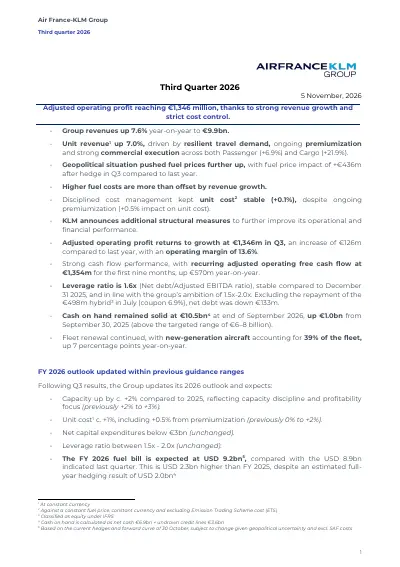
Group revenues increased by 7.6% to €9.9 billion with nearly 30 million passengers traveling across our global network during the quarter. Unit revenue rose 7% at constant currency driven by resilient travel demand, the strength of our upmarket strategy, and strong commercial execution.
This performance was broad-based with passenger unit revenues up 6.9% and cargo unit revenue surging nearly 22%. At the same time, we maintain rigorous cost control.
Unit costs remain essentially stable year-on-year despite ongoing strategic investments in our cabins and customer experience across our airlines. As a result, adjusted operating profit increased by €126 million to €1.35 billion, pushing our operating margin up to 13.6%.
We also continue to generate strong free cash flow and kept our leverage ratio disciplined at 1.6 times even after the successful repayment of our €500 million hybrid bond in July. Fleet modernization continues at a fast pace with next-generation aircraft now representing 39% of our fleet at 7-point a 7-point increase year-on-year.
Crucially, the strength of our unit revenues in Q3 allowed us to fully absorb higher fuel costs during the peak summer period. That said, fuel remains a major headwind.
Based on the current forward curve, we now project our full-year fuel bill to reach approximately €9.2 billion $9.2 billion, sorry, roughly $2.3 billion higher than last year and $300 million above the guidance shared last quarter. While the environment remains demanding, this quarter once again demonstrates the fundamental resilience of our model, the relevance of our strategy, as well as our ability to adapt through dynamic yield management, strict cost control, and agile commercial execution.
This operational discipline is particularly critical at KLM. While the back-on-track transformation plan has already yielded tangible results, KLM today announced additional structural measures to further elevate operational stability, strengthen profitability, and secure the group-wide 8% operating margin target by 2028.
Moving on now to slide 4. At Air France, we continue to build on the core attributes that make our brand unique.
This quarter, we brought together seven renowned French chefs to curate our new long-haul menus while continuing to elevate our ground experience with refreshed lounge offerings. We're also making the customer journey seamless beyond the airport terminal.
Our partnership with SNCF Voyageurs reached a new milestone with the extension of the Train + Air program to all Ouigo high-speed services connecting to Paris-Charles de Gaulle, providing our customers with even greater intermodal choice and regional connectivity. At KLM, we celebrated the 60th anniversary of KLM Cityhopper, which continues to play a vital role in feeding our Amsterdam hub and connecting Europe to our global network.
KLM also marked a major sustainability milestone with the groundbreaking of the Netherlands' first dedicated sustainable aviation fuel, SAF, production facility developed by SkyNRG. This directly supports KLM's off-take commitment of purchasing at least 75,000 tons of SAF annually starting in 2028.
On the operational front, I want to recognize both the Air France, Transavia teams for their flawless execution in supporting the logistics of an exceptional event, Pope Leo's visit to France this quarter, once again demonstrating our group's exceptional agility, operational precision, and service expertise under high-profile conditions. Finally, as testament to our customer-centric focus, Flying Blue was named the world's number one airline loyalty program for the third consecutive year by Point.me.
This award reflects our ongoing efforts to build deep, rewarding customer relationships across Air France, KLM, and now Transavia while continuously expanding the reach of our partner network. Moving on to slide 5.
When we made a strategic decision in 2018 to move our offering further upmarket, our objective was never simply to add more premium capacity. It was to design products and experiences that would genuinely differentiate us at the very highest end of global aviation.
In September, the long-term ambition received landmark recognition. Air France La Première was named the world's best first class by Skytrax.
This award honors the meticulous work of our teams across the entire La Première ecosystem from ground service to the cabin and fully validates the disciplined investments we have made over the past several years. More importantly, it reinforces our firm conviction that moving upmarket is the right strategy for Air France-KLM, combining operational and service excellence with strong customer preference and superior financial returns.
I want to extend my heartfelt thanks to everyone who contributed to this journey. Our focus remains on the future, and we will continue to push the boundaries of luxury travel for our customers.
On to slide 6. Here you see that this upmarket shift is clearly reflected in our revenue mix.
Over the past two years, the share of passenger revenues generated by Business and La Première has expanded from 26% to 29% while Premium Economy grew from 7% to 8%. In other words, our premium cabins now represent approximately 37% of our total passenger revenues, up 4 percentage points compared to 2024.
Looking ahead, we expect our revenue mix to continue shifting upmarket through 2028. The commercial momentum underpinning this shift is exceptionally strong.
Over the past two years, Business and La Première revenues grew by 21% led by outstanding performance across India, Asia, and the United States. Premium Economy revenues grew by 38%, outpacing capacity growth of approximately 21% with the strong performance shown by high-yield leisure travelers.
This continuous outperformance of premium revenues relative to capacity growth confirms the strong pricing power and market appeal of our upgraded cabins. I want to take a second to highlight the fact that our upmarket strategy positively impacts the experience in all cabins.
The new high-speed Wi-Fi powered by Starlink, currently being rolled out at Air France and soon to come to KLM, is free for all customers, also in Economy. When we modify an aircraft's cabin, we install new seats in all cabins, improving the comfort of all passengers.
Our aim is clear: to provide a great traveling experience to all our customers and to elevate our offering in all cabins. Slide 7.
We're very proud to highlight a major structural milestone in our MRO strategy: the formal finalization of Alpha Component Solutions, our 50-50 joint venture with Airbus dedicated to A350 component support. This venture brings together the best of both worlds: the advanced capabilities of Airbus's flight hour services and the deep frontline operational maintenance expertise of our MRO division, Air France Industries and KLM Engineering & Maintenance.
Launched with immediate global scale, this JV already contractually supports more than 500 aircraft worldwide. By combining world-class supply chain integration with our proven maintenance excellence, this partnership allows us to optimize component availability, drive life-cycle efficiency, and capture high-value growth in the rapidly expanding Airbus A350 aftermarket.
On to slide 8. As we were not selected in the TAP privatization process.
While we would have welcomed a different outcome, our strategic ambition in South America and Portugal remains clear: to protect and further solidify Air France-KLM's leader position on routes between Europe and South America while continuing to capture high-value opportunities in the Portuguese market. We already hold the leading market position across the South Atlantic, anchored by the strength of our own network and our long-standing strategic partnership with Gol.
Our priority is to continue deepening this alliance, driving greater commercial integration, and expanding seamless connectivity across Brazil and the broader Latin American continent. Looking ahead, we will continue to pursue targeted organic growth in Portugal, notably through Transavia, while remaining opportunistic regarding potential remedies or slots that may become available in Lisbon following regulatory review.
Throughout the privatization process of TAP, we maintained strict financial discipline, and we remain fully confident in the strength of our standalone strategy. On to slide 9.
To build a stronger and more competitive future, KLM is further pushing boundaries and taking far-reaching structural measures across its operations. The plan laid out today by KLM rests on several key pillars.
First, a strict focus on the core: a powerful network of 160 direct destinations from Amsterdam Schiphol, reliable operations, an excellent customer experience, and the iconic KLM brand. Second, restoring our European network profitability, adjusting our European fleet composition, and expanding the central role of KLM Cityhopper.
Third, a smaller, more agile, and more simple organization, streamlining processes, simplifying the organizational structure, and making much more targeted choices regarding resource allocation. Together, these initiatives will further establish a stronger financial foundation for a sustainable KLM, ensuring it continues to connect the Netherlands with the world for decades to come.
Handing it over now to Steven Zaat, our CFO.
Steven Zaat
Thank you, Ben, and good morning, everybody. If I could use one word for this presentation, I would use the word resilience: resilience in executing the strategy growing our profitable premium segment, leading to resilience in charging to the customer more than the additional fuel cost, resilience in an effective hedge strategy, which is a strong fundamental under our results, and resilience in our focus on cost reductions.
It all comes together if you go to page 11, which is a very simple way to look at the results, where we are actually able to increase our unit revenues with 7% while the fuel price is just bringing a 400 million. If you look at that fuel price, it's around 6.2% what you need to get back to the market, and actually we are overperforming on that.
I will go later through all the segments. Also, what is very keen and what is very important for us is we stress it again, and it is again also mentioned on the KLM measures, we need to get our unit costs under control, and we get our unit costs under control.
We have a flattish unit cost in this quarter, even beating our own guidance which we give to the market, which is between 0 and 2%. If you look at the results per business segment, you see that we have a 6.9 unit revenue at the passenger business.
I will go back later over the world map as usual to show where we are gaining that high unit revenue. Especially strong also the cargo segment.
We have a 22% unit revenue per ATK growth, partly coming from the fact that we increased our pricing by fuel surcharges, partly coming, of course, by the situation in the Middle East, but also there is a fundamental demand coming also from the high-tech. All that together, a strong demand for that product, and also we are able actually to offset our fuel price.
If you look at the the €134 million increase in the adjusted operating profit for the network, there's 89 coming from our cargo business. Then on Transavia, we grew our capacity further, taking over the slots in Orly.
You see that the unit revenue increased by 3%. That is not beating our 6.2%, but on top of it, they had 2.3% cost reductions.
Including the cost reductions, they were able to improve their results year-over-year in this third quarter by, let's say, a more difficult operation also to taking over all the slots from Air France and in Orly. The maintenance segment is more or less flattish.
We had a better performance at KLM Components, but it deteriorated a bit on the Air France Components. All in all, it is a flattish result on the maintenance at a stable margin around 6% for this segment.
If we then go to the difference between Air France, KLM, and Flying Blue, you see that Air France has a, let's say, more or less stable result. They were able to offset with the unit revenues the higher fuel price, but at the same time, there was a slight unit cost increase.
At KLM, we see that the unit costs are decreasing. That is good news.
They were able also to offset the fuel price, but you see that there's still a gap of 2% between Air France and KLM. We need to improve further KLM to make sure that they are able to reach our 8% margin for a full year in 2028.
Flying Blue, as I already stated it, the gift that keeps on giving, again a 25% growth in revenues, especially on the third-party revenues as we call so to the outside world, and this brings another margin improvement for this segment. We are now hitting a 28% margin on our Flying Blue segment, which is a very hard cushion under our results.
Let's then go over the world. Let's start at the top left.
You see that we reach the 6.4% on the passenger. They were able to to cover the increase of fuel costs, which again I come on the 6.2%.
Especially very strong on the first and business segment, almost 12% increase over there with a slight drop in load factor, the Premium Economy up 9%, and even our Economy segment was very close actually to that to that 6.4%. If you look at the world, a very strong demand, and we have also seen it, let's say, at other presentations, still in North America, 9.3% increase of yields in this segment.
Latin America a little bit lower for us, 4%, but we increased the capacity with 9% over there, so that has a significant impact. Africa is fulfilling its compliance with the 6.2% increase of unit revenues.
That is good to see. Then Asia still holding strong despite the fact that we of course decreased capacity related to the Gulf.
We see that we have an increase of 10% in terms of yields. Despite the fact that the Gulf carriers are coming back, we see still that especially on the corporate segment, there is a big preference to fly with European airlines towards towards Asia.
Long haul, 7.6%. Then on the short- and medium-haul in Europe, we are able to have almost 7% increase in yields.
To our surprise, to be honest, because I think that we also saw the situation in Europe where it was extremely hot. In this hot season, we would expect that less results, but it's good to see that we could pass through this higher fuel costs to our customers.
Then Transavia already explained with a 2.5% yield. We're happy with our unit revenue performance and we are happy the of the success of our premiumization strategy.
Then the unit costs. We were able actually to to to gain in productivity to offset the increase of our of the labor costs, in total there's almost no impact from the labor cost part on our unit costs.
Then the fleet renewal brings a 0.4% fuel efficiency, this newer fleet is really bringing also lower costs in our operations. Then you see that the other is more or less flattish at at -0.1%.
There are ups and downs there, we still see high flight-related costs, high ATC costs, high costs especially on the ground in in the airport. At the same time, we have less wet leases in place during the summer, which had an impact of 0.5% positive on our unit costs.
Excluding the premiumization, you see that we had actually reduced our unit costs by 0.4%, and then if you add that 0.5% of the premiumization, which is partly coming from having less seats in a plane, and at the same time we are improving our product on the catering and on the whole ground operation and including the cabin. It's quite good to see that we can offset those premiumization costs in our unit cost trajectory.
Then if you deliver a a good result, you deliver for sure a good cash, we had an €1.4 billion in recurring adjusted operating free cash. The good news is that we see that there are still these exceptionals in for for €744 million, and the good news is that next year actually we only have to pay the wage taxes for KLM up to October, and then we are get rid of all this debt which is we are still having from the COVID.
Good also in relation to our guidance to significantly positive free cash flow delivery. On the net debt, you see we reduced it by €133 million if you take out the hybrid, we are able to, let's say, slightly reduce our net debt, and we paid the hybrid of Apollo of around €500 million, which increased the net debt, but it is a hybrid debt, you could also, and there are some analysts in this room who are actually taking it as debt when they value our shares.
The leverage ratio stayed stable, 1.6, which is the same as we had at the beginning of the year despite the fact that we paid off this hybrid. The good news is that all the financing needs were secured before the summer with very attractive conditions, which you can again have seen on the bonds which we put into the market.
And 80% of our debt is actually a fixed-rate interest, and that excludes even operational leases, which you could also see as a fixed-rate interest rate. We have an average cost of 3.7% for those financial for that financial debt, which is I think very healthy also for the coming years.
Then on the outlook. Now, the big the big Now, the big issue, let's say, in our industry is of course the fuel price.
We see that the fuel bill is going up with $2.3 billion this year. It's good to see that we had an impact of our hedge portfolio of $2 billion this year, very good cushion under our results.
We hedged 62%. We stopped hedging actually for 2026 after the after the first quarter, so that actually we didn't add any hedges for Q4 this year.
If you look at the the the 2027 portfolio, you see that we have hedged 54% for the overall year, bringing at the end of today a cushion of $1.4 billion, which is helpful because part of our hedge result of 2026 will fade away next year. First, I have to admit this is the forward of last Friday, the the oil and the fuel prices are much higher than it is today, probably it will be slightly lower.
If you look at our hedge strategy is that we continued hedge hedging after there was a so-called peace agreement. We have we put a ceiling on the jet fuel, which I will not disclose, and and we actually locked in hedges in that period for the year 2027.
Then we saw actually in the last couple of weeks that actually the jet fuel crack was so expensive that we said, "Okay, let's let's go for another strategy. Let's focus especially on oil because oil is still in strong backwardation."
We put actually in a ceiling, another ceiling to execute our hedges on the oil price. If you look at this portfolio, there is around 50% we always have a minimum of 50% of our portfolio which we do in jet fuel or in gasoil, and we are still above that target.
It's good to see that we actually have also that crack already hedged, let's say, more in the in the previous months and also of course in the year 2025 and the beginning of 2026. I think we have a healthy hedge portfolio.
We continue we continue our hedge policy, of course looking at all the market aspects, also looking carefully at our competitors, and also looking very carefully what is the maximum upside risk and what is, let's say, the potential for any drop in this fuel market. Let's then look at the bookings.
We see already for a long time that there is a that there is a small load factor gap last year compared to this year. You see that we are for the long-haul 1% below, for the medium-haul 1% below, and for Transavia also 1% below.
It comes with very strong yields. If you look at the first 26 days of October, load factor gap, actually we have an a higher load factor in October than we had last year.
You see that the shoulders are are are strengthening in the sense that the the month of September was very strong, but also October is very strong, and we have a yield ex-currency of 12% for the first 26 days. for than it is in Q3.
That where I referred for Q3 for 6.2% on the unit costs, it is around 11% in Q4 what the higher jet fuel price does, but still again that is related to the fuel price of a weeks some weeks ago. Maybe also to add, sorry, on page on on this page on the the the booking because you will ask it, "What is the impact of Paris?"
Before to to save you other questions to us, the impact up to now, if it takes October and also November and December, is around 10 million of of cancellations on our bookings, but of course it all depends what are the bookings doing in the weeks to come. Then the guidance on our capacity.
Actually it is unchanged. Long-haul, 2%; short- and medium-haul, 1%; Transavia, 8%.
Q4, we will be around 1% increase of our capacity where our main network is more or less flattish, but we still grow Transavia in that quarter because we are taking over the slots. You see that for the total group, we are at the lower end of our range which we gave you between 2 to 3%.
If we then go to page 21, you see the outlook of our guidance. Actually, we didn't change anything.
The group capacity I already discussed, 2%. Unit costs, still 1% including the 0.5 increase coming from the cabin premiumization.
Net capex, below 3 billion, and our leverage between 1.5 and 2. With that, I hand over to Ben for his concluding remarks.
Benjamin Smith
Just as an ending here before we open up for questions, another solid quarter for us, strong execution for Air France-KLM. However, we enter the final quarter of the year with prudent caution while maintaining strict operational and financial discipline across the group.
Before we open the floor to your questions, I want to express my sincere thanks to all our teams across Air France-KLM all around the world for their continuous dedication, hard work, and commitment throughout the quarter. Thanks for your attention, and we're now very happy to take your questions.
Operator
Ladies and gentlemen, if you wish to ask a question, please press pound key 5 on your telephone keypad. If you wish to withdraw your question, please press pound key 6.
The next question comes from James Hollins from BNP Paribas. Please go ahead.
James Hollins
Thanks very much. Good morning, both.
A quick one on the unit cost guide. I was wondering if there's any particular cost pressure in Q4.
I think year-to-date you're up 0.6%. Clearly suggests an acceleration in Q4 or you just being very cautious?
Just that low capacity increase in Q4, any detail would be welcome. Then secondly, on M&A, just want to get an update if you can on the SAS timing, moving to 60%.
I guess be remiss not to ask you, Ben, on a scale of 1 to 10, how annoyed were you really at losing TAP? What went wrong?
Did you offer the wrong price, etc.? I suppose less flippantly, with a bit more detail on how you'd expect to evolve your LatAm network in light of not getting it.
Thank you.
Steven Zaat
Good morning, James. Yes, let's say if you look at our unit cost guidance for the full year, you could say that we are maybe a bit pessimistic for the end of the year.
We don't have any specific items which are actually popping up in the fourth quarter, but we have to admit that in the third quarter, the maintenance costs were pretty, let's say, pretty flattish. I think especially on the maintenance side, you see that the costs are going up a bit.
There's no any specific specificity. We just wanted to give a rounded number and then you come to the 1%.
Benjamin Smith
James, it's Ben. On SAS, the next major milestone we have to reach is regulatory approval by the European Commission.
The teams are working diligently on that, and based on what I'm seeing and what the feedback we're getting from the case team in Brussels is that we should be well aligned to complete this transaction, hopefully by the first quarter of next year. On TAP, 1 to 10, oh, I would say maybe 5 or 6.
Listen, when we went into this, we knew it was going to be a tough battle with our competitor, knowing full well that the requirement to have a presence in Latin America was much more important for them because of their current situation, and there were limits to how far we wanted to go in terms of bidding for a strategic investment. We already have SAS in the works.
The timing for TAP was not ideal for us. Spreading our management team so thin to be able to look at integrating a second carrier was not ideal.
Also the price sought by the Portuguese government was much higher than what we had in mind in the beginning, and we pushed really our company to the absolute limit as to what was comfortable. We were quite surprised to the extent of which our competitor went to buying or to bidding and being the successful bidder in this transaction.
Also, I don't know if you saw the details that they accepted to what they put into their bid to which helped them win. I don't think it's a way to properly run a company.
I think it's going to be very, very difficult for them, and I don't think we have any regrets. We'll see.
We have a great position. We have great partners in South America.
There are lots of other partners that would like to do business with us, and we actually do have growth plans. Look, disappointed, but based on the results of how the decision was made, I don't think we ever would have imagined or would be comfortable going that far.
James Hollins
Oh, thanks very much.
Operator
The next question comes from Alex Irving from Morgan Stanley. Please go ahead.
Axel Stasse
Morning, everyone. A couple of questions on my side.
Just wanted to understand, you said at first 28th of October, yields were up 12%. Is this trend accelerating even further going to November and December driven by the business travelers, and how should we think about early 2027 as well?
Second question is related to the unit cost inflation, excluding fuel going to next year. You just mentioned maintenance is probably slightly higher than expected in Q4.
Is low single digit a reasonable number going to next year? Are there any moving parts we should be aware of going to 2027 just to have your views on this?
Thank you very much.
Steven Zaat
Thanks for the question. Let's first start on the yields.
Indeed we see also for November and December strong yields. It is a little bit less than October because October is actually what I said there is an impact of, let's say, increasing the summertime towards October.
Then November, as you see the weather today, it's not really, let's say, the best time to travel. It's still strong, it's still double digit, and as I told you, we need double-digit numbers.
October is slightly stronger than what we see for November and December. For Q1, we are a very, very lazy booking market in France and in the Netherlands because they think about their next holiday after the Christmas.
If you look at, for instance, January, you see that we have just a booking load factor of 40%, and the game is especially after that. We don't see any drops in January, February, and March in the ticket pricing, for the moment you can hold it, but it is a little bit too soon to tell.
The same is for the unit costs. We are just entering in the discussions for the budget.
That we have a strong cost discipline. You have seen the measures of KLM today, but I cannot give you any guidance for now.
I will give it to you in February when we release our results of the full year.
Axel Stasse
Lovely. Thank you very much.
Operator
The next question comes from Stephen Furlong from Davy. Please go ahead.
Stephen Furlong
Good morning, Ben and Steven. Just want to ask, first of all, Steven, you mentioned the social taxes are basically concluding in October.
Also, next year, if I remember, perpetual hybrid, there's one more to be repaid. Can you just confirm, after that, in effect, the balance sheet is clean?
Then for Ben, it's kind of related to that. Maybe you'll talk about this when you do a capital markets day.
Since you've joined, there's been great progress being made with all the stakeholders. I'm thinking of employee relations, I'm thinking of customers, premium award, I'm thinking even dealing with governments, and on the environmental side.
I'm just wondering about investors, and is something on the board down the line in terms of dividends or something like that because, obviously, it's a long time, I think, the global financial crisis before Air France-KLM paid a dividend to investors. Maybe just talk, Ben, about stakeholders, and Steven about the balance sheet.
Thank you.
Steven Zaat
Stephen, thanks for this interesting questions. Let's start over there.
If we go back to indeed the social charges, yes, it is only for KLM what is continuing. We talk about I think, and I look at 2 241, which is remaining next year, and then it's done.
We have paid the social charges to the French state at the end of this year, and we have no cargo claim anymore to pay. That is all done.
Then indeed, you're right. We have this €1.5 billion hybrid, so that is at the end in December.
I don't call it dirty, as you do it. I think it is a clean instrument.
To be honest, if you look at the interest rates today, it's not that bad, and we have an option actually to postpone it for one year if we want if the interest rates are interesting. We are trying to reduce the hybrid stock, so that is actually really our ambition.
Usually we do 50% in a year, and we want to replace it by the net result. We will come back on what we will do with this hybrid.
It is not a very expensive hybrid, to be honest, and at the same time, we have enough cash in that entity to pay back this hybrid. Then the question on dividends, and you will start?
Benjamin Smith
Okay. Steven.
You laid out some of the key elements of reaching a more solid position. In 2018 when I arrived, we had a very, very weak foundation starting off with significantly improving the relationships with staff, in particular at Air France, where if you followed us in 2018, we had rolling strikes that were costing us above €300 million in 2018 alone and about a billion euros for the years before.
Also, the Air France model did not work. A lot of negotiations with the unions and some difficult decisions around fleet were made.
The concept of expanding Transavia is one of the major ones, removing the Airbus A380s, and then putting forward a clear brand, in particular again at Air France, that could meet customers' expectations and be very clear. That took time, and we're very pleased with the results.
There's still a lot more to come. The stakeholders of employees and customers, much improved to the position we were in 20 2018.
I think we now have a much stronger foundation. The margin is more stable.
We are going to 8%. That's our commitment.
Then for shareholders and dividends by extension, yes, we are a listed company. It's our objective to be in a stable, sustainable position to be able to pay dividends.
I'm a shareholder as well, it's front of mind very often. We're not ready to make a commitment as of today, but yes, it's something we talk about a lot.
Yes, it is something we do expect to put in place as soon as we have a better and more sustainable foundation. We don't want to start paying and then have to remove them again.
Obviously, that's that position we take. It's the same approach we take with our unions saying, "We don't want to give you increases where in a couple of years we're going to have to reverse and ask you for efforts."
No, to clearly answer your question, it is something that we'd like to move forward with in the short term.
Stephen Furlong
Understood. Thanks, Ben, and thanks, Steven.
Operator
The next question comes from Harry Gowers from JPMorgan. Please go ahead.
Harry Gowers
Morning, gents. Thank you for taking the time.
First question, it's an extension really on the balance sheet one because I can see that the cash on hand I think is 10.5 billion now, which is a lot higher than your target kind of range. Is that cash just being saved up to continue to simplify the balance sheet?
Just any kind of further color on why the cash level has to be so high above your target range. Then just an extension of that and an extension of the dividend question as well.
Would you consider share buybacks as well, or do you think a dividend would always be the first port of call? Secondly, I just wanted to ask on the Paris protest, can you just confirm I think the 10 million impact you said is just for October and November so far?
Has there been any other impacts in terms of the bookings curve or kind of forward bookings beyond that sort of December or into next year over the coming months? Thanks a lot.
Steven Zaat
Good morning, Harry. We have a very high cash level.
First, we already have the cash in place to pay for the acquisition of SAS, so that is one where we have the cash in order. It's true also part of the cash will be used also to pay off this hybrid in towards Apollo.
It is true that we keep it also for the uncertain times to come. We saw especially when, let's say, the uncertainty kicked in, we used the right moment to put a bond into the market and also to have a kind of security buffer for this year.
Now, this year turns out to be better than what we expected when the war started. Of course we have more room to use also to pay off certain debt.
If you talk about share buyback and dividend, we don't have those kind of discussions yet, but I think we didn't pay any dividends so far, it would be for me more logical to do it in dividends, but we didn't have that internal debate at all at this moment. Then on the Paris impact, I hand over to Ben.
All right,
Benjamin Smith
yes, confirming that for October and the beginning of November, we're expecting about a €10 million hit, probably maybe even all the way through the end of November. What we're pleasantly surprised is today, November 5th, is a countrywide strike, and less than 1% of Air France employees are following this strike.
The impact on our operation is basically zero, and all of our flights are operating. As an outsider, I would have thought the impact would have been much higher, but it's minimal.
Harry Gowers
Great. Thank you both.
Operator
The next question comes from Jarrod Castle from UBS. Please go ahead.
Jarrod Castle
Good morning, Ben, Steven. Firstly, you're able to offset fuel.
Doesn't seem like any other airline I'm aware of can do that. What's different about Air France-KLM?
Is it your premium mix, your network, your client base, or is it some secret sauce how you revenue manage? Secondly, I think, Steven, you said you don't want to talk too much about next year, but is there any color on capacity for next year and fleet deliveries given all the moving parts, how you're thinking about getting planes?
Then one more if I may. I think you made some comments that you're still doing pretty well in Asia given issues in the Middle East.
Do you think this is going to be a bit longer-lasting when all hostilities have ceased? Is there a change from your customer base in terms of how they're thinking about the product?
Thanks.
Benjamin Smith
Secret sauce, I don't know if we have that, but we've got an very experienced team, and our network is very diversified. Not many people know that CDG is the largest international hub on the continent by far.
The number of destinations, the number of flights that we have out of CDG is incredible. Amsterdam, for its size, is actually the number two hub on the continent.
The teams that manage the revenue and put in place the pricing and the distribution have extensive experience in all the different regions around the world. As you can imagine, each region has different characteristics of how we revenue manage.
The upmarket strategy we put in place or started putting in place six years ago, I think we were one of the first in the Western world that really started to focus on this. This maybe is the secret sauce, the unique Paris market, there's no market like it where you have such a luxury leisure component where price elasticity is very unique.
Even with the situation we're seeing in Paris with the protests, it is very resilient. If you follow any of the hospitality, hotel, restaurant industries in Paris, extremely resilient.
I think we have that as a big advantage versus our competitors. Also, the aircraft size that we now are focusing on.
The mainstay of the Air France fleet being the new Airbus A350s, the efficiency of that airplane, as well as the reconfigured 777-300s at Air France are proving to be winning aircraft. We've got the right size, the right number of premium seats in terms of the balance of the configurations on board.
That is 1, 2, 3% improvement of what we had in the past, and you add all that up over almost 100 airplanes, it makes a difference. At KLM, the introduction of the 787-10 and now more recently the Airbus A350-900 is proving out to be the same result.
We're a little bit lagging at KLM, and obviously the formula is not the same. Amsterdam is not Paris, but Amsterdam is really well set up to link a lot of secondary cities in the UK and in Scandinavia, which is going to be enhanced now with the SAS majority position.
It does have unique destination. Let me give you an example.
If you look at the number of destinations we serve in the UK, I think it's about 12. Three quarters of destinations have limited service to other hubs, our ability to channel those passengers via Amsterdam, our ability to yield up is quite strong because the other choices are not great.
I don't think we have secret sauce. I think we have a unique hub in Amsterdam and we have a very unique destination and home market in Paris.
Then maybe the second part of your question here on avoiding the Middle East or our improvements in results going to Asia and to India, that area. We don't have that much exposure, there is a significant increase in the flights that we have, but you look at the overall number of flights that we operate in the whole system, it is not a big percentage.
We are seeing a significant increase on those few flights that we have because of the reluctance of consumers to fly over the Gulf, which I think eventually will revert back to normal habits, but I think it's going to take a little bit of time in the shorter term. All
Jarrod Castle
right, is there anything on capacity and fleet deliveries, Ben and Steven?
Steven Zaat
No, I think if you look at the capacity, let's say the fleet deliveries are still coming in. I think there's a little bit less pressure, I would say, on the aircraft manufacturing given the current circumstances, but we keep on refleeting our fleet, but it's not actually to increase significant our capacity.
We will have a moderate capacity increase as we have seen more or less where we give the bandwidth this year. Then I don't know if you want to add.
Benjamin Smith
Maybe here, we had 67 long-haul aircraft at KLM in 2018 and we're moving towards 70, not a big increase here. At Air France, we had 108 and we're at 120, but in 2018, 10 of those airplanes were A380s, you can say double, two airplanes for one when you switch those out.
The number which we mentioned in the beginning of this call, the number of premium seats on each one of those airplanes has considerably gone up. The mix is very different.
The number of passengers has stabilized, but the footprint of the seats that are carrying the higher-yielding customers takes up obviously a lot more space, the number of seats on the airplanes and the ASKs are tempered compared to the capacity that we have out there. Something else I should mention, the utilization of the airplanes that we have, especially at Air France, has gone up considerably.
Jarrod Castle
Thanks very much.
Operator
The next question comes from Alex Irving from Bernstein. Please go ahead.
Alex Irving
Good morning. Two for me, please.
First one, how are you thinking about the need for a Southern European hub now that TAP is not available? Do you need to take another look at Air Europa as the last asset out there, or is your most Southern hub going to have to be in Paris?
If so, is that an issue given that it's further away from the South Atlantic geographically, less direct Latin American traffic versus either Madrid or Lisbon? Second question, you announced some KLM restructuring measures this morning, which sounds like it could include the meaningful downgauging in medium-haul flying.
Amsterdam's slot-constrained, you of course can't really add flights into that airport, are you going to have another feed for the long-haul operation at KLM? Thank you.
Benjamin Smith
Hi, Alex. For TAP or the need for a Southern European hub, well, this was the strategic reason why we move forward with a bid, but not at any price.
There are other ways for us to serve Latin America, and without a Southern European hub, we were number one off the continent in terms of capacity. If you count the other competitor that we have, only if you combine their non-continent hub with the continental hub where they slightly above us in terms of capacity.
We're in a very good position. We have a very strong partner.
It would have been a lot of money to invest in TAP, there are other ways for us to maintain or to improve our position in Latin America. Also, our other competitor on the continent, they're also developing a Southern hub in Italy.
They'll have their resources stretched. They've committed to investing in Porto.
To have a concentration in Lisbon, which is a slot-constrained airport, we don't see a big amount of additional capacity, and that airline is already in the Star Alliance. Impact on us is not as great as if they would be switching alliances.
It would have been accretive for us, but I think we'll be focusing on additional capacity out of Europe and strengthen our relationships with our partner in Latin America and then also looking at new partnerships potentially in Latin America. I think at the price that the Portuguese government ended up selling the big stake in TAP for, as I said earlier to answer one of the other questions, I don't think it would have been worth it and would have been accretive for us in the short term.
As for Air Europa, we've looked at this company for a while. Not an easy shareholding structure for us to imagine getting ourselves into.
Would we look to do some kind of more extensive commercial partnership with them? Possibly.
It's not number one on our list. For now, our ability to properly serve Latin America is not a concern for us for the next two to three years, and that time gives us a lot of opportunity to solidify our already strong position in Latin America.
You also asked a question, sorry, on KLM. Previously, over many years, KLM had an extensive European connecting market, customers traveling from one European city via Amsterdam to another European city.
That was a big portion of the KLM traffic. This is what's under severe pressure with a big increase in low-cost intra-Europe flying, some new non-stop links that have been put in place.
A lot of this traffic, we're saying it's too expensive to carry with the increase in charges at Amsterdam as well as the new aviation taxes that the Dutch state has put in place. We're reducing our exposure to that part of the market while ensuring we have enough flights and enough capacity to maintain the same amount of feed to our long-haul.
The offering of capacity to the European market or into the European market via Amsterdam from our long-haul network will remain unchanged.
Alex Irving
Understood. Thank you.
Operator
The next question comes from Andrew Lobbenberg from Barclays. Please go ahead.
Andrew Lobbenberg
Hi, Ben. Hi, Steven.
Can I ask, as you look ahead to bringing SAS into the group, what are your thoughts on governance structures or perhaps changing the structure of the group and how it works with the opcos? Just on the same thing, just to clarify, did I understand that you're saying that SAS will happen in or you expect SAS to happen in the first quarter of next year?
Can we just be clear on that? Then can I just come back on the question on the KLM fleet change and restructuring?
That makes good sense that you're trying to get rid of the short-haul to short-haul connecting stuff. How much of the decision to go to the Embraers is motivated by labor arbitrage?
Also, do you see scope to increase the premiumization at KLM? Obviously, it's a connecting hub and Amsterdam's not Paris.
How can you leverage the premium strategy as best you can for KL? Thanks.
Benjamin Smith
Hi, Andrew. You've been following the industry for a while.
The governance structure, when you only have two airlines, is obviously more challenging than if you have more. I think with one of our competitors, it was similar until they added a third and then a fourth carrier.
We're think this is positive from a governance structure perspective and the ability for management to work more effectively. The work we're doing to be best positioned to integrate the SAS management staff.
Far, we're all excited about how this will further simplify the way KLM and Air France work today. That we view is straightforward.
This is not new. We have examples of other carriers on what some of the other practices are and in most cases they're better than how we operate today.
There should be increased synergies that we have not put into any of our forecasts. I'm really excited about that.
The streamlined, simpler, more straightforward governance, which hopefully will have less interference by outside people who have views on how we operate. Q1 for SAS, assuming that the remedy package that we put in front of the European Commission is accepted, then I think we should be good to go in terms of closing in Q1.
If the remedy package is not enough, then that'll take some time to work out something that makes sense. I think what we're confident about is there are no barriers to entry into Copenhagen or Stockholm.
We've already allotted into the plan or taken into account the loss of some slots at Schiphol Airport to account for maintaining the same amount of competition. Of course, CDG is not slot-constrained other than just a few hours in the morning.
I think if we were in another jurisdiction, it'd be much faster, but this is Europe. The fact that Stockholm and Copenhagen are not slot-constrained, it gives us a lot of comfort that this should be more simple than perhaps, let's say, TAP around an airport that is heavily slot-constrained.
On the KLM fleet side, a little bit of everything. When we ordered the Airbus A321s, we'd also ordered A350-1000s and the Embraer 195-E2s, and this was a upgauge of the entire KLM fleet to reduce unit costs.
That was on the regional, on the European fleet, and on the long-haul fleet. Now, since the cost of operating at Schiphol has considerably gone up since these airplanes were ordered, we're now course-correcting to our new reality.
We have now canceled all the A350-1000 orders and we've moved those to 900s. The A321s, even though the unit cost is so much better, we're saying when you do the trade-off, it's just too much capacity if we don't have the 1000s on the long-haul.
We're going to reduce the number of 321s and increase the number of Embraer 195s, even though the 195 is a step up from the Embraer 190. This is the airplane that, I think will best suit KLM's network for the future.
In terms of labor arbitrage, of course there are different CLAs with the cabin crew and the pilots at Cityhopper, and we'll work that through. Cityhopper's already created.
This is not a new AOC. It already had 50 airplanes before we went down this path.
There's 50 airplanes in 2018, and then we had a few more. Maybe we had 10, 20, 25 more.
It's not a complete shift in the way we work with our unions, and there's not a new long-haul AOC or a new AOC for a medium-haul. It's just pretty more capacity in one of the existing AOCs that we have.
Andrew Lobbenberg
Thanks.
Benjamin Smith
Oh, you had one last one, Andrew, which is around the premiumization and whether that would work in Amsterdam. Look, we don't have a La Première market in Amsterdam, a first class market in Amsterdam, so that's not part of the plan.
The Business cabins, because KLM was a real volume market because of the relatively low cost of transferring customers in the past in Amsterdam, that model is now changing. We need to get a greater share of the local market, which we can do.
It won't be easy, but we can do. Which is new, which we didn't have in 2018, it's only been introduced over the last few years, is a Premium Economy, which we dubbed Premium Comfort at KLM, which is doing extremely well, as with most carriers that have this cabin.
We're increasing the size of that cabin. Right now, we have only 2/3 of the KLM long-haul fleet equipped with a Premium Comfort, Premium Economy cabin.
That'll go to 100% over the next two years. The profit per square foot with this cabin is significantly higher than the rest of the plane.
We'll adjust the interior configurations of the long-haul aircraft to better meet the revenue opportunity. We'll be moving to more premium seats, but it's not going to be to the same extent as we did at Air France.
Andrew Lobbenberg
Makes sense. Thank you.
Operator
The next question comes from Antonio Duarte from Goodbody. Please go ahead.
Antonio Duarte
Good morning, gentlemen, and congratulations on the results. Two from me.
One of them relates with the load factor gap. If I remember correctly, on your Q2 results, you reported between long- and medium-haul about the 2 percentage point gap.
This is now decreased apparently to 1%. Just wondering if there are any changes in terms of booking trends that you have seen there, or is just related with your capacity management?
The second one, you mentioned the strong performance in premium leisure. Just talking about on the corporate side, in terms of corporate demand, what types of trends are you seeing there?
Thank you.
Steven Zaat
Hi, Antonio. The load factor gap indeed decreased compared to what we have seen when we entered the third quarter.
I think there is a couple of reasons. I think it was also part of the weather at that moment when we looked more or less at the third quarter.
I think that also had an impact on the bookings itself. It is not a big difference.
We talk about 1%. I think last but not least, then we were looking at July.
July and August, and especially August was, if you look at three months, a more difficult month compared to September. Especially September and October, and again October, we have a higher load factor at the moment for the first 26 days than we had last year.
You see that there's also more demand. I think it has to do a little bit on the timing where we are looking at these results.
There's no really difference in capacity management or anything else.
Benjamin Smith
On the corporate demand, if we focus on Air France, the resilience of the market coming into France is well welcomed by us and very positive. We're seeing really no change in corporate demand going out of France by the corporations based here in France.
I think it's quite resilient, and if not in some markets, it's actually increasing. Thanks to the situation in the Gulf, there's a lot of our corporate clients that head over to the regions that normally would connect over the Gulf are now returning or are now flying with us, and that of course is all positive.
Again, when you look at the 90 departures we have a day long-haul out of CDG, we're talking 10 10, 12 flights that fly over the Gulf region. Those, of course, the performance on those flights is much, much higher than what we had before.
Out of the Netherlands, everything's pretty much stable.
Antonio Duarte
Thank you.
Operator
The next question comes from Quirijn Mulder from ING Financial Markets. Please go ahead.
Quirijn Mulder
Good morning, everyone. This is Quirijn.
I have a couple of questions. My first question is if you look at your EBITDA last year, 5 billion, and probably you're going to exceed that in 2000 2026.
Given the developments, despite the fact that there was a real crisis in February starting, but still what are the lessons you have learned from this crisis? What are you picking up and what you're taking up, let me say, in the case that everything is probably normalizing in a couple of years' time?
What are the takeaways from that what happened here, especially with regard to the fuel and maybe also with regard to the increases of rates, etc.? Then about the competition, it looks like that, okay, some sort of benefits were there from the developments in the Middle East.
Have you now reduced your capacity completely back to the level before the crisis, and, let me say, redirected all your fleet to North America, South America from Southeast Asia? That's what you're mentioning in the press release?
That were my questions.
Steven Zaat
Hi, Quirijn. Good to have you.
It's the last time, thanks for following us all this long time, and I appreciate that our working together. What are the lessons from the crisis?
I think first, it shows that a resilient hedge strategy is really, really important because the fuel price has a strong, strong impact on our results. You cannot adjust capacity overnight.
I think and you want to keep your network running, I think having that is the first lesson. The second one is to be very agile in your network.
When you see that there is no demand anymore in the Gulf, really look for the spots and really quickly act in terms of capacity management. That's what we did.
Last but not least, I think you should not be nervous in pricing. If you see increases in your cost structure coming from the fuel, you should really pass that to the customers.
For that, you need loyalty, and I think by, let's say, upgrading our product, we have more loyalty, also more loyalty customers in our Flying Blue. These loyal customers, they are willing to pay a higher price for our product.
Actually, you see that the value perceived by the customer is still higher than what we charge them, and that's also that we can still able to charge that. I think there has been discipline in the industry.
We were not nervous in our pricing strategy, and we immediately put in place the, let's say, what we call a fuel component in our tariff structure. For the second, I hand over to Ben.
Then
Benjamin Smith
in terms of redeploying our airplanes, Dubai has been closed, reopened, closed, reopened, same as Saudi Arabia, Israel, and Lebanon. The 8 8 to 10 airplanes, we've found new places to deploy these airplanes or we've taken the opportunity to early up some maintenance so that we have more availability to fly these during busier times in the third quarter of next year.
The airplanes are being well optimized during this unusual period.
Quirijn Mulder
Thank you.
Operator
The next question comes from Marc Zeck from Kepler Cheuvreux. Please go ahead.
Marc Zeck
Good morning. Thank you for taking my questions.
First one is on yields, and I recognize were pretty strong, but I would assume that you still had a sizable percentage of tickets in there that were booked pre-crisis. Could you quantify what percentage that was and is it possible what the yield drag was from tickets sold pre-crisis?
The second question, just to follow up on lessons learned, I guess the guys at United and Lufthansa would say that one of the lessons learned is that maybe ticket price was structurally too low pre-crisis and that the crisis yeah, gave the airline industry an opportunity to reset the structural underpricing to a higher level. Would you agree or do you see things differently on that one?
Thank you.
Steven Zaat
Good morning, Marc. Now, I think we don't have a lot of tickets.
I don't know the number, to be honest, but we don't have a lot of tickets for Q4 which are pre-crisis. We have what I say, in France and Netherlands, it's a very slow booking market.
It's not like the UK where people already booking for their next holiday in September for the next summer holiday. Not a lot is related to the pre-crisis.
Then on the remarks of the US carriers, I think that actually echoes my sentence that we say the perceived value is actually higher than the ticket prices. Indeed, the fact that we could increase the ticket prices, let's say, in this period with 7% and that we are now currently at 11% has to do also that there is still a strong demand and that we actually have a perceived value for it.
Then the question mark is if the fuel price drops, what will happen? Let's see.
It's all also about capacity discipline into the market, which is actually underpinning this strong result.
Marc Zeck
Thank you.
Operator
Ladies and gentlemen, as a reminder, if you wish to ask a question, please dial pound key 5 on your telephone keypad. The next question comes from Jack Raeburn from Bank of America.
Please go ahead.
Jack Raeburn
Hello, thank you very much for taking my questions. Three from me.
I was wondering if you could maybe give us some color on the 12% October yields, maybe split segment and geography, where things come over and underperformed on that number. Secondly, perhaps linked to that, North Atlantic yields are up 9.3% with 4.6% capacity growth.
How sustainable do you think that yield dynamic is moving forward? With fuel still elevated, how much do you expect US carriers will continue to raise fares heading into next year?
Finally, just on hedging, you're currently 54% hedged for 2027. I'm just wondering, looking into next year, is there an intention to continue to top up programmatically or kind of opportunistically?
Is there sort of a cap level that you wouldn't want to go over with jet fuel at the current price? Thank you.
Steven Zaat
Hi, Jack. If we go first to your first question, if you want some coloring, I think it doesn't change so much as what we have seen in Q3.
We still see a very strong US market. We still see a very strong long-haul market, and I would even say that the hub is doing not too bad at all.
I think it is more or less the same, and I don't have the details for that yet for Transavia. Let's say you can more or less take the same geographical split.
What the US carriers say, yeah, I don't know. It's nice that they say that they will increase the pricing.
We are working very closely together with Delta, of course we will benefit from that. I think we are quite, let's say, pleased by the pricing in the US.
We are very pleased on the results on North America. If we can drive up further prices, that is the big question.
Although, we will see that also of course other European carriers will also run out of their hedges, there is also, as I showed you, the fuel price is still increasing. We still need to pass through a part of the fuel costs which we are actually absorbing at the current moment with our hedge strategy.
Then on the what we did for the strategy, we keep our strategy, the strategy is still the same as was before. We adjusted for the moment, let's say, the month that we didn't hedge, so that is we are not going to rush to lock that also in.
That is actually the basis. Indeed, as you say, we have a ceiling for jet fuel and we have a ceiling for oil only, and that means that up to now, we were more hedging in the let's say, the third and the fourth quarter and not so much in the first quarter of 2027.
We already have 57% locked in, but the official target that is that we should be at 70 at the end of the quarter. What we need to do is actually we have an combination of pragmatism but following our hedge policy because we don't want to give up on the hedge policy because nobody knows in what kind of world we will entering in '27, and we already start hedging for 2028.
Jack Raeburn
Cool. Thank you very much.
Operator
Thank you for your questions. Let me hand the conference back to the speakers for closing remarks.
Benjamin Smith
Thanks to all of you for taking the time to listen to our presentation today and for all your questions, and we look forward to speaking with you in February at our next session. Thank you.