Ardmore Shipping Corporation
Q3 FY2026 · Earnings Call TranscriptNovember 3, 2026
Operator
Good morning, ladies and gentlemen, and welcome to Ardmore Shipping's third quarter 2026 earnings conference call. Note that today's call is being recorded and an audio webcast and presentation are available in the Investor Relations section of the company's website, www.ardmoreshipping.com.
We will conduct a question-and-answer session after the opening remarks; instructions will follow at that time. A replay of the conference call will be accessible anytime during the next week by dialing 1 (888) 660-6345 or 1 (646) 517-4150 and entering passcode 40219.
At this time, I would like to turn the call over to Gernot Ruppelt, Chief Executive Officer at Ardmore Shipping.
Gernot Ruppelt
Good morning and welcome to Ardmore Shipping's third quarter 2026 earnings call. First, let me ask our President, Bart Kelleher, to discuss forward-looking statements.
Bart Kelleher
Thanks, Gernot. Turning to slide two.
Please allow me to remind you that our discussion today contains forward-looking statements. Actual results may differ materially from those projected in the forward-looking statements.
Additional information concerning factors that could cause the actual results to differ materially from those in the forward-looking statements is contained in our third quarter 2026 earnings release, which is available on our website. I will now turn the call back to Gernot.
Gernot Ruppelt
Thank you, Bart. Let me outline the format of today's call, which you can see here on slide three.
First, I provide a brief overview of our third quarter highlights. Thereafter, I will hand over to Bart, who will cover the market outlook and update you on our financial and operating performance.
Then I will conclude the presentation before opening up the call for questions. Turning to slide four, which covers our earnings highlights.
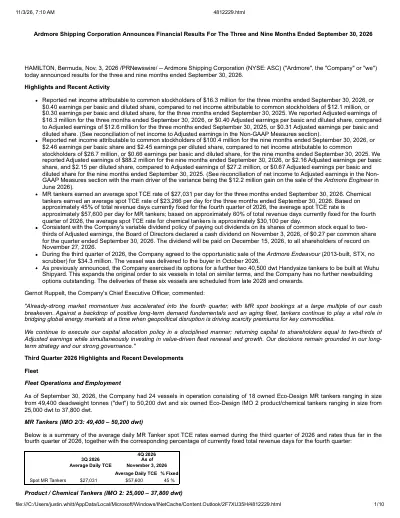
We are pleased to report another strong result, with third quarter adjusted earnings of $16.3 million or 40 cents per share. Geopolitical dislocation continues to reshape trade patterns, absorbing tonnage and boosting TCE rates.
Even stronger momentum has been building into the fourth quarter. We continue to execute on our capital allocation policy.
Ardmore is declaring a dividend of 27 cents per share, consistent with our policy of paying out 2/3 of adjusted earnings. During the third quarter, we agreed to sell one of our 2013-built MRs for $34.3 million, and the ship was subsequently delivered in mid-October.
As previously announced, we exercised options for two handy-size tanker newbuildings, bringing our total order to six vessels with delivery dates starting from 2028. Moving on to our TCE performance on slide five.
Our third quarter bookings reflect a firm market during what is a seasonally slower period. Moving into the fourth quarter, rates have been accelerating meaningfully.
Our MR tankers earned $27,000 per day for the third quarter and $57,600 per day so far in the fourth quarter with 45% booked. As you can see in the chart here, these levels are roughly double the TCEs achieved during the same period last year.
If you were to zoom in further, our recent bookings are north of $80,000 per day. Our chemical tankers earned $23,300 per day for the third quarter and $30,100 per day so far in the fourth quarter with 60% booked.
For some additional context, our handy-size chemical tankers, the focus of our newbuilding program, have concluded average charter rates of nearly $50,000 per day over the last month. Our operating leverage is exceptionally strong, with TCE earnings at a multiple of our operating cash breakeven of $10,800 per day.
Turning to slide six. Here, we outline the company's approach to capital allocation, whereby we continue to return capital to shareholders while investing in fleet renewal and growth.
At the start of the year, we increased our dividend payout ratio to 2/3 of adjusted earnings. Today, we are declaring our 16th consecutive quarterly cash dividend.
As mentioned, we've contracted six handy-size tanker newbuildings with delivery starting in 2028. These highly flexible assets can carry the full range of mainstream oil and refined products, as well as the majority of advanced chemical cargoes, edible oils, and alternative fuels.
This year, we sold two older vessels at very attractive prices, while last year, we had acquired three modern second-hand MRs at prices around 30% below current market levels. We retained considerable financial flexibility across a wide range of market conditions, with an operating cash breakeven of just $10,800 per day and ample debt capacity.
With that, I'd like to hand it over to Bart for the market outlook.
Bart Kelleher
Thanks, Gernot. Turning to slide eight and the market outlook.
Starting on the top right, global seaborne crude shipments are essentially back to pre-conflict levels. The chart on the bottom left shows crack spreads averaging over $60 per barrel on WTI and over $50 on Brent, up from the $20 range at the start of the year.
This is supporting robust refining activity. As depicted in the bottom right, the IEA forecasts global throughput to rise by more than 1 million barrels per day in the fourth quarter, with further growth through 2027, supporting higher product exports and product tanker utilization.
Moving to slide nine and the inventory restocking opportunity ahead. Disruption to crude and product flows has created supply gaps in several regions.
Inventories have been drawn, leaving product stocks at multi-year lows. The chart on the top right shows European jet fuel now half of what it was at the start of the year, sitting well below its five-year range.
Looking to the two charts on the bottom, US gasoline and diesel are both below their five-year lows as well. Rebuilding these stocks will add an incremental layer of product tanker demand.
Just to frame this, the decline in global product stocks equates to over 600 MR equivalent cargoes. Additionally, several countries are planning to increase their strategic reserves, potentially further lengthening the restocking cycle and corresponding product tanker demand.
Turning to slide 10 and how geopolitical shifts and refinery dislocation are reshaping global trade. Energy security remains a fundamental priority, with governments diversifying import sources and securing seaborne supply chains.
At the same time, refining and consumption are increasingly dislocated. The continued trend of closures in the West is being replaced by new capacity in the East, extending voyage distances.
On top of these structural drivers, trade disruption is absorbing fleet capacity. The map shows a few representative examples.
Volumes from the US Gulf to Europe and Asia have risen significantly year-on-year. MR naphtha east is up fivefold.
Moving to slide 11, where we highlight the favorable supply dynamics. Starting on the left with the MR segment, the order book represents 18% of the fleet, and within five years, half of all existing MRs will be over 20 years old.
Moving to the handy-size segment on the right, which, as a reminder, is the focus of our newbuilding program, the order book is just 6% of the current fleet, and within five years, 75% of handies will be over 20 years old. That's 17 million tons approaching the scrapping window, dwarfing the 1 million tons on order.
Slide 12 further shows how the aging fleet impacts effective supply. Given rigorous safety, environmental, and compliance standards, older tankers are increasingly scrutinized by top-tier charterers.
As the chart highlights, utilization meaningfully declines as a vessel ages. Even when older vessels are not scrapped, effective supply is reduced accordingly.
Moving now to our financial and operating performance. Turning to slide 14, where we detail our financial position.
We continue to generate robust cash flows by optimizing TCE performance and tightly managing costs, supporting our low operating cash breakeven level of $10,800 per day, or $11,700 per day including drydocking capex. Looking ahead, including the forward commitments associated with our newbuilding program, effective leverage stands at 32%.
Turning to slide 15, again highlighting our third quarter results, with adjusted EBITDA of $28.8 million and adjusted EPS of 40 cents. The EBITDA reconciliation and our fourth quarter guidance can be found in the appendix.
Turning to slide 16 for operational highlights. Seafarer well-being continues to be a top priority, and we acknowledge the key role our seafarers play in an increasingly challenging operating environment.
During the quarter, we achieved an impressive 99% on-hire utilization, supported by our very active ship-to-shore collaboration, with innovation continuing to drive strong efficiencies. For the remainder of the year, fleet capex is estimated at $2 million, and we forecast $13 million for 2027.
With that, I'm happy to hand the call back to Gernot and look forward to answering any questions at the end.
Gernot Ruppelt
Thank you, Bart. Moving to slide 18, in summary, Ardmore is well-positioned and capitalizing on a strong market.
We are capturing TCE rates at large multiples of our cash breakeven, with MR earnings so far in the fourth quarter of almost $60,000 per day. Recent bookings point even higher, as discussed earlier on the call.
Near-term disruption and inventory restocking needs create strong immediate drivers in addition to compelling structural long-term demand growth and an aging fleet. We are distributing 2/3 of adjusted earnings to shareholders while renewing the fleet through targeted investment in line with the company's dynamic approach to capital allocation.
As always, our decisions are guided by our long-term strategy, strong governance, and a commitment to creating value through market cycles. We now welcome your questions.
Operator
Thank you, sir. If you do have any questions at this time, please press star followed by one on your touch-tone phone.
You will then hear a prompt that your hand has been raised. Should you wish to decline from the polling process, please press star followed by two.
If you're using a speakerphone, you will need to lift the handset first before pressing any keys. Please go ahead and press star one now if you have any questions.
First, we will hear from Jon Chappell at Evercore ISI. Please go ahead, Jon.
Jon Chappell
Thank you. Good afternoon.
Gernot, slide six is your policies and priorities that you've had in place for a few years and they've obviously served you quite well. We're in incredible times right now, and the cash flow generation, the asset value movements, we've never seen before in this industry.
Does that change the way that you think about these priorities into '27 and beyond? If not the priorities themselves, but maybe the timing of how you look to introduce them or potentially accelerate them?
Gernot Ruppelt
That's a terrific question, Jon. I like to think we have been and will continue to approach that topic in a very non-binary way where, as a business, we continue to make sure that we return capital to shareholders.
Of course, as any business, you also have to invest in your future. Those different levers don't have to be always pulled simultaneously or within any given quarter, but rather need to be looked at kind of through the cycle.
For us, we continue to adjust those levers on right now our accelerated dividend payout ratio. At a different time, we embraced share buybacks on the fleet renewal side, very well-timed acquisitions in the second-hand market last year, and equally some well-timed newbuilding constructions that we've committed to at pre-Iran prices and then layered as various tranches at options throughout the year.
In all those situations, kind of really moved early before the market. Then also continuing to assess opportunities to take some value off the table by pruning some of our older ships if we're seeing sort of the right price.
We'll continue to approach it exactly in that fashion.
Jon Chappell
Okay. Thank you.
Then as a follow-up, again, extraordinary, typically when you'd have this kind of quarter-to-date level of rate, I would tend to fade them because typically they don't last, they're not this strong for this long. However, as you insinuated and one of your product tanker peers spoke to last week, they're actually continuing to march higher.
Is there any way to kind of give us a sense of where you sit today relative to that average? Then, given the inventory slides especially that Bart laid out, maybe how to think about magnitude and direction for the rest of this quarter, understanding it's very difficult to predict.
Maybe just kind of where we are today versus the average is a good way to start.
Gernot Ruppelt
Acknowledging some of those challenges of a true prediction, but at the same time grounding us in some of the facts that we are seeing, that we're observing today. Just looking at the market around you, it feels like a winter market already before it is even winter.
If you look at refining margins, we had, of course, some data updated during the slide show, but in very simple terms, refining margins today are double of what they were before the situation in Iran kicked off earlier this year. Those levels are yet again double of what they would have been at the start of the decade.
None of this is set to change anytime soon. Atlantic product markets remain extremely tight, as you can see with some of the significant product deficiencies in some markets, and then at the same time, some barrels, of course, coming out of the Middle East, and you see an overall structural Chinese refining surplus probably kicking into an even higher gear if you consider the recent publication of higher export quotas from China.
At the same time, you also saw that Korea made some announcements with regard to expanding the export capacities. India typically gets quite busy this time of the year as well.
We'll continue to see these significant swings. Overall, the barrels are back, but the efficiency is not.
You, of course, now see product tankers continuing to connect these inefficient commodity markets in a very efficient way.
Jon Chappell
Okay. Thanks very much, Gernot.
Gernot Ruppelt
Thanks, Jon.
Operator
A reminder to please press star one should you have any questions at this time. Thank you.
Next will be Omar Nokta at Clarksons. Please go ahead, Omar.
Omar Nokta
Thanks, operator. Hey, Gernot and Bart.
Thank you for the good update. Hi.
Clearly, 3Q, even though it was softer quarter-over-quarter, was still historically very good. Then 4Q is looking off the charts, as you're highlighting.
Wanted to just ask about maybe somewhat related to Jon's first question about capital allocation. You mentioned opportunistically selling the 2013-built MR.
How do you think about replacing those earnings or taking the cash and using that for a separate purpose? What are you thinking about that?
Over the past few quarters, you've invested in the handies via the newbuildings. How are you thinking about the MR specifically?
Would you look to recycle the cash into more newbuildings on the MR side, or would you look to acquire potentially modern vessels, or is it just sit back and leave as is?
Gernot Ruppelt
Right now, we're very happy with the position that we're in, Omar. We have a very modern fleet, all eco-spec, 85%, roughly 85% spot, as we're heading into the winter market here.
As far as the future is concerned, I believe the market will guide the way. There are times to be just patient and let your position play out, and then there are other times to be decisive, as we have demonstrated at the start of last year, again at the start of this year.
We'll continue to have a very live, interactive discussion internally and with our board about where are the pockets of value, closely tracking price dislocation, while again bringing it back to the overall levers of our capital allocation policy: balancing, returning capital to our shareholders, reinvesting in the business in the long run, but always also in line with what is our long-term strategy and what has been our long-term strategy that underpins those decisions. Kind of combining a very deliberate long-term strategic focus while being nimble and opportunistic, for instance if there's an opportunity to prune some of these older ships.
I will say the Ardmore fleet, as you see, also the ship that we sold, these are fine ships, all eco, built by Ardmore or owned by Ardmore for longer than a decade, with various efficiency upgrades already undertaken, and we're fully prepared and would be very happy to take them through various cycles to come and hold them for another seven years. We're preparing any additional upgrades and maintenance programs and drydocking schedules with that baseline assumption.
If somebody really wants to come and present a strong number, of course, on an older ship, we're always there to listen. That's probably not today.
We're very happy approaching the winter as it is now and letting our position play out here.
Omar Nokta
That's fair. Basically go into the winter, see how that goes, and then perhaps revisit as we get into next year, if I'm reading you correctly?
Gernot Ruppelt
Absolutely. I think there's a lot of really important, interesting immediate drivers that are just really starting to play out on the market.
I think there's the broader picture with the relationship between the bigger ships and MRs, and MRs just really stepping into that normalized relationship, kind of taking their rightful place there. I think looking ahead at where the world is going, not to belabor the state of the world, but at times like these, this concept of having access to energy, supply chain resilience, all that becomes for state players a matter of national security, and at an enterprise level for our customers, protecting these incredible refining profits through access to tonnage will continue to mean one thing and one thing only: maritime assets are essential assets, and the market is probably just in the process of finding how to price those assets correctly.
We're quite happy to see that play out.
Omar Nokta
Certainly. Thanks for that.
Maybe if I could, just another question. Wanted to ask about chartering in tonnage.
It's something that you have done generally in the past. As we think about opportunities there, you've got a very strong balance sheet, plenty flexibility, with all the liquidity you have in the cash.
How do you think about maybe looking to trade more on the TC-in side by going long and bringing vessels in and going short in terms of chartering them out in the spot market? Is that something that's interesting just given kind of where the market is today in terms of the separation between what a TC-in would cost versus what a spot rate would get you today, and then, obviously, in the context of having a very robust balance sheet?
Gernot Ruppelt
Absolutely. I feel like these are levers we have used in the past and something we would continue to explore.
At the moment, well, we have actually redelivered a ship and currently don't have any ships on time charter in, but that could always be something that's very much in the mix for Ardmore. Of course, we're not only looking for a particular number with time charter in relationships, it is also important that we have strong compatibility on brand, on technical management, on the quality of the ships, on the quality of the technical management company behind that vessel, as we then move it into the Ardmore tonnage list, that it is fully up to our expectations because we have a strong following among our community of customers and charterers, and maintaining that is also really important for us.
In principle, very much a part of the playbook, even though that might not be the case today.
Omar Nokta
Got it. That's very helpful.
Thanks, Gernot. I'll pass it back.
Perfect.
Gernot Ruppelt
Thanks, Omar.
Operator
Thank you. At this time, we have no other questions registered, which will conclude the question-and-answer session, as well as our conference call today.
I would like to thank everybody for taking the time to attend and ask that you please disconnect your lines. Have yourselves a good afternoon.