Aspen Aerogels, Inc.
NNYSE:ASPNQ4 FY2025 · Earnings Call TranscriptFebruary 25, 2026
Operator
Good morning. Thank you for attending the Aspen Aerogels, Inc.
Q4 2025 and Full Year 2025 Financial Results Call. All the line will be muted during the presentation portion of the call, with an opportunity for questions and answers at the end.
I would now like to turn the conference over to your host, Neal Baranosky, Aspen's Senior Director, Head of Investor Relations and Corporate Strategy. Thank you.
You may now proceed, Mr. Baranosky.
Neal Baranosky
Thank you, Gabby. Good morning, and thank you for joining us for the Aspen Aerogels fourth quarter and full year 2025 financial results conference call.
With us today are Donald Young, President and CEO, and Grant Thoele, Chief Financial Officer and Treasurer. The press release announcing Aspen's financial results and business developments, and the slide deck that will accompany our conversation today, are available on the Investors section of Aspen's website, www.aerogel.com.
During this call, we will refer to non-GAAP financial measures, including adjusted EBITDA and adjusted net income. The reconciliations between GAAP and non-GAAP measures are included in the back of the slide presentation and earnings release.
On today's call, management will make forward-looking statements about our expectations. These statements are subject to risks and uncertainties that could cause our actual results to differ materially.
These risks and uncertainties include the factors identified in our filings with the SEC. Please review the disclaimer statements on page 1 of the slide deck as the content of our call will be governed by this language.
I'd also like to note that from time to time, in connection with the vesting of restricted stock units and/or stock options issued under our long-term equity incentive program, we expect that our Section 16 officers will file Forms 4 to report the sale and/or withholding of shares in order to cover the payment of taxes and/or the exercise price of options. I'll now turn the call over to Don.
Don?
Donald Young
Thanks, Neal. Good morning, everyone.
Thank you for joining us for our Q4 2025 earnings call. My comments will cover the evolving demand environment for electric vehicles and our related organizational adjustments, our growth outlook for the Energy Industrial segment, and our progress in developing a battery energy storage systems segment.
I will also outline our strong liquidity position and a strategic review process that we are undertaking to explore opportunities to maximize shareholder value. Grant will amplify these points with his comments, and we look forward to your questions.
Throughout 2025 and into 2026, we streamlined the organization, lowered our fixed cost base, strengthened liquidity, and positioned Aspen to operate effectively in a resetting EV market. As expected, US EV sales in Q4 dropped significantly.
GM followed suit with a ramp-down of its EV production rates beginning in Q4 2025. We expect GM and other North American EV OEMs will determine the demand for EVs absent incentives and regulation during the first half of 2026 and align inventory and production rates based on the new market conditions.
From this reset level, we expect EV penetration to resume growth, though at a more measured pace than in prior years. GM has maintained its full line of EV nameplates and has stated that it remains dedicated to its long-term EV success, including in its Cadillac division, where EV sales represented nearly 30% of total sales over the year 2025.
In Europe, we see stronger structural drivers for our PyroThin thermal barrier segment. The key factors of market penetration, charging infrastructure, and steadier policy guidelines create a more visible multi-year adoption trajectory for OEMs.
Battery electric vehicles now represent over 20% of new vehicle registrations in the region. At our last earnings call, we disclosed a battery design award from a major European OEM.
That customer is Volvo Car, bringing our total to 7 European OEM design wins. We remain actively engaged with other European OEMs as they advance to their next-generation EV platforms, and we anticipate securing an additional award during the year.
Across these European awards, we are supporting programs that incorporate battery cells from a diversified global supply base, including European, Korean, Japanese, and leading Chinese manufacturers. We are encouraged by our momentum in Europe and believe the region will be an important contributor to our revenue in 2027 and beyond.
Our Energy Industrial segment is poised to grow through the year 2026. Revenue in 2025 of $102 million was comprised largely of baseload maintenance and limited LNG work, and was largely absent subsea project work where we had record years in 2023 and 2024.
We believe 2026 growth in this segment could reach 20%, supported by three primary drivers. First, we now have a robust pipeline for subsea projects and anticipate strong demand throughout the decade as more subsea developments move into deeper water and more challenging environments.
Aspen has led this segment for two decades, and we are well-placed to benefit from the current subsea cycle. We are off to a good start in 2026 with our first award win for an attractive North Sea pipe-in-pipe subsea project, which we expect to deliver in Q3.
Second, LNG is an attractive growth vector for our Energy Industrial segment, and we're positioned across the entire LNG value chain, not just liquefaction. The market is in a multi-year build cycle, and we expect our LNG and natural gas infrastructure activity in 2026 to roughly double versus 2025 in both project count and revenue contribution, and we also see steady opportunities through the decade.
Accelerating electricity demand keeps natural gas central for reliability and speed to power. We are positioned to convert this demand into profitable growth for our Energy Industrial segment.
The third key factor is pent-up demand for maintenance in refinery and petrochemical end users who have run their facilities hard and profitably over the past year while minimizing maintenance and turnarounds. Again, we are well-placed to meet this demand and to increase our important baseload maintenance revenue.
Collectively, these three drivers support the potential for 20% growth in 2026 for our Energy Industrial segment, with opportunities for similar growth in 2027 and 2028. In 2026, we are investing in our Energy Industrial business by adding to our customer-facing sales and technical service teams around the world.
Our objective is to scale Energy Industrial into a $200 million, high-margin segment without the need for incremental capital investment. As part of our long-term growth strategy, we are also investing in the development of additional commercial segments to leverage our unique technology, sales and technical service teams, and existing manufacturing assets.
We believe the effort will diversify and broaden Aspen's addressable market. A key example is battery energy storage systems, or BESS, where macropolicy and technology shifts are aligning in our favor.
As developers move toward higher density LFP architectures, they are encountering the same thermal propagation challenges we have already solved in EV platforms. We are actively engaged in multiple qualifications and bids supporting grid infrastructure, data centers, and other high-reliability applications.
With EV-proven performance and domestic manufacturing capability, we believe we are well-positioned to participate in this growing market beginning in 2026. We have taken decisive actions to strengthen and increase the flexibility of our balance sheet.
We ended 2025 with approximately $159 million in cash and in a strong net cash position. In March, we will receive a payment from General Motors of nearly $38 million related to a commercial settlement associated with prior EV capacity adjustments.
In addition, we have advanced the sale of our Plant 2 assets and are entering due diligence with the leading bidder following a competitive process. In addition, we continue to manage cash and working capital tightly.
In parallel, we have structurally reduced fixed cash costs by approximately $75 million annually and expect further streamlining in 2026, with a longer-term goal to lower our adjusted EBITDA break-even to $175 million of revenue. Importantly, beyond the break-even level, incremental revenue carries an expected 50% to 60% adjusted EBITDA margin while requiring limited incremental capital investment.
Again, we are initiating a strategic review to ensure our growth strategy and capital allocation priorities are aligned to maximize long-term shareholder value. Following a period of market change and internal restructuring, this review is a disciplined evaluation of our strategic options.
Importantly, it is being conducted from a position of financial strength and operational progress. Our objective is clear: ensure our strategy, capital structure, and asset base are optimized to drive long-term value creation.
Grant, over to you.
Grant Thoele
Thanks, Don, and good morning, everyone. I'll review our fourth quarter and full year 2025 results, provide our Q1 outlook, discuss the European EV market, and close with our strategic framework.
2025 was a transitional year for Aspen. North American EV production levels fell in response to accelerated deregulation and in-market demand, while Energy Industrial results were weighted toward maintenance activity with fewer large project awards.
We believe a recovery is around the corner as EV demand finds a floor and a new baseline is established, with momentum building in our energy business. More on this later.
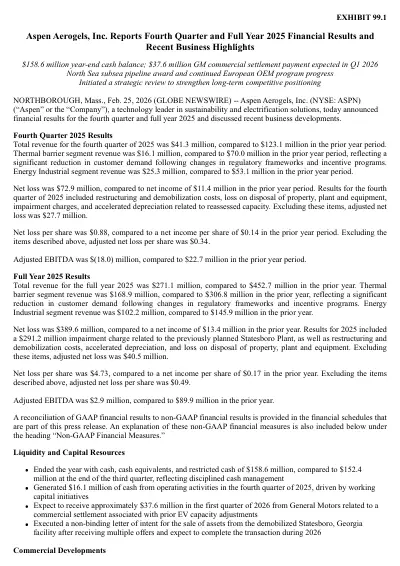
Fourth quarter revenue was $41.3 million, including $25.3 million in Energy Industrial and $16.1 million in thermal barrier. GAAP net loss was $72.9 million, and adjusted EBITDA was -$18 million.
Gross margin was materially impacted by lower production volumes and certain discrete items incurred during the quarter. Adjusted operating expenses, excluding impairments, restructuring charges, and bad debt expense, declined from $22.6 million in Q3 to $21 million in Q4, reflecting continued cost discipline.
Q4 results included several one-time items: a $22.5 million non-cash charge related to underutilized assembly equipment, which materially impacted conversion costs and gross margin; a $3.0 million of bad debt expense associated with a customer solvency issue; several year-end material adjustments, temporarily elevated material costs to 48% of revenue in Q4, which we view as non-recurring. Importantly, we do not believe Q4 profitability levels reflect our go-forward cost structure.
Lower EV production volumes during the year reduced manufacturing absorption, particularly in Q4, and we responded by implementing structural cost actions. Turning to full year performance, revenue totaled $271.1 million, with $102.2 million from Energy Industrial and $168.9 million from thermal barrier.
GAAP net loss was $389.6 million, and adjusted EBITDA was $2.9 million. Gross profit was $46.3 million, representing a 17% gross margin.
Excluding one-time items, gross margins would have been approximately 27% and adjusted EBITDA approximately $13 million for the year. Despite P&L headwinds, we generated $6.1 million of cash in Q4 and ended the year with $158.6 million in cash and cash equivalents.
This performance reflects disciplined working capital management, inventory optimization, and materially reduced capital expenditures. In December, we amended our MidCap credit agreement to enhance covenant flexibility, and we maintain a substantial liquidity cushion under the revised terms.
Turning to slide 4, for the first quarter of 2026, we expect total revenue between $35 million and $40 million. We anticipate approximately $25 million of that revenue to come from the Energy Industrial segment.
Our guidance assumes GM production at an annualized rate of approximately 40,000 to 50,000 vehicles in the quarter, down from the 72,000 annual rate in Q4. This decline was anticipated and reflects typical Q1 planned production downtime and inventory drawdown, along with the effects of GM's previously announced EV transition actions.
We expect production levels to normalize as the year progresses. Accordingly, we expect Q1 to represent the lowest revenue quarter of the year.
From this base, we anticipate sequential revenue growth through 2026, supported by three primary drivers: first, increasing GM production as downtime subsides and EV volumes normalize through the year; second, the continued ramp of our European OEM programs, which we expect to contribute approximately $10 million to $15 million of revenue in 2026; third, we expect approximately 20% revenue growth in Energy Industrial, with a greater concentration of project activity in the second half of the year. As volumes increase and we continue to lower our cost structure, we expect improved operating leverage and margin expansion throughout the year.
Given the mix in the revenue range, we expect adjusted EBITDA to be between -$13 million and -$10 million for the quarter. We expect working capital to be neutral to slightly positive and capital expenditures to remain minimal.
Including scheduled debt amortization, we anticipate approximately $10 million to $15 million of net cash outflows in the quarter. Including the expected $38 million payment from GM, we anticipate ending Q1 well above our 12/31 cash balance of $158.6 million.
This level of liquidity provides flexibility to further delever the business, and we're evaluating a host of options while staying nimble to opportunistically invest in growth initiatives. Over the past year, we have methodically restructured Aspen to operate with a significantly more efficient cost base while preserving long-term revenue capacity.
In 2024, adjusted EBITDA break-even was approximately $330 million of revenue. In 2025, that level declined to approximately $270 million, and by the end of 2026, we will have reduced that further to approximately $200 million.
Looking ahead to 2027, as further structural efficiencies are realized, we're targeting an adjusted EBITDA break-even level of approximately $175 million of revenue. For 2026, we currently expect $10 million of capital expenditures and approximately $35 million of scheduled debt payments, including $24 million of term loan principal amortization.
Proceeds from the potential sale of Plant 2 assets would be applied directly toward term debt and offset scheduled principal payments on a dollar-for-dollar basis. Factoring in scheduled debt amortization, disciplined capital spending, and improving profitability through the year, we expect to expand our net cash position from approximately $60 million today to over $70 million by the end of this year.
As we navigate 2026, maintaining balance sheet strength remains a top priority. Let me turn to slide 5 to highlight our positioning in Europe, which we view as a structurally attractive EV market with increasing visibility into future platform launches.
EV penetration is projected to approach 40% of European production by 2030, supported by continued infrastructure expansion, OEM electrification commitments, and evolving regulatory frameworks. Importantly, Aspen is embedded across major European EV platforms spanning both passenger and commercial vehicles.
Our European-only pipeline represents approximately $220 million tied to 2027 launches, expanding to more than $450 million in 2028. These figures reflect customer-provided full production volume assumptions and normal platform ramp profiles.
We model these programs conservatively, and even under moderated volume assumptions, we continue to see meaningful growth potential into 2027 and 2028. These programs incorporate similar part designs, allowing us to utilize common assembly equipment across these platforms.
This supports capital-efficient growth with minimal incremental CapEx, as most of the required equipment is already in place. While this slide highlights Europe, we remain actively engaged in quoting programs in North America and Asia as well.
Taken together, Europe is positioned to become a meaningful revenue contributor beginning in 2027, with attractive capital efficiency as these platforms ramp. Lastly, I'll build on Don's comments by framing our long-term strategy around three clear priorities.
First and foremost, we have a healthy balance sheet. This provides flexibility: flexibility to operate through market volatility, allocate capital deliberately, and pursue growth from a position of strength.
With that foundation in place, our strategy centers on three pillars: first, continue driving structural operating leverage. We've reset our EBITDA break-even level from $330 million in 2024 to $175 million in 2027, with additional efficiency opportunities ahead.
Above that level, incremental revenue delivers 50% to 60% EBITDA margins, meaning a core market recovery translates directly into profitability; second, strengthening and optimizing our capital structure. We have line of sight to increasing our net cash position by the end of 2026.
We've transitioned to a capital-light, flexible manufacturing model that eliminates the need for new plant construction and allows us to scale using existing assets and swing capacity. This flexibility allows us to fund key growth initiatives while maintaining a strong liquidity profile; and third, accelerating growth through aerogel platform expansion and pursuing transformative opportunities to unlock the full potential of the business.
We are scaling our core EV and energy industrial platforms, including growing European EV momentum and renewed subsea and LNG activity, and at the same time broadening our aerogel technology into adjacent markets and other next-generation energy applications. Through our strategic review process, we are evaluating unique and transformative pathways that could accelerate growth and enhance long-term value creation.
We've engaged highly qualified advisors to rigorously test our assumptions, evaluate capital allocation options, and sharpen our strategic roadmap. Importantly, this review is being conducted from a position of strength, not necessity.
Our objective is clear: thoughtful and disciplined execution of our strategy that maximizes value creation. In closing, we've stabilized the business with a strong balance sheet and built a financial framework that supports both resilience and growth.
We remain confident in our core markets and in the differentiated value of our aerogel technology. With a deliberate strategic review underway and a clear three-pillar framework in place, we are positioned to expand our addressable markets, strengthen our competitive position, and deliver sustainable long-term shareholder value.
Operator, over to you for Q&A.
Operator
Thank you, Grant. To ask a question, please press star followed by 1 on your telephone keypad now.
If you change your mind, please press star followed by 2. When preparing to ask your question, please ensure your device is unmuted locally.
Please kindly limit yourself to one question and one follow-up. If you have any further questions, please rejoin the queue.
Our first question is from Eric Stine from Craig-Hallum. Your line is now open.
Please go ahead.
Eric Stine
Good morning, everyone.
Grant Thoele
Morning, Eric.
Eric Stine
Morning. Morning.
Maybe just starting with PyroThin, and let's see, it's slide 5 that is very helpful. I guess I just wanted to confirm.
The numbers you're giving for 2027 and 2028, the awarded number, is that the full value of what is being provided by your customers, or is that discounted, as I know when you've done this in the past, you have given it a pretty healthy discount? Then curious, as you think about these numbers, and I know a lot of these programs are in ramp mode, but when you compare that to GM, and I know there's uncertainty as to what GM looks like as well, what do you think the mix looks like when you get out into 2027 and 2028 between your primary OEM today and a lot of these programs that are coming on in Europe?
Grant Thoele
Good questions, Eric. To answer your first one, it is full customer volumes in 2027 and 2028.
That blue shaded portion of the chart, the 120 and the 150, that's what they have provided to us. When we look forward at 2027 and 2028, there's a lot of activity.
You can see how much quoted activity we have with programs that start in 2027 and really ramp in 2028, combined with our awarded programs today. As we think about North America versus Europe and the shifts in mix in 2027 and 2028, it's probably fair to assume that GM will probably continue to be at least half in 2027 and 2028.
We're opportunistically looking at these kind of quoted pipeline and current awards that they will ramp faster, and so that mix could change. It's worth noting that these are all at similar margins, our 35% gross margin target, these will be very accretive to the current business.
Eric Stine
Got it, that's helpful. Then, maybe just for my follow-up, you mentioned and you have a little bit in the past, but battery storage.
Wondering if you can provide any clarity. You mentioned that you're actively involved in some quoting and some potential opportunities, maybe clarity there and just if you're able to, any idea or any estimate of what you think that means in terms of fitting into that 20% growth for EI in '26?
Donald Young
Hi Eric, this is Don. Actually, we think about it independently when we talk about the potential for 20% growth in EI.
We are focused on our core maintenance, LNG, subsea type work. Contributions from energy storage would be in addition to that.
We are deep in the qualification and bidding activity levels. We are providing significant sampling and as we go through that process, auditing, etc., of our facilities.
We are deep in that process. As I said in my script, we anticipate beginning revenue in this new segment here in 2026.
Eric Stine
Thank you.
Donald Young
Thank you.
Operator
Thank you, Eric. Our next question is from Colin Rusch from Oppenheimer.
Your line is now open. Please go ahead.
Colin Rusch
Thanks so much, guys. I want to dig into the stationary storage product.
There's a lot of interest around rack-level storage and indoor applications, and I'm just curious about where you're seeing interest. Is it really for some of these larger systems that are outside, some of the data centers looking at very sturdy cycles around kind of voltage management and some of the heavy-duty duty cycling, or is it more tailored towards some of the UPS systems and some of the things that may end up inside buildings, just where it seems like some of your safety attributes could be more valuable?
Love any sort of color on that.
Donald Young
Thank you, Colin. It's both, actually.
We are doing some of the larger-scale external systems, but we're also doing rack-level, modular type systems as well. Again, as you point out, where fire safety is most critical, right?
That's what we're bringing to the party in this particular case. We were working with large companies on these projects.
Again, we're deep in the qualification and bidding process. Not only are we bringing important technology to it, but we have some policy advantages as well with our domestic capacity here in the US, which is creating benefit for those projects.
Colin Rusch
Awesome. Then, I guess a market where it seems like there's some applications, and we haven't heard a lot about it, is in around the military, certainly if you're doing things out at sea, and there's a build-up of incremental EVs or EV-related devices.
Just curious about any sort of initial conversations or potential for you guys to enter into the defense market in a little bit more substantial way.
Donald Young
It's an interesting question, and we do have a team as I've talked in the past this idea of broadening our addressable market. We have deep roots in the defense industry going back to our early first decade, really.
We are focusing on certain applications within defense. Our first priority though in adding a segment is on the energy storage side most immediately, and that's where we're applying the majority of our resources.
Colin Rusch
All right, thanks so much, guys.
Donald Young
Thank you.
Operator
Thank you. Thank you, Colin.
Our next question is from George Gianarikas from Canaccord Genuity. Your line is now open.
Please go ahead.
George Gianarikas
Good morning, and thank you for taking my question. I'd like to focus on the Energy Industrial side and ask if you've tried to make an assessment as to what your market share trends have been over the last several quarters.
It's good to see it getting back to growth this year, but I'm just sort of curious as to if you've discerned what the lack of growth was due to last year. Thank you.
Donald Young
Thank you, George. It it's it's we of course spend a good amount of time analy- analyzing this, and and I think we can point pretty clearly to the lack of project work that separates our 2023 and 2024 numbers from our 2025 number.
Let let's just say roughly a $30, $35 million gap between the earlier years and and last year. You can go straight to to subsea, for example, and that accounts for the vast majority of that of that gap.
Our our market share in that segment is extremely high. Yes, we occasionally lose a project, but not very often.
I the fact in in 2025, there just weren't many projects to be had. When we look at the pipeline for 2026, 2027, and 2027, sorry, 2028, it is much more robust.
The project that we won earlier this year, gets us back, I mean 2023 and 2024 were were unusually large years for subsea. More typically is is a number in the mid-teens.
The project that we won earlier this year that we will deliver in Q3 gets us a long ways towards getting back to that average level, and we have other projects that we're trying to tie down now for for the second half of this year. That's why, George, we we believe that we will grow our Energy Industrial business throughout the throughout the year.
We'll we'll build on it quarter in and quarter out through the year, and and do believe that we've got that opportunity to to grow that business by 20%.
George Gianarikas
Thank you. Maybe as a follow-up, on slide 5 you talk a lot about this growth potential for Europe, particularly in 2027, 2028.
I'm sort of curious as to how you juxtapose that with some of the news coming out of Europe that the ACC, they're still operating, but they appear to be winding down some of their growth projects. Are there other battery manufacturers that you're working with to supply some of the OEMs that are involved in that joint venture?
Thank you.
Donald Young
Yes, George. I think both Grant and I had referenced in our comments, we are in fact working with battery cell manufacturers who are European, Korean, Japanese, and a couple of the leading Chinese manufacturers as well.
That has given us a more robust, I think, outlook on Europe and a little less dependent on any single cell manufacturer. You mentioned ACC.
We had Northvolt as well. Just as an example, in the Northvolt case, those battery cells were replaced by Asia-based cell manufacturers, and we're right in the middle of those programs.
That diversity is important to us, I think, and gives us confidence about the European market.
George Gianarikas
Thank you so much.
Donald Young
Thank you. Thanks, George.
Operator
Thank you, George. Our next question is from Chip Moore from ROTH Capital Partners.
Your line is now open. Please go ahead.
Chip Moore
Hey, good morning. Thanks for taking the question.
Don, maybe on adjacent growth opportunities beyond BESS, any more you can share on what you might be looking at? Obviously, building materials in the past has been something you've targeted, but any update on some of those potential markets?
Donald Young
We have a strong background on the B&C side, and we are working on a product today that we believe can be effective in a slice of that market. It's a very large market, and so a slice is additive for us and incremental for us.
As we've pointed out, incremental revenue is extremely extremely valuable to us. It is a product that we would most probably supply from our EMF supplier, and we want to make sure we have just the right product.
It gets certified properly, and then we renew the relationships that we had in that space. We did before we became tight on capacity in the late teens, we developed that segment into a multimillion-dollar effort on our part, and we think we can rekindle that with our fire safety and thermal performance characteristics.
Chip Moore
You think Europe would sort of be the target market still?
Donald Young
I'm sorry, say that again?
Chip Moore
Oh, with Europe in particular, would that be more of the target opportunity for that type of product?
Donald Young
Sorry. Yes, just the building type and more of the thermal efficiency regulation and the style of buildings in Europe suit our retrofit-type approach to the market and increasing thermal performance in existing buildings.
Chip Moore
Maybe just for my follow-up question, just on the strategic review, just any more you can give us on the process and timeline and potential options that you might consider. Thanks.
Donald Young
Thank you, Chip. Look, from the strategic review, we have had a lot of change in our commercial markets.
We have restructured the company significantly. We have strengthened our balance sheet significantly, and we can feel that we're making operational progress that translates into quarter-over-quarter growth throughout this coming year.
From a strategic review point of view, we just want to make sure that we have some external influences on our thinking and that we don't get too caught in our own thinking. Testing our assumptions externally, we think is a prudent thing for us to do.
We're able to do it, again, much more off of our front foot as opposed to our back foot, and so we're going to be very deliberate about it, on the one hand. This is important to us, and we're going to do it with urgency, and we have a broad view.
We're in our early stages, we don't want to take anything off the table, but we're not prepared quite yet to say what the logical outcome would be of that effort.
Grant Thoele
Maybe just to add to Don's comment, we are in the early stages, but right now, we have plenty of cash runway. This is not about just kind of bolstering the balance sheet more or anything like that.
Really what we are focused on is pouring gasoline on the fire. We want to accelerate growth.
To do that, we want to have world-class advisors and have fresh thinking and make sure that we are pursuing every strategic opportunity and while maintaining optionality for the business. We're going to be very deliberate in our search and in our process, and in doing so, I think that we'll naturally over time funnel down these opportunities to find that unicorn.
Chip Moore
Thank you.
Donald Young
Thank you.
Operator
Thank you, Chip. Our next question is from Ryan Pfingst from B.
Riley. Your line is now open.
Please go ahead.
Ryan Pfingst
Hey, guys. Thanks for taking the questions.
To follow up on battery storage first, can you size the revenue opportunity, maybe if not this year, perhaps later in the decade, as it matures or still early to do that there?
Donald Young
It is still early, Ryan, to really get to exact numbers or exact projections, if you will, by the end of the decade. What I would say is that we know it's a growing market and an important market, and we wouldn't do it unless it could be impactful and also leverage our current technology and our current manufacturing capability.
For us, this is a little bit of a tweener in the sense that it leverages our expertise around thermal barriers, but it's in more of an industrial setting. It is a natural extension of our existing markets and capabilities.
Again, what I would just say over the course of the remaining part of this decade, we wouldn't be doing it if it didn't have impactful growth potential.
Ryan Pfingst
Got it. Appreciate that.
Then maybe one on the EV side and quoting activity. Don, I think you mentioned it in your prepared remarks, but how are you thinking about potential wins this year, and how would those wins compare to some of your current OEM partners in terms of scope?
Donald Young
I did indicate that we think we're in a strong position to add an additional opportunity in Europe and potentially here in the United States as well, and we don't exclude some of the work that we're doing in Asia as well. We do think we have the opportunity to add one, two, possibly three additional awards.
What I would say about the awards is that these OEMs are more experienced. Their technology has developed more significantly than even two years ago or three years ago, let alone five and six years ago when some of the platforms that are rolling off now were originally conceived.
Our work is much faster and more technical and with just a greater knowledge base not only for ourselves, but for those OEMs as well. We see these programs proceeding much more effectively.
As I said, we see the European market just the structural aspects of that market with steadier policy and a more mature infrastructure to be a great opportunity for us as we showed, I think, in the opportunity base in one of our slides there today.
Ryan Pfingst
Great. Thanks, guys.
Thanks, Don.
Donald Young
Thank you, Ryan.
Operator
Thank you, Ryan. We currently have no further questions, I will hand back to Don for closing remarks.
Donald Young
Thank you, Gabby. We appreciate your interest in Aspen Aerogels, and we look forward to reporting to you our first quarter results in May.
Be well, and have a good day. Thank you.
Operator
Thank you. This concludes today's Aspen Aerogels, Inc.
Q4 2025 and Full Year 2025 Financial Results Call. Thank you for joining.
You may now disconnect your lines.