AptarGroup, Inc.
Q3 FY2026 · Earnings Call TranscriptOctober 30, 2026
Operator
Ladies and gentlemen, thank you for standing by. Welcome to Aptar's 2026 third quarter results conference call.
At this time, all participants are in a listen-only mode. Later we will conduct a question-and-answer session.
Introducing today's conference call is Mrs. Mary Skafidas, Senior Vice President, Investor Relations and Communications.
Please go ahead.
Mary Skafidas
Hello everyone. Good morning and thanks for being with us on our call today.
Joining me on today's call are Gael Touya, President and CEO, and Vanessa Kanu, Executive Vice President and CFO. A press release and accompanying slide deck have been posted on our website under the Investor Relations page.
During this call, we will be discussing certain non-GAAP financial measures. These measures are reconciled to the most directly comparable GAAP financial measure, and the reconciliations are set forth in the press release.
Please refer to the press release, disseminated yesterday, for reconciliations of non-GAAP measures to the most comparable GAAP measures discussed during this earnings call. As always, we will post a replay of this call on our website.
I would now like to turn the conference call over to Gael.
Gael Touya
Thank you, Mary, and good morning, everyone. I'm pleased to join you today for my first earnings call as CEO of Aptar.
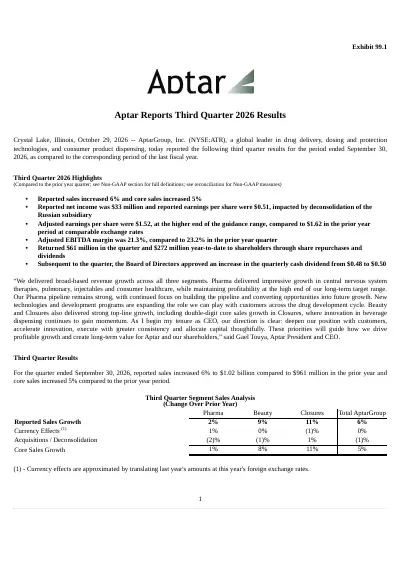
I will touch on the quarter briefly and then turn it over to Vanessa to add more details. Our results in the quarter demonstrate the underlying strength of our businesses, with 5% core sales growth across all three segments and adjusted earnings per share at the higher end of our guidance range.
Our adjusted EBITDA margin of 21.3% remained within our long-term target range despite emergency medicine destocking and the associated mix impacts. In Pharma, while the anticipated reduction in emergency medicine sales continued to affect our growth rate, the underlying business remained strong.
Results were driven by broad-based demand across a number of end markets in each of our divisions. This breadth is important.
Our Pharma growth opportunities are not dependent on one product or one therapeutic category. It reflects the depth of our portfolio, innovation pipeline, and the increasingly important role Aptar plays with customers across the drug development cycle.
Our ambition is to continue moving forward becoming the partner of choice for our customers through our technology, scientific expertise, services, and regulatory capabilities. Beauty also delivered strong top-line growth in the quarter, with strong demand from a number of end markets, including prestige fragrance and color cosmetics.
Looking at the profitability, I want to be clear: sales growth alone is not our objective. Our goal is to convert the strong demand for our products into more consistent profitability.
We have excellent technology, strong customer relationships, and leading positions in attractive categories. At the same time, the margin performance, mostly in North America, is not where it needs to be.
Closures also delivered double-digit core sales growth, reflecting strong demand in beverage and food and continued momentum from innovation. From a margin perspective, without the decrease from the impact of indexation, Closures would have been within their long-term adjusted EBITDA target range, and Vanessa will talk further about that.
Across Aptar, my priorities remain straightforward: profitable growth, execution, and disciplined capital allocation. Pharma is a pipeline business, and many of you have asked us to provide more visibility into that pipeline.
I want to spend a few minutes highlighting some of the key developments we have seen over the last several months. These opportunities span different technologies, customers, and therapeutic areas, and they are at different stages of development.
Some will take time to contribute, but taken together, they provide a clearer view of how we can extend our leadership positions and create new avenues of growth. Let's look at some concrete examples.
In ophthalmic, we continue to see attractive opportunities to build on our strong position in eye care. Earlier this year, we introduced Beat the Blink, designed to improve dosing precision and the patient experience.
The technology is not yet commercially available and is being developed and industrialized through an exclusive collaboration with Bausch + Lomb. Since then, we are encouraged by an early clinical study of Beat the Blink, which showed strong patient acceptance and preference for the solution.
This innovation demonstrates how we are bringing together our drug delivery, formulation, and human factors expertise to address unmet patient and consumer needs. In our ophthalmic pipeline, I want to point out that we are starting to see biologics in clinical testing across areas such as limbal stem cell deficiency, macular degeneration, and dry eye disease.
Biologics are starting to be disseminated through different routes of delivery beyond injectables. This is another area where we see meaningful long-term growth potential.
Overall, we see ophthalmic as an attractive area for continued innovation and future growth. Prescription to over-the-counter switches can be an attractive growth opportunity for Aptar, as broader consumer access can translate into higher volumes for our dispensing solutions.
A recent example is an acne treatment where our device is supporting its transition from prescription to OTC in the US. It also reflects the growing intersection of pharmaceutical innovation and consumer skincare.
Switching to nasal drug delivery, we recently announced a research collaboration with Massachusetts General Hospital focused on advancing the science of nose-to-brain delivery. The goal is to make this emerging pathway more predictable and data-driven and to help pharmaceutical companies assess molecular classes earlier and accelerate the development of therapies targeting neurological and central nervous system diseases.
This builds on decades of Aptar expertise in nasal delivery and is expected to strengthen our position in an area where we see meaningful long-term opportunity. Nasally delivered therapies continue to progress across several therapeutic areas.
We have Phase 3 programs in pain management and severe allergic reactions. Phase 2 programs include amyotrophic lateral sclerosis, or ALS, other neurological diseases, and therapies focused on the prevention of respiratory viral infections and emergency treatment.
Earlier-stage opportunities further broaden the pipeline across schizophrenia, nausea, concussion, Alzheimer's and dementia, and migraine. We also see longer-term potential in pain and anesthetics, addiction, depression, and other novel therapeutics.
These developments demonstrate how the pipeline is maturing, with programs advancing through clinical development and moving closer to potential approval and commercialization. We have also seen developments related to vaccines, with our Lyo-Vax intranasal delivery system and Spreadvider now carrying the European conformity mark, enhancing our ability to support customers developing intranasal vaccines.
In inhalation, we continue to expand our capabilities in next-generation pulmonary drug delivery. We recently announced a 3-year collaboration research with Macquarie University focused on high-dose dry powder delivery of biologics medicines using our Orbital inhaler platform.
This is yet another example of biologics projects in our pipeline being disseminated through a route of delivery beyond injectables. We are also expanding our respiratory platform through the acquisition of Pulmatrix, adding its Colibri non-propellant liquid inhaler technology.
Together, these initiatives are intended to broaden the range of complex therapies we can support and create opportunities for long-term growth. We are also supporting the transition toward next-generation lower-carbon metered dose inhalers.
One program using our valve technology has progressed through Phase 3 into regulatory review in Europe, with the potential to significantly reduce the environmental footprint of a widely used respiratory therapy while maintaining comparable efficacy and safety. Beyond the pipeline, we continue to invest in manufacturing capabilities to support customers as these markets grow.
This quarter, we expanded our pharma operations in Mumbai, India, strengthening our supply chain resilience and our ability to serve customers in the region. In injectables, we launched Premium Precision, a new quality standard for elastomeric components designed for complex and high-value injectable therapies, including biologics, GLP-1 medicines, for instance.
It brings together tighter quality controls, advanced contamination and defect management, and 100% automated vision inspection. Earlier this week, we announced a collaboration with Stevanato Group to advance system-level solutions aimed at helping customers make earlier, more informed packaging decisions for complex biologics and other injectable therapies.
This is Aptar Pharma's first collaboration as part of the integrated system-level framework launched in July for injectable drug development. These developments are meant to position Aptar Pharma for the future.
We are continuing to deepen our differentiation across all delivery routes, where our technology, services, scientific expertise, and patient understanding position us as the partner of choice for our customers. Turning to Beauty, we are focused on driving growth by bringing differentiated, premium solutions to leading brands across key beauty categories and geographies.
Recent wins include the first launch of our patented fragrance refill technology with Bulgari's Le Gemme Tygar travel spray in Europe, our premium cosmetic pump on Helena Rubinstein's Powercell Serum, and our custom pump for SK-II Facial Treatment Serum in China. These launches highlight the strength of our innovation pipeline and our ability to translate customer partnerships into attractive growth opportunities.
In Closures, we continue to support the conversion of tub-based condiments to easy-squeeze pouch dispensing. A recent example is Hormel Foods' Wholly Guacamole, featuring our closure with SimplySqueeze valve.
Our SimplySqueeze valve technology is also used in the personal care market for ease of dispensing products in the shower, as found on the new inverted dense body wash by IP-One in Thailand. Finally, our continued partnership with McCormick, which is focused on elevating their spice portfolio, led to the launch of a distinctive two-color, easy-open closure for spices in Mexico.
As you can see from our highlights, we believe we have strong businesses, excellent customer relationships, and differentiated technologies. My focus is on initiatives intended to translate those strengths into consistent financial performance and long-term value creation.
I'm encouraged by what I've seen in my first weeks as CEO, but I'm equally clear about where we need to improve. We are focused on staying close to our customers, continuing to invest behind our best growth opportunities, and bringing greater accountability and operational discipline to how we execute to improve profitability.
With that, I'll turn the call over to Vanessa to take you through the quarter in more detail.
Vanessa Kanu
Thank you, Gael, and good morning, everyone. Before we get into the results, I want to acknowledge our 8-K filed in late September regarding our Russian subsidiary that is now under administrative control.
As previously reported, that subsidiary, which is currently primarily closures, is not material to the company's ongoing revenue and earnings. As a result of the loss of control, we have deconsolidated the Russian subsidiary effective September 21, 2026.
We recorded a combined charge of $61.2 million before tax and $60.4 million after tax, or 94 cents per diluted share. The charge consists of a $58 million loss on deconsolidation, which included approximately $30 million of cash held by the subsidiary, along with related receivables reserves and legal costs.
This charge has been excluded from our adjusted earnings. Now turning to top-line results, our reported sales increased 6% to just over a billion dollars, and core sales increased 5% compared to the prior-year period, driven by growth across our segments and the impact of pass-throughs of higher input costs.
Let me provide additional details on sales growth by segment, starting with Pharma. Our Pharma segment's core sales increased 1%.
Excluding the impact of the anticipated emergency medicine headwind, core sales grew 8% in the quarter, demonstrating the underlying strength of our portfolio. As previously discussed, emergency medicine sales are expected to decrease by approximately $65 million for the full year 2026.
This destocking is expected to lap in the fourth quarter. Looking across our key pharma markets, starting with our proprietary drug delivery systems, prescription core sales decreased 7%.
Excluding emergency medicine, prescription core sales increased 6%, with central nervous system and asthma and COPD therapies driving growth in the quarter. Consumer healthcare core sales increased 13%, driven by strong demand for nasal decongestants and dermal solutions.
Injectables core sales increased 9%, with continued strong demand primarily for elastomeric components used for GLP-1, biologics, and vaccines. We also continue to see strong pipeline activity across Annex 1, GLP-1, and biologics projects.
For our active material science solutions, core sales increased 4% in the quarter, with growth in oral solid dose and probiotic sales. Turning to Beauty, core sales increased 8%, driven by higher demand for dispensing systems across prestige fragrance, color cosmetics, and hair care markets.
Pass-throughs of higher input costs contributed approximately half of the core sales growth. Looking at Beauty's two largest end markets, fragrance, facial skincare, and color cosmetics core sales increased 5%, primarily due to strong sales growth in prestige fragrance pumps and color cosmetics.
Our turnkey indie beauty business continued to perform well, benefiting from the growth of indie brands. Personal care core sales increased 11%, as we continued to see good demand for hair care, shower gels, and baby care applications.
Beauty generated strong core sales growth, albeit lower margins reduced the flow-through to profitability. Turning to Closures, core sales increased 11% compared to the prior-year period, reflecting strong product sales growth, in addition to the pass-through of higher input costs, which contributed approximately half of the segment's core sales growth.
Across Closures' two largest end markets, food core sales increased 9%, primarily due to continued demand for our sauces and condiments dispensing closures. Beverage core sales increased 19%, primarily driven by increased sales for bottled water and concentrates, with additional support from strong tooling sales in the quarter.
Now moving from sales to profitability, consolidated gross margin declined by 120 basis points year over year, primarily due to lower sales of high-margin emergency medicine products and lower gross margins in Beauty and Closures. We expect the emergency medicine destocking impacts to lap in Q4 2026.
SG&A increased in absolute dollars by approximately $11.4 million to $160 million, and as a percentage of sales increased slightly from 15.5% in Q3 2025 to 15.7% in Q3 2026. The increase was attributed to a number of current-period dynamics, including higher professional fees, largely associated with our CEO transition, an allowance for credit loss related to our Russian receivables, and a pension cost transfer, which from an accounting perspective increased SG&A, but is offset by a curtailment gain that is classified in other income.
These current-period increases offset productivity savings we continue to generate across the business. From an EBITDA perspective, we achieved adjusted EBITDA of $217 million, a decrease of 2% from the prior year, and delivered an adjusted EBITDA margin of 21.3% compared to 23.2% in the prior year.
Breaking that down by segment, Pharma's adjusted EBITDA margin for the quarter was 36.4%, an 80 basis point decline from the prior year. The margin decline was anticipated and driven by short-term unfavorable product mix arising from the decline in high-margin emergency medicine sales, while royalties and productivity initiatives continued to contribute positively.
Beauty's adjusted EBITDA margin for the quarter was 11.4%, a decline of 70 basis points year over year, including unfavorable mix and ongoing challenges in our North American operations, which, as Gael indicated, we are focused on improving, but it will not be a linear progression. Closures' adjusted EBITDA margin was 15.5%, a 60 basis point decline from the prior year, driven by the margin dilution effect of indexation pass-throughs, which impacted margins by 120 basis points.
Without this impact, the segment's adjusted EBITDA margin would have improved by 60 basis points due to favorable product mix, mainly from higher-value beverage dispensing. Turning to earnings per share, adjusted EPS was $1.52, a decrease of 6% compared to the prior year's adjusted EPS of $1.62 at comparable exchange rates, which was primarily due to lower adjusted EBITDA, higher interest expense, and a higher effective tax rate.
Turning to our year-to-date performance, reported sales increased 8% and core sales increased 2%. Strong growth in consumer healthcare and injectables offset the emergency medicine destocking, while Beauty and Closures also saw growth on a year-to-date basis.
Adjusted EBITDA declined slightly to $619 million, while adjusted EBITDA margin declined by 180 basis points to 20.4%. Adjusted EPS was $4.13, which decreased 10% compared to the prior year, including comparable exchange rates.
Turning to free cash flow, free cash flow year to date was $198 million, comprising cash from operations of $390 million, less capital expenditures net of government grants of $192 million. Year to date, we have returned $272 million to shareholders through share repurchases and dividends.
Over the last 9 months, we have repurchased 1.3 million shares for $180 million. As of September 30th, we had $420 million remaining under our existing share repurchase authorization.
Additionally, our board of directors have authorized an increase in our quarterly dividend by 4%. Exiting the quarter, our balance sheet remains strong, with a cash balance of $204 million and a leverage ratio of 1.49.
With that, let me turn to our outlook for the fourth quarter. We anticipate fourth quarter adjusted earnings per share to be in the range of $1.39 to $1.47.
At the midpoint, this reflects expected growth of 17% from prior-year Q4, including comparable exchange rates. This assumes an effective tax rate range of 17.5% to 19.5% and a euro to US dollar exchange rate of 1.12.
For the full year 2026, we continue to expect capital investments to be in the range of $260 million to $280 million, and depreciation and amortization expense to be between $310 million and $320 million. With that, I will turn it over to Gael to provide a few closing comments before we move to Q&A.
Gael Touya
As we look to the remainder of the year, we expect Aptar to finish on a strong note, driven by Pharma. We anticipate continued growth across a number of Pharma end markets, led by robust demand for consumer healthcare dispensing systems and elastomeric components for injectables.
Additionally, the segment will no longer be affected by the emergency medicine destocking headwind. We expect Pharma margins to improve year over year as productivity initiatives continue to gain traction and operational efficiencies take hold.
We remain excited about the strength of our Pharma pipeline and the opportunities it creates for future growth. Across nasal, inhalation, ophthalmic, and injectable drug delivery, our technologies and services are supporting programs that span a broad range of therapeutic areas, including neurological disorders, respiratory conditions, pain management, and macular degeneration and other eye diseases.
As these programs progress through development and toward commercialization, they reinforce the long-term growth potential of our Pharma business. Our Beauty and Closures segments are both supported by differentiated dispensing solutions and strong customer partnerships.
Beauty has strong momentum in prestige fragrance, supported by high-value dispensing solutions. In Closures, we remain encouraged by the positive response to our beverage applications that continue to drive customer adoption.
We believe Aptar is well positioned for both near-term performance and long-term value creation. Before I open the call to questions, I wanted to highlight that we recently announced the appointment of Virginie Maisonneuve as President of Aptar Pharma, effective January the 1st.
Virginie brings deep global pharma and medical experience and a strong customer and growth orientation. She will build on our strong foundations as we deepen customer partnerships and pursue the significant growth opportunities across our Pharma portfolio.
With that, I'd like to open the call to questions.
Operator
We will now begin the question-and-answer session. In the interest of time and fairness to all participants, please limit yourself to two questions, and then come back into the queue if you have more questions as time allows.
If you would like to ask a question, please press *1 to raise your hand. To withdraw your question, press *1 again.
We ask that you pick up your handset when asking a question to allow for optimum sound quality. If you are muted locally, please remember to unmute your device.
Please stand by while we compile the Q&A roster. Your first question comes from the line of Ghansham Panjabi with Baird.
Your line is open. Please go ahead.
Ghansham Panjabi
Thank you, operator. Good morning, everybody.
I'll just ask my two questions upfront, both specific to Pharma. First off on 3Q, just the margin dynamic year-over-year down 80 basis points, which is quite a bit better than the trend line during the first half of the year.
Would love some color as to what drove that. Then second, as it relates to the emergency medicine destock, is that still tracking in line with plan?
I.e., will there still be a residual impact on 4Q? Do you have confidence that that will be done, if so, by the fourth quarter with no residual into 2027?
Thank you.
Gael Touya
Hello, Ghansham. Thanks for the question.
I will take the second one, and Vanessa will bring you some color regarding margins. Yes, we are trending where we said we're going to be trending.
The $65 million negative impact with the naloxone destocking emergency medicine being naloxone. As we run to Q4, the destocking impact will be behind us.
Trending where we said we're going to be trending. The question will be where is going to be the baseline moving forward, and we're going to know this by Q1 2027.
There is no official data you can buy, we are relying on conversations we've got with our customers.
Vanessa Kanu
Hey, Ghansham. On the margins front, absolutely, we had a very strong margin quarter for Pharma, 36.4%.
Yes, it was down about 80 basis points year over year. Last Q3 was, I would say, abnormally high, in excess of 37%.
We were actually quite pleased to see the 36.4, higher than the top end of our guidance range. Why was that?
We had strong Pharma revenues in the quarter, as you saw from the or heard from the prepared remarks, coming in at 8% growth, isolating for the emergency medicine impacts, and that was broad-based, not necessarily one thing. Royalties are helping to improve things.
Then importantly, I also want to call out, because when we had talked about the emergency medicine impacts several quarters ago, we also did say that the segment was going to be initiating productivity improvements to help to partially mitigate the impact, and we are seeing those pay off quite well. I would say all of those different factors contributed to very strong margins, 36.4%, notwithstanding being down slightly from a high in Q3 last year.
Gael Touya
I will add that if you exclude the emergency medicine negative impact, the year-over-year margin for Pharma is improving.
Vanessa Kanu
That's right. Thank you, Ghansham.
Ghansham Panjabi
Okay. Thank you so much.
Thank you.
Operator
Your next question comes from the line of Paul Knight with KeyBanc. Your line is open.
Please go ahead.
Paul Knight
Hi, Gael. If EvaluatePharma is to be believed, which seems to be a credible source, of course, they're looking at a 14% growth rate in the top 10 intranasal drugs.
Do you think with this higher level of sales in intranasal that your long-term goal in Pharma of 11 at the top side is got some room above that 11?
Gael Touya
Huh. What we said and shared, Paul, is we are pretty comfortable with that corridor, the 7 and the 11.
This is a long-term trajectory. Obviously, some quarters, some years we're going to be above or under.
What I would like to say, we are very confident with our pipeline. The pipeline is robust, but not only robust, I'm quite satisfied with the progress programs are making through development.
The robustness of the pipeline, the growing recurring nasal business is quite positive, and when you look at the market fundamentals, we see market attractions around biologics, the GLP-1, the different SNDD, CNS, central nervous system. I'd like to thank you for calling out nasal, because this is a great business, but what is very important is to say we've got a good-quality pipeline, and we are really happy with the kind of support we give to Big Pharma, early-stage biotech company.
Then
Paul Knight
lastly, the Stevanato joint venture, when do you expect that to start delivering on revenue? Is it something for next year, or when do you expect it to become revenue generating with Stevanato?
Gael Touya
First, we are really happy with that partnership with one of the key leader in the market. This integrated solution is really offering the market the right profile for better stability testing and moving through the validation up to approval by the regulatory bodies.
That's going to contribute to the pipeline build and the pipeline conversion.
Paul Knight
Thanks.
Operator
Your next question comes from the line of Matt Roberts with Raymond James. Your line is open.
Please go ahead.
Matt Roberts
Hi, Gael, Vanessa, Mary. Good morning.
Looking at prescription medicine, I believe that ex-emergency, that was up 6% in 3Q, down slightly from 2Q. Maybe just talk about any changes quarter-over-quarter, what happened in that category?
I think 4Q for Pharma overall faces a tough comp ex-emergency, basically excluding emergency, what are your expectations for Pharma and specifically prescription now that the emergency headwind is over?
Gael Touya
Yeah. I'm not really anything specific from quarter to quarter with prescription.
Our pulmonary business is solid. That we are supporting the propellant switch, and we are one of the key partner for different players in the market.
Outside naloxone, our emergency category has been growing, huh? I could think about severe epilepsy, severe hypoglycemia, anaphylactic shock.
This is some of the categories where we see a good growth in the business, and what is key for us is we continue to be what I call a partner of choice to the ecosystem, where on top of our product quality, and I believe we've got the best frank portfolio on the market, we can support our customers through formulation development, through analytical testing and regulatory capabilities for them to be approved first time whenever they reach the last stage of their development program.
Matt Roberts
Thanks, Gael. Appreciate that.
Maybe another one if I may. You highlighted earlier Beauty as a priority and that you've spent time being reacquainted with that business.
Where do you see the biggest opportunity [unclear] in Aptar's control?
Vanessa Kanu
Matt, Matt, we're not sure if it's your connection, but we cannot hear you. Could you repeat the question?
Matt Roberts
Is that any better? No.
It is the same. Are we the only one or not?
Operator.
Vanessa Kanu
Warren, are you getting...
Matt Roberts
I'll try again. Sorry about that.
Operator
Our next question comes from the line of George Staphos with Bank of America. Your line is open.
Please go ahead.
George Staphos
Hi, everyone. Good morning.
Thanks for the details. Gael...
Vanessa Kanu
Oh, this is so much better, George. You sound great, George.
Now we know it was Matt, not us. Yeah.
George Staphos
Okay. Matt's better looking and funnier than me, in any event.
Listen, don't let that go to your head, Matt. Anyway, first question for you, Gael, we look forward to working with you in the new role.
I guess with emergency medicine, I think you said revenue, the decline you expected this year was $65 million. I guess then, without trying to draw too fine a point on it, what has been the revenue hit so far so that, back to Ghansham's question earlier, we could gauge how much is left in terms of the destock for this year, and into the first quarter you said, Gael, we could gauge the trajectory.
Do you expect that E-Med, emergency medicine, the margin on that business will be comparable to what it had been prior to the destock? Then I had a follow-on.
Gael Touya
Thanks, George. I don't think so.
I think the naloxone market moving forward, first we need to understand what is the baseline, and we're going to get a better visibility by Q1, but I don't think the growth rate will be as before the inventory situation. Why?
Because in a 1 to 2 years, the market transition from prescription to over-the-counter and public market interest, from prescription to generic, this is something that we have never seen before. Lifecycle management in the pharma is taking years.
Due to the emergency situation, the government has been pushing strongly to fast-track generic and to open large distribution. The positive news, you've got far less people dying from opioid overdose, and I believe that the accessibility of naloxone is one of the triggering points.
I think, and from the discussion with our different customers, we should see a GDP, GDP+ type growth for naloxone moving forward.
George Staphos
Okay. Lower margin, GDP+ growing forward.
How much is left of the revenue decline in the fourth quarter?
Vanessa Kanu
Yeah. We've lapped...
We lapped. We've lapped, and so it lapped in Q4.
We've lapped in Q4, and the comments on the margins, the product margins should be comparable going forward, but the growth rate, as Gael just articulated, will obviously not replicate what it was historically.
George Staphos
All right. My second question, Gael, you talked about leveraging the strengths of the company and effectively getting those strengths to the bottom line, I'm paraphrasing, to a greater degree.
Obviously, if I'm not characterizing that the way you wanted, please correct me, but if that's true, what are you going to do differently than your esteemed predecessors to get performance to the bottom line to a greater degree, and in particular in Beauty, which has been not performing at the targeted levels for nearly 10 years? What's going to change?
Thank you, and I'll turn it over.
Gael Touya
Okay. George, thanks for the question, and let me take a step back and frame it that way.
That I'm really engaging with the business at large. I've been a Beauty guy for years, but that was years ago.
Beauty has a fantastic business, long-term relationship with customers. They've got leading position in many business categories, and they've got a fantastic talent base.
At the same time that in Europe, which is the largest Beauty part of the business, and in Asia, we are well within our long-term target, and we've got a major issue being in North America, where I'm with you, I'm not satisfied with the performance of North America. This being said, we've done a deep dive.
We nearly completed the diagnostic. We understand the issues, and we have a path forward.
Now that will be execution with discipline and accountability. Something that is quite clear, that's not going to be a fix and quick fix.
That's not going to be to be a linear improvement. We have to do a transformation, and that's going to take time.
What I might be pushing way more the organization to, and maybe because of my 9 years in Pharma, quality and operational excellence is a must-to-have. This performance mindset by setting your expectation, by having the right level of accountability and making sure that we commit to deliver on what we are doing, is an imperative.
In Pharma, you know better than I do, yeah, we are working in a very compliant environment with very tight specification, and safety of supply and quality of supply is a must to happen. We need to get the same mindset in Beauty, and especially in North America.
George Staphos
Okay. Appreciate that.
We don't make light of it. We know it's a tough job.
We just push numbers around on a spreadsheet, and we respect everybody's efforts there. I'll turn it over.
Operator
Your next question comes from the line of Matt Larew with William Blair. Your line is open.
Please go ahead.
Matt Larew
Good morning, everyone. Thanks for the question.
I wanted to ask on injectables, up 9% core against a tough comp, and now the sixth straight quarter at least in the high single digits. You talked a bit about GLP and Annex 1.
Just curious if you could also comment on the new product launch that you mentioned today, and how you're viewing your product offerings and the capacity you have and what that means about growth going forward for injectables.
Gael Touya
Okay. A lot of questions.
Thank you, Matt, for the questions. Number one, very satisfied with our injectable business.
That we share that we will be in the high single digit and low double digit, I'm very satisfied with the performance of injectables this quarter. We've got a strong pipeline.
We've got, I would say, the technical capabilities and the technical offering to really satisfy customers looking for biologics, Annex 1 requirements, the right level of quality and expertise in order to make sure that they're going to go to market with the right partner. From a capacity standpoint, you know that we largely invested years back to globalize our business, and we are now a global player with footprint in the US, in China.
We increased capacity in Europe, and thanks to that capacity increase, we've got the ability to face the market demand. You refer to GLP-1.
We are satisfied with GLP-1, but I'd like to say that we are not depending on any single blockbuster drug to match our long-term target. We are not predicated on any one drug, and I would like to say that we like to hit singles or doubles, rarely a home run, even though we like a home run, but I'm satisfied with the breadth of our portfolio in the injectables space.
Matt Larew
Okay. That's great.
Then, if I take a step back on Pharma overall, the decade prior to kind of the Narcan unwind, that business CAGR'd in the 8% to 9% range, sort of the midpoint of your long-term construct. Now on a TTM basis, Pharma is up 7% ex-Narcan, two straight quarters of 8% growth.
You gave some nice transparency today on the pipeline. You just talked through the injectables opportunity.
Is there anything that we should think about for why it wouldn't get back to that 8%, 9% plus range going forward? Everything we heard today I think seems to be to that trend returning.
Gael Touya
The 7-11 corridor is a long-term target of us, and we've been well within this corridor. We've been some years below.
I remember the time of COVID, huh, back in 2021 has been challenging for us, and we have been way above and so I'm confident with that long-term target. What is critical to understand, it's not a five-week quarter of every year.
Like any kind of business, we're going to get periods where we're going to face lower growth and period of more accelerated one. The Pharma business is a pipeline-driven one, and you know that around 90% of our business is repeat, growing business, and once this program reach commercializations, they can continue contributing to the growth over time.
Our pipeline build and pipeline conversion is adding an additional layer of growth. We are very encouraged to see the breadth and the development and the acceleration of our pipeline conversion.
As programs progress, and new therapies are approved, we're going to continue to share these developments and the kind of expanded therapeutic areas we support. Confident with the long-term target.
Matt Larew
Okay. Thanks very much.
Operator
Your next question comes from the line of Daniel Rizzo with Jefferies. Your line is open.
Please go ahead.
Daniel Rizzo
Good morning, guys. Thanks for taking my question.
As we're kind of gearing up and heading into winter season, when would it become apparent that maybe there's some destocking or some of the issues that have cropped up in the past because of a cough/cold season might be cropping up again?
Gael Touya
We're going to know. We're going to know that one pretty soon.
As you can hear, I've got a huge cold, and thanks God I'm working for Aptar, I've got first-hand drug delivery devices to help me to join that call. Hey, we're going to be in the season.
We're going to look at that one. That's why we need to get an agile and a resilient supply chain to face demand if we are facing in the Northern Hemisphere a severe cold season.
We're going to know, and we are tracking and we are staying very closely connected to our customers.
Daniel Rizzo
Okay. Then if I missed this, I apologize, but have you given kind of a TAM for the eye care market or for what you see as your part of the eye care market?
Because it seems like a pretty exciting opportunity.
Gael Touya
We are excited. First, the number of initiatives we've got in our pipeline, there's a real conversion from I would say preserved formulation to non-preserved formulation, and whenever you go for a non-preserved formulation, this is a different game in terms of compliance, in terms of quality, and we're happy to support the conversion from preserved to non-preserved with our multi-dose OSD technology.
We are excited by the kind of innovation we're going to bring to market, and we share with you we sign a kind of exclusive agreement with one of the leader in the market, Bausch + Lomb, with a very new way to dispense your non-preserved formulation. We're going to share more whenever we're going to get more to share.
We've got also pretty excited by seeing first biologics to the ophthalmic space. We are in the clinical stages for different eye treatment disease.
Yes, the ophthalmic part of our portfolio and the critical positions we have will be one of the key driver for the growth of the Aptar Pharma segment.
Daniel Rizzo
All right. Thank you very much.
Operator
Your next question comes from the line of Justin Bowers with Deutsche Bank. Your line is open.
Please go ahead.
Justin Bowers
Good morning, Gael. Enchanté and look forward to working with you.
Appreciate all the comments on the Pharma pipeline, and was just curious, for the acne product that you mentioned transitioning from prescription to OTC, has that hit the market, or when is the timing for that to hit the market? Then part two would just be around emergency medicine and your comments around that being a GDP, GDP+ business.
Is that something that happens over the next 12 months, and is there an OUS opportunity for that product line as well?
Gael Touya
Justin, enchanté. Two questions.
The first one around the acne treatment, we're pretty excited with that one because we're going to move from a prescribed-status drug to an over-the-counter. We've seen this happening in different therapeutic areas.
Years back with our allergic rhinitis product, companies like Glaxo and so on moved one day from prescribed to OTC, and if a product is doing well, you've got way more product accessible for end users. We are pretty exciting by that one on a broad base.
Cannot share the name of the customer for confidential reason, but we are pretty excited by this one. The number two question around the naloxone and the GDP+ type growth, we have to really be close to our customers, and all the customers, the originator and all the generic players, to get their feedback and how do they see the market.
That's really critical because we cannot buy any QVIA data or IMS-type data, it doesn't exist. We have to rely on our customers.
At the same time, you know that federal funding continues to support naloxone purchasing and distribution, on top of substance use prevention or treatment and recovery program. There's fundings into the ecosystem to keep on supporting the accessibility of the naloxone product at large and at scale in the US.
GDP+ is our best estimate as of today, and we will get a better understanding by Q1 2027.
Justin Bowers
Thank you. One follow-up for Vanessa, if I may.
Gross margins has improved sequentially since 4Q '25. Is that the right way to think about it for 4Q '26 as well from 3Q?
Vanessa Kanu
Good question. The gross margins have improved sequentially, as our overall bottom-line results, as you would have seen.
I wouldn't necessarily project that into 4Q necessarily. We do actually have some seasonality in 4Q.
Seasonality has been a little bit obscured by the impact of emergency medicine of late, if you look at last year's Q4, the overwhelming factor there was emergency medicine, but typically Q4 for the company is a seasonally softer quarter. I would expect to see that in the results, but of course we've baked all of that into our guidance.
As I said in my prepared remarks, we're expecting that improvement in Q4, year-over-year margin improvement in Q4, as well as EPS improvement in Q4. Midpoint of our guide is about 14% year-over-year growth and about 17% on a like-for-like currency basis.
Good, strong quarter, and obviously lapping EM is a big part of that, and just underlying strength in the rest of the portfolio.
Justin Bowers
Great. Thank you.
Operator
Your next question comes from the line of Anojja Shah with UBS. Your line is open.
Please go ahead.
Anojja Shah
Hi, good morning, everyone. I just wanted to ask, in North America Beauty, was there any impact from tariffs?
Was that part of the issue with margins? I don't know if you have any core components that you're importing from Europe, but just wanted to ask about tariffs.
Gael Touya
Not so much. Hey, I'm not ready to share all of the specifics today about North America, but I could give you some better color on where we are focusing.
It really comes to two things: the way we compete on that market and the way we execute. The way we compete, we are subscale in certain markets that are growing and that are quite profitable, such as indie brands.
Fusion did well in the quarter, but we need to scale up that one. We've lost certain market share with certain customers, it is going to take time.
The way we execute, that's really for us to raise the bar, making sure that we plan better, we produce with more efficiencies, we improve our quality, and we build a more agile and resilient supply chain that is smart and fit for the customers. That's not going to be a quick fix, once again.
That's not so much tariff-related, because we are in the region for the region. By the quarters and by focusing on delivering better results, we are expecting to see improvement, but once again, that's not going to be a sharp and quick fix.
Anojja Shah
Right. Thank you.
That's very helpful. Just one modeling question: so Q3 corporate costs was quite a bit higher than we modeled, and you mentioned some reasons for that in the prepared comments.
Should we keep it at that level for Q4, or does it come back to a more normalized level? Then also, if we could get an early read for that line for '27, that would be helpful as well.
Thanks.
Vanessa Kanu
Yeah. Q4 sorry, Q3, I I did call out as as you indicated, we do have temporarily higher costs associated with our CEO transition, we've got some pension expense items, all impacting, Q Q3 corporate costs.
I would say that is temporarily elevated. I'm not necessarily going to guide on one line item for for Q4 relative to the overall, but the the increase you saw in Q3 should be temporary.
Anojja Shah
Great. Thank you.
I'll turn it over.
Operator
Your next question comes from the line of George Staphos with Bank of America. Your line is open.
Please go ahead.
George Staphos
Hi. Thanks for taking the follow-ons.
First question, not that it's a comparison issue year on year, but the tax rate sequentially dropped quite a bit, Vanessa. What's driving that, and should 23%, whatever you've been at, be the more normal range into next year, number one?
Number two, Gael, recognizing you're not ready to talk about Beauty and your plans there yet, or your tactics, when should we be able to ask you what you'll be doing as an enterprise differently, what the plans will be? Then if I could sneak a third one in very, very quickly, just Premium Precision, what drove that move, and how are you implementing it across the organization?
Thanks. Good luck in the quarter.
Vanessa Kanu
Thanks, George. I'll start with your question on the tax rate.
As we can have some quarterly variation in our effective tax rate. Obviously, the overall statutory tax rates don't change quarter by quarter, but the effective tax rate can have some variation.
For Q4 specifically, we're anticipating being able to recognize the benefit of some previously unrecognized tax losses. That's really what is creating that.
We have seen this from time to time where we've had certain quarters where we're able to recognize the benefit of a tax asset. In terms of long-term, how should we think about the ETR, I do think that, in that sort of 21% to 23% range is really what our long-term ETR is and ought to be, but of course we do get one-off quarters where we're a little bit below.
Then in terms of the guide, the 18.5% in the middle is really not that different from Q4 last year, which also had the benefit of a tax valuation allowance relief.
Gael Touya
George, for your second questions, 2 months in the job, I'm re-engaging with the business. I can tell you that we will have more to say about our broader strategy for Beauty at the appropriate time.
For today, what I would like to share, we've got regions well within our long-term target, Europe and Asia. We've got a challenging situation, and I can get the frustration from you.
I'm frustrated as well, but we know where to go. We have to execute on that one.
When I'm re-engaging with the business at large, I'm happy with the feedback from customers. I've seen a lot of customers, and they want more of Aptar.
They are telling me, "Guys, you've got the solutions for our most complex delivery challenges. We like your innovation.
We want more of you." I'm very encouraged by this one.
In due time, we'll come back to you with a proper answer, George.
Operator
We have reached the end of the question-and-answer session. I will now turn the call back to Mr.
Gael Touya for closing remarks.
Gael Touya
Thank you very much, all. Before we end the call, I wanted to take a moment to leave you with why I'm coming in that job with deep confidence in the opportunity we've got for Aptar.
We expect to finish 2026 strong, as you've heard, and we will end definitely the year in a better place than where we started. I believe we have all the ingredients to build on that momentum.
First, Pharma is a phenomenal business. We've got approximately 90% generally growing repeat revenue.
We've got strong customer position, and we've got a very solid and robust pipeline. We have expanded well beyond our traditional markets like nasal saline, allergic rhinitis, into areas such as CNS, central nervous system, or the emergency medicine, ophthalmics, neurological disease, but also thanks to our elastomeric components, our services, and the many solutions focusing on improving patient outcomes.
Importantly, emergency medicine destocking and the naloxone part of the business will no longer be the same headwind. If I look at Closures, our innovation pipeline is on the right track, with an opportunity to continue improving profitability.
In Beauty, North America remains our biggest and largest area for improvement, while globally we see attractive opportunities. Across the portfolio, our approach is very clear: we focus where we have a differentiated position and the right to win.
We will continue to focus to be the partner of choice for our customers, and get back to the basics of execution: with discipline, accountability, and sense of energy at every level of the organization. We know where we can win, we know what we need and where we need to improve, and we know what we need to do.
We have the technology, we've got the customer relationship, we've got the pipeline, and we have the talent. The opportunity is simply in front of us.
Now it's about execution. Thank you very much.
Operator
This concludes today's call. Thank you for attending.
You may now disconnect.