Autolus Therapeutics plc
NNASDAQ:AUTLQ1 FY2026 · Earnings Call TranscriptMay 14, 2026
Operator
Good day, everyone, and welcome to Autolus Therapeutics First Quarter 2026 Financial Results Conference Call. At this time, all participants are in a listen-only mode.
After the presentation, there will be a question-and-answer session. To ask a question, you will need to press *11 on your telephone.
You will then hear a message advising your hand is raised. To withdraw your question, please press *11 again.
Please be advised that today's conference is being recorded. I would now like to turn the call over to the Executive Director of Investor Relations, Amanda Cray.
Please go ahead.
Amanda Cray
Thank you, Carmen. Good morning or good afternoon, everyone, and thank you for joining us on today's call.
With me are Chief Executive Officer, Dr. Christian Itin, and Chief Financial Officer, Rob Dolski.
I'd like to remind you that during today's call, we will make statements related to our business that are forward-looking under federal securities laws and the safe harbor provisions of the Private Securities Litigation Reform Act of 1995. These may include, but are not limited to, statements regarding status of the ongoing commercial launch of Aucatzyl in the US and UK, Autolus' manufacturing, sales, and marketing plans for Aucatzyl, the market potential for Aucatzyl, and the status of clinical trials, development, and/or regulatory timelines, and market opportunities for obe-cel.
These statements are subject to a variety of risks and uncertainties that could cause actual results to differ materially from expectations and reflect our views only as of today. We assume no obligation to update any such forward-looking statements.
For a discussion of the material risks and uncertainties that could affect our actual results, please refer to the risks identified in today's press release and in our SEC filings, both available on the Investors section of our website. On slide 3, you'll see the agenda for today's call.
As usual, Christian will provide an overview of our operational highlights, Rob will then discuss the financial results, and Christian will conclude with upcoming milestones and closing remarks. We'll then take questions.
With that, I will turn it over to Christian.
Christian Itin
Thanks, Amanda, and welcome, everyone, to our first quarter update. Moving to slide number 4, we had a very good first quarter, and we see nice traction building both in the US and obviously in our early launch in the UK as well.
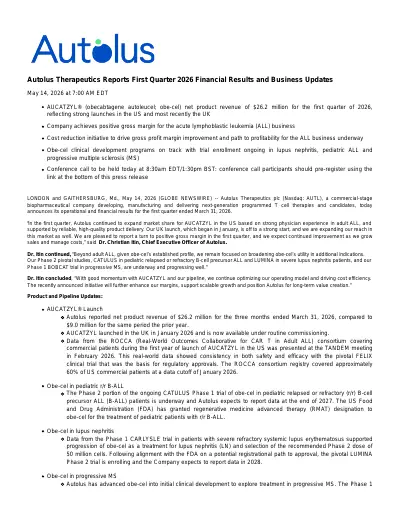
In Q1, we had $26.2 million in revenue booked, and we do see a very nice penetration and deepening with the positive physician experience that was highlighted at the Tandem meeting as part of the ROCCA Consortium presentation, where we had approximately 60% of our commercial patients represented in that data set, and we had discussed the data at a full-year update which we gave a few weeks ago and also was further analyzed and reviewed in the context of a KOL call we did in the early part of April. When we then look into the UK, we do see very good start in the UK.
We have more than 10 centers already active. We're going very strong in the UK with regards to not only center onboarding, but also start to see early patients come in and actually become treated under the NHS access program.
Now, when we look into the 2026 overall outlook, we do see that we have a very nice continued momentum. We're currently from a perspective of US centers already at around 73 centers, and we're increasing beyond 80 centers by the end of the year.
Our full-year guidance is unchanged at $120 to $135 million, and for the first time this quarter, we did see a shift to positive gross margin, which is important because obviously this is one of the key metrics that we're looking at during the course of this year to start to actually see that the overall commercial base and our ability to ultimately drive proper cash flow into the company increase over time. First time positive gross margin, and obviously a lot of that impacted by, on the one hand, an increase in volume, but also operational improvements that we made to the overall operation of the company, but in particular, the operation of the manufacturing plant that we're running.
This is where we are with regards to the overview from a commercial perspective for Aucatzyl: very good dynamic and we believe very strong momentum as we go into Q2. With that, we're going to slide number 5, and I would like to start on the right-hand side and just briefly talk about the journey that we're on with regards to moving the product to a place where indeed we have a profitable ALL business.
The foundation was really laid during the first year of launch, and what we had to establish during that first year of launch is consistent and high-quality product supply and services so that we have a strong firm foundation, we serve our patients properly, and we can generate very strong outcomes in these patients. You've seen all of that actually presented as part of the ROCCA Consortium's experience, which had more than that actually almost all patients that were intended to be treated actually received treatment.
We also did see that that treatment actually translated into a very positive safety profile with no high-grade CRS, only 3% high-grade ICANS, and more than 90% overall response rate in the patients. A remarkable outcome in the hands of the physicians in the real-world setting.
We're already starting to see branching out of the patient pool into patients that actually are older, have more comorbidities, typically tend to be considered difficult to treat. That's one expansion that we've seen, but also an expansion into patients that have a very limited tumor burden and with that obviously, what we have seen in our prior studies, certainly have a good opportunity to sort of get a more pronounced benefit over time.
We've seen an expansion already in terms of the patient pools. That is very important because based on that behavior, as well as the good safety profile, we do expect that that forms a very strong foundation, and we see that translate actually already in the first few months in 2026.
The second stage now, as soon as we actually have had established consistent high-quality product supply and services, that is actually when we switched gears and really started to drive optimization, improve efficiency, as well as at the same time, obviously increase the volumes that actually were driving through the overall operation, and with that have an ability to actually get our overall cost down for the products. We expect at peak ALL business to be around 65% to 70% gross profit margin, which gives us a very healthy business for the ALL side of Aucatzyl.
Now, the optimization we ran through obviously also was not just an optimization in processes, but also with that, obviously, we have run through a reduction in force at the company of 13%, and we also at the same time have driven up the efficiency that we're running within the operation, and you'll see that in a very simple metric. We expect to produce twice as much product this year compared to last year with overall staffing that is at or below the levels that we had last year.
That gives us a very clear understanding of why indeed these gross margins are moving into the positive and will continue to improve as we go through the course of this year. Now overall, once the one-time effect of the restructuring is taken care of, and you'll see that pass-through and Rob will talk to that briefly, we expect for 2027 a net impact of a savings of $15 million on an annualized basis.
When we then look on to the development side and leveraging the exceptional profile that we now not only are seeing in clinical trials, but see it translated also in the real-world setting, we're obviously building on that set of properties into a range of additional indications. The first one clearly to extend the treatment from the adult population into the pediatric population, and we have the Phase 2 expansion of the Catalyst study ongoing.
Data is expected towards the end of 2027, and we have aligned with the FDA on the protocol design in support for potential registration. The second study, obviously that is progressing well, we expect additional data towards the end of this year is the CARLYLE study, where we have added additional patients, and we're also obviously will have substantial more follow-up in that patient population.
I think that will give us a very good understanding of the type of benefit that indeed Aucatzyl or obe-cel can induce in indications now beyond oncology, in this case, in a refractory form of lupus, systemic lupus. The next study that is actively enrolling is the LUMINA study, which is in lupus nephritis.
This is the Phase 2 study, where we have agreement with the agency to based on this study aim for a registration in refractory lupus nephritis. The study is active in certain countries in Europe as well as the US, and we're expecting data from this study in 2028.
Finally, the study that will get us into neurological diseases is the progressive multiple sclerosis study that we're conducting, which is the BOBCAT study. This study is continuing to enroll, and we expect initial data at the end of this year, and then full data during the course of next year.
When we look a bit more broadly, we also obviously will have additional data collection through the ROCCA Consortium, which is actually continuing to collect information from patients treated with commercial product, and then actually starting to look at quite a range of questions related to the performance of the product and the properties of the product with a clear view from the real-world setting. In addition, and this was also part of the KOL call that I referenced before, we're seeing investigator-sponsored studies starting that actually are looking at the use of obe-cel in frontline consolidation setting, which is ultimately aiming to explore whether indeed an abbreviated frontline treatment might be possible, and we're obviously very interested to see how the product performs in those settings, and we expect our investigators to report in upcoming conferences on their studies.
With that, I'm at the end of the introductory remarks, and I will hand over now to Rob for the financial results.
Rob Dolski
Thanks, Christian, and good morning or good afternoon to everyone. It's my pleasure to review our financial results for the first quarter of 2026, and I'll be referring to slide 8 in the presentation.
Total net product revenue for the first quarter of 2026 was $26.2 million compared with $9 million in the first quarter of 2025. This quarter reflects sales in the US and our first quarter in the UK market, though given it is early in the launch, contribution from the UK was minimal.
As Christian noted, we're pleased to shift to a positive gross margin during the quarter with $1.6 million compared to losses in prior quarters in 2025. With the combination of increasing product revenue and our cost-reduction initiatives that Christian mentioned that are underway, we expect the margin expansion to continue as we move forward.
Underlying that gross margin, cost of sales in the first quarter totaled $24.6 million. That's compared to $18 million for the same period in 2025.
The increase primarily reflects costs related to higher Aucatzyl sales period-over-period. Our research and development expenses decreased to $21.2 million for the first quarter of '26 from $26.7 million during the same period in 2025.
This change was primarily due to a decrease in development activities, including clinical trial and clinical manufacturing supply costs, as well as capacity mobilization costs, mostly all related to obe-cel. Our selling, general, and administrative expenses increased to $39.9 million for the first quarter of 2026 compared to $29.5 million in the same period 2025.
This increase was primarily due to salaries, other employment-related costs, and professional fees supporting commercialization activities in both the US and UK. In addition, this quarter also included one-time termination-related expenses related to the operational efficiency and cost-reduction initiative that we announced last month in April.
Loss from operations for the three months ending March 31st, 2026, was $59.5 million as compared to $65.2 million for the same period in '25. Finally, net loss was $71.6 million for the three months ending March 31st, 2026, compared to $72 or $70.2 million for the same period in 2025.
Our cash, cash equivalents, and marketable securities at March 31st, 2026, totaled $229.4 million as compared to $300.7 million at December 31st, 2025. This decrease was primarily driven by net cash used in our operating activities.
As Christian noted, we are reiterating financial guidance issued in January that we expect between $120 and $135 million in Aucatzyl net product revenue in 2026, including contribution from both the US and UK markets. Finally, based on our current operating plans, including anticipated Aucatzyl net revenues, we expect that current and projected cash, cash equivalents, and marketable securities will be sufficient to fund our operations into Q4 '27.
I'll now hand back to Christian to wrap up with a brief outlook on expected milestones. Christian?
Christian Itin
Thanks, Rob. When we look towards the end of this year, we have updates from three of our programs.
We have the longer-term follow-up from the CARLYLE study. We have initial clinical data from the BOBCAT Phase 1 in progressive MS.
We expect to have initial clinical data from the ALARIC Phase 1 study, that's the AUTO8 trial in light chain amyloidosis, which we're collaborating on with UCL, also by year-end of this year. Full data then expected for the BOBCAT study during the course of 2027.
The pediatric Phase 2 data readout is expected for year-end 2027, and the LUMINA Phase 2 data in lupus nephritis is expected in 2028. Those are the key updates and key milestones, and with that, we're opening up to questions.
Operator
Thank you. As a reminder, to ask a question, simply press *11 to get in the queue.
One moment for our first question. It comes from Gil Blum with Needham and Company.
Please proceed.
Gil Blum
Good morning, everyone, and thanks for taking our questions and congrats on the progress. You're saying you're seeing some level of market expansion, older patients, maybe a bit patients for consolidation, that sort of thing.
It didn't seem to change the guidance for this year, I'd appreciate your commentary on that, and then I have a follow-up.
Christian Itin
Thanks a lot for joining, Gil. The dynamic we're seeing in the market is very positive, but obviously, we're still early in the year, and want to see the dynamic obviously play out into fuller aspect as we go through the course of the year.
The guidance at this point we believe is reasonable, and there's frankly no reason for us to change the guidance at this point. Obviously, we'll keep monitoring the development, and if indeed we see a different trajectory, we obviously will update the market.
Gil Blum
Thank you. Very helpful.
As it relates to the LUMINA study, we just saw another registrational study come up again in lupus nephritis, kind of like in a similar line of therapy. Are you guys seeing any potential challenges in enrollment?
It is a little crowded. Thank you.
Christian Itin
Thanks, Gil. The population we're going after is a proper refractory population that are post the standard of care, which is based on B-cell depleting antibodies as well as calcineurin inhibitors.
That's a pool that's currently not served by the standard of care, you'd be drawn to that. The trial size that we need to recruit is very limited.
We're looking at a 30-patient trial. From that perspective, and also given that we're running the study both in the US and outside the US, we believe we're in a good position to enroll the study, we're not worried about that.
Gil Blum
Excellent. Maybe a last one on the multiple sclerosis.
Could you remind us what level of data you think you may have in 2026?
Christian Itin
The BOBCAT study, first of all, it's a dose-escalation study, we're starting at 100 million with an ability to go further up. That's the basic design of the study.
We expect to have initial information on the behavior obviously of the product with regards to safety, but also the dynamic, the cellular dynamics that we're seeing, which is important. You want to understand the ability of the product to expand in the periphery, but also look at the presence of the product in the CSF, obviously on the other side of the blood-brain barrier.
Then certainly, we'll record the various types of markers that we have available here that actually monitor both the inflammatory state of the disease as well as potential damage to tissue that you can monitor both with biochemical markers as well as with imaging. We'll have early data in terms of the behavior, and then I think as we look into next year, I think we start to have more data points that look at the actual disease scores and the ability obviously and frankly any potential impact on disease scores going forward.
For that, you want to have several data points and a longer observation time to make sure you're not actually monitoring potential placebo effects or other types of impact that you might have, given that part of those assessments are either physician- or patient-reported. Hard measures for this year mostly on the actual behavior and safety, behavior from a pharmacodynamic perspective and pharmacokinetic markers, but also then as we go into next year looking into the actual disease scores themselves.
Gil Blum
Thank you for taking our questions.
Christian Itin
Thank you.
Operator
Thank you. Our next question comes from Simon Baker with Rothschild and Company Redburn.
Please proceed.
Simon Baker
Thanks very much for taking my questions. Two, if I may, please.
Christian, I just wondered if you could give us a little bit more detail on the mechanics of the UK rollout. As I believe there are 20 CAR-T centers that in principle could administer Aucatzyl.
What's the cadence for rolling those out in terms of getting centers on board? How does this compare with the experience in the US?
Any color on that will be helpful. Then on the R&D expense, it was lower than expected in the quarter because of clinical trial activity.
I just wondered if you could give us any more color on the evolution of R&D spend as the year goes on. Thanks so much.
Christian Itin
Yes, thank you. Thanks a lot for joining.
With regards to the UK rollout, we actually see a dynamic that we think is at least as quick as what we saw in the initial phase in the US. It might actually be quicker.
One of the things that is positive about the UK system is that the decision whether or not a patient would actually go on a CAR-T therapy or not is actually centrally made, which actually accelerates decision-making. That's actually a benefit of the way that is organized rather than individual center-by-center, physician-by-physician decision that is normal in other healthcare systems.
There are elements actually that are allowing us to probably move even a bit faster than we were able to do in the US. We see very positive dynamic, very positive messaging also right from the NHS.
There were interviews held on television in the UK, etc. There was quite a lot of presentations and work that the NHS itself did frankly increasing the awareness of the product and the opportunity for this new treatment modality for patients.
I think from an awareness perspective as well as from a drive perspective that we see on the center base and then the initial decision-making process, or the internal decision-making process basically being going through a single body to take the decisions, I think is actually very helpful, and we expect a good rollout here in the UK. With regards to R&D expense, I think I'll start, and then I'll hand over to Rob.
I think what's important on the R&D expense, obviously there is some changes as we see our activity with regards to clinical trials. There, as you transition from one trial phase to another trial phase, that usually slows down a little bit the enrollment in that process.
There can be some fluctuations. Also, if you look back into last year, obviously there was still quite a lot of work that was ongoing related to the longer-term follow-up of the FELIX study that work will be reduced over time as we're sort of obviously ramping up some of the other clinical activities.
They're quite important trade-offs there that we have on actual clinical trial activity. Then the other area is really the mobilization of additional capacity at the Nucleus, which we're obviously kind of taking on as we're sort of ramping now the demand in the US, and we also had some activities still ongoing during the course of last year.
Those activities will substantially be reduced or are pretty much coming to a stop. Obviously we'll have a certain of those activities, which are also R&D-related costs as you mobilize the activity, will start to obviously be reduced while at the same time we start increasing obviously our clinical trial costs.
We expect all in all that there's going to be very helpful trade-offs and also will keep overall that R&D expense at a fairly steady level. Rob, do you want to add anything?
Rob Dolski
The only additional thing I can add, Simon, I think Christian covered it really well. Another example I'd throw out there certainly was our pediatric study where it was at a stage where we had that kind of first cohort enrolled, and was still active at sites.
That was part of the data presentation that happened at the end of last year, but in terms of getting this next wave up and going, we were more in kind of a valley and now we're in the enrollment for the expansion cohort. Certainly as we start treating more patients both in the clinical programs, even on some of the investigator-sponsored trials that we have out there that Christian mentioned, you will see more clinical supply-related costs that will come in.
This is going to kind of move kind of up and down a little bit. We're not projecting any significant add of infrastructure, etc., on the R&D side.
Simon Baker
Great. Very helpful.
Thanks so much.
Christian Itin
Thank you.
Operator
Thank you. One moment for our next question that comes from Salim Syed with Mizuho.
Please proceed.
Salim Syed
Great. Good morning, guys.
Congrats on the quarter. Just one for us on the data that we're expecting this year, Christian, Rob.
Sounds like for the MS, the more important data set's going to be coming in in '27. I don't know if you sort of interpret the same way for ALARIC.
I'm just trying to balance how important do you guys deem these data sets coming in at year-end? Are we expected to get any sort of bogey or how you guys are deeming what is a successful outcome on these year-end measures?
I'm just trying to balance that with just the cash runway here before Q4 '27. Thank you.
Christian Itin
Yes, when we look at the nature of the MS study, obviously we're collecting data points on disease score, and in order to actually get I think a good sense of the trajectory of the disease score, you need to have a certain amount of observation period. We obviously collect the data.
We'll have an initial view on that, but to actually make a strong statement about the trajectory that you see after a few months is probably not sufficient. I know there's a temptation to do that, and certainly we see that sometimes in the market that that's being done.
We believe with those types of data points, you actually want to have a little further out a view, and with that, I think more stable data. On the ALARIC study, I think what we do have is certainly an initial good understanding of the level of activity we have in this disease setting.
We haven't actually reported on that before, and I think that should give us a good feel for the level of activity that we're seeing and the impact we're seeing in these patients. I think that's certainly going to be a data point that obviously I think will be very helpful and will certainly from a readout perspective, I think will certainly be interpretable in a clear way.
The other aspect, I think, is also getting back to the MS program. I think one of the things to sort of be clear about is that the importance here is on the one hand for the data point at the end of the year is the ability to demonstrate that indeed the product actually gives a safe product profile in these patients, which I think is very important for these patients, but also then actually be able to actually show that indeed the product is active in the CSF and with that in the central nervous system.
I think that actually is a key piece of the information, and it really goes to the foundation of the rationale for using a cell-based product because that allows us to actually get across the blood-brain barrier and with that have an ability for activity. Just as a reminder for some of you, if you haven't actually been able to listen to the KOL call, Laurie Muffly did present one of her patients that had explosive ALL, all filled up bone marrow, the disease strongly frankly intruding into the brain and into the CSF, and frankly putting pressure onto the spine directly, leading to the patient becoming paraplegic.
What she described is that she treated the patient with Aucatzyl, which she thought was the only treatment she could give the patient that would be actually safe enough. What she was seeing is that the patient within 28 days had actually the leukemia taken care of, MRD-negative in the periphery, but also obviously clearance in the CNS, and the patient actually recovered mobility and control over her body.
That tells you a lot about the ability of the product to cross the blood-brain barrier, to be very active, and remove CD19-positive cells, in this case obviously leukemic cells in the brain, to a point where indeed there is massive improvement that could be seen in the patient. That's really at the heart of the feature which is unique to this type of a therapy, and that's really what we're building on for the BOBCAT study in progressive MS.
Salim Syed
Got it. Thanks, Christian.
Operator
One moment for our next question. It comes from the line of James Shin with Deutsche Bank.
Please proceed.
James Shin
Hey, good morning, team. Thank you for the questions.
First one, appreciate Aucatzyl achieving positive gross margins this quarter. Impending Aucatzyl's top-line growth and with the RIF in place, could we see Autolus becoming profitable on a company-level basis by, say, late '27?
Second question, between Besponsa and Blincyto, is Blincyto the main bridge before patients receive Aucatzyl? Does the bridging duration tend to align with Aucatzyl's manufacturing turnaround time?
Thank you.
Christian Itin
Thanks, James. Very good question.
The first related to kind of the trajectory for the ALL business. What we're projecting for the ALL business is that we're going to cross the line to profitability in the ALL business in 2028.
The whether or not the company will actually be profitable at that point also depends on the reinvestment rate that we'll have in the upcoming one and a half years towards that towards that time point. That's going to be the key driver whether or not we're going to be, can be profitable as a company or not by that time point.
As an ALL business, we expect to cross that line in 2028. With regards to the bridging therapies that are employed for Aucatzyl, typically you would use for bridging either chemotherapy or inotuzumab or Besponsa.
You would not use Blincyto, and the reason for Blincyto is this is when a treatment when you start it, it should go for it's basically a continuous IV infusion for four weeks, which is actually longer than the manufacturing turnaround time for these patients, and that actually wouldn't make sense. We don't actually see the use of Blincyto for bridging in with with our product.
It's mostly driven by chemotherapy and/or inotuzumab. Now
Operator
we continue to the next question. It comes from Matthew Phipps with William Blair.
Please proceed. Hi,
Matthew Phipps
thanks for taking my questions. I guess could you maybe characterize a little bit of the growth that you've seen this quarter?
Is it from greater utilization of current centers? You mentioned expansion to older patients, or is it mainly expansion to new centers?
I guess what percent of the market do you think you'll have covered when you reach the 80 centers by the end of this year? Thank you.
Christian Itin
Thanks, Matt. When we look at the growth, we see that actually given that we already have 73 73 centers on, and when you compare to beginning of the year, we were at about 65, the majority obviously comes from the centers that were already active.
That's where you see the repeat use and you see that build up. The new centers obviously gradually build on, but their initial activity is going to be limited.
It's going to be one or two patients, initial experience gained, and then that eventually translates further. We see a lot of good positive momentum out of the centers.
One of the metrics we're looking at is also not just the centers themselves, because when you look into the centers, what you do see initially is that typically it's a small number of physicians that might actually use product. What you really want to do is you want to see actually the group of physicians using the product increase per center.
One of the metrics we're looking at is obviously the physicians that are actually using the product, and we actually see very nice progression in terms of the numbers of physicians using the product and have actually dosed a patient. We kind of track that as one of the key metrics, and you clearly see that dynamic.
For the most part, that expansion actually is within the centers we're already active in, and we're starting to see broader adoption. That's really how ultimately you will build market share.
It's the use of the product by most of the physicians at each given center across the range of the indication and the label, and that gives you really the ability to grow that market share. Overall, we do believe we see very good dynamic in terms of increasing the market share obviously as we're going forward.
Based on just our guidance, you would expect that we would have a substantial increase in the overall market share that we're projecting obviously for 2026, and that's the guidance we have reiterated.
Operator
One moment for our next question, please. It comes from Emily Bodnar with H.C.
Wainwright. Please proceed.
Emily Bodnar
Hi, thanks for taking the questions. Maybe a follow-up from the prior question.
Can you kind of comment on what contribution UK revenue had on growth in the first quarter and how you're kind of expecting that to play out for the remainder of 2026? Then maybe on the data update for SLE and LN later this year, if you can kind of talk about what level of durability you're hoping to see in the updated data and also response rates for the 100 million dose.
Thanks.
Christian Itin
All right. Thanks a lot, Emily.
Thanks for joining. For UK sales, given that the UK is obviously a fraction of the size of the US, we decided not to actually break out UK sales numbers certainly initially in the launch, because it frankly doesn't make much sense.
It is too early in the process. We expect to break it out likely towards the end of the year, but for the first quarter, that doesn't actually make much sense at this point, because obviously a lot of the products, which still the patients would roll in, you start to produce initial products, and then you start to actually see the momentum translated into actual sales numbers.
With regards to the LN update, obviously we have patients that will have about 12 months or more follow-up in terms of the initial cohort. I think that is going to be very meaningful because it tells us a lot about not just the initial safety and the initial reset, but then also how the B-cell compartment sort of reconstitutes over time, and with that, then also the ability to see a sustained response in these patients going forward, which is one of the key elements and metrics that we're looking at.
Then obviously for the other patients, which include higher-dose cohort as well as adolescent patients, we're obviously going to have a limited follow-up. That's going to be mostly around the initial response, the safety, the initial response, and initial kind of recovery of the B-cell compartment.
Obviously that will have a limited follow-up compared to what we will have from the first cohort, where we're going to be certainly beyond the year of follow-up.
Emily Bodnar
Great. Thank you.
Christian Itin
Thanks, Emily.
Operator
One moment for our next question that comes from Jacob Mekhael with KBC Securities. Please proceed.
Jacob Mekhael
Hi there, and thanks for taking my questions. I have a few, if I may.
Just on the gross margin, you mentioned in one of the slides earlier that you expect it to be 65% to 70% at peak. Curious, do you plan to provide peak sales guidance at some point in the future, and when would be the right time to do that in your view?
That's the first one. Then maybe I have a follow-up on your agreement with Cellres for the manufacturing.
Is there a timeline by which you need to have a formal agreement in order to incorporate that into the new manufacturing process for the pivotal program in autoimmune?
Christian Itin
All right. First thanks for joining, Jacob.
First, with regards to the gross margin reference and peak sales, I think what we have been pointing out with regards to the overall opportunity in the relapsed/refractory setting in the US is that we have approximately 1,600 to 1,800 patients. We have seen certainly with other agents before that you can get with a good profile up to about 60% penetration, which we expect of market share, which we expect kind of the upper end of the range is in the relapsed/refractory setting.
That's kind of where we are and I think where we sort of see the opportunity. I think to guide towards a more formal peak sales, I think that's premature at this point in time.
I think it gives you a good understanding of kind of the overall size of the market and the overall opportunity that we're sort of identifying for the product. With regards to the Cellres timing, we're in the midst of a feasibility study, we want to understand whether the product actually produced on that technology platform versus the platform we're using at the Nucleus today, how the products compare.
That's a key analysis that we're running. That's what we're really going to be focusing on this year, and if that data turns out positive, that's then I think the time point to actually take the next steps.
In terms of being in time, we believe that the key area where I think that technology I think could be attractive to us is if we're sort of getting to a step change in the need for product. We believe that that step change certainly could come from an indication like progressive MS, and I think that's sort of where we're looking to sort of actually work through and make sure that we have an option there that would allow us to actually scale production in a reasonable and economical way as well.
That's sort of where frankly the elements that are being connected, but for this year, it's really around making sure we get the clear data from the feasibility and our understanding whether the quality of the product we're getting actually is comparable.
Jacob Mekhael
Thank you.
Christian Itin
Thank you.
Operator
Thank you. Our next question comes from Roger Song with Jefferies.
Please proceed.
Fiona Huang
Hi, good morning. This is Fiona on for Roger.
Thanks for taking our questions. Just a couple from us.
On the Aucatzyl revenue, how should we think about the near-term and long-term growth driver and any active measures you're taking to further keep in the penetration in the US versus ex-US dynamics? Just another one, understanding that you're going to switch to positive gross margin from this quarter, do you see any further optimization needed moving forward, or do you want to see the impact of the cost reduction play out?
Thank you.
Christian Itin
Thanks a lot, Fiona. First with regards to the revenue drivers, clearly there's sort of two key elements here.
There's sort of obviously getting to a large percentage of the patients or the market you can cover in terms of patient access to centers. We believe that when we're in this 80-plus center range, we're getting to certainly in the range of 80% of the patients that we can actually cover from that perspective, which I also believe is an add-on answer to what Matt was asking as well before.
What really drives the ability to drive the market share up, and this is in any jurisdiction that you're active in, is really getting the physicians at a given center to use the product consistently, gain experience, and gain confidence, and with that starting to use the product in the first place for typically a limited number of patients, which is sort of typically patients they think they cannot serve with the standard of care that they have experience with, gain experience with the product, and then actually start to apply the product much more widely across the full range of the label. We've seen that play out actually during clinical trials, and we see it play out also now in the marketplace as well.
That is really what drives ultimate the market share, is the conviction of the physicians that this product actually allows you to treat a wide range of patients. Again, Laurie made these types of comments actually also at the call that we had organized.
What she was talking about is the ability to actually have an option with Aucatzyl that irrespective of modality actually gives you a safe way of treating patients, and actually allows her to treat patients she would not have even considered treating before. That was actually not a differentiation between CAR-T products, but across the range of product options and modalities that she has available.
That's kind of an expression of that level of confidence, and I think that is where we see I think the biggest growth is for physicians to get to that place. That's also where the ultimate decision-making resides, is obviously with the physician.
The patients receive the product once. It's a one-time experience for the patient.
It's a repeat experience for the physicians, and that's what's your foundation, what's really driving this. This is true whether this is in the US or it's in the UK or elsewhere.
With regards to the opportunity to sort of expand beyond the US, obviously we're active in the UK at this point. We continue conversations in Europe, and we're navigating market access and MFN topics in Europe.
Obviously, we need to make sure we get to reasonable places there. At this point, we're not guiding for European sales.
We're obviously approved. We continue those conversations, and we'll certainly once we actually get through market access in first European countries, we'll obviously inform everyone on that.
This is an ongoing process and certainly somewhat delicate also with the policy changes that we see across the board that we need to take into account.
Fiona Huang
Then finally,
Christian Itin
with regards to optimization, the final question I think you had was on optimization. Actually, optimization certainly from a manufacturing process is a continuous process.
It's not just a one-off. We made some very significant changes in our operating model that are now implemented, and will continue to improve as we go through literally every step along the way of the manufacturing process.
What we're really aiming for is to make sure that the hours of work that go into produce every single product can be minimized. It's really a drive to minimize the work spent per product.
At the same time, obviously, we want to reduce the overall contribution from the fixed cost, and that particular aspect is driven by the volume of products you run through the facility. Those are the two key metrics that actually are driving ultimately your cost down per product.
One is the total volume and with that a reduction of the fixed cost allocation, and then obviously or a reduced number of work hours per product. That's really what we're driving at, and we'll see a very significant steady impact as we go over the upcoming probably two years.
Fiona Huang
Thank you, Christian.
Christian Itin
Thank you.
Operator
Thank you. Our last question comes from Shyam Kotadia with Goldman Sachs.
Please proceed. Hi,
Shyam Kotadia
thank you for taking my question. Just two from my end.
On the gross margin that reached positive this quarter, how should we think about that cadence for the rest of this year? Should we expect a steady improvement?
What is your target gross margin, I guess, for full-year '26? Also on that peak margin you mentioned, when are you expecting to reach that?
That's the first one on gross margin. Then the second one on multiple sclerosis.
I know it's early, but just wanted to see if you guys could provide any color on your commercialization plan there. Are you planning to go at this yourself, or would you look to partner or in-license for this indication?
Thank you.
Christian Itin
Thank you very much. With regards to the gross margin, we expect to actually see continuous improvement of the gross margin as we go through the course of this year.
We obviously have implemented significant improvements in the operating model in the first few months this year. They will start to actually have impact in terms of the cost as we get through the remainder of the year, and I think we'll see sort of an increased impact over time.
At the same time, we'll see obviously, and we expect an increase in terms of the volume of product that we're running through the facility as well, and those two parameters will actually be supportive to really see a continuous improvement of the gross margin. We haven't given guidance on where we expect to be by the end of this year, but obviously it's a metric that we continuously will report, and I think you'll start to get a good understanding and feel for the dynamic as we go through the next few quarters.
That's the first part of the question. The second is, when do we expect peak?
Typically, to get through to peak sales in indications like ALL, that's probably taking between four and five years. The main impact that you'll see from a gross margin perspective is likely going to be somewhat earlier, because if you get to a certain level of volume of product you run through the facility, the amount of improvement you get on the fixed cost contribution obviously becomes limited, you're running an asymptotic line.
Obviously, the big gains that we expect on productivity and with that reduction of labor cost is expected to happen actually during the course of this year. Then there may individual elements where we might actually to introduce particular improvements on technology that can actually lead again to a step change, but those obviously will take time and will not be in a straight line, but obviously will then give us sort of individual discrete steps that we expect to see.
For the time being, I think most of it is really just the actual improvement on the work hours and the impact of the changes in the operating model, which will likely have the single biggest contribution that will be made through that, and then there are a number of much smaller initiatives that over time will add to that. Then with regards to the MS commercialization question, what we're seeing in MS is obviously a population of patients that, first of all, it's a much larger population, they're much more distributed.
It's also a patient group that's extremely motivated, and we see that also even in the conduct of the clinical study, where we see even a different dynamic even to acute leukemia, where this is a disease that can actually and quite likely may kill you. There's still actually a higher degree I think of dynamic that we're seeing with MS patients.
That is sort of one side of the equation. Then there's a sheer volume question in terms of if you have some product that actually impacts these patients, it's a very substantial patient population.
From that perspective, it does make sense to consider certainly commercial approach where you would operate in collaboration with a partner, and that's certainly one of the areas that we're exploring.
Shyam Kotadia
Thank you.
Christian Itin
Okay. Thank you very much.
Operator
Thank you. This concludes our Q&A session for today.
Christian Itin
Very good. Well—
Operator
Thank you so much.
Christian Itin
Thanks, everybody, and have a great Q2. We're looking forward to keeping you updated at the various conferences during the quarter.
Thank you.
Operator
Thank you for participating in today's conference. This concludes the program, and you may now disconnect.