Autolus Therapeutics plc
NNASDAQ:AUTLQ3 FY2026 · Earnings Call TranscriptNovember 10, 2026
Operator
Good day, and thank you for standing by. Welcome to Autolus Therapeutics Third Quarter 2026 Financial Results Conference Call.
At this time, all participants are in a listen-only mode. After the speakers' presentation, there will be a question-and-answer session.
To ask a question during the session, you will need to press star one one on your telephone. You will then hear an automated message advising your hand is raised.
To withdraw your question, please press star one one again. Please be advised that today's conference call is being recorded.
I would now like to hand the conference over to your first speaker today, Amanda Cray, Executive Director of Investor Relations. Please go ahead.
Amanda Cray
Thank you, Stephanie. Good morning or good afternoon, everyone, and thank you for joining us on today's call.
With me are our Chief Executive Officer, Dr. Christian Itin, and Chief Financial Officer, Rob Dolski.
I'd like to remind everyone on slide two that during today's call, we will make statements related to our business that are forward-looking under federal securities laws and the safe harbor provisions of the Private Securities Litigation Reform Act of 1995. These may include, but are not limited to, statements regarding commercialization and manufacturing of Aucatzyl in the US and UK, our full-year 2026 net product revenue outlook, our anticipated cash runway and financing assumptions, and the therapeutic potential, clinical development, regulatory timelines, and market opportunities for obe-cel and our other product candidates.
These statements are subject to a variety of risks and uncertainties that could cause actual results to differ materially from expectations and reflect our views only as of today. We assume no obligation to update any such forward-looking statements.
For a discussion of the material risks and uncertainties that could affect our actual results, please refer to the risks identified in today's press release and in our SEC filings, both available on the Investors section of our website. On slide three, you'll see the agenda for today's call.
As usual, Christian will provide an overview of our operational highlights, Rob will then discuss the financial results, and Christian will conclude with upcoming milestones and closing remarks. We'll then take questions.
With that, I will turn it over to Christian.
Christian Itin
Thanks, Amanda, and welcome to our third quarter 2026 update. Moving to slide number four.
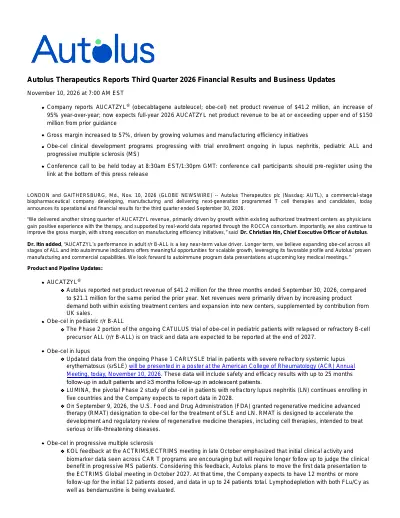
We had a strong quarter with $41.2 million in Aucatzyl net revenues, which is 95% up from Q3 in 2025. Looking at the first nine months of 2026, we are at $113.1 million net sales, up by 122% compared to the first nine months in 2025.
Center onboarding is progressing ahead of plan, with 90 centers in the US and 18 in the UK authorized. The UK launch is going well, and we expect to break out UK sales with the full-year financials.
Critical for this performance are the positive experience of treating physicians with Aucatzyl and the consistently high performance of our teams throughout the year. At ASH, we expect the next update of the real-world experience with Aucatzyl in presentations from ROKPA.
Moving to slide number five. We have demonstrated strong execution of our commercial plan for 2026.
Net revenue for the full year was initially expected at a range of $120 to $135 million. With Q2 financials, we raised guidance to $140 million up to $150 million, and we expect now to be at or above $150 million in net revenue for the full year 2026.
The second key objective was to achieve a positive gross margin in 2026. We are tracking at 44% for the first nine months and have reached 57% in Q3.
The key drivers for the strong manufacturing performance are volume increase and a relentless drive for efficiency at our Nucleus manufacturing facility. For 2026, we had set out to activate 80 centers in the US.
We have achieved 80 centers in Q3 and are now at 90 centers activated, which creates a strong base to operate from in Q4. Moving to slide number six.
Our path to profitability is driven by increase in net sales and improving our gross margin. Use of our product is driven by physicians' experience and confidence in Aucatzyl.
Increasing the number of prescribing physicians in authorized centers and use of the product across the full range of the label are the key levers for driving adoption and sales. Gross margin development in turn is driven by production volume and efficiency initiatives at our manufacturing facility.
As an illustration of the magnitude of the efficiency improvement, we can look at the following metric. In 2026, we will manufacture more than double the number of products as in 2025, with a staffing level that is below our staffing level in 2025.
Year-to-date, we're tracking at 44% gross margin. Slide number seven, and moving to our pipeline activities.
Today, we are presenting longer-term follow-up data from our Phase 1 CARLYLE study in severe refractory SLE patients at ACR in Orlando. The poster will be presented later today and shows sustained clinical responses and safety profile with up to 25 months of follow-up.
At ASH, we expect additional data presentations for Aucatzyl in adult relapse refractory ALL patients from clinical trial and real-world experiences. We also expect first data for AUTO8 in light chain amyloidosis.
CATALYST in pediatric ALL patients is on track to complete enrollment end of 2026 or early 2027, and LUMINA in refractory lupus nephritis patients continues to enroll. With BOB-CAT, we have decided to present data with sufficient follow-up to allow for interpretation of clinical outcome.
We will present at ECTRIMS 2027 in October and not at ACTRIMS in March. Moving to slide number eight.
The clinical aim in progressive MS is to stop progression. Specifically, we are looking for stabilization of EDSS scores, with stabilization maintained over time.
KOLs at the recent ACTRIMS-ECTRIMS 2026 meeting in October were very clear that EDSS stabilization with less than 12 months of follow-up has limited correlation with true disease arrest or even reversal. They considered initial reports from CD19 CAR T programs in progressive MS encouraging, but due to the limited follow-up, the field still lacks proof of concept.
In their view, minimal follow-up for an initial interpretation of EDSS scores in progressive MS is 12 months, with a preferable observation period of 24 months. With this very consistent KOL feedback, we have decided to present first data from the BOB-CAT study at ECTRIMS in October 2027.
At that point, we will have 12 patients with at least 12 months of follow-up and 12 additional patients with 6 to 12 months of follow-up. We are on track with BOB-CAT and have no delay in the study.
With that, I'm handing over to Rob for a review of the financials. Rob?
Rob Dolski
Thanks, Christian, and good morning or good afternoon to everyone. I'm pleased to review our financial results for the third quarter ended September 30th, 2026, and I'll be referring to slide 10 in the presentation.
Our net product revenue for the third quarter of 2026 was $41.2 million compared with $21.1 million in the third quarter of 2025, representing a quarter-over-quarter growth of 95%. As Christian noted, based on our year-to-date results, we now expect full-year 2026 Aucatzyl net product revenue for both the US and UK combined to be at or exceed $150 million, which was the upper end of our prior guidance range.
Gross margins improved to 57% in the third quarter compared with 55% in the second quarter of 2026 and a negative gross margin in the third quarter of 2025. The year-over-year improvement was primarily driven by lower manufacturing costs per batch, reflecting increased production volumes, ongoing operational efficiency initiatives, as well as lower inventory reserves and write-offs versus the prior year quarter.
Our cost of sales decreased to $17.9 million in the third quarter compared with $28.6 million for the same period in 2025, reflecting the manufacturing and inventory-related items just discussed. Moving on to research and development, those expenses increased to $30.9 million for the three months ending September 30th, 2026, compared to $27.9 million in the same period in 2025.
This change was primarily due to an increase in clinical manufacturing supply costs driven by the clinical trial activities, and partially offset by a decrease in the R&D head-count-related costs. Our selling, general, and administrative expenses of $35.9 million for the third quarter of 2026 remained fairly in line compared with the $36.3 million in the same period in 2025.
Loss from operations for the third quarter was $43.5 million, that's compared with $71.6 million for the same period in 2025. Finally, net loss was $55.1 million for the three months ended September 30th, 2026, compared with $79.1 million for the same period in 2025.
Turning to the balance sheet, cash, cash equivalents, and marketable securities totaled $248.4 million at September 30th, 2026, compared with $201.6 million at the end of June in 2026. The increase here was primarily driven by net cash inflows from the credit facility executed with Perceptive Advisors in July, which included the initial $75 million credit facility tranche taken down at the closing.
Our cash runway outlook also assumes proceeds of $25 million from the second tranche available to us, bringing the combined first and second tranches to $100 million. Based on our current operating plans, anticipated Aucatzyl net sales, and these financing assumptions, we expect our current and projected cash, cash equivalents, and marketable securities to fund our operations into the second quarter of 2028.
I'll now hand back to Christian to wrap up our presentation. Christian?
Christian Itin
Thanks, Rob. Moving to slide number 12.
We had a strong quarter driven by excellent execution. Full-year revenue is expected at or above $150 million for the full year 2026.
We see significant opportunity to continue to grow the market in relapsed/refractory adult ALL, and with our development activities expect to position Aucatzyl over time across all settings in ALL. We continue to explore the use of Aucatzyl beyond ALL in our ongoing studies in lupus and progressive multiple sclerosis.
Next data releases are today at ACR for long-term follow-up from our CARLYLE study in severe refractory SLE patients, and additional updates are planned for ASH on Aucatzyl in ALL and first data for AUTO8. With that, we have concluded our prepared remarks and are happy to take questions.
Operator
Thank you. At this time, we will conduct the question-and-answer session.
As a reminder, to ask a question, you will need to press star one one on your telephone and wait for your name to be announced. To withdraw your question, please press star one one again.
Please stand by while we compile the Q&A roster. Our first question comes from Gil Blum of Needham.
Your line is now open.
Gil Blum
Good morning and good afternoon, and congrats on the consistent execution. Maybe a first one on the multiple sclerosis side.
There's clearly some pretty positive feedback from one of your competitors' study, and it appeared that there were some leading indicators of activity there, but basically you're saying that your discussions with KOL suggest that that's not sufficient. If you can help me understand the reasoning.
Thank you.
Christian Itin
Thanks, Gil. Thanks for joining.
Yes, it was very interesting because we did review with KOLs also the data were presented from competitors at the conference, and it was very clear in their view that the data are encouraging, which is the way I would describe our data as well, but from a clinical outcome perspective not yet interpretable. I think that has been a very clear, consistent feedback that to actually make statements or have clarity around the impact on the clinical side, not just the pharmacodynamic and pharmacokinetic markers, requires you to have at least 12 months of follow-up.
That is a key feedback that we've received, and the consistency of the feedback was remarkable, and we believe it makes more sense to actually have a consistent picture that also allows you to actually interpret the clinical data rather than give an initial sense, which is kind of what we've been seeing at this stage within the field.
Gil Blum
Okay. A related question.
Will you guys be able to provide the safety updates from this cohort or do we need to wait all the way till next year?
Christian Itin
What we're planning to do is actually basically present the integrated view. At this point, I think the data we have is consistent with our experience with obe-cel as obviously in terms of early clinical readouts to the extent obviously with the limited follow-up also look consistent with what we would expect.
We're on track with the study, we are where we want to be with the study, but we want to be able to go out and actually make an actual statement about the clinical impact that the treatment has rather than give premature kind of indicative data at this point.
Gil Blum
Okay. I do want to spend a second on lupus.
It's been a somewhat challenging space for cell therapies. You've seen reports from some of your competition as it relates to safety.
How do you continue to view this space? I know you guys really focus on the most difficult-to-treat patients in lupus, but does that offer you an opportunity to maybe go earlier?
Thank you.
Christian Itin
Thanks, Gil. Obviously, what we have shown previously also with the trial and obviously we'll update also today is that we have had a very nice safety profile in that population, consistent with kind of our observations in the hundreds of patients that we treated in acute leukemia as well.
We do have a good profile that we believe that is relevant in the setting. We continue to obviously watch the space, see what the dynamic looks like, and sort of evaluate kind of what the opportunities, how it may shift.
We're pleased with the data we have, and I think certainly have a good foundation.
Gil Blum
Thank you for taking our questions, and congrats on the progress.
Christian Itin
Thanks, Gil. Much appreciated.
Operator
Thank you. Our next question comes from Salim Syed of Mizuho.
Your line is now open.
Salim Syed
Great. Good morning, good afternoon, guys.
Thanks for the question, and congrats on the progress. I guess I'll just follow on the MS front.
Christian, the trial was updated also in October from 18 patients to 24 patients on ClinicalTrials.gov, and I know you noted that as well today. Just curious if there's anything about the additional six patients that you plan to have enrolled into the study.
Is there anything different that you'd like to see in their baseline criteria or what exactly was the reason to also increase the size of the study? Did you not think you'd be able to get the signal you wanted in the 18 patients that you originally had planned?
Thank you.
Christian Itin
Thanks, Salim. What we had indicated in the press release is that we've been using two types of preconditioning regimens in the study.
We've used flu/cy as well as bendamustine, and we want to make sure that the data set we have is a reasonable size to give us a strong indication of the actual clinical impact that we're seeing. We felt that the extra six patients actually going to be helpful.
18 patients for safety look is fine to look at. From an efficacy perspective is on the low end.
Enrollment is going really well in that study, it was an easy thing to add on, and we felt that that was the right thing to do.
Salim Syed
Got it. Thanks so much.
Christian Itin
Thank you.
Operator
Thank you. Our next question will come from Yanan Zhu of Wells Fargo.
Your line is now open.
Kuan Hung
Hi, thanks for taking our questions. This is Kuan Hung for Yanan, and congrats on the quarter.
On SLE, your ACR poster showed the cell expansion data, and it looks like 50 million might be more persistent than 100 million, and we know it's small n, but anything you can share with us there?
Christian Itin
Thanks for the question. It's correct, we did include pharmacokinetic data.
I think what we do see is that we do see good expansion in all patients. We see the typical range of about three months of persistence of the product, and then afterwards you start seeing, as the CAR T-cells actually gradually remove, you can then actually see the reconstitution of the B-cell compartment, which is obviously one of the key features you want to see to be able to sort of demonstrate not only the reset, but also the recovery in those patients.
We do see that. There's some fluctuations that we have seen in terms of the expansion.
I don't think that we can actually conclude anything from the dose levels. When we look at the data, and we also look at the broader range of data we have, we don't believe there are actually variabilities there from a product perspective or dose perspective, but you do have certainly patient-to-patient variability.
We don't think there's a difference from a dosing perspective there, but clearly the 50 million cell dose is highly active and performs extremely well.
Kuan Hung
Got it. Quick question on Aucatzyl sales.
Based on your guidance, it looks like the 4Q number might be similar in the same range as 2Q and 3Q. Can you talk about the dynamics there and when do you expect the sales to return to growth?
Thank you.
Christian Itin
Thanks for the question. When we look at last year's trajectory, you can see that in last year's trajectory you had basically Q2, Q3, Q4 in similar levels of sales that we had throughout the year.
It's not unexpected to see somewhat of that dynamic during the course of the year. What we do see is certainly this year is very positive impact from the real-world experience.
There's significant updates that we're going to expect at ASH and ASTCT coming up in the next two, three months, and we believe that that will have a significant impact and setting us up for a really good 2027 as well.
Kuan Hung
Got it. Thank you for all the colors.
Christian Itin
Thank you.
Operator
Thank you. Our next question is from Roger Song of Jefferies.
Your line is now open.
Hi, this is Fiona on for Roger. Congrats on all the progress, and thanks for taking our question.
Just on the Aucatzyl sales, with another ROKPA data coming out in December, do you expect it to have another significant lift on the sales into '27 or because this is not the first time, you think the impact would be more moderate? Thank you.
I think,
Christian Itin
first of all, thanks for the question, Fiona. I think when you look at at sales curves, obviously we're having a very significant step-up year one to year two.
What you typically see with the sales curves is that, that we'll see the increase year in year three and year four tend to obviously be smaller than what you see between year one and year two. There's clearly, we would expect the curve to actually have a similar shape as you would know or what you've seen with other products.
We do believe that the continued work that's done at the ROKPA consortium and collecting a large amount of data is a really powerful is really powerful information because it's, in essence, a peer-to-peer communication of the treating physicians to their colleagues of what their actual experience is. I think that is very valuable, and that's certainly what we've seen this year.
We expect that to continue to have a significant impact, but I also would expect that as we sort of general look at a general sales curve, that, we would have a similar trajectory as you would normally see with product adoptions as well. I think that's kind of in terms of color at this point I think that that we can provide.
Thank you, Christian. If I may, just with respect to MS, would you still collect data and see the earlier biomarker data before 12 months?
Christian Itin
Oh, sure. You look at all the correlation.
You want to have both the clinical outcome and the correlating pharmacodynamic markers that we're seeing. That is important to actually see those parameters as well as imaging parameters as well.
In terms to actually assess the actual clinical scores as a clinical score, you do actually require longer follow-up, and that was loud and clear, I think, from the KOLs in the field that they thought the data that was shown to date in the field was just premature.
Got it. Thank you for the clarification.
Christian Itin
Thank you.
Operator
Thank you. Our next question comes from Matthew Phipps of William Blair.
Your line is now open.
Matthew Phipps
Hi, thanks for taking my questions. Just wondering how enrollment has been going across the autoimmune trials, both lupus and MS.
I know you mentioned some robust enrollment in MS, but other companies have talked about maybe a slight slowdown over the end of the summer as there was kind of broader safety concerns for CAR T in autoimmune. Then for AUTO8, the abstract at ASH, I think just shows a couple patients treated with the BCMA CAR construct alone with two achieving MRD negativity.
At ASH, will we also see patients that got kind of the dual BCMA and obe-cel constructs and then some follow-up on those patients? Thank you.
Christian Itin
Okay. Hi Matt, thanks for joining.
On recruitment, we actually didn't feel that or didn't see an impact in the second half of the year. On the progressive MS side, it's a population of patients that we see is quite remarkable in terms of their interest in joining clinical trials, quite at one end of the spectrum across the autoimmune space.
I think the lupus patients in general are much less inclined to go on clinical trials, which is what we've seen over the last 30 years and across a wide variety of development programs. I think that is consistent.
We haven't seen a significant change across the board there, but the news flow that we had sort of the second half of the year, at least from what we are seeing, does not seem to have impacted patient flow in a way that would be visible to us in our clinical trials. Then on AUTO8, we have initially the study similar as we did the original study in multiple myeloma patients, starting with the BCMA component and then adding the CD19 component on top.
Obviously, the abstract was done with an earlier data set. There's more data collected now, and we're going to have early patients also with both vectors included, both the BCMA and the CD19 targeting component included, and of course also longer follow-up on the BCMA-only patients as well.
Operator
Thank you. Thank you.
Our next question is from Douglas Tsao of H.C. Wainwright.
Your line is now open.
Douglas Tsao
Hi, good morning. Thanks for taking the questions.
Christian, I'm just curious, on the MS side, it totally makes sense why you would wait to present the data to 12 months. I'm just curious what you think or how you think this might ultimately impact the timeline in terms of development and sort of moving ahead to potentially registrational studies, et cetera?
Thank you.
Christian Itin
Thanks, Douglas. Really good question.
It doesn't change the decision-making process around the program. We had indicated that we would need longer-term follow-up to be able to assess actually the clinical outcome.
We had indicated that actually for a while. That is, I think, is unchanged in that sense.
You want to have that longer follow-up with the patients, and based on that then actually make your decisions around the clinical trial design and also the timelines associated with a pivotal program. That is unchanged from our perspective, which is also why we're going into the fall meeting, because frankly the data at the March meeting, is data that would not have been actionable from a development perspective or development decision perspective.
Douglas Tsao
Great. Also if you could just maybe touch on I think conceptually we all get why you would try the preconditioning with bendamustine, but I'm just curious exactly what you might see and how significant could it be and maybe some KOL feedback that you've gotten in terms of how much more tolerable that could ultimately be for patients?
Thank you.
Christian Itin
Very good question. The preconditioning regimens obviously have been developed originally for stem cell transplants, and this is where the flu/cy conditioning is coming from.
It's been very well optimized for that type of an application, and it is very well characterized and shown to be the most active way of preconditioning for lymphoma and leukemia patients. That's where that's coming from, where we have an awful lot of data.
What flu/cy conditioning does is it leads to a temporary neutropenia in patients, which you see in a lot of the curves that you might have seen over time, including our own data, where you see an early kind of drop in cell counts, and then obviously recovery over time, which is typical for flu/cy conditioning. Bendamustine is known to actually have much less of an impact on this type of hematological toxicity.
It also is known, certainly in the case of leukemia and lymphoma, to be somewhat less effective as a preconditioning agent compared to flu/cy. We're looking at this as an option for the autoimmune patients, and this is what we're exploring in the current study, and believe that's a relevant question to ask obviously in the context of the overall benefit/risk profile that you have in autoimmune patients.
Douglas Tsao
Great. Thank you very much, and congrats on the progress.
Christian Itin
Thank you. Appreciate it.
Operator
Thank you. Our next question is from Mathijs Geerts Danau of KBC Securities.
Your line is now open.
Mathijs Geerts Danau
Hi, yeah, I had a question. Congrats on the quarter, and thanks for taking the question.
I was just wondering whether you expect to see some impact of the holiday period in the fourth quarter since with the guidance increase now. Thanks.
Christian Itin
Thanks, Mathijs. Good question.
The fourth quarter certainly has an element of impact because you typically have a slow week around Thanksgiving, and you also tend to obviously have a slowdown, particularly on the dosing side, from Christmas to New Year's. There's certainly impact in December that we would expect.
Have seen in last year in the first year of commercialization, but we've also seen it when we look at clinical trial performance and conduct as well across the December period, end of November and into the December period. That's typical what you would expect, there's going to be somewhat of an impact, but the impact certainly last year was limited.
Mathijs Geerts Danau
Thanks.
Christian Itin
All right, thank you.
Operator
Thank you. Our next question comes from Rajan Sharma of Goldman Sachs.
Your line is now open.
Rajan Sharma
Hi, thanks taking my questions. One on gross margin.
Now that you've sort of had three quarters of positive gross margin, should we assume that's going to be a consistent sequential margin improvement until you get to that peak guidance of 65% to 70%? Then secondly related to that, how are you thinking about timelines to reaching that now that you've obviously made some improvements on cost efficiencies?
Then just on center onboarding, you've obviously delivered sort of more quickly relative to your expectations at the beginning of the year. Could you maybe just talk to the drivers of that?
Is it a case that maybe you are underestimating the number of centers, and could you maybe talk about where you think that goes next year? Thank you.
Christian Itin
Very good question, Rajan. Thanks.
On the gross margin side, I think what we've been seeing is obviously a significant impact of, on the one hand, increased volume that we see come through the facility, but we've also made significant changes in the operating model, and there's a lot of operational excellence work that we've done to really look at any unit of operation and are optimizing that. There were some big changes or improvements we could implement in the Q2 timeframe, and you saw that then reflected in the Q2 numbers, and you see that continue obviously Q3 as well.
That gives us sort of a new level and a new foundation, and we continue to actually drive systematically through efficiencies in the manufacturing facility. We expect that to continue to improve.
We don't expect over the upcoming periods step changes, but a continuous improvement over time. Are certainly been very pleased with the dynamic that we've seen this year, and we also already see that projected also into the fourth quarter as well.
When we look into kind of getting to the place where we get to what we believe is sort of the upper range of what is feasible on the ALL side and for the ALL business alone, we expect that we're approaching kind of that upper end of the range in 2028, but that will not stop us to continue to push forward as well beyond that. I think 2028 is probably a good way of thinking about the range that we indicated in the presentation today as well.
When we look at center onboarding, I think where we're at, once you reach about give or take 80 centers in the US, which are obviously the larger centers across the country, you do actually have access to approximately 80% of the patients. That's sort of the ballpark that you get to.
Now, when you look at the chart that is visible on Autolus Assist, where you can see how the centers are distributed across the country, you do see that they kind of follow the major population density that we have across the US, which also means that if you get more towards the central part of the country, that the distances between centers actually get increased, and that also creates opportunities. When we look now in terms of the centers we're looking to onboard, that has on the one hand has certainly considerations about patient access and driving distances or travel distances for patients to reduce those.
There is also another dynamic which certainly has been very interesting to see, and that is that a lot of the physicians in the field are younger. It's a newer technology.
They've grown up with the technology. We see now some of those physicians kind of move out from their current academic settings into new centers and setting up CAR T therapy at those new centers.
What we're also are looking to do is actually follow those physicians to the new centers that are setting up, and with that have a very targeted approach towards center expansion and center addition. There are distinct dynamics that we're seeing also as we get more information about non-academic centers and patient flows where we have identified certainly a few centers that have a surprisingly good flow of ALL patients that I think normal market research would not have predicted.
Those are kind of the areas. A lot of it is very targeted, and it's opportunity-driven.
Rajan Sharma
Thank you.
Operator
Thank you. This does conclude the question-and-answer session.
I would now like to turn it back to Christian Itin for closing remarks.
Christian Itin
Thank you very much, everybody, for joining today. Obviously, had a great quarter, looking forward to a great end of the year, and obviously with the various conferences coming up, I think plenty of opportunity to also interact in person.
With that, looking forward to seeing you, and we'll keep you updated. Thank you very much.
Operator
Thank you for your participation in today's conference. This does conclude the program.
You may now disconnect.