Aviat Networks, Inc.
Q1 FY2027 · Earnings Call TranscriptNovember 10, 2026
Operator
Hello, and welcome to Aviat Networks' first quarter fiscal 2027 earnings call. At this time, all participants are in listen-only mode.
A question-and-answer session will follow the formal presentation. Please note this conference is being recorded.
I will now turn the conference over to your host, Mr. Andrew Fredrickson, Vice President, Corporate Finance.
Thank you. You may begin.
Andrew Fredrickson
Thank you, and welcome to Aviat Networks' first quarter fiscal 2027 results conference call and webcast. You can find our press release and an updated investor presentation in the IR section of our website at www.aviatnetworks.com, along with a replay of today's call.
With me today are Pete Smith, Aviat's President and CEO, who will begin with opening remarks on the company's fiscal quarter, followed by Andy Schmidt, CFO, to review the financial results for the quarter. Pete will then provide closing remarks on Aviat's strategy and outlook.
As a reminder, during today's call and webcast, management may make forward-looking statements regarding Aviat's business, including, but not limited to, statements relating to fiscal guidance, financial projections, business drivers, new products and expansions, and economic activity in different regions. These and other forward-looking statements reflect the company's opinion only as of the date of this call and webcast, and involve assumptions, risks, and uncertainties that could cause actual results to differ materially from those statements.
Additional information on factors that could cause actual results to differ materially from the statements expressed or implied on this call can be found in our most recent filings with the SEC. The company undertakes no obligations to revise or make public any revision of these forward-looking statements in light of new information or future events.
Additionally, during today's call and webcast, management will reference both GAAP and non-GAAP financial measures. Please refer to our press release, which is available in the IR section of our website at www.aviatnetworks.com, and financial tables therein, which include a GAAP to non-GAAP reconciliation and other supplemental financial information.
At this time, I would like to turn the call over to Aviat's President and CEO, Pete Smith. Pete?
Pete Smith
Thanks, Andrew. Let's review results from the first quarter.
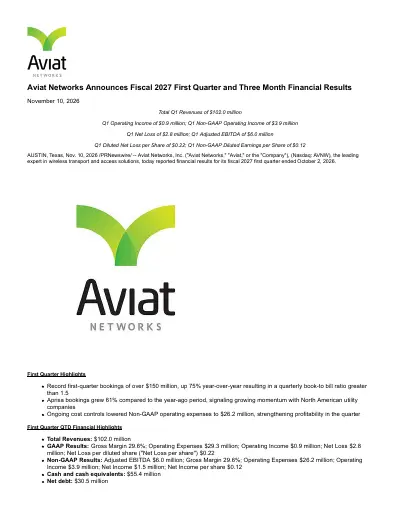
Quarterly revenues of $102.0 million. Adjusted EBITDA of $6.0 million.
Non-GAAP EPS of 12 cents. Strong demand with record first quarter bookings of over $150 million, up 75% year-over-year, and a quarterly book-to-bill ratio greater than 1.5.
This demand increase resulted in our backlog growing by $70 million or 19% from the fourth quarter of fiscal 2026. We observed significant competition for electronic component supply.
To improve our priority versus hyperscalers, we paid down our accounts payable balance by $26 million. This will be critical for achieving the organic growth opportunity.
As we expected, our fiscal 2027 is shaping up to be an exciting year with meaningful organic growth opportunities. Let's start with an update on our MDU opportunity.
Demand from our Tier 1 customer is shaping up to be the largest program in Aviat's history. As we previously disclosed in September, we received an additional follow-on order in the range of $35 to $40 million.
We've also received subsequent orders and remain actively engaged with the customer regarding additional orders for more markets, as well as additional services Aviat can offer. Moving on to our Aprisa products, including our Aprisa cellular router.
The overall Aprisa portfolio saw its bookings increase by 61% versus the year-ago period. This kind of demand growth is exciting and shows the progress we are making with our utility customers.
We've also been investing in our portfolio with two major product announcements in the quarter. First was the launch of our low Earth orbit, or LEO, satellite integration solution for microwave backhaul and cellular mobility applications.
Leveraging our Aprisa router and ProVision Plus management, we've designed a solution that integrates dataplane and network management to provide one-screen visibility, as well as seamless failover to and from LEO satellite, microwave, and cellular links. This solution helps customers keep critical sites, vehicles, and services connected when their terrestrial wireless networks are unavailable, degraded, or difficult to restore.
Network uptime and reliability is the most critical metric tracked by public safety and mission-critical infrastructure customers, and Aviat's LEO integration delivers significant benefits in this area. Second, in the quarter, we launched the industry's only quad all-outdoor radio, four microwave channels in a single compact device.
This solution has fewer boxes and better performance than competitive solutions, allowing smaller antennas, longer paths, and more reliability. Let's touch on BEAD.
We continue to see this program as mainly a calendar 2027 and beyond event. However, we do have incrementally positive news to share.
Aviat has received its first order related to BEAD from customers. After many years since the legislation has passed, it's good to see these projects coming to reality.
Note that all 56 states and territories have now received the final approval from the NTIA. We are excited to build out these critical rural broadband networks.
Turning to our supply chain. As we discussed last quarter, and like others in the technology hardware space, we dealt with continued component shortages and cost inflation in the quarter.
Additionally, we also had a flooding event in Thailand impact our contract manufacturer. Together, these challenges created a headwind to revenue and margins in the quarter.
Although we do not see these component issues going away in the near term, we are committed to minimizing the financial impact to the company and its shareholders to the extent possible. We have taken pricing action where necessary to offset rising costs, and are continuing to review where more price is needed.
Since the close of the first quarter, we've been unable to agree on price with some low-margin customers. As a result, we will remove approximately $25 to $30 million of revenue from our plan going forward.
Note, we believe this will have no impact to our profitability. We believe this will create a stronger and more profitable Aviat over time.
With that, I will turn the call over to Andy to go through financial results.
Andy Schmidt
Thanks, Pete. I'll review some of the key fiscal year 2027 first quarter results.
Please note that our detailed financials can be found in our press release, and all comparisons discussed are between the first quarter of fiscal year 2027 and the first quarter of fiscal year 2026, unless otherwise noted. For the first quarter, we reported total revenues of $102 million, as compared with $107.3 million for the same period last year.
North America, which comprised 48.3% of our total revenues for the quarter, was $49.2 million. International revenues, which made up 51.7% of total revenues, were $52.7 million for the quarter.
EMEA showed solid results with continued growth year-over-year. Sales in the region grew 9% compared with the first quarter of fiscal 2026.
Gross margins in the first quarter were 29.6% on both a GAAP and non-GAAP basis. This compares to 33.2% GAAP and 33.8% non-GAAP in the prior year.
The year-over-year change in gross margin was driven by regional and product mix, as well as component shortages and associated price inflation. First quarter GAAP operating expenses were $29.3 million.
Non-GAAP operating expenses, which exclude the impact of restructuring charges, share-based compensation, and other costs, were $26.2 million. This is versus $30.5 million GAAP and $28.4 million non-GAAP in fiscal 2026 for first quarter, a decrease of $1.2 million and $2.1 million, respectively.
As mentioned in previous calls, Aviat relentlessly assesses its expense base and takes out costs based on corporate needs and driving process efficiency. The decrease in operating expense year-over-year is beneficial for our shareholders and sets us up for increased profitability in quarters ahead.
First quarter operating income was $0.9 million on a GAAP basis and $3.9 million on a non-GAAP basis. This compares to $5.2 million GAAP and $7.9 million non-GAAP in the year-ago period.
The first quarter non-GAAP tax provision was $0.5 million. While the company reported a pretax GAAP loss for the quarter, the loss was concentrated in jurisdictions where tax benefits are not currently recognized due to valuation allowances.
As a result, those losses did not reduce the company's tax provision. At the same time, profitability jurisdictions generated taxable income and associated tax expense.
The combination of these factors resulted in income tax expense for the quarter, despite the company's overall pretax loss. As a reminder, as of fiscal 2026 year-end, the company had over $420 million of net operating losses, or NOLs, that will continue to generate shareholder value via minimal cash tax payments for the foreseeable future.
First quarter GAAP net loss was $2.8 million, and non-GAAP net income was a positive $1.5 million, which excludes restructuring charges, depreciations and amortization, share-based compensation, interest and other income, and other non-recurring expenses, and non-cash tax provision. First quarter GAAP loss per share was 22 cents on a fully diluted basis, and non-GAAP earnings per share came in at 12 cents on a fully diluted basis.
Adjusted EBITDA for the first quarter was $6 million, or 5.9% of revenues. Moving on to the balance sheet.
Our cash and marketable securities at the end of the fourth quarter were $55.4 million. Our outstanding debt was $85.9 million, bringing the net debt position to $30.5 million.
Aviat continues to make improvements in its balance sheet, both in terms of assets and liabilities. Unbilled receivables were lower for the fourth consecutive quarter.
The first quarter balance was $7 million lower compared to the fiscal 2026 fourth quarter ending balance. This brings our total unbilled receivables balance to $75.1 million, which is the lowest balance since fiscal 2024.
Accounts receivable continue to decline and decreased by $16.3 million, as compared to fiscal 2026 fourth quarter, and in light of a Q4 seasonally high sales quarter. Inventories were also lower sequentially by $2.8 million, bringing our inventory balance to $66.3 million.
In terms of liabilities, we strategically reduced our accounts payable by $26.2 million, focused on managing our pricing, product availability, and overall account management of critical vendors. In consideration of our balance sheet improvements, our net cash from operating activities was a $6.3 million use of cash.
However, taking into account our strategic reduction of accounts payable, we were significantly cash flow positive from an operating perspective. With that, we'll turn it back to Pete for some final comments.
Pete?
Pete Smith
Thanks, Andy. We are encouraged by the demand we see from our customers.
Given the strong demand and the electronic component environment, we are adjusting our guidance as follows: full year revenues to be in the range of $450 to $475 million; full year adjusted EBITDA to be in the range of $50 to $55 million. We leave the midpoint of the revenue guidance unchanged, and increase the overall range of our revenue guidance.
As shown by our strong bookings, we have the demand to support the upper end of the range. However, the lower end of the range of guidance, we are contending with supply chain shortages and the customer rationalization.
Taken together, we left the profitability guidance unchanged, as we see the customer rationalization being a net positive to our profitability metrics. With that, operator, let's open up for questions.
Operator
Thank you. At this time, we will conduct a question-and-answer session.
As a reminder, to ask a question, you'll need to press *11 on your telephone and wait for your name to be announced. To withdraw your question, please press *11 again.
Please stand by while we compile the Q&A roster. Our first question comes from Jaeson Schmidt with Lake Street.
Please go ahead.
Jaeson Schmidt
Hey, guys, thanks for taking my questions. Just regarding the lower-margin business you're walking away from, is that concentrated amongst a few customers or is it more broad-based?
I guess relatedly, could you talk about what geographies this was primarily in?
Pete Smith
Jaeson, this would be in APAC, and it's a limited number of customers.
Jaeson Schmidt
Gotcha, that's really helpful. Then, I'm sorry, Pete, go ahead.
Pete Smith
No, you ask your follow-up, go ahead.
Jaeson Schmidt
Just on the MDU opportunity, obviously, it sounds like it's tracking better than what you expected. When could you see additional orders here?
You guys were obviously proactive this past quarter on the supply chain front, but would there be any issues with meeting additional demand here?
Pete Smith
There's more demand for the products, there's more demand for the services than we've booked. What's really the gating item is on the component availability and our ability to get base stations and terminals to the field and do the services work.
In our opening remarks about our book-to-bill ratio and our incredibly high backlog, we don't factor in the demand that we haven't landed due to the constraints from the electronic components. I would say, and this is a little bit amorphous, the demand environment for the MDU is greater than what we've recorded, and when we have improved component availability, then we think we can capture that additional upside.
Jaeson Schmidt
Gotcha, that makes sense. I'll jump back in the queue.
Thanks a lot.
Pete Smith
Thanks.
Operator
Thank you. Our next question comes from Christian Schwab with Craig-Hallum.
Please go ahead.
Ben Taxdahl
Hey, guys, it's Ben Taksen on here for Christian Schwab. Just going back to that MDU order and some upside, would that be revenue that's recognized in this fiscal year or next fiscal year?
Then my follow-up to that would be, if you get more orders from this Tier 1, could we see upside to guide?
Pete Smith
We announced in June orders between $25 and $30 [million?] , in September we announced $35 to $40 [million?]
. The upside would come from services, and the upside would come from component availability.
The way to break that down is the June 2026 announcement, I believe that all of that will ship in our fiscal year 2026. The September 2026, we would like it to land in this fiscal year, but given component availability, there could be some slippage into the July through September quarter, which would be Q1 FY 2028, yeah, sorry for my numbering.
Then in between now and then, we do significant amount of services to make sure things like line of sight are solved, and the faster we can deploy hardware, the faster we can capture services. With that said, if you look to the Tier 1's earnings call, you'll note the importance to that Tier 1's overall strategy.
We're pretty comfortable saying that there's more demand than the component shortages permit us to serve.
Ben Taxdahl
Perfect, thanks. Then just one more, on BEAD, it's good to see we're finally seeing a BEAD order come in.
Sounds like it's mainly calendar 2027, can you just talk about what you think the total opportunity for BEAD would be?
Pete Smith
I think it could be a couple percent growth for Aviat when it's peak. What we would say we're struggling with is that how soon do we get to the peak, and we're happy that we've got a few POs.
We see it ramping in the Q1, Q2 order, but how it gets to be a couple percent top-line growth for us, it's a little bit too early for us to estimate.
Ben Taxdahl
All right, that's all I got. Thanks, guys.
Operator
Thank you. Our next question comes from Scott Searle with Roth Capital Partners.
Please go ahead.
Scott Searle
Hey, good morning. Thanks for taking the questions.
Hey, Pete, just want to make sure to clarify in terms of the removal of the $25 to $30 million of low-margin revenue, I want to just clarify that the comparable prior guidance for fiscal 2026 would have been $475 to $500 million. Want to clarify that number.
Then in terms of the impact and the timing of that, what do we expect from gross margins and going forward, the benefit of that? Did we see any impact in the September quarter or is it just going to be going forward?
Pete Smith
Andy will do the gross margins, and then I'll come back to the revenue.
Andy Schmidt
Hey, Scott, good hearing from you. Let's just talk about where we sat today.
Consensus had us at about 31.7% gross margin, and we came in at 29.6%, about 210 basis point difference. Essentially 170 basis points are related to the expediting dynamic we just ran into.
When we're talking expediting, it's the shortages of certain key components across various vendors, which case we're competing in the marketplace for short-term buys. As we mentioned, we've taken actions to actually solidify our buying activities, hence reduction in AP.
Pete talked to pricing elements that are going to come into play. Make no mistake, there's only certain components, which case we're seeing expediting.
We're taking action on other components in terms of reducing cost to offset that. We have a whole slew of different activities to address the gross margin dynamic in general.
Now that's going to come into play incrementally over the next number of quarters, just rationally. As we work on pricing, we can change prices, which we do, but they don't necessarily take effect until upcoming quarters based on buying patterns, right?
Same thing with components. We have existing inventory of components at a certain cost.
As we reduce cost, those will come into play in future quarters, right? That's kind of a general on the business as it works as normal.
Now when it comes in low-cost geos, as we cut out of these geos, that happens instantly, and what we're looking at right now in these geos, especially in the current dynamic and the cost dynamic, that can increase gross margins by 1% to 2% just by exiting those geos. It's an amazing offset to the revenue.
We can see a revenue decline while seeing increasing gross margin and actually increased EBITDA. It just makes good business sense to actually be addressing this in the current allocation environment.
Pete Smith
Scott, let me jump in on the revenue. Our previous range was $455 to $470 [million?]
. Our new range is $450 to $475 million.
If we didn't have this rationalization of customers, you could add the $25 to $30 [million?] on the old, but we see that this is an opportunity for us we see this as an opportunity to to drive gross margin and efficiency into the business given our demand demand environment.
The the puts and takes the put and take on the the range that we have now, $450 to $475 [million?] , is really it's really component availability.
Great.
Scott Searle
Thank you. Very helpful.
Pete Smith
Very good. That's why the payables went down by $26 million because we basically use that cash to secure supply ahead of time.
Scott Searle
Perfect.
Pete Smith
Thank you.
Scott Searle
Pete, I'm not sure, did you mention a timeline when the MDU opportunity will actually ramp given those constraints? Then I'm wondering, from a high level, a lot of discussion within the industry about SpaceX and becoming a fourth terrestrial MNO.
Implications, what you're hearing or expectations are on that front, and kind of the implications for wireless backhaul and transmission? Thanks.
Pete Smith
We think the MDU will be in full-on ramp in the March quarter. Okay?
On the difficult to decipher, do we have a fourth network provider, we think that if the backhaul connectivity is fiber, that's neutral to us. If they wind up buying the previously announced and now defunct fourth carrier, we were one of two vendors who were qualified with Dish.
We think that that would be positive for Aviat. Then what we're also doing is we see where is the technical problem.
We think it's at the edge of the terrestrial network as it goes over into the low Earth orbit, and our software solutions are increasingly focused on solving that problem at the edge of the terrestrial network. Should SpaceX decide to become the fourth carrier, we're super well positioned to help solve the seamlessness that I think that they're advertising.
Scott Searle
Okay? Great.
Thanks so much, guys.
Operator
Thank you. Our next question comes from Theodore O'Neill with Litchfield Hills Research.
Please go ahead.
Theodore O'Neill
Thanks very much. My first question is about data centers, sort of in general, but specifically, if there's a revenue component for you out of data center business, and/or is data center buying crowding out some of the components that you're trying to get access?
Pete Smith
Yeah. The bandwidth in and out of data centers is on terabits per second, and beyond the typical microwave case.
We can see some backup disaster recovery. We have little to no revenue from data center.
We imagine that AI ramps up, that transmission needs will happen, which would be positive for microwave. With respect to electronic component competition with what we call the, or the industry calls the hyperscalers, that is definitively real, and that's really why we've decided to leverage our balance sheet and try and secure as many components as possible.
Our demand is largely, if not completely independent of data centers, and our supply is in competition, and so we don't have a demand problem right now. We have a supply and a competition for supply with the hyperscalers.
Theodore O'Neill
To follow up on this paydown on payables, is that because the suppliers are saying that if you pay cash, you can get the front of the line or is there some other dynamic going on?
Pete Smith
It improves the allocation from the supply base.
Theodore O'Neill
Great. Following up on the last question about SpaceX, would you agree that if there is a fourth carrier, that will spur some more competition and it should be good overall for your business in general?
Pete Smith
I think it'll be good if they build out the backhaul connectivity with microwave. I would say, secondly, if they pick up the old Dish assets, that would be good.
If they deliver on their seamless crossover from terrestrial to low Earth orbit, that'll be good. What would be neutral for us would be if they decide to use a disproportionate amount of fiber, which the advantage microwave has is we're faster to deploy, and as population density falls off, the value proposition for microwave increases.
Theodore O'Neill
Right. So.
Thanks very much.
Operator
Thank you. Our next question comes from Tim Savageaux with Northland Capital Markets.
Please go ahead.
Tim Savageaux
Hi, good morning.
Pete Smith
Hey, Tim.
Tim Savageaux
Want to come back to that SpaceX question, I guess from a similar angle, which is to say, could we be seeing a dynamic where just kind of the headlines and the activity are driving an uptick in activity amongst your core customer base, both on the Tier 1 side and on the rural side? Seems like those dynamics are possible.
You're talking about an initial BEAD order. Probably a coincidence, it's been long enough.
Verizon's activity really seems to have picked up. Have you noted that dynamic at all across your business, number one?
Then number two, I think you sized that Tier 1 MDU opportunity at $100 million-plus annually in total. Is that still the case, and how are you feeling about your share potential there?
Pete Smith
Yeah. I would confirm the sizing for the MDU opportunity.
I think, if we weren't throttled by component availability, I'd be likely to raise the size of that opportunity. I believe that we are in the lead position with respect to supply.
With respect to competitive response to SpaceX, it's a really good question, and I don't have any evidence to say that the BEAD funding or rural broadband customers are responding to SpaceX. I think it's business as usual.
I can't make that discernment for Tier 1s. What I can say is that our private network customers, and we announced the LEO backhaul and mobility software suites.
The private network customers that really care about mission criticality, when you go past the edge of the terrestrial network, they want solutions that will allow them to cross over. We are seeing a lot more interest from our private network customers who operate at the edge.
To put the specific color on that, that would not be, say, New York City, but it could be in rural Arizona, as you go, say you drive on the country roads up near the Grand Canyon where you don't have terrestrial connectivity. We are definitively seeing that from public safety customers who operate at the extreme edge of the network.
Tim Savageaux
Interesting. Thanks.
You mentioned some subsequent orders on the MDU program. Is there anything to quantify there, or that's material from your kind of initial announcements of the two big orders?
Pete Smith
I don't think we're ready to announce that. I think we need to deliver on what we have in front of us.
I think what could possibly happen is as we deliver, I think we'll get more services in the mix. If we do that, I think we could update you guys in the February call.
Tim Savageaux
Thanks very much.
Operator
Thank you. Our next question comes from Dave Kang with B.
Riley. Please go ahead.
Dave Kang
Thank you. Good morning.
First question regarding international service providers. You talked about CapEx timing just if you can provide additional color on that.
Is it mainly India or any other customers?
Pete Smith
It's in APAC, and you have a good guess, Dave. What I'd like to say to just take a little time on this.
The rationalization is in APAC, and you're properly guessed the lead country there. With respect to our bookings on a year-over-year basis, we're up every place where we are not rationalizing customers.
North America, Latin America, Europe, the Middle East, and Africa, we're up on a year-over-year basis.
Dave Kang
Got it. Then, you talked about supply chain component availability.
Just wondering if you can quantify how much of revenue that was impacted during the quarter. All right.
Andy Schmidt
Sure. When we look overall, we had two, whatever, let's say, macro items affecting us this quarter on revenue.
One was the component shortage, the other one was the Thailand flood. Again, thumb in the air, this is not perfectly accurate, but we look at the two together at about $10 million on revenue, and let's say Thailand's going to be much smaller, maybe $2 [million?]
. Let's call it $8 [million?]
on components, but that's an estimate in terms of availability, because obviously, if we had those components, we'd slap to deliver. We were definitely hamstrung by both items.
Dave Kang
Got it. Thank you.
Operator
Thank you. This concludes the question-and-answer session.
I'd now like to turn it back to Pete Smith for closing remarks.
Pete Smith
Look, it's an exciting demand environment, and it is a challenging electronic component availability. The leadership of Aviat will be overly indexed on sorting out the electronic component supply, and we look forward to 90 days from now giving you an update on our progress.
Thanks.
Operator
Thank you for your participation in today's conference. This concludes the program.
You may now disconnect.