Itau Unibanco Holding S.A.
Q3 FY2026 · Earnings Call TranscriptNovember 4, 2026
Gustavo Rodrigues
Hello, good morning everyone. My name is Gustavo, and it is a pleasure to have you join us today.
In accordance with the Level 1 corporate governance listing regulation, this conference call qualifies as our mandatory annual public meeting. In this meeting, we will present the results for the third quarter of 2026.
As always, Milton will explain our 3Q 2026 financial performance, and afterwards, we will have our traditional Q&A session, during which analysts and investors will be able to interact directly with us. Before we move on with Milton, I would like to share a few instructions about the event.
For those accessing through our website, there are three audio options: the entire content in Portuguese, the entire content in English, or the original audio. The first two options offer simultaneous translation.
To select this option, simply click on the flag icon located in the upper left corner of your screen. Questions can also be submitted via WhatsApp to the number displayed on your screen.
Today's presentation is available for download on both our hot site and, as always, on our investor relations website. I will now hand the floor over to Milton, and later, we will have the Q&A session.
Milton, over to you.
Milton Maluhy Filho
Good morning, welcome to another earnings release as we discuss the third quarter of 2026 results. I will walk you through the results, the credit portfolio dynamics, capital, NII with the market, but I have also brought additional slides to invest a bit more time discussing the solidity of the balance sheet.
It is very important to understand not only the P&L dynamics, but also to understand the structure of the balance sheet, to show how prepared we are and how protected and reinforced the bank's balance sheet is. I will move straight ahead now, and it will become clearer with the data presented further on.
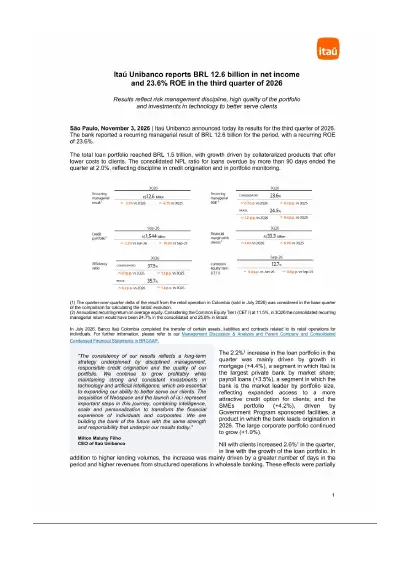
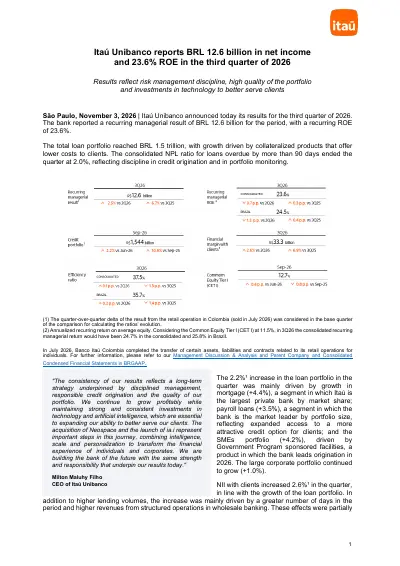
I will start by talking about recurring net income of 12.6 billion reais in the quarter, growth of 2.5% compared to the second quarter of 2026 and of 6.7% compared to 3Q 2025, consolidated ROE of 23.6% and in Brazil of 24.5%. As always, we include the note that, at 11.5% of Common Equity Tier 1, ROE would be 24.7% on a consolidated basis and 25.8% in Brazil if we were operating with the 11.5% appetite.
This shows once again a very strong quarter in terms of results and profitability. Moving on to the loan portfolio, we have an observation regarding both the portfolio and the margin.
On the portfolio side, we had the event of the sale of the retail operation in Colombia. It was a 10 billion reais portfolio that exited on August 1st, 2026.
For the purposes of NII with clients, we normalize this two-month effect to make it comparable with the third quarter, and for portfolio purposes, we exclude the Colombia effect. Therefore, the portfolio grows 2.2% against June 2026, growing 11% year-over-year.
I will provide a bit more detail shortly. NII with clients grew 2.6% compared to the second quarter and 7% compared to 3Q 2025, reaching 33.3 billion reais.
The consolidated efficiency ratio was 37.5% and in Brazil it was 35.7%. Once again, a strong efficiency ratio for the quarter.
For the first nine months of the year period, we continue to improve the efficiency ratio. I will provide more detail shortly.
We had capital generation of 12.7%, already after all uses and sources, which also shows a very solid capital base, presenting growth compared to June 2026. I'll also share some more data with you shortly.
Regarding the credit portfolio, I will just go through the total, which grows 2.4% in Brazil in the quarter and 11% in the year, as I mentioned a moment ago, and I will go straight to the highlights. First, I will reconcile Colombia.
In Latin America, you can see that the portfolio posted a decline of 3.5% in the quarter, but excluding the asset sale in Colombia, it would have grown 0.8%. On a year-over-year basis, Latin America credit portfolio growth would go up from 6.4% to 11.1%, and total credit portfolio growth in the quarter would be 2.2% rather than 1.4%, and 10.9% year-over-year, rather than 10.2%.
That 10.9% growth was the figure I mentioned a moment ago. Moving on to credit cards, the portfolio grew 1.9% in the quarter and 7.9% year-over-year.
The auto loan portfolio was flat in the quarter. We carried out an important risk adjustment effort on the auto loan portfolio, like the de-risking we had already done in the credit card portfolio.
The auto loan portfolio drops 3.6% year-over-year, but the most important thing is to look at the performance in the mid- and high-income segments, Uniclass and Personnalité. In these segments, credit cards grow 4.3% in the quarter and 16.3% year-over-year, while auto loans grow 3.6% in the quarter and 9.8% year-over-year.
This performance shows our discipline for high-quality growth, focusing on more resilient clients. All these portfolios, both credit cards and auto loans, continue to return above the cost of capital and create value for shareholders.
In payroll loans, we grew 3.5% in the quarter and 16.3% year-over-year. The most important thing is to note that the portfolio continues to grow in private payroll loans.
We took the lead in this private payroll loan portfolio from the start, and today we are growing 93.7% year-over-year. Once again, delivering the client the best solution, the best product, and the best price.
That is the reason the portfolio dynamic is what it is. When we look at the personal loan portfolio, growth is smaller, whether due to the decline in the personalized credit portfolio within it or due to lower demand by formally employed CLTista clients, given our focus on private payroll loans.
Mortgage grows 4.4% in the quarter and 15.8% year-over-year. It totaled 41 billion reais in origination over the last 12 months, and more importantly, a 56% market share among private banks, which shows our consistency, client focus, and long-term vision.
Turning to SMEs, the portfolio expanded 4.2% in the quarter and 15.1% yearly. Equally important is where that growth came from.
Government-sponsored lending facilities for SMEs increased 8% in the quarter and 32.4% year-over-year, indicating that collateralized products drove portfolio growth. I will discuss the portfolio's composition in more detail later.
The large corporate portfolio grew 1% in the quarter and 9.5% year-over-year. Taking good advantage of the windows we had in the capital markets throughout the year, we continue to follow the dynamic of growing with quality and with transactions that, without a doubt, create value for the client and for the shareholder.
This discipline has been very important for building our portfolio. Talking about NII with clients, first I will show you that we removed the Colombia effect, which is not very relevant.
Looking from last quarter's margin ex-Colombia of 32.5 billion reais, we reach growth of 2.6% or 800 million reais. We have the traditional working capital effect, which needs to be put into perspective here.
Ultimately, volume continues to be an important driver. In the product mix, as you saw, not only between wholesale and retail, but also within retail, growing in more collateralized products, which naturally pulls the spread to a somewhat lower level.
On the other hand, we have the calendar effect in our favor this quarter, in addition to Latin America and others also in our favor, especially the wholesale structured operations, which drives this margin growth in the period. Moving on to the annualized consolidated margin, NIM was 9% on a consolidated basis and 6.1% risk-adjusted, practically stable.
You can observe small variations between quarters. In Brazil, NIM was 9.9%, also very close to previous quarters, and 6.6% risk-adjusted.
Again, within the logic that, for us, as important as the margin is the risk-adjusted NIM. Therefore, I think the data speak for themselves.
On NII with the market, it was a very good quarter. We were able to deliver 1.3 billion reais, already deducting the cost of the capital ratio hedge.
In Brazil, we had a very strong performance of 1.7 billion reais. In Latin America, it was slightly better, but still within a very small margin relative to previous quarters.
It was a good quarter of NII with the market for the bank. Now I will talk about commissions and fees.
Throughout the year, I have been telling you that fee income and economic activity go hand in hand, and we have seen slower economic activity in general, a much weaker capital market, and greater volatility, which makes performance fees difficult for all asset managers. We continue to act meaningfully to deliver quality products and solutions to our clients, with ever less dependence on fee revenues.
This is very important, but we can see the effect of financial advisory and brokerage, which fell from 1.3 billion to 0.9 billion reais in the quarter. I think this was the main effect.
The main message is that we revised the commissions and fees guidance for 2026 back in the previous quarter, and our best expectation today is growth within the guidance range, but more towards the low range. I will talk about 2026 guidance shortly.
Our expectation is to deliver growth close to the floor of the range in fees and result from insurance. In insurance, we continue with very favorable dynamics, especially in bancassurance, and results continue to come with high quality.
No major highlights to share here, beyond the points I have already mentioned. On credit quality, I think the most important thing is to reinforce to you, once again, the stability our portfolio has delivered.
We improved short-term delinquency across all indicators: total, Latin America, and Brazil. In Brazil, the individuals portfolio is absolutely stable, with no change in short-term delinquency, while SMEs posted a 10 basis point decline in the quarter.
In large corporates, we had a practically stable variation this quarter. I always reinforce that this is not the best indicator to track the dynamics of large corporate asset quality, but we can see the good short-term delinquency dynamics even though market delinquency has been rising quarter after quarter.
I will talk about this shortly. Moving on to long-term delinquency, the first point is that, on a consolidated basis, it is also quite stable.
When we look at the total, we had an increase of 10 basis points, but it is in the decimal place. In Brazil, you will see that individuals portfolio is absolutely stable, and in SMEs, there was an increase of 10 basis points.
If you go back to last quarter's call, you will remember I said that our best expectation was a 10 basis point deterioration for this quarter. It was absolutely in line with expectations within that SMEs dynamic.
The collateralized products came out of the grace period, delinquency begins to appear, but it is a very well collateralized portfolio that has been operating at a very good profitability level. Our best expectation was a 10 basis point deterioration; for the next quarter, we expect stability.
Clearly, 10 basis points up or down are small variations, but our best expectation today is that this 2.1% will remain flat in the next quarter. This shows not only the solidity of the portfolio, because if you go back to the 2024 indicators, you will see that we are operating at lower levels than we used to, but above all, stability and predictability.
I think these are the main messages I wanted to leave here. When we look at the stage 2 and stage 3 portfolios, we do not have any major message.
Regarding coverage, there is only one message. If you look at corporate entities, there was the exit of a client that went into bankruptcy.
It was a 100% provisioned portfolio, the provision goes out, the coverage goes out, and since what remains has a provisioning level lower than 100%, this naturally reduces the indicator, but there is no specific effect. It is a one-off case with the full exit of a client that was 100% provisioned.
Regarding the cost of credit, we again have the stability I mentioned a moment ago at 2.7%. If you look at the series since the first quarter of 2025, we are running at 2.7% of the portfolio, around 10.4 billion reais.
The portfolio grows, and the cost of credit also rises nominally, also within very favorable dynamics. The renegotiated portfolio was also very stable.
The variations we see reflect a one-off case that moved to the restructured portfolio. There is also some Desenrola effect, but it is practically nil.
The effect is very small, and that is why the portfolio rises slightly in nominal terms. The most important thing is to look at the relative indicator of 2.6%, which is restructured portfolio over total portfolio, also quite comfortable.
Now I will bring an important market data point. I have already brought it to you in a previous quarter, but I think it is worth reinforcing.
This is the series published by the Central Bank for delinquency in the national financial system. The only difference is that this is delinquency over 15 days, it is delinquency running from 15 days onward.
The second effect is that we removed Banco Itaú from the indicator. Analyzing the series, we start in 2019, and around the pandemic period, we were operating at levels very close to the market's, and then we began to decouple materially from the system's delinquency.
Delinquency over 15 days, which will not match what we disclose because the over 15 and over 90 need to be reconciled, is today at 6.7% against market's 13.1% for individuals. The market continues to worsen, but our portfolio remains very stable.
This is the long-term vision, the portfolio management and capital allocation discipline that I talk about in our meetings and that I insist on so much in. Still on credit quality, I also brought the portfolio view.
In personal loans, the market is at 17.2% in delinquency over 15 days, and we are at 9.4%. In credit cards, the market is at 14.8%, and ours is 6.6%, less than half of market's level.
In auto loans, the market is at 13.9%, and ours is at 9.7%. We can see the expansions relative to December 2019: in personal loans, the market rose 260 basis points, and we fell 20; in cards, the market rose 310 basis points, whereas we fell 60; and in auto loans, the market is up 360 basis points, and we are up 90.
In private payroll loans, there are quite different dynamics in the market. We have been leading this market.
NPL over 15 days overdue, already considering all processing and transfer effects, is at 6.9% compared to the market's 18.9%. A very relevant message is that all these portfolios, without exception, are creating value and operating above the cost of capital, generating solid, sustainable, consistent, and predictable results.
This is the main message. The portfolio management takes time to generate effects, but once the portfolio is well-constructed, the results become very consistent, and we have already reached that maturity.
Let me share another important data point, since I am often asked how Itaú provisions for its retail portfolio. How does the expected loss model work?
How timely are the models? To avoid any doubt, let me show you today how our model works.
For individuals, excluding mortgage because it distorts the information given the collateral, a client up to 14 days past due, which is the operational delay, already carries a 4% provision. For a client that is 31 days past due, the provision increases to 58%.
That is why I insist so much that short-term delinquency is the best indicator for understanding the cost of credit dynamics on the bank's balance sheet, because our models respond very quickly. We provision based on expected loss rather than incurred loss.
At 31 days past due, I already have 58% provisioning on the portfolio for individuals, and it increases over time. We did not change the write-off criteria, even though Resolution 4966 allows some flexibility.
We kept our best expectation of recovery for that client. Therefore, there was no change in provisioning in the write-off model.
These are the minimum levels set by the Central Bank for S1 to S3 and S4 and S5. As it is a minimum level, each institution operates as it sees fit, given its models and discussions with the regulator itself.
The most important message is that there is no minimum level for these very short delays, and then they appear more prominently here. In other words, at the limit, you can wait 91 days to provision 50%.
We, at 31 days, already provision 58%. This is the main message.
In addition to maintaining a very solid balance sheet, we recognize provisions for short-term delinquencies at a very early stage, keeping the balance sheet well-protected and minimizing the risk of surprises going forward. Here we have another quite important data point, since there are also many questions about stages 2 and 3, whether they are not the same thing as short-term and long-term delinquency.
They are not, because if we take the balance of our stage 2 and stage 3 portfolio and divide it by delinquency over 15 days, we will see 240%. This is because there are several other criteria that may lead the bank to move a client between stages well before any delinquency.
Delinquency is not the only variable that leads us to move a client to stages 2 and 3. Our timeliness in classifying the client is also fundamental.
This is the risk management pillar I talk about so much, and this discipline is essential to building solid balance sheets in the future. In SMEs, we also brought delinquency on a market-comparable basis, removing Itaú from the indicator.
In December 2021, post-pandemic, we were operating above the market, and we carried out in-depth work on the portfolio. A few years later, the market is at 5.8% delinquency, and we are at 2.9%.
Once again: discipline, consistency, long-term vision, and risk management. What did we do in SMEs?
I first shared this indicator with you a few quarters ago, and we have made progress since then. The portfolio, which in December 2019 was 36% collateralized, reached 58% this quarter, showing the strength of our portfolio.
Analyzing only micro and small companies, which is where we have a bit more volatility and where the cost of credit and delinquency tend to be higher, we reached 72% of collateralized portfolio. Once again, this is practically double what we had in December 2019.
In other words, we are growing with discipline, quality, risk management, and capital allocation. Let's talk about corporate now, and I also brought this view to you recently.
With 2019 indexed to 100, our portfolio has grown to 209 over these last years, while concentration has declined. The share of our top clients declined from 20% to 14%, showing that we diversified the portfolio over this period.
The share of investment grade clients, which was 69% of the portfolio in December 2019, reached 78% this quarter, also very solid. Now, there are two important data points regarding judicial reorganizations and provisioning dynamics to highlight.
When we look at everything that happened in the market in terms of judicial and extrajudicial reorganization, which for large corporates is relevant, considering everything that came out in recent years 2025 and 2026, our market share by volume in these operations was 2.3%. In agribusiness, considering all extrajudicial and judicial reorganizations, our market share by volume was 4.3%, and in both segments, our credit market share is substantially higher.
Once again: portfolio management, capital allocation discipline, and risk management. Another very relevant piece of information, since there are also many questions about how we provision large corporates.
Often there is no delinquency, and the question remains about incurred loss versus expected loss. Our model is based on expected loss, and that is why many clients migrate between stages without having any delinquency.
A deterioration in the rating, combined with timely analyses, is enough for us to move that client to a different stage. If we take the five cases of Chapter 11 with plans approved in the last two years and divide the volume of provisioning I had before these proceedings by the incurred loss we had after the renegotiation, our provisions were four times the incurred loss at the time of the restructuring, approval, and ratification of the plan.
Why don't we release this provision? Because execution risk remains.
The plan is just one more step. Once the plan is approved, the company needs to execute it.
That is why, very timely, we build the provision and at the same time keep the provisioning level quite adequate throughout the cycle to avoid volatility in the portfolio. Just look at how much we have provisioned in the large corporate portfolio on the balance sheet every quarter, with a solid and very high-quality portfolio.
This discipline of always keeping the balance sheet provisioned is a fundamental principle of our management approach. In non-interest expenses, the main message is high discipline.
During the year, we had very small variations. The largest variation is in other expenses, which was impacted by a one-off effect in marketing expenses and ended up producing this overall effect, with growth of 1.5% in the year and 3.2% on a cumulative basis in Brazil.
Including Latin America, cumulative nine-month growth was 3.1%, which shows our dynamic of not giving up on the future, not failing to invest, and not failing to expand the bank into new businesses. We have been able to pursue efficiency where it is truly necessary, with a great deal of technology and solutions.
The efficiency ratio, as I mentioned at the beginning, was 35.7% in Brazil and 37.5% on a consolidated basis, but on a nine-month cumulative basis, we have 37.3% on a consolidated basis and 35.4% in Brazil, also showing very solid dynamics, not only in top-line revenue generation, but also in cost management. Finishing with capital, before going through guidance, we had a generation of 0.8% in the period from earnings and IOC, and risk-weighted assets consumed half a point.
We ended with a Common Equity Tier 1 ratio of 12.7% plus 1.5% of Additional Tier 1, therefore 14.2%. In addition to everything I said, the healthy dynamics of value creation and earnings generation, with great cost discipline and risk management, lead us to important value creation for shareholders through capital formation.
Finally on guidance, all lines remain unchanged. I emphasized the growth of commissions and fees and results from insurance operations at the beginning, saying that we should end the year closer to the lower end of the range, and this is our best expectation.
It is important to bring you this information. The other adjustment, which is mechanical, is in the effective tax rate, considering the whole interest rate dynamic, the increase in the long-term interest rate, TJLP, and all the effects this produces on the balance sheet, as well the geographic mix of our businesses.
We made this adjustment. Previously, the guidance was between 29.5% and 32.5%, and we naturally revised the range to 28% and 29%.
We only have one quarter left, but we thought it would be better to make this adjustment, given that this reflects the best information available today. With that, we maintained our guidance for all other lines, and this is how we expect to end 2026.
This is typically the deck I use on these calls, focused on our results and P&L dynamics. I brought some market indicators that, in my opinion, are very important to understand how our portfolio has performed, but I wanted to place some emphasis on certain pillars that, in our view, are important differentiators of our management model.
I would like to make one comment first. The intention here is not to praise ourselves.
Our culture: we are realistic, focused on results, and focused on the client. I understand that, from time to time, it is important to reinforce what our convictions are and what the pillars of the bank's management model are.
Clearly, there are other elements that are not reflected here, but I believe this framework allows me to highlight some very important points and make them more tangible. The first is client-centricity, which is at the center of everything we do.
Culture is something I talk about a lot, you've heard me discuss this topic many times, and it's something we talk about extensively within the organization: culture and long-term vision, talent pool and execution capability, I will talk about that, modern platform and data, balance sheet strength, results diversification and efficiency, and value creation, which is the outcome of all of this, right? At the core, the question that always arises is whether it is possible to have a high NPS and generate results and value creation.
The answer is yes. Without client-centricity, your results in the long run are not sustainable, and I will talk about this shortly.
I will start by talking about customer-centricity, the central point of everything we do. The bank's NPS evolution between 2021 and 2026 improved by 12 points.
It is a substantial increase, especially given the starting point. When we look at the NPS of digital channels, for both individuals and corporate, we have 80 points, which is also one of the highest NPS levels we have ever reached.
I am referring to the apps: the bank's app, the super app, and an internet banking that, for medium and large corporate entities, is extremely important. We have 83% of company segments with NPS in the excellence zone, and 80% of all individual segments with NPS in the excellence zone.
All these segments have improved over recent years. In culture and long-term vision, we have been working on the bank's culture since the merger.
Between 2008 and 2021, we called it Our Culture, which also underwent adjustments over time. In 2021, we launched the iTubers Culture, the new culture, with adjustments and new elements that I always say are timeless.
In 2025, we added a new pillar, which is very important for the moment we are living in. We measure culture by results, by client-centricity, and by employee satisfaction.
Our eNPS, which is the employee net promoter score, is at 85 points, in the excellence zone for quite some time now. We have been able to do this with highly motivated teams, a high level of engagement and satisfaction.
It is only in this way that one can deliver incredible results and keep clients highly satisfied. These are the pillars of the culture.
I will not go through them one by one, but we added the pillar: We make choices and decisions. This is the new pillar, at an important moment of discipline, of trade-offs, of knowing how to make the right choices, and of generating ever more autonomy and accountability in the teams.
This was a relevant topic discussed across the entire organization. Talent pool and execution capabilities: I could bring a whole series of recognitions, but I wanted to highlight a few that are particularly important to us.
First, ensuring that our talents are prepared for the future. In this regard, we have our trainee program and development and training programs advancing quite strongly.
In our most recent trainee program alone, more than 95,000 people applied. It is a program with a limited number of positions, and it shows our ability to attract talent.
Highlights in the main talent rankings: Fast Company Best Workplace for Innovators 2026, where we are the only Brazilian company in the ranking. It is a very strong result, especially showing a very modern bank that has the capacity to innovate and transform itself every day.
In LinkedIn Top Companies, we ranked first in Brazil for the eighth consecutive year, showing our ability to attract and retain talent. In Great Place to Work, we ranked for the sixth consecutive time among the five best companies in Brazil with more than 10,000 employees.
We ranked first in two of those six years, which also shows our ability to engage our people. In Incredible Places to Work, we have been in the ranking since 2020, when this ranking was created.
How do we make our execution capabilities tangible? Results, delivery, client focus.
In the efficiency program, we reduced the bank's efficiency ratio by 7 percentage points from 2021 to now, on a nine-month view. Our agribusiness initiative is another example.
We have grown the business sustainably, while maintaining asset quality and building a very different operating model. We have 143 billion reais in portfolio, growth of 20% per year, with a market share in Chapter 11 that is very small relative to the size of the portfolio we have.
Regarding One Itaú, which you have heard us talk about several times, we migrated 15 million clients to the super app, consolidating seven apps into one. This demonstrates execution capacity at its core.
Regarding the acquiring turnaround and the entire integration with the corporate business, we took the lead in the segment with an additional 5 percentage points of market share over this period. Satisfaction rose 40 NPS points, which represents a truly very significant jump, and profitability grew seven times more than TPV, which is the transacted volume.
These are just some of the projects that show that when we design a very clear strategy and put in place a plan with a high-quality team, our execution capacity is outstanding. Forgive me a little for self-praise, but I really think this says a lot about the organization we have been building over the years.
Regarding the modern platform and data, I wanted to comment on the technological modernization that was carried out. We have 21,000 employees working in multidisciplinary teams and nearly 3,000 squads.
Regarding the modern data platform, we have more than 92% of the AI initiatives already in use. All the modernization carried out over the years means that today we have a 50% reduction in the unit cost of tokens compared with the first quarter of 2025, which is something much talked about and discussed.
We have been able to pursue efficiency, and by 2028, we will complete the modernization agenda, ceasing to be a transactional bank and becoming a conversational bank, with artificial intelligence embedded across everything we do. This is a very relevant milestone.
Can you imagine a bank of our size decommissioning its last mainframes in the organization? I think there are few cases in the world where this has been possible.
Regarding connectivity and the technological frontier, we made the acquisition of Neospace, as announced to you last week, and this was a very relevant acquisition. After three years of testing, learning, and developing the models, we saw incredible results, which led us to acquire the company.
I would also like to highlight the Itaú Institute for Science and Technology, which is very relevant, holding more than 39 patents, working with the leading universities in the world, developing new solutions and reaching new markets. The debates here have been intense around our latest innovation initiatives, and the ICT has been actively involved in these projects.
Last but not least, we have our corporate venture capital, through which we also seek to make investments, whether in Endeavor or Simbiose, to try to understand how these solutions can improve the bank. It is not investment for investment's sake, but rather how we can improve our ecosystem through investments, and naturally, given our relationship with the company, how we also capture equity value over the long term.
There are more than 10 investees with very strong results. I would like to comment on balance sheet strength.
We ended up talking very little about this subject, but I wanted to spend a little more time discussing this slide. Regarding the bank's tangible capital, we have 138.7 billion reais, and we grew relative to the second quarter of this year and relative to the third quarter of 2025, with all the dividend distribution we have been making over all these years.
Here we show that tangible capital represents 60% of our shareholders' equity, which is perhaps one of the highest indicators in the financial system. Regarding the dynamics of tax credit generation, this represents 31.2% of our shareholders' equity, and I will comment more on this shortly.
Goodwill and intangibles represent 8.2% of shareholders' equity, but we only make investments and keep on the balance sheet what will truly generate future value. Otherwise, we will take impairment.
We are absolutely comfortable with the goodwill and intangibles we have on the balance sheet, and we conduct periodic reviews, but it is natural for us to keep a portion of equity distributed in this way. How do I understand the net tax credit shown here?
We broke down and showed that it is 71.5 billion reais in total, and of this, 52.3 billion reais are tax credits arising from expected losses, for which the risk weighting factor is 100%. The lowest weighting factor among all tax credits is the tax credit related to expected credit losses.
Of the 71 billion, 52 has this characteristic. We amortize this over time.
There is no limit on the utilization of these tax credits. We also have what we call tax credits arising from temporary differences, which represent 24.8% of total tax credits, and in this case, it already has a somewhat higher weighting factor, of 250%, but even so, it is natural to the bank's activity that you generate these tax credits over time.
The most important thing is that both the expected losses tax credit and the temporary difference tax credit do not end up as tax loss carryforward tax credit, which is when you end the year with a negative tax base and generate a loss. Once this happens, you must deduct this loss, this tax credit, from the capital ratio in full.
For this reason, we apply a weighting factor of 1,250%, and you are then limited to amortizing only 30% of the following year's profit, which is in fact what you can amortize of tax loss carryforward tax credit. It is a very slow dynamic to exit the balance sheet unless you take impairment over time.
In this case, we have only 2% of tax loss carryforward tax credit, which represents 1.4 billion reais and tends to be zeroed out by the end of the year. It may still keep a small amount, but it tends towards zero.
This shows good management and our ability to manage expected loss, which is the natural portfolio management dynamic, and temporary difference credits. Doing good tax base management so that you do not generate the worst, which is tax loss carryforward tax credit, which deducts from the capital ratio.
With this, you are able to have a very healthy and solid capital base via tangible capital. In this second block, we bring data on labor, civil, and tax provisions, in which we have a balance of approximately 17 billion reais, which has been falling.
In other words, our management capacity in these lines is fundamental. What we did here was try to show you in a way that allows you to measure the relevance.
We have 9.6 billion reais in labor-related provisions, which represents 3.1 times coverage based on the payments made over the last 12 months. Is this little or a lot looking at the historical average?
Is it only now, or has it always been like this? Looking at the average of the last five years, it is 2.9 times.
In other words, this shows that our models are very consistent, both for generating the provision that is necessary and for maintaining an adequate coverage level over longer periods. When we look at civil provisions, we have the same view.
We have a 3 billion reais balance, which is almost twice the amount we needed to cover payments over the last 12 months, and looking at a longer series, the average is 2.3 times. This also shows consistency between the short and long periods.
In tax provisions, we have a balance of 4.3 billion reais. This is what we have provisioned on the balance sheet for probable loss.
What represents possible loss is in the notes to the financial statements. What represents remote loss does not need to be detailed in the notes nor provisioned.
In this way, it is difficult to make this coverage calculation. When we look at the balance sheet, the LCR, which is a liquidity coverage ratio indicator that is regulatorily 100%, we have been running at 206%.
That is twice what the regulator requires for short-term liquidity. As for net stable funding ratio, where the indicator is also 100% according to regulation, we have been running at 123.7%, we are above not only in short-term liquidity, but also in long-term liquidity and needs.
This second piece of information is extremely important. If we take our loan portfolio and divide it by the bank's gross funding volume, we reach a percentage of 78.6%, which shows that we have an enormous capacity to raise funds from investors, retail, and corporate markets, and the portfolio is self-funded in this way, with a highly adequate mix reflected in the other indicators here, between retail and wholesale and institutional funding.
Regarding the distribution and diversification of results, we would first like to show that retail represents 41% of our credit portfolio with 635 billion reais, and wholesale holds 665 billion reais. They have very similar portfolios in terms of size.
The Latin America loan portfolio represents 16%. When we look at the bank's results, it shows what a truly universal bank is: one that operates across all businesses and that has very balanced results across all segments.
In our business model, which we present both in the MD&A and in the earnings presentations, you can see this dynamic. Retail results represent 43.4% of recurring net income on a consolidated nine-month view.
Wholesale Brazil results represent 38.8% of recurring net income in the same period, showing once again a very balanced portfolio with excellent profitability and strong earnings generation capacity across the various businesses. Latin America results represent 6.6%, and corporation and activities with the market also posted an important result of 4.2 billion reais.
We have leadership in Latin America as the leading bank in card issuance, in acquiring, and in asset management, with leadership among private institutions. We are also leaders in payments, acquiring, and cash management.
We have leadership among investment banks, and we have been pursuing this leadership across all the rankings in this sector. This is a truly universal bank, one that brings consistency and predictability insofar as all the bank's businesses are relevant and lead their respective markets.
Where does all of this lead us? To efficiency and value creation.
How do I show you that? Our profitability was 19% in the first nine months of 2021, when we began the cycle, and now, looking at the first nine months of 2026, we reach profitability of 24.1%.
The efficiency ratio went from 44.4% in the nine months of 2021 and reaches 37.3% in the first nine months of 2026. We have rising profitability and a declining efficiency ratio.
How does this translate into results and value creation? We started with recurring net income of 19.7 billion reais in the nine months of 2021 and reached 37.3 billion reais on a nine-month view of 2026.
What happened to value creation over this period? It increased from 6.9 billion reais to 15.8 billion reais, more than doubling the value creation.
The cost of capital went from 12.8 billion reais to 21.5 billion reais. In short, the bank's results grew at a CAGR of 14% over this period, value creation grew at a CAGR of 18%, and the cost of capital grew at a CAGR of 11%.
In other words, we were able to create value by growing above the bank's cost of capital. In closing, everything we do ultimately comes back to the client, and this translates into results and value creation for our shareholders.
With that, I conclude. It is a somewhat longer presentation than usual.
I will shorten my closing here to allow more time for our chat. I will now join Gustavo and Gabriel for our Q&A session, and I would like to thank you once again, not only for your trust, but also for your participation.
To say what I always say and what I've been saying for many quarters: Itaú has never been so prepared to face whatever scenario may lie ahead, whether a scenario of opportunities, growth, value creation, and business generation, or a more challenging scenario due to economic activity, potential delinquency, or macroeconomic indicators. Whatever the scenario, the bank is very well prepared, whether through its earnings generation dynamics, the strength of its balance sheet, or its management pillars.
Itaú Unibanco has prepared for many years to arrive in this position. Obviously, we have a lot to do, we have many opportunities, but I think we are very well positioned for what lies ahead.
With that, I conclude here and will join the two of them. We will soon begin our chat.
Thank you, and see you shortly.
Gustavo Rodrigues
Hello. Welcome to our studio with Gabriel and Milton for our Q&A session.
This is a two-language session, we're going to answer the questions in the language that they're asked. Should you need any support, the platform has the options of the audio in English or Portuguese.
You can submit your questions via WhatsApp. First question, Thiago Batista, UBS.
The floor is yours.
Thiago Batista
Good morning. Congratulations on the predictability of your data and also your slides, they were very interesting.
The tax reform: in that sense, two months down the line, CBS starts. Can you have an overview of the impact of the measures?
If everything is constant, lower the risk, lower the tax, do you have a prediction on the impact of the tax reform? If you allow me a second question, well, you are looking at the end of your speech where the challenging scenario that Itaú is ready.
I'm looking at your macro scenario: GDP 0.5%, inflation 6%, Selic 13%, 14%. It seems like a challenging scenario.
Can you tell us, I know that this is not guidance, but what is the long road dynamics?
Milton Maluhy Filho
Hello Thiago. Thank you for taking part in our call.
Tax reform: everything is very recent. There is a discussion on how the taxation will unfold, how much the aliquots are still being discussed.
We've seen debates on CBS and IBS. We know that a great deal of our revenues are going to be within the specific regime.
Therefore, it is predicted that we're not going to pay more taxes than we pay now. This is a protection that exists so we don't have a costly credit for the client.
There are two effects that we're working with: the tax effect, we still don't have a very clear vision of materiality in terms of cash and taxes that are going to be paid, and also there is the effect of accounting, how we should look at the future. Two of these effects, Gabriel is here, we've been discussing this day and night.
As soon as we have a clear vision, we can publish it for you. Nothing further, we're still analyzing.
Second point, the scenario: looking at 2027, it's a challenging scenario as I mentioned. It's challenging because of several reasons.
First, the activity is decelerating, economic activity decelerating in this quarter and the next. We will see and experience challenging numbers on the growth of GDP.
For next year, the houses are reviewing a downward GDP. We said 1.5%, there are people mentioning zero growth next year.
Very early to mention a number, but more important than the number is the direction that we had it, that produces challenges. It happens with the job market, an increase in the decrease of jobs, the indebtedness of the families still high, the interest rates are very restrictive because of the volatility, exchange rate devalued, inflation being reviewed for 2027 at a threshold that is higher than the what we expected, and we are getting to the top of the inflation, the inflation very restrictive, which will naturally lead the Central Bank, and the interest rate is a consequence and not the cause, they're going to have to withhold the monetary politics for a longer period.
On our side, what is the impact? First, the impact in which we are building the portfolio, retail and wholesale.
We have a long-term view, and we are going to work with resilient clients through the cycle, lower income or high income. That's how we build a portfolio that is less volatile, more balanced, and we continue to operate with the credit, being careful, because at the end of the day, the client with an income compromised and more leverage is bad for the client and the bank.
The dynamic for the building of the portfolio doesn't change. What are the variables that we should look up ahead?
Is there any additional squeeze in the job market? Is there any expectation for the loss of credit in the market for the retail, how our portfolio is going to grow?
We've positioned and we've grown two digits in the middle to high income clients in different credit solutions, increasing the propensity for the credit for the resilient publics. The wholesale, I expect a worse scenario in 2027 than 2026.
This has to do with the interest rate that is for a long period, and the dynamic of our portfolio, we're going to get into this year with a portfolio that is well provisioned. We have to highlight that we've expected 800, 900 million reais in the wholesale portfolio that is healthy, even the delay in payments, with a portfolio with the ratings and the less concentration that we built over the years.
Even so, we increased the level of provisioning on wholesale over the quarters, we can keep the balance very solid. Portfolio of next year will depend on the dynamic of the wholesale.
Capital markets will absorb part of the demand. Maybe it's possible that there is going to be a repricing, and part of the demand goes to the balance of the banks.
We've seen that at a lower degree. On the other hand, I felt a demand that is withhold of the big and middle companies, all the segments that is less demand.
As we have more uncertainty up ahead, the companies tend to shorten their demand with the interest rate higher. The demand also drops for several products.
There is caps for all of them, for most of them. It's not different from the portfolios that we've been building this year, but we don't have a guidance and neither the clear vision.
We are now working to find the optimum point to continue to grow with consistency and quality, always with a long-term view.
Gustavo Rodrigues
Second question, Renato Meloni, Autonomous. Floor is yours.
Renato Meloni
Thank you for the opportunity. Congratulations on the deck.
Let's continue on the mid-term, 2027. With the scenario of deceleration that you described and a growing of the credit portfolio, higher cost of capital, deterioration of the cost of credit, what are the levers, well, excluding the control of cost that you see, how do you keep the spread between the profitability of the bank, ROE, and a cost of capital that is increasing?
Milton Maluhy Filho
Thank you, Renato. I believe the levers are the ones that I just presented to you.
A lot of discipline, talent. I believe that the main lever that we have is the capacity to navigate well through turbulent waters.
The bank has that tradition, and I am certain that depending on the scenario, we will be able to perform very well. Cost of capital is a relevant variable.
We've increased the cost of capital in the margin facing the recent changes in the market. How do we reprice our portfolio as the demands appear?
This is natural with the cost of capital, and also it will impact the prices. The curves of the interest rates on the long term will impact the price as the cost of funding changes, our portfolio is highly repricable through time.
That will continue. The expansions continue to take place in the businesses that we have a high conviction.
We are investing in the future, we are investing in technology, we bought a company very relevant of AI, Neospace. They've done an incredible work with us over the last three years.
What is the practical benefit of this acquisition? The results that we've seen in our models.
It's completely different. We increased 10 points the Gini of the models with high penetration, high accuracy.
These are the levers that we're going to use: more efficiency, excluding efficiency, but it's impossible to exclude these expenses with a perspective on look, the world doesn't end at 2027. What is the bank that we want to have in 2030, 2040, 2045?
That's the long-term view. We're trying to understand what is the opportunity.
That's our focus in all the businesses: trying to define profitability and what makes sense, where do we need to reprice, where we have to be more aggressive, where we have to be more conservative. The part of cost and efficiency, it's not efficiency in the brute force, but efficiency in an intelligent way, being able to improve the leverage.
It's our obligation to continue to seek efficiency in all the businesses that we have. It's more of the same: models of management that are implemented all years, and we're going to continue to adapt them through the cycles.
Renato Meloni
Thank you.
Gustavo Rodrigues
Next one, Eduardo Rosman, BTG Pactual. Floor is yours.
Eduardo Rosman
Good morning. Still in the issue of value creation, you have in your institutional presentation a very nice graph of the records showing the ROE, the cost of capital, the generation of value, and we've seen that at the worst moment you had a cost of capital 17%, at the best moment 13%, to be more exact, 12.9%.
Now the long interest rates are above 15%. Probably you are going back to the next of the worst moment of the series.
I wanted to understand today: how do you see, looking at these series of the last 10, 15 years, how do you see Itaú in the future? Do you think that you are at the best moment of your series from the competitive standpoint?
We saw a lot of competition suffering for the tangible cash generation under pressure, and more of the fiscal pressures, of course, new competitors arising. Help us understand how do you see all these opportunities for the next year.
Milton Maluhy Filho
Thank you. Great to see you.
The cost of capital, it has naturally a lower limit, which is the cost of capital, well, let's imagine that interest rate in true at the US, or ours is 12 and a half was the lower indices of the series because we don't understand that Brazil at 12 is reasonable when we look at the dollar plus 12 in the United States. For us, that's the floor of the cost of capital.
Even now with the interest rates in United States going up, that equation to me stops at the bottom. Looking up, we are looking at the AT1 level of the bank that has with the levels that we've seen with the cost of capital.
We've done a recent review. We've operated with 14 and a half, and we are now operating with 15.25 at the cost of capital.
That's the cost of capital now. Can it change up or down?
Depends on the economic conditions, depends on the long curve, depends on the risk premium, depends on the institutional environment, depends on the legal securities, all the elements that are necessary for you to work with a lower cost of capital. We need to address as a country, because the cost of capital is not just for Itaú, it's for the whole system, for all the companies that invest, that seek the returns and that want to remunerate their shareholders.
That's a relevant point. On our standpoint, first, the capacity for generating capital endogenous.
We've managed to generate value, create capital, and more than finances the expansion of the bank creates the options for the bank for what we think that makes sense for the capital allocation. In the limit, it's not an additional dividend, well, it's not extraordinary.
Last year, we anticipated, but this is a discussion that will come at the beginning of the year: where is the basis of the capital of the bank for the next 12, 14 months, inorganic, organic, we can decide to do an additional distribution. Now, liquidity: it seems that the moment of the market that is more stressed, if we live a difficult moment, there is a flight to quality in the bank, the cost of liquidity, we have a base of liquidity that is very good, strong.
The balance is liquidity, creation of capital, and team. I believe that with that, we can seize all the opportunities that arise.
Of course, you have to change the way that you navigate, in a few businesses more conservative, in others more aggressive. The most important thing is that we don't have any active restrictions to grow and continue to expand the bank.
We don't have a restriction of capital, we don't have a restriction of liquidity, we don't have a restriction of predictions of the balance, we don't have a restriction of the dynamic of P&L. It's important to continue to work with a solid profitability, always the spread over the cost of capital, and repricing the businesses in the way that the economic conditions change.
We don't have a silver bullet. Risk management and capital allocation never were so important as they will be today.
Next question, BofA, Antonio, the floor is yours.
Thank you for your question. Let's go back to the issue of credit market for next year.
The expectation for the market has been changing very accelerated over the weeks, and you highlighted you were preparing for a more difficult scenario. It seems that this presentation is very focused on the tees of the balance.
It shows that you also expect a scenario that is even more difficult. This at a moment that not necessarily all the players have a balance as robust as yours.
My question is: do you expect a year specifically difficult for next year, and given that the other players have a strong balance, do you believe that there will be any central bank measure, whether if it's capital, provision, or any type of restriction for any type of cap? Congratulations on the results.
Milton Maluhy Filho
Thank you, Antonio. Thank you for the considerations as well.
Let's see it this way. First, the market has a high capacity for management, capacity for discipline, and the active restriction that is most important is always the capital index for any institution.
Given a very challenging scenario, every institution will do their homework. There are levers for this.
There is the lever of dividend payout, always good to retain more capital. The way that you manage the fiscal base is always a lever, you can avoid the interest.
This is management. There is the way that you accelerate or not your portfolio, and I just wanted to do a very relevant point here.
For next year, many of the measures that will have an inflationary effect and the deceleration of the activity were already subcontracted. Regardless of the results of the elections, the scenario for 2027 was a challenging scenario without a shadow of a doubt.
Naturally, now the macroeconomists and the economists start to adjust their models and their projections. We do not work with a conservative scenario, we work with a realist scenario.
Of course, with a decision with a degree of uncertainty very high, you tend to be more cautious. You can build a portfolio that does not have the volatility that is expected at the moment of higher squeeze.
I would say that, on the one hand, showing that the balance is robust and solid has an objective: whatever the opportunity that we're going to have in 2027, we're ready to face it, whatever the challenge is. If the challenge is worsening delinquency, the balance is very well provisioned, robust, and we have the capacity to absorb any effect, because we have a capital creation that is very solid, we have a capital base that is very solid.
If we have the opportunity, and we will always have those opportunities at a challenging moment, we will seize it. We've done that in the past.
In more acute moments of the economy, where we have a repricing, where the capital markets many times needs to let go of assets, our capacity of absorbing is enormous. We know the companies, we know the clients, we're close to the companies, we're close to the clients.
We want to be present not only at the moment of abundance, but also at the difficulty if it should take place. That's our role.
A long-term view relationship bank has to be present in all moments, but we have to do it right. We have to allocate the capital in the adequate return.
In our vision, it's very early to say what is 2027. We're closing the budget, me and Gabriel.
We are doing a deep dive with the executive committee, and over the next weeks, we're going to have more visibility. We need to look at the top line, the capacity for the execution.
It seems more uncertain today than what it was yesterday. On the other hand, that are levers that depend on ourselves: efficiency, cost.
We cannot be just at a whim with a scenario. We have to use the opportunities of top line and more efficiency.
That has to be the journey so we can continue to deliver value and create value for the clients first of all, and for the shareholders as a consequence. I continue conservative in the sense of the word, because it can be challenging, but I am optimistic that opportunities are there for the taking and we have to seize them.
Gustavo Rodrigues
Next question, Bernardo Guttmann, XP, the floor is yours.
Bernardo Guttmann
Good morning. Thank you for the opportunity.
I would like to talk about the segment of SMEs. Portfolio still growing well, delinquency normal, but the delinquency on the short term has increased on the quarter.
How do you see this indicator from now on with the interest rates higher, longer, and how the part of the portfolio that doesn't have a guarantee of the government is behaving?
Milton Maluhy Filho
Thank you, Bernardo. Great to see you here.
First, let's do a relevant statement: the government program is a lever, but it also has to be done in a correct way. We have to identify what is a portfolio, how do you service your clients well, how do you deliver a solution that goes from product to journey to care with the decisions that are taken.
We, through the years, have worked on the change of rating of the portfolio. This portfolio of SMEs has also evolved with a portfolio with ratings that are much better than what we had over the years.
This migration has also helped with the cost of credit, because even though government has a very relevant role in this segment, the rest, if they're not performing well, there is no government that can withhold the delinquency, because the delay of the government also occurs. One thing is the recovery of the guarantee and execution for some products you do 90 days post delay, for others 180, delays, they arise.
You see the result and has to do with a portfolio that is very well built, very well managed over the years, with the right volume, with the right client in the right price. That makes a difference as the time goes by.
Growing with a speed at the wrong price, it generates a revenue in the short term, but the loss is later, your financial margin is impacted. Our best estimation today with the information that I have now is that we should stabilize the long delay in 12/10 for the next quarter.
Volatility of 10 basis points up and down, which is expected, but my best prediction is that we have 12 and 10 with the delay of SMEs over 90 for the next quarter, which shows not only the stability of the delay, but the predictability of the portfolio. When you look at the short-term delay, there is a drop of the 10 basis points.
It's something that shows for the long-term delay and it gives me security for doing the segment that I've done in the past. This is a segment that we have penetration that is relevant.
We have a deep relationship with these companies. We've done a deep review of strategy, the model of service, even with the business of the natural persons, individuals, and retail.
The digital is gaining more relevance in the model of service. We've grown materially in the number of clients serviced by this platform.
We're going to continue to grow with all the levers: going through experience, model of service, purpose, digital proposals, and model of credit and management. Everything that we've done with AI for the credit models are for individuals and companies.
That expression of genius with the level of accuracy of the models is also for the individuals and for the companies. This is a challenging scenario.
Of course, this year has been more challenging than the previous one, but the portfolio continues performing very well, with a lot of quality, profitability, and depth in relationships. We've increased the lifetime value with the clients and growing, which is important with quality.
Beyond the government programs that certainly are an important lever, but it's not the only lever in the management model.
Gustavo Rodrigues
Next question, Gustavo Schroden, Citi, the floor is yours.
Gustavo Schroden
Good morning. Thank you for the opportunity.
Redundancy, but congratulations on another quarter that is very strong. Congratulations on the deck.
Let's go back. Everybody explored the challenges, and you have a challenging scenario for 2027.
Let's try and quantify, because when we look at the performance of your portfolio, stage 2 dropping, 3 stable, there is the coverage issue of stage 3 that you explained, but when you look at the creation, also stable. If you look at PDD close to 11 billion, the bad debt, the overview that suggests in your forward-looking, you are capturing risks that did not appear in the observed indicators.
Of course, you don't have to give me a number, specific number, but how much of the expected credit loss that you've given us is of growth and how much is looking at 2027 for the models that you're capturing for the future problems?
Milton Maluhy Filho
Thank you. Excellent question.
Thank you for your ideas. Let me tell you.
First, the expected loss model, the coverage is a consequence for us. It's no input for our management.
As we are tempestuous with the change of rating, tempestuous in the management of risk for delays, tempestuous for the variation of the worsening, the clients tend to move through the stages quicker. There are clients that go from stage 1 directly to 3.
Some from one to two in a reasonable horizon of time. If they go back, if they had the cure, or eventually they worsen and they migrate the stages.
The stages mode shows to you tempestiveness, how tempestuous we are, and the several variables that we have here do not depend only on the short-term delays or the long. That's where we have these 240% of the budget in regards to the 90 days.
The central message for you is: first, forward-looking is a variable of the model, and we adjust. I'm going to answer a part here: if you look at the model of business, profitability, you will see that in the retail this quarter, we had an adjustment in the profitability.
Part of that is the forward-looking that we've done. We've recorded the scenario.
The expected loss model that we work with is very sensible to short-term delays. You've seen in the presentation: the delay 31 days, we are provisioning 58%, and you migrate those clients through the stages.
This is the dynamic. A great deal of the provisions that you've seen had to do with growth, and naturally, migration of the clients in inter-stages.
This is a matrix, as we discuss inside. We have a portfolio that is all done in A.
It's expected that a part of the portfolio stays in A, goes to A1, A2, A3, and it worsens the ratings as time goes by. This is nothing more than the natural dynamics of portfolios.
What I can tell you is: there is no relevant credit craze that has been discussed in the press that doesn't have the provisions that are adequate for the information that we have now. This is important, because all the new provisions are in the margin of a new information.
It's difficult when you have provisions that are not done and they're accumulated through time. There is a moment that you don't have the capacity to absorb.
Our mantra is: first the provision, and then the result. It's not first the result, and then the provision.
That for us is key. If you ask me, Milton, do you have any discomfort in regards to the provisions?
No, I have a comfort, excess of comfort, and that gives you degrees of freedom for you to continue to work and correct proactively. The importance of speed in these delays, we have to identify very quickly and you do a feedback on the model, they correct the model.
That's the continuous learning that we have here. Very comfortable.
Sometimes the delays are solid. We are still reviewing the projections.
No disruption predicted in any of the business, but it's a scenario that has challenges. We have a numerator challenge, maybe, but we also might have denominator challenges, depending on the growth of the portfolios.
This is our outlook for the portfolio. I'm very comfortable, and these migrations of stages, a surety that I have to give you is that as we have a new client from stage 1 to 2, typically they get less provision, and the client that migrates 2 to 3 typically migrates with a volume of provision that is higher.
The client that leaves 3 typically leaves with a write-off with a provision close to 100, taking into consideration the guarantees that they have. This dynamic is natural.
No review of the models in the sense of favoring the bank, reversion against the cost of credit, and even so, we've gotten the 2.7 over the portfolio consistently since the first quarter of '25. Very comfortable with the dynamic of provision and reviewing the models.
Next question, Yuri Fernandes, JPMorgan.
Yuri Fernandes
Good morning. Congratulations once again, very predictable results and balance.
Talking about the balance, the bank has liquidity, capital, we have a strong capital, strong culture, and invested in technology. You have all the ingredients, but the macro scenario very challenging.
Even the competitors facing challenges that are equal or more challenging than yours. What would you need, Milton?
Milton Maluhy Filho
What would you need to see to be able to accelerate the growth of the bank or gaining market share from the market? It's a moment of a lot of uncertainty.
I'm very concerned because different from other crises, we don't have some tools. The checking account is not a tool, the overdraft is not a tool.
That message of cautious is important, but I see you prepared. I see you're preparing for that scenario that is difficult.
Again, my question: what would make you or Itaú in general to become a winner of market share in this difficult scenario? Thank you.
Great to see you. Yuri, the answer is the following.
We don't look at the portfolio, we always look at the long term. All the portfolio that was built, all the management of the portfolio that was done was done considering and looking in the rear-view mirror scenarios of stress and benign scenarios.
When you talk about working with resilient clients, and even in challenging scenarios they're still going to be performing, if this is the variable of the model, all the growth looking up ahead, we're going to have that as a principle: is it a resilient client through the cycle? Do they create value through the complete cycle?
How am I distributing the cluster of risks, this portfolio target? What is the level of volatility in distress of bad debt?
What is the level of return that we're going to have? Those are some of the variables that we look to build the portfolio.
I would like to say that market share, and I understand your message clearly, but I would just like to highlight, market share is a consequence, it's not an objective. It's important that you don't follow just a market share, because once you start to do this, we would be making a lot of mistakes if the market share would be the target.
It's not. Our variable is to build a long-term portfolio, increase the lifetime value of our retail clients, big companies, SMEs.
We are a consultative relationship bank that is present for the clients in all the moments, and we have a healthy, balanced portfolio. To have a strong balance is something necessary, it's not just enough.
This is why we need to have a model for capital allocation, a model for risk management, proximity, we can take good decisions at the moment that the opportunity appears. My answer is that we are prepared for occupying whatever the space that is available so we can continue to grow and investing in the franchise.
Probably we lost the market on some lines. We were aware, this is by design.
Our market share in credit cards dropped by design. We took the decision to re-profile our entire portfolio.
We had to renounce market share, and thank God we did, because otherwise the results were not as strong as we got them. Renouncing is a part, especially when you see a growth that is not sustainable in the market.
When you see one, two, three, the competitors operating with more aggressiveness, this is the moment that you lose market share and not lose money. When the opportunity arise, you can get market share and you get money.
We are ready to continue with the strategy long term. The strategy hasn't changed.
We continue with the opportunities to grow in all the segments within the strategy that was designed, with the adjustments that we will do through the cycle. I am under the impression that we have a solid balance, and that can open opportunities.
Tito Labarta
Hi Milton, Gabriel. Thank you for the call.
Thank you, my question. Also, congratulations as well on the strong results.
Actually, a little bit of a follow-up to Yuri's question just now. Just thinking about the competitive environment.
It's a clean and more challenging scenario. You can argue your relative bank has increased over the years when you look at your profitability, maybe where some of your peers are today relative to where they have been in the past.
Do you think that maybe creates some potential for irrationality, just because some competitors may try to get market share, that could put pressure on profitability of the system? We've seen some pressure on your fees, which I think you're doing it to protect client base, but maybe there's further competitive pressures that could put some pressure on your overall profitability.
As Milton, you also mentioned, right, focus on efficiency, and you have that nice chart in exhibit 22, where you continue to deliver better efficiency over the years, ROE has been going up. Is that still a sustainable trend, right?
I know it's a challenging year in 2027, but how do you think about that continued evolution in terms of efficiency, profitability, and the competitive dynamics that may evolve in this scenario?
Milton Maluhy Filho
Hey Tito, thank you very much. Good to see you.
Thank you for having you here. My thoughts on this question is: first of all, I believe that there is no room for irrationality.
This is my first comment over here. Why is that?
Because everybody who is operating in a relevant basis in the market know that the delinquency is going up of the system, the level of capital it's being consumed, the excess capital. Everybody doing their homework in terms of capital adequacy, they know that to grow irrational now to gain market, you'll be paying that for long, long term in the future.
I think we've seen some histories like that in the past, and everybody knows in the market that a excess at this moment is not suggested, recommended, somehow. I believe that the discipline will speak loud, and everybody will be looking to grow on a disciplined way, the right pricing, the right return.
This depends, of course, of each bank strategy, each bank model, of managerial model, of running the bank. My expectation is that no one will be rational at this time.
You might see some irrationality here and there, and we still see, but this will be corrected very soon. My view is that this is not sustainable in the long term, number one.
Number two, for next year, and Gabriel can go and tell you more about that, but we are having a lot of discussions on the efficient side. We know that there is other costs coming to the bank, like the facilities, we just rented new buildings to make an adaptation in our home office model.
We are investing in IT, keep investing in tokens, in technology, keep investing in enhancing our businesses. That means that we still have some cost pressure.
We might see more inflation for next year, that means that for our wages and the salary, we should have more pressure. We have pressures coming from one side, but we have the discipline and the way to manage that in the other side.
We will have to find what is the key point, the break-even point where we can keep growing costs, investing in the bank, and investing in IT, investing in the strategy of the institution, investing in the future, but not forgetting that we need to be more efficient in the long term, especially in the businesses line where this is key and relevant for the future. Areas where we need to enhance the efficiency ratio, we'll keep enhancing, and those are the ones that are contributing more positive for us in the efficiency ratio now.
Others, we have a very good level of efficiency ratio benchmark globally, I would say, and we'll see less room to keep increasing efficiency ratio in those cases. There's a lot of things to be done, and we still are very positive about the way we are managing and the program that we have in place.
Don't know, Gabriel, if you want to add something on.
Gabriel Moura
Sure. Hi Tito.
I think there is a common thread to everything that we're discussing here is seeing things across the cycle, right? Milton told you about how we do this in the credit portfolio, and the same thing is in efficiency, right?
If you think about all the investments that we are making, all the companies that we acquired this year, you can clearly see that we are investing in the future, but taking care of the operational efficiency and scalability that we have for the bank right now. If we go back in time a few quarters back, at the beginning of 2025, in the first quarter, we were moving our expenses in something around 10% year-over-year.
If you take a look at this quarter, is 1.5%. Doing this while investing in the bank is always a challenging, but this is a easy discussion for us.
We are maximizers of value creation, this is at the end of the focus that we have, we are always going to invest, and there is always opportunity for us in the portfolio management. As Milton mentioned, for credit is the same thing for expenses, all the resources that the bank does is that we're taking resources out of some segments, business, and in creating efficiency and investing in others.
This shifting portfolio is something that we've been doing and we still see space in the future to continue to do so.
Gustavo Rodrigues
Thank you, Gabriel. Now we go back to Portuguese with Daniel Vaz, Safra.
Daniel Vaz
Thank you, Gustavo, Milton, Gabriel. Congratulations on the results.
Very solid balance. Great deal of the questions were in regards to 2027, but I'm going to try and look back.
My perception is that over the last years, we went over a super cycle, well, it was 40% on average, but we didn't see a big deceleration of the portfolio. The system is very net with the financial inclusion, government programs, FIDIC capitals, there are some new lines, well, thresholds for discussions of the Central Bank recent show that in some fronts, they're more concerned with the level of leverage of the system and the capital base that we have to absorb all this growth, and what may take place in the future.
Looking to the future with a more difficult scenario if it should take place, is this still the modus operandi of the system: a lot of liquidity, still in the programs, the government helping this modus operandi, or maybe is there a reversal of this net liquidity? If you look at the portfolio looking at '27, '28, is there any space for any more relevant adjustment, portfolios dropping, and in fact, leaving the cycle of the high interest rates, as it was, having a more retractive effect on credit?
That's my question. It's a bit more difficult to answer, but it would be great to hear your opinion.
Milton Maluhy Filho
Thank you, Daniel. I believe firmly that there is an important challenge in credit.
All the indicators are there: the compromise of the income of the families, the delays measured by over 15, thresholds that are higher on the series. There is an excess of offering in the market.
I'm certain that there was an overvalue of credit in the market, and I am not questioning if people made good or bad decisions. There is an excess of credit offerings over the years, and we see that a few niches grow and they take on the growth of credit.
The digital allows you to have more access, less fee in the credit card. In my time in credit cards in 2013, a client had 1.3, 1.4 credit cards, and you had two deadlines for paying.
Now the average client has five, six credit cards, because in the past you had to pay yearly fees and you had restrictions, and you're not going to have a lot of limit. Today, when you open the app and you hire a credit card, you have five, six products, always a credit without any cost to have.
The conditions have worsened. There's an over-offering of credit.
On the other hand, there is, in a capital markets area in Brazil, in the past the monopoly for the funding in the long term, it's not negative, the only one that offered credit on the long term was BNDES. It went through a relevant adjustment, and now capital markets has developed in a material way in Brazil.
Now the level of credit corporate in the capital markets, looking just at corporate, I am removing LF of banks, I am removing from the economies effects, you're talking about a trillion reais. The FIDIC market, we're talking about a trillion reais.
It's not just a credit in the balance of the banks that has grown. The credit adjacencies, they're growing materially.
Liquidity, it goes until the pocket can withhold. If you have a credit situation that is more complex and the prices of the papers deteriorate, that will cause a higher migration for the fixed income titles of the government, the banks that give you a remuneration that is very competitive.
This is a risk. I'm not saying that it will happen, but it's a possible risk.
I'm not saying that it's probable, it's a possible risk, and that will direct the liquidity of the system, and there is a repricing of the asset, because the final asset will behave. How the banks will behave in a scenario of higher stress?
Nobody is foreseeing a scenario of stress of a credit cycle that is more complex, no credit crunch, but the conditions herein are complex, and the government has been a buffer with these programs, because they help, but they didn't really fix structurally the problem, because the risk of you having a program that is recurring is, better to have a program with an FGI that is recurring that you are at the beginning of the concession, stimulating the credit with competitive conditions and good quality, than just getting in this cycle of getting the payment, and when the problem is materialized, that generates a moral hazard. People are going to take the credit waiting for the saving to happen.
Remember that the people continue responsible for the debt. Even after this umbrella, the responsibility for the payment, even though there is a guarantee after the discount, there's still the credit taker.
They're not going to have their clean name if they're not paying their obligations. There is structural challenges, there's less space for irrationality.
Efficiency levels, we open new markets and new losses, some players that operate with a lower, well, they have higher absorption of losses, it opens markets, but there is saturation. The market as a whole will have to adjust, it's not avoidable, and here is the opportunity.
You have a portfolio that is performing well, with the delays under control, with a solid capital, and the firepower with whether if it's liquidity, possibility, and relationship with the client. This is where the opportunity may appear, we can grow in portfolios at moments of liquidity in the system and losses.
We are ready for this, the portfolio of the bank is well built. We're going to have to follow 2027 still with the level of uncertainty.
We have to follow, but I am continue positive, not with the scenario, but with the opportunity of working with this adverse scenario. It should it materialize.
Gustavo Rodrigues
Next question, Marcelo Mizrahi, Bradesco. Floor is yours.
Marcelo Mizrahi
Hello Milton, Gabriel. Congratulations on your results.
Question is, well, people are looking at 2027, and I wanted you to discuss the dynamic of revenue. We think about the mix, more collateralized, it has led us to a drop in the margin, and looking up ahead, well, looking at the 2027, the mix shouldn't have any changes: large corporate, maybe better, but it should be collateralized.
Can you tell us on how do you understand the level of margin NII?
Milton Maluhy Filho
The lower level of NII can have a profitability level, an ROI that is lower next year, thinking about the maintenance of the collateralized mix, the growth, there shouldn't be anything different from what we see. How do you think about this dynamic, that this is the right decision, and it's possible for the ROE of the bank, even with these challenges looking ahead?
That would be the question. Thank you, Marcelo.
Thank you for your question. We don't give up guidance of ROI because of that.
Our work is to create value and use the management levers that I just commented as a mechanism to deliver value and consistent results. It depends on the scenario and the dynamic of the scenario.
We need to advance and create value for the shareholders. I think, well, inertia is very much in favor in that sense.
A great deal of the portfolio you build it in a few from now on, as you have less demand, the market is more conservative. We will see what is the real opportunity for the portfolio for the next cycle, of course.
Portfolio is built for the next year, there is a runoff of the portfolio, given our portfolio which is 1.5 trillion reais. I believe that the NII, the dynamic of the market is not going to change, it's going to continue to grow in collateralized products that generates this effect.
Look at NII adjusted by risk. It doesn't matter that you work with NII and you're with a high NII and you return that with a cost of credit, it's no use.
You open the gap between the NII and the NII adjusted by risk. This is not what we're seeking.
We need to deliver an NII stable through the cycle, with a migration, and remember that in our NII, besides the spread, besides the portfolio, besides the segment, there is liabilities, structured operations that we understand that continues to be a relevant franchise, and the capturing and a relevant franchise for the cost of proximity, the capacity for servicing our clients. There is a series of businesses, and more so, a balance between the business.
This diversification universal is an advantage, because in the past there was a lot of that concentrated, but there was that doubt that our result was very sensitive to the interest rates, and we've seen a series as our portfolio behaves in a different way from the interest rate. It has an NII that is more stable than the cycle and the volatility with the interest rates in Brazil, and this is the dynamic of the portfolio that has been built.
Talking about ROE, our expectation is to continue to deliver good profitability looking ahead. If the ROE will be higher or lower, we are working with this so we can calibrate what we expect, and it will depend on the scenario, specifically in the cost of credit that we will see looking at 2027, and the levers that we have to help is the lever of efficiency, we have a constant lever for the management.
We will continue to deliver with profitability. If it's lower or higher, the ROE is difficult to mention at the beginning of the year.
There will be in the guidance the results that is implicit, and the ROE that is implicit, but with a level of profitability that is adequate, or even higher than what was expected for a challenging scenario such as the one that we're going to face. We are building this for the guidance.
Now we have Henrique Navarro, Santander. Good morning, everyone.
Great result. My question is: on the challenging scenario, well, you can imagine that the banks are building the thresholds of 2027, which is the basis of the guidance, we can expect a growth that is lower of the credit portfolio that inevitably will have more capital.
Can you imagine this excess of capital being distributed in dividend, or maybe cautious will require this on the safe side? What you can expect in dividend with this scenario of more capital being used?
Thank you for your participation. We're going to discuss the discussions of dividends briefly.
We have a quarter, accounting, that we have to close to continue to do the projections in 2027: budgeting, still under construction, organic, inorganic projections, regulatory changes, capital. We have the third year of the phase-in, operational risk.
I would like you to consider, well, for our appetite is very well defined. When we have the set one for appetite, 12, for the distribution of the dividends, I don't have any discomfort.
The protection that we have in regards to the regulatory minimum is very high, we can absorb any shock should the shock appear, and our capacity of growing and the capital generations. From the standpoint of distribution, we will continue to practice the same policy of doing the projection, looking at the accident to 12, and what should be the addition of the distribution, because our objective is not to have access specifically if we don't have an opportunity for capital allocation.
It's difficult to say if it's going to be higher or less. We're going to have more real, because last year we anticipated, jokes aside, specifically because we have a higher result this year.
The dividend by share will be higher by consequence, and the level of payout will depend on all of these points. It's very difficult to give you an estimation of payout, but certainly we will do a distribution that is adequate and very consistent to what we've been doing over the last years.
I am not foreseeing anything that justifies a higher retention than what we have.
Gustavo Rodrigues
Switch back to English as we have Carlos Gomez-Lopez from HSBC. Carlos, you may go ahead.
Carlos Gomez-Lopez
Thank you, Gustavo. Thank you, Milton.
Let's try to make the last one a bit more optimistic. In terms of the opportunities that you can take advantage of because of the strength of your balance sheet, because others may be retrenching, where do you see some of those?
Maybe these places we are not looking, maybe auto loans, agro, or mortgages? Which areas perhaps can you identify that you think where maybe Itaú can be bigger in this particular segment in the next two or three years?
Thank you.
Milton Maluhy Filho
Thank you, Carlos. Good to see you.
Thank you for the question and the comments at the beginning. My view is that mortgage, I think we're growing in a very strong basis due to the level of demand deposit we have, of the deposits that we have in the bank, saving deposits that we have.
I think we have the best structural funding to keep growing mortgage in the balance sheet, I don't think we're going to grow more or less, we will keep growing in the same pace that we are seeing now. In auto loans, we've been very disciplined, and we did the same de-risking that we did in other portfolios like the credit card portfolio and others, we did in the auto loans as well.
We've been growing with current account holders, clients of the bank, in a very disciplined way because it's a very volatile market. We had our experiences in the past, we learned from the past.
Of course, things changes, but we have to be very disciplined to keep the learning from the past, and I think we have that in place in our strategy. Don't expect big growth in this portfolio, but the discipline to create and allocate good capital as a complement product in the offer that we have to our clients.
I see opportunities on the wholesale. We might see good opportunities to allocate in good names, good level of price and returns, and to help our clients if the debt capital market, it's not there.
I think here it's a good opportunity to keep the discipline in capital allocation, returns on capital. This is key to maintain the level of returns on our portfolio.
In all the businesses, we have a strategy to keep growing organic. We're not going to be erratic in grow fast and grow very slow.
The idea to have this portfolio approach is to manage the credit throughout the cycle. That means less volatile in terms of results, less volatile in terms of concession.
I think the opportunities will be there, and we have to keep developing our way to the future. I'm still positive that there're going to be opportunities ahead, not only in credit, but in businesses in general, and all the strategy we've been developing in individuals, in SMEs, in the wholesale, in all the areas that were in LatAm are being in place.
I think we should have very strong developing in the coming years, implementations programs that should bring a lot of returns in the future as well. I keep positive that there are a lot of projects being implemented as we speak.
Gustavo Rodrigues
Thank you, Milton. Thank you, Gabriel.
Thank you, everyone that took part of our event. With that, we finish the Q&A and our earnings call in the third quarter of 2026.
I'll give the floor to Milton so he can close.
Milton Maluhy Filho
Thank you, Gustavo. Thank you, Gabriel.
I don't have anything else to add besides everything that I just mentioned in the Q&A. The important message that is that we have a business model, the pillars of the management of the bank.
This is a work that we've done with the board. All of our employees are focused with this culture, with this model of management that permeates all the governance of the organization.
We are still very focused, very disciplined with the management mantras, the capital allocation, and the overview of the client. We are growing in all the businesses, we strengthen all the businesses, and I believe that the expectations for the future are not different.
We continue to strengthen and continue to be strong, regardless of the cycle. We are ready.
We've never been so ready to face any cycle. We expect a better cycle if it comes great.
If we have a challenging cycle, then I hope to have the wisdom that we have now. It's our tradition of navigating well through challenging moments, with humility, respect to the competition, and everything that is happening, with an outlook for the regulatory, and above all, looking at the client.
I would like to thank your participation here, your presence. It was a dense call, but I believe very important so we can share our strategy with all of you.
See you soon.