Becton, Dickinson and Company
Q4 FY2026 · Earnings Call TranscriptNovember 5, 2026
Operator
Hello, and welcome to BD's fourth quarter and full year fiscal 2026 earnings call. At the request of BD, today's call is being recorded and will be available for replay on BD's Investor Relations website, investors.bd.com, or by phone at 800-677-7085 for domestic calls, and area code +1-402-220-0665 for international calls.
For today's call, all parties have been placed in a listen-only mode until the question-and-answer session. I will now turn the call over to Shawn Bevec, Senior Vice President, Investor Relations.
Shawn Bevec
Good morning, and welcome to BD's earnings call. I'm Shawn Bevec, Senior Vice President of Investor Relations, thank you for joining us.
This call is being made available via audio webcast at bd.com. Earlier this morning, BD released its results for the fourth quarter and full-year fiscal '26.
The press release and presentation can be accessed on the IR website at investors.bd.com. Leading today's call are Tom Polen, BD's Chairman, Chief Executive Officer and President, and Vitor Roque, Executive Vice President and Chief Financial Officer.
Before we get started, I want to remind you that we will be making forward-looking statements. You can read the disclaimer in our earnings release and the disclosures in our SEC filings on our Investor Relations website.
Unless otherwise specified, all comparisons will be made on a year-on-year basis versus the relevant fiscal period. Revenue percentage changes are on an FX-neutral basis unless otherwise noted.
Also, references to adjusted EPS refer to adjusted diluted EPS. The financials discussed here and included in the earnings release are presented on a continuing operations basis.
Prior periods have been recast to reflect the spin-off of our Life Sciences business and combination with Waters, which is accounted for as discontinued operations. Reconciliations between GAAP and non-GAAP measures are included in the appendices of our earnings release and presentation.
With that, I will turn it over to Tom.
Tom Polen
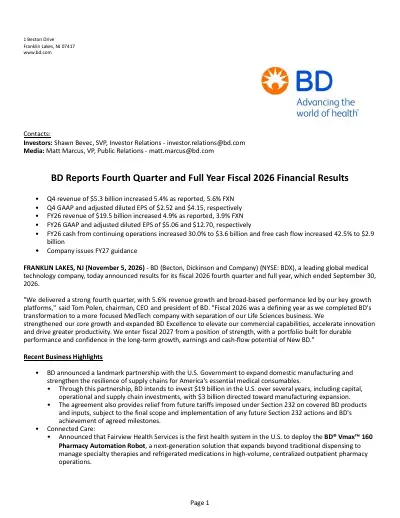
Thank you, Shawn, and good morning, everyone. Earlier today, we reported strong Q4 results, with revenue of $5.3 billion, up 5.6%, and 27.3% growth in adjusted EPS to $4.15.
For the full year, we delivered $19.5 billion in revenue, up 3.9%, and 6.7% growth in adjusted EPS to $12.70. Growth remained broad-based, with momentum across all our businesses.
Excluding the Alaris prior-year comparison, we delivered high single-digit revenue growth in Q4 and solid mid-single-digit growth for the full year. Growth was led by the key platforms where we've been investing, including Advanced Patient Monitoring, PureWick, Advanced Tissue Regeneration, biologic drug delivery, and ROWA pharmacy automation, all of which delivered double-digit growth with accretive margins in both Q4 and the full year.
Importantly, fiscal '26 marks a significant milestone, completing BD's transformation to a more focused medtech company with the separation of our Life Sciences business. New BD is doing exactly what we designed it to do: demonstrating the growth and earnings potential of our focused portfolio through commercial and innovation momentum across our key growth platforms, delivering strong operational execution, and the expanding impact of BD Excellence.
Before we get into more details on the quarter, I want to highlight our recent landmark partnership with the U.S. government, which reflects BD's important role in the U.S.
healthcare infrastructure and a shared commitment to expand domestic manufacturing capacity and strengthen access to essential medical technologies. Through this agreement, we committed to invest $19 billion in the U.S.
over several years, with $3 billion of the overall investment directed toward manufacturing expansion. Importantly, this does not represent incremental investment for BD, rather a reprioritization of investments toward the U.S.
to support domestic manufacturing and supply chain resiliency. The partnership also provides relief from future tariffs imposed under Section 232 on covered BD products and inputs, subject to the final scope and implementation of any future Section 232 actions and BD's achievement of agreed milestones.
We've already mobilized the organization and begun taking action to deliver on these commitments. Turning to our New BD strategy, we're seeing clear progress against our three strategic pillars: compete, innovate, and deliver.
Our growing commercial, innovation, and operational capabilities are strengthening the quality of our growth while improving earnings power and cash flow. Starting with compete, we've been raising the bar on commercial execution across BD, investing in every part of the commercial flywheel.
That spans talent, AI sales tools, a disciplined sales process, and new pay-for-performance compensation plans, all powered by BD Excellence and a relentless focus on solving customer challenges with speed and urgency. In Q4, this translated into measurable outcomes across the company.
Within Connected Care, commercial execution continued to drive share gains and new adoption across all platforms. In Advanced Patient Monitoring, sales force investments are driving uptake of HemoSphere Alta that contributed to strong capital growth in Q4.
APM continues to perform well ahead of the deal model, generating one of its highest annual growth rates in the last 20 years, while significantly expanding margins under BD's ownership by applying BD Excellence in APM manufacturing. Alaris finished the year with strong competitive momentum, gaining additional share in Q4 and more than 250 basis points for the full year.
Dispensing also continued to gain share, with strong Pyxis Pro order momentum and a 95% attachment rate of our new Ancora AI platform. This strong early adoption reflects high customer interest in our new BD AI platform and supports our strategy to build recurring software, analytics, and AI revenue.
In Pharmacy Automation, incremental investments we made coming into the year are delivering results. We're seeing increased central fill win rates and an improving growth outlook, aided by the recent U.S.
launch of BD VMAX. We exited the year with strong commercial momentum, winning all six central fill opportunities we competed for in Q4, with VMAX attached to every sale, reinforcing the strength of our portfolio in the growing U.S.
healthcare systems central fill market. In BioPharma Systems, we expanded our position in next-generation biologic drug delivery, including continued momentum in delivering GLP-1 therapies.
In Interventional, incremental commercial investments are translating to stronger growth, with PI accelerating each quarter throughout the year. In UCC, PureWick delivered another quarter of double-digit growth, driven by continued adoption, competitive wins, and momentum in the VA channel.
Across the portfolio, we're seeing our commercial investments translate into stronger growth and competitive performance. We've added resources in priority areas, introduced new tools, applied BD Excellence to commercial execution, and better aligned incentives with our growth priorities.
These actions are raising execution across New BD. Our second priority is innovate.
We're concentrating investments in attractive markets where healthcare needs BD most and where we believe BD can create sustainable competitive advantage. This is in Connected Care, enabling the shift to newer, low-cost settings, and advancing the treatment of chronic disease.
Earlier this year, we moved more R&D resources and decision-making closer to the businesses. We increased investments behind our six key growth platforms, and our pipeline is expanding.
We also deployed BD Excellence into R&D this year and are introducing new products faster, having compressed launch times by an average of 10 months. In Q4, we received FDA approval for Liverty TIPS stent graft, and we're seeing strong customer interest.
In a market that's seen limited innovation for many years, Liverty brings enhanced ease of use, the broadest range of lengths, and compelling clinical data, broadening BD's presence in the approximately $2 billion global venous market, which is growing high single digits. We recently received 510(k) clearance for Phasix ST Parastomal, a first-of-its-kind resorbable mesh designed specifically for parastomal hernia repairs.
It's an underserved market with significant unmet clinical needs. With the launch expected in the first half of fiscal '27, this innovation further expands our Advanced Tissue Regeneration portfolio and strengthens our position in the $1.8 billion served market.
We're increasingly seeing the benefits of the strategic choices and investments we've made over the last several years. Combined with our strengthened innovation capabilities and execution, we're building a robust pipeline and look forward to sharing more at our upcoming Investor Day next month.
Our third priority, deliver, is about operational excellence at scale. It's about improving quality, service, productivity, margin, and cash flow.
Through BD Excellence, we've built one of the most resilient supply chains in our industry, which, combined with our scale, has become a meaningful competitive advantage. In fiscal '26, we delivered approximately 8% gross productivity in our plants, with customer service levels above 90%.
This was driven by more than 2,000 kaizen events, resulting in higher manufacturing efficiencies and raw material savings, as well as ongoing network optimization. We're also generating value from the $200 million cost-out program launched at the beginning of fiscal '26, with 100% of the savings now identified.
Turning to capital allocation, our disciplined framework remains unchanged. Importantly, we're seeing our operational progress translate into stronger cash generation.
As free cash flow improves, does our capacity to invest organically, return capital to shareholders, and pursue focused tuck-in M&A. This will continue to increase as we drive towards our 90% free cash flow conversion target over time.
In summary, fiscal '26 was an important year for BD. We completed our portfolio transformation to a pure-play medtech company.
We strengthened execution and increasingly saw the benefits of the strategic choices and investments we've made over the last several years. Our differentiated growth platforms are strengthening our portfolio and expanding our opportunities for growth.
We enter fiscal '27 with a more focused portfolio, and we have confidence in the underlying trajectory of New BD and our path towards sustainable mid-single-digit growth. Looking ahead, we see a compelling opportunity to combine that growth with continued earnings expansion and a step change in cash flow generation to drive long-term value creation.
We are still early in realizing the full potential of New BD, and we look forward to laying out that opportunity in greater detail at our Investor Day on December 10th. With that, I'll turn it over to Vitor to provide more detail on our financial performance and guidance.
Vitor Roque
Thanks, Tom, and good morning, everyone. We delivered a strong quarter, with $5.3 billion in revenue, up 5.6%.
Excluding the Alaris prior-year comparison, revenue growth was high single digits. As Tom highlighted, performance was broad-based, driven by continued double-digit growth across multiple key platforms and strong U.S.
performance. Medical Essentials grew 5.9%.
In MDS, solid mid-single-digit growth was driven by share gains and health utilization across the vascular access management portfolio. In Specimen Management, high single-digit growth was driven by share gains across the BD Vacutainer portfolio, new supply capacity, and incremental demand as customers continue to work through competitor disruptions.
Connected Care grew 2.1%, led by double-digit growth in Advanced Patient Monitoring, with strength in both capital and consumables. MMS declined low single digits due to difficult prior-year comparison in Alaris capital.
Excluding the Alaris comparison, MMS delivered mid-single-digit growth, driven by strong infusion sets performance from Alaris share gain pull-through and strength in ROWA pharmacy automation. BioPharma Systems grew 7%, driven by continued double-digit growth in biologics, led by GLP-1s and moderating vaccine headwind.
Interventional grew 7.6%, with high single-digit growth in Peripheral Intervention and UCC, and solid mid-single-digit growth in Surgery. In PI, growth was led by peripheral vascular disease and oncology, reflecting strong commercial execution in new product launches.
UCC was led by continued double-digit growth in PureWick, while Surgery benefited from double-digit growth in Advanced Tissue Regeneration. Turning to the P&L, adjusted gross margin was 56.8%, and adjusted operating margin was 28.6%, up 180 and 280 basis points, respectively, versus the prior year.
Margins benefited from productivity gains through BD Excellence and favorable mix, while we continue to invest in selling and R&D to support our long-term growth strategy. Adjusted EPS was $4.15, up 27.3% and ahead of our expectations, reflecting our strong revenue performance and disciplined execution.
For the full year, adjusted gross margin was 55.1%, and adjusted operating margin was 25%, down 10 and 20 basis points, respectively, versus the prior year. This was driven by a 90 basis points impact of tariffs, mostly offset by our work through BD Excellence and favorable mix.
Adjusted EPS was $12.70, up 6.7%. Turning to cash flow and capital allocation, we are encouraged by the progress we made in fiscal '26 and the momentum heading into '27.
Improving free cash flow conversion is expanding our financial flexibility, enabling us to invest in growth, return capital to shareholders, and pursue focused tuck-in M&A. Full-year free cash flow was $2.9 billion, an increase of 42% versus the prior year.
This reflects lower working capital and non-operating cash items such as Alaris remediation outlays. Including separation costs, free cash flow conversion increased from approximately 57% to 74% in fiscal '26, and we expect another meaningful step-up this year.
In fiscal '26, we returned $3.6 billion to shareholders. This included approximately $2.4 billion in share repurchases, with $183 million repurchased in Q4 using proceeds from recent tariff refunds.
We also paid $1.2 billion in dividends, and earlier this morning announced our 55th consecutive year of dividend increases. Finally, we paid down $2.4 billion in debt and ended the year with 2.7 times net leverage.
Moving to our fiscal '27 guidance. Starting with revenue, we expect low single-digit growth for the full year.
Based on current spot rates, currency is estimated to be a headwind of about 70 basis points. As previously discussed, this reflects an approximate 200 basis points impact from the Alaris capital comparison.
Excluding this impact, we expect mid-single-digit growth at the midpoint of our guidance. Moving down the P&L, we expect adjusted operating margins to be roughly flat year-over-year.
Our adjusted tax rate is expected to be between 16% and 17%. Weighted average shares outstanding for the full year are expected to be approximately 273 million.
Adjusted EPS is expected to be in a range of $13.10 to $13.30. As you think about fiscal '27 phasing, we expect Q1 revenue growth to be at the low end of the range, with the first half expected to be in line with the midpoint of our full-year guidance.
As for earnings, given our Q1 revenue seasonality, annualization of last year's commercial investments, and inflationary impacts, we expect Q1 adjusted EPS to be between $2.32 and $2.37. We expect earnings growth to accelerate in Q2 and the second half of the year.
With that, I'll turn it back to Tom.
Tom Polen
Thanks, Vitor. Before we open the call for questions, I want to take a moment to recognize our associates around the world.
Completing the Life Sciences separation while simultaneously executing against our New BD strategy required tremendous focus and commitment across the organization. Our strong finish to fiscal '26 reflects their work, and I want to thank each of our associates for everything you've done.
We enter fiscal '27 with a more focused portfolio, clear priorities, and confidence in the long-term growth, earnings, and cash flow potential of the New BD. With that, let's begin the Q&A.
Operator, please open the line for questions.
Operator
At this time, if you have a question, please press star one. If at any point your question is answered, you may remove yourself from the queue by pressing star two.
In order to allow for broad participation, please limit yourself to only one question. Lastly, to provide optimal sound quality, please pick up your handset while you ask your question.
Thank you. Our first question is from Patrick Wood with UBS.
Please go ahead.
Patrick Wood
Amazing. Thanks so much for taking the question, guys.
If I take a step back and look at it, it looks like a decent chunk of the growth that you guys have is coming from investments, stuff like the sales force in PI, things like that, helping you to take share. I guess, I'm sure you'll chat about it more at the Investor Day, but big picture, how are you thinking about the rate of investment to help drive that top line relative to margins?
Is it just that you've got a flywheel going on BD Excellence that enables that recycling, just how are you thinking about the interplay between the investment for the top line and then the margin structure big picture? Thanks.
Tom Polen
Good morning, Patrick, and thanks for the question. I'll start off, and then can turn it over to Vitor.
We are, as you said, really pleased with the momentum that we're seeing, particularly in the growth drivers that we've been investing behind. You could see, ex-Alaris, about 7% growth in the quarter, led across essentially all of our growth platforms performed very strong.
Where we've been investing, we invested in the APM sales team, you saw a near 20-year high in the quarter. Certainly, those investments help fuel that.
Same thing in PI, same thing in UCC. Obviously, capacity investments that we had made in the past in our biologic capacity in Pharm Systems, you're seeing play out with a strong quarter there at 7% growth, driven by our biologic business and some stabilization of the vaccine space.
We're going to continue focused investments there. We obviously absorbed tariffs this year, which was meaningful.
We expanded margins outside of that. We're going to continue to take a prudent approach to making targeted investments behind our growth levers.
We've reallocated R&D as well behind those growth levers. We've been doing that over the last several years.
You're seeing those pay off. We're going to look forward to sharing more on our pipeline and the momentum in that at Analyst Day on December 10th.
We expect that we will continue to drive operating margin expansion as we go forward as well. Obviously, again, you've got a tariff dynamic this year and then the Alaris grow-over.
As that normalizes, right, we're going to continue to see the mix benefits of the growth drivers that we're investing behind because they all come with accretive gross margins to the company. The larger that those growth platforms become a percentage of our revenue, actually, it has a flywheel effect on our gross margin.
Obviously, BD Excellence has a flywheel effect on our gross margin, and then that flows through the P&L as we continue to be very prudent. You saw the cost actions that we took on G&A.
We continued to do additional work there as we're streamlining and simplifying and focusing the company very aggressively as part of New BD, and then making targeted investments in selling as well. Vitor, other [comments?]
?
Vitor Roque
No, I will just complement. I think we are very happy with the investments we have made during FY '26.
I think that clearly generating results from a top-line perspective, but also on the bottom-line perspective, given Tom was explaining, we were able to cover topics like tariffs and other types of pressures we had to navigate. When we see our Advanced Patient Monitoring business is growing double-digit in FY '26, our PI sales force expansion continue to result very strong growth, those are all going to be accretive for us as we move forward, not only in '27, but beyond '27 as well.
'27, as we expected, and is part of our plan, we expecting to have an inflationary environment into our numbers, but our continued mix and efforts on BD Excellence will result the benefits of offsetting those and continue to expand our operating margins down the road.
Patrick Wood
Love it. Thanks, guys.
Tom Polen
Thanks, Patrick.
Operator
Thank you. We'll move next to Travis Steed with Bank of America.
Please go ahead.
Travis Steed
Hey, congrats on a good quarter. Good morning.
Maybe I'll ask on the guidance. Q1 obviously a focus this morning.
I heard you say it was below the full-year guide. I don't know if there's any more kind of qualification on the top line on Q1, but also just trying to understand, I think, your guidance philosophy, Vitor, you've been executing really well since you've been CFO.
How much of this is conservatism, and then the Q1 being below, how much of this is just functional stuff from Alaris and other stuff that's kind of very explainable?
Vitor Roque
Sure. Thanks, Travis.
I'm completing now my first full year as a CFO. I'm very happy with the results we have delivered to the organization and to the shareholders.
The philosophy continues to be the same. I want to make sure that we have a guidance that is responsible and prudent, and we can deliver during the year with upsides to our shareholders.
If we think about Q1 specifically, there are a few dynamics there that are important to explain. First, we have very good momentum coming out of Q4, and that momentum is continuing as we head into Q1.
If we see segments like BioPharma or Interventional or even Medical Essentials, we continue to see good momentum there. What we have in Q1 is a dynamic with the Alaris, as you mentioned.
We mentioned that Alaris is about 200 basis points of pressure for the year. In Q1, Alaris is more acute than the rest of the year, is about 250 basis points just in Q1.
That puts a little bit of a pressure on the Connected Care number. We also have a dynamic happening because on our APM business, well, first, we have very great momentum in APM, we continue to be solid, and we are coming to the conclusion of our integration, and now we are going live with the systems inside APM.
We took a prudent approach to make sure that we reflect that scale of the new system during Q1, so that's another impact we have in Q1 that is putting our growth rate at about the low end of the range. In general, the momentum is very positive, the orders are coming in, and the APM actually we are tracking this on a daily basis now.
We have very good momentum, we are seeing orders coming and actually shipments happening. We just took a conservative approach from an APM perspective.
Other than the MMS situation and the APM, we feel very good about the numbers, the underlying of the other segments we have in the Q1 as well.
Tom Polen
Travis, I think you nailed it. Clearly, as Vitor shared, right, it's really those two factors.
We see strong momentum continuing across the company, a little bit higher grow-over in Alaris, and then the APM. I think kudos to Vitor, again, we're really pleased.
We've had a lot of focus. Vítor's brought around our forecasting process, and we want to make sure that we continue that and set it up right in going into '27.
I think, with APM, it's a big cutover from the Edwards system going live for us. Many times, companies don't kind of plan that in their numbers.
We assumed, hey, we want to make sure if everything doesn't go perfectly smooth, we're going to assume that some room in that. Orders are still coming in, there's no demand difference at all, it's just we may end up shipping a bit more in Q2 than in Q1 with that.
Now, with that said, we actually went live this week, and things are going as planned. Right, there could be actually, as we'll continue to play that out, and if it goes even better than we expected, we could see a little bit more rebalancing between Q1 and Q2 on the positive of Q1.
Again, we want to take a prudent approach to do that the right way, starting FY '27. Those are the two dynamics.
Great.
Travis Steed
Thanks a lot.
Tom Polen
Yep.
Operator
Thank you. We will move next to Vijay Kumar with Evercore ISI.
Please go ahead.
Vijay Kumar
Hi, Tom. Good morning, and thank you for taking my question.
Congrats on a nice print here. Tom, I just want to go back on this performance here in Q4, 5.5-ish, close to 6.
Any one-timers or timing, because this came in well above. I just look at the back half of '26 performance, you guys have done five organic, inclusive of headwinds, right?
With that kind of execution, why is 2% or 2.5% the right number for fiscal '27? Thank you.
Vitor Roque
Yeah. Hi, Vijay, it's Vitor.
We are very pleased with the entire year performance in '26, with the acceleration of 5% on the back half of the year. From going into '27, as we mentioned, we want to make sure that we take a prudent approach for our guidance.
Of course, Tom mentioned, I'm spending a lot of time with the teams in terms of forecasting, making sure we have the right processes in place and accuracy on our numbers. Alaris pressure increases, as I mentioned, 200 basis points, with a more acute impact on the first half of the year.
It's a matter of we making sure that we have a number that is a responsible guidance that we can deliver and even exceed during the year. That's what we are looking for heading into FY '27.
Tom Polen
Thanks for the question, Vijay. We are very pleased with how our executions playing out.
Again, as part of our BD Excellence strategy, we've really doubled down on commercial excellence in FY '26, right? Whether or not it's our comp plans, our hiring approaches, our training approaches, our digital systems, we are seeing benefits of that coming through, complemented by physical expansion of more people selling behind our key growth platforms.
You can see that momentum as it built through the back half of the year, so.
Vijay Kumar
Thanks, Tom.
Operator
Thank you. We will move next to Robbie Marcus with J.P.
Morgan. Please go ahead.
Robbie Marcus
Congrats on a good quarter, and thanks for taking the question. Maybe a more macro-related one.
Tom, you're very plugged in through AdvaMed into D.C. The sector was up a lot yesterday on the blue wave.
Maybe speak to any of the immediate or intermediate-term changes that you could foresee with Congress held by the Democrats. Then also, maybe on the other side of the world, in Europe and China, just speak to any trends you're seeing from healthcare policy.
We've heard a number of your competitors talk about negative pricing in China. It'd be great just to get a global overview.
Thanks.
Tom Polen
Thanks for the question, Robbie. Just from a a U.S.
perspective, maybe I can start with just some utilization comments and and then can mention on the the political side, and and then we can go around to the rest of the world. Just from a a utilization perspective, obviously we've got a very unique view there as as as you know very well, as our products are used across essentially all types of procedures and all care settings.
Particularly indicators like our our blood collection tubes, syringes, catheters, kind of core products that have broad use, they're fantastic utilization indicators. We in in that regards, we continue to see strong utilization in the U.S.
U.S. MDS, 4%, that's a solid number, and and SM was 9% growth.
A bit of that was because we've we've had new capacity come online and and some competitive share gain, but underlying that was still very solid, and we continue to see more tubes collected per patient, which is an indicator that we're seeing more testing going on, which is a good sign of of healthcare utilization. Capital, we continue to see it constructive, I'd say, but selective, and they're prioritizing high-ROI investments.
We're seeing that come through in really robust growth in our Pharmacy Automation business. We're seeing it come through with Pyxis Pro doing very well, and you heard us comment that we have a a 100% attachment rate of our new AI platform, which is an upcharge from Pyxis Pro.
Everyone's choosing it, though. That AI platform is bringing new capabilities that help customers reduce their inventory levels, improve their cash flows, improve service levels for patients for drug availability.
I think that's a that's also a new revenue stream from a SaaS model that we're going to continue to be focused on building. I think it's an indicator that, again, the solutions that we have fit well with the needs of hospitals today, and we're seeing strong, continued capital placements.
APM had a had a great capital quarter and and actually, significant acceleration, and we don't see a slow down in in that. As we think about the governments, obviously, we've been around for 125-plus years.
We work with any any party, whoever is in office. We're focused on helping patients and helping advance healthcare.
I think, clearly, there's been a perception that Democrats appreciate investing and the value of healthcare more broadly. I'm assuming that's what happened yesterday, but we're focused on continuing to do our work around optimizing access for our solutions and technologies.
Obviously, we're focused on executing our tariff agreement with the the government, which doesn't change, and and making that come come through. Obviously, that opportunity is not in our guide for FY '27, and if 232s are are implemented, would be, an upside option that exists within our our current guide.
As we think about, around the world and in China, China's pretty stable for us. I know there's organizations that have talked about it in their earnings, and maybe it's new for them.
Fortunately, unfortunately, it's not new for us. It's something we've been managing for a number of years.
On a positive side, China now is a a much smaller portion of BD. We really don't see it as a a separate headwind this year.
It's just part of our base business dynamic. It's kind of continuation of last year.
It's not an incremental item. We continue to we're just executing that, focusing on our commercial excellence and and and driving that, but we don't see that as anything incremental to to us.
Then in in Europe, we saw strong performance in Europe. Again, we're seeing strong partnerships with governments, particularly around medication management.
We've had some great performance, there as pharmacy automation in in Europe, you heard us call out ROWA. It did exceptionally well, double digits for both the quarter and the year.
Again, that's a a labor improvement, a cost improvement. We see Europe actively consolidating pharmacies, both in the hospital and healthcare systems, to these megacenters, which are all requiring our pharmacy robots to get put in place.
We're also seeing solid underlying demand on the consumable stream, and you you can see that across their different businesses. So, we expect that to continue.
I think our team feels good as we're going into '27 in in Europe as well, and we're not seeing a specific change against the solutions that we offer. Thank you for the question.
Robbie Marcus
Thanks, Tom.
Operator
Thank you. We will move next to Matt Taylor with Jefferies.
Please go ahead.
Matt Taylor
Hi, good morning. Thanks for taking the question.
I wanted to follow up on your partnership with the government. You noted the shift in spending and potential relief from 232s.
I know we don't know what the 232s are going to look like, but wondered if you had any insight into that, and if they do come to pass, how does the relief work, and what's contemplated in your forward guidance in regards to the agreement and the tariff treatments specifically?
Tom Polen
Sure. Thanks for the question, Matt.
A couple things. One is just to reiterate, when we did receive refunds this year, they were excluded from our adjusted results, right?
There is no grow-over for us from a tariff refund. That's a positive, right?
Any benefit on tariffs would flow through as a positive in our earnings. Our initial guide assumes tariffs generally in line with FY '26.
We have no benefit of that deal in our current guide. The rationale for that obviously is just because the 232s tariffs, the product scope, and the effective timing hasn't been finalized.
We didn't think it's appropriate to include that in our outlook at this time. Obviously, the government has made commentary that they would expect that to be in place by the end of the calendar year.
We're staying in touch on that, but we'll be watching that just like you. If and when that is communicated, we'll look to provide an update to our guide at that time.
Obviously, the Section 232 tariffs are intended to cover medtech overall, and which would include many of the products that we have and that we currently pay tariffs on. As we've shared, our agreement would be that any products that are in those 232s that we would not pay any tariffs on.
That would be an upside to what our current assumptions are, if and when that occurs. As you also said, it's not incremental spending for us.
We're reallocating investments that would typically make globally, and we've concentrated those in not only in the U.S., but often in areas where we already have focus, in Nebraska, in our Columbus plants; in Texas, in our El Paso plant; in South Carolina, in our Sumter plant, etc. We're going to continue to execute on those.
There's also benefits even just from a global supply chain, as as much of that is going to be servicing the U.S. That actually brings up our ratio of the products that we make in the U.S.
and sell in the U.S. within our MedEssentials portfolio, where those essential medical devices, to about 80%, right?
That's a positive as well, too, as you think about shipping, etc. We'll keep everyone updated.
Obviously, as soon as anything's announced on the 232s, we'll share implications of that for BD. I would view it as a positive option that's kind of built into our outlook right now.
Great.
Matt Taylor
Thanks so much, Tom.
Operator
Thank you. We will move next to Larry Biegelsen with Wells Fargo.
Please go ahead.
Larry Biegelsen
Good morning. Thanks for taking the question.
Congrats on a nice quarter here. Tom, you have an Analyst Day coming up in December, the first one in a while.
I'd love to get a quick preview and to help set expectations. I think the expectation is for return to mid-single-digit growth once the Alaris headwind goes away in fiscal '28.
Is that fair, and do you think you can get leverage on the P&L after fiscal '27? Thank you.
Tom Polen
Thanks, Larry, for the question. I think to your point, and sometimes we joke that some of what we share financially may not be overly exciting because it's in line with just what you said, right?
We will be communicating and expect we'll be back at mid-single-digit growth, just like we were in FY '26, ex-Alaris headwind, we were about 5% growth. Our current guide at the midpoint is mid-single-digit growth starting the year, ex-Alaris headwind.
The Alaris headwind goes away as we go into next year, and right, with that, we would expect just the straightforward all-in number will be ex-Alaris headwind, and it'll be mid-single digits. We do expect, obviously, there's about 500 basis points of EPS pressure from the Alaris headwind this year.
That also goes away as we go into next year. We will absolutely have margin expansion as part of what we'll share at earnings.
That's in line with what we've been communicating: mid-single digits with solid continued margin expansion, increasing cash flow, and a very disciplined approach to value creation with that cash flow. We're excited for the upcoming event.
It's an important moment for us to provide clarity on the next phase of growth for BD. We're going to provide a strategic update on overall our portfolio.
We'll go deeper and highlight those key growth areas of the business that we've been investing behind. We'll reveal some new innovations in that space that we haven't shared to date that we're excited by.
We'll give an update on BD Excellence and how we're applying it not just in operations, and how it's going to drive continued growth and operating margin expansion over the mid and long term, but also how it's benefiting us in R&D and how it's going to be benefiting us increasingly in commercial. You started seeing that happen this year.
We'll double-click into our capital allocation framework, which is in line with what we've already communicated. We're going to give long-term financial targets that govern that strategy.
We've got a product showcase as well planned that folks will be able to walk through and touch and feel and discuss our innovations firsthand. I'm confident that the event's going to only add conviction to our investment thesis.
We look forward to seeing you and everyone else there.
Larry Biegelsen
Thank you.
Operator
Thank you. We will move next to Josh Jennings with TD Cowen.
Please go ahead.
Josh Jennings
Hi, good morning, Tom and Vitor. Thanks for taking the questions, and echo the congratulations on a strong quarter.
Wanted to just touch on biologics and one of the largest potential long-term growth opportunities in healthcare. BD's very well-positioned to capitalize.
How should investors think about the durability of growth for your biologic franchise in GLP-1s and beyond GLP-1s? Thanks for taking the question.
Tom Polen
Thanks, Josh. You saw strong performance in biologics throughout FY '26, and we expect continued strong performance through '27 and beyond.
I think we're really pleased with portfolio of GLP-1s that we have, both partners that we work with today who continue to do very well, but also the portfolio that we've built of the new novel molecules coming to market, which we have a very high share in from a win rate perspective, and also the biosimilars. We are starting to see benefits, and we'll see a bit more of benefits of biosimilars in FY '27 than we saw in '26.
I think the first one of meaningful size is in Brazil. We put out a press release on that.
What happens, we're going to see just what we've said, as products go to biosimilars, we not only can capture the syringe itself inside, but we also have the opportunity to capture the autoinjector, which is several times higher ASP. For example, our Brazil partnership is for the pen, which, again, is several times higher per-unit value that we capture than if we were just selling a syringe.
We've got more of those coming. Again, we've signed now nearly 100 deals in that space, and we'll expect those to continue to roll out over the years ahead.
We do see some of that starting in FY '27, and that'll be a positive. Outside of GLP-1s, we continue to have strong success.
We have a very high win rate in biologics overall, one of the highest win rates of any product line in the company, in fact. Our solutions are very unique there, whether or not it's our XSI cross-linked coatings that we use for biologics, our unique needle technology for biologics, our Neopak product line, which is best-in-class there, and we see people standardizing on it for biologics.
Obviously, we've got capacity that we invested in. We made a pretty bold decision a couple years ago to put $1.2 billion in capacity, that was right during the middle of the pandemic.
We got questions then when we did it, but we're seeing it pay off because we've got state-of-the-art lines now that are producing really high-quality product, which is really important for these high-value biologics, and it's helping fuel that win rate. Again, we saw good performance in the quarter, we expect that to continue as we go into Q1.
As Vitor mentioned, we expect Pharm Systems to continue to have that very strong performance. I think maybe just one other thing I'd say on Pharm Systems, and it wasn't in the question, but we do expect vaccines to not be a topic that we're talking about in '27.
It moderated in the quarter. It still had a decline, vaccines declined about 11% in Q4, basically more than cut in half what we had seen prior in the year.
We expect that to basically totally dissipate in FY '27 and not be a headwind to the Pharm Systems business. We see that as a positive.
Really, the only thing for '27 is Alaris grow-over, and we're going to continue to gain share in Alaris, we continue to do extremely well there, it's not a performance topic, and we'll see that totally disappear as we go into '28.
Shawn Bevec
Thanks for the question, Josh.
Operator
Thank you. We will move next to Joanne Wuensch with Citibank.
Please go ahead.
Joanne Wuensch
Good morning. Thank you for taking the question, and nice quarter.
Two quick questions. Your guidance for fiscal year '27 is for operating margin to be flat year-over-year, and I appreciate the commentary that that should resume expansion in the following year.
Can you tease out a little bit between gross margins and operating expenses so we can really maybe think about the components of that? Then my second question has to do with AI.
Those initials are being sprinkled in here and there as I'm talking to more and more medical technology companies, and hoping you can sort of give your view on how that can help your business and your patients. Thank you.
Vitor Roque
Sure. I'll start with the margin, Joanne.
We are very pleased with the efforts we did in '26, and those efforts are going to continue in '27. Our margin, gross margin and operating margin, as we mentioned, is going to be roughly flat, and it's going to be similar between gross profit and operating margin, there's not going to be a big difference there.
We continue to make some strategic investments on our commercial and R&D organizations to continue to kind of feed the flywheel of positive growth on the platforms we have. We are not hindering any investments that are going to drive that future growth.
We expect GP to be roughly at the same level as operating margin, roughly flat. As we mentioned before, we expect '27 to be an inflationary environment, and that's according to what we have said, nothing has changed from our assumption there.
That was part of our guidance and plan all along. Our initiatives around BD Excellence with supply chain, but also our capacity of increasing prices, are going to be used in order to kind of mitigate those headwinds we have from an inflation perspective.
In operating margin, we continue to do the investments. I think it's important to remember the Alaris impact on our margins.
It's, as Tom said, it's about 500 basis points on EPS, but also in margin, we are talking about a 60 basis points of pressure from Alaris on our operating margin, excluding that, we will be actually expanding the margins in FY 20 '27 as well. We feel very good about the buckets of where we are heading into FY '27 from a margin perspective.
We feel that we have all the plans in place, and we are going to continue to execute them during '27.
Tom Polen
Thanks for the question also on AI, Joanne. I can address that.
We do see significant opportunities from AI, and we've spent a lot of time focusing specifically where we want to apply that to maximize return and value creation. On the R&D and innovation, we'll share more at Investor Day, but obviously the launch of our Ancora AI platform for all of our products in BD is a major milestone in that.
Again, we're seeing 100% attachment rate now on all new Pyxis placements, which is going to be embedding that across healthcare systems quite rapidly. All BD products, right, will end up feeding their data into Ancora, and we have plans to continue to not only have that be a solution for our customers to reduce costs, but also improve clinical outcomes.
We'll share more about our road map and the types of indications that will be going after there, but imagine some of that will be in line with what we've talked about in the past, including taking data from sensors on patients that we have now access to from APM, with all of the drug delivery information that we have from our platforms, and looking to improve patient outcomes there, while also improving costs from drug inventory, drug waste, and availability to improve nursing workflow. Beyond what we're doing in AI in products, and APM, that's actually a big part of their growth are all the APM AI algorithms that they've been deploying, they're helping improve patient care, but we're also applying AI within the company to make us more efficient and to deliver better outcomes.
We've focused on a few specific areas there rather than just peanut butter spreading it. One of the number one areas is in manufacturing.
We've communicated that we've recently begun deploying a new AI platform across the company. We've shared our product name for it.
The Kognit platform, though, is the AI platform that we're deploying across manufacturing. That really is an end-to-end platform that is going to help us automate and improve everything from the demand planning to the production planning to the inventory levels to supply levels to our customers.
We've begun deploying that across our manufacturing plants, and we see that, in partnership with BD Excellence, as helping to catalyze the next phase of opportunity for us from a cost efficiency perspective and a cash flow perspective. It's also allowing us to get rid of a lot of other platforms at the same time as we consolidate that from an IT tech stack perspective.
The second major area that we're focused on is our tech stack within our sales organization, and we've started using AI in everything from our hiring and screening practices. We've got this really interesting new tool that we're using and standardizing on that uses AI to understand the behaviors of sales reps that we're hiring, and making sure that they match the characteristics that we've done research on that match with the highest-performing reps, and making sure that we're systematically bringing those on with no bias.
We're using AI for sales planning so that they can practice and prep before they go visit with customers, as well as helping them analyze the sales performance data and identifying information to tee up to our sales team where there's opportunities or anything that they need to address, we can be faster-paced and more on top of the information. We're really excited about what we can do there on the commercial side.
We're doing some things on the R&D side, where we've set some goals using AI where we can remove inefficiencies, particularly on our sustaining engineering work that we do, which there's a lot obviously across the breadth of our portfolio, and simplifying that with AI. We have plans on being able to reallocate more of sustaining engineering spend into new innovation spend, and AI is a piece of that.
Then, obviously, over time, there's opportunities on just G&A efficiencies. As part of that, I'd also just call out that we've spent a lot of time making sure that we have the capabilities to advance the New BD in a way that fully leverages the opportunities of the technology that's becoming available today, and for us to be at the forefront of that within medtech.
This past year, we reallocated actually all of our central R&D resources that were doing anything digital, we moved into the Connected Care business, and we actually created an AI COE in Irvine, California, that's under Bilal, and that's off to a great start. We also brought in a new CIO, Art Hu, who joined us from Lenovo, where he's got a ton of experience in this, obviously coming from the tech industry, which I think is certainly more advanced than we see medtech overall.
We're really pleased to have Art with us, sharing his experience and his bar of excellence and opportunity that he sees in leveraging AI to improve business performance and competitive advantage. We'll look forward to continuing to provide more updates on that, but we certainly see opportunity there, and we'll share more at Analyst Day.
Thanks, Joanne.
Joanne Wuensch
Thank you.
Operator
Thank you. We will move next to Michael Polark with Wolfe Research.
Please go ahead.
Michael Polark
Hi, good morning. Thank you for taking the question.
Tom, I appreciate all the color already on BioPharma Systems. I'm going to ask one follow-up.
One of your large competitors earlier this week in glass packaging cautioned on GLP-1 revenue in 2027, personally suggesting it will be down. Personally, I was stunned.
Injectable category is growing a lot, even with rise of orals and format shifts. You sound more optimistic here on GLP-1s for that business.
Can you help further square this? Are you taking share?
Is it something about customer mix or product mix? I'd welcome any further color about kind of your enthusiasm still and the message from one of your competitors.
Thank you.
Tom Polen
Thanks for the question, Michael. We don't, obviously, comment on specific competitors, but what I can say is, again, we're really pleased with our very high win rate in the category.
It is exceptionally high for new molecules coming to market, it's very high for biosimilars, and customer mix is very important here, right? Obviously, there's companies in GLP-1 that are winning differentially than others, and the mix that you have is really important there.
Just leave it at that. We continue to see solid growth in GLP-1s looking forward.
Michael Polark
Thank you.
Operator
Thank you. We will move next to Chris Pasquale with Barclays.
Please go ahead.
Chris Pasquale
Thanks. Congrats on the quarter.
Wanted to ask about capital allocation priorities in FY '27. You got some more debt coming due this year.
This morning, you also announced the incremental share repurchase authorization, and it looks like maybe there's a little bit of buyback assumed in the guidance. Can you walk through what's in the outlook in terms of use of cash, and how you're going to prioritize debt paydown versus buybacks versus maybe getting a little bit more aggressive on the M&A front this year?
Thanks.
Vitor Roque
Thanks, Chris. We continue to be very focused on our capital allocation strategy.
Earlier in '26, we mentioned that one of the top priorities of our capital allocation is share buybacks, and that has not changed. We will continue to execute that.
In '26, as we mentioned on the prepared remarks, we returned more than $2 billion to shareholders via share buybacks and dividends. We plan to continue to dedicate an important part of our cash flow into share buybacks and return to the shareholders.
Of course, debt paydown, it's also achieving the net leverage that we have been committing to is important. It's going to be a mix between debt paydown and increase on our income.
Also, we are leaving power for us to do focused tuck-in M&A, which is a very important topic for us. We're going to continue to build our portfolio in order to be that sustainable mid-single-digit growth company.
The priorities on capital allocation have not changed since we started this year in '26. We continue to focus on share buybacks and focus on tuck-in M&A going forward as well.
Thanks for the question.
Operator
Thank you. That will conclude today's question-and-answer session.
At this time, I'd like to turn the floor back over to Tom Polen for any additional or closing remarks.
Tom Polen
Thank you, operator, and thanks, everyone, for your questions and your continued interest and support in BD. We look forward to seeing you all in December 10th at our Investor Day in New York City, and hope you have a great rest of the day.
Thank you.
Operator
Thank you. This does conclude this audio webcast.
On behalf of BD, thank you for joining today. Please disconnect your lines at this time, and have a wonderful day.