Big Digital Energy, Inc.
NNASDAQ:BGDEQ3 FY2026 · Earnings Call TranscriptNovember 5, 2026
Operator
Ladies and gentlemen, and thank you for standing by. At this time, I would like to welcome everyone to the Big Digital Energy's third-quarter 2026 earnings call.
I'd like to remind everyone that this call is being recorded, and that all lines have been placed on mute to prevent any background noise. After the speakers' remarks, there will be a question-and-answer session.
If you would like to ask a question during this time, simply press * followed by the number 1 on your telephone keypad to raise your hand and enter the queue. If you would like to withdraw your question, press *1 again.
Thank you. I would now like to turn the call over to Samir Jain.
Please go ahead.
Samir Jain
Thank you, operator. Good afternoon, and thank you for joining us for Big Digital Energy's third-quarter 2026 earnings call.
Joining me on the call today are Chief Executive Officer, Phil Stanley; Chief Operating Officer, Cody Smith; and Executive Chairman, Josh Kilgore. Before we begin, please note that the information reported on this call speaks only as of today, November 5th, 2026, and therefore any time-sensitive information may no longer be accurate as of the time of any future replay, listening, or transcript reading.
A replay of today's call will be available via webcast on the company's website, www.bigdigital.energy, and more information on how to access this replay feature will be included in the company's earnings release. Comments on this call may contain forward-looking statements within the meaning of the US federal securities laws.
These statements are based on our current expectations and beliefs, and are subject to risks and uncertainties that could cause actual results, products, activities, or timeframes to differ materially. In some cases, you may identify forward-looking statements by terms such as believe, expect, potential, should, plan, or similar terminology.
Any statement that is not a statement of historical fact may be a forward-looking statement. These statements reflect the current views of Big Digital Energy's management and are not guarantees of future performance.
Actual results may differ materially from those expressed or implied by any forward-looking statements due to a number of factors, including those described in the company's filings with the SEC. The company undertakes no obligation to update or revise any forward-looking statements except as required by law.
We will discuss certain non-GAAP financial measures during this call. These measures should not be considered as substitute for GAAP results.
A reconciliation to comparable GAAP measures is included in our earnings release and SEC filings. With that, I'll pass the call to Big Digital Energy's CEO, Phil Stanley.
Phil Stanley
Thanks, Samir, and thanks everyone joining us today. Last quarter, we laid out a roadmap for Big Digital.
This quarter is about action. Our strategy is straightforward: secure powered sites, develop them, bring in the right customers and partners, and finance that growth in a way that creates long-term value for shareholders.
During the third quarter, we moved forward down that path. We advanced our Hood County site to establish a framework with TensorIQ.
We continued work with financing partners. We progressed engineering and development, and we continued evaluating additional powered assets that could become part of the Big Digital platform.
We still have a great deal of work ahead of us, but I believe the opportunity in front of the Big Digital team is becoming clear. The key to all of this is power.
AI infrastructure demand remains strong. At the same time, getting large amounts of new power onto the grid is becoming more difficult.
Interconnection, permitting, grid reliability, and development readiness all matter. Investors are also beginning to become more sophisticated about the difference between announced megawatts and executable megawatts.
That distinction is important to us. Land alone is not enough.
A power request is not enough. Our goal is to move assets through a clear progression of controlled land, power, customers, financing, and ultimately revenue.
Available power is becoming the scarcest input in this market, and we believe its value appreciates with time. Hyperscalers building traditional data centers can't wait 3 to 5 years for power, a site that is energized today is worth more than one that gets energized later.
The grid is tightening. PJM came up substantially short of its reliability requirements in its most recent auction, and ERCOT continues to see large-load interconnection applications.
Every year that new power is delayed makes a megawatt we can deliver today worth more. We have 169 of those valuable megawatts in the Big Digital portfolio today.
Behind that, our affiliation with 630 AI gives us access to nearly 600 more. It's a substantial pipeline that can be the backbone of years of development.
Texas is a good example. It remains one of the most attractive markets in the country for AI infrastructure.
The process for bringing large loads onto the ERCOT system is becoming more challenging. We believe that makes existing energized capacity, credible development pathways, and flexible power solutions more valuable, which takes us to Hood County.
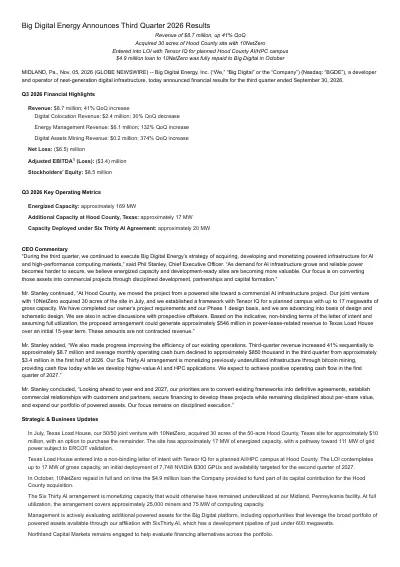
The site currently has approximately 17 megawatts of energized capacity, and we have a pathway towards 111 megawatts there. Our focus this quarter has been on moving Hood County from a powered site towards a commercial AI infrastructure project.
To this end, we signed a letter of intent with Texas Load House, our joint venture with 10 Net Zero, and TensorIQ. The framework contemplates up to 17 megawatts of gross capacity and an initial deployment of nearly 8,000 Nvidia B300 GPUs.
Our current Phase 1 design is 6,336 GPUs. Current planning assumptions target availability into the third quarter of 2027.
We are executing on this plan we laid out for Hood County. Last quarter, we set out to secure powered sites, advance development, build strategic partnerships, and finance growth responsibly.
This quarter, the joint venture acquired 30 acres of that site. We signed a letter of intent with TensorIQ, and our engineering and development work is advancing.
Based on the indicative terms in the LOI and assuming full utilization, the arrangement could generate in excess of $550 million in aggregate power lease-related revenue to Texas Load House over the initial 15-year term. If both 5-year extensions were exercised on the same indicative economics, the figure could reach approximately $1.1 billion over 25 years.
The LOI is non-binding, and there is important work ahead before we reach definitive agreements. The project requirements are complete and signed off, and the Phase 1 design basis is complete and quoted.
We are now moving into basis of design and schematic design, and we are finalizing our general contractor, mechanical, electrical, and plumbing, and civil engineering partners. We are in active discussions with offtake for this site and expect to execute a lease before the end of the fourth quarter.
While the Load House site moves forward, we are also actively evaluating opportunities to bring additional powered assets onto the Big Digital platform. We are building a portfolio of high-return assets, and we are leveraging the broad and substantial portfolio of powered assets available through our affiliation with 630 AI.
The 630 AI development pipeline, which sits at just under 600 megawatts, gives us unique access to opportunities that are difficult to source in the public market. Not every discussion will become a transaction.
Not every site will meet our standards. We believe the pipeline is significant, and we are focused on the opportunities where power, economics, and execution can come together.
Our strategy has not changed since the last call. What has changed is how far we have moved along it.
Josh will now talk about the industry opportunity, our capital strategy, and the governance framework that supports this growth. Josh?
Josh Kilgore
Thanks, Phil. The operating opportunity Phil described is substantial, but converting that opportunity into shareholder value requires discipline.
That applies to the assets we pursue, the capital we deploy, the counterparties we select, and the governance process around every material decision. Let me start with the broader industry environment.
AI infrastructure demand continues to place extraordinary pressure on the availability of power. The market is increasingly distinguishing between available capacity and capacity that can actually be developed.
Interconnection queues are longer. Utilities and regulators are applying greater scrutiny to large-load projects.
Permitting, transmission, generation, and community considerations all influence the timing and economics of development. We believe those barriers increase the value of assets that combine controlled land, energized power, and the readiness to develop.
That is the segment of the market where we are competing. As Phil mentioned, our objective is to build a portfolio of powered land assets.
We continue to evaluate additional sites, including opportunities involving privately controlled assets that could potentially be brought into the public company. We will evaluate any transaction that makes strategic and economic sense for Big Digital shareholders.
If an opportunity with an affiliated party is presented, we will be transparent and follow every necessary governance protocol. We intend to maintain the same emphasis of transparency and shareholder alignment that we discussed last quarter.
Capital is also critical for our strategy. AI infrastructure is capital-intensive.
If we are successful in expanding this platform, we will need substantial capital. The question is not simply whether we can raise capital.
The question is whether we can structure that capital in a way that allows the value created at the project level to accrue to Big Digital shareholders. As such, we are actively evaluating a range of financing alternatives, including project-level debt, strategic and joint venture capital, customer-backed structures, and institutional capital.
Our objective is to match capital to identifiable assets and identifiable returns. Corporate common equity is one financing tool, but it is far from the only option available to us.
As a reminder, management remains the largest shareholder of Big Digital. Our interests are aligned with every Big Digital shareholder.
Rest assured, the creation of long-term shareholder value is our top priority. Turning to the balance sheet, we ended the third quarter with cash of approximately $3.1 million compared with $16.3 million at June 30th.
The decline in cash was driven primarily by our acquisition of the Hood County site through Texas Load House, which cost approximately $10 million. The company also provided a $4.9 million loan to our JV partner to fund part of its capital contribution.
The loan was repaid in full and on time in October 2026. In addition, the company has accumulated more Bitcoin through reducing sales of mined Bitcoin.
As of the end of the quarter, the company held 20.8 Bitcoin worth $1.7 million, compared with 10.2 Bitcoin at December 31st, 2025. Stockholders' equity was approximately $8.5 million at September 30th compared with $12.4 million at June 30th.
During the quarter, we made significant progress in realigning our business operations with our strategic vision. Additionally, while legal expenses remained elevated for the quarter as a whole, run-rate for legal expenses declined through the quarter with the exception of a one-time, non-recurring charge.
We expect improving run-rate to become more apparent in subsequent quarters. Overall, operational improvements have dramatically improved the company's cash burn.
During the first 6 months of the year, we averaged a burn rate of $3.4 million per month on operating activities. During the third quarter, the burn rate dropped to $850,000 per month with the rate of improvement accelerating by 50% from the beginning to the close of the quarter.
As investors know, Nasdaq requires us to maintain at least $5 million of stockholders' equity for the applicable monitoring period. Our September 30th stockholders' equity of approximately $8.5 million represents the next quarterly measurement under that requirement.
Maintaining compliance remains an important priority. We also continued working through legacy balance sheet obligations and simplifying the company's capital structure.
Resolving outstanding litigation remains a top priority. Some of the matters are largely in the hands of the courts, especially in cases that we believe we have a strong argument.
However, if there is a path for amicable resolutions and walkaways in some of these matters, we will definitely pursue them. We appreciate the importance of every legacy obligation and recognize the expedient resolution allows management to spend more time and capital on the assets that can drive future value.
With that, I'll turn it over to Cody to discuss the quarter's operating performance and the work underway across our infrastructure. Cody?
Cody Smith
Thanks, Josh. Our operating priorities remain consistent with what we discussed last quarter: keep our existing infrastructure productive, improve the efficiency of the platform, and prepare our assets for higher-value AI and HPC opportunities.
I'll start with the third-quarter operating results. During the quarter, Big Digital generated total revenue of approximately $8.7 million compared with $6.2 million in the second quarter, an increase of 41%.
We have approximately 169 megawatts of current capacity across our operating portfolio with additional capacity in development. Our Pennsylvania infrastructure continues to provide an operating base while we advance the broader AI strategy.
The 630 AI arrangement allows us to monetize capacity that otherwise would have remained underutilized. The agreement generated approximately $1.5 million of revenue since the JMA came online.
We continue to view Bitcoin mining as a bridge into the broader AI strategy. It provides a way to monetize power today while preserving the ability to deploy that power toward higher-value uses as those opportunities become available.
At the same time, we remain focused on operating efficiency. Since taking control of the company, we have reviewed vendor relationships, service agreements, staffing levels, and operating processes across the organization.
This has resulted in several changes that will make Big Digital a leaner, more efficient company. Our goal is to be breakeven on a cash basis by year-end.
This work matters because efficiency creates flexibility. Every dollar we remove from an unnecessary cost is a dollar that can support operations, development, or growth.
The other major focus is preparing Hood County for AI and HPC. The TensorIQ framework gives us tangible, technical requirements around which development work can advance.
Our teams and partners are working across engineering, site design, power configuration, cooling, construction planning, interconnection, and behind-the-meter generation analysis. The contemplated initial deployment is designed for high-density GPU infrastructure and is expected to support both AI training and inference workloads.
The current framework contemplates direct liquid cooling in the first phase and immersion cooling in the second phase. This is an important distinction in how we think about the business.
Our objective is not to simply accumulate megawatts. It's to convert those megawatts into infrastructure that can support compute, attract customers, and generate durable economic returns.
That requires operational work long before a facility is ready for deployment. It requires engineering, procurement planning, construction sequencing, power design, and coordination with customers and financing partners.
Those efforts are underway. Our existing operations give us a productive base and flexibility.
The development work underway is intended to move the portfolio toward higher-value AI and HPC applications over time. With that, I'll turn it back to Phil.
Phil Stanley
Thanks, Cody. Let me close with where we are and what comes next.
Last quarter, we told investors where we were headed. This quarter, we began delivering on that path.
Hood County is moving from a powered asset toward a commercial development project. TensorIQ gives us a framework to realize the monetization of electrons.
Our teams are advancing engineering and development. We are working with financing partners, and we are engaging with customers and strategic partners.
We continue to evaluate additional powered assets to expand the Big Digital portfolio. We believe the industry backdrop makes this work increasingly important.
Power is scarce, development is difficult, and the market is beginning to separate announced megawatts from revenue-generating megawatts. That is where we are competing.
As we look toward year-end and into 2027, there are four areas I want investors to watch. First, deals: we are moving existing frameworks towards definitive agreements.
Second, customers and partners: we are converting active discussions into commercial relationships. Third, capital: we are securing the financing needed to develop these projects while staying disciplined about per-share value.
Fourth, sites: we are bringing additional powered infrastructure under Big Digital's control. This includes finding ways to bring in some or all of the close to 600 megawatts at 630 AI.
None of these steps happen overnight, but each one moves an asset closer to revenue. We are stacking tangible milestones: more powered assets, more development progress, more partnerships, more financing, and more contracted revenue.
We believe Big Digital has an opportunity to build something significant. We have the team, we have a growing base of powered infrastructure, and we have a clear roadmap for turning the infrastructure into a broader AI and HPC platform.
We are focused on execution, and we are excited about what lies ahead. With that, let's move to questions.
Samir Jain
Thanks, Phil. Since our last earnings call, we've continued to hear from shareholders, analysts, and other interested parties through email, social media, and direct conversations.
We appreciate that engagement. There are several topics that have come up consistently, including the company's capital structure and potential dilution, liquidity and legacy obligations, the Hood County joint venture, TensorIQ, project financing, capacity, and the economics of our existing operations.
Before opening the call to live questions, let's address those topics first. All right, I will send the first question to you, Phil.
Can you update investors on the TensorIQ relationship, where a definitive agreement stands today, and what needs to happen before Hood County can begin commercial deployment?
Phil Stanley
Thanks, Samir. The letter of intent with TensorIQ sets the framework for negotiating definitive agreements, but it is not a signed customer contract.
The owner's project requirements for Hood County are complete and signed off, and the Phase 1 design basis is complete and quoted. We are now moving into full design with electrical and mechanical underway and vendor quotes in process.
The work still ahead covers commercial terms, customer diligence and credit support, completion of engineering, financing, our required approvals, and definitive documentation. As far as offtake, we are in active discussions with prospective partners, and we expect to execute a lease by the end of the fourth quarter.
Availability in the second quarter of 2027 is a planning assumption that we treat as a target, but not a commitment.
Samir Jain
Great. I'll direct this next question to Cody.
Beyond Hood County, how are you prioritizing Midland, Bellefonte, and Corning? What capacity is energized today, and which locations are best positioned for AI and HPC development?
Cody Smith
Thanks, Samir. Our energized capacity today is approximately 169 megawatts across our operating portfolio.
Midland, Pennsylvania is our largest site at 120 megawatts and sits in the PJM market. Bellefonte, Pennsylvania has 8 megawatts of self-mining capacity that complements Midland, and it can be expanded to 24 megawatts.
Corning, Ohio is 24 megawatts. We've prioritized sites by time to power because power available now is the scarcest input in this market.
Each site has its own interconnection, fiber, cooling, retrofit requirements, and we're working through those site by site. In addition to our operating portfolio, 630 AI has close to 600 megawatts.
Samir Jain
Okay. The next question is for Josh.
What's the actual development plan at Hood County? How much of the existing infrastructure can be used, what must be built, and how do you expect to finance the project?
Josh Kilgore
Thank you, Samir. Hood County's development is moving in stages.
The site has approximately 17 megawatts energized operational capacity today. The next step is expanding utility service to approximately 111 megawatts subject to ERCOT validation.
The electrical source strategy, including whether to use behind-the-meter generation at the site's existing natural gas infrastructure, is still under evaluation. The TensorIQ framework sets the technical requirements.
The plan deployment is high-density GPU infrastructure with warm-water direct liquid cooling in Phase 1 using a chiller-free dry cooler concept, and immersion cooling for Phase 2 subject to final design and definitive agreements. On financing, our strategy is to use project-level financing, strategic partnerships, and customer-backed structures where appropriate.
Samir Jain
Great. Thanks, Josh.
Back to Cody for this next question. Can you clarify the economics of the 10 Net Zero joint venture, including each partner's responsibilities, future capital commitments, and whether ownership could change as Hood County develops?
Cody Smith
Today, Hood County is held through Texas Load House LLC, a 50/50 joint venture with 10 Net Zero formed in July. To help 10 Net fund its capital contributions for the acquisition, the company provided a $4.9 million loan.
That loan was repaid in full and on time in October with interest, and 10 Net Zero did not lose any ownership. Governance is set by the joint venture's operating agreement.
While the loan was outstanding, Big Digital was the sole manager of Texas Load House. Under that agreement, once the loan was repaid in full, 10 Net Zero and Big Digital serve as managers of the joint venture.
Samir Jain
Great. Thanks, Cody.
I'll go back to Phil for the next question. You've discussed bringing privately controlled powered assets into Big Digital.
Which types of opportunities are you prioritizing, and how will you ensure affiliated party transactions are fair to public shareholders?
Phil Stanley
Thanks, Samir. We separate assets into three categories: Big Digital-owned assets, joint venture interests such as Hood County, and privately controlled opportunities including assets owned by 630 AI.
Our investor presentation shows a 630 AI development pipeline of 584 megawatts. We prioritize sites that combine power, economics, and a credible path to AI or HPC use.
An affiliated acquisition would go through third-party valuation, a review by independent directors, and a recusal of any principals with interest in the targeted assets. The same standard applied to the 630 AI transactions, which are independent audit committee reviewed.
These opportunities give us access to powered infrastructure that is hard to source in the public market, but no opportunity is worth compromising governance.
Samir Jain
Great. I will direct this next one to Josh.
The amended proxy contemplates authorization of up to 600 million shares. Why is that level of flexibility needed, and how will management balance potential acquisitions and financing with dilution to existing shareholders?
Josh Kilgore
Thanks, Samir. First, I'll remind our shareholders and investors that management is looking long-term.
We're looking 20 years down the road in our decision-making process. As of September 30th, 2026, we had a little under 6.5 million common shares outstanding and 90 million shares authorized.
The Series B financing requires us to reserve enough authorized shares for conversions and warrant exercises, and to seek stockholder approval to increase authorized shares no later than November 14th, 2026. Remember, authorization is not issuance.
We will reconcile the share count in our filings, including ATM activity, Series B financing, and securities issued under commercial agreements. Our objective is to finance growth intelligently and protect long-term per-share value.
Phil, Cody, and I own approximately 31% of the company, we experience dilution alongside every shareholder. Growing into a larger platform will require room in the capital structure for others to participate.
Having that flexibility means we can act when the right opportunity arises rather than returning to shareholders at the wrong time.
Samir Jain
Great. Thanks, Josh.
Cody, this one's for you. What progress has the company made on liquidity and inherited obligations, including Celsius, W Capital, and Marshall?
How should investors think about the going concern disclosure and Nasdaq equity requirements?
Cody Smith
I'll start with the liquidity question, and then I'll get to obligations. At September 30th, 2026, cash was approximately $3.1 million, and stockholders' equity was approximately $8.5 million.
Nasdaq requires at least $5 million of stockholders' equity each quarter for 12 months, beginning with the quarter ended June 30th, 2026. Our June 30th equity satisfied the first test, and our September 30th equity of approximately $8.5 million is the next test.
Legacy matters including the Marshall loan, the W Capital loan, and Celsius matters remain in litigation as described in our 10-Q. We will not characterize their outcome until they are resolved.
The management team remains committed to strengthening the balance sheet while we execute on the operational transformation of the company.
Samir Jain
Great, and let's finish with this last question, and I'll direct this towards Phil. How does the 630 arrangement contribute to Q3 revenue and cash flow, and how do you decide whether powered sites should be used for Bitcoin mining or developed for AI and HPC?
Phil Stanley
Thanks, Samir. The joint mining agreement with 630 AI generated approximately $1.54 million of mining revenues and $1 million gross profit since miners started arriving in June 2026.
Because the arrangement has contractual flexibility, we can maximize cash flows until our AI facilities are ready and then quickly pivot away from mining. As a reminder, in our deal with 630 AI, Big Digital deployed no capital, took on no debt, and receives 100% of the cash generated under the arrangement.
630 is paid only in common stock and warrants under the JMA, and is aligned with all shareholders in that the benefit to 630 of the JMA is directly driven by appreciation in the share price.
Samir Jain
Great. Thanks, Phil.
Also thanks Josh and Cody. Now let's open up the call to live questions.
Operator, could you please open up the lines?
Operator
Thank you. We will now begin the question-and-answer session.
If you have dialed in and would like to ask a question, please press *1 on your telephone keypad to raise your hand and join the queue. If you would like to withdraw your question, simply press *1 again.
If you're called upon to ask your question and are listening via loudspeaker in your device, please pick up your handset and ensure that your phone is not on mute when asking your question. Your first question comes from the line of Kevin Dede with JonesTrading.
Your line is now open.
Kevin Dede
Thank you. Hey Josh, Phil, it's Kevin Dede at JonesTrading.
I know I've spoken to Josh, but I don't think I've spoken with you, Phil. I've got a handful of questions, let me fire off.
Granbury, Hood County, one of your competitors has a data center there, and they get extremely negative pushback from residents, and I'm wondering how you may have addressed community relations in Hood County.
Phil Stanley
We're engaged with local stakeholders. The site itself is located in a prior-zoned industrial park.
Our neighbors in the vicinity are quite a far distance away. The site itself, prior to us taking over ownership, had an air permit that was under the exemption.
We believe in the future, if there is a possibility to bring behind-the-meter, we can work with our stakeholders and third parties to try to bring a resolution to the air permit that's to our benefit. Additionally, the site itself is set up for 17 megawatts to bring processing online pretty quickly.
That exemption that we have in place should allow us to scale fairly quickly on that location, but we probably can't disclose too much more than that with ongoing engagement with community. I'm happy to answer more questions.
Kevin Dede
Great. Thanks.
I've got them. 111-megawatt target there would require ERCOT review.
I think anything over 75 megawatts sort of creates a flag, and given the change in the political climate, Texas being a different color, what's your take on moving through the regulatory bodies there?
Phil Stanley
I think it's still very fluid here in Texas. I think we're all living under a different regime change.
We'll have to see how things shake out. We believe that from a Big Digital perspective on the pubco level, we do have multiple other sites in other states.
We're trying to stay nimble, and we're going to do whatever we can to stay on the good side of the political climate.
Kevin Dede
Have you started to deal with ERCOT on getting approval to go to 111, or where are you in that process?
Phil Stanley
For the process, we have 17 megawatts that's available currently. We have a load study that's been submitted and approved to bring us up to 74 to stay under the large load limit.
The additional megawatts would be coming via behind-the-meter generation through the nat gas pipeline that lies on the property itself.
Kevin Dede
Have you evaluated tech for that? Is that turbine, recip, wind?
Phil Stanley
That would be a recip, and we are looking at deploying multiple under the prior air permit exemption.
Kevin Dede
Okay. The JV structure now is between 10 Net Zero and Big Digital.
Does that mean everything is split 50/50, top to bottom, in deployment and earnings?
Phil Stanley
Yes, sir. That is the way it's split up.
Kevin Dede
Okay. 25,000 miners, 75 megawatts at Midland, what is the hash rate there, and how did that relate to the energy revenue that you recognized in September, which seemed to spike up beyond historical norms?
Phil Stanley
I may pivot to Cody just on this particular question.
Cody Smith
Cody Smith here. We're a little over 1 exahash of self-mining or JMA-related hash rate there with the type of machine that we're mining, that comes with some opportunities for curtailment and to support the local grid.
We continue to bring on more load there and more megawatts on a daily basis.
Kevin Dede
Was it that curtailment that supported the spike in energy-related revenue in September?
Cody Smith
That's kind of the opportunity there in the PJM market is to be able to play the markets, support the grid, have some downtime when appropriate, but also bring in revenue to kind of get back into the market.
Kevin Dede
I don't want to hog the call, let me hop back in queue.
Cody Smith
Thank you.
Operator
Your next question comes from the line of Bryan Baratian with Roth Capital. Your line is now open.
Bryan Baratian
Hey guys, thanks for taking my questions. Two for me, a lot more broader thematic, and I'll dovetail on what Kevin just asked.
The Democratic win in Texas, I'm hearing mixed things where some people don't really understand, don't have certainty on the TCEQ permitting, what's going to happen, is it going to be lifted, the permit pause, is it going to be lifted upon the delivery of the audit come December 10th or I guess December 17th. What have you guys been hearing internally, and what can give us confidence with what's going on in Texas right now, sort of what's your take on the political situation with respect to I guess the permit pause ahead of Hinojosa taking office?
Phil Stanley
The TCEQ board itself is constituted usually through the governor will appoint. There are a number of those positions.
Those positions I believe last for around 6 years. I believe one of those commissioners is about to roll off, I think as early as December, and then Hinojosa will have an opportunity to appoint someone of her own choosing.
I believe that we don't have a full understanding of what that would look like, but the remaining TCEQ board members that are currently on the board were appointed by Abbott at a more favorable timeframe.
Bryan Baratian
Got it. Okay.
It sounds like even if they were to go scorched earth, theoretically, it's ultimately up at the TCEQ board, and they're probably aligning themselves with Abbott, if that makes sense. The other question I have
Phil Stanley
is on- There'd be a higher number of board members that were under Abbott's appointment than Hinojosa's, from a majority standpoint.
Bryan Baratian
That makes sense. Then the other thing for me is what we've been seeing outside of the political noise that has happened over the last week and the concerns about building costs going up and construction costs going up and labor costs, or construction costs I guess covers those.
As we think about the financing market, how are you guys seeing lenders' appetite towards granting financing? Then on the flip side, how are you thinking about pricing with this LOI?
Is there a certain yield on cost or spread of yield on cost to the cost of debt that you're trying to maintain? Does TensorIQ seem amenable to that?
Some color there would be great.
Phil Stanley
Josh, do you want to take this one?
Josh Kilgore
I can touch on that one, Phil. I would say it's pretty obvious in the market right now the opportunity to finance has been quite dampened over the last 90 days or so.
We're still seeing deals get done every week. The lenders that we're working with are pretty consistent in if you can bring us a project that has a signed lease that you can monetize, we can get you there.
I would say for our team, for what Big Digital is working on, we're thoughtfully concerned about the broader financing market, but when you take it down to a project-to-project level basis, a strong project that still has merit can still get financed. We're working with banks on the street, and we're also working with banks in our local communities.
There's not just one place to shop these deals. One other item, I know most of the deals that get put out there, they're multibillion-dollar, 300-megawatt to gigawatt-size projects.
We have a lot of projects that are well under that cap, and they're much more digestible. From a return perspective, we're not looking at 13% yield on cost-type deals.
A lot of the models that we're working on today have yields that are 25%, 30%, 40% yield on cost. That has to do with the type of location, the type of client that we're looking at, down to the type of build that we're looking at.
We're not just looking at the Tier 3 that everybody else has been building. We're really focused on modular solutions that fit perfectly in a number of our sites, and our customers are very excited to utilize.
Bryan Baratian
Great, thanks.
Operator
Again, if you would like to ask a question, please press *1 on your telephone keypad. Your next question comes from the line of Kevin Dede with JonesTrading.
Your line is now open.
Kevin Dede
Sorry guys, I lived up to my threat, I came back. You just mentioned modular builds, very interesting in light of Riot's Anthropic collaboration at Corsicana, and I'm wondering, I think you stipulated somewhere between 6,300 and 7,700 GPUs, I wonder if that's a modular build that you're looking at for Hood County?
Josh Kilgore
Kevin, the first buildout at Hood County is actually retooling an existing building. We have a very large industrial building, we actually have two of them plus an administrative office on that site.
Those GPUs are being designed for that first building. It has about a 25,000-square-foot footprint, 40-foot clearance, I think the concrete slab is 4-plus-feet thick there.
We're going to white-box that. For the additional developments on that property, we will look at both modular, power shell, and or Tier 3.
Kevin Dede
Okay. I think I'm still a little unsure on your GPU count.
There somehow I just messed up the numbers because I thought I may have heard 6,300 and I think it's 77-plus in the press release.
Josh Kilgore
There's been a couple of different numbers out there. I think there's kind of a Phase 1 and then a second Phase 2 gap.
There's somewhere between 6,300 to 6,400 in the initial, and then there's an additional set that takes it up by let's say approximately another 1,000 or so GPUs, and that's all in that initial buildout.
Kevin Dede
You guys have orders in and assurances that you'll get them?
Josh Kilgore
Our partner on the project, the LOI that we signed with TensorIQ, they have a direct working relationship with Dell, and they have been lining up these GPUs, the racks, since middle summer. I would say we're well ahead of schedule on those allocations.
Kevin Dede
Could you just walk me through the business model you expect TensorIQ to implement? Because I got the sense that you were looking for a longer term, five Oh, I'm sorry, the deal is what, 25 years fully executed with two extensions, and I guess I just want to understand if that's just the 17 megawatts or that step-up to 74, what's included in that from a power perspective in that LOI?
Josh Kilgore
That's a great question. The initial LOI that we signed is for just the first 17 megawatts.
It's a 15-year contract, and it has two 5-year extensions, so that's how you get to the 25. Tensor would like to develop with us all of the megawatts that we bring onto that site.
Our position is we're going to focus on this first 17, see how the economics and timelines all work out, and then as additional megawatts get brought on, if the working economic relationship is strong, we'll continue down that path. If there's another reason to bring in another operator for a Phase 2 or Phase 3 deal, then we'll assess that at the time.
Right now, Tensor has been wonderful to work with, they really have a great team.
Kevin Dede
Okay. Two two more questions, then I'll let you go.
First one is just sort of the constraints and opportunities that you have to absorb 630 AI assets. I would just like to understand what has to happen in order for you to be able to execute that strategy on a tactical basis.
Josh Kilgore
Phil or Cody, I don't want to hog the mic here. Would you guys like to comment on that?
Phil Stanley
No, go ahead. I think really the answer to that question is all this is contingent upon fairness opinions.
We have our independent board that outnumbers Cody, Josh, and ourselves. We do have a large number and amount of private assets and megawatts that we do think could be valuable into the future.
Some of those megawatts are more approachable early in this process than others. I would also characterize the board as engaged outside legal counsel, and anything that we want to do as far as bringing in privately held assets has to go through a process, and then from a legal standpoint, and then additionally to that, a special transaction committee that would be set up to underwrite the economics of that deal.
I'm not entirely sure if that answered all of your question, but if there's a point A or point B to that you'd like me to go deeper on, I'm happy to do that.
Kevin Dede
It helps a lot because it's kind of just the black box from where I was sitting, I appreciate that. On the LOI that you have signed, I know you touched on some of the points that you need to cross in order to get it fully signed and executed with hope for delivery in the second quarter next year.
I was wondering if there's, as part of that agreement, if there's some sort of separation clause and penalty, and I guess when the best that you can estimate that might actually be signed, sealed, and delivered.
Phil Stanley
I'm not entirely sure from a legal perspective how deep we can get into the P's and Q's of any breakup clause that's contemplated through the document itself, but on a more broad basis, we feel very strongly. We met the engineering team out there on the site in person, walked every inch of the site, and brought in additional outside field engineers to work with that team and put together a really good working plan of how we were going to go about the development phase.
I can say the vibe was very strong, and the amount of total megawatts of that 17 that they're working towards is high. We think that we'll have full deployment of that 17 megawatts.
I'm hesitant to give you the exact percentage that they gave me on-site, but I can say that it's favorable.
Kevin Dede
Okay. All right, well, I look forward to hearing more good news.
Thank you very much, gentlemen. I really appreciate you entertaining all of my questions this evening.
Phil Stanley
Absolutely.
Josh Kilgore
Thank you, Kevin.
Phil Stanley
Good questions.
Operator
Again, if you would like to ask a question, please press *1 on your telephone keypad. Your next question comes from the line of Rick Lutz with Alphi Group.
Your line is now open.
Rick Lutz
Yes, I'd like to ask a question and comment. Since in the past 24 hours, there's been a lot of talk that any company with HPC compute capabilities with access to power have been considered to be undervalued because before it was roughly about 1 megawatt, $1 million a megawatt prior to AI pivot and CapEx, and it's been going up based on the fact that the moratoriums that have been threatened after the midterms make the access to capital even more valuable.
I would like to ask you for a comment on that, and also whether or not it's had an effect on the ability to do financing. I know it's a short term, it's only been 24 hours, but is it easier to find financing in better terms now that you can boast about 160 megawatts of available power?
I would like a comment if I may.
Josh Kilgore
Rick, fair question there. I would say everything's just happened here in the last handful of days, very fluid environment we're working in, and I don't have relevant data that's come across the desk in the last 24 to 48 hours on better terms than we've seen in weeks prior.
I think to your broader point, I think the fact that we do have a significant amount of live power that we can roll right into puts us in a very valuable situation. I don't think the market has quite recognized that yet, and that's okay.
In terms of financing, if we're not having to wait on an energization timeline, it certainly makes it a lot easier on the deals we're working on right now.
Rick Lutz
Thank you.
Phil Stanley
Absolutely. It's a great question.
Operator
That concludes our question-and-answer session. I will now turn the call back over to Mr.
Josh Kilgore for closing remarks.
Josh Kilgore
I just want to thank you all for joining our call today. It really has been a tremendous run since we took over control of the company April 6th this year.
I think it was a great quarter, very proud of the team for all the efforts in righting the ship and getting us pointed in the right direction, and really looking forward to what the next few quarters are going to bring. Look forward to visiting with you all again.
Have a great day.
Operator
Ladies and gentlemen, that concludes today's call. Thank you all for joining.
You may now disconnect.