Agora, Inc.
Q1 FY2026 · Earnings Call TranscriptMay 27, 2026
Operator
Please be advised that today's conference is being recorded. The company's earnings results press release, earnings presentation, SEC filings, and a replay of today's call can be found on its IR website at investor.agora.io.
Joining me today are Tony Zhao, Founder, Chairman, and CEO; Jingbo Wang, the company's CFO. During this call, the company will make forward-looking statements about its future financial performance and other future events and trends.
These statements are only predictions that are based on what the company believes today. The actual results may differ materially.
These forward-looking statements are subject to risks, uncertainties, assumptions, and other factors that could affect the company's financial results and the performance of its business and which the company discusses in details in its filings with the SEC, including today's call, earnings press release, and the risk factors and other information contained in the final prospectus relating to its initial public offering. Agora, Inc.
remains no obligations to update any forward-looking statements the company may make on today's call. Now, with that, let me turn it over to Tony.
Hi, Tony. Yeah.
Tony Zhao
Thank you, Operator. Welcome, everyone, to our earnings call.
I'll start with a review of our overall operating results for the quarter. I'm pleased to report our sixth consecutive quarter of GAAP profitability alongside another quarter of strong top-line growth.
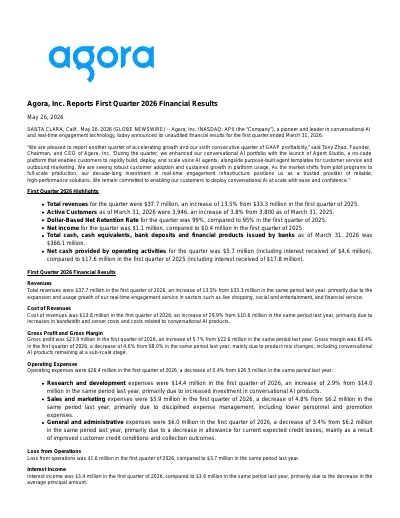
Total revenue for the first quarter of 2026 reached $37.7 million, up 13.5% year over year, growth further accelerating from our prior quarters. GAAP net profit was $1.1 million, more than double the level of Q1 last year.
These results reflect the continued expansion of our real-time engagement use cases globally, as well as increasing contribution from AI-related applications and products built with our solutions. Now, let me turn to our business, product, and technology update for the quarter.
Over the past several months, we continue to make progress in bringing conversational AI to real-world production, deepening the capabilities with our real-time engagement infrastructure, and expanding our ecosystem partnerships. In March, we officially launched Agent Studio, a visual no-code environment that enables developers and enterprise to rapidly build, test, and deploy voice AI agents at scale.
We also introduced conversational AI agents for inbound use cases such as customer service, as well as outbound use cases focused on sales and marketing. The market opportunity here is enormous.
According to Gartner, conversational agents are expected to automate 70% of customer interactions by 2027, and by 2028, AI agents are projected to outnumber human sellers by 10 to 1. At the same time, many enterprises still struggle to deploy voice AI in production environments.
The challenge is not simply the AI model itself, but the complexity of orchestrating multiple technology layers while maintaining low latency, reliability, and a natural conversational experience at scale. In addition, attractive enterprise deployment require domain-specific expertise.
A successful voice AI agent must do more than respond accurately; it must reflect the tone, personality, and workflow of the industry it serves. For example, a car sales assistant and a debt collection agent need very different conversational styles, compliance guardrails, and customer engagement approaches.
Our solution is designed to eliminate this complexity through a fully integrated stack that combines three core components. First, Agent Studio provides an intuitive, no-code environment that allows enterprise to design, test, and deploy voice AI agents in minutes rather than weeks or months.
Second, our conversational AI engine orchestrates ASR, large language model, and TTS capabilities with intelligent interruption handling, noise suppression, multilingual support, and domain-aware conversation design, enabling more natural and human-like interactions. Third, our global real-time network infrastructure delivers subsecond latency and carrier-grade reliability worldwide.
We are already seeing strong early validation from real-world deployments. In Q1, one customer implemented a survey and pooling agent that matched 10% conversion rate of human agents.
This allowed them to scale date collection and reward distribution far more cost-effectively, without adding operational headcount. Overall, enterprise feedback has been highly encouraging.
Customers increasingly recognize that scalable conversational AI requires not only powerful models, but also real-time infrastructure's capability of delivering [subsecond?] and seamless interaction and integration.
We believe we are uniquely positioned at the intersection of these capabilities. Last month, we also strengthened our position in the enterprise collaboration market with the launch of our Intelligent Meeting Engine product.
Intelligent Meeting Engine offers end-to-end encryption, flexible deployment options including on-premises and private cloud, and a full data isolation to help ensure that customer meeting content remains entirely within their controlled infrastructure. At the same time, it integrates AI-powered capabilities such as real-time transcription, translation, intelligent meeting summaries, and automated follow-up workflows that can connect with customers' existing business systems.
This solution addresses growing enterprise demand around compliance, data sovereignty, and intelligent workflow automation, and has been well received in industries including finance, government, and healthcare. Turning to ecosystem partnerships, we continue to integrate the latest AI models such as Google's Gemini Live and xAI's Grok models into our conversational AI solutions.
In particular, Google has featured Agora as a recommended partner for building real-time conversational AI, validating our technology leadership in this space. In addition, we recently entered a strategic partnership with NetEase enterprise service division, NetEase Smart Enterprise.
Together, we will provide integrated solutions spanning real-time video, content moderation, and AI agents. This partnership combines NetEase expertise in AI and content moderation with our leadership in real-time engagement infrastructure.
We believe this partnership is meaningful validation of our technology from one of China's leading internet companies, while also expanding our go-to-market opportunities across education, customer service, digital entertainment, and enterprise collaboration. Before I conclude, I want to thank the Agora and Shengwang teams for their continued dedication and execution, and thank our shareholders for their ongoing trust and support.
Globally, conversational AI is rapidly moving from proof of concept to large-scale deployment. Since the official launch of our conversational AI engine product last year, usage has demonstrated remarkable momentum, with over 150% sequential growth every single quarter.
Enterprises today are no longer asking whether they should adopt conversational AI. Instead, they are asking how to deploy it at scale with reliability, low latency, and seamless integration.
We believe our decade of experience in real-time engagement infrastructure uniquely position us to help customers solve exactly these challenges. With that, let me turn things over to Jingbo, who will review our financial results.
Jingbo Wang
Thank you, Tony. Hello, everyone.
Let me start by first reviewing financial results for the first quarter of 2026. Then I will discuss outlook for the second quarter.
Starting this quarter, we have simplified our disclosure approach for revenues and active customers, and will no longer separately disclose these metrics for Agora and Shengwang. We've also refined our dollar-based net retention rate, or DBNRR, methodology.
We now compare quarterly revenue from the same cohort of paying customers year over year to calculate DBNRR. This change aligns DBNRR more closely with our quarterly revenue growth rate, making it easier for investors to compare the two.
Total revenues for the first quarter reached $37.7 million, representing 13.5% year-over-year growth. Those results exceeded the high end of our guidance range of $36 to $37 million, and reflected continued expansion and usage growth of our real-time engagement services in sectors such as U.S.
live shopping, social and entertainment, and financial services. DBNRR for this quarter was 99%, compared to 95% in the first quarter of 2025.
Gross profit for the quarter was $23.9 million, representing a 5.7% year-over-year increase. Gross margin was 63.4%, compared to 68% in the same period last year, mainly due to product mix change, especially conversational AI products remaining at a subscale stage.
Turning to expenses. R&D expenses were $14.4 million in Q1, up 2.9% year over year.
R&D expenses accounted for 38.1% of total revenues, compared to 42.1% in the same period last year. The increase was primarily due to continued investment in conversational AI products.
Sales and marketing expenses were $5.9 million in Q1, down 4.8% year over year. Sales and marketing expenses represented 15.6% of total revenues in the quarter, compared to 18.7% in Q1 last year.
The decrease was primarily due to disciplined expense management, including lower personnel and promotion expenses. General and administrative expenses were $6 million in Q1, down 2.4% year over year.
G&A expenses represented 15.9% of total revenues, compared to 18.8% in Q1 last year. The decrease was primarily due to lower allowance for current expected credit losses, mainly as a result of improved customer credit conditions and collection outcomes.
Moving on to the bottom line. We delivered net income of $1.1 million in Q1, more than double the net income in the first quarter last year, representing a 2.9% net income margin.
This marks our sixth consecutive quarter of GAAP profitability and reflects continued improvement in our operating leverage. Now turning to cash flow.
Operating cash flow was $5.7 million in Q1, including interest received of $4.3 million, compared to $17.6 million in Q1 last year, which included interest received of $17.8 million. Moving on to balance sheet.
We ended Q1 with $366.1 million in cash, cash equivalents, bank deposits, and financial products issued by banks. Net cash outflow in the quarter was mainly due to share repurchase.
During the quarter, we repurchased approximately 12.5 million Class A ordinary shares, or 3.1 million ADSs, representing approximately 3.6% of our total outstanding shares at the beginning of the quarter for approximately $13.1 million. As of March 31, 2026, we had repurchased 174.7 million Class A ordinary shares, or 43.7 million ADSs, for approximately $156.2 million under our share repurchase program, which represented 78.1% of our $200 million share repurchase program.
The current program will expire at the end of February 2027. Now turning to guidance.
Based on currently available information, we expect total revenues for the second quarter of 2026 to be between $39 and $40 million, compared to $34.3 million in the second quarter of 2025, representing year-over-year growth of 13.7 to 16.6%. Notably, even at the low end of this range, we expect to deliver faster revenue growth than we did in the first quarter.
In closing, I want to thank our teams for their focused execution in the first quarter. We beat revenue guidance, and net income more than doubled year over year.
Our second-quarter outlook also points to a further acceleration in revenue growth. We will continue to invest in AI with discipline, and we are confident that it will become an increasingly important driver of long-term growth.
Thank you all for joining today's call. Let's open it up for questions.
Operator
Thank you. As a reminder, to ask a question, please press star one one on your telephone and wait for your name to be announced.
To withdraw your question, please press star one one again. Please stand by as we compile the Q&A roster.
First question comes from the line of Harry Zhuang from Bank of America Securities. Please go ahead.
Harry Zhuang
Hi. Thanks, management, for taking my questions.
Congratulations on the strong first-quarter results and solid Q2 guidance. I have three questions here.
The first one, since the company did not disclose the revenue breakdowns by region, we'd like to know the growth trend in overseas and China market, and what are the verticals driving the growth behind? Secondly, in terms of the conversational AI, we'd like to know the primary application scenarios at current stage, and what revenue scale could the company achieve by the end of this year?
Thirdly, it's about the profit guidance. What is the operating profit target for full 2026, and any timeline for operating-level break-even?
Thank you.
Jingbo Wang
Thank you. On the first question, first of all, in this quarter, both the China business and the U.S.
international business are growing very rapidly. The U.S.
business is still relatively faster, as both are at very healthy rates. In terms of the demand in both markets, well, I'll talk about the demand in the RTE market first, and Tony will talk about demand in AI market.
For RTE in China, demand from the traditional verticals: social, entertainment, education, from all these verticals, demand continue to recover. In the U.S.
and international markets, demand from live shopping, financial services, and gaming use cases are among the strongest. We have a very healthy pipeline of new customers in these verticals as well.
Overall, RTE demand looks quite healthy.
Tony Zhao
About the demand on AI side, from the beginning of this closely watching the progress on all front. We were the first to introduce AI into the whole RTE technology stack and offer the first generation of products empowered by those capabilities.
Since then, we've been closely working with customers on practical demand. The thing is in the last few years, there has been a lot of hype around how AI can change people's lives.
Those claims are not fake, but many of those claims are overstatements and far ahead of what's happening on ground, mostly oversimplifying the practical challenges and actual adoption process. Since early last year, we've been seeing demand from call center, education, digital avatar, etc.
I think we talked about that last year. This is happening over the past few quarters in different regions.
In each of those areas, we actually had certain partners and customers to work with them to grow into real production. With them, we made progress in the overall experience, practical token economy, and customer use-case adoption.
At this moment, we see fairly large demand from the call center side, as the technology of voice agent is increasingly able to communicate and resolve many communication tasks. Leveraging large language model intelligence, it's improving day by day.
On IoT side, after successfully helping to launch the companion toy Fuzuzu, similar demand is expanding. Fuzuzu's growth itself is also very promising.
It can get enough monthly subscription revenue from the most sticky user group every month. It's not just a one-time sale of the hardware toy.
We're seeing a similar trend in other use cases of conversational AI.
Jingbo Wang
Tony just talked about the demand for conversational AI, so that's also answered partly the second question. Yes, for revenue contribution this year, we believe call center and IoT will be the biggest contributors.
As Tony also talked about that in his opening remarks, that since we released our conversational AI engine product in March last year, its usage has been growing at more than 150% sequential growth rate every single quarter. Although the revenue contribution at the moment is still relatively low, we expect to see this revenue to quickly ramp up, and towards the summer, around 5% revenue contribution by end of.
In terms of the 2026 operating target, given the current growth trajectory and seasonality, we expect operating income and net income to both grow sequentially every quarter from Q1 to Q4. In terms of the full year profit, we expect the GAAP net income will be significantly higher than last year.
Our goal is to achieve GAAP operating profit in the second half of this year.
Harry Zhuang
Thanks, management. Very clear.
Thank you.
Operator
Thank you. Just a moment for our next question, please.
Next, we have Rachel Han from CICC. Please go ahead.
Rachel Han
Thanks. Hi.
This is Rachel Han Rachel from CICC. Thanks for taking my questions.
Congrats on another solid quarter, especially with revenue coming above the high end of guidance. My first question is on e-commerce overseas.
Last quarter, I remember you highlighted Whatnot and the Super Bowl live shopping event. Could you give us an update on how this vertical has been developing since then, and how should we think about the potential revenue contribution from overseas e-commerce for the rest of 2026?
My second question is on domestic China business. I know we shared some color on the growth drivers for the domestic business this year, but I noticed we announced NetEase Smart Enterprise partnership this quarter.
How should we think about its potential impact on our Shengwang's growth in 2026? Thank you.
Jingbo Wang
Sure. First question on commerce use case.
I want to say that in U.S. market and in probably all developed markets in general, video-based live shopping is still a very nascent.
We mentioned Whatnot last quarter. After that event, very successful event, actually, it did help Whatnot in terms of new user acquisition and user stickiness.
We continue to see growing demand from that customer. In addition, we recently won over another fast-growing, video-based e-commerce customer in U.S.
market from a competitor. On top of that, the event last quarter was a milestone in the industry.
Now everybody in the industry is watching, and several other players are trying to host similar events in the future. We are discussing with a few of them already.
We do expect this vertical to have a lot of room for growth, and we are making solid progress on that front. In terms of the business in China, as I said earlier, right, demand from this internet-based use cases: social, entertainment, education, we see demand recovering, although still at a moderate rate.
Also from verticals such as IoT, like cameras, doorbells, cars, and smart wearable devices, demand from IoT is going very fast. It has been very fast in the past 2-3 years.
Also digital transformation customers, with the addition of AI features, right, we also see renewed demand or growth from traditional enterprise customers. In terms of the NetEase, I think it's certainly very helpful on its own, but also it reflects a further consolidation of the RTE market in China.
Right. Recently, just to give some more examples, maybe that's helpful to you, a private competitor in this market repurchased all of its venture capital investments and started to focus more on profitability rather than scale.
Right. NetEase used to be a competitor, now is our partner.
We also see another large public cloud competitor has further reduced its staff on the RTE business. We do believe this trend of consolidation will gradually help our revenue growth as well.
Rachel Han
Okay. Thanks, Jingbo.
That's very helpful. Hope all the best going forward.
Thanks.
Operator
Thank you. Just a moment for our next question, please.
Last question comes from Yue Xu from China Securities. Please go ahead.
Yue Xu
Hi, management. Thanks for taking my question, and congrats on the strong results.
Just two quick ones. First, are we seeing further improvement in the domestic competitive landscape, and how should that translate into pricing power and revenue growth?
Also, excluding the initial gross margin drag from conversational AI, what is the underlying gross margin trend for our core business? Second question, as for conversational AI skills, how are its unit economics trending?
If AI income comes in below expectation, how should we think about our target of turning OP margin positive by Q4 of 2026?
Jingbo Wang
Sure. First question on competition and the margin.
I will talk about RTE, and Tony will talk about AI. Actually, I just talked about a little bit about the competition in China market.
We see that the market is moving into further consolidation, with more players no longer going after scale, right? We do believe that will help with revenue growth as well as margin improvement in the coming quarters.
As you can see, overall, the gross margin this quarter was a bit down compared to the same quarter last year. That's mostly due to the initial negative gross margin of the conversational AI business.
If excluding conversational AI, the gross margin of the core RTE business remained actually relatively stable in the first quarter.
Tony Zhao
On the AI side, there's a lot of competition for conversational AI in Silicon Valley and U.S. market.
The market is still at early stage, and there are different players trying to attack it from quite diverse angles. Because it's still a growth market, every company has a chance to attack from different angle and still making progresses.
We're the ones who focus more on the fundamental technology, trying to enable the most promising use cases through the ultimate quality of conversation. The customer demand is strong.
As we see, the stack is actually adapting to those customer demands and improving the conversational quality so that it can resolve communication tasks at a higher and better level, making it more effective. China market is quite different.
As you can see, most of the AI companies can only make a fraction of revenue in China market compared to their U.S. peers.
The market is quite hard to get to at this moment. However, there is similar demand on conversational AI side, and the technology and product progress are also similar.
Jingbo Wang
Okay. In terms of the unit economics of the conversational AI product, I think it is still too early to talk about UE.
For example, in first quarter, the reason we had a negative gross margin for this product is because we have a lot of POC customers, a lot of experimentation that basically generated no revenue, but had a lot of cost. We believe as we continue to scale this customer move from POC to deployments and scale usage, by the end of year, we expect to see meaningful revenue contribution.
At that point, the gross margin will certainly turn positive, and also will be at a healthy level. In the long run, we actually expect the conversational AI business to generate similar, if not higher, gross margin than current RTE products, because of one, higher pricing, and two, the more technical sophistication and value creation for customers.
You talk about that if the AI progress does not meet the expectation, but actually we have considered all the investments we need to make on that front, and it will not affect our goal of turning operating profitability in the second half of the year.
Yue Xu
Thank you.
Operator
Thank you. As a reminder, to ask a question, please press star one one on your telephone and wait for your name to be announced.
Thank you. With that, this concludes today's Q&A session and conference call.
Thank you again, everyone, for attending the company's call today. As a reminder, the recording and the earning release will be available on the company's website at investor.agora.io.
If there's any further questions, please feel free to email the company. Thank you.
Jingbo Wang
Thank you. Bye-bye.