Agora, Inc.
Q2 FY2026 · Earnings Call TranscriptAugust 14, 2026
Operator
Please be advised that today's conference is being recorded. The company's earnings results press release, earnings presentation, SEC filings, and a replay of today's call can be found on its IR website at investor.agora.io.
Joining me today are Tony Zhao, Founder, Chairman, and CEO; Jingbo Wang, the company's CFO. During this call, the company will make forward-looking statements about its future financial performance and other future events and trends.
These statements are only predictions that we based on what the company believes today, and actual results may differ materially. These forward-looking statements are subject to risks, uncertainties, assumptions, and other factors that could affect the company's financial results and the performance of its business, and which the company discussed in detail in its filings with the SEC, including today's press release and the risk factors of other information contained in the final prospectus relating to the initial public offering.
Agora, Inc. remains no obligation to update any forward-looking statements the company may make on today's call.
With that, let me turn the call over to Tony. Hi, Tony.
Tony Zhao
Hi, thanks, operator. Welcome, everyone, to our earnings call.
Let me begin with a review of our operating results for the quarter. I'm pleased to report another quarter of accelerating top-line growth, as well as our seventh consecutive quarter of GAAP profitability.
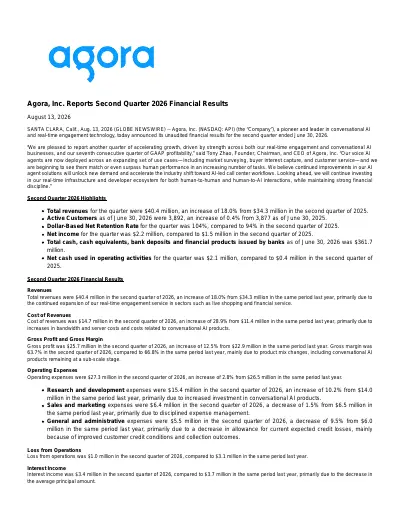
Total revenues for the for the second quarter of 2026 reached $40.4 million, an increase of 18% year-over-year. This performance reflects both the continued strength of our core real-time engagement business and the growing contribution from our conversational AI products as more customers move from proof of concept to commercial production.
Our GAAP net profit for the quarter was $2.2 million, up 50% year-over-year, which demonstrates improved operating leverage and disciplined cost management across the organization. Our most important progress this quarter occurred in call centers across the globe.
We are seeing strong momentum in adoption of our voice AI agents. Trained on the best sales and customer service playbooks, these agents deliver consistent, high-quality performance across every conversation.
They do not experience fatigues fatigue, lose focus, or vary in performance based on workload or time of day. They also maintain calm and steady interactions, even during challenging calls.
Further, customers are now seeing substantial cost savings from deploying our voice AI agents. Indeed, we're beginning to see them match or even surpass human performance in an increasing number of tasks in achieving target business outcomes.
The first example is outbound marketing and buyer interest capture. Our voice AI agents are now being used to initiate calls, qualify leads, collect information, and schedule meetings with prospect customers.
At a similar conversa- at a similar conversion rate with human with human reps, our voice AI agents also outperform in two other important areas: the volume of calls they can handle and the unit economics they deliver. The second example is market survey.
Our voice AI agent can conduct in-depth interviews for consumer insights and product feedbacks while capturing structured data throughout each conversation. The high concurrency of our solution compresses the time it takes to conduct large-scale survey that traditionally takes weeks weeks or days into just a few hours.
Marketing and surveying are only two examples of how voice AI agents can reshape call centers worldwide. We see similar opportunities in financial services out- in financial services outreach, gaming user acquisition and retention, debt collection, and many other areas.
We are already working with customers across these sectors, and we expect several of them to move from proof of concept to large-scale deployment in the coming quarters. At the same time, we continue to invest in our developer ecosystem.
This quarter, we launched Agora Skills and the Agora CLI. Agora Skills package our platform knowledge so that AI coding assistants, including Claude Code, Cursor, or Codex, can work with our latest SDKs and best practices when building real-time engagement or conversational AI applications.
The Agora CLI complime- compliments this with a simple command-line interface for coding agents to do their work. Together, these tools make it easier for both human developers and AI coding agents to build and deploy real-time engagement applications with us.
We're also continuing to we're also continuing to strengthen our technology ecosystem through through strategic partnerships. This quarter, we announced a partnership with Gradience, a leading voice AI platform recently founded by the research team behind Moshi and Kyutai, two speech models with strong recognition in the open source community.
Through our partnership, developers can enable Gradience TTS within our conversational AI engine through a simple configuration without introducing additional latency hops. Looking ahead, we will first remain laser-focused on accelera- accelerating the transition of our conversational AI solutions from pilot to production across use cases.
Each use case will present its own set of challenges, but each will also help us refine our technology. We believe that continued improvements in our solutions will unlock additional demand and drive industry shift towards AI-led workflows in call centers.
Second, we will continue to invest in our real-time infrastructure. Our Software Defined Real-time Network, or SD-RTN, has long has long been a foundational advantage for us.
As we expand into human-to-AI interactions, the importance of this infrastructure does not diminish. On the contrary, it becomes more critical because smooth conversations require ultra-low latency inference and transmission.
We're confident that our investment in real-time inference and communication infrastructure will serve as a decisive factor in our ability to compete and succeed in the conversational AI arena. Third, we will continue to strengthen our partner ecosystem and build up developer mindshare.
On October 23rd and 24th, we will host we will host our iconic and annual conference, RTE, or Real-Time Engagement, in Beijing. We look forward to bringing together developers, partners, enterprises, and inter- industry leaders to explore the next phase of real-time engagement and conversational AI.
In summary, we believe the center of gravity in the AI industry is increasingly shifting from model cap- capabilities towards infrastructure and harness layer required to operate voice AI agents reliably at scale. At the intersection of real-time engagement, AI, and global infrastructure, we believe Agora is uniquely positioned to help enterprise market to help enterprise make this transition a transition and create sustainable long-term value for both our customers and shareholders.
Before I conclude, I would like to thank our customers, developers, partners, and shareholders for their continued trust and support, and our global Agora and Shengwang teams for their dedication and innovation. With that, let me turn it over to Jingbo, who will review our financial results.
Jingbo Wang
Thanks, Tony. Hello, everyone.
Let me start by first reviewing financial results for the second quarter of 2026. Then I will discuss outlook for the third quarter.
Total revenue for the second quarter reached $40.4 million, above the high end of guidance range, and representing 18% year-over-year growth. This marks our third consecutive quarter of accelerating growth, driven by continued expansion of our real-time engagement services across sectors such as e-commerce, as well as growing customer adoption of our conversational AI solutions.
Our dollar-based net retention rate for the quarter was 104%, compared to 94% in the second quarter of 2025. This represents a meaningful improvement and moves us back above 100%.
Gross profit for the quarter was $25.7 million, representing 12.5% increase year-over-year. Gross margin was 63.7%, compared to 66.8% in the same period last year, and 63.4% in the first quarter of 2026.
On a year-over-year basis, the decline was primarily due to product mix change, as conversational AI products continue to see growing usage during the quarter, but it remained at a subscale stage. On a sequential basis, the increase was mainly driven by technical optimization.
Turning to expenses, R&D expenses were $15.4 million in Q2, up 10.2% year-over-year. R&D expenses represented 38.1% of total revenue in the quarter, compared to 40.8% in the same period last year.
The increase was primarily due to our continued investment in conversational AI products. Sales and marketing expenses were $6.4 million in Q2, down 1.5% year-over-year.
Sales and marketing expenses represented 15.9% of total revenue in the quarter, compared to 19% in the same period last year. The decrease was primarily due to disciplined expense management.
General and administrative expenses were $5.5 million in Q2, down 9.5% year-over-year. G&A expenses represented 13.5% of total revenue in the quarter, compared to 17.6% in the same period last year.
The decrease was primarily due to lower allowance for current expected credit loss, as customer credit conditions and collection outcomes improved. Turning to operating results, we recorded GAAP operating loss of $1 million in the second quarter, compared to a loss of $3.1 million in the same period last year, thanks to continued improvement in operating leverage.
Based on our current business momentum, our goal is to achieve quarterly GAAP operating profitability by the end of this year. Moving on to the bottom line, we delivered net income of $2.2 million in Q2, up 50.3% year-over-year, and representing net income margin of 5.4%.
Now turning to cash flow. Operating cash flow was negative $2.1 million in Q2, compared to negative $0.4 million in the second quarter of 2025.
Moving on to balance sheet. We ended Q2 with $361.7 million in cash, cash equivalents, and deposits, and financial products issued by banks.
The decrease in our cash balance was mainly due to annual bonus payment, as well as share repurchase during the quarter. During Q2, we repurchased approximately 1 million ADS for approximately $3.7 million.
As of June 30, 2026, we had repurchased approximately 44.6 million ADS in total for approximately $159.9 million under the current share repurchase program. As of June 30, 2026, we had 83.8 million ADS outstanding, compared to 87.3 million ADS at the end of 2025.
The current share repurchase program will expire at the end of February 2027. Now turning to guidance.
Based on currently available information, we expect total revenue for the third quarter of 2026 to be between $41 and $42 million, representing year-over-year growth of 15.8% to 18.6%. This outlook reflects our current and preliminary views on the market and operational conditions, which are subject to change.
In closing, this was another strong quarter for us, both in terms of revenue growth and profitability. At the same time, we are increasingly encouraged by the usage momentum and commercial potential in conversational AI, and we'll continue to invest with discipline to support our long-term goals.
Thank you all for joining today's call. Let's open it up for questions.
Operator
Thank you. As a reminder, to ask a question, please press *11 on your telephone and wait for your name to be announced.
To withdraw your question, please press *11 again. Please stand by while we compile our Q&A roster.
Our first question is going to come from the line of Harry Zhuang with BofA Securities. Your line is open, please go ahead.
Harry Zhuang
Hi, thanks, management, for taking my questions, and congratulations on the strong results and guidance. I have three questions.
The first one is regarding the demand. How's the demand trend in overseas and domestic market?
What are the key subsectors driving the growth? Second one is regarding AI.
We're happy to see that the call center application scenarios are growing really fast. What are the other potential scenarios that could drive a meaningful conversational AI demand growth?
What will be the revenue contribution from conversational AI by the end of the year and the gross margin trend? Lastly, about the competition.
Could management share the latest competitive landscape in overseas market against our major competitors? Thank you.
Jingbo Wang
Okay. In terms of demand, I will talk about the RTE side, and Tony can talk about the AI side.
On RTE side, actually, things haven't changed that much. Overall, what we see this quarter in both China, U.S., international markets are largely the same as last quarter.
In China, thanks to a more stable operating environment, demand from social, entertainment, education customers continued to recover. Things look pretty stable here.
On the U.S. and international side, demand from live shopping, financial services, gaming use cases continued to grow.
Demand looks healthy on RTE side.
Tony Zhao
Yes. On AI side, I think it's fair to say our vision has been validated and reinforcing on a daily basis with a rapid development and continued improvement we achieve on the ground.
In call centers, as I mentioned in the remarks, voice AI agents are matching and sometimes even surpass human reps on certain tasks with solid, measurable business outcome for the enterprise customers. This is just the beginning of a very, very long run, and I believe we will witness the transition from human call center reps to voice AI agents around the world, just like how large language model has reshaped software engineering.
This is actually a very good thing for people and the society because it will free people from a very tedious and stressful line of work. Keep talking to different person for hours about the same task and keeps the conversation strictly professional is very exhausting and emotionally draining.
Jingbo Wang
Yeah. In terms of the use case for conversational AI, I can talk about two verticals, right, call center and the companionship devices.
Tony already covered a lot on the call centers. I want to highlight one point.
When we talk about call centers, it's not a single use case. It's a collection of many, many use cases, each with different features and different domain knowledge.
When we talk about these use cases, actually, in terms of difficulty for replacement by voice AI agents, actually, they form a spectrum from the easy one on the left-hand side to the hard one on the right-hand side. Now we are only beginning to explore a few use cases on the left-hand side, such as outbound marketing and survey.
These are the low-hanging fruits. As we continue to refine our solutions and accumulating more experience working with our customers, we will convert more and more use cases from impossible to proof of concept to real-world production.
It has a very long runway. It's not a single simple use case we can conquer in one quarter or in one year.
It's going to be a multi-year process. Secondly, on the companionship device, we talked about our customer, Unitree, in the past.
In this quarter, they actually expanded into new markets in Japan and other countries, and the initial market feedback has been quite encouraging. We also partner with several chipmakers to make our solutions compatible with more chips because these are not mobile phone chips, these are very specialized IoT chips.
This will make our solution available on a wide range of smart devices, including robots even. Overall, we are still targeting a 5% revenue contribution from conversational AI by the end of this year.
Competition, Tony, want to talk about competition?
Tony Zhao
Okay. You want to talk about gross margin or not?
Oh,
Jingbo Wang
no. That's fine.
Tony Zhao
Okay. About competition, especially on conversational AI, conversational AI has several distinct technology layers: from the agent layer that orchestrates and optimize the call experience, to model layer that includes large language model and voice models such as ASR or TTS, and, finally, infra layer such as telecom APIs and cloud.
Different players attack this market from different angles. For example, Twilio would leverage its strength in telecom APIs and phone numbers from their CPaaS business.
We are focused on the voice models, audio pre-processing and post-processing, low-latency cloud infrastructure, and agent layer to deliver the best possible call experience. Given the huge potential of the conversational AI market, it is natural to have competition.
In fact, a lot of the technology in conversational AI involves audio processing such as handling noise, echoes, or packet loss. Obviously, we have a lot of experiences in those areas, which can hugely improve conversational AI experience.
We remain confident about our position in this market.
Jingbo Wang
Harry, does this answer your questions?
Harry Zhuang
Yes, very helpful. Thanks, Tony and Jingbo.
Congratulations again on the results. Thank you.
Operator
Thank you. One moment for our next question.
Our next question comes from the line of Yushu Zhao with China Security Co. Your line is open, please go ahead.
Yue Xu
Hi, management. Thanks for taking my question, and congrats on another strong quarter.
My first question regards to convo AI, could you please update on convo AI revenue for that and it is projected contribution to full-year revenue? My second question is the conversion cycles for AI use cases.
Could you disclose the current backlog for this AI use cases and for maybe just customer counts? How do you view the trend for AI revenue for the coming quarters, maybe next year?
Jingbo Wang
Thank you. Thanks for the questions.
We already talk a lot about the use cases. I want to explain that it actually takes quite some time for a use case to really ramp up from the start of the POC to the point where an agent can deliver consistent performance and can be deployed at scale.
It usually takes several months. I talked about that many, many use cases we need to attack them one by one.
Also, we can do a few in parallel, but still it's going to be a gradual process. As I mentioned earlier, we're targeting 5% revenue contribution by the end of the year.
Basically, our goal is in Q4, or in terms of the run rate, ARR run rate, we want to achieve 5% by the end of the year. Obviously, that means for the full year of 2026, it's not going to be 5%, it's going to be smaller than that.
If we achieve 5% by end of this year, and given the strong pipeline we already have on hand, which will only become bigger by the end of the year, we believe there will be still significant room for growth next year. Yeah.
We remain quite optimistic about the outlook in this market.
Operator
Thank you. One moment for our next question.
Our next question comes from the line of Zongxuan Yang with CITIC Securities. Your line is open, please go ahead.
Zongxuan Yang
Thanks for taking my question. I just have one question regarding to our AI business.
Have we ever dynamic guidance on the long-term for about three to five years for the AI penetration rate for our total revenue, and also for the gross margin guidance? Okay.
Tony Zhao
All right. I'll take the question.
In the end, the call center market will have three segment. First is the easiest task, such as simple notifications.
This will be handled by NLP-based technology, which has no real intelligence, but can understand simple keywords from human. The second would be the hardest task, or most important tasks, such as handling complaints from high-value customers, or handling emergency situations, which will continue to be handled by human.
Even if AI agent is technically able to handle the task, in some cases, only human can take certain responsibilities, such as in a 911 call. The third would be everything else in the middle of the previous two.
Those will be handled by voice AI agents with real intelligence. It is hard to say exactly how big this part will be, but it will be a significant portion of the entire market.
Jingbo Wang
Yeah. Tony talked about the term of the three- to five-year outlook for the call center market, which is a huge market.
There are literally close to 20 million people working in call centers today in the world. As Tony said, there will be three categories in the future.
Probably the middle category will be the biggest, and that will be handled by voice AI agents. Even taking a small part of that market, that would be transformational for our company.
At this point, it's hard to give a clear number as this market is still at a very, very early stage. The overall penetration of voice AI agents is still very low, it's hard to say exactly how big this will become, but it certainly will be transformational for us.
In terms of the gross margin, today the gross margin is not high for us. We talked about that last quarter, it's crossing the negative, passing the line, right, still around there.
The fundamental reason is because, one, we are subscale. The volume is small, and the volume happened at different geographies.
At each single geography, the volume is even smaller, subscale. Secondly, we haven't really focused so much on the technical optimization.
Right now, our optimization is more focused on the experience than on the cost. Once we have a larger scale and also be more focused on the technical optimization on cost, we believe, in the end, the gross margin will be similar to, if not higher than, what we have right now in the RTE business.
Zongxuan Yang
Great. It's very clear.
Thanks. I have no more questions.
Operator
Thank you. As a reminder, if you would like to ask a question at this time, please press *11 on your telephone.
Our next question comes from the line of Tristan Yang with DoubleLine Capital. Your line is open, please go ahead.
Tristan Yang
Hey, nice results today. Tony, regarding your announcement to purchase the additional $20 million of shares on the open market, I'm wondering how much have you purchased to date?
Then what valuation do you believe appropriately reflects Agora's intrinsic value? Then giving your existing ownership stake, have you considered taking the company private, returning additional capital to shareholders through a special dividend or an accelerated buyback program?
Thank you.
Jingbo Wang
Let me answer this question because it's quite technical. Basically, Tony has not started due to certain blackouts and legal restrictions, but once these are cleared, he will start the repurchase.
Obviously, he's insider, and he has previous purchases in past at beginning of this year, there are certain legal restrictions. As to the $20 million, that has not started yet.
We have returned, as up to this point, about $160 million of capital back to the shareholders through share repurchase. That compares to what, about $400 million, $350 million of market cap of the company, which is substantial, and probably among the most substantial among any public company in the world.
We will continue to do that, but at this point, we have not considered a special dividend, which we might consider in the future, but not as present.
Tony Zhao
I think my purchase will start in two, three weeks, right? September.
Jingbo Wang
Subject to certain conditions.
Tony Zhao
Okay. Yeah.
I don't think we will consider take the company off the market. We will want to keep communicate with the capital market and, for ourselves, focus on the business operation and improve our overall technical and operational strength.
We still very confident that the future of our direction has a very big potential. We think, by focus on our business operations and technical advancement, we will be able to make a lot of value for our customers, our shareholders, and our employees.
Tristan Yang
Got it. Very clear.
Thank you.
Operator
Showing no further questions, this will conclude today's Q&A session. Thank you, everybody, for attending the company's call today.
As a reminder, a recording and the earnings release will be available on the company's website at investor.agora.io. If you have any questions, please feel free to email the company.
Thank you. You may now disconnect.
Everyone, have a great day.