Banco BPM SpA
Q3 FY2026 · Earnings Call TranscriptNovember 5, 2026
Operator
Good evening, this is the Chorus Call conference operator. Welcome, and thank you for joining the Banco BPM Group 9-Month 2026 Results Presentation.
As a reminder, all participants are in listen-only mode, and after the presentation, there will be an opportunity to ask questions. Should anyone need assistance during the conference call, they may signal an operator by pressing star and 0 on their telephone.
We kindly ask to limit yourself to two questions only. At this time, I would like to turn the conference over to Mr.
Arne Riscassi, IR Manager of Banco BPM. Please go ahead, sir.
Arne Riscassi
Good evening, everyone, and thank you for joining Banco BPM conference call to present the results for 9-month 2026 of Banco BPM. The presentation will be hosted, as usual, by our CEO, Mr.
Castagna, and our Joint General Manager CFO, Mr. Ginevra.
Let me remind that all the documentation is already available on our website under the Investor Relations section. I now hand over to Giuseppe.
Giuseppe Castagna
Thank you, Arne. Good evening, everybody.
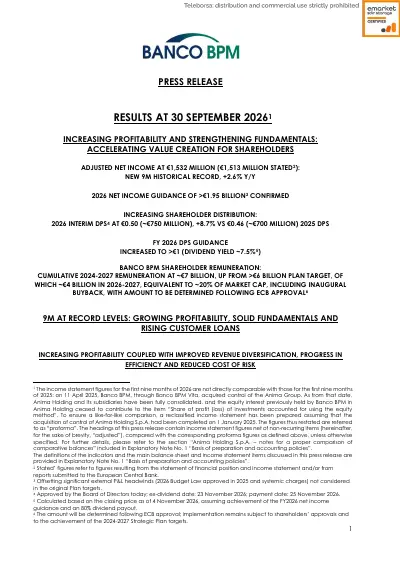
Thanks for being with us. I'm here to present a very good 9-month results at record level for profitability and shareholder remuneration.
These are results based on long-term value creation and on robust fundamentals, as you will see in few minutes. Let's start from net profit.
Let me talk of adjusted pretax net profit because, of course, there is some issue about taxation. The first result is that in the 9-month '26, we register 8% of growth vis-à-vis 9-month '25.
If we go back to '21, we have a 19% CAGR, thanks to improved revenue mix. Of course, you know very well our track record in fee income and product factory, together with a reduced cost-income and a very low cost of risk.
The adjusted net income after a tax rate that for this year is 34% vis-à-vis the average 31% of the previous five years is, in any case, better than last year at €1.53 billion compared to €1.49 billion. These results, again, are driven by excellent commercial achievements, both in terms of customer loans, plus 4% year on year, on current account and deposit, again plus 4%, and indirect funding, plus 7%, with a gross NPE ratio below €2 billion at €1.9 billion, and a net NPE ratio at 1%, and a capital which is still well above 14% at 14.27%.
This bring us to a net income of €1.51 billion, which allow us to confirm both the guidance to above €1.95 billion for '26, the interim dividend confirmed at 50 cents per share, which amount to €750 million, with an increase of 8.7% vis-à-vis last year interim dividend, which was 46 cents. Also, the guidance for this year, we can confirm is increased to above €1.
The total remuneration for our shareholder is increased, as we anticipated in the presentation of six months, from €6 [billion?] to €7 billion, which leave us for the next 18 months to deliver €4 billion of remuneration for our shareholder, which means almost 20% of our current market cap.
This, of course, is including the inaugural share buyback, whose amount will be determined following ECB approval. On page 7, let's check what is making the difference.
Is a combination of increase of revenues through diversification, coupled with progress in efficiency in terms of cost-income and reduced cost of risk. On the left part of the slide, you can see how total revenues grew 2% year on year, having non-NII revenues growing from 49% to 50%, which amounts to 52% if we consider NII at full funding cost.
In the last two years, following the acquisition of Anima, the non-NII revenues grew 39%, and versus last year, 4%. This allowed us to compensate the reduction in NII coming from the reduction of interest rates in the last two years from €2.6 billion to €2.3 billion.
The excellent performance in non-NII revenues come for €650 million in the last two years coming from non-NII revenues driven by the increase in product factory from €700 million to €1.19 billion, which means €470 million of increase amount. The cost went down 2% year on year.
The cost-income went down from 46% to 44%, and also went down the cost of risk from 34 basis points of last year to 29 basis points of this year. The net NPE ratio, as I was mentioning before, is down to 1%.
Let's have a look to the commercial volumes momentum, which is doing very well, not only in core direct funding, where we are experiencing 4% of growth year on year, which is quite the natural pace of growth for our bank, coupled with indirect customer funding for 7%, which means €7 billion of net inflows, coupled with only €1.5 billion of market effect due to the volatility of the market. The good news is the increase and the growth in core performing customer loans, which grew 3.7%, and the new lending for this year in the first nine months amount to €21.3 billion, of which €7.5 billion in the third quarter '26, which is plus 32% compared with third quarter '25.
Asset quality: again, it was mentioned the results of going down €2 billion. I have to mention that in the last 22 quarter, we were the only bank to have experienced a reduction in the NPE ratio, constant reduction quarter by quarter, which is a sort of unique case amongst our competitor, in which the second-best performer was able to reduce for seven times in a row the NPE ratio.
This shows our attention to risk, to loan growth done with a lot of focus on quality, and as we will see ahead, also on profitability. The net bad loan ratio is down to 0.3%, and if we exclude the NPEs with state guarantees, the net bad loan ratio is before 1 basis point.
This is also thanks to a very good default rate, which is down to 0.71%, together with a reduction also of Stage 2 loans, which are down from 8.1% to 7.5%. Capital on page 10: again, we want to show how in the last 21 months, we were able not only to recover more than 240 basis points of negative impact due to the Anima acquisition, coupled with more than 60 basis points of regulatory headwinds, notwithstanding that, starting from 12% after these two headwinds, we were able to recover up to 14.27%, calculated assuming inclusion of retained profit based on 80% payout.
As we were asked by ECB to not consider the inclusion of interim profit until they will authorize us to the share buyback capability. The stated Common Equity Tier 1 is now 13.8%.
Let's go to the profit and loss on page 12. You can see both the quarter on quarter, year by year, and the year-to-date.
Basically, both are growing between 1% and 2% in core revenues. Operating costs are minus 2%, both year on year and quarter by quarter.
The pretax profit are up to 7.5%, and of course, for us, is quite normal now to talk about pretax profit due to the taxation that has been applied into '26 and recent maneuver of '27, which are not already known exactly in the impact that will do for this year and next year. Of course, taxes are increasing of €120 million in nine months, leaving us with a net income stated of €1.513 billion on nine months and €453 million in Q3, compared with €450 [million] of Q3 '25.
Let's have a look at the growth that we had in terms of profit from pretax. As you can see, on yearly basis, we were able to grow €164 million, mainly due to non-NII revenues for €90 million, reduced operating costs for almost €40 million, and total provision reduced for €35 million.
The effect of the NII will be much more evident starting, of course, first in this fourth quarter, but especially in 2027. I will go again on this when we'll talk about NII.
As you can see, the growth is supported again by a combination of non-NII revenues growth with a cut in cost and lower provision in cost of risk. Let's go at NII on page 13: an increase of 4.6% on a quarterly basis year on year, 0.9% in nine months for this year, which comes from an increase of the commercial spread, which is going up from 3.03% to 3.21%, mostly, basically, thanks to liability spread.
As you can see, the asset spread is going down from 1.43% to 1.41%, but this is not due to a negative repricing of the new loans, as we will see in a minute, but by the early reimbursement of loans with higher spread. The sensitivity is always around €150 million.
To say exactly, now we are at around €160 million. This is due to the reduction of replicating portfolio down from €27 [billion?]
to €25 billion, and reduction of the indexed current account, which now amount to 34% versus 37% of December '25. The contribution to the increase of NII came also from the reduction of the cost of new wholesale bonds issued this year.
As you can see on the bottom right side of the page, you can check all the different asset class of bond issued by the bank, which, from covered bond to AT1, experienced always a big reduction, not only in terms of the previous issuing in '25, but of course, especially if you compare it to the issue done in '24. Let's have a look to the lending volumes: year on year, again, 3.7%; year-to-date is 2.5%.
The main contributor to this increase are the non-financial corporates, which are up 4.5%, always with a very low-risk profile due both to the footprint of our clients, 72% in North of Italy, and also to the big part of loans secured. As you can see, 46% of our loans are secured, of which 23% with state guarantees.
If we go to small business, this 46% increase to 62%. New lending: €7.5 billion in Q3, basically the same amount of Q2, but much higher of the €5.7 billion of Q3 '25.
As you can see on the bottom of the histogram, this is also coupled with an increase of spread applied. We pass from 1.41% of spread in Q3 '25 to 1.52% of spread in the asset spread for the new loans issued this year.
This should bring soon to a recover also on the total asset spread, also because the increase in Euribor will most possibly not bring to early repayment during 2027. Net fees are up 5.6% year on year, as far as investment products fees are concerned, which now represent 51% of total fees.
If we go into details, you can see that on a yearly basis, the big contribution was brought by Anima contribution, plus €40 million, and by the running fees, which grew €22 million on a yearly basis. Meanwhile, we have a reduced contribution for only €6 million in the up-front fees, which I can anticipate will be fully recovered already in Q4 '26.
The investment products sales was €17.3 billion, slightly higher than €16.9 [billion] of last year, and this pace has been confirmed also by the October investment sales product, in which we registered €2 billion of sales, together with sales of €1.1 billion of BTP. The same kind of increase and reduction you can see also on a yearly base, quarter on quarter.
Talking about other fees, we have basically still the final impact of ecobonus, which are phasing out by the end of this year, €13 million lower than last year. Meanwhile, we have a good increase in payment system, plus €16 million, together with good fees in trade finance, which almost offset the reduction in structured finance for lower volumes due to margin interest rate.
Let's have a look to our growth in the total customer financial asset. This is driven especially by a very good performance of our commercial network, in which we grew 4.9% year-to-date—2.2% sorry, year on year and 2.2% year-to-date.
On yearly basis, we were able to grow €11 billion, which are basically mostly represented by net inflows and increase of deposit for almost €5.5 billion. Meanwhile, Q-on-Q, we had a very good contribution for net inflows of almost €2 billion, but offsetted by negative market effect in last quarter for €1.6 billion.
If we include Anima total customer financial asset, we grew to €395 billion, of which €208 [billion] account for Anima, which register almost €5 billion of reduction, all entirely coming from market effect for €5.7 billion. The contribution of Anima, as I mentioned before, is still very good for the bank.
We have a contribution to total revenues of 14% higher vis-à-vis last year and 22% in terms of net income. We mentioned the increase of product factories' contribution.
Let's have a look again of the last two years, basically comparing the acquisition before and after Anima acquisition. As you can see, we have been able to reach almost €1.2 billion of contribution in 9-month '26, which is, again, €450 million plus vis-à-vis two years ago and €90 million plus vis-à-vis 9-month '25, and now represent 26% of the total contribution to our revenues.
As you can see, the €1.191 billion contribution of these nine months has basically reached the target for '26, meanwhile we have another €90 million-€100 million to increase next year to match our target for '27. Again, €90 million is the usual pace of growth that we have been registering during '26.
Let's talk about cost discipline: very good result, minus 2%, driven by staff cost, minus 3%, mainly thanks to positive contribution from voluntary exit schemes. Meanwhile, we have basically an even results in terms of other administrative expenses and D&A, with reduction in terms of other and a small increase in terms of D&A due to the increase in investment for technology investment, IT investment.
Page 19: some more detail on the good performance of cost of risk and reducing NPEs. Here, you have a bit more of detail about the different gross NPE ratio, net NPE ratio, and on the bottom side, the NPE ratio excluding state guarantee, which amount in terms of net total NPE ratio to 0.5%, and again, net bad loan ratio at 0.09%.
Basically, we don't have anymore bad loans in terms of net bad loans. The results driven to a cost of risk which was reduced from 40 basis points full year '25 to 29 basis points, thanks to a reduction of default rate from 0.84% to 0.71% and an increase in cure rate from 5.64% to 7.32%.
The consistency in continuing to reduce NPE and providing support with provision led us to increase the NPE coverage ratio at 47.4%, which increased to 58% for NPEs and 80% bad loans in terms of NPEs without considering state guarantees. I leave the floor to Edoardo for the financial results.
Edoardo Maria Ginevra
Thanks a lot, Giuseppe. Now let's go to the contribution of NFR, Net Financial Result, went from €98 [million] to €129 [million] in the nine months of this year.
The improvement has been made possible by the reduction in cost of certificates, which now are at €91.5 million. A very strong and resilient contribution remains from the other part of Net Financial Results, which were stand in the nine months as €221 million.
The level of securities in the banking book remained very constant, very similar to the previous quarters. We are now at €46 billion, 28% represented by fair value at comprehensive income, 72% represented by amortized cost, with share of Italian govvies, as usual in our recent history, below 40%, now at 38.8%.
Turbulences in the financial markets have determined a reduction in the fair value of the comprehensive income reserves. After the improvement we had in the second quarter, we are now below the level we experienced at the beginning of the year.
Now we are at -€429 million. We undertook a series of action to manage risk of these reserves, reducing the BPV, the basis point value, at €1.64 million end of September.
It used to be €2.15 million end of June. These negative reserves do not represent a long-term risk for our capital, bearing in mind, taking into account that almost 100% of them are represented by investment-grade bonds.
Corporate account for only 6% of the total, 16% is Italian govvies, 78% of negative reserves is due to non-Italian and supranational bonds. All of them have been investment grade.
60% of this negative level of €421 [million] is expected to be reabsorbed by 2029 owing to the pull-to-par effect. Liquidity continues to be very solid.
Total cash position is at almost €49 billion, with a reduction that is explained by the context of tightening monetary policy, which made liquidity more expensive. Now we have the level of eligible assets is went down to €41.1 billion.
Total direct funding has benefited from the positive contribution of current account and deposits, which, as described in the previous slide by Giuseppe, went up to €106.5 [billion]. LCR, the 12-month average is at 140%, with high-quality liquid assets at €30 billion, and NSFR is stable at 122%.
The rating continues to deliver a strong, positive momentum for the bank. We received an upgrade by Fitch in May, BBB+, and BBB+ has been also assigned by S&P in September with positive outlook.
Now all rating agencies assigned the same rating, senior ratings to the bank at this level of BBB+. Capital position remains very solid.
We started the year at 13.58%. In June, we were at 14.40% pro forma accounting for the attribution of retained earnings to capital.
Now, with the same pro forma, is at 14.27%. Moving parts are represented by earnings, 70 bps; dividends and AT1 coupon, -57 bps; the negative evolution of reserves weights for 24 bps, on top of which we highlight 14 bps of fair value of comprehensive income that again with pull-to-par effect or that are deducted from capital only for the mechanism of threshold and with pull-to-par effect and/or in the unlikely case we realized the negative reserves would be deductible, with transforming capital in any case.
19 basis points is the creation from DTA, tax loss carryforward and other types of DTAs; 7 bps is the remaining impact of a number of second-order elements. MDA buffer is at 474 [bps], or at a stated level, which corresponds to a stated level of CET1 that does not include retained earnings of 13.75%, MDA in this case is 426 [bps].
Excess capital is at extremely high level compared with our planned threshold of 13%, excess capital is €870 million, compared with the SREP overall requirement of 9.53% is at €3.250 billion. As usual, we also disclose the evolution of capital contribution from the elements that are not included in P&L.
In particular, we have this future capital contribution that is now as high as 180 basis points, of which 65 basis points expected to be created by year-end 2027. The drivers of this contribution are DTA and fair value of comprehensive income reserves.
Thank you, Edoardo. Let's wrap— Sorry, I don't know if you heard what I say because I didn't have the microphone, sorry for that.
Let me start again. Very strong 9-month results.
Giuseppe Castagna
I have to thanks my colleagues for the results of this last two years which we were able to obtain, notwithstanding external factors likewise, of course, the geopolitical, but also a couple of OPS that we had to manage during the last, let's say, 19-20 months. In any case, I think thanks to my colleagues, we are very well equipped to go forward continuing to deliver very strong results.
To wrap up, more than €1.5 billion in net income, plus 8% in pretax profit, 50% of non-NII revenue share, cost-income down from 46% to 44%, increase of volumes, loans and deposit 4%, indirect funding 7%, NPE ratio at a very low level, 1%, organic capital generation confirmed also this year, and interim dividends plus 9% versus '25. This allow us to confirm a guidance above €1.95 billion of net income for this year, which I may remember will be reached considering almost €100 million of increased taxation, which, of course, was not possible to forecast when we delivered in February '25 the guidance for '26.
Basically, a guidance confirmed, but with an implicit €100 million results on top of it. This, of course, allow us to also increase to more than €1 the dividend-per-share guidance for this year.
Let's have a look on page 25 on the trajectory versus strategic plan. As the plan will be terminated in 2027.
Basically, we have reached almost our target one year ahead, apart from non-NII revenues in which still we have €90 million-€100 million to grow, but again, is the exact pace of growth that we experienced in the last years and especially this year. Meanwhile, net interest income is possible to go much ahead, much higher than the target '27 due to the interest rate scenario.
We are on top of '27 also for total operating costs and total provision, very much in line to overcome the initial result pretax. Of course, tax is something quite complex to discuss due to the lack of transparency that we have right now in terms of new budget law.
Let me say that as much as we were able to recover the '26 budget law into our target, we are confident to do the same also for next year. Of course, we cannot right now give you any kind of comment about the tax coming in '27 from '27 budget law, which, of course, will be dealt as soon as we will have higher transparency about the different element, and in any case, dealt with countermeasures that we will adopt in terms to try to offset the total effect by the first part of '27, thanks to the renewal of our strategic plan, 2027-2030.
Last page, of course, on the solid position of the bank in terms of capital, profitability, and gross NPE ratio, which allow us to confirm the increase of €1 billion in terms of shareholder remuneration. We have already distributed €3 billion in the first two years.
Now, from the 23rd of November, in which we'll pay the interim dividend for '26, and the end of 2027, we'll be able to pay €4 billion to our shareholder, which means almost 20% of our current market cap. I think these are very remarkable results, which allow to foresee a strong contribution, strong remuneration for our shareholders, thanks again to the work that we have done and we are delivering in terms of contribution to the strategic plan.
Thank you, and I leave to you the floor for Q&A.
Operator
Thank you. This is the Chorus Call conference operator.
We will now begin the question and answer session. Anyone wishes to ask a question may press star and 1 on their touch-tone telephone.
To remove yourself from the question queue, please press star and 2. We kindly ask to limit yourself to two questions only.
First question is from Elena Perini, Intesa Sanpaolo.
Elena Perini
Yes, thank you, and good evening. I've got two questions.
The first one is on the positive trend in costs. You explained that it is mainly due to the staff cost component.
What is your outlook for the next quarters? Do you have additional levers to action to be able again to deliver such an improvement?
The second question is on the NII trend, if you can provide us with a guidance for next year considering the current market conditions and your healthy growth in volumes. Thank you.
Giuseppe Castagna
Thank you, Elena. Let's say on cost, I don't think we will do anything exceptional for Q4 '26.
I think the cost will be almost the same as an average of this first nine months. Of course, we are already trying to understand some maneuver in order to try to reduce the cost for 2027.
As there is the potential renewal of the contract for our colleagues, and so as always, we will try to understand the amount and trying to reduce the cost through some efficiency. In terms of NII, basically, of course, as I mentioned before, we are much ahead of the plan '27.
Maybe it's still too early to know the exact number because we do not know exactly when the couple of increase that everybody expects will come in. Of course, we have different numbers depending if both of them will come by the end of this year or only one of it now in the next months and the other beginning of next year.
In any case, will be a considerable higher of the business plan.
Operator
Next question is from Sofie Peterzens, Goldman Sachs.
Sofie Peterzens
Hi. Here is Sofie from Goldman Sachs, and thanks a lot for taking my question.
Maybe just a few more questions on net interest income. You mentioned earlier on the call that we should see NII kind of doing better in the next quarter and also next year.
Could you maybe just elaborate a little bit on the previous question, like how should we think about the tailwinds from the replicating portfolio? What kind of loan growth do you expect?
Do you expect loan growth to accelerate and deposit growth to accelerate from the current levels, or do you think that's a good run rate? How should we think about the impact on net interest income from the ecobonus?
That would be my first question. Then my second question would be around your fee income.
How should we think about the growth drivers from here? Thank you.
Edoardo Maria Ginevra
Next quarter will be a very moderate trend in NII. Basically, we have a positive impact of the environment of increasing rates, but this positive impact will be translated into more interesting and material growth during next year, as mentioned already by Giuseppe in commenting on the trends.
We basically are now playing with two scenarios: one where the rates are increased to 2.75%, and another one where there is a second hike. Of course, there is a sort of fork between the two scenarios in terms of impact on NII.
Volumes are expected positive, continuing the current trend that you're starting to observe during the last 9 to 12 months, especially on the asset side and also constructive also on the liability side. Ecobonus, which you asked, is expected to decline due to the fact that progressively over the years, the amount of the outstanding amount of the asset which generates positive contribution to NII is reduced owing to the compensation with the tax liabilities that the bank generates.
Of course, this has also some question marks for next year given the discussions on the budget law. Apart from the budget law, we expect a reduction of around €60 million.
This reduction does not take into account the reinvestment of the liquidity generated by the compensation of taxes. For as far as fee income are concerned, we are confident to generate positive trends from product factories, from growth in corporate and investment banking that will be delivered.
When I say product factory in general, I extend this also to the wealth management distribution activity of the network. This to be generated both in the next quarter, where also some seasonalities are removed, and during 2027.
Giuseppe Castagna
If may I add some color on that, let's say that we forecast a good growth in asset management driven by running fees, an increase of the other product factory, as Edoardo was mentioning. We are finally well on track with non-life product factory after the IT migration, and we have now new product that are already boosting the end of the year, and we expect a very good '27.
On terms of payment service with our Numia, we have done very well in terms of merchant business, meanwhile we are still substituting credit card, and we consider to terminate all the job during '27, also in this respect, we expect more contribution. Good results already from life insurance, of course, in a way offsetted by the increase of govvies yield, and of course, depending on the volatility of the market, we can make good results also in non-life.
The only, let's say, small question mark due to the increase of interest rate is for our consumer finance. As when interest rate go up, it's a bit more difficult to grow more, but as now also the competitive environment is very reduced, and we expect not to have any offset from this.
All in all, the target of '27 plan can be confirmed.
Sofie Peterzens
Thank you.
Operator
Next question is from Delphine Lee, JPMorgan.
Delphine Lee
Yes, good afternoon. Thank you for taking my questions.
Just wanted to come back on net interest income and cost. On NII, some of your peers are guiding to sort of mid-single-digit growth for next year or even higher.
The growth that you've seen so far this year has been a little bit more muted. Should we expect also a bit lower sensitivity to rates next year for Banco BPM?
Then on the cost side of it, just to clarify, on the earlier question, your answer was you're looking at ways to decrease costs. Is that the objective is to try to have in the next coming years a cost base that goes down in absolute terms year after year?
Thank you very much.
Edoardo Maria Ginevra
Thanks for the question, Delphine. I think that I'm proud to be asked a question where analysts ask if we have a lower sensitivity than our competitors.
This means we've done a great job in convincing the market that we are not too exposed to interest rate risk. I believe that we can expect a mid-single-digit growth next year, probably.
We have aspirations to do a little bit better, but I want to be conservative. Depends a lot on the scenario, of course.
With the various components that are consistent with strategic plan, I didn't mention probably before the replicating portfolio, which is expected to stay at the same level as we guided the market for the duration of the plan, the usual €25 billion, whose contribution will depend on the scenario and on the fact that we have maturities of swaps during this year for some 5 billion, €5 [billion] to €6 billion at lower rates than the current level of swap rates.
Giuseppe Castagna
Let's go to the cost. Of course, let's say that our goal is to recover the increase of both cost of labor and the increase of D&A due to the investment that they are going to face for cyber, for technology, and so on.
Of course, costs is a part of our job, but we believe that we have a consistent and credible track record since the merger, 10 years ago, reducing cost-income year by year every time. This is the engagement that we can take that we will be able to reduce cost-income also for the year to come.
Delphine Lee
Thank you very much.
Operator
Next question is from Manuela Meroni, Intesa Sanpaolo.
Manuela Meroni
Good evening. Thank you for taking my questions.
The first one is on the capital contribution that you expect from DTA and the fair value through the OCI reserve. It has increased since last quarter.
I guess that this is due to the impact of the reserve that we have already taken in this quarter, if you can just confirm that. If you can also share what is the timeframe in which you expect the 180 basis point positive impact, and if the 65 basis point you expect for 2027 is already including the effect of the 2027 budget law?
The second question is again on capital. Some of your competitors has flagged some model changes, I'm wondering if you expect something similar also in the fourth quarter of this year, and more generally, if you expect some, let's say, regulatory headwinds going forward.
Thank you.
Edoardo Maria Ginevra
Yes, capital creation from DTA and fair value comprehensive income reserves increases versus previous communications mostly because of the increase in negative reserves in the fair value of comprehensive income book. This is the main driver.
As far as the timeframe to recover these 180 basis points, Unfortunately, we don't have the crystal ball. We are not able to take into account the effect of the budget law, which is still a draft, before including them, we will need this to be approved.
The pace is around 65 basis points in the plan horizon, then in the following two years, the current expected pace is of additional 60 basis points, just to give you an idea of the rhythm of this source of capital creation. We are continuously maintaining our models.
We are capturing already some impacts of expected increasing RWA in our buffers using Article 3. Traditionally, we have done this, and in the future, expected model changes do not change our profile, our capital profile in terms of commitment to stay above 13% and commitment to distribute the €4 billion in the next year and a half or so.
Manuela Meroni
Thank you.
Operator
Next question is from Luis Manuel Grillo Pratas, Autonomous Research.
Luis Manuel Grillo Pratas
Good evening, everyone. Thank you for taking my questions.
My first one is on M&A. As there continues to be a lot of market speculation around the potential combination between Banco BPM and Crédit Agricole Italia, and both parties have acknowledged in the past the potential strategic merits.
Could you help us understand what conditions are not yet in place for a transaction to be considered? For example, is the key issue the relative valuation between both banks?
Is it more like the political environment, governance, or even like the proposed structure? If those obstacles are resolved at some point, from the Banco BPM perspective, do you think a reverse merger scenario is the preferable outcome, or do you think a direct acquisition by Crédit Agricole with an appropriate premium can be the more attractive option for Banco BPM shareholders?
Then my second question is on the 2027 business plan profit guidance. The Montepaschi dividend is around 5% of annual net profits more or less.
Do you see scope to offset this through other earnings levers? Related to this, there is also, of course, the 2027 budget law.
Are you confident in the net profit target? Thank you.
Edoardo Maria Ginevra
If I understood correctly, the question is in general the level of confidence for our net income on 2027. It's early to tell in terms of analyzing the impact of the additional taxes that are expected or potentially being introduced should the current text in the current form be approved.
We will need to sit down and define what could be the mitigating actions and what could be the final outcome of new taxes and mitigating actions. What we said and confirmed is that the last year's budget law has been recovered, the bank produced a very important, noteworthy effort in ensuring delivery of this year's target, which is confirmed at €1.95 billion.
For next year, it will depend actually on the amount of taxes that will be introduced and on the scenario. MPS dividend is not a concern per se.
We believe there are various ways to reinvest in portfolios that may generate similar level of remuneration.
Giuseppe Castagna
As far as M&A is concerned, let me say that basically you said everything yourself because what I can add is that we know the strong value of our bank, the capability to grow on profitability year by year, the capability to increase shareholder remuneration also on a standalone basis. Of course, whatever due to the current environment, which has been changing dramatically after the Montepaschi transaction, which, as will be split amongst Intesa Sanpaolo and BPER, is very much possible that a new transaction can happen, but frankly speaking, we are not the one who are doing the first move.
We are, of course, examining all the potential opportunity. As I mentioned other times, we have been talking about a potential transaction with Agricole since they entered into our capital with the first 9.9%, and of course, we cannot not consider that is a possibility now that they have 29.6%.
The two things that I think is important to have in mind is, first of all, that there is a very important industrial shareholder with 29.6%, which we respect, which we work very well in terms of the product factory that we had together. We get along very well, but of course, we have also another 70% of shareholder that have to be happy about the transaction.
As far as the condition of the transaction can be good and satisfactory for our shareholder, this is for sure an opportunity that we'll examine without any problem. Up to now, frankly speaking, we didn't see any kind of proposal, but we appreciate that the declaration from Agricole are always well tuned vis-à-vis a potential transaction with us.
Which kind of transaction? Again, I don't know.
I heard more about this potential reverse merger, but at the end of the day, is in their hands, having such a stake in our bank, to decide the best way to go ahead if the decision will be to go ahead. Our job is to make this transaction good and satisfactory and convenient for our shareholder.
Operator
Next question is from Ignacio Ulargui, BNP Paribas.
Ignacio Ulargui
Thanks very much for the presentation. I have two questions.
One is on credit quality and the good performance that you have delivered over the last years, as you are showing in the presentation in terms of NPE performance. Just was wondering on how much you think cost of risk can go down more from the current level?
The second one, looking to the performance of the deposits in the quarter and volume, that has been a very good increase in the quarter on quarter of current accounts. Just wanted to get a bit of a sense of how do you see the deposits growing going forward, and how should we think about the index current accounts as a percentage of the total?
Should it be around the current level of 34, or there is space to reduce that further? Thank you.
Giuseppe Castagna
Thank you. Yes, asset quality, we are very satisfied about the job that very consistently we have been doing for basically since the merger, reducing the cost every quarter, and reducing the NPE level every quarter, up to the almost zero net bad loans that we have right now.
Cost of risk depends, basically, only from default rate, because we don't have basically net bad loans that we have to provision anymore. Depending on the default rate, you know that we have provision policy that start from 30% since the beginning going up, and due to this ratio, the cost of risk can be very much lower or increase if the default rate will increase in a considerable way.
Basically, there is not anymore the management of the stock, which absorb a further provision. Deposit: well, we have been growing always.
I would say that in the last years, we have been growing more or less €10 billion per year in terms of the combination of the indirect and direct deposit. Deposits normally are €2 [billion] to €3 billion per year.
This is without increasing cost of acquisition. This is due basically to the increase current account from our clients.
Meanwhile, of course, our job is to trying to have a good inflow into indirect funding. We will continue this way.
Italy in this respect is doing very well. The footprint that we have in Italy is much better than other banks, we think we can continue to grow in terms also of deposit.
Ignacio Ulargui
Thank you.
Operator
Next question is from Hugo Cruz, KBW.
Hugo Cruz
Hi, thank you for the time. I just have a couple more questions.
Given the latest developments with the Intesa offer, what are your latest views on Anima and its listing? On capital, RWA density went down in 3Q.
Have you done any SRTs, and what are you planning in terms of further SRTs to come? Thank you.
Giuseppe Castagna
Sorry, again, I didn't have the microphone. I was saying you know that we have a contract with Montepaschi expiring in 2030, we are not worried about the prosecution of the relationship with the network, or let's say the current network and the possible new network of Montepaschi branch.
We will have to check, of course, where this branch will end up, but I am sure that we'll have all the possibility to deal on a very convenient and friendly way under the legal framework of the contract with both Intesa Sanpaolo and BPER. I am sure that there will be no problem in this respect.
I give the floor to Edoardo for the securitization.
Edoardo Maria Ginevra
Yes, sir. We are regular users of the SRT instruments, and we have done one transaction in this last quarter.
We expect to continue tapping regularly the market during 2027. We are now planning specifically the activities.
Expectation is to perform two or max three deals.
Hugo Cruz
Thank you.
Operator
Next question is from Andrea Lisi, Equita.
Andrea Lisi
Good evening. Thank you for taking my questions.
There are just two. The first one is related to the contribution from the insurance business that we have seen declining a bit versus the run rate of the previous two quarters, just to understand if this is a temporary effect and we should expect coming back to the level as we've seen in the first half already in the fourth quarter, or if there is some more structural element there, and in case if you can provide an update on that.
The second is if you can give us an indication of what you expect on Net Financial Results at the current level of rates, or at least the impact of certificates, also related to the progressive expiry of these certificates, which impact we should expect on that at current level of rates for next year? Thank you.
Giuseppe Castagna
Andrea, thank you for the question. Yes, basically, we are running in line with the 9-month '25, as you said, a bit below Q2 '26 in terms of insurance.
This is not due from performance, but from the govvies increase of rate yield on the CSM. As the calculation of the profit and loss in life insurance is very much affected by the market condition, which you take exactly the last day of the months in which you make your results.
Depending on the curve and what will be the yield of the govvies end of the year, we can experience either let's say results that can be in line with the current one, or maybe a recover of the contribution if the 10-years govvies yield is going a bit lower that what we experienced at end of September, which as you may remember, was very high. Maybe for the certificates, Edoardo?
Edoardo Maria Ginevra
The question was about NFR including cost of certificates. You are correct.
This will represent a headwind next year given the evolution of rates and also the evolution of the average level of the instruments in our liabilities that during this year has been reduced, but next year will come back to a level consistent with long-term average. Taking this into account, we expect to stay at the double digit for the next year for the contribution of trading income, of course bearing in mind that this is a volatile contributor to P&L.
Andrea Lisi
Thank you.
Operator
Next question is from Noemi Peruch, Morgan Stanley.
Noemi Peruch
Good evening. Thank you for taking my questions.
I have one follow-up on M&A and on Anima. Thinking about the potential deal or proposal from Crédit Agricole, what role could Anima have in this context?
Then two follow-ups: one on NII. Is it fair to assume that the repricing of the replicating portfolio could add at least €70 million next year on NII?
Then on the administrative costs: in the slide, you mention a fiscal one-off for Q3. Do you mind quantifying it?
Thank you.
Giuseppe Castagna
I start from M&A, Anima. No, Anima is, as you have seen and I show in my presentation, a fundamental part of our let's say strategic approach to the market.
We worked a lot in order to get the possibility to consolidate Anima, we will do all is possible, and I think everything is possible in order to maintain Anima inside our group. I don't see any problem also in a potential combination with Crédit Agricole, because of course the Italian activity, I think, will be dealt by this combination that we could do in Italy if and when this will happen, together with all the other product factory.
I don't see any different possibility from that. Maybe Edoardo can give you some—
Edoardo Maria Ginevra
Noemi, on replicating portfolio, unfortunately, we don't expect a positive contribution to NII next year. The rate we pay is expected to be significantly higher versus the historical experience of this year.
This will be partially compensated by the fact that we will receive higher rates for what is expiring, and on average, the receiving rate is expected to increase, but the overall balance between the two is unfortunately not positive. It will represent a negative contributor of our positive elasticity to the rates that, at the end of the day, will determine an increase, a tailwind for our NII during 2027.
In isolation, there is no tailwind from replicating portfolio. The tailwind is from the total structure of the balance sheet.
Giuseppe Castagna
Sorry, Noemi, you were asking also of a one-off? Tax one-off?
A
Noemi Peruch
one-off you mentioned within costs.
Giuseppe Castagna
Within costs?
Noemi Peruch
One-off fiscal effect, page 18.
Giuseppe Castagna
No, the only fiscal effect is as I mentioned, almost €100 million coming from the fiscal law '26, which are, of course, into our profit and loss guidance, but were not into when we gave the guidance one and a half years ago. Is the only one-off that we are considering.
What are you referring other than that? I don't know.
Noemi Peruch
Administrative costs were particularly low this quarter, and I was wondering if you have any positive one-off.
Giuseppe Castagna
No, no, no, the cost is low because you know very well because you are following us for years that we reduce quite consistently our cost base, and especially our cost-income, which will be the name of the game also for next year.
Noemi Peruch
Thank you.
Operator
Next question is from Marco Nicolai, Jefferies.
Marco Nicolai
Hello, just two quick follow-ups. The first one on trading revenues: double digits, so that also includes the dividend from Monte dei Paschi, or whatever it will substituted from 2027?
Just as a follow-up. Then another one on replicating portfolio.
Because the way I look at it, and I might be wrong, is that basically replicating portfolio covers a portion of the deposits. The variable leg you pay effectively is netted with the revenue you get from the deposit base.
That kind of nets off, and then therefore, the benefit comes from rolling over the fixed leg at higher rates. If you look at it this way, the contribution should be positive, I guess, to NII next year.
The question basically is, what's the rate that will roll off on the fixed leg? What's the rate of the maturing portion next year and the year after that you can reinvest at higher rates?
Thank you. I hope I was clear.
Edoardo Maria Ginevra
As I said, for NFR next year, we don't expect unfortunately a growth. We expect this to come back to two digits and no longer three digits, given especially the evolution of certificates, bearing in mind that we may have alternative investments that could consistently replace the contribution of MPS dividend.
Replicating portfolio: so basically, the contribution of the replicating portfolio, the way we normally deal with it in answering to question is the calculation of the difference between the fixed and the variable leg, whilst deposits generate a cost in accounting terms, a low cost, but a cost, which is the funding cost of retail funding. What happens in 2027?
Fixed leg: 25% of replicating portfolio maturing replaced with new swaps, if we keep, as we assume currently, the level constant. This replacement has a positive impact on 25% of the stock, of the €25 billion, but the actual impact depends on the rate we will find in the market when we replace maturing with new ones.
Expectation is that this is positive, because the new rates are expected to be higher than the old ones. Variable leg: variable leg is driven by average level of the portfolio and variable rates.
Variable rates next year will be higher than current year variable rates. On the total amount of the €25 billion, not on the 25% one quarter that expires next year, this variable leg will have a negative impact.
The balance between the two is a overall headwind that, as I said, is in a context of a benign interest rate environment for the P&L of the bank because the rest of the balance sheet overcompensate the impact on the replicating portfolio. Per se, the replicating portfolio is just a means to reduce the sensitivity of the overall balance sheet of the bank in case of reduction in rates.
Marco Nicolai
Thank you.
Operator
Mr. Riscassi, gentlemen, there are no more questions registered at this time.
Giuseppe Castagna
Thank you, everybody, for staying with us in this call, and we will see each other in the next few days in person. Thank you again.