B.O.S. Better Online Solutions
NNASDAQ:BOSCQ2 FY2026 · Earnings Call TranscriptAugust 20, 2026
At BOS, we're built around one idea: that supply chains can be smarter, faster, and more efficient, and that the right technology makes that possible. We pursue that idea through three specialized divisions, each one tackling a different layer of the supply chain challenge.
Our Robotics division replaces manual labor with automated solutions, transforming how inventory is handled. Our RFID division brings precision to tracking and end-of-line automation, from sorting to packing, across the entire supply chain.
Our Supply Chain division works even closer to our clients, integrating our franchised electromechanical components directly into their products. Together, these three divisions give BOS a broad and complementary platform, one that allows us to serve clients across multiple touchpoints in their operations.
Our Supply Chain division integrates franchised electromechanical components directly into the products of leading defense and high-tech companies. Our engineers work hand-in-hand with our clients' R&D teams, ensuring seamless integration that generates long-term OEM revenue as those products move into production.
The growth driver here is simple: the more components we embed, the more we grow. That's why over the past two years, we've doubled our engineering team and tripled the number of manufacturers we represent.
We're proud to serve global defense leaders: Israel Aerospace Industries, Elbit Systems, and Rafael, along with their hundreds of subcontractors across the USA, India, and Europe. This network is our launchpad for global expansion, without the need for costly overseas offices.
Our RFID division delivers end-to-end supply chain automation for logistics centers and production lines, covering inventory tracking and end-of-line automation. We create real-time inventory visibility by connecting warehouse operations directly to our clients' ERP, WMS, and MES systems.
Our integrated platform combines ruggedized industrial hardware from tier-one manufacturers like Zebra and Honeywell with our own proprietary middleware software. Beyond tracking, we deploy complete end-of-line automation.
This includes autonomous mobile robots, AMRs, used in logistics centers in place of driver-operated forklifts, and on production floors to shuttle components, subassemblies, and finished parts between stations. We also deploy automatic sorters, carton packing machines, robotic palletizing, and pallet wrapping, enabling fully integrated order fulfillment.
Our business model is built for predictability and scale: recurring revenue from annual service contracts, ongoing consumables sales, and expansion revenue as clients grow to new facilities. We serve top-tier enterprises across Israel, including Shufersal, IKEA, and Teva.
Our Robotics division designs and deploys custom automation solutions, replacing labor-intensive processes with precision robotics and automated machinery. Our engineers evaluate client production lines, identify automation opportunities, and deliver a complete proposal, from concept design and cost breakdown to ROI projections.
Each robotic cell we build is fully integrated: robotic arms, custom grippers, proprietary peripheral machines, and end-to-end electrical and software systems. Over the past two years, we've strategically focused on the defense industry, a sector that still relies heavily on manual labor, yet faces growing pressure for speed and quality.
That's a powerful tailwind for automation. Our flagship client is Elbit Systems, one of Israel's largest defense manufacturers.
We've successfully developed and installed robotic production lines at their Israeli facilities, though due to confidentiality, we're unable to share footage of those systems. BOS is led by an experienced executive team of eight and a board of four, including a former head of procurement for the Israeli Ministry of Defense.
Given our technology focus, we have two dedicated CTOs: one for Robotics, one for RFID. In total, we're a team of 80 professionals, with 30% being engineers and technicians.
Thank you for watching. Ladies and gentlemen, welcome to BOS Q2 investor summit.
Thank you for joining us today. Before we begin, a brief reminder that this call contains forward-looking statements relating to BOS's business, financial condition, and results of operations.
These statements are subject to risks and uncertainties that could cause actual results to differ materially from those anticipated. Such statements include, but are not limited to, matters relating to product demand, pricing, market acceptance, economic conditions, and technology development, as further detailed in the company's filings with the various securities authorities.
Before I turn things over to management, I would like to give a brief recap of the results we just released. The growth momentum continued.
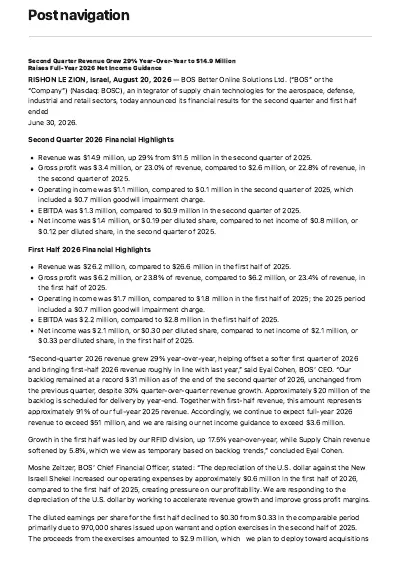
Second quarter 2026 revenue grew 29% year-over-year, helping offset a softer first quarter of 2026 and bringing trailing 12-month revenue to the same level as our record 2025 revenue. We anticipate that full year 2026 revenue will exceed full year 2025 revenue.
Our backlog remained at a record $31 million as of the end of the second quarter of 2026. Approximately $20 million of the backlog is scheduled for delivery by year-end.
Together with first half revenue, this amount represents approximately 91% of our full year 2025 revenue. Despite the increase in our operating expenses due to the dollar's devaluation, we believe we will offset this through revenue growth and improved gross profit margins, and as a result, we expect net income for full year 2026 to exceed $3.6 million we achieved in year 2025.
Our balance sheet is solid. Shareholders' equity stands at $30.9 million, and cash stands at $10 million.
That gives us the flexibility to capitalize on organic and M&A opportunities. BOS is a company with a growing backlog, accelerating revenues, a clean balance sheet, and exposure to some of the strongest structural trends in the global economy: defense spending, automation, and supply chain modernization.
Yet, BOS currently has a market capitalization of approximately $31 million, and its enterprise value, market cap less cash, is approximately $21 million. For comparison, the Russell Microcap Index trades at approximately two times book value versus BOS trades one time book value.
Russell Microcap Index price-to-earnings ratio of roughly 16 times, compared to our roughly nine times. Thank you for watching.
Now I will turn the call over to Eyal Cohen, CEO.
Eyal Cohen
Good morning. Great to see you again in our quarterly conference.
Joining me today is Moshe,
Moshe Zeltzer
Hi.
Eyal Cohen
our Chief Financial Officer. I am pleased to see strong participation today, including many new names following the recent virtual conferences we participated in during May, June, and July.
Let me start by sharing a few thoughts on how the business is progressing. I am very pleased with our financial performance, financial position, management team, board members, and the growth opportunities in front of us.
This has given us the confidence to grow year after year, and we remain focused on continuing that trend. I am pleased that the commercial market in Israel has recovered, as reflected in 17% growth in the RFID revenue in the first half of the year as compared to the comparable period.
Demand in the defense segment continues to be strong, as reflected in our record backlog, most of which relates to our supply chain division. The penetration of our robotics division into more factories in the defense segment is going very well.
We are successfully implementing AI within BOS for internal use to improve our operational efficiency, and in software development for commercial sale. I believe these steps will yield improved operational margins and support our revenue growth.
Moshe Zeltzer
On the financial front, despite 30% growth in the total revenue between Q1 '26 and Q2 '26, cash remained roughly unchanged at $10 million. We grew without needing to burn cash, which is a strong indication of highly efficient cash management, with our vendors helping to finance our clients.
We will deploy this cash to support our external growth through M&A. On the M&A front, we have several opportunities on the table that we have been evaluating carefully.
Eyal Cohen
On the IR side, in May, we presented at the MicroCapClub Virtual Summit, and in June, we participated in the I-Axess Alpha Virtual Summit. In July, we hosted our first investor webinar.
We are going to participate in the Sidoti Conference scheduled for the end of September. In September, we will also join a non-deal roadshow to ThinkEquity clients.
During July and August, we released three announcements on major contract. In recent months, we have became active online, on Facebook, LinkedIn, X, and via email, and we plan to increase our investment in those channels.
I will send you the link to our pages, and you're welcome to follow and share. We are hopeful those activities will help close the gap in our valuation.
With that, I want to thank you again for your continued confidence and support in BOS, as we carry this momentum into the second half of the year. Thank you for listening.
We will now be happy to open the call for questions. Please unmute yourself if you want to ask question.
Good morning, Eyal. Good morning, Moshe.
Congratulations on a fantastic quarter. Regarding one of your recent orders, it was in the semiconductor industry.
Is that kind of a one-time order, or do you see more orders occurring from that industry?
Eyal Cohen
We have to understand that once we announce on a contract that relates to the supply chain division, on the back of it, there is a design work of embedding our component into the client's product that is in development process. Actually, we work on that order a year ago.
Once the products start the mass production, then we start to get the order. We expect, as long as the product is alive, the orders will follow.
Okay. Can you kind of give an update on your progress in India?
I know that's becoming a large part of your revenues, and where do you see that progressing over the next year?
Eyal Cohen
We are very pleased with the progress of our team in India. They're doing a very good job.
They are reaching to a client that we have never been in contact with. I'm sure that it will support the growth of BOS in India in year 2027.
Okay. My final question is referring to M&A, you still plan to make any M&A activity non-dilutive to shareholders and finance that with existing cash and bank loans, is that correct?
Eyal Cohen
That's correct, Todd. Actually, we are planning to do an M&A, but as in the recent two, three years, we have not succeed to close a deal because it doesn't match to our criteria, especially for the first criteria that it should be a company with a solid history of profits and a positive outlook.
We have several opportunities on the table. We are checking it, and we are in negotiations with several companies.
Hopefully, one of them will be closed. Of course, we have the policy how to finance those deals.
As I mentioned before, we have $10 million in the cash in hands, if we are buying a profitable company, there is no reason why the bank won't participate at 50% of the financing, we actually can reach to maximum acquisition value of $20 million. We are set.
Thank you. I'll hop back in the queue.
Congratulations again on a great quarter. Thank you.
Eyal Cohen
Thank you, Todd. I'm looking forward to meet you in Israel.
Thank you.
Good morning, Eyal. It's Scott Weiss.
How are you?
Eyal Cohen
Fine, thank you. How are you, Scott?
Good, thanks. Nice quarter.
My question is on the RFID division. It was up a nice 17.5% year-over-year.
It bounced back. Was that a function of the easy comp year-over-year, or are you seeing some kind of a positive change there?
Eyal Cohen
We see a positive change. We actually we were expecting for that.
It happened. A little bit silent here in Israel, and it comes.
There is a rebound in the market. The demand starts very strong.
We see a recovery. Hopefully, it will continue for a long time, after three years of to be in a hold position.
For year 2026, I'm bullish on year 2026 for the RFID division.
The same question for the supply chain segment, revenues were down 6% or so. Is there any insight you can give us as to why it was down?
Eyal Cohen
No, as you saw that the fluctuation in this division are significantly high. As you remember, in the first quarter, we were below the comparable quarter last year and about if I remember correctly, it was 17% less.
Then, here in the second quarter, we succeed to close the gap. We know that our clients in the defense segment will buy our component, but we are not controlling on the rate of consumption.
There could be fluctuation. Because of that, I'm not giving importance to the 5% decrease.
More than this, we have a very strong backlog, that $31 million, which is a record backlog. By the way, despite of 30% growth in revenues from Q1 to Q2, the backlog still remain on the same level of $31 million as it was at the end of the first quarter, Moshe (CFO):
Moshe Zeltzer
Consolidated.
Eyal Cohen
Consolidated, sure. Out of the $31 million, we have $20 million for delivery by the year-end.
We did a calculation, and based on that, we provided positive outlook that we will exceed the $51 million in year 2026.
Great. Thank you.
Eyal Cohen
Thank you, Scott.
Hi, Eyal. This is
Moshe Zeltzer
You can go ahead. It's okay.
Okay.
Eyal Cohen
[foreign language]
Moshe Zeltzer
Who's going to be the first one, Kevin?
Eyal Cohen
Yes, please.
Moshe Zeltzer
Think Kevin, was it?
Okay. Hi, this is Kevin from Alliance Global Partners.
Thanks for taking our questions. As a follow-up on M&A, could you speak to what are kind of the gating factors in it?
Would it be finding targets, price expectations, or the financing capacities?
Eyal Cohen
I'm not sure I got your question. Can you repeat?
Because the line is not so clear. Can you repeat, please?
Sure. As a follow-up to the earlier M&A question, could you kind of speak to what are some of the gating factors on kind of closing a deal?
Would that be finding targets, price expectations, or the financing capacity?
Eyal Cohen
Yes. The criteria are, as I mentioned, that the cap of acquisition of investment will be $20 million.
The criteria that there should be a synergy to our core business. The synergy could be a range of synergy: how much is 50% synergy, 100%, full synergy.
We have flexibility on that issue, on that criteria. Regarding the financial position, the performance of the company, we are checking that in the recent three or four three to five years, the company presented consecutive profits and there is positive outlook going forward.
Regarding the multiple, the valuation, the thing that we have on the table, the multiple on the EBITDA is between 5 to 6. This is the range of valuation we are talking about.
Got it. Thanks.
Then as a follow-up, you've announced about 4.7 million in new orders since late July on top of the 7.1 million from India and the US through May, and your guidance has stayed pinned around that 3.6 million range, which is flat to last year. Could you walk me through that bridge?
Is it incremental revenue being absorbed by shekel in the mix, and then specifically what has to change? Would that be FX, pricing, or mix for this momentum to break through to the bottom line in 2027?
Eyal Cohen
Yeah. In this press release, we just announced that we will exceed the $3.6 million.
Usually, we don't provide exact percentage of growth. Usually, we use that we will exceed, like we are doing in the revenue, that we will exceed the $51 million and we will exceed the $3.6 million.
Still, there is a challenge we are facing with the devaluation of the US dollar. As you saw in the first half of the year, it increased our operational expenses by about $600,000.
Moshe Zeltzer
It is a That's
Eyal Cohen
that. It increased the operational expenses by $600,000.
On annual basis, it's $1.2 million. We have to find way to compensate it in order to generate profits that will be higher than year 2025, higher than the $3.6 million.
We can work on internal efficiency, and we are doing it mainly with the assistance of AI tools to improve our operational efficiency, but to improve our operational efficiency by $1.2 million a year, it will be very tough. We are doing it by operational efficiency, by increasing the gross profit margin of our products in order to compensate, and we are increasing our revenues.
If you increase the revenues and you work with all those points together, this is assumption for our outlook for exceeding the $3.6 million.
Got it. Thanks a lot.
Eyal Cohen
Thank you, Kevin.
Hi, Eyal.
Eyal Cohen
Hello.
Hi. James Khan here.
In a previous conference call, you suggested that you were open to the possibility of a new name for your company because Better Online Solutions is awkward at best and a little inaccurate and a little bit silly. I've been working on this and giving it some thought and consulting with people, and I believe the best solution is an organic one, something that you're already known by.
I suggest BOSC, your symbol, as the name for the company.
Eyal Cohen
I totally agree with you. I think, you know why?
BOSC, because it's also BOS Coin. It's okay, it's great.
I agree. All the investors know the name BOS, they know the ticker.
I totally agree with you, and if I won't get any other recommendation from our shareholders that can send me emails and other suggestion, I think we will go on it.
Thank you.
Eyal Cohen
Great idea. Thank you.
Mm. Any further questions?
Hi, this is Igor Novgorodtsev, and nice talking to you again, especially after a strong quarter. I want to touch upon gross margins.
The gross margins, I don't have it really in front of me right now, but they seem to be kind of being a little bit flat while your revenue is growing. Is gross margins affected by RFID versus supply chain mix?
Maybe you can guys give us I know you don't disclose them exactly, but maybe you can walk us a little bit through that. Or are they affected by FX?
Do you think your gross margins can improve while your revenue is growing?
Eyal Cohen
I think the gross margin we we are working that the gross margin will improve because what I just mentioned before, because we have to compensate on the the effect of the devaluation of the US dollar. We are working extensively with our clients to increase the sales price.
I have to tell you that since the beginning of the year, we all the salespersons, all the sales team increasing prices in order to compensate it. I'm following month by I'm following, we are following months by month.
Our expectations are that our gross profit margin, go ahead, will increase. In certain cases, when we have there could be a huge transaction, especially in the supply chain, for a certain kind of product that the gross profit margin could be lower.
It's a price of it's a it's a matter of negotiation with the client. I hope it won't decrease it won't decrease it won't lower the average of our it won't lower the average of the gross profit margin that we're expecting.
In general, we are expecting higher gross profit margins.
Does it apply to just supply chain, or it also equally applies to RFID?
Eyal Cohen
I mentioned the supply chain because in the supply chain, they are huge transactions. There could be a transaction of $2 million, $1.5 million, that can effect significantly on a specific quarter.
In the RFID, the transaction are much lower, could be $0.25 million, $100,000, $0.5 million maximum. Because of that, I mentioned just the effect of certain transaction of the supply chain.
For RFID division, apart from, obviously, the issues that Israel has been in various stages of war in the last few years, you had specific company, if I remember, that last year you were restructuring your RFID division. Is this restructuring over, or we expect some significant further improvements or how much did it change from the last year?
Eyal Cohen
It was improved. It's not a company under the RFID, it's a unit under the RFID.
Right. We are I we have done
Eyal Cohen
we have been doing a great work there and great progress, and it absolutely the performance now are much better than we had in the parallel in the comparable period last year. Still, we have work to do, but this unit will be profitable in year 2026, as opposed to year 2025.
The the certain unit in the RFID, the RFID in general is a profitable unit is a profitable division. The certain specific unit that caused us such a a that caused us some losses, decreased our revenue in not income, net income in the RFID division, I think now the the situation is much, much more better.
Is RFID more or less a function of if Israel in a state of war or there is relative quiet, because, obviously, RFID has done much better in the Q2 than in Q1, or there are other significant factors?
Eyal Cohen
I think the RFID is 100% affected by the Israeli commercial market. We, as I mentioned before, we are in a process to penetrate with the RFID to the defense segment, and we hired a consulting company special for that mission.
We also working to penetrate to hospitals, and which is a growing segment in Israel and very stable, like in all other places in the world. We are searching acquisition in that field.
It's very tough. We are not finding, we don't even have opportunity on the table.
The other option is to set a team to build it from scratch, and by that, reduce the exposure of the RFID division to a geopolitical event that put on hold the commercial segment in Israel.
Thank you very much. I don't have any more questions.
Eyal Cohen
Thank you, Igor.
Moshe Zeltzer
Thank you. Next.
Eyal Cohen
Any further questions? Okay.
Thank you for your time and attention. Feel free to reach out if you would like to schedule with us a one-on-one session.
Thank you very much. It was pleasure to see you again today.
Moshe Zeltzer
Thank you. Have a good day.