B.O.S. Better Online Solutions
NNASDAQ:BOSCQ1 FY2026 · Earnings Call TranscriptMay 28, 2026
Ladies and gentlemen, thank you for joining us today. My name is Claude, and I will be leading today's presentation.
Following the prepared remarks, Eyal Cohen, Chief Executive Officer, and Moshe Zeltzer, Chief Financial Officer, will be available to take your questions. Before we begin, a brief reminder that this call contains forward-looking statements relating to BOS' business, financial condition, and results of operations.
These statements are subject to risks and uncertainties that could cause actual results to differ materially from those anticipated. Such statements include, but are not limited to, matters relating to product demand, pricing, market acceptance, economic conditions, and technology development, as further detailed in the company's filings with the various securities authorities.
With that said, let's get started. BOS is a company built around one idea: that supply chains can be smarter, faster, and more efficient, and that the right technology makes that possible.
We pursue that idea through three specialized divisions. Our Robotics division replaces manual labor with automated solutions, transforming how inventory is handled.
Our RFID division brings precision to tracking and end-of-line automation, from sorting to packing, across the entire supply chain. Our Supply Chain division works even closer to our clients, integrating our franchised electromechanical components directly into their products.
Together, these three divisions give BOS a broad and complementary platform, one that allows us to serve clients across multiple touchpoints in their operations. How we grow: Now, when we talk about growth at BOS, we think about it in two ways: organic growth, building on what we have, and strategic acquisitions that expand our reach.
Over the past four years, the story has been primarily organic, and the numbers speak for themselves. Revenue grew from $33.6 million in 2021 to $51 million in 2025.
That is meaningful, sustained growth, built on real demand from real clients. We believe that demand is only accelerating.
Three tailwinds in particular give us confidence. The first is the global increase in defense budgets.
This is not a short-term cycle. It is a structural, long-term shift in how governments around the world are prioritizing security.
BOS is well-positioned to benefit from this trend for years to come. The second is closer to home.
The replenishment and expansion of the Israeli Defense Forces' inventory, driven by the conflict that began in October 2023, has created significant and ongoing demand that directly supports our business. The third is newer and very promising.
India is rapidly emerging as a major subcontracting hub for global defense programs, and the numbers are already telling that story. In the first quarter of 2026 alone, we received $3.3 million in orders from Indian customers, compared to just $172,000 in the same quarter last year.
To capture this momentum and build on it, we appointed an Indian representative company in March 2026 to establish a dedicated presence in that market. We are only at the beginning of what we believe is a significant long-term opportunity.
Alongside organic growth, we are actively building our acquisition pipeline, and we have the financial strength to act on it. Our balance sheet is solid.
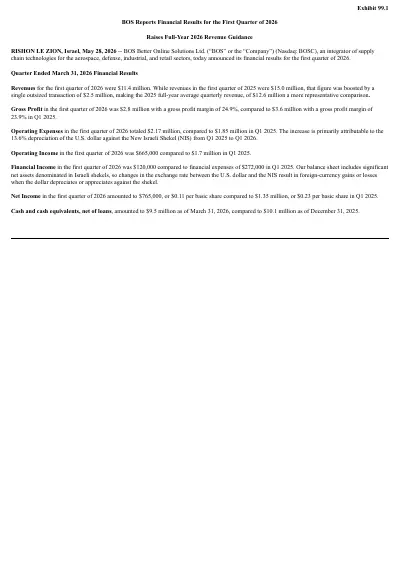
Shareholders' equity stands at $29 million, and we hold $9.5 million in cash net of loans. That gives us real flexibility.
We are targeting companies valued at up to $20 million, with two non-negotiable criteria. First, financial strength: a proven track record of profitability and consistent growth.
Second, strategic fit: companies that deepen and expand what we can offer to our existing clients. On the financing side, approximately half of each acquisition will be funded through long-term bank loans, with the remainder coming from our own resources.
I want to be clear on one point: no shareholder dilution is expected. Let me now turn to where we stand heading into the rest of 2026, and the picture is an encouraging one.
When you combine our backlog of $31 million as of March 31st, 2026 with Q1 revenues, we are already at $42.4 million, 83% of our full-year target after just one quarter. As a result, we now expect to exceed our previously announced annual revenue target of $51 million.
The depreciation of the U.S. dollar against the New Israeli Shekel is creating pressure on our profitability, and as a result, we are maintaining our net income target of $3.6 million for the full year at this stage.
We are responding on two fronts: accelerating revenue growth and actively working to improve our gross profit margins. Both of these efforts are already showing up in our Q1 results.
Our gross profit margin reached 24.9%, up from 23.9% in the same quarter last year, and our backlog grew 29% during the first quarter, from $24 million to $31 million. As we monitor the progress of these initiatives, we will reassess our net income outlook for the full year and update accordingly.
I want to close with something that we believe deserves your attention. BOS is a company with a growing backlog, accelerating revenues, a clean balance sheet, and exposure to some of the strongest structural trends in the global economy: defense spending, automation, and supply chain modernization.
Yet, BOS currently trades at book value. The Russell 2000, the index of small-cap companies we are measured against, trades at approximately 2.6 times book value.
Our price-to-earnings ratio stands at roughly 11 times, compared to 22 times for the index. We believe this gap exists primarily because not enough investors know our story yet.
That is what we are working to change, and calls like this one are part of that effort. Ladies and gentlemen, that concludes the prepared remarks.
We will now open the floor for questions. Eyal Cohen and Moshe Zeltzer are ready to take your questions.
Please unmute yourself to begin.
Eyal Cohen
I hope you enjoyed our new presentation format. My only concern is that his English and his voice are much better than my voice and English, and yours as well.
Let's open the floor for discussion, ready to take your questions.
Good morning, Eyal. This is Todd Felte.
Good morning, Moshe. Just wanted to ask on the devaluation of the dollar with the NIS, are you doing anything to hedge or compensate on that aspect?
Eyal Cohen
Yes. I think the most efficient way to handle this long-term trend, I believe, of strong shekel is to increase the efficiency of the business, because any kind of hedging has a limited period.
Although we are doing hedging on the balance sheet, not on the P&L, because we are doing hedging on the balance sheet, we see the fluctuation in the currency differences in the financial expenses or income. For the long term, we have to increase the efficiency of the business.
We are doing it based on two pillars. The first one is to increase the sales price, even though it's quoted in dollar, but to increase the gross profit margin to compensate our operational expenses, which are quoted in NIS.
This is the first one. Second one is to grow our business.
As you saw, in this trend, we saw 30% growth in the first quarter in the backlog, and you also saw a growth in the gross profit margin by one point from 23.9% to 24.9%. We are in the right direction.
On top of that, we are working on acquisitions and on good acquisition, or as Trump says, beautiful acquisitions. Beautiful acquisition based on the criteria we just illustrated in the video is solid history of profit and high synergy.
This is the long-term solution for the devaluation of the dollar.
Thank you. That's helpful.
I know your components are used a lot in the Arrow and Iron Dome systems, as well as missiles and fighter jets. Are any of your components used in drones, which seem to be kind of the weapon or defense tool of choice these days?
Eyal Cohen
Not yet. We are on it.
Hopefully, we will find the right manufacturers to represent his product to embed in our client's product. Hopefully, it will come.
My final question. In the past, you had spoke about the expansion of RFID to different sectors, and that you were excited about the expansion of RFID to the healthcare sector.
How is that progressing?
Eyal Cohen
First, we put team in place with the defense to expand the RFID business to the defense. As we announced, we hired a company, external company, to escort us through this very complicated process and to short the timeline of the success.
We have team in place to penetrate to the defense, to expand the business of the RFID to the defense. In the hospitals, we are part of the team in place, we have not signed yet.
I have to gather together all the ingredients of the team, and once it will be ready, I will sign the contract and start the penetration. I know exactly what kind of person, how the team should look like, what is his experience, and once I will have it, we will start the expansion.
I believe it will be this year.
Thank you.
Hi, this is Kevin from AGP. Thanks for taking our questions, by the way.
Backlog increased 29% sequentially to $31 million. Could you break down which of your divisions contributed most to that growth?
Eyal Cohen
Most of the backlog related to the Supply Chain division because it has a long-term orders. This is a primarily portion.
Okay. Thank you.
Then what do you attribute some of the early success in the Indian market to?
Eyal Cohen
The success that we saw in the first quarter regarding with the amount of orders?
Yes.
Eyal Cohen
I think this is a initial yield of the work we have done in the field in India by our Israeli team. I believe once we have a local team in place in India, it will urge the process of participating in more bids with more clients to expand our client base there.
The result you saw in the first quarter was made by our local team in Israel.
Great. Thank you.
Eyal Cohen
Thank you.
Hello, this is Igor Novgorodtsev. I would like to ask a few questions now.
First, a comment. I think it's actually a very good quarter, given all the circumstances.
I think there was a lot of investor caution, and you could see it in your stock price, given your prior comments. I think everybody feels that this was a positive result.
My question is this. I'm looking at your RFID results, and I see that the profitability is still relatively low.
Was it, first of all, impacted by the war and the situation with Hezbollah and Persian Gulf and so on in this quarter? Or was it something else, and how do you expect the RFID division to perform, hopefully assuming that the situation remains relatively quiet for the remainder of the year, or at the environment?
Eyal Cohen
Thank you for the question. Regarding the RFID, in the first quarter, during the month of March, the division worked partially.
It's damaged the gross profit margin. We had a fixed cost with the low revenues during March.
The another effect on the gross profit margin was the devaluation of the dollar, because our cost of goods includes a lot of workforce, all the lab team, all the warehouse team. It increased the labor cost in total.
We are working, as I mentioned before, we are working to increase the gross profit margin of the products we are selling. I believe we will start to see this result in the second quarter of the year.
To compensate on the devaluation of the dollar, and in the second quarter of the year, hopefully until now there is no resumption of the conflict of the war, it looks like we will be in a good shape in the second quarter related to the RFID division, and it will represent improved results.
Thank you. My other question is, first of all, obviously you have tremendous expansion in India and now it's a more meaningful revenue from there.
Do you think you can repeat it in any other countries? Because obviously Israeli defense sector now is highly valued and has customers in many other countries.
Do you think you can have meaningful revenues abroad from other countries than India?
Eyal Cohen
Yeah. We have connection with the two subcontractors in the US, and we got revenues from them during this year.
I assume we will announce during this year on two major contracts, and I believe that the revenue will continue to grow over there. We are tracking now additional area in the East where the local defense clients here in Israel does business over there, not just in India.
There are many places in the Far East that, for example, IAI and Elbit has business over there. We are following their tracks there, and hopefully we can duplicate the business model that we have in India to other territories.
There is a potential, yes.
Right. My last is sort of question, comment.
Any thoughts of renaming your company? Because I think your name is right now silly, giving what you do has nothing to do, Better Online Solutions just really confuses a lot of people.
Eyal Cohen
It's a good question. Do you have a better name?
I can come up with a few. I'm sure ChatGPT can, but it sounds like a late '90s internet company.
Eyal Cohen
Okay. I know.
We talked about it many times, but it's a lot of headache to change a name for a company. I believe after several acquisitions that we will do, we'll have to rebrand our business, it will come.
Right. I think it would help, especially if you go to conferences and do presentations, because I think a lot of people dismiss what your business, they have no idea that you have anything to do with defense industry looking at your name, it might be a great idea.
Eyal Cohen
Okay. If you have a good recommendation, send me.
I'll send it. Thank you.
I don't have anything else. Thank you for taking my questions.
Eyal Cohen
Thank you. I think Scott is missing today.
Any further questions? On behalf of the Board of Directors and management team, thank you for participation in our Q1 2026 conference call in the new format.
I hope you liked it. If you need more details or would like to follow up, please feel free to reach out.
Thank you. Have a great day.