Boston Scientific Corporation
Q3 FY2026 · Earnings Call TranscriptOctober 28, 2026
Operator
Good morning, and welcome to the Boston Scientific third quarter 2026 earnings call. All participants will be in listen-only mode.
Should you need assistance, please signal a conference specialist by pressing star, then zero on your telephone keypad. After today's presentation, there will be an opportunity to ask questions.
To ask a question, you may press star, then one on your telephone keypad. To withdraw your question, please press star, then two.
Please note this event is being recorded. I would now like to turn the conference over to Lauren Tengler, Vice President, Investor Relations.
Please go ahead.
Lauren Tengler
Thank you, Drew, and thanks to everyone for joining us. With me today are Mike Mahoney, Chairman and Chief Executive Officer, and Jon Monson, Executive Vice President and Chief Financial Officer.
During the Q&A session, Mike and John will be joined by Joe Fitzgerald, Executive Vice President and Group President, Cardiology, and our Chief Medical Officer, Dr. Ken Stein.
We issued a press release earlier this morning announcing our Q3 2026 results, which included reconciliations of the non-GAAP measures used in this release. The release, as well as reconciliations of the non-GAAP measures used in today's call, can be found on the Investor Relations section of our website.
Please note that on the call, operational revenue excludes the impact of foreign currency fluctuations, and organic revenue further excludes certain acquisitions and divestitures for which there is less than a full period of comparable net sales. Guidance excludes our previously announced agreement to acquire Penumbra, which we expect to close in early 2027.
For more information, please refer to the Q3 financial and operating highlights deck, which may be found on the Investor Relations section of our website. On this call, all references to sales and revenue are organic, and relative growth is compared to the same quarter of prior year unless otherwise specified.
This call contains forward-looking statements regarding, among other things, our financial performance, business plans, market expectations, and product performance and development. These statements are based on our current beliefs using information available to us as of today's date, and not intended to be guarantees of future events or performance.
If our underlying assumptions turn out to be incorrect, or certain risks or uncertainties materialize, actual results could vary materially from those projected by the forward-looking statements. Factors that may cause such differences are discussed in the earnings release we issued earlier this morning and our periodic reports and other filings with the SEC, including the Risk Factors section of our most recent annual report on Form 10-K.
Boston Scientific disclaims any intention or obligation to update these forward-looking statements, except as required by law. In addition, this call does not constitute an offer to sell or the solicitation of an offer to buy any securities or solicitation of any vote or approval in connection with the proposed transaction with Penumbra.
Boston Scientific has filed with the SEC a registration statement on Form S-4 containing a proxy statement of Penumbra and a prospectus of Boston Scientific that contains important information about Penumbra, Boston Scientific, the proposed transaction, and related matters. At this point, I'll turn it over to Mike.
Mike Mahoney
Thanks, Lauren. Thank you to everyone for joining us today.
I want to begin by walking through our third quarter results, provide some fourth quarter outlook, and then assumptions behind our updated view of 2027. I'll then provide more details on both the region and business unit performance and outlook.
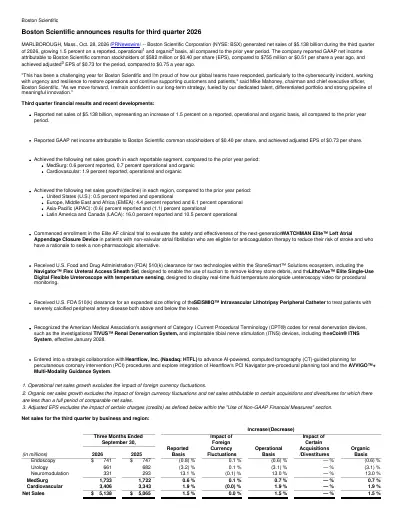
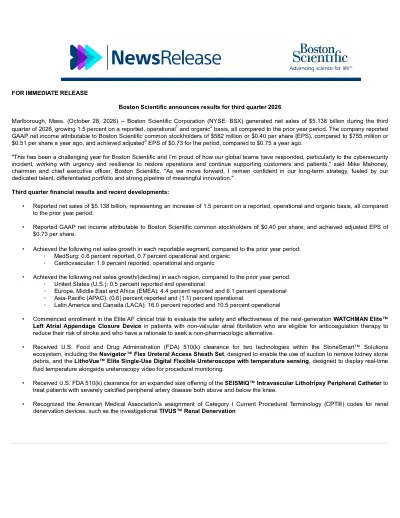
Q3 total company organic sales grew 1.5% versus our original guide of 3% to 5%. Q3 adjusted EPS of 73 cents declined 3% versus our guidance range of 80 to 82.
Our Q3 results were impacted by our previously reported cybersecurity incident, which we estimate reduced our sales growth by approximately 300 basis points and adjusted EPS by 7 cents in the quarter. Importantly, after a two-week outage as a result of the cyber incident, all operations are back up and running as of September 8th.
I'm very proud of our team's resiliency and the efforts they made to help us return as quickly as possible to supporting physicians and their patients with our products. Turning to Q4, we anticipate that there will be a 200 to 300 basis points of impact from the cyber incident as we work through elevated customer orders at the end of Q3 to replenish inventory levels.
Additionally, since our second quarter earnings call, EP share pressure has intensified, further accelerated by the cyber incident. We have also seen pricing dynamics in China become more challenging.
To that end, we are guiding to organic revenue declines of -1% to -3% for fourth quarter '26, and adjusted EPS of 77 cents to 79 cents. This results in a full-year '26 organic revenue growth guide of approximately 4%, and EPS of $3.16 to $3.18.
Boston Scientific has enjoyed several years of exceptional growth, driven by strategic investments and strong execution globally, particularly within our EP and WATCHMAN franchises. In '26, we've seen that cycle turn, and those two businesses are now weighing on our total company growth as we navigate competition and market dynamics.
We believe that 2027 will be the trough in this cycle, and we have several investments and new innovations coming over the course of the next three years that we expect will support stabilization and growth for both the EP and WATCHMAN businesses. While the remaining 75% of our business has grown consistently, we anticipate there will be additional price headwinds in China in '27, and the growth likely won't be enough to offset the pressure from EP and WATCHMAN next year.
As a result, we believe we'll be challenged to grow sales and adjusted EPS in '27, excluding our pending acquisition of Penumbra. Having said all that, we are taking immediate actions to prepare for the future, including through our previously announced restructuring program and the evolution of our operating structure, while ensuring that we continue to make the right strategic investments across a number of growth platforms.
We have a very strong cadence of launches in '27 and '28, and anticipate entering several new markets over the next few years that will unlock $25 billion in new market opportunity by 2030. Importantly, we expect these actions to drive meaningful improvement in both our revenue and adjusted EPS performance as we aim to exit this cycle in '27 and return to delivering high performance in '28, with further improvement expected in '29.
I'll now provide some more details on Q3 and full-year '26. Turning to our regional performance, the US was flat year over year on an operational basis, driven by ICVT, ION, and Neuromodulation.
Europe, Middle East, and Africa grew 6% on an operational basis, with strong performance across many of our businesses, and within the quarter, there was some impact from cyber, offset by a transient headwind in third quarter '25 from our ERP platform go-live. Asia Pacific declined 1% operationally, with growth impacted by the cyber incident as well as price pressure in China.
Pricing dynamics in China continue to evolve, with a number of our businesses seeing VBP and other pricing impacts as a result. We expect growth in this market will moderate to single-digit growth.
Turning to our business units, I'll start with Neuromodulation. Sales grew 13%.
In pain, growth was broad-based across the portfolio, with exceptional performance with our Nalu PNS technology, and within the quarter, data was presented from the IMPROVE study evaluating our Intracept technology, with real-world outcomes showing improvements in pain, function, and quality of life at three months. In brain, growth was driven by our Cartesia X lead and Illumina 3D software, which enable more precise placement and programming.
Urology declined 3% this quarter, with impact from the cyber incident as well as expanding pricing pressure in China. In stone management, we have received a number of approvals for key products, including FDA clearance of our Navigator Flex suction sheath, CE mark and FDA clearance for distribution of the 7.5 SlimScope, and FDA clearance of our LithoVue Elite single-use ureteroscope.
As we look forward, we expect these new stone launches, as well as stabilization and productivity from our SNM commercial organization, to help our Urology performance improve its growth profile over the course of 2027. Endoscopy sales declined 1% versus Q3 '25, inclusive of an impact from China VBP and cyber.
Importantly, the underlying performance of this business continues to be strong, led by AXIOS, our differentiated technology. As we look ahead, we expect our Endoscopy performance to be slightly pressured, closer to mid-single-digit market growth until we annualize the impact from the China VBP in fourth quarter '27.
Cardiovascular sales delivered growth of 2%, and Interventional Cardiology and Vascular Therapies sales grew 12%. Our Interventional Cardiology business had another exceptional quarter, growing 19%, with continued strength in our global imaging franchise and drug-eluting technologies.
We had another outstanding quarter of our AGENT DCB, which is backed by strong clinical evidence, and now has been used to treat over 400,000 patients to date. We remain focused on both the near- and longer-term growth opportunities for this business, and last quarter, we received IDE approval of the VITAL-PCI trial that is studying our Vitalist circulatory support technology in the high-risk PCI population.
However, considering evolving clinical evidence in this space, we've made the decision to shift our strategy and focus our development and clinical efforts on the AMI cardiogenic shock indication. We believe that our device design has the potential to be well-suited to treat patients experiencing cardiogenic shock, and look forward to initiating clinical efforts in '27.
Our Vitalist program is one of the largest internal R&D programs and an important long-term growth driver. To solidify funding for the AMI shock program, we have entered into an agreement with Blackstone Life Sciences, and aim to bring this important technology to market in 2030.
Our Vascular Therapies business grew 1%, with some impact from cyber as well as TCAR supply constraints. Importantly, we anticipate that our TCAR supply to improve throughout fourth quarter, with full resolution by early next year.
Our Seismic launch continues to go well, and within the quarter, we received FDA clearance for Seismic IVL to treat patients with severely calcified peripheral artery disease in small vessel, expanding our size matrix to now treat above the knee and below the knee. We also received FDA approval for the Ranger 035 drug-coated balloon, offering an expanded size and providing a highly complementary offering as most IVL procedures that are performed in lower limbs are also followed by drug-eluting technologies.
We are excited about the opportunity to add the Penumbra team and their highly differentiated and complementary portfolio to Boston Scientific. We continue to work with regulators, and now expect to close in early '27, subject to the receipt of the remaining regulatory clearances.
Our Interventional Oncology and Embolization business grew 5%, driven by strong performance in our cancer therapies franchise, partially offset by some supply constraints that we anticipate will be resolved in early 2027. We continue to see strong adoption of any-day dosing on TheraSphere 360, as well as momentum with our hepatic artery infusion technology, providing a portfolio of options for cancer treatment.
Cardiac Rhythm Management sales declined -2%, with some impact from the cyber incident as we navigated usage and activation of technologies that leverage remote monitoring while our systems were down. In Q3, our Diagnostics franchise grew high single digits, our low-voltage business declined mid-single digits, and high-voltage business declined low single digits.
We anticipate that our performance will improve over the course of '27, with new launches and ongoing momentum. Before I turn to WATCHMAN and EP, I want to acknowledge the pressures in these two businesses and the impact that it has on our overall growth.
We are acting now to strengthen the LAAC market and focus our EP resources where we can compete most effectively, while investing in innovation that we believe can improve over time. On WATCHMAN, sales declined -6%, declining 7% in the US and growing 4% internationally.
Within the US, concomitant procedures grew approximately 35%, and standalone procedures declined high teens versus third quarter '25. We continue to believe that the overall LAAC market slowdown primarily reflects changes in patient identification and referral patterns, as physicians assess the clinical evidence published over the last year.
Importantly, we are executing against our investment priorities that we laid out in our 2Q call. We held over 200 MedEd events in second quarter and third quarter, providing an opportunity for more than 2,000 referrers and implanters to gain a deeper understanding of the clinical evidence available.
We've added more dedicated commercial resources to WATCHMAN to support both concomitant and standalone procedures, and support the referral pathway. In the third quarter, we saw increased patient engagement, further reinforcing the strong demand for alternatives to oral anticoagulation, and highlighting the significant unmet need among patients who can't, shouldn't, or won't take lifelong OAC.
We continue to believe that focusing on these priorities will support improvement in the LAAC market over time. With our third quarter performance largely in line with expectations despite the cyber incident, we are maintaining our previous outlook for our WATCHMAN business.
In fourth quarter, within the US, we anticipate no improvement in the year-over-year standalone procedure performance and continued deceleration in concomitant procedure growth against a very high baseline. Internationally, we anticipate similar performance in Q3 and Q4, resulting in sequential flat, low-single-digit declines versus Q3 '26 globally.
Turning to '27, we believe our investments, along with a potential label change, will improve the market over time. However, until we see the market improve, we are assuming that the market performance will be similar to Q4, with additional pressure due to a new competitive launch.
We believe in the benefit of this therapy and continue to innovate and invest for the future, and within the quarter, we commenced enrollment in the ELITE-AF clinical trial to evaluate the safety and effectiveness of the next-generation WATCHMAN FLX platform. We anticipate bringing this fourth-generation technology to market in '29.
Additionally, we look forward to the late-breaking data presentation of our SIMPLIFY trial at TCT, studying post-implant drug therapy using WATCHMAN FLX Pro, and assessing whether a less intensive drug regimen may help mitigate post-implant bleeding risk. Turning to EP, sales declined 5%, with a decline of 8% in the US and 2% growth internationally.
We estimate that the cyber incident contributed to roughly half our miss, primarily within our international region. Within the quarter, we continued to expand our OPAL footprint and drive more utilization of our mapping systems with our FARAWAVE and FARAPOINT catheters.
The EP market has transformed over the past few years, led by our differentiated FARAPULSE platform. We have seen our strong market share position erode as new technologies are introduced and adoption of these different PFA form factors has been highly dynamic.
While the cyber incident has accelerated some of this share shift, we do expect continued erosion of our PFA share position until we launch FARAWAVE ULTRA, now expected in early '28. We expect our EP performance to meaningfully improve in '28 as we expand our PFA ecosystem with 2D ICE in the second half of '27, FARAWAVE ULTRA in '28, and FARAFLEX, a wide-area focal catheter, in '29.
In the near term, we're focusing our teams where we know we can win. We have the most utilized and studied technology for de novo AFib ablation procedures with our FARAWAVE catheters.
We have a differentiated portfolio available, including our VersaCross transseptal needle and WATCHMAN technology, and we continue to invest to bring differentiated innovation to this large and fast-growing market. In closing, I want to restate that I remain very confident in Boston Scientific's long-term outlook.
We operate in attractive markets, with approximately 75% of our business historically growing approximately 6% for many quarters. We have an impactful cadence of future growth catalysts anticipated in '27 and '28 that we expect to drive meaningful improvement to our growth profile in '28 and beyond.
We remain focused on execution, delivering our updated '26 guidance, taking appropriate actions to evolve our organization that will create greater focus, speed, and accountability, while ensuring we are continuing to invest in our long-term growth drivers. I'm incredibly grateful to our global employees for their resiliency and winning spirit.
Across all of our businesses and regions, I've seen our colleagues step up in extraordinary ways, adapting quickly and supporting one another, and doing what it takes to ensure we are focused on what matters, improving patient lives through our relentless pursuit of innovation. With that in hand, I'll hand over to John to provide more details.
Jon Monson
Thanks, Mike. Before I provide details on our third quarter financial performance, I want to express my gratitude to our customers, physicians, and employees for their patience and partnership as we worked through the recent cyber incident.
I'm very proud of our global teams who have worked diligently to restore operations, and continue to support our customers and the patients that they serve. The cyber incident caused significant disruption to our business operations, and it materially impacted our third quarter financial results.
Despite these challenges, we remain focused on taking the necessary actions to drive improved financial performance. Turning now to the quarter: third quarter consolidated revenue of $5,138 million represents 1.5% reported growth versus third quarter 2025, and includes a neutral impact from foreign exchange, which was in line with expectations.
As a result, operational and organic revenue growth were also 1.5% in the quarter, below our third quarter guidance range of 3% to 5%. We estimate the cyber incident had a net negative impact of approximately 300 basis points on third quarter organic revenue growth.
This impact reflects the eight-business-day disruption to our global network, during which we were unable to manufacture or ship product, partially offset by revenue recovered as operations resumed. Third quarter 2026 adjusted earnings per share of 73 cents declined 3% versus 2025, below our third quarter guidance range of 80 to 82 cents.
As Mike mentioned, third quarter results include an approximate 7-cent unfavorable impact from the cyber incident, primarily driven by lower-than-expected sales and the additional manufacturing and operating costs associated with the cyber incident. Adjusted gross margin for the third quarter was 68.0%, representing a 300 basis point decrease versus the third quarter of 2025, primarily driven by unfavorable manufacturing absorption during the cyber-related disruption.
Third quarter adjusted operating margin was 26.5%, contracting 150 basis points versus the third quarter of 2025, primarily driven by the impact of the cyber incident on gross margin. On a GAAP basis, third quarter operating margin was 16.1%.
These results include an approximate $80 million charge, primarily related to certain product liability cases. Moving to below the line, third quarter adjusted interest and other expenses totaled $124 million, which was in line with expectations.
On an adjusted basis, our tax rate for the third quarter was 14.3%, which was higher than expected due to certain discrete tax items. Fully diluted weighted average shares outstanding ended at 1,452 million in the third quarter, and free cash flow for the third quarter was $867 million, with $1,047 million from operating activities, less $180 million in net capital expenditures.
As of September 30th, 2026, we had cash on hand of $609 million, and our gross debt leverage ratio was 1.9 times. Our capital allocation approach remains disciplined and growth-oriented.
Our top priorities remain strategic tuck-in M&A and opportunistic share repurchases, while we continue to evaluate and fund the opportunities that we believe will create the greatest long-term value for our shareholders. We look forward to closing our acquisition of Penumbra, which we believe will strengthen our long-term growth profile through its innovative portfolio and strong strategic fit within our Cardiovascular business.
In addition to tuck-in M&A, we're leveraging strategic partnerships to advance innovation, ensuring we're directing capital toward high-growth opportunities. Consistent with this approach, we recently entered into an agreement with Blackstone Life Sciences to co-fund the development of our Vitalist circulatory support system for the treatment of patients with cardiogenic shock.
Under the agreement, Boston Scientific will receive funding from Blackstone, which will be recognized as a reduction to R&D expense as the related costs are incurred. Upon achievement of certain milestones, expected starting in 2030, Blackstone will be eligible to receive a return on the actual amount funded for the program, plus royalties on sales of Vitalist.
This agreement allows us to continue advancing Vitalist while accelerating investments in other high-growth opportunities. Before I discuss guidance, I want to acknowledge that we need to rebuild confidence in our forecasts.
We've implemented meaningful enhancements to our forecasting process, which we believe provide a stronger foundation for more accurate forecasting going forward. Now I'll walk through our guidance for the fourth quarter and full-year 2026.
We now expect full-year 2026 reported revenue growth to be approximately 4.25% versus 2025. Excluding an approximate 50 basis point tailwind from foreign exchange based on current rates, we expect full-year 2026 operational and organic growth to be approximately 3.75%.
We expect fourth quarter 2026 reported revenue to decline in a range of down 3% to down 1% versus fourth quarter 2025. We anticipate no impact from foreign exchange based on current rates, and therefore expect fourth quarter 2026 operational and organic revenue to also decline in a range of down 3% to down 1%.
As Mike mentioned, our fourth quarter guidance contemplates a headwind from the cyber incident, reflecting elevated customer ordering at the end of the third quarter, which we expect to normalize over the course of the fourth quarter. We expect full-year 2026 adjusted gross margin to be below full-year 2025, reflecting a less favorable product mix, investment in our global supply chain and quality systems, and the additional impact of the cyber incident.
We now expect full-year 2026 adjusted operating margin to be approximately 27.6%, reflective of gross margin pressures. We continue to expect full-year 2026 adjusted below-the-line expense to be approximately $485 million.
Under current legislation, including enacted laws and issued guidance, we now expect a full-year 2026 adjusted tax rate of approximately 12%. We expect full-year 2026 free cash flow to be approximately $3.6 billion, reflecting our reduced operating income outlook.
We expect full-year 2026 adjusted earnings per share to be in a range of $3.16 to $3.18, representing growth of 3% to 4% versus 2025, including an approximate 6-cent headwind from foreign exchange. We expect fourth quarter adjusted earnings per share to be in a range of 77 cents to 79 cents.
As Mike outlined, we anticipate continued top-line pressure into 2027, which we expect will make it challenging to grow revenue and adjusted earnings per share, excluding Penumbra. We expect our underlying business dynamics in Q4 to persist into 2027, and believe our fourth quarter guidance provides a reasonable baseline for next year's revenue and adjusted earnings per share outlook.
Importantly, we're taking decisive actions to drive greater focus, speed, and accountability, most notably through our company-wide restructuring program. This comprehensive initiative is focused on org structure evolution, supply chain optimization, back-office transformation, and reductions in other categories of spend.
We expect these efforts to deliver sustained cost efficiencies, while allowing us to prioritize investments that support long-term growth. In closing, we believe we're well-positioned in attractive markets, we're making the right investments, and taking the necessary steps to strengthen our financial performance.
I'm confident that these actions will position us to stabilize Boston Scientific in 2027, and then drive improved revenue and adjusted earnings per share growth in 2028, and then further acceleration in 2029. For more information, please check our Investor Relations website for third quarter 2026 financial and operational highlights, which outlines more details on third quarter results and 2026 guidance.
Lauren, with that, I'll turn it back to you to moderate the Q&A.
Lauren Tengler
Thanks, John. Drew, let's open it up for questions for the next 30 minutes or so.
In order for us to take as many questions as possible, please limit yourself to one question. Drew, please go ahead.
Operator
Thank you. We will now begin the question and answer session.
To ask a question, you may press star, then one on your telephone keypad. If you are using a speakerphone, please pick up your handset before pressing the keys.
If at any time your question has been addressed and you'd like to withdraw your question, please press star, then two. Again, please limit yourself to only one question.
At this time, we will pause momentarily to assemble our roster. The first question comes from Robbie Marcus with JP Morgan.
Please go ahead.
Robbie Marcus
Hi, good morning. Thanks for taking the question.
A lot to dig into. I'll stick with one here and focus on guidance.
There's a lot of questions I'm getting from investors, hopefully this will help clarify. How do we think about sort of the actual underlying impact from the hack disruption in third quarter?
It sounds like there were some order benefits. What's the actual impact and why bleeding into fourth quarter?
With the no-growth comment on 2027, how much of that is conservatism related to the hack, and how much is new information of and market and product timing? Thanks a lot.
Mike Mahoney
John, you want to take the cyber question?
Jon Monson
Sure. Thanks, Robbie.
Let me lay out the impacts of cyber. In Q3, we estimate a roughly 300 basis point headwind to our revenue from cyber, call it roughly $150 million of headwind on the top line, and then bottom-line impact to EPS of 7 cents.
The impact of the lost sales, we did have unfavorable manufacturing absorption that contributed to the 7 cents of EPS, as well as other direct costs, expedited shipping, cost of experts that impacted Q3 cyber. For the fourth quarter, we expect an ongoing impact of approximately 200 to 300 basis points.
What we saw, Robbie, coming out of the cyber incident is a level of stocking from customers, and over the fourth quarter, we'll burn off some of those inventory levels. That's why you see the ongoing impact into the fourth quarter of that 200 to 300 bps, and then that drops through down to EPS, roughly 4 to 5 cents of impact in the fourth quarter.
Mike Mahoney
Maybe just some comments on the '27 question. When we think about it, we obviously aim to exceed these expectations, but just to frame it—and we'll give our guidance obviously in January—we really do expect some of the underlying business dynamics that we see in the fourth quarter to persist in 2027.
If you look at that, you've got a number of our businesses doing extremely well: Interventional Cardiology, Vascular, ION. Endoscopy's underlying business is doing quite well, despite the pressures in China.
The overall base business, we feel, has consistently grown about 6%. We expect about a point of impact due to the comprehensive China pricing issues, and that represents about 75% of the business.
The two key questions are: what will be the impact of WATCHMAN and EP in 2027? For the basis of our early framing of guidance, we wanted to be appropriately conservative.
We're assuming that the WATCHMAN market dynamics do not improve over current state. We are obviously doing a lot to turn that around, but those underlying markets today are growing about -7%, -8%-ish in that area, and we do have a competitive launch coming in 2027.
The error bars around the WATCHMAN assumptions are quite wide, given that we are assuming no improvement in the market, despite some of our efforts and an anticipated label change. We're assuming that the market baseline stays similar to Q4, with competitive entry in '27.
Similarly in EP, EP will be a challenging near-force in '27, and we're very optimistic about '28 and '29 based on our product launch cadence. In '27, we're lacking new product launches.
The market continues to be fairly healthy, but we expect to continue to cede share in 2027 in EP, similar to the rates that we've seen in the second half of 2026, until we successfully launch a ICE program in second half of '27, an excellent platform upgrade with FARAPULSE ULTRA ideally late fourth quarter, early first quarter '27, and as we've initiated our clinical trial of our FARAFLEX platform, which will be a early '29 launch. Hopefully that gives you some context for 2027.
Operator
Thank you. The next question comes from Larry Biegelsen with Wells Fargo.
Please go ahead.
Larry Biegelsen
Hey, guys. Thanks for taking the question.
Super helpful color on '26 and 2027. Mike, just talk about your confidence in improving sales and EPS growth in '28.
I'm not looking for specifics, obviously, but what are the drivers? It looks like FARAFLEX, the launch was pushed out to 2029 in the slides, if I'm reading that correctly.
I think there are some concerns about new PFA competition coming in '28 with a novel waveform, and so how are you factoring that in? Thank you.
Mike Mahoney
Thank you. Just a backdrop a bit and maybe not new news: '23 to '25, we experienced a very high growth cycle, much on the heels of our base business being strong and the tremendous growth of WATCHMAN and EP.
We also had a decent first half, despite some of our forecasting challenges, growing 8% in the first half of 2026. We are clearly in the middle of a downcycle, which is a short-term phenomenon for Boston Scientific, that you will see that we've predicted in fourth quarter based on our guide in 2027.
We are very confident about the return to growth and kind of pushing off the bottom in '27 as we enter '28. A high-level formula for growth in 2028, potentially below our WAMGR, but solid growth, and growth above our WAMGR in '29, if you look at our three segments: our biggest segment as you look at 2028 will be our Interventional Cardiology, Vascular, and Penumbra business.
We expect that collection of businesses to comfortably grow above their market WAMGR as Penumbra goes organic, and they continue to drive excellent momentum with a very strong portfolio cadence in that business, with our IVL platforms in peripheral and vascular, potentially hypertension in 2028, and a strong cadence of imaging capabilities, as well as launches within our BT, ION platform. That will represent our biggest segment, very much on offense, growing above WAMGR and propelling the growth of the company.
Our MedSurg business, with a number of key launches—you saw a couple key approvals just this quarter in our Urology business—we expect our MedSurg segment businesses to essentially grow at their market WAMGR, call it mid-single digits. Then it really comes down to what happens to EP and WATCHMAN, and CRM.
The good news in CRM is we'll be launching a significant platform launch with Denali, our defibrillator platform, which we expect CRM will comfortably return to growth in 2028 to help that segment. Then in WATCHMAN, we will anniversary a competitive launch in 2028.
We'll be in the midst of our trial of our fourth-generation platform. As we've got very, very strong share in WATCHMAN, and we expect to maintain that strong leadership position during this case.
We'll also aim to have an approved label change, ideally by 2028. We see the WATCHMAN business kind of maximum down is in 2027, and will return to healthier position in 2028.
Similar with our EP business, again, it's driven by portfolio and cadence. As I mentioned before, we'll have our ICE platform launch, our full year of FARAPULSE ULTRA, and pending approval of our FLEX business.
We expect the overall rhythm solutions business, with a stronger growth in CRM and an improving cadence of effective launches in EP and WATCHMAN, to significantly improve the growth profile of rhythm in '28, whereas 2027, that segment's driving the challenges.
Operator
Thank you. The next question comes from Joanne Wuensch with Citi.
Please go ahead.
Joanne Wuensch
Good morning, and thank you for taking the questions. Two parts: one part is internally, it sounds like you're doing quite a bit to build the bridge between today and 2028, which could include any number of things, such as sales force realignment, expense reduction, etc., etc.
Could you please address what you're doing internally to build that bridge? Then second of all, the Penumbra delay, is there a way to share the steps to that resolution?
Thank you.
Mike Mahoney
Sure. John, you can comment a bit more.
As you'd expect, we're aligning our cost structure to a reality of what we see in fourth quarter and 2027. The team has gotten ahead of that about six months ago, and are implementing a pretty meaningful restructuring program, both in terms of where our discretionary spend, head count—we want to delayer the company a bit more, increase some of the spans and layers in the organization, and get after some SG&A offsets.
That program is very much in flight. Importantly, we maintain the really important culture of values of Boston Scientific that makes it a special place to work and focus on advancing science for life and our winning spirit.
We believe we will continue to drive a important culture within Boston Scientific focused on the future, despite the needed restructuring initiatives. Importantly, while we're doing that, we're also continuing to invest in these big growth platforms that will drive the company's growth back to its decent growth in '28 and above market WAMGR and entering all these new markets that we're taking on.
I think it's important that we show the discipline to drive those cost savings and invest in our growth drivers at the same time.
Jon Monson
Joanne, I'd just add with the restructuring program, I'll fill in a couple pieces there. Anticipate to achieve over $500 million of savings from the program over the next three years.
Been some tough decisions, but I've been very pleased with how we've been tracking. We're a little ahead of where I thought we'd be at this point in the program.
Expect to achieve over half of those savings exiting 2027. Back to Larry's question, that contributes to our confidence in 2028.
Mike went through the top line, but from an EPS perspective as well. Program itself, focus on streamlining org structures, back-office transformation to streamline our processes, leverage shared services.
There's a supply chain optimization, looking across our global supply network to better leverage technology, AI, and streamline across supply chain. Then a broader initiative, just looking at other pools of spend, like T&E and meetings, like use of external vendors, to reduce our spend there.
It's a very broad initiative, but very focused. Again, I've been pleased with how we've been tracking, we're a little ahead of schedule there.
Mike Mahoney
Sorry, Joanne, on the Penumbra comments, maybe some good and bad news. Overall, we're super impressed with the Penumbra results for 2026, and the good news is, with a bit of an extended closing period, we've continued to get to know the Penumbra team extremely well, how they run the business, the synergies that are very obvious on the growth side and some on the cost side when you combine two powerful businesses with Interventional Cardiology, Vascular, and the Penumbra business.
We're very bullish on the Penumbra team, the progress, the innovation pipeline they have, and how they will work very seamlessly within Boston Scientific to drive ongoing strength in Penumbra and our ICVT business. On the regulatory process, it's taken a bit of time.
We're still very confident in closing the transaction, but based on some of the discussions with the regulatory authorities, we anticipate a early first quarter close.
Operator
Thank you. The next question comes from Rick Wise with Stifel.
Please go ahead.
Rick Wise
Good morning. Mike, I was hoping maybe you could further unpack the MedSurg outlook a little bit.
You said, I think just a moment ago, you expect the combined business to grow mid-single digits, sort of in line with the WAMGR market growth. Maybe talk us through each piece.
Historically, these are businesses that in totality grew 7% or 8%. Why can't we dream or aspire for you to get back to that kind of range?
Maybe what needs to happen in Urology, Endoscopy, and Neuro to get back there, and what are the key drivers here as we look ahead to the next year or two? Thank you.
Mike Mahoney
Yes, I would agree. 5% to 6% mid-single-digit growth is not what we want MedSurg to be, and not what it's been, and not what the potential is.
Just to break through the three of them really quickly: Neuromodulation is doing very well. Our brain franchise is doing well.
We've really diversified our pain business into more minimally invasive alternatives in addition to spinal cord stim, and we continue to have additional growth drivers in that business with a whole new SCS launch that will happen in 2028. Overall, I would assume kind of over a period of time, the neuromod business will continue to be accretive to the MedSurg growth profile.
Our Endo business is very strong. We've got a list of quite a few product launches in that area with scopes and our versatile platform and a number of others.
The headwind in 2027 for Endo is China. Significant pricing erosion we will see in our China business in 2027, the Endo business will anniversary that China pricing impact in fourth quarter 2027.
We expect kind of our Endo business to be that mid-single-digit growth range in '27 and accelerate in '28 based on launching and lapping that China piece. The challenge quite frankly has been Urology, and we've been wrong on calling the growth trend in Urology.
Obviously a lot of efforts are going on in that area. We expect the Urology business to improve in 2027, not back to its previous levels, but certainly not at a negative growth profile that we see in 2026.
This business is all about people and portfolio. We just announced in our script there, we've got three stone approvals, which has been the one segment that's been lagging the growth for that franchise.
We expect our core stone business to improve in 2027. As you've heard for many quarters now, we've struggled a bit with the Axonics integration.
We've done great with the Silk Road integration, with the Nalu integration, but we've struggled with Axonics based on significant commercial turnover. We've done a lot to hire a lot of new reps and clinical people in that area.
It takes a bit of time for them to get seasoned in their territories. We would expect to see improvement in that in 2027.
In short, '27 we think Endo, Uro will be in that kind of lower to mid-single-digit range, and Neuro slightly higher, and Endo and Uro both lapping significant China VBP pricing in fourth quarter '27 to have a stronger '28. Overall we do aim to get back to kind of that 7% to 8%-ish numbers that we used to see.
Operator
Thank you. The next question comes from Travis Steed with Bank of America.
Please go ahead.
Travis Steed
Hey, thanks for the question. I wanted to ask on the pipeline.
There was a lot of things kind of across the board pushed out. Is there something bigger picture going on on the pipeline, like a de-risking of the pipeline?
Also, John, you mentioned better forecasting abilities, just curious if you could elaborate on that as well. Thanks a lot.
Jon Monson
Travis, I'll start on the forecasting question, and then turn to Mike and Joe's in the room here to go through the pipeline. 2026 has been a challenging year for us.
As Mike said, after several years of exceptional growth, driven in large part by EP and WATCHMAN, we've seen that cycle turn. We're in a tough business cycle now because of the dynamics predominantly within those two businesses, and we've struggled to forecast that this year, and we need to be better.
I recognize that. Mike knows that, Joe knows that, the whole team here knows that.
We feel we've got a clearer picture of the business dynamics now, we've laid that out. We're taking action with the restructuring program.
We have our new operating model, which will drive greater focus, greater speed, greater accountability. From a forecasting process perspective, we've made a number of enhancements: implemented more sensitivity and scenario analysis, more objective models, more third-party data that we pull in.
We feel with all of that together, you'll see improved forecasting accuracy from us on a go-forward basis. With the guidance that we put forth for the fourth quarter here and the framework for 2027, very, very focused on delivering on that.
Mike Mahoney
Maybe just a quick things, we pride ourselves in executing. '26 has not been the year we've executed so well, we've done a lot to tighten our performance.
John just went through some of our forecasting areas. In terms of overall business, the business has gotten larger, one of the reasons for Joe now becoming COO and breaking into sectors is to have even more focus on these sectors so we improve our efficiency and reliability in terms of the dates that we give you for these big launches.
We do have a very impressive pipeline that's coming for the company. We're down for a bit, but we're far from out, and these pipeline products will come through and return Boston Scientific to its high performance reputation that we want to earn back with you.
Some of these products are complicated with clinical trials and regulatory processes, we've kind of seen about a six-month delay in some of these big platforms. We want to make sure we launch them at high scale, with high quality, and we aim to do that.
The pipeline is very rich, and we can go through some of those elements, or Joe can provide more detail, but we're not happy with some of these slips. We've put a lot of focus on it, and we know the impact that it has on the business.
Operator
Thank you. The next question comes from Josh Jennings with TD Cowen.
Please go ahead.
Josh Jennings
Good morning. Thanks for taking the questions.
Mike, I was hoping to just clarify just the outlook for the WAMGR as you've given a good high-level color on 2027 and 2028. 2026 WAMGR is 7%.
You've got some pipeline products potentially could expand, but is the assumption baked into some of your high-level color in the out years that that WAMGR is sustainable at that 7% level? Then just a side question, maybe just hoping to get an updated outlook on your view of the US EP market and growth there as we move into 2027 and 2028.
Thanks for taking the question.
Mike Mahoney
On the WAMGR, we don't we're not used to growing below our WAMGR. We think it's still about 7%.
We've seen some pressure overall in maybe the Euro market and Endo markets that have pushed it down a bit to that 7% level. EP market continues to remain very strong.
Obviously, the WATCHMAN market has pulled that WAMGR to that 7% range, but the WATCHMAN market's about a $2 billion market overall. Importantly, as you look at the LRP, we're entering markets that grow faster than our WAMGR: the IVL market, potentially the hypertension market, and some big launches in EP in segments that we don't play in today with ICE and also with FARAFLEX.
I think overall, kind of that 7% WAMGR today, in that 7% to maybe, and then adding Penumbra, which is at scale a accretive WAMGR to the business, or at least in line. I think that kind of 7% range now, and maybe 7% to 8% over the next three years, is about the right way to call it.
When we look at 2027, based on the comments that we made, it's I'm sorry, when we look at 2027, obviously growing below the WAMGR based on the comments that we made, and in '28, we aim to get back to closer to those WAMGR numbers and beyond.
Operator
Thank you. The next question comes from Marie Thibault with US Bank BTIG.
Please go ahead.
Marie Thibault
Hi there. Wanted to circle back to the commentary on no growth for 2027 when it comes to EPS.
We heard John talk about some of the restructuring efforts that are being put in place. I know this quarter you were able to offset things like expedited shipping costs related to the cyberattack, you were able to offset some of that with better OpEx control.
Thinking about all this, when we think about no growth in adjusted EPS next year, is it really about product mix and some of those less profitable products being the contributors to sales growth, or why else shouldn't we expect some adjusted EPS growth given some of the efforts you're putting in place? Thanks for taking the question.
Jon Monson
Mix is the biggest factor, Marie. As we talked about, do see pressure on the top line.
That pressure predominantly is with WATCHMAN and EP, we'll feel the mix impact of that within gross margin. With the China pricing pressure that we see escalating, that will also impact gross margin in 2027 as well.
We do have some investment that we continue to make across supply chain, our quality systems. As you look ahead to 2027—and we'll give the guide and all the detail in the Q4 earnings call—but expect significant pressure in gross margin next year.
We'll continue to invest in the portfolio. We have a lot that we're excited about in the portfolio, and want to make sure we're fully funding those initiatives.
Now, again, we will have restructuring that will help to offset some of those costs. We'll continue to be very disciplined with spend in 2027.
As you put that all together, I'd expect our EPS next year to be roughly in line with revenue, and again, on our commentary, expect to be challenged to grow next year.
Operator
Thank you. The next question comes from Pito Chickering with Deutsche Bank.
Please go ahead.
Pito Chickering
Hey, good morning, guys. Thanks for taking my question.
Can you talk about what's causing the delay of the THRIVE data and therefore the Vivious launch? On Vitalist, I think you said you weren't looking at high-risk PCI.
Can you talk about what you're seeing with the product, and do you think the market is still attractive with just shock? Thanks.
Ken Stein
Pito, it's Ken. Maybe let me start with Vitalist.
There was data from a competitor released last year that I think called into question the broad use of mechanical circulatory support for high-risk PCI. We still believe that there is a role for that therapy there, but we do, I think as a field, need to figure out better patient selection.
The pivot to first studying cardiogenic shock, I think it's very important to realize just how much of an unmet medical need there is in AMI cardiogenic shock. There is still mortality approaching 50% in patients who present with acute MI and shock, and it occurs in up to 10% of patients who are having ST-elevation MI.
Data was presented a couple of years ago, the DanGer Shock trial showed beyond a doubt that mechanical circulatory support can reduce mortality in those patients. This is both an area of major need and an area where we know that mechanical circulatory support can improve outcomes.
We believe that with our Vitalist platform, we have differentiated advantages over the current incumbent in terms of dealing with shock. Vitalist has a novel catheter design that improves positional stability.
That's particularly important in dealing with shock patients, where the catheter needs to stay in place in the CCU for a longer period of time, along with strategies aimed at just minimizing the complexity of managing these patients and minimizing vascular complications. That's why we're so excited about the potential for the Vitalist platform, and why actually we like the move into AMI shock as the first trial.
Pito Chickering
Then on THRIVE?
Ken Stein
On THRIVE, really again, it's just a matter of continued execute on enrollment in the clinical trial. Enrollment, I think frankly, has been a little bit slower than we would have hoped as we navigated the transition, the integration of the Sonivie team into the Boston Scientific ecosystem.
Again, we're confident that we can get that on track, and that we will eventually finish enrollment in the trial. Believe in the technology.
We do believe that ultrasound is the best of the energy sources that we can use for doing renal denervation, and we continue to believe that the THRIVE platform has differentiated advantages over the two current approved devices for renal denervation for hypertension.
Operator
Thank you. The next question comes from Matthew O'Brien with Piper Sandler.
Please go ahead. Good
Matthew O'Brien
morning. Thanks for taking the question.
Just to follow up on the pushback on the pipeline, because that's what we're all kind of banking on at this point is the pipeline coming through. You just mentioned THRIVE and what's happening there, but with ULTRA and with FLEX, is it product-related?
Is it enrollment? Is it manufacturing?
What's slowing things down in terms of getting those to market? Then just anything more you can provide on Penumbra and the modest push on the timing there?
Is it just more regulatory questions, specific product-related questions, just anything on those things? Thanks so much.
Mike Mahoney
We won't provide any more updates on Penumbra other than what I commented on. We're very bullish on the transaction, and we're aiming to close that as early as we can, likely it'll be pushing into early 2027.
In terms of some of the product delays, Joe's here. Joe, you can give some comments.
Joe Fitzgerald
I'll take ULTRA first. As ULTRA is a PMA supplement, does not require a clinical study.
Most of the issues we have there are just on getting through what we call design verification and validation. If you look at ULTRA, that's a hardware, software, and a catheter project.
The, let's call it, one-quarter delay that you see is just a summary of issues that we have to work through with D&V, has nothing to do with anything on the clinical trial because we don't need clinical data to get ULTRA approved. On FARAFLEX, I would call it three things: it is related to our negotiations with FDA on getting the actual IDE approved; we've had slight delays with CMS for approval; and there are some operational challenges getting everything that's needed to complete a FARAFLEX case done to expand the number of sites.
We believe we will have that largely—we just got CMS, and we believe our supply chain to support the study will be pretty robust by end of year. I think when we get on the Q4 call, a good question for us will be: how is enrollment going in the FARAFLEX study, which we expect that to ramp each successive week and month going forward.
Operator
Thank you. I understand there's time for one last questioner, that would be from Matt Taylor with Jefferies.
Please go ahead.
Matt Taylor
Hi. Thanks for taking the question.
I wanted to follow up on Penumbra, not on the timing, but could you talk about the kind of growth that you expect from that platform? Before, you had said in the first year it could be 6 to 8 cents dilutive, but some of the math there has changed.
I was wondering if you could update us on that at all. It's decelerated a little bit in the last couple quarters, just wanted to get an update.
Jon Monson
Thanks, Matt. I'll take the dilution piece, and then Mike and Joe can give quick comments on the growth profile.
We're excited to add Penumbra. You can see from their results, they're performing very well, high growth.
Will be a great addition to our Cardiovascular portfolio. We had announced Penumbra in mid-January.
We anticipate closing in early 2027 at this point. At the time of announcement, we had said we expected 6 to 8 cents of dilution.
That assumes no divestitures, that assumes interest rates that were in place at that time. We have seen increases in interest rates since then, so that will drive incremental financing costs, and I think will put additional pressure on the EPS dilution that we'd expect.
Once we close the deal, we'll provide much more detail.
Lauren Tengler
Thanks so much, John. Thank you for joining us today.
We appreciate your interest in Boston Scientific. If we were unable to get to your question, or if you have any follow-ups, please don't hesitate to reach out to the Investor Relations team.
Before you disconnect, Drew will give you all of the pertinent details for the replay. Thanks, everyone.
Operator
Thank you. Please note, a recording will be available in one hour by dialing either 1-877-344-7529 or 1-412-317-0088, using replay code 8506317 until November 11th, 2026, at 11:59 p.m.
Eastern Time. The conference has now concluded.
Thank you for attending today's presentation. You may now disconnect.