Burford Capital Limited
Q3 FY2026 · Earnings Call TranscriptNovember 4, 2026
Operator
Thank you for joining us, and welcome to the Burford Capital Third Quarter 2026 Financial Results Conference Call and Audio Webcast. After today's prepared remarks, we will host a question-and-answer session.
If you would like to ask a question, please press star one to raise your hand. To withdraw your question, press star one again.
If you have logged in via the webcast, please use the Q&A button to submit your questions. I will now hand the conference over to Rob Bailhache, Head of Investor Relations.
Please go ahead.
Rob Bailhache
Good day, everyone. Thank you for taking time to join us to discuss Burford's third-quarter results.
On the call, we have our Chief Executive Officer, Chris Bogart, our Chief Investment Officer, Jon Molot, and our Chief Financial Officer, Jordan Licht. Earlier today, we posted a detailed earnings presentation, which we'll refer to during the call, and we also filed our Form 10-Q.
If you haven't already accessed them, you can find those materials on our Investor Relations website at investors.burfordcapital.com. Before we get started, just a reminder that today's call may contain forward-looking statements that involve certain risks, uncertainties, and other factors that could cause actual results to differ materially from those discussed during the call.
For information regarding these risk factors, please refer to our earnings materials relating to this call posted on our website and our filings with the SEC. We will also be referring to certain non-GAAP financial measures during the call.
Please refer to today's earnings materials and our filings with the SEC for additional information, including reconciliations of these non-GAAP financial measures to the most directly comparable GAAP measures. Without further delay, I'll turn the call over to Chris.
Hang on.
Chris Bogart
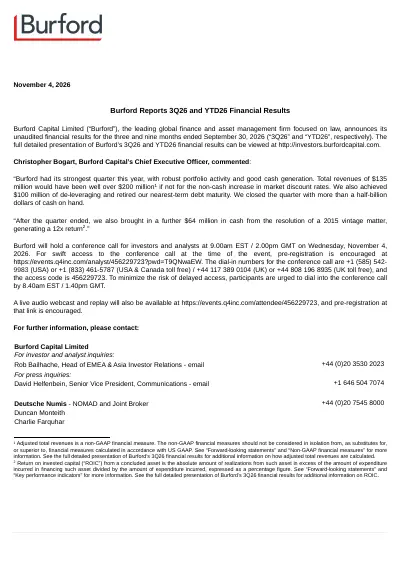
The top line here obviously is that it was a strong quarter. You see the numbers sitting on the slide: revenues up, strongest year to date, more than double the revenues that we posted in the comparative period last year.
That was notwithstanding some real headwinds from adverse discount rate moves that affect our non-cash modeled results, and Jordan will take you through that in a little bit more detail. Without those headwinds, we would have been north of $200 million of capital provision income, well north of $200 million of revenue.
Even with those headwinds, we posted an ROE of 13.4% annualized. If we hadn't had the interest rate headwinds, that number would have instead been well into the 40s.
It was a solid quarter for cash. We're well pleased with the quarterly performance.
In a minute, we're going to talk about a further success that happened after the quarter end. The other thing during the quarter, that it feels a little bit like old news now, but was very significant for us, was the beginning of our delevering campaign.
We took $100 million of debt off the balance sheet. We eliminated our 2028 maturity.
We had an extremely successful new issue that pushed the timing out. We're well pleased with that as well.
Before I turn some pages, I'll just mention a couple of other things of note during the quarter. These all have been sort of out there in the public, but it's worth just rolling them all together.
On YPF, while YPF is likely going to go through an arbitration process, it hasn't completely finished in the US courts. In fact, Monday was the deadline for the filing of what are called amicus briefs.
Those are briefs by third parties who want to express their views to the US Supreme Court about the case. We saw the filing of a significant number of amicus briefs, nine in total, which is an unusually large number for a case like this.
They included, among other things, 15 US states and territories, a US Senator, market participants, and a bunch of policy institutions and legal academics. That was a pretty significant development in the process of that case.
We also, as you know from public statements, during the quarter had a couple of big sort of first-instance litigation activities. We had a successful arbitration win in a case involving an African mining matter against Cameroon.
That was a $600-plus million tribunal award, with Burford entitled to something around a third of that. That obviously has to go through now some more proceedings and some enforcement, but that was certainly a nice, strong result.
We also saw In fact, the largest US patent verdict in history, a very large patent verdict in a case that we had been involved in against Apple. Those all are coming down the road.
We'll see what happens with all of those individually. Turning to Slide 9, I want to use this slide for several purposes.
This at bottom is another strong success from a case resolution. This is a resolution that has already been completed.
We've already got the cash in the door from this. This has been paid in full.
I want to use this to make a number of points. Obviously just the success itself.
We're very pleased with outcomes like this. This is a very significant ROIC, as you can see here.
We made more than 11 times our money. It's a nice, high-return matter with, as I said before, the cash already paid.
I'd really use this to underline a very important point as well. Lots of investors talk to us about old cases, and they talk to us with some skepticism about them.
I think that's probably a hangover maybe from private equity, where if you start seeing things that are a decade old in a private equity fund, the odds of that going well are probably not very high. There's a little bit of a sensation out there that old cases might be bad cases.
We've always said that isn't our view at all. That age in litigation usually means either the case is trundling down the road, a fairly long procession towards trial, or that there have been procedural machinations along the way.
That in our world, old does not mean bad. I think this case is really absolutely proof positive of that adage.
It's also a good case study for the showing the real-world impact of court delay. If you look at the chronology that we've set out here, we won an important point on appeal in 2020.
That set the case up for trial. Sure, there needed to be a little bit more stuff to happen first, but not that much.
In the normal course of things, without COVID, without the pandemic, that you would have reasonably expected that case to be teed up for trial not too long after that 2020 appellate outcome. Instead, it took 6 years.
That is just too long. It's aberrationally long.
The courts are working hard to reduce those timelines. I think we're going to be the beneficiaries of those timelines coming down as we go forward.
It does illustrate what we have seen in this post-pandemic period as well. The final thing I'd point out here is we're also using this as an illustration of how our fair value accounting works.
You can see that it goes up and down, and it follows the events in the case. It also comes out in the right place at the end.
We're very pleased with that and with the ability to share that information about that case with you. Turning to Slide 10, I would really just make the point here.
This is a slide about the volatility of interest rate movements and the consequent impact of that on our non-cash fair value P&L. I really just have to underline this.
I've been underlining it for 17 years, and I'm not going to stop doing it. This stuff has nothing whatsoever to do with cash results in our portfolio.
This is all just interim accounting along the way that all gets washed out when we get to the end of the case and we get to a result. Because of the way the accounting works, and it's not something we have any choice about, there is obviously market volatility as you see interest rate movements.
We saw basically the largest negative impact of interest rates that we've ever had, with 90 basis points of impact in the quarter. Some of that's obviously already been turned around and reversed in the fourth quarter.
That's why you saw a very strong quarter somewhat negatively impacted by these non-cash charges. Finally for me, on Slide 11, the balance sheet.
We have talked to you a number of times about our focus on the balance sheet over the last 6 or 9 months. You've seen us engage in very focused and active management of the balance sheet and our capital structure.
We are committed to delevering. We've started that process.
We took $100 million of leverage off the balance sheet in the quarter. That took our debt-equity ratio down by a third of a turn.
As I said at the outset of the call, that enabled us to retire the entirety of the 2020 maturity debt in full. We had a very successful offering in the market, given where interest rates were at the time, at competitive, satisfactory rates for us to issue a new round of 2029 paper.
Credit rating agencies, debt ratings, all satisfactory around that. This is just the beginning of us continuing to work on and manage actively the balance sheet.
In summary, we're pretty pleased with how the quarter went. We're delighted to be able to give you, in addition to just some strong numbers, some actual data points so that you can have a little visibility and see what's going on inside the business.
With that, I'll turn you over to Jordan and Jon.
Jordan Licht
Thank you, Chris, and thank you, everyone, for joining us this morning. I'm going to start on page 13, which goes over some of the financial KPIs for the quarter and for year to date.
As a reminder, it's hard to compare year to dates between the years, given the activities associated with YPF in the first quarter. Bear with me when I jump around between some quarter numbers and some year-to-date numbers.
Overall capital provision income, which Chris just highlighted was impacted by the movements in interest rates was $116 million, that compares very favorable to the year-to-date pace that we saw last year. Overall net realized gains is just shy of where we were last year on a year-to-date basis, 82 versus 93.
The flip to that is asset management income, which is correlated neatly with our assets as they move, at $29 million versus $21 million. Overall cash receipts, I want to point out, while Chris walked through that case study just a second ago, that case study actually concluded, both the settlement and the realization, in the fourth quarter.
When I'm walking through these numbers, you don't see them appear in it. The 63 or $64 million that we received on that settlement puts us in a nice place compared to year-to-date cash receipts for last year.
The other portfolio metrics, I'll hit on as we talk more about the principal finance segment and the asset management segment. Overall, though, earnings per share at $0.10 took us to book value just slightly below $4.
Chris already hit upon a number of the debt ratios. I'm going to jump forward then to the principal finance segment.
Remember two segments, principal finance is when we're investing for our balance sheet, asset management when we're investing on behalf of the funds that we manage. On page 18, you look at the fair value of the assets on the balance sheet compared to the deployed cost.
That's $500 million compared to the $1.9 billion. You see that ratio, and you then compare that to our historical ROIC.
That's somewhere around 30% versus a 80-plus percent historical ROIC. That demonstrates that there's a lot of revenue to come on the existing assets.
I know I've mentioned that before, but the reason why I hearken back to it is actually the look at the most recent example of the case study that Chris outlined. When you look at that example, you actually see that most of the revenue associated with that asset occurs at the tail end.
If you go back to Investor Day 2 years ago, we actually talked about the fact that around 50-ish percent, when you do some sample sizes, of revenue associated with concluded assets happens within the last year or towards the very tail end. That's the nature of the assets and the valuation model.
The right-hand side shows the diversity of the portfolio. You've seen these pie charts before.
They don't change significantly from period to period, and it just continues to demonstrate the global platform when you look at the geography, as well as the skill sets that we have when you dissect the different asset types of which were invested. How did the fair value move forward?
The page 19 demonstrates how that balance sheet, how the capital provision income, and then just how the asset changes over the period of the quarter. Deployments is straightforward.
When we deploy, we look to capitalize the cash that has gone out the door. You have the impact of duration as we get closer towards the conclusion of an asset.
The change in discount rate, which I won't go into too much, Chris already mentioned it, you can see that's been a headwind not just in the third quarter, but on the right-hand side, you have the year-to-date bridge, and it demonstrates the headwind that it's been for the year. Then you have milestones and other impacts.
These are the favorable outcomes that occurred in trial, or negative, all in cumulation across the models, and the other inputs. That represents itself in the next green bar.
Then of course, you have realizations. That's the progression of our assets.
You can see how it moved from 2.3 to two point just shy of $2.5 billion of fair value at the end of the quarter. On page 20, we outline new business.
The key to new business and to getting realizations is also putting the money out the door. We've consistently put out around a 100-ish million dollars of deployments per quarter, and that you can see on the bottom.
It goes up and down, that's been fairly consistent. Undrawn commitments, slightly larger than where we had finished the year, where we sit right now.
That shows that we have a healthy book of business to continue to deploy to, as well as the discretionary undrawn commitments, which is like a right of first refusal or a partnership with either a law firm or a corporate. When you then look at the year-to-date new definitive commitments, obviously, there's a slight decline when you compare that to year to date last year, as we will tend to look at things more broadly than just a quarter.
What that also represents is a little bit of our focus in the most recent quarter, short-term decisioning around prioritizing deleveraging and liquidity when we compared that to moderate expected returns that was in the pipeline at that moment. With that, I'd like to turn it to Jon.
Jon Molot
Thanks, Jordan. Thanks to you all for joining.
Turning to Slide 21, and this slide confirms what we've always said, that there's period-to-period unpredictability to the business. For example, Chris mentioned that case that came in after the quarter, that would have changed the numbers for the quarter.
We're consistently generating positive cash flow and case realizations, and I focus less on the quarter than the longer-term activity. There's a ton going on.
If you turn to Slide 22, you see that over time, that has translated into us passing quite a remarkable milestone that we've taken in $4 billion of cash realizations. I think back to when we started this business from scratch 17 years ago, and to think that it's now generated more than $4 billion in cash, with desirable returns and consistently low losses, it's a great business model.
As Chris said, there was a period with COVID where things backed up and it took longer, but that stuff is in the portfolio moving through. Some of the stuff where we see activity is much more recent vintages, as well.
Turning to Slide 22, you've seen this as well, Slide 23, you've seen as well. This is how it happens, that there's sort of a natural spread of possible outcomes to matters with asymmetric return profiles, and that makes it a very attractive business class if you've got the right team to do it, which we do, and we've built a pretty good mousetrap.
With that, I will turn it back over.
Jordan Licht
Thanks, Jon. I'm on page 26 to talk briefly about the asset management segment.
Two key numbers to look at: both the GAAP income number, which is on the left-hand side, which shows increase year-to-date of $29 million versus $21 million; and then when you look at the cash number that we've received year to date, generally in line with where we were over the same period last year, overall $14 million versus around $16.5 million. Obviously, you can see in the bottom, we continue to enjoy the partnership on BOF C, and that's what represents the profit sharing income.
Those assets are quite correlated to the assets that we have on balance sheet. Then you see the runoff of the other funds as we continue to manage those down.
Moving to page 28, which highlights the liquidity and our capital bridge, started the year at $621 million, and now we're at 514. Then that, of course, includes the redemption associated, that Chris just highlighted, of the '28 bonds, and as part of that redemption, a $100 million reduction in our total debt outstanding.
We sit strongly in a liquidity position from a cash perspective at the end of the quarter, and $120 million in our due from settlement balance as well. That doesn't include the case study, right?
That was a fourth-quarter event that of $64 million that has already paid out. Page 29 outlines our operating expenses.
Here again, I'm going to mention that some of these numbers get distorted a bit when you try and look at the year-to-date comparisons. There's a couple of items to make sure that we describe so that people can digest the numbers.
First and foremost, when you try and dissect the long-term incentive compensation, the negative number in the year-to-date, positive numbers obviously in the quarter, when you push that together and then try and strip out the YPF-related mark, what you do see is that the long-term incentive comp was approximately 10% of our non-YPF revenue, and that's generally in line with the guidance that we've historically given around the range of the carry program. The other piece you can see is the large number in the year-to-date case-related expenditures.
That $31 million represents or $28 million of the $31 million represents deployed cost that is not able to be capitalized in the investment. From our vantage point, it's deployed cost just like every other asset, and just given some of the accounting rules, we can't capitalize it.
We'll continue to outline that number for you so that it can be tracked and appears appropriately in our investment table. And $18 million of that was a reversal associated with some deployed costs from previous periods.
Obviously that number distorts a bit of the income statement. You can see our G&A is tracking below where we were on a year-to-date basis compared to last year.
With that, I'm going to move then to wrap up on our capital structure. Normally, I get this slide, but Chris took a little bit of my thunder early on in the conversation here, I won't repeat all of those activities except to say look, we're in a great spot considering our debt-to-tangible book value ratio having come down a third of a turn since last quarter.
The other piece, when you look at our weighted average cost of debt at 8.2%, that compares very favorably to a 25% historical IRR. Then you look at the debt outstanding and the weighted average life of it, and you compare that to the average life of concluded assets, or even the active deployments that we have, and we feel as though we built a capital structure that puts us in a good place and a good position.
With that, I'd like to turn to Chris to handle any closing remarks before we get to Q&A.
Chris Bogart
Thanks, Jordan. I'm on Slide 31 just to wrap up.
Just to go back to where I started, very pleased with the robustness of the quarter, not only in terms of the operations of the business and its cash generation and case progress, but also in terms of the work that we did on the balance sheet. I will echo Jon's amazement at getting over the $4 billion threshold.
That's $4 billion of cash. Those are not accounting numbers, that we have realized on successful investments, while being able to continue for a long period of time to generate desirably high, positive returns and desirably low losses.
We are leading this industry that keeps on growing. We've got a large portfolio that's going to throw off cash for years to come, as we continue also to originate new business.
We are pretty excited, as you can probably tell, about where we are. With that, we'd be delighted to take your questions.
Operator
We will now begin the question-and-answer session. If you would like to ask a question, please press star one to raise your hand.
To withdraw your question, press star one again. We ask that you pick up your handset when asking a question to allow for optimum sound quality.
If you are muted locally, please remember to unmute your device. If you have logged in via the webcast, please use the Q&A button to submit your answers and questions.
Please stand by while we compile the Q&A roster. Your first question is from the line of Timothy D'Agostino with B.
Riley. Timothy, your line is open.
Please go ahead.
Timothy D'Agostino
Hi, good morning. Thanks for taking the questions.
I guess to start on the focus for deleveraging, could you just maybe talk through the priorities when you approach deleveraging? Is it handling the closest maturities, maybe paying down the highest-coupon debt, or looking out to the deepest discounts of long-term debt where it's trading at?
It'd be great to just kind of understand your priorities around handling the deleveraging, and maybe how you rank those three initiatives or the way you look at the debt. Thank you.
Chris Bogart
I think, and Jordan can talk in more detail about this, I think the answer is sort of all of the above. Those are all things that we take into consideration.
The other thing, of course, that we're taking into consideration is the business opportunities to be able to put new capital to work as well. The goal, as we've said consistently during the course of this year, is to do both of these things, is to deleverage the balance sheet while also continuing to grow the business.
Growing the business, of course, is its own form of deleveraging, because as we drive in returns from the portfolio, those build equity value and delever the business as well. We sit in a pretty active capital management world where we're considering all of those dynamics, pretty much in real time all the time.
Jordan, do you have something to add there? No,
Jordan Licht
I think you hit the points well. I'll add just a little bit, which is we've purposely built a long-term capital structure for a reason, to match the assets that have unknown duration.
That being said, you're right. We've got some higher bars in some of the earlier maturities.
You get the most gain to equity if you buy back a little bit of debt in the long term. I think when you take all of those, Chris was right in saying it's a little bit of everything.
Timothy D'Agostino
Got it. That's helpful.
I guess, just thinking about deleveraging while still growing the portfolio and kind of I guess having that kind of dual mandate to help deleverage the business, could you just probably Can you just give us some commentary on what do you think about cash? Maybe, what's the minimum cash balance decreased quarter over quarter?
Obviously with repurchasing $100 million of debt and putting money to work. What's the minimum liquidity that you want to hold just to get a better sense?
Chris Bogart
Jordan?
Jordan Licht
Yeah. I don't think there's one number that we look at in terms of minimum liquidity.
I think it varies based off of a number of different factors. We have good visibility to the portfolio in terms of what activity is going out the door on a regular basis, given the fact that these aren't revolvers, and that we understand where the cases sit.
We have visibility, not as close, but some visibility on to where we expect cases to resolve, and when, just given all the activity. While we can't predict each case, we do with a large, diversified portfolio feel comfort in the fact that things will resolve throughout the year.
Then we have new business and opportunities. Unfortunately, it's difficult for us to sit here and give the market a direct answer to say, hey, what's the minimum amount of cash that we would see on the balance sheet?
I do feel as though we have a little bit of extra compared to where we normally have, and you can see that based off of our historical balances and how much we've carried. We don't give guidance on the exact number.
Timothy D'Agostino
Okay. Thank you so much.
Operator
Your next question from the line of Henry Coffey with Wedbush. Henry, your line is open.
Please go ahead.
Henry Coffey
Yes. Good morning, and thank you for taking my question.
I hope it don't seem too stupid here. I was trying to straighten out some of the moving parts.
You were talking about the cash case-related expenditures, and you said there was a reversal in there?
Jordan Licht
Yeah. When you look at the case-related expenditures overall for year to date, we had originally deployed that capital.
Okay. Year to date.
Okay. We had originally deployed that capital and capitalized it into the balance sheet.
Overall, case-related expenses year to date is $31 million. $28 million of that we view as a deploy-
Henry Coffey
Wait. Hang on.
Hang on, I've got to get to the right numbers then. Okay.
Overall case-related expenditures Overall,
Jordan Licht
Yep. I'm on
Henry Coffey
page with $31 million. Yeah.
Jordan Licht
I'm on page 29. There was $31 million.
Of that $31 million, 28 is related to what we call a deployment, right? Those are deployments, unfortunately, though, that we can't actually put out and capitalize, and so it comes through an expense.
Of that 28, 17 to $18 million of it was from the previous year. Those weren't deployments of cash that we had put out this year, they were from a previous year that we had capitalized, but that we unwound and expensed this year.
Hopefully, that helps.
Henry Coffey
What about as it applies to the 3 months of 2026? Were there any reversals in
Jordan Licht
No,
Henry Coffey
I'm looking at the P&L, yeah.
Jordan Licht
I was referring to the year-to-date numbers then. We have a little under $4 million of case-related,
Henry Coffey
and
Jordan Licht
That's just regular way. Right.
Henry Coffey
Okay. Then you talked about I understand how the numbers work.
Jordan Licht
Okay. Go ahead.
Henry Coffey
They don't let you do certain things. If we had, I don't know, we could maybe do 5 or 6 hours and I'll tell you what I think about GAAP.
The case studies, the 64 million, what was that? Is that a realization this quarter?
Jordan Licht
This was a fourth-quarter event. What you can see on looking at that page is we outlined how the asset has moved forward over time.
What will happen in the fourth quarter, right? Look, what happened in the third quarter, you can see there's a little bit of unrealized gain that occurred, based off of I can't get into too much details because of confidentiality, but based off of some occurrences and developments associated with the case.
There's a little bit of unrealized bump that you see in the third quarter, and then in the fourth quarter, what you will see is the subsequent realization. If the quarters were happening on days, that realization would turn into a due from settlement, but it immediately went from a due from settlement into cash.
Henry Coffey
That's a that's a positive. In terms of sort of outlining where you stand, we'll call it soon or today or where you stand during the fourth quarter, how much liquidity and funding capacity do you have right now?
I know
Jordan Licht
Yeah,
Henry Coffey
how much business could you, how much
Jordan Licht
Yeah. If you think about our business, well, one, we sit in a similar liquidity position, I'm not going to give an exact cash number of how much is on the balance sheet today, but it's similar to where we were at the end of the third quarter.
In terms of how much business could we do today, I think the answer is, majority of our cases are what are drip capital, and they're capital that goes out the door over time, and not a large monetization immediately. Those over time over multiyear periods.
We have plenty of room to continue to invest in new assets and continue to grow the portfolio as the historical portfolio rolls off.
Henry Coffey
You yeah, you have $446 million in cash right now, 60 million of marketable securities, so that gets you to 560 or so
Jordan Licht
of quote
Henry Coffey
What? 514.
Jordan Licht
Yeah. The marketable securities are very short-term, so, we practically treat them as cash.
Henry Coffey
Okay. You could fund 500-and-something million of business with what you've got on hand today.
That's not how the business works. Nobody calls up and says, "I need $500 million now."
You do have that. What about additional debt capacity?
Where
Jordan Licht
Yeah. In fairness, we have had people call up and say, "I need a couple hundred million."
I'm not sure of $500 million. We have historically done some large monetizations.
In terms of debt capacity, right now we're at our covenant levels. There are baskets that we could use to do some incremental items, but our goal is to actually see the debt-to-equity ratio improve, as opposed to taking on any more debt.
Henry Coffey
Would there be an appetite for preferred or something if you needed, or would you rather go to the third-party market and out do a managed deal?
Chris Bogart
I don't know that we see the need to do that at all. When you think of the business, we can control the amount of new business that we take on.
Our goal is to continue to grow the business, but also, as Jordan said, to reduce the level of debt that we have, or to reduce the debt-equity ratio. I think that we would opt to If we all of a sudden had an onslaught of a billion dollars of client demand in the fourth quarter for business, I think the simple answer is we wouldn't do all of it.
Henry Coffey
If improving your debt ratios, some of that obviously will come from earnings, how much cash would you be willing to commit to that over the next 3 to 6 months?
Chris Bogart
I think it depends. It's a fluid, as we said in response to Tim, it's a fluid issue for us, because we're sort of constantly looking at three different dynamics at the same time, right?
We're looking at how much deleveraging we want to do, how much new business we want to put on, and then, in the existing portfolio, what are the net flows from the existing portfolio? How much capital is coming in from cases that are resolving, and how much cash is going out to cases that we've already taken on and are underway?
We sort of engage in a real-time basis in that triangulation while also maintaining a liquidity cushion as we do that.
Henry Coffey
Okay. Thank you very much.
A great quarter. Good accomplishment.
Chris Bogart
Thank you. Thank you very much.
Appreciate it.
Operator
Your next question from the line of Hal Potter with Bank of America. Hal, your line is open.
Please go ahead.
Hal Potter
Hi, gents. Thanks for taking my questions.
Just two quick ones from me. One is on your operating expenses.
You've called out $10 million of annual compensation savings from changes to your management teams. Could you just give us a bit of color on where in the business those have occurred?
Do you expect any impact on performance of those business lines? Then, secondary is about modeled realizations.
It would just be great to get a sense of how those are tracking. Obviously, you had your 5.2 at Q2.
It'd be good to get a sense of how those are shaping up, particularly in the context of your new business. Your new definitive commitment mix is mainly in the less than 10% model risk category.
Is that a deliberate shift? Does that impact your return expectations?
Thanks.
Chris Bogart
Jordan, do you want to do those?
Jordan Licht
Sure. I'll try and hit all of all of them, and and if I miss a little bit, tell me.
Look, we talked, I think, a little bit more in detail in the last quarter around some of the moves around the expense savings. Those were predominantly in middle middle management.
Don't real don't really we don't see them affecting our ability to continue to execute against the portfolio, as well as to see new growth opportunities. While we had one or two retirements, and we wish some of those folks well, they've been with the the company for quite a long time.
Again, I think we feel very well positioned in order to execute against our goals around the portfolio, both seeing the existing portfolio and new growth. With respect to the $5.2 billion, we give an update on an annual basis, not on a quarterly basis, of what are expected what what the models produce with the models real- modeled realizations.
When you saw that referenced in Q2, that was actually referencing the year-to-date nu- the excuse me, the end-of-year number from the previous year. We'll give an update on where that stands again in the next in the next quarter.
In terms of the the mix of new business, I think overall there's probably there's always deliberate decisions around each of the investments that we do and what we see. I think that overall we see a good mix that will allow us to produce along our historical returns.
I think we're conscious of, as always, but continuing to be conscious of larger deals that would potentially have longer duration. Outside of that, I think we we still continue to see healthy pipelines, and we haven't significantly changed the way in which we view new business.
Hal Potter
Thank you very much.
Jordan Licht
Thank you.
Operator
Your next question from the line of Michael Dunlevy with Deutsche Bank. Michael, your line is open.
Please go ahead.
Michael Dunlevy
Hi. Thanks for taking my questions.
I just had two quick ones as well. The first, I just wanted to ask about the really strong fair value gains related to milestones, and confirm the timing around the Apple patent case.
I know you put out a statement on the jury verdict very late in the quarter, and could you just confirm if any fair value milestones related to that verdict would have been captured here this quarter as opposed to 4Q, given it was right on the cusp?
Chris Bogart
Jordan can talk to the accounting. Let me maybe just say a word with your question though about the case progress.
When things like that happen, that's just the first act of the play, if you will. Unlike the case study that I took you through, which was a resolution by settlement, which means you can both finish the case and get the cash in a short period of time, when you have a contested piece of litigation, especially one that has a very substantial trial win like that, there are going to be a series of steps that need to be gone through thereafter.
You start with staying in the trial court and doing post-trial proceedings, where one side's trying to knock out the verdict, and the other side is trying to keep it or add interest to it, or add some other embellishment to it. Then, if there's not a settlement along the way, then a case like that is obviously going to end up going up on appeal as well.
As I said, we've got a number of acts still to play in a case like that. Jordan can talk to the accounting.
Jordan Licht
Yeah. When milestones occur in the quarter, we would look to account for them in the quarter that they occurred.
I think, but as Chris outlined, there's a lot more litigation risk and procedure associated with the case.
Michael Dunlevy
Got it. Thanks.
That's helpful. Then just to follow up on new business as well, you called out in the slide the conscious pull back in new commitments to prioritize delevering in the short term.
I realize this all depends on the opportunities coming in and how attractive they are, but is there a ballpark range for the amount of new commitments you might expect to take in on a quarterly basis over the next 12 months or so?
Chris Bogart
No, we don't really think of it in quite those terms. We get a meaningful flow of potential opportunities, and we close on the ones that we like, calibrated by where we sit with liquidity, deleveraging, and sort of our risk tolerance for price.
If you look at the bands that we put out, what you see is that in last in 2025, we were doing considerably more business in the what we call the 10% to 25% risk band than we did in 2026. What I'm going to say is not hard and fast, because cases fit into lots of different buckets.
As a general rule of thumb, you can sort of think about the lowest risk band being sort of multi-case, cross-collateralized portfolios. You can think of the middle band as being relatively low-risk, larger transactions that are often including a monetization element.
You can think of the upper band as being more likely to contain traditional litigation, like a single-risk case. The middle band is where you see us doing less work, right?
We're pretty much on top of the low-risk band, and we're actually a little bit above on the high-risk band. What that suggests is us saying, "Well, gee, if somebody shows up with a chunky, low-risk ask, and therefore because it's low risk, they're only prepared to pay a comparatively low return to us on the capital, more this year than last year, we might say, 'Eh, maybe not.
Maybe we'll instead husband that capital and use some of it to buy back debt, or put it towards the deleveraging that we did this quarter.'" That sort of the decision tree that you see us going through.
Michael Dunlevy
Got it. Thank you.
That's really helpful.
Travis Lenkner
We have some questions from the webcast as well. The first being with respect to the 2016 and 2017 vintages, do you have expectations that these vintages will realize gains beyond merely covering deployments?
When can we expect to see significant upside on these vintages?
Chris Bogart
If you think about the pace of litigation, these are your very classic COVID vintages. I know that seems strange, because they're 2016 2017 2016, 2017, but when you think about the cadence of litigation, if you're starting down the road with a case in 2016 or 2017, you would have realistically been thinking that you'd be getting to trial in and around 2020.
Welcome to COVID. Those are vintages that have seen real pandemic-related delay.
Just as we showed you with the case study, that does not in any way mean that we have lost faith in what the vintages are going to perform. What's happened is delay.
Sometimes that is corrosive to IRR, but in terms of their ability to produce well above the deployments, there's no reason to believe that the performance is going to alter on a cash basis for any particular vintage of cases. Each vintage, of course, does perform differently.
There's nothing about those vintages when you look at them that makes you say, "Oh, gee, something went badly wrong there," as opposed to looking at them and saying, "Gee, those are cases that should have been done by now."
Travis Lenkner
The next question, also from the webcast: the debt-to-tangible book value multiple is 3.2. Do you have a target?
Chris Bogart
I think we sort of went through that before. Go ahead, Jordan.
Jordan Licht
Yeah. Oh, no, I didn't mean to cut you off there.
What I was going to say is the first piece is that, obviously, we have covenant ratios, but those covenant ratios were set at a time where we had one single large asset, and so, while we've historically talked about a 1.25 or 1.5 times ratio, I do want to highlight the fact that we have actually a very diversified portfolio when you think about the GAAP numbers and the fair value associated with that compared to the debt. I don't think Chris, you're probably going to say, I don't think we have an exact number or an exact target, except to say we understand that it's higher right now, and there's two ways to attack it, which is to continue to have positive quarters from a milestone standpoint that helps produce incremental equity, and then continue as the portfolio resolves to use some of that cash not just for new business, but also to help delever.
Chris Bogart
Yeah.
Travis Lenkner
The last question, also from the webcast: do you believe Burford Capital's shares are fairly valued at the current market price? If not, where do you believe the gap between market value and intrinsic value comes from, and what events do you expect could help close the gap?
Chris Bogart
It's obviously for the market to value the shares instead of for me to do so. I probably belong pretty firmly in the club of CEOs who are unlikely to say anything other than, "Yeah, I believe the business is worth more than the market does."
Why do I believe that? I believe that because of the track record that we've developed over 17 years of being able to produce high returns, with, as I said earlier, with consistently high returns with consistently moderate loss rates.
I think that warrants the combination of being able to do that, and the growth that we have shown over time, I think that warrants a higher valuation than the market is presently according us. That being said, we're all very conscious of the fact that this has been a turbulent year, and that has both taken some time to settle down, and it also has involved the rotation of a number of investors.
Jon and I, as are individually the largest shareholders in the business. We have a longer-term perspective on it.
It's obviously our hope that continuing to show performance of the way that we have been, and continuing to have a focus on the balance sheet will close that gap and see continued share price improvement.
Travis Lenkner
Now the last question, one more from the webcast: if the Q4 case win of $64 million isn't in the due from settlement component, is it still accounted for on the balance sheet in capital provision assets?
Jordan Licht
Yes. That's exactly how to think about it.
If you look at page 9, you'll see, and we actually outline what the fair value was. It would have been as of the end of the quarter accounted for in capital provision assets at just under $31 million.
Chris Bogart
I think that brings us to a close. For those of you who were curious, the dulcet tones of our question reader, that was Travis Lenkner, our COO, who came along for the ride to help us out managing both the phone questions and the website questions.
Thank you, Travis. Thank you all for joining us today.
We were very pleased with the quarter, and we look forward to pushing through to the end of the year, and reporting some interesting numbers to you when we talk to you again in February. Thank you again.