CCL Industries Inc. Class A
Q3 FY2026 · Earnings Call TranscriptNovember 11, 2026
Operator
Good morning, and welcome to the CCL Industries 2026 Third Quarter Investor Update. Please note that there will be a question-and-answer session after the call.
The moderator for today is Mr. Geoff Martin, President and Chief Executive Officer, and joining him is Mr.
Sean Washchuk, Senior Vice President and Chief Financial Officer. Please go ahead, gentlemen.
Sean Washchuk
Thank you, Matt. Good morning, everyone.
We're dialing in today from Mexico City where we just hosted our third quarter Board of Directors meeting. Let's get started.
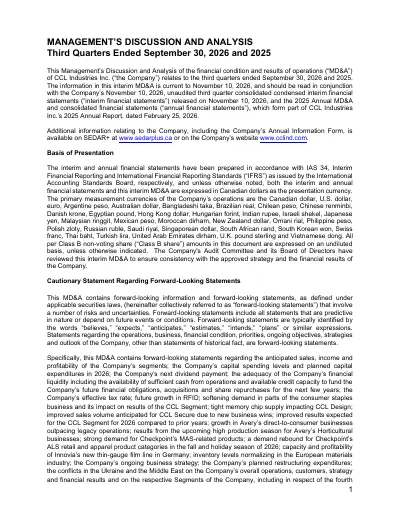
Moving to slide 2, I'd like to draw everyone's attention to our updated disclaimer regarding forward-looking statements. I'll remind everyone that our business faces known and unknown risks and opportunities.
For further details of these key risks, please take a look at our 2026 third quarter report and our 2025 annual report, particularly the section Risks and Uncertainties. Our annual and quarterly reports can be found online at the company's website, cclind.com, or at sedarplus.ca.
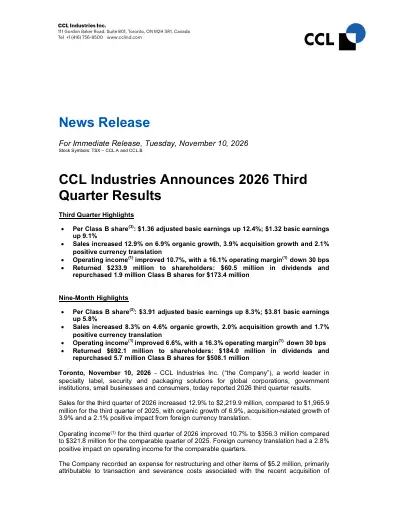
Moving to slide 3, our financial summary: for the third quarter of 2026, sales increased 12.9% with 6.9% organic growth, 3.9% acquisition-related growth, 2.1% positive impact from foreign currency translation, resulting in sales of $2.22 billion compared to approximately $1.97 billion in the third quarter of 2025. Operating income was $356.3 million for the third quarter of '26 compared to $321.8 million for the third quarter of 2025, an improvement of approximately 8% excluding currency translation.
This, however, did include $2 million of non-cash acquisition accounting adjustments to fair value acquired inventory from the Sleever transaction. Excluding this non-cash adjustment, operating income improved 11.3%.
Geoff will expand on our segmented operating results for the CCL, Avery, Checkpoint, and Innovia segments shortly. Corporate expenses were up for the 2026 third quarter compared to the prior-year third quarter due to higher variable compensation expense and general costs.
Consolidated EBITDA for the 2026 third quarter, excluding the impact of foreign currency translation, increased 8% compared to the same period in 2025. Net finance expense was $20.3 million for the third quarter of 2026, higher than the $18.2 million for the third quarter of 2025.
The increase is due to higher finance costs on the company's drawn debt and a reduction of finance income on the company's cash and cash equivalents. The overall effective tax rate for the third quarter of '26 was 27.7% compared to an effective tax rate of 25.5% recorded in the third quarter of 2025.
This is due to an increase in taxable income in higher tax jurisdictions and an increase in withholding tax on repatriated cash from foreign regimes compared to the third quarter of 2025. The effective tax rate may change in future periods depending on the proportion of taxable income earned in different tax jurisdictions with different rates, or if more cash is repatriated from regimes imposing withholding tax to Canadian domiciled corporations.
Net earnings for the 2026 third quarter was $223.6 million compared to $210.8 million for the third quarter of 2025. For the nine-month period, sales, operating income, and net income increased 7%, 5%, and 2% excluding currency translation, respectively, compared to the nine-month period in 2025.
2026 included the results from four acquisitions completed since January 1st, 2025, delivering acquisition-related sales growth for the period of 2%, organic growth of 4.6%, and foreign currency translation was a tailwind of 1.7% to sales. Moving to our next slide, earnings per share: basic and adjusted basic earnings per Class B share were $1.32 and $1.36, respectively, for the 2026 third quarter compared to $1.21 basic and adjusted basic earnings per Class B share in the 2025 third quarter.
Adjusted earnings per Class B share increased 12.4% compared to the third quarter of 2025. The 15 cents increase in adjusted basic earnings per share was primarily driven by improved operating income of 12 cents, share count reduction accounted for 4 cents, and there was a 4 cents positive impact from foreign currency translation.
This was partially offset by higher income tax rate, increased net finance costs, and higher corporate expenses summing to 5 cents. Moving to our next slide, free cash flow from operations: for the third quarter of 2026, free cash flow from operations was an inflow of $236.5 million compared to an inflow of $233.4 million posted for the third quarter of 2025.
The decrease is principally due to improved earnings offset by an increase in working capital and an increase in taxes paid for the third quarter of '26 compared to the prior-year third quarter. For the trailing 12 months, our free cash flow from operations remains very strong.
Moving to our next slide, returns to shareholders: during the first nine months of 2026, the company moved from a discretionary share buyback to an automatic share purchase plan that commenced March 2nd of this year. Year to date, September 30th, 2026, the company repurchased 5.7 million shares for $508.1 million.
In addition, during the blackout period starting October 1st to yesterday, the company also repurchased 1.3 million shares for $128.1 million. Including the 12.5% increase in the 2026 annual dividend announced in February of this year, dividends paid year to date amounted to $184 million for a total of $692.1 million returned to shareholders, including the aforementioned buyback.
It is the company's expectation that more will be returned to shareholders in 2026 as the automatic share repurchase plan is active in the market daily, including blackout periods when the company was not permitted to make purchases in 2025 under its discretionary buyback plan. I'll remind everyone our Board of Directors has authorized us commencing March 2nd of 2026 to spend up to $1.2 billion over that 12-month period on share buybacks.
Moving to the next slide, our cash and debt summary: net debt as at September 30th, 2026, was $1.76 billion, an increase of $497.6 million compared to December 31st, 2025. The increase is principally a result of higher total debt outstanding due to capital expenditures, business acquisitions, and our share buyback plan.
Despite the increase in the company's net debt, the balance sheet closed the quarter in a strong position. Our balance sheet leverage ratio was 1.03 times as at September 30th of this year, up from 0.78 times reported at December 31st, 2025.
Early in July of this year, the company signed a delayed draw syndicated term loan for $500 million US dollars. This term loan was accessed subsequent to the quarter end on October 1st to repay the US $500 million of bonds falling due on this date.
The term loan bears interest at SOFR plus 85 basis points. CCL's current liquidity remains strong, with US seven point- $0.7 billion of undrawn debt capacity and cash on hand of $1 billion.
The company's overall average finance rate was 2.6% at September 30th, 2026, up slightly from 2.5% at December 31st, 2025. This reflected an increase in our variable drawn debt in the first nine months of this year.
Finance costs should increase in future quarters as the company's new syndicated term loan bears interest currently at approximately 4.75%. The company's balance sheet continues to be well-positioned as we move through the balance of 2026 and into 2027.
Geoff, over to you.
Geoff Martin
Thank you, Sean. Good morning, everybody.
I'm on slide 8, highlights for capital spending for the year: $302 million spent so far through Q3. That's quite a gap to the $470 million that we plan to spend this year, I would estimate we will probably undershoot by something in the range of $30 to $50 million, and we'll see how that pans out at the end of Q4.
Slide 9 highlights for CCL: very strong organic growth, high single digits in North America and Europe, mid single digit in Latin America, low single digit in Asia Pacific influenced by CCL Design, which I'll talk about in a minute. Good profitability gains in Healthcare and especially Food & Beverage, solid results in Home & Personal Care for labels, but our aluminum container profitability fell on swings in metal costs.
CCL Design was impacted by unprecedented memory chip inflation, which really hurt some of our customers, and supply availability of chips for the whole electronics industry in Asia has become quite a topic du jour, and we have tough comps for an unusually strong prior year at CCL Secure. Slide 10 highlights for Avery: strong organic growth again in the direct-to-consumer product lines, especially in the United States, a very smooth back-to-school season in North America, absent of many of the issues and challenges we faced in Q3 last year, a stable quarter in the horticulture, even though it's a seasonally low period.
Slide 11 highlights for Checkpoint: the MAS merchandise availability business had a solid quarter, despite difficult comps on some large retailer rollouts last year of new technology, which gave us quite a hurdle to overcome, but we just about did it, and the apparel label business improved modestly as industry demand recovered. RFID growth continues quite nicely.
Slide 12, Innovia: so, 24% change in sales rate here. I can tell you about half of that is volume driven, the other half is price and mix.
It's certainly not an entirely a volume story. We had very good results in Poland as EcoFloat continued to gain share, and other label films growth continued.
Very, very good performance in the Americas. I'm going to visit the main plants in Mexico here on Friday, and internal productivity initiatives really helped improve our profitability mix.
European results were impacted by the corrective destocking in the pressure sensitive materials industry channel following the demand spike in Q2 caused by events in the Middle East, and we expect that to continue some in Q4, and our German startup losses narrowed modestly. Slide 13, outlook for the next quarter: core CCL segment orders in Home & Personal Care, Healthcare, and Food & Beverage, our core CCL label businesses, are stable, but our CCL Design business and particularly its customers will be further impacted by the memory chip supply crisis in what is normally a peak season for customer demand.
This is really a supply issue. It's not about end use market demand, it's really about the ability of our OEM customers to build enough units to supply the market.
Avery and Checkpoint both face strong comps in Q4. Innovia should see similar demand patterns as Q3, albeit December is a very short month.
EcoFloat growth is continuing, good results in the Americas will also continue, but we will have the ongoing effect of the destocking events in Europe to deal with. FX should be a modest plus in the coming quarter.
With that, operator, we'd like to open the call for questions.
Operator
Certainly. Everyone, at this time we will be conducting a question-and-answer session.
If you have any questions or comments, please press *1 on your phone at this time. We do ask that while posing your question, please pick up your handset if you're listening on speakerphone to provide optimum sound quality.
Once again, if you have any questions or comments, please press *1 on your phone. Our first question is coming from Ahmed Abdullah from National Bank.
Your line is live.
Ahmed Abdullah
Hi. Good morning, and thanks for taking my question.
My first question is on the CCL segment. You've delivered solid organic growth, despite a somewhat softer consumer backdrop.
Can you give us a bit more color how much of that came from volume versus pricing here, and what are you seeing early in the fourth quarter around that dynamic?
Geoff Martin
It's very difficult to measure volume and price in this part of our business. It's too many transactions with too many different natures.
I can tell you the strong businesses in the quarter were Healthcare and Specialty, Food & Beverage, the label side of the Home & Personal Care business was also strong. CCL Design impacted by soft automotive and electronics markets, impacted by the chip problem, and we had tough profitability at CCL Secure.
Ahmed Abdullah
That's fair. Just touching on the Sleever integration, it's your first full quarter here.
How are the margins tracking against your acquisition assumptions here, and any operational changes that you can give us some color on, and how that's going to bring in some associated savings?
Geoff Martin
It's early days yet. It's only a few months since we've owned this company.
The impact on our P&L was pretty modest in the quarter because we had all these acquisition accounting effects of eliminating profit on finished goods inventory that we acquired. Marginal gains in profitability this quarter, that will eventually phase out.
We've taken some actions to cut costs in a number of areas, but so far we're pretty pleased. The underlying financial performance is pretty much in line with expectations.
Ahmed Abdullah
That's fair. Just one final one on housekeeping: tariff refunds in the quarter, can you quantify how much that contributed to overall EBITDA?
Geoff Martin
Handfuls of millions of dollars.
Ahmed Abdullah
All right. Thank you.
Operator
Thank you. Our next question is coming from Hamir Patel from CIBC Capital Markets.
Your line is live.
Hamir Patel
Hi, good morning. Geoff, you've seen organic growth north of mid single digits for the last two quarters.
Do you see that level of organic growth being sustained in Q4 and into 2027?
Geoff Martin
We just don't know. Your guess is as good as mine.
The consumer environment, as we all know, is quite challenged with the availability crisis. We see some parts of the world doing well, and we see some parts of the world struggling a bit, and look across all the commentary in the CPG space, you hear that.
Europe gets called out by a lot of companies as being slightly weaker than other parts of the world. Developed markets are generally considered to be less good than emerging markets, emerging market strength has been a feature of why I think some businesses held up in the consumer space pretty well.
Look, how sustainable it is and what happens in the future given all that's going on in the world, who knows? For now this is what we have.
Hamir Patel
That's helpful. Just turning to CCL Design, from a volume standpoint just given the memory chip shortages, how are volumes tracking with those customers, and you referenced weakness on the auto side as well, if you could speak to maybe how volumes are faring on that side of CCL Design?
Geoff Martin
It's very difficult in the PC sector. We hear demand reports.
It's not really demand. I'm sure these companies are being overwhelmed by people in their distribution channels for wanting to get product.
The output demand is down well into double digits, high teens, 20% in the PC space. It's also inflation is become a factor.
When you have inflation in memory chips, you look for cost savings in other areas, those customers are a lot more demanding about pricing than they have been in more recent quarters because of that. It's a double-edged sword.
We know the demand will improve. We know there's some chip supply products will become available in 2027.
How soon they'll be able to deal with this crisis in a meaningful way is not clear. Some of our customers say it's likely to continue for a few quarters into next year, but this is a pretty fast moving space, we'll just have to wait and see what really unfolds.
It's been quite an unpleasant surprise in that part of our business.
Hamir Patel
On the auto side?
Geoff Martin
The orders are down because they're all on just-in-time manufacturing, our orders are a reflection not of their consumer demand, they're a reflection of what they can make. Orders in that space are down.
Hamir Patel
Right. Okay.
Just the last question I had, Sean, how are you thinking about capex in 2027? Any major organic projects worth highlighting?
Sean Washchuk
What? It'll be in the neighborhood of $470 million give or take.
We're going through our budget process now, so, it's a good question for us at the end of Q4 if we have any major projects to take on next year.
Hamir Patel
Fair enough. Thanks.
That's all I had. I'll turn it over.
Operator
Thank you. Your next question is coming from Sean Steuart from TD Cowen.
Your line is live.
Sean Steuart
Thank you. Good morning, everyone.
Couple questions with respect to the outlook. You referenced strong Q4 comps for Avery and Checkpoint, and Avery would seemingly make sense, but Checkpoint last year, Q4 '25, organic sales were down 8.1%.
That looks like an easier comp. Just wondering, Geoff, if you can clarify the outlook for Checkpoint for the fourth quarter.
Geoff Martin
The problem last year was all in the apparel industry. The comp challenge for us is really more in the MAS space where we had hardware business, and that's where we face tough comps.
Sean Steuart
Understood. You referenced stable demand for the core CCL segment excluding Design and for Innovia.
When you say stable, is that meant to reflect steady year-over-year or quarter-over-quarter trends or both? Just trying to qualify exactly what you're referencing there.
Geoff Martin
Stable means stable.
Sean Steuart
Okay. Then, just lastly, with Sleever and the other acquisitions fully integrated and obviously with a lot of flexibility in the balance sheet, can you give updated perspective on what the M&A pipeline looks like and your appetite for more deals?
Geoff Martin
We always have an appetite, but we're a disciplined buyer, we'll have to wait and see how things unfold. We didn't predict we would have bought Sleever International this time last year, but strange things happen in life, if you're patient and disciplined, good things eventually come.
Sean Steuart
Understood. That's all I have for now.
Thank you.
Operator
Thank you. Our next question is coming from David McFadgen from ATB.
Your line is live.
David McFadgen
Oh, great. Thank you.
A couple questions. Just on the RFID growth, I was wondering if you could give us a little more detail.
Was it low single digit, mid single digit? Then could you give us just an update on the size of the RFID [business?]
? I think before it was around $250, $270 million.
Just wondering where that stands right now.
Geoff Martin
Sorry, David, your voice is very muffled. We can't hear you.
Could you repeat the question?
David McFadgen
Is this better? Hello?
Geoff Martin
Just. We can just about hear you.
David McFadgen
Oh, okay. Sorry.
I guess I have a bad connection. Just on RFID, I was just wondering if you could clarify what the growth is.
Is it low single digit, mid single digit? Then can you just give us an update on the size of the RFID business?
I think before it was around $250, $270 million. Just wondering where that stands right now.
Geoff Martin
Yeah. It's a question about RFID?
David McFadgen
Exactly. Yes.
Geoff Martin
RFID, there hasn't been a material change in the size of our business. It's certainly up from last year.
I can tell you that our production of inlays, which is probably the clearest indication we can give you, our production of inlays is up low double digits, low teens.
David McFadgen
Okay. Then just on Avery, the direct-to-consumer growth, can you quantify that just approximately?
Was it mid single digit or high single digit?
Geoff Martin
High single digit.
David McFadgen
Oh, okay. All right.
That's it for me. Thank you.
Geoff Martin
You're welcome.
Operator
Thank you. Your next question is coming from Nevan Yochim from BMO.
Your line is live.
Nevan Yochim
Good morning, Nevan filling in for Steve today. Just wanted to ask on the CCL margins.
Hoping you can unpack some of the compression we saw in Q3. Was the primary driver the higher inflationary pass-throughs or some of the challenges you saw in CCL Design?
Then would you expect margins to remain down year-over-year as we move into Q4?
Geoff Martin
There were two two impacts in the quarter that really affected margin. One is the first part of your question, the pass-through of aluminum cost in container, we had some challenges with that in the quarter.
The other one was the profit swing. We had a very good mixed quarter at CCL Secure last year.
If you look at CCL Secure this year and last year, it's quite a gap. If you amalgamate the two together, the difference is about 110 basis points from those two issues.
Nevan Yochim
Thank you. Are those issues continuing into Q4?
Would we expect another decline year-over-year?
Geoff Martin
CCL CCL Secure has always been a a business that varies quarter-to-quarter, sometimes you get these comps, and it it it it was pretty big swing this quarter because last year last year's Q3 was unusually strong. That was really what what what the driver was.
Nevan Yochim
Got it. Then on the Innovia segment, with the revenue growth in the quarter, can you quantify how much of that would have been from volumes relative to pricing?
Then just what you're seeing so far?
Geoff Martin
A little under half is volume, and the rest is pricing and mix.
Nevan Yochim
Okay.
Geoff Martin
Mix has quite a considerable impact, especially in the Americas. In Europe, the revenue gains we had in Europe were more driven by pricing and passed-on higher resin cost.
Nevan Yochim
Understood. On the Innovia margins, can you unpack some of the drivers in Q3?
It felt like there was a couple of factors there, and then just the sustainability of the margin expansion into Q4.
Geoff Martin
Q4 is a short quarter in that business, it's never as good as Q3. We typically have shutdowns in the plants in the December month, it's always a shorter quarter than Q3.
I think we've given you some color in the outlook, and we don't have much more to say than that, really.
Nevan Yochim
Thanks for taking the questions.
Geoff Martin
No problem.
Operator
Thank you. Once again, everyone, if you have any questions or comments, please press star then one on your phone.
Our next question is coming from Carol Abu-Habib from Scotiabank. Your line is live.
Carol Abu-Habib
Good morning. This is Carol on for Jonathan Goldman from Scotiabank.
Thanks for taking my question. Have you noticed any trade down given the tougher consumer spending environment, and has this impacted the label business?
Geoff Martin
We haven't seen much impact from trading down. The one area I would say that we've seen some significant issues is in the Wine & Spirits category.
It's not a particularly large business for us, but we know there's quite a bit of trade down activity happening in that space, which has become quite challenged. Beyond that, certainly in the Home & Personal Care sector, we don't see that.
In parts of our Food & Beverage business in Europe, we've got some private label customers there supplying retailers like Aldi that they're doing quite well. I wouldn't say we've seen any big issues affecting us from that trend in consumer behavior.
Carol Abu-Habib
Okay. Thank you for the color.
Just a quick follow-up: I know you previously mentioned that you continue to be disciplined on M&A and such. I just wanted to get your take on: have you seen any change in seller expectations?
Geoff Martin
The line's breaking up a little bit. I didn't catch the last part of your question.
Carol Abu-Habib
Can you hear me now?
Geoff Martin
Yeah.
Carol Abu-Habib
Okay. On M&A, I wanted to follow up on the previous question to ask whether you've seen any change in seller expectations.
Geoff Martin
All right. I would say the private equity world, the era of double-digit multiples in our industry space for small private equity transactions seems to have elapsed, which is for our industry a good thing.
We've seen private equity multiples come down as interest rates have gone up, so that's a good thing as far as we're concerned. Memories are long, people that looked at selling their business in 2023 and being told they could get 10, 11, 12 times EBITDA don't want to hear about we now would like to pay 7.
I think it needs a little more time to elapse before some of that materializes into, well, this is the new world we live in, and if you want to sell our company, we have to do it. On the other hand, certainly the Sleever transaction that we executed earlier this year, if it's been two years prior to that, we would never have been able to have bought that business for the price we paid in the market conditions of two or three years ago.
Carol Abu-Habib
Appreciate the color. Thanks for taking my question.
Geoff Martin
No problem.
Operator
Thank you. That concludes our Q&A session.
I'll now hand the conference back to Mr. Geoff Martin for closing remarks.
Please go ahead.
Geoff Martin
Thank you for joining us, everybody, and we'll look forward to hearing from you early in the new year.
Operator
Thank you. Everyone, this concludes today's event.
You may disconnect at this time and have a wonderful day. Thank you for your participation.