Cognition Therapeutics, Inc.
NNASDAQ:CGTXQ4 FY2025 · Earnings Call TranscriptMarch 26, 2026
Operator
Hello, and welcome everyone joining today's Cognition Therapeutics fourth quarter and full year 2025 earnings call. At this time, all participants are in a listen-only mode.
Later, you will have the opportunity to ask questions during the question-and-answer session. To register to ask a question at any time, please press star one on your telephone keypad.
Please note, this call has been recorded. We are standing by if you should need any assistance.
It is now my pleasure to turn the meeting over to Mike Moyer with LifeSci Advisors. Please go ahead.
Mike Moyer
Thank you, operator, and good morning, everyone. Welcome to Cognition Therapeutics fourth quarter and year-end 2025 results conference call.
With me today are Lisa Ricciardi, President and Chief Executive Officer; John Doyle, Chief Financial Officer; and Dr. Tony Caggiano, Chief Medical Officer.
This morning, the company issued a press release detailing its 2025 fourth quarter and year-end results. We encourage everyone to read this morning's press release as well as Cognition's annual report on Form 10-K, which is now filed with the SEC and available on our website.
In addition, this conference call is being webcast through the company's website and will be archived for 30 days. Please note that certain information discussed on the call today is covered under the Safe Harbor provisions of the Private Securities Litigation Reform Act.
We caution listeners that during this call, management will be making forward-looking statements. Actual results could differ materially from those stated or implied by those forward-looking statements due to the risks and uncertainties associated with the company's business.
These forward-looking statements are qualified by the cautionary statements contained in Cognition's press releases and SEC filings, including its annual report on Form 10-K and previous filings. This conference call contains time-sensitive information that is accurate only as of the date of this live broadcast.
Cognition undertakes no obligation to revise or update any forward-looking statements to reflect events or circumstances after the date of this conference call. With that, I would like to turn the call over to CEO Lisa Ricciardi.
Lisa Ricciardi
Mike, thank you. Good morning, everyone.
Cognition's primary focus since its inception has been on the development of zervimesene for patients with debilitating neurodegenerative diseases. Zervimesene is the USAN name for CT1812.
Over the past 18 months, we've reported data from two Phase 2 studies: one in dementia with Lewy bodies, and a second one in mild to moderate Alzheimer's disease. Finally, we concluded enrollment in our 18-month START trial.
This is a 545-patient study in early Alzheimer's disease. We've held meetings with both US and European regulators.
With data in hand and feedback from regulators, we've made the decision to prioritize development of zervimesene for the treatment of DLB psychosis. I'll turn the call over now to Tony Caggiano, our Chief Medical Officer, to walk you through the rationale.
Tony Caggiano
Thank you. We recently published results from our Phase 2 SHIMMER study in DLB and showed that zervimesene has a meaningful impact across DLB symptom domains, specifically movement, cognition, function, and behavior, including psychosis.
These behavioral symptoms were the subject of our recent presentation at the Alzheimer's and Parkinson's Diseases Conference last week in Copenhagen. These symptoms were measured in the Phase 2 trial using an assessment called the NPI-12, which is a 12-item index of neuropsychiatric symptoms.
Zervimesene showed a strong impact on the neuropsychiatric symptoms with an 86% slowing of progression relative to placebo. Within the NPI-12 behavioral symptoms, the effects of zervimesene were particularly notable for hallucinations and delusions, which collectively we refer to as psychosis.
This is an important finding and one of the topics that we discussed both with the FDA in our FDA Type C meeting in January, as well as with our peers during the AD/PD meeting. We are very encouraged by the response to this plan from our KOLs and expert consultants at AD/PD.
In our conversations with the FDA team, they agreed that the effects on psychosis were compelling and directed us to the Division of Psychiatry in order to define a path towards registration. The Division of Psychiatry has familiarity with trials designed to measure psychosis associated with neurologic disease.
They have recently overseen registrational studies and new drug applications for Rexulti for Alzheimer's agitation and Nuplazid for Parkinson's disease psychosis. We look forward to meeting with the Division of Psychiatry to discuss a registrational plan for the treatment of DLB psychosis.
A meeting request with the Division has already been filed. Many of you who follow this space know that psychosis is commonly associated with neurodegenerative diseases like Alzheimer's disease, frontotemporal dementia, Parkinson's disease dementia, and DLB.
In DLB, psychosis is more prevalent than in other dementias and often occurs early in the course of the disease. As many as 80% of DLB patients experience psychosis.
The presence of hallucinations is one of the core clinical criteria for a diagnosis of DLB. Unlike psychiatric conditions like schizophrenia, some DLB patients recognize that these images, sensations, or sounds that they are experiencing are actually hallucinations.
This is understandably very stressful, both to patients and to their families, and can lead to withdrawal from social activities and isolation, negatively impacting the entire family unit. Delusions are also common in DLB.
These are often imposter delusions, where patients believe their friends and family members have been replaced by others pretending to be their family members. These delusions are difficult to manage and can accelerate the family's decision to move their loved ones into care facilities.
As you can see, psychosis is extremely debilitating for DLB patients. There are no approved medications for DLB patients with psychosis.
Neurologists and psychiatrists have few treatment options for hallucinations and delusions, as most patients cannot tolerate traditional antipsychotics. Few clinical trials for patients with DLB psychosis have been conducted, and none have been successful to date.
Most drugs in development for DLB psychosis are acute treatments, as they modulate specific receptors involved in psychosis. The difference between the acute treatment and Cognition's approach is the mechanism.
Acute treatment acts rapidly to impact specific symptoms, but does not change the course of the disease. Patients' disease continue to progress, their symptoms worsen, and these acute treatments may become less effective over time.
Zervimesene works differently by interrupting the basic pathophysiology of the disease. It has shown robust efficacy over 6 months in certain symptom domains of DLB, most notably behavioral symptoms, including psychosis.
In the Phase 2 SHIMMER study, patients' psychosis, anxiety, and aggression with zervimesene were stable compared to these same symptoms that worsened in placebo-treated participants. As we mentioned, these data were presented last week at the AD/PD meeting, and the posters are available on our website.
Given the strength of this psychosis data, we expect registrational studies focused on psychosis to be smaller and shorter than studies that focus on cognition and general symptomatology. Therefore, we believe that our decision to develop zervimesene for DLB psychosis will allow us to expedite its path to market.
After completing our meeting with the Division of Psychiatry and receiving the official meeting minutes mid-year, we will issue an update in a press release.
Lisa Ricciardi
Thank you, Tony. Before I move on, I'll add that one of the factors that led us to decide to pursue DLB psychosis was the anecdotal feedback from our expanded access program, or as we refer to it, our EAP program.
We started this program in mid-2025 after we received a philanthropic donation from a patient's family. The patient had been in our Phase 2 SHIMMER study.
This family was driven to find a way to maintain access to zervimesene because of the impact they believe it had on the patient with DLB. They were focused not only on their mental health needs, but that of the broader SHIMMER trial population.
Once the EAP started, it quickly filled to capacity. The level of interest from DLB patients and their physicians was and is astounding.
We still get queries from patients and families about gaining access or extending access to the drug. Now, since the EAP is open label, we're in a unique position to hear directly from patients and their loved ones.
The response has been consistent: that people believe zervimesene is making a tangible difference in their daily lives. These experiences fuel our desire to complete our development work and, if approved, see this drug available all over the world.
Right now, we have funding to continue the EAP program for another 9 to 12 months. Now, moving on to Alzheimer's disease.
As you may recall, we completed the Phase 2 SHINE study in mild to moderate Alzheimer's disease in 2024. We saw a reduction in cognitive decline of 38%, and that is on the ADAS-Cog 11 scale, in treated versus placebo patients.
This was comparable to the effects observed in Phase 3 trials with the immunotherapeutics Kisunla and Leqembi. In SHINE, the treatment effect was most pronounced in patients with lower levels of a protein called p-tau217 in their blood.
These participants experienced a 95% reduction in cognitive decline. When we met with the FDA during an end-of-Phase 2 meeting in 2025, the FDA agreed with our proposal to screen for participants with lower levels of p-tau217.
This strategy could expedite patient recruitment. Importantly, it will also enrich the study with patients who are most likely to benefit from zervimesene treatment.
Zervimesene currently is being studied in a Phase 2 trial called START in patients with mild cognitive impairment, or MCI, and early Alzheimer's disease. This study met its enrollment goal at the end of 2025 with a total of 545 participants.
Topline results are expected in 2027 after the last participants complete the 18-month treatment period. Given the strong results we observed with zervimesene in the mild to moderate AD trial, we remain committed to developing zervimesene for Alzheimer's disease, and we look forward to the results of our START trial.
With that, John Doyle will review our financial results and provide more color around our cash position and capital requirements. John?
John Doyle
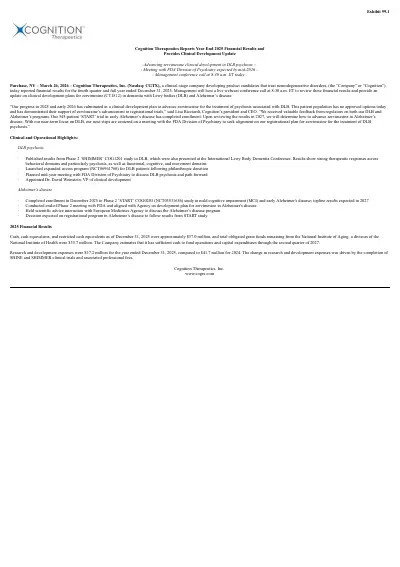
Thank you, Lisa. Cash, cash equivalents, and restricted cash equivalents as of December 31st, 2025, were approximately $37 million.
Total grant funds remaining from the NIA were $35.7 million. We estimate that the company has sufficient cash to fund operations and capital expenditures through the second quarter of 2027.
Research and development expenses were $37.2 million for the year ended December 31st, 2025, compared to $41.7 million for 2024. The change in R&D expenses was driven by the completion of SHINE and SHIMMER clinical trials and associated professional fees.
General and administrative expenses were $10.6 million for the year ended December 31st, 2025, compared to $12.3 million for 2024. This change in G&A expenses was driven primarily by reduced stock-based compensation expenses.
The company reported a net loss of $23.5 million, or 32 cents per basic and diluted share, for the year ended December 31st, 2025. This is compared to a net loss of $34 million, or 86 cents per basic and diluted share, for 2024.
Lisa?
Lisa Ricciardi
Thank you, John. I'll now turn the call back to our operator who can open this up to questions.
Nikki?
Operator
Thank you. If you would like to ask a question, please press star one on your keypad.
To leave the queue at any time, press star two. Once again, that is star one to ask a question.
We will pause for a moment to allow everyone a chance to join the queue. We will take our first question from Ram Selvaraju with H.C.
Wainwright. Please go ahead.
Your line is open.
Hi. This is Katie on for Ram.
Do you guys plan to seek a partner for further exploration with zervimesene, particularly in ocular conditions? If so, when?
Lisa Ricciardi
Hi, good morning. Nice to talk to you.
Right now, our priority is developing zervimesene for DLB. We're not looking at an ophthalmology program at the moment.
Thank you for the question.
Great. Thank you.
Operator
Thank you. We will move next with William Wood with B.
Riley Securities. Please go ahead.
Your line is open.
William Wood
All right, thanks for taking our questions, and congratulations on a very nice ending of the year. Just trying to sort of think about in terms of the DLB program, maybe you could walk us through what you see as the regulatory path forward.
Should we expect your next trial, I believe you said in the past it might be a Phase 2b, would that be expected to be registrational, or do you think you could go to Phase 3 directly? Then, what are your current thinkings on your DLB trial, both in terms of size and duration, but also primary endpoint?
Then I have a follow-up.
Tony Caggiano
Thank you for the question. As we mentioned, our intent is to develop this now for a label relating to psychosis in DLB, like we saw, as was mentioned, with Nuplazid and Rexulti in Alzheimer's disease and Parkinson's disease dementia.
Now, we have not completed the FDA meetings yet to comment on exactly what the outcome measure will be. We have to work on that.
You can imagine it'll be very similar to what we've done here before. Certainly, our intent is to move as expeditiously as possible through registrational trials.
Again, until we have the meeting with FDA and have minutes, it'd be premature to comment exactly what that would look like.
William Wood
Got it. Then in terms of you'd reported that you had numerous other additional trials, including pharmacology in healthy volunteers, DDI, bioavailability, food, and then I believe also you were switching from a capsule to a tablet formation.
Is there any update on any of these additional trials that could aid in your moving forward quickly into your DLB psychosis? Then additionally, what other remaining gating steps do you sort of see in getting that DLB psychosis trial underway once you have the regulatory feedback?
Tony Caggiano
You're correct. Those are the studies that we'd want to complete before starting those trials.
Again, based on the nature of these studies, these are very low risk studies, right? They're really informing us on things such as do we need to add any instructions as to whether people should take drug with or without food or have no instructions whatsoever.
These are extremely low risks that we just need to get behind us. As you mentioned, you're correct, we're moving from a capsule form to a tablet form, which we think will be better as this is eventually, hopefully, once approved, commercialized.
Those are all moving along, and we look to accomplish this all in this year, 2026.
William Wood
Got it. Helpful.
Thank you very much. I'll hop back into queue.
Operator
Thank you. We will move next with Daniil Gataulin with Chardan.
Please go ahead. Your line is open.
Daniil Gataulin
Hey, good morning, guys. Thank you for taking my question.
First, how does the effect of zervimesene on behavioral domains in DLB affect your thinking about pursuing also behavioral domains in Alzheimer's disease? Or is the current focus still on an overall slowing of the disease progression?
Lisa Ricciardi
Thanks for the question, Daniil. We want to see the results of our START trial: big trial, important trial.
We hope it builds on the SHINE results, which we've already seen, particularly those impressive effects in patients with low p-tau. With that kind of data, we can then prioritize in the out-years what do we do next.
Right now on the fairway is the DLB study as a first priority. Then while that study is recruiting and getting underway, we anticipate seeing the results of START, which is the early AD trial.
We've by no means given up on AD. It's a question of prioritization.
As a small company, we've chosen DLB psychosis, and we'll get such great information sometime next year from START in AD.
Daniil Gataulin
Got it. Makes sense.
Then for DLB, you'll be having the meeting with the FDA. What about alignment on psychosis with the EMA?
Where are you in those meetings, and do you anticipate the trial to be including sites both in the United States and Europe to support global approval?
Tony Caggiano
Thank you. We haven't really announced exactly where the trial will be.
Certainly, once we have agreement with FDA, as we've done with AD, we'll want to seek alignment with EMA before launching trials there. It's a little premature to talk about exactly what those plans are.
Daniil Gataulin
Yeah. All right, thank you for taking my questions.
Operator
Thank you. We do have a follow-up from Ram Selvaraju with H.C.
Wainwright. Please go ahead.
Your line is open.
Thank you. Which existing approved CNS medications might zervimesene exhibit synergy?
Do you guys plan to explore any of those synergies clinically in the foreseeable future?
Tony Caggiano
We have a bit, right? Most of our studies are done on standard-of-care background medications.
Obviously, in Alzheimer's disease and our mild-to-moderate study, this was acetylcholinesterase inhibitors and memantine. Interestingly, now, most people with DLB are also on acetylcholinesterase inhibitors.
In our trial, and this is all published information, about 80% or 85% of individuals were on acetylcholinesterase inhibitors. The effects of our drug have been on top of these standard of care.
Similarly, in our START trial in early AD, we've allowed people to be on and have been on, provided they're on a stable maintenance course of the immunotherapies, right, lecanemab and donanemab. The intent there is, as much as you suggested, to begin to collect data not only on zervimesene alone, but is there any indication that there might be an additional benefit of using the drugs in combination?
That's the information that we have and will be getting in the near future.
Thank you so much.
Operator
Thank you. We will move next with Sumant Kulkarni with Canaccord.
Please go ahead. Your line is open.
Sumant Kulkarni
Good morning. Thanks for taking my questions.
I have a couple. First, what's the state of the art in terms of the hypothesis behind zervimesene's mechanism of action on psychosis?
Do you have any similar anecdotes from patients in your SHINE study?
Lisa Ricciardi
Sumant, what was the second part of your second question?
Sumant Kulkarni
The second part was if, just like you had some anecdotes that led you to explore psychosis in DLB, did you have any similar anecdotes on the Alzheimer's study?
Lisa Ricciardi
Got it. Tony, you want to take the first question?
Tony Caggiano
Sure. Yeah.
We mentioned briefly, but obviously, we didn't get into too much detail in our discussion. You're right.
We don't believe that we are impacting the receptors particularly known to be responsible for psychosis. What we believe, much like the global state of the disease, is that we're interrupting the basic pathophysiology.
By just like in Alzheimer's disease, blocking the ability of Abeta oligomers to interact with neurons, we have similar data showing that we prevent the interaction of alpha-synuclein from interacting with their receptors, thereby preventing the basic damage to neurons. Now the symptomatology in DLB from alpha-synuclein toxicity, is based on where that toxicity is occurring.
Again, we believe that we are able to impact the broad symptomatology of the disease, and that those effects were most notable or most measurable within the psychosis. That's what we're pursuing.
Sumant Kulkarni
Got it. Then my follow-up, I guess, in your proposed DLB psychosis trial, what would the time point be to the primary endpoint on psychosis?
Do you expect to have secondary endpoints involving cognition? I'm asking because with reference to your potential to eventually attain a disease-modifying label.
Yeah.
Tony Caggiano
We have not announced exactly what the study looks like and the duration and so forth. That'll certainly be topic of our discussion with FDA.
Obviously, you've seen the results of our SHIMMER trial, and we won't want to stray too much from that design. Absolutely, we will have other measures, secondary measures, which are ranked and protected, looking at cognition and motor function and sleep and so forth.
Again, because as you saw with the results of the SHIMMER trial, we were very impressed by the global impact of the drug on the disease, and certainly eventually we'll want to study those other impacts as well. The reason we're focusing right now on psychosis is because the impact of the drug on psychosis was really quite strong, and that gives us the ability to do smaller, faster trials, and, hopefully, much more efficient path to market.
Sumant Kulkarni
Got it. Thank you.
Operator
Thank you. At this time, there are no further questions in queue.
I will now turn the meeting back to CEO Lisa Ricciardi for closing comments.
Lisa Ricciardi
All right, Nikki. We are looking forward to meeting with the FDA psychiatry division shortly so, as Tony said, we can finalize our plans and timing for studying DLB psychosis.
This is an important indication. It's currently unaddressed by any approved or unapproved medications.
Based on our Phase 2 findings and anecdotal feedback, as we discussed, in participants in our EAP program, we believe zervimesene has the potential to be a first-in-class treatment option for DLB patients with psychosis. With that, thank you all for joining us today.
Operator
Thank you. This brings us to the end of today's meeting.
We appreciate your time and participation. You may now disconnect.