Church & Dwight Company, Inc.
Q3 FY2026 · Earnings Call TranscriptOctober 30, 2026
Operator
Good morning, ladies and gentlemen, and welcome to the Church & Dwight third quarter 2026 earnings conference call. Before we begin, I have been asked to remind you that on this call, the company's management may make forward-looking statements regarding, among other things, the company's financial objectives and forecasts.
These statements are subject to risks and uncertainties and other factors that are described in detail in the company's SEC filings. I would now like to introduce your host for today's call, Mr.
Rick Dierker, President and Chief Executive Officer of Church & Dwight. Please go ahead, sir.
Rick Dierker
Good morning, everyone. Thanks for joining the call.
We delivered strong third quarter results, and I want to start off by thanking all of our Church & Dwight employees around the world for executing so well in a volatile environment. I'll begin with some thoughts on the broader environment, and then review our Q3 results, and then I'll turn it over to Lee McChesney, our CFO, and when Lee is done, we'll open it up for questions.
Starting with the broader environment, conditions remain challenging, including inflationary pressure related to the Middle East conflict and increasing global transportation rates. That said, our teams continue to execute with excellence.
Our portfolio of value and premium brands, they are performing well. We remain focused on offering consumers high-quality, solution-oriented products at the right value.
Our power brands drove our third consecutive quarter of industry-leading organic sales growth, supported by innovation, distribution wins, and targeted marketing investments. Turning to the quarter, we exceeded our outlook across key metrics.
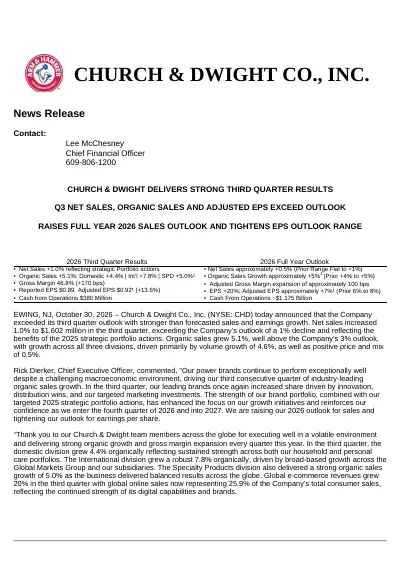
Net sales increased 1%, ahead of our outlook of a 1% decline. Organic sales grew 5.1%, well above our 3% outlook, with growth across all three divisions.
This performance was driven primarily by volume growth of 4.6% and positive price and mix of 0.5%. Gross margin was up 46.8%—up 170 basis points—and adjusted EPS was 92 cents, up almost 14% and above our 89 cents outlook.
Innovation and distribution gains continue to be key drivers of our organic growth performance. Our 2026 innovations across the power brands are performing very well, and we remain confident that our relentless focus on innovation will continue to drive industry-leading growth on shelf and fuel market share expansion.
Now I'll turn my comments to each of the three divisions. First up is the U.S.
Consumer business. Domestic organic sales increased 4.4%, driven by 3.6% volume growth and favorable price and product mix of 0.8%.
Growth was broad-based across our household and personal care portfolios, led by ARM & HAMMER Liquid Laundry Detergent, TheraBreath mouthwash and toothpaste, ARM & HAMMER Cat Litter, and Waterpik water flossers. Miss Mouth's is also off to a great start.
This quarter we had such broad-based growth, I didn't list them all, but six brands contributed in a meaningful way. The ARM & HAMMER brand, which had another quarter of growth, with laundry hitting record shares across total laundry, ARM & HAMMER Laundry Detergent consumption grew over 4%, and the category grew about 2% in the quarter.
Promotional levels for the category were elevated; however, ARM & HAMMER gained share as the value segment in laundry continues to be fit for purpose in this economic environment. Next up is litter: continued fantastic results as ARM & HAMMER Cat Litter consumption grew 5.4%, and share increased 0.6 points to reach 24%.
While category promotional levels declined slightly, they do remain at historical high levels. Our ARM & HAMMER Cat Litter Dual Defense with Microban clumping litter launch continues to do very well.
Now turning to the personal care side of the business. TheraBreath continues to contribute considerably to our overall performance as the brand gained 3.5 share points to reach a record share level of 26.8%, which further solidified our number two position in total mouthwash.
Even with that growth, household penetration remains relatively low at only 14% compared to the mouthwash category of 65%. TheraBreath Complete is now the top-selling new rinse nationally, and we recently launched portable rinse sachets for freshness on the go.
TheraBreath toothpaste is building trial and an everyday regimen through a robust marketing campaign with strong average consumer ratings of 4.5 stars. HERO is expanding its acne expertise into cleansers with a lineup designed to balance efficacy and gentleness.
HERO consumption outpaced the patch category in the quarter, and we're confident that the cleansers launch will lead to share gains in total acne. In fact, in the last four weeks, that is happening.
Facial cleansers represent a $650 million category and account for approximately 30% of the total acne category. Lots of runway for HERO, as again, we have relatively low household penetration at 10% compared to the category at 30%, which gives us great confidence in the continued growth of the brand.
Turning to Waterpik, that business had double-digit sales growth in the quarter and is gaining share in 2026. As we discussed on the last call, Touchland sales growth in the U.S.
has slowed from our original expectations due to competitive products growing in channels that we did not compete in. The good news is that our plans to expand distribution in the U.S.
are on track. As a reminder, a significant opportunity remains on household penetration in the U.S., where Touchland is only 6% compared to the category, which is around 47%.
Additionally, the international rollout for Touchland remains significant. We recently launched Touchland in the UK and Australia, and the early results have been excellent.
We have plans for a much broader distribution in '27 and '28. Turning to International, organic sales delivered another strong quarter of growth and grew organically 7.8%, driven by volume growth of 9.1%, partially offset by lower price and product mix of 1.3%.
Again, similar to the U.S., growth was broad-based, was led by TheraBreath, Batiste, Touchland, and OxiClean. In fact, nine brands in International had double-digit growth.
Global e-comm was once again a strong contributor. Revenues grew 20% in the quarter, and global online sales now represent 25.9% of total consumer sales.
Our SPD division also delivered strong results: organic sales growth of 5%, reflecting volume growth of 2.9% and higher price and product mix of 2.1%. These balanced global results contributed to our overall great organic growth performance in the quarter.
This was now our 11th straight quarter of organic growth in the SPD business. Regarding 2026, I continue to be very pleased with our performance through the first nine months of the year.
Our brands remain strong, our portfolio is more focused following the strategic actions we completed in 2025, our operating fundamentals continue to support volume growth, market share gains, and gross margin expansion. Looking ahead to 2027, I'm also very optimistic about the company's performance.
We have momentum as we enter the year. Our teams are advancing our 2030 growth initiatives focusing on expanding ARM & HAMMER, increasing TheraBreath in oral care, and scaling our international business.
I look forward to sharing our first formal update on these initiatives at our Analyst Day at the end of January. With that, I'll turn the call over to Lee for more detail on the quarter.
Lee McChesney
All right. Thank you, Rick, and good day, everyone.
We appreciate you joining the call. As Rick just shared, our teams delivered another strong quarter in 2026.
Against the backdrop—backdrop of ongoing industry headwinds and uncertainty, our team has delivered three quarters of 5%-plus profitable organic growth. A big thank you to our team members and all of our retail and distribution partners for driving growth.
Really well done. Let's get into the details.
We'll start with EPS. Third quarter adjusted EPS was 92 cents, an increase of 13.6% versus last year, and it was above our outlook of 89 cents.
Stronger than expected sales and continued gross margin expansion fueled the earnings growth, enabled healthy levels of marketing, and supported our SG&A investments. Organic sales in the third quarter grew 5.1%, well above our outlook of approximately 3%.
Growth was broad-based and primarily volume-driven, with volume growth of 4.6% and positive price and mix of 0.5%. Our Consumer Domestic business organic sales increased 4.4%, our Consumer International business increased 7.8%, and our Specialty Products business increased 5%.
This steady and broad-based growth continues to demonstrate the strength of our portfolio of categories, our innovation that drives true incremental growth, and the execution mindset of our commercial teams. Let's now turn to gross margin.
Our third quarter gross margin increased to 46.8%, an increase of 170 basis points versus last year. Productivity delivered 150 basis points, our acquisition mix and portfolio actions drove 160 basis points, and 40 basis points was a combination of volume, price, mix, and FX.
These positive contributions were partially offset by the headwinds from inflation and transportation costs of 180 basis points. In this quarter, our marketing investment levels reached 11.9% of sales as we continue to invest behind our brands and new products.
Adjusted SG&A was $261 million, or 16.3% of net sales, an increase of 110 basis points versus last year. The increase reflects acquisition-related amortization and our SG&A investments in international, e-commerce, and AI capability building.
Adjusted income from operations increased $27 million, or 10.1%—10.1% to $298 million, reflecting our strong and profitable growth results. Let's now turn to cash flow.
Cash from operations for the first nine months of 2026 was $841 million, which drove a healthy cash flow conversion of 114%. Capital expenditures totaled $92 million through the third quarter, and we expect full year capital expenditures to be approximately $125 million, or about 2% of sales.
As for the third quarter—as of the third quarter, total debt was $2.2 billion, and cash on hand was $441—$447 million. Our board of directors approved a new share repurchase program authorizing up to $1 billion of common stock repurchases.
This program has no expiration date and replaces the prior authorization. This program is consistent with our disciplined approach to capital allocation.
It gives us additional flexibility to return capital while continuing to invest in the business and pursue strategic acquisition opportunities. Let's now turn to our 2026 outlook.
As detailed this morning in our press release, we are raising our sales expectations and tightening our adjusted EPS outlook. Our outlook reflects the strong year-to-date growth and our confidence in continued fourth quarter momentum.
It also includes the latest impact of the Middle East commodity pressures and the latest transportation rates that have both increased further over the past 90 days. Overall, our outlook for 2026 includes approximately $150 million of inflation, which brings us up to $50 million more than we had in our original outlook at the beginning of 2026 and $20 million more than our July outlook.
This outlook assumes roughly a crude oil price of $100 a barrel. Now, our teams have continued to focus on delivering incremental productivity and leveraging an RGM toolkit to mitigate this pressure, which has helped us—helped our business deliver gross margin improvements every quarter in 2026.
For '26, we now expect organic sales growth of approximately 5%, at the high end of our prior range of 4% to 5%. We now expect adjusted gross margin to expand approximately 100 basis points, inclusive of the latest cost headwinds.
Our marketing investments remain at approximately 11% of sales, reflecting our continued commitment to brand investment. SG&A as a percentage of sales is expected to remain above 2025 levels, including acquisitions, our target investments in growth initiatives, AI capabilities, e-commerce, and our international business.
The adjusted tax rate is expected to be approximately 21%. We now expect adjusted EPS of approximately 7%, tightening on our prior range of 6% to 8%.
Our cash from operations outlook remains approximately $1.175 billion. If we turn to the fourth quarter, we expect organic sales growth of approximately 4%, and adjusted EPS is expected to increase 17% to 19% versus last year.
To close out our remarks, let me reiterate we are very pleased with our third quarter performance and remain confident in our ability to deliver an improved 2026 outlook. Our strong portfolio, continued share gains, and disciplined execution position us well as we look forward to 2027.
Matt, we are now ready for questions.
Operator
We will now begin the question-and-answer session. If you would like to ask a question, please press star one to raise your hand.
To withdraw your question, press star one again. We ask that you pick up your handset when asking a question to allow for optimum sound quality.
If you are muted locally, please remember to unmute your device. Please stand by while we compile the Q&A roster.
Your first question comes from the line of Anna Lizzul with Bank of America. Anna, your line is open.
Please go ahead.
Anna Lizzul
Hi, good morning. Thank you so much for the question.
Rick, your portfolio is clearly performing really well with innovation across categories, which has elevated your mix and made it a bit more premium over time. I was wondering if you could talk about innovation on the value tier, especially in light of some higher promotional activity you mentioned from peers.
Then on the cost side, I wanted to ask how we should start thinking about gross margin expansion into early 2027, just given the heightened inflationary environment and the pressure that you might be seeing there. Thank you.
Rick Dierker
Yeah. Thanks, Anna.
I think innovation has become a core competency of Church & Dwight. We just had Carlos Linares, who was our head of R&D for many years, retire.
What he brought to this company, I think, was just a great, multi-factored way to innovate. We've built this muscle.
It's not a muscle that we've built just in personal care; it's in household as well. Now we've gone through the ARM & HAMMER strategy, and part of that is good, better, best strategy for laundry and for litter.
There's a lot of work going on with household innovation. You'll see some stuff coming in 2027, but in fact, I just sat through 2028, probably two weeks ago, and I was really encouraged about the entire innovation portfolio, but especially household for 2028.
I think it's broad-based.
Lee McChesney
We always want to compete on innovation. Value is not just price; it's what the consumer's getting when you intersect value and price.
That's how you win with innovation over a long period of time. Then, Lee, you want to take the forward-looking gross margin?
Yeah. To your point, Anna, we certainly know what commodities are today.
That's certainly what everyone's faced in the business. We have some good confidence as we look forward here.
We look at productivity levels of where we are today, where we're going to have a record level of productivity in 2026, and as we sit here today, the same time last year, we're actually a little bit favorable to that. That's a good start for next year.
We have our RGM toolkit that's served us well this year. The team's rallied around that for '27 as well.
Then certainly, we have a nice positive drive towards good mix from innovation and from the portfolio. All those things are in play.
Again, it's all against the backdrop of the inflation we see today. As we said, we're optimistic for '27, and we'll continue to respond to the macro environment.
Rick Dierker
I would maybe add one or two comments to that. I think the other thing that's kind of not unique, but kind of normal, is we actually get fixed cost leverage next year, right?
This year, our reported sales growth was essentially flat to up 1%. Organically, we're doing great, but remember we shed $400 million of businesses.
Next year, our organic and reported numbers will be a lot closer, and that provides some leverage. As Lee said, we had a record year of productivity.
Looking at what we know right now, we expect another record year next year for productivity. Those are great tailwinds.
Anna Lizzul
Great. Thank you both.
Very helpful.
Operator
Your next question comes from the line of Peter Grom with UBS. Peter, your line is open.
Please go ahead.
Peter Grom
Great. Thank you and good morning, everybody.
Happy Friday. Two top-line related questions, Rick.
At first, maybe just to start, would love to get some perspective on what you're seeing from a category standpoint. Obviously, there's a lot of moving pieces across different categories, but curious if you've seen any major shifts as we've moved through the quarter.
I know a lot can change between now and January, but just any thoughts on how you see category growth progressing over the next, call it, 12 to 18 months. Then I guess just related to that, the 4Q organic sales guidance, a bit of a step-down versus what we've seen year-to-date despite an easier comparison, understanding you have a track record of overdelivering, but curious if that's just simply conservatism given the external environment or is there something else driving that view.
Thanks.
Rick Dierker
Yeah. Thanks, Peter.
I think first of all, categories, I'm actually a little bit more bullish on these days. I think we started the year saying category growth of around 2%.
Q1, Q2, and Q3 now have all kind of been at or above 2.5%, like we had a strong Q1 of around 3.5%, Q2 was 2.7%, and Q3 was 2.5%. Outlook for categories is closer to 2.5%.
Also, I would say as we look forward in 2027, we think it's around 2.5%. That's all a good thing.
On Q4 organic sales, look, 4% is still super high compared to the rest of the industry. Maybe we're being a little conservative.
I would say our trends are very strong as we look at October even.
Peter Grom
Awesome. Thank you so much for that.
I'll pass it on.
Operator
Your next question comes from the line of Bonnie Herzog with Goldman Sachs. Bonnie, your line is open.
Please go ahead.
Bonnie Herzog
Thank you. Good morning, everyone.
I had just a quick follow-up on gross margins, and then another question. First, how hedged are you on commodities heading into next to our year?
Are you guys below your typical levels? Then I did have a question on your pricing and promotions.
As we think about the consumer, consumption remains pressured on stretched consumer wallets. Could you talk about how you're thinking about pricing for the rest of this year and into next year?
Also, with gas prices still elevated, what are you seeing in terms of promotional intensity in your categories? Are there certain categories that are still more impacted than others?
Thank you.
Rick Dierker
Yeah. Why don't I take the price and promotion question, and then Lee can circle back on gross margin and hedging.
Look, the consumer is still stretched. A lot of inflation happening out there.
You're right. Gas prices are up, that means disposable income is down.
When you have this amount of inflation, typically promotional levels kind of retreat a bit. That hasn't happened largely, I think, because manufacturers have spent back kind of tariff refunds to help extend promotional spending.
As I said kind of in my prepared remarks, in laundry, as an example, amount sold on deal for the category went from the mid-30s typically to around 40. We also did that.
We're gaining share in this environment. The value part of the segment is growing.
Promotional spending is up versus historical levels for laundry and litter. Elasticities are still strong.
When that happens, you do see the volumes kind of come in and react. I guess my comments on price and inflation in general is we've been very clear.
We are, first and foremost, going after productivity. You just heard me say we had record productivity this year; we think we're going to have record productivity next year.
That's what we do first and foremost. We then do what Lee said.
We look at our revenue growth management and promotional spending, and when inflation is elevated, typically promotional levels do come down. That's what we've seen as I've seen over the last 20 years.
Then the last is price. I'll say if inflation maintains at this type of level historically, the perspective is companies have to move.
If it's not transitory, if it's structural, then it starts to make its way throughout the entire kind of cost picture. We hit number one and number two the hardest, and then if we need to, then we look at number three.
Lee, you want to talk about hedging and gross margin?
Lee McChesney
Sure. As Rick and I talked, we got lots of things that help drive gross margin improvement.
We've always done a healthy amount of hedging in key areas. We talked about earlier this year as some of the inflation came along.
Then, with all the volatility, we paused a bit, but we've been back at it. The hedging going into '27, I would say at this point right now, we're actually slightly hedged a bit more than we were at this time last year.
You have to consider that we hedge certain key things that we purchase. Right now, you're just seeing inflation everywhere.
The impact's helpful, but certainly, just the overall inflation bucket is larger as we look forward here. That's all part of the math we talked about earlier that we're looking at and facing into for '27 with all of our tools.
Bonnie Herzog
All right. Thank you.
I'll pass it on.
Operator
Your next question comes from the line of Rupesh Parikh with Oppenheimer. Rupesh, your line is open.
Please go ahead.
Rupesh Parikh
Good morning, and thanks for taking my question. On the HERO business, I was just curious how that continues to perform in international markets.
Rick Dierker
Sure, Rupesh. International, it's actually a a great growth driver.
We should have listed it in the release for international. Maybe that was just an oversight.
It's it's definitely a a net sales driver. Consumption's up, sales are up.
In the U.S., gained share in patches. Last four weeks, we've gained share in all of acne.
Cleansers are off to a good start, 4.85 stars consumer reviews. Sales were slightly down in the U.S., but that was consumption was up, but sales were only slightly down because remember, a third of that business is online, and some of that shifted as Prime Day had shifted from July to June.
We feel great about HERO. We feel great about the innovation coming for HERO.
A lot of positive things.
Rupesh Parikh
Great. Then, I guess my follow-up question just on Touchland.
Your team has cited slowing growth for that business. What are the updated growth expectations for this year?
I guess we'll probably have to wait for next year, but just curious as you think about international, just I don't know if there's a way to think about the level of growth going forward when you incorporate some of the international opportunity.
Rick Dierker
Yeah. No, on Touchland, I would say the business is going to be close to flattish all in.
With the confirmed distribution gains that we've already heard about in the U.S. and with the international launch plans which are underway now, we expect growth in 2027, so that's the good news.
Rupesh Parikh
Great. Thank you.
I'll pass it along.
Operator
Your next question comes from the line of Chris Carey with Wells Fargo. Chris, your line is open.
Please go ahead.
Chris Carey
Hey, thanks so much. One clarification question first.
What was the tariff refund benefit in Q3? Did it come through?
Is there any remaining impact in Q4? Maybe it's within that net inflation number, but I just wanted to confirm that, then I have a follow-up.
Lee McChesney
Yep, sure. Chris, it was netted about $15 million in the third quarter, and in the fourth quarter, we expect it to be about $5 million.
Chris Carey
Great. That lives in that inflation figure that you gave in the quarter?
Lee McChesney
It does. Yep.
Chris Carey
Okay. Understood.
Okay. All right.
Thanks so much. The bigger question, one of your key strategies is to expand the oral care business.
I get the question a lot, how long can TheraBreath sustain growth? I realize you gave some tidbits about household penetration, but maybe you could just expand a bit as we head into next year.
Secondly, on the toothpaste side of the business, the growth has been very strong. I think the distribution you thought you would get, you did get.
As of last call, you were still assessing whether it was the distribution and you were still assessing kind of repeat demand. Can you give us a sense of these two items really within the concept of the oral care business and how durable you think above-average growth can be going into 2027, giving your multi-year plans that you laid out at the prior Investor Day?
Thank you.
Rick Dierker
Yeah. I'll give you some color.
We're going to go through a lot more detail in January on the growth initiatives, but basically on TheraBreath mouthwash, we think there's still a ton of room to run. We're within six or seven share points of Listerine these days.
We're growing double digits; the category is flat. We're winning with innovation.
We're winning on the shelf space. We're winning with the marketing and reaching the consumer.
Our repeat rate is fantastic. Customer loyalty is growing.
Across the board, we believe that TheraBreath mouthwash has still a long runway, and the one fact that I continue to hit again and again is just household penetration for TheraBreath versus the category. I think that's a good approximation.
Meanwhile, that's just talking about the U.S. TheraBreath is a fantastic brand globally.
It is starting to win globally. We just introduced that actually in Japan.
Remember, we bought Graphico, our distributor, a few years back, and now we're putting a few of our brands through that distributor, like Waterpik, like HERO, like TheraBreath. I think TheraBreath has already reached 15% or 20% of their sales in a matter of 12 months or less.
That trend, that need, problem-solution brand for mouthwash is not just a U.S. trend or need; that is a global consumer need.
A lot of optimism about the global expansion of TheraBreath. Meanwhile, TheraBreath paste, like I said last call, off to a great start.
We have a 1 share already on the paste. Repeat rate is closing in on 30%, which is really good for a toothpaste innovation, because there's high brand loyalty for toothpaste typically.
We got trial, and now we're getting repeat rate up, and we're laser-focused on that. Meanwhile, I think I'll hold any other further comments to January on how each of the initiatives are going, but I would just say I expect those growth initiatives to be tailwinds in '27, '28, and '29.
Chris Carey
Okay. Thank you both.
Operator
Your next question comes from the line of Nik Modi with RBC Capital Markets. Nik, your line is open.
Please go ahead.
Nik Modi
Thank you. Good morning, everyone.
Rick, I wanted to follow up on that operating leverage question, you said you'll start seeing it next year because you're going to be lapping the loss of the revenue. I suppose you're also spending a lot of money to try to fix those businesses before you sold them.
If you can maybe give us some context on if that will be a meaningful contributor for next year of at least over the next six to 12 months. Then if you can just provide any more distribution clarity on Touchland, are you going mass broad, is it going to be more targeted, any context would be helpful.
Rick Dierker
Yeah. Nik.
My comment on the question before I think from Bonnie was really who helped us understand why we think we have some positive tailwinds on gross margin. We have multiple positive tailwinds on gross margin, one of which is just being able to leverage our fixed costs.
I think in 2026 versus 2025, you're right. We had some higher spending that was happening.
A lot of that higher spending was actually happening in the marketing line and the gross-to-net line, not necessarily on the cost of goods line. That comparable's already good and done with, and then as we move forward, we're going to have real revenue growth, and you should expect some leverage, and that's a tailwind.
That's really the only point. Not really trying to quantify that; it's just a normal tailwind for any business as we have real growth.
The second question on Touchland, I would say it's a little bit broader-based than where we're at now. It's going to be in a couple different classes of trade, which is good.
It's one big step in the right direction, and we already have confirmed acceptances for that. Meanwhile, in the beauty class of trade, we're working hard on making sure we have innovations and exclusives in order to differentiate that a bit.
I would say I'm really, really happy with the progress we've made, and I'm optimistic.
Nik Modi
Great. Just one quick follow-up on that.
Is the spacing going to be with beauty and mass or because I know that was a big debate point, I'm just curious where you all fell out on that in terms of where it actually is being placed at retail.
Rick Dierker
Yep, that's where we expect it to be.
Nik Modi
Great. Thanks.
I'll pass it on.
Operator
Your next question comes from the line of Andrea Teixeira with JP Morgan. Andrea, your line is open.
Please go ahead.
Andrea Teixeira
Thank you, operator, and good morning, everyone. I was just hoping if we can elaborate a little bit more on the pricing.
You mentioned obviously that the pressures obviously for 2027 will be higher. I was wondering if you can comment on how to position now into next year.
You have had tremendous success with your productivity program, as you just alluded to. I want to summarize it, correct me if I'm wrong, that you're still looking for margin accretion.
I don't think you took that back from your evergreen models into next year. Just to think as we put in pricing into next year, how we should be thinking.
If not, it will be only with innovation, just if you can help us think about your negotiations at this point.
Rick Dierker
Yeah. Thanks for the question, Andrea.
I'm not going to make any more comments on pricing than what I've already made, and just to re-emphasize it, I said, first and foremost, we focus on productivity, and we've done that in such a good way this year, hitting record levels. We expect to have record levels for next year, and we can see around the corner at that already.
Number two, we expect promotions to come down over time as inflation is sustained at these levels. Then number three, I just said that if inflation remains at these levels, typically the industry is priced in those examples, when it becomes more structural, not transitory.
That's the extent to which I'll talk about pricing. Our evergreen model is to have gross margin expansion.
Revenue growth and margin expansion are the two things that are the lifeblood of any organization. You have to have all the right things in order to do that, though.
You have to have a productivity program, you have to have the right innovation, you have to have consumer-moving innovation that the people want to pay for. We have some great tailwinds and our goal each and every year is to expand margin.
Andrea Teixeira
Thank you, Rick.
Operator
Your next question comes from the line of Olivia Tong with Raymond James. Olivia, your line is open.
Please go ahead.
Olivia Tong
Great. Thanks.
Good morning. I want to talk about the top line given the upside this quarter and, quite frankly, all through the year.
You mentioned obviously the category doing a little bit better, obviously you gained some share. Can you talk about which elements of these you think are most repeatable and where you think there's still more work to do to sort of maintain momentum across the key categories?
Obviously, Touchland was a bit of a tough one this year. You talked about some of the gains next year, but just thinking through the drivers of the top line next year.
Then my follow-up is just around international. If you could talk about sort of the next 12 months, your thoughts around international expansion from where you are right now.
Notice that price/mix obviously swung the other way this quarter. If you could talk about that, whether there was more investment in price/mix or if there was something else that was driving that.
Thanks so much.
Rick Dierker
Yeah. No problem, Olivia.
I would say I'm really encouraged with the top line. Number one, it matters what categories you're in.
Our categories, I would pick our categories over almost any other company out there. They've been the balance of premium and value, the lack of private label exposure in general.
There are a lot of good things to say in why our categories are growing around 2.5%. Fantastic.
Then we tend to take share over time. Like I said before, innovation muscle is alive and well.
Our marketing and commercial teams are doing a great job gaining those TDPs. We were the second-highest TDP growth, I let everyone know that last quarter as an example for 2026.
There's a lot going right. Our growth isn't just one brand; it's broad-based.
I said that in my prepared remarks: laundry, litter, TheraBreath, Waterpik, Batiste, baking soda. There's a whole host of drivers.
Internationally, like I said before, it's not one brand or two brands; it's nine brands that had double-digit growth. They're doing a great job taking our recent acquisitions like TheraBreath and HERO global, and I gave you the example about Japan.
It's very broad-based. I believe it's very sustainable.
Then you throw on top of that the growth initiatives that we've been working on. Remember all the time that we spent maybe a year and a half or two years ago on fixing business that kind of were at structural disadvantages?
We're spending all that time on innovation and on the growth initiatives. The growth initiatives, we're laying the groundwork, and I'm going to announce in January the category that we're going to go into in the U.S.
for ARM & HAMMER, but we have a lot of optimism about that. Then finally, for international, it's all about also M&A.
A year or two ago, our M&A portfolio and kind of diligence was all U.S.-based. That's not true anymore.
We're looking at acquisitions all the time outside the U.S., and moving down the field fairly quickly through the filters, and that process is getting more repeatable, more sustainable, and I'm optimistic.
Olivia Tong
Thanks, Rick. Appreciate it.
Operator
Your next question comes from the line of Kaumil Gajrawala with Jefferies. Kaumil, your line is open.
Please go ahead.
Kaumil Gajrawala
Thank you. Hey, guys.
Good morning. I guess you answered a little bit of this in your M&A commentary just now, but maybe if you could put that in the context of the buyback as well.
Was this just housekeeping and sort of reauthorizing a plan or is there maybe a bigger, broader indication on speed of buyback or how you're sort of envisioning what may or may not be around for M&A in the future?
Rick Dierker
I would call it more housekeeping than anything. We're getting to the end of our previous authorization, you always want to make sure you have flexibility as you look forward into the future.
That's probably how I'd characterize it.
Lee McChesney
It was a program from '21, it was time to renew. That's it.
Kaumil Gajrawala
Okay. Got it.
Then, as it relates to margins, this is a gross margins specifically. You're doing mid-single-digit growth, you'll have some leverage next year, bit of pricing, it sounds like, but I think you guys, unlike some other companies, do incentivize specifically on gross margins.
How are you sort of thinking about what is the appropriate target to shoot for 2027 in the context of what we're seeing in various input costs, the consumer environment, all those types of things?
Rick Dierker
It's a great question. I don't think we'll get into that level of detail yet.
If you want to ask it again in January, feel free. We're going to have inflation that's quite large next year, but offsetting that, we're going to have productivity, we have mix as a tailwind typically, especially as you think about TheraBreath or Miss Mouth's, even Touchland globally.
Then, like I said before, about fixed cost leverage. There's a lot of things going in our direction.
We always believe that we can expand margin, just not ready to put that out there yet. It's about two or three months too soon.
Kaumil Gajrawala
Got it. Thank you.
Operator
Your next question comes from the line of Lauren Lieberman with Barclays. Lauren, your line is open.
Please go ahead.
Lauren Lieberman
Great. Thanks.
Good morning. I just wanted to ask about the revised net sales guidance, because the implication for 4Q suggests sort of the puts and takes of acquisitions and divestitures is a net negative.
I think the Street, we were all expecting that to be positive. Given we kind of knew how to think about VMS and the divestitures, that makes me wonder if Miss Mouth's is a bit slower.
Just curious if you could talk about Miss Mouth's trends and just sort of conversations on incremental distribution and plans for '27, and just also specifically that 4Q dynamic. Thanks.
Rick Dierker
Sure. I don't remember who asked it previously, maybe it was Peter.
I think if you take all the noise away, we are saying that, hey, we've grown 5% for the last three quarters, and our outlook for the year is 5%. That makes the math 4%.
That was the high end of our range previously. I just don't think we have a lot to gain by going above our normal range.
Maybe we're a little conservative on the quarter call, but it is what it is at 4%. We think 4% is head and shoulders above almost anybody else out there.
Lee, anything you want to add to that?
Lee McChesney
I would just say Miss Mouth's is off to a great start, and the outlook for the year is still very strong. Great, great consumption numbers, did really well during the Prime Day season.
We're as we've said before, super optimistic, no less optimistic, probably even more optimistic as we look forward.
Lauren Lieberman
Okay. Thanks a lot.
Operator
Your next question comes from the line of Steve Powers with Deutsche Bank. Steve, your line is open.
Please go ahead.
Steve Powers
Thank you very much. One quick housekeeping.
Lee, you mentioned the $100 oil. Can you remind me if you guys benchmark to WTI or Brent?
Lee McChesney
It would be WTI is the math.
Steve Powers
Okay. Perfect.
Lee McChesney
I would just add, just keep in mind, we buy products that aren't always going to be proportional to oil. That's to give a good rough reference for you, okay?
Steve Powers
Yeah. Yep, perfect.
Then, I guess another kind of follow-up. Rick, you mentioned Touchland finishing round about flattish on the year.
I guess how does that compare with year-to-date performance, because my sense is there's been growth, so that implies maybe some 4Q declines. If that's the case, then I understand the overall optimism looking into next year with distribution international, but maybe just how quickly you can turn those declines into positives as we think about the progress into next year.
Thanks.
Rick Dierker
Yeah. I would say we do expect, I think, growth in Q4.
I think in Q3, it was slightly negative, but it's a sales and shipment timing when you've got to get ahead of the different seasons and programs. For the full year, flattish is the call.
I guess I just have a better lens into what retailers have accepted, what programs are in place for displays, how they're going to be set up, as Nick was kind of alluding to, like in at least one major retailer. This is in the beauty set, and the set is absolutely beautiful.
It's right where we would want it to be. The displays look great.
The packaging is right where we want it to be. We believe that a lot of times consumers are going into the store and they're looking for this because Touchland's kind of created a category that didn't really exist, and then they don't have the choice to buy the Touchland brand; there's only one alternative.
We believe that once they are in more of a accessible retail distribution, then consumers will pick the Touchland product. I think what we're seeing internationally is also off to a great start.
In one retailer just a couple weeks ago, they sold out in a matter of hours what they thought they were going to do for one week. We're trying to make sure we go broad quickly, can get through all the regulatory barriers that are in place around the world, and we've made a lot of progress in doing that, and we think we're going to have some great success next year.
That's kind of why I have optimism.
Steve Powers
That makes sense. As does your comments on the exit rate, that helps a lot.
Thank you.
Operator
Your next question comes from the line of Filippo Falorni with Citi. Filippo, your line is open.
Please go ahead.
Filippo Falorni
Hi, good morning, everyone. I have two quick clarification.
One on the cost inflation, the $150 million that you mentioned, Lee. Can you give us a sense of how much is the raw material piece versus the transportation?
Just more broadly, I'd love to hear your thoughts on just the transport piece. We're hearing a lot of companies thinking this is a bit more structural of a headwind given shortages in drivers.
How are you thinking about that potential headwind continuing from here?
Lee McChesney
I'll start. I would just say the move from a $30 million to $50 million of incremental inflation, it was a mix of commodities and a mix of transportation.
Now, to your point, transportation, we're viewing that as the situation. That is mostly linked to the driver rules in the U.S.
and just creating a shortage of drivers. That's the mindset, and accordingly we're responding around that, trying to make sure we do the most efficient things in transportation.
That's all part of what we're looking into as we put together our plans for '27.
Rick Dierker
We're not transportation experts, but I would say that when spot rates go up 40%, that's typically transitory. Supply and demand forces balance out over time, and we've seen in years past where we've had large spikes, but over 20 years or so, on average, usually have 3% to 5% inflation in transportation rates.
This might be a little bit more structural for a period of time, but over time, it will also balance out.
Filippo Falorni
Got it. Makes sense.
Thanks for the clarification. Then, one other one for you, Rick.
You mentioned M&A in international. Obviously, this has come up more in recent quarters.
Can you just remind us criteria for M&A in international? Is it the same as U.S.
M&A? Could you potentially think about larger size to get more exposure in some international markets?
Any thoughts on your criteria there would be helpful. Thank you.
Rick Dierker
Yep. A fair question.
I think the criteria is very similar, but there's just a couple asterisks. Of course, you want it to be a number one, number two brand; that doesn't go away.
Of course, you want it to be gross margin accretive, asset-light, what's the real competitive advantage? I think we're more willing to accept a plant or a factory in these examples, because then you can bring in some of our other products potentially.
We're more willing to buy an entire business there that you need the entire back office, for example, especially if you're going into a different country. I think there's a little bit more latitude, but it all makes sense.
Filippo Falorni
Great. Thank you very much.
Operator
Your next question comes from the line of Edward Lewis with Rothschild & Co. Edward, your line is open.
Please go ahead.
Edward Lewis
Thanks very much. Yes.
Rick, I was looking at the e-commerce performance, and it's up at 25.9% of consumer sales in Q3 in this quarter, and you've had quite a significant move in that percentage, I guess, over the past few years. The divestments presumably helped.
How much of an advantage is that giving you at the moment? Is that why you think you're growing ahead of the categories as we talked about and enjoying the share gains, having this level of e-commerce exposure that, frankly, your peers don't really have?
Rick Dierker
I think that's insightful. I think partially yes.
I think we went from a laggard to a leader on e-commerce growth, and so we've been ahead of the curve for a while now on typically gaining share with these brands online. When you look at retail, if you take a big step back, a lot of the growth at retail is what?
It's coming from e-comm. That's one.
I kind of acknowledge that. Number two is mix matters, and some of the businesses that we sold had low exposure to online businesses and sales, and some of the businesses that we've bought, like Touchland, like Miss Mouth's, are over-indexed to online businesses or online sales, and so that's helped as well.
Your portfolio mix also matters.
Edward Lewis
Thanks.
Operator
Your last question comes from the line of Sergio Matsumoto with TD Cowen. Sergio, your line is open.
Please go ahead.
Sergio Matsumoto
Hi, good morning. I'm calling on behalf of Robert Moskow.
Thanks for the question. Back at the Investor Day, you discussed some retail sales through licensee partners and that you have through an incubator model and potentially reacquiring those brands.
Are there any specific licensing categories that are showing good traction that perhaps makes sense to bring those brands back in-house over the next 20 to sorry, 12 to 24 months?
Rick Dierker
Yeah. Sergio, that is an excellent question.
I'm not going to give you as much as you want. I'll give you an update in January on our Analyst Day about that.
I would say there's one that we've already taken back, and there's two or three that we're looking at if they can hit some key thresholds. There's also a couple that we're going to ask, sometimes you go through an innovation process internally, and then we think it has legs, but maybe another company's better set to get it off the ground.
We're having those conversations as well. It's pretty broad-based and comprehensive, and I'll give you more of an update at our Analyst Day.
Sergio Matsumoto
Great. Thanks.
Looking forward to it.
Operator
There are no further questions at this time. I will now turn the call back to Mr.
Rick Dierker for closing remarks.
Rick Dierker
All right. Thank you very much.
We had some fantastic results in Q3. It wasn't possible without a whole group of people at Church & Dwight to make that happen.
Just thanks to the entire team. We'll speak to everyone soon, late January for Analyst Day.
Really looking forward to that, too. Take care.
Operator
This concludes today's call. Thank you for attending.
You may now disconnect.