The Chefs' Warehouse, Inc.
Q3 FY2026 · Earnings Call TranscriptOctober 28, 2026
Operator
Greetings, and welcome to The Chefs' Warehouse third quarter 2026 earnings conference call. As a reminder, this conference is being recorded.
We would now like to turn the conference over to your host, Alex Aldous, General Counsel, Corporate Secretary and Chief Government Relations Officer. Please, go ahead, sir.
Alex Aldous
Thank you, operator. Good morning, everyone.
With me on today's call are Chris Pappas, Founder, Chairman and CEO, and Jim Leddy, our CFO. By now, you should have access to our third quarter 2026 earnings press release.
It can also be found at www.chefswarehouse.com under the Investor Relations section. Throughout this conference call, we will be presenting non-GAAP financial measures, including, among others, historical and estimated EBITDA and adjusted EBITDA, as well as historical adjusted net income, adjusted earnings per share, adjusted operating expenses, adjusted operating expenses as a percentage of net sales and as a percentage of gross profit, net debt, net debt leverage, and free cash flow.
These measures are not calculated in accordance with GAAP and may be calculated differently in similarly titled non-GAAP financial measures used by other companies. Quantitative reconciliations of our non-GAAP financial measures to their most directly comparable GAAP financial measures appear in today's press release and third quarter 2026 earnings presentation.
Before we begin our formal remarks, I need to remind everyone that part of our discussion today will include forward-looking statements, including statements regarding our estimated financial performance. Such forward-looking statements are not guarantees of future performance, and therefore, you should not put undue reliance on them.
These statements are subject to numerous risks and uncertainties that could cause actual results to differ materially from what we expect. Some of these risks are mentioned in today's release.
Others are discussed in our annual report on Form 10-K and quarterly reports on Form 10-Q, which are available on the SEC website. Today, we are going to provide a business update and go over our third quarter results in detail.
For a portion of our discussion this morning, we will refer to a few slides posted on The Chefs' Warehouse website under the Investor Relations section titled Third Quarter 2026 Earnings Presentation. Please note that these slides are disclosed at this time for illustration purposes only.
Then, we will open up the call for questions. With that, I will turn the call over to Chris Pappas.
Chris?
Chris Pappas
Thank you, Alex, and thank you all for joining our third quarter 2026 earnings call. Revenue trends displayed typical seasonal cadence through the third quarter of 2026, building from the summer months into September with strong year-over-year growth.
Our regional Chefs' Warehouse teams delivered excellent execution across markets and product categories, driving strong growth in revenue and gross profit dollars, as well as continued progress increasing relevance within our customer base, with solid year-over-year growth in unique item placements and unique customers. Momentum continued into October, and as we head into the busy holiday season, I would like to thank all our Chefs' Warehouse teams, from sales, procurement, and operations, to all the supporting functions, for their dedication and commitment to delivering our diverse, high-quality products and service in partnership with our suppliers and customers and the communities we serve.
Our Middle East operations continue to operate effectively in a challenging environment. Revenue trends in recent weeks have been approximately 100% of prior year, as food-away-from-home activity is supported by local residents and expatriates returning from the summer off-season.
Our teams in the UAE, Qatar, and Oman are doing an exceptional job of executing for our customers in the region and delivering high EBITDA margin results. We remain committed to our business and customers and to the region long term.
With that, please refer to slide 3 of the presentation. A few highlights from the third quarter include: organic net sales grew 10.3%; organic specialty sales were up 8.4% over the prior year, which was driven primarily by unique placement growth of 7.2%, specialty case growth of 6.1%, and price inflation; unique customers grew 4.4% year-over-year.
Reported unique customer growth was impacted partially by the conflict in the Middle East. Excluding this impact, third quarter unique customer growth was approximately 5.7%.
Pounds in center-of-the-plate were approximately 6.6% higher than the prior year third quarter. Gross profit margins increased approximately 84 basis points.
Gross margin in the specialty category increased approximately 63 basis points as compared to the third quarter of 2025, while gross margin in the center-of-the-plate category increased approximately 137 basis points year-over-year. Jim will provide more detail on gross profit and margins in a few moments.
For an update on certain of our operating metrics, including continued improvements in year-over-year gross profit per route and adjusted EBITDA per employee, please refer to the slides provided in the appendix of our third quarter 2026 earnings presentation. With that, I'll turn it over to Jim to discuss more detailed financial information for the quarter and an update on our liquidity.
Jim?
Jim Leddy
Thank you, Chris, and good morning, everyone. I'll now provide a comparison of our current quarter operating results versus the prior year quarter and provide an update on our balance sheet and liquidity.
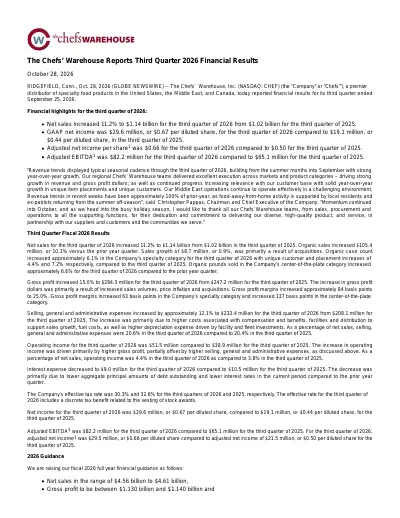
Please refer to slide number 4. Our net sales for the quarter ended September 25th, 2026 increased approximately 11.2% to $1.135 billion from $1.021 billion in the third quarter of 2025.
The growth in net sales was a result of an increase in organic sales of approximately 10.3%, as well as the contribution of sales from acquisitions, which added approximately 0.9% to sales growth for the quarter. Net inflation was 4.1% in the third quarter, consisting of 2.6% inflation in our specialty category and 6.6% inflation in our center-of-the-plate category versus the prior year quarter.
Gross profit increased 15% to $284.3 million for the third quarter of 2026 versus $247.2 million for the third quarter of 2025. Gross profit margins increased approximately 84 basis points to 25%.
Selling, general, and administrative expenses increased approximately 12.1% to $233.4 million for the third quarter of 2026 from $208.1 million for the third quarter of 2025. The increase was primarily due to higher costs associated with compensation and benefits, facilities and distribution to support sales growth, fuel prices, as well as higher depreciation driven by facility and fleet investments.
Adjusted operating expenses increased 11% versus the prior year third quarter, and as a percentage of net sales, adjusted operating expenses were 17.8% for the third quarter of 2026. Operating income for the third quarter of 2026 was $51.5 million, compared to $38.9 million for the third quarter of 2025.
The increase in operating income was driven primarily by higher gross profit, partially offset by higher selling, general, and administrative expenses. Our GAAP net income was $29.6 million, or 67 cents per diluted share, for the third quarter of 2026, compared to net income of $19.1 million, or 44 cents per diluted share, for the third quarter of 2025.
On a non-GAAP basis, we had adjusted EBITDA of $82.2 million for the third quarter of 2026, compared to $65.1 million for the prior year third quarter. Adjusted net income was $29.5 million, or 66 cents per diluted share, for the third quarter of 2026, compared to $21.5 million, or 50 cents per diluted share, for the prior year third quarter.
Turning to the balance sheet and an update on our liquidity, please refer to slide number 5 and 6. At the end of the third quarter, we had total liquidity of $348.1 million, comprised of $164.7 million in cash and $183.4 million of availability under our ABL facility.
During the third quarter, we priced and allocated a new $675 million, seven-year term loan, and subsequently issued a redemption notice to the holders of our 2028 convertible notes. Subsequent to the third quarter close, on October 15th, 2026, the new term loan closed and funded concurrent with the settlement of the convertible notes.
The proceeds of the new term loan were used to prepay the term loan due in 2029 and settle the principal and a portion of the premium of the convertible notes. The remainder of the premium was settled via the issuance of approximately 2.7 million shares of common stock to noteholders.
Our objectives in executing this refinancing are as follows: to address the 2028 convertible maturity and the related springing maturities on our then-existing term loan and our ABL facility, to maintain net debt leverage in our target 1.5 to 2.5 times range, and to reduce our fully diluted share count, aligning our capital structure with our previously announced 2030 financial targets. As of September 25th, 2026, total net debt was approximately $448.5 million, inclusive of all cash and cash equivalents, and net debt to adjusted EBITDA was approximately 1.4 times.
By year-end 2026, we expect net debt to be in the range of $550 to $600 million, and net debt to adjusted EBITDA to be in a range of 1.7 to 2 times. For the fourth quarter of 2026, we expect interest expense to be between $15.5 million and $17.5 million.
Approximately $2.7 million of estimated fourth quarter interest expense is related to one-time costs associated with the debt refinancing. We currently expect our fully diluted share count to be in the range of 43 to 43.5 million shares for the fourth quarter of 2026.
For future modeling purposes, we currently expect the fully diluted share count for 2027 to be in the range of 42 to 43 million shares. Please refer to slide 7.
We are raising our full year 2026 guidance as follows: we estimate net sales for the full year 2026 will be in the range of $4.56 billion to $4.61 billion, gross profit to be between $1.13 billion and $1.14 billion, and adjusted EBITDA to be between $317 million and $321 million. Thank you, and at this point, we will open it up to questions.
Operator?
Operator
Thank you. We will now be conducting a question-and-answer session.
If you would like to ask a question, please press star one on your telephone keypad. A confirmation tone will indicate your line is in the question queue.
You may press star two if you would like to remove your question from the queue. For participants using speaker equipment, it may be necessary to pick up your handset before pressing the star keys.
One moment, please, while we poll for questions. Our first question is from Mark Carden with UBS.
Please proceed with your question.
Mark Carden
Good morning. Thanks so much for taking the question.
To start, you continue to generate double-digit organic sales growth with some pretty strong results across the business. Do you think this is being driven more by market share gains from your competitors, or against your competitors, or by continued underlying strength from your higher-income consumers just overall?
Any shifts on that front, that's first. Then second, are you seeing any pockets of we'll call it relative weakness to the rest of your portfolio?
Thank you.
Chris Pappas
Great question. I think it's Goldilocks.
I think it's coming from, a little bit from everywhere. It's really good demand.
We continue to take market share, and we continue to grow new categories, new territories. I think just the team is executing to the plan that we laid out for the next few years.
You're just seeing good tailwind from the consumer. A lot of new customers in all regions for all Chefs' Warehouse businesses, and I think it's just really good execution and it's what we're counting on to continue.
Mark Carden
Great. Then, as a follow-up, your implied guidance for 4Q suggests a noticeable slowdown on net sales and EBITDA growth.
Have you seen anything quarter-to-date that's giving you more hesitancy on any parts of the business, or is this just a case of being prudent given the macro?
Chris Pappas
Thanks, Mark. No, actually, the top end of our guide for Q4 implies really consistent year-over-year revenue growth.
It's pretty much all organic in Q4. We lapped the Italco acquisition.
That's about 50 to 80 basis points of year-over-year that evaporates just from lapping that acquisition. We have a little bit of conservatism on the Middle East.
December is a very powerful tourism month in the Middle East, and so even though they're operating a little bit above 100% right now, we are putting in a little bit of conservatism. Then we have a tougher comparison, about 1% tougher comp to last year.
If you looked at our organic growth the first three quarters of the year is about 11%. The top end of our guide implies about 10%, and it's just very consistent throughout the year and what the guide really implies, given what I just kind of went through.
Mark Carden
Makes sense. Thanks so much, and good luck, guys.
Chris Pappas
Thank you.
Operator
Our next question is from Brian Harbour with Morgan Stanley. Please proceed with your question.
Hilary Lee
Hi, this is Hilary Lee on for Brian Harbour. Great quarter, guys, and another quarter of strong margin.
Just wanted to know if you guys could provide some color on what drove the expansion, and do you think this sort of expansion is sustainable into 4Q and 2027?
Chris Pappas
Hilary, are you referring to gross margin, or EBITDA margin?
Hilary Lee
Adjusted EBITDA.
Chris Pappas
In adjusted EBITDA. No, I think our guidance implies a very consistent kind of above 7% type of EBITDA margin in Q4.
Our full year guidance implies getting to 7%, which was our 2028 target. We've been seeing pretty consistent growth.
As I just mentioned, there's a little bit of conservatism in the guide, but that's just mostly driven by what I kind of just discussed.
Hilary Lee
Great, thanks. Just as a follow-up, I guess what are you guys really seeing in terms of inflation?
Anything that you can provide on diesel prices rising rapidly?
Chris Pappas
I think one thing to point out, obviously, fuel prices have rose egregiously, really since March. If you look at our operating leverage this quarter and last quarter as a percent of revenue, you see that most of it is coming from the gross profit margin line, and the adjusted opex line is relatively flat versus prior year, and the main driver of that is fuel.
Then you're seeing the offset in the gross profit margin line. I would say, we're passing most of it on, not all of it.
You're never really going to be able to pass all of it on, but that's been the real driver of that operating leverage gap dynamic.
Hilary Lee
All right, great. Thank you, guys, so much.
Chris Pappas
Thank you.
Operator
Our next question is from Alex Slagle with Jefferies. Please proceed with your question.
Alex Slagle
Hey, thanks. Good morning.
Following up on the fuel, I don't know if inbound freight's become any more of a challenge or sort of how you're looking at that passing through. Then, just looking out 2027, I don't know if there's any initial comments at a high level just to start thinking about.
Should we think about that overall view for '27 to 2030 on revenue, gross profit, EBITDA as sort of linear, or is there something different in '27 to think about?
Jim Leddy
Thanks, Alex. No, look, I would say on the inbound freight, I think our teams have done a really good job of kind of managing procurement and pricing very effectively in this environment of higher fuel and higher freight costs.
Obviously, you see it in our gross profit dollar growth at 15% year-over-year and strong gross profit margins, so, as our smaller markets and high-growth markets start to get scale and generate the benefits of that scale on the procurement side, that flows into pricing. We're leveraging our digital platform, and, as I just mentioned, we're able to pass on a good portion of that fuel cost.
I think, as Chris mentioned, our teams are executing at a very high level, and it's showing through in the results.
Chris Pappas
I think Alex, we're running the business with the outlook of if something great happens, and the world's at peace, and oil comes down, and there's better logistics out there, and all the other things that we've kind of built into the model that the world has inflated, it's moderate at this point. It's up and down.
Protein commodities be a little tricky, can be really high one year and down the next. I think we only reported in specialty only about 2%, 2, 2.5% of inflation.
We're trying to keep costs down. Obviously, we have to be competitive, and we want our customers to be able to get the best value of what we can provide, but I just think the new world is higher cost, and you have to fight it with technology, you have to fight it with a team operating, kind of like a symphony, and being able to take out some cost as much as possible as we do start to leverage our new facilities.
I think you're seeing that, and it's built into our forecast to 2030. I don't think we're going to see much different.
If it does, it's a plus. If we have a little headwind, I think we built that in, I like where we sit, and I like where the team is taking us.
Alex Slagle
Great. Thanks for the color.
Chris Pappas
Thank you.
Operator
Our next question is from Peter Saleh with BTIG. Please proceed with your question.
Peter Saleh
Great. Thanks, and congrats on another great quarter.
I did want to ask, I guess first, if you guys could give us a little bit more color on the gross margin gains that you're seeing, and really some healthy gains here for the past several quarters. Just trying to understand maybe what's driving that, and how much of that is sustainable as we head into 2027?
Jim Leddy
Alex, I'll just revert to kind of my previous comment about, sorry, Peter. That that the operating leverage, as expressed as percent of revenue, could shift around quarter-to-quarter, year-over-year based on market dynamics.
This quarter it happens to be that, fuel prices are are are are causing, normally with 11% or 10% type of growth in revenue, you're going to see your adjusted opex line be lower year-over-year, but it's relatively flat, really because of fuel prices and and the impact on the opex line. Then you're seeing that offset, and that's, juicing up the gross profit margin line a little bit.
I would say what we're really seeing is, product mix, as our, as our operating companies in many of our markets are becoming more of a true Chefs' Warehouse over time as we grow categories, as our our our our sales teams become more mature, more expert, and and, continue to drive market share. We're selling a higher mix of higher-margin products, both on the specialty side and and on the protein side.
I mentioned before that we're we're starting to get to leverage really leverage our scale on the procurement and pricing side. Then behind that, we have continued improvements in digital with integrating AI-type technology that's flowing through to our our pricing and to our sales teams.
It's it's all of those things coming together. It's not two home runs.
It's, like we like to say, it's, 20 base hits and doubles, and that's really contributing to a lot of that gross profit margin improvement.
Chris Pappas
Peter, cautiously optimistic, we like to think there's lots of buffers going forward into 2030, '31 beyond, with just the growth into the capacity we we have built. We're still running many mid-size, small businesses.
We only have one or two really sizable businesses, and as our new facilities, keep coming online, where we do have the space to buy direct, buy in volume, not have LTLs, all those will contribute to better better top-line GP, which should result in better bottom-line, GP and EBITDA margin. We we kind of look at it that, we could take a few hits, there could be tailwinds, but there's a lot of I mean headwinds, but there's a lot of tailwinds coming, with the growth of of CW family of businesses as we do grow into all these new investments, and we start to get the the synergies and the leverage on the on the, enormous investments we've made the last 12 years.
Very cautiously optimistic about that. Under-
Peter Saleh
understood. Then just, can you guys give us an update, the organic growth has been double-digit all year.
Where are we on the the sales force? Has that been growing at the same rate, maybe slower, and and how are you seeing hiring trends right now?
Chris Pappas
I I think no change. Really, the the the the team is executing to, it's always been very hard to find, great people and, to do what we do, because you have to have a lot of knowledge, you have to be able to absorb all that knowledge and and talk like a a, advisor, to the best chefs in the world.
We find good people, we hire them, we're always, unfortunately, there is, some turnover at the bottom. It's not for everybody.
It's a very expensive investment to invest, 2, 3 years into somebody who doesn't make it or stay. We do take a lot of time and care, and and spend the time, in the hiring process.
We're hiring still as fast as possible where we could find really good people, because we still can't meet the demand that will, that that's coming at us. A lot of our regions, the the salespeople still have way too many accounts.
We see it that, we can't we we just can't hire fast enough to meet the demand that that we have for our businesses.
Peter Saleh
Thank you very much.
Chris Pappas
Thanks, Peter.
Operator
Our next question is from Kelly Bania with BMO Capital Markets. Please proceed with your question.
Kelly Bania
Good morning, Chris and Jim. Just wanted to to follow up on on the top line.
You've obviously had an incredibly strong, year, and and not to nitpick at all, but, I guess some might do the the some math and say if if CME really accelerated and and the top line did moderate just a little bit, looks like the domestic business maybe slowed a little bit. Is there is there anything to note from just a seasonality standpoint or customer behavior standpoint?
As well, can you talk about the visibility you have into just the holiday season and the bookings that your customers are, seeing at this stage? I think you normally have some some visibility into what that looks like for the fourth quarter.
Jim Leddy
I'll I'll I'll start, and then I'll I'll let Chris comment, more if he'd like. I I'll really just go back to kind of my comments earlier.
While we always build a little bit of conservatism, into our guidance, we did raise it fairly significantly, and it does imply, the top end of the guidance implies very consistent year-over-year organic growth with the prior year when you factor in, a tougher comp to last year, about 1%, and some conservatism around, December for the Middle East, just given that there's still a lot of unknowns there. I don't There's nothing, in the in the guidance change, that we really need to expect to call out.
We're not I would say that revenue trends, as we said in our prepared remarks, continued into October. We saw a really a really good October, double-digit growth consistent with, what we've been seeing, all year.
I'll just I'll let Chris comment on the what we expect for the the fourth quarter, but, that's really, what we have.
Chris Pappas
Basically, Kelly, what I'm and what what we're hearing, from all our our sales meetings, and obviously looking at the numbers, there's there's a a lot of demand in the fourth quarter of private events, corporate events, celebrations. It it's really healthy at the top, you know.
Anything negative that I could hear is, certain conferences have 10, 12% less people attending. I don't think that's a surprise, to anybody, and from a lot of our private club businesses, what I might be hearing is, the summer was a little, up and down, a lot of people were traveling, but à la carte could be a little soft, but the private events are more than making up, their top-line, bottom-line for for their budgets.
It it seems like, a little bit goes down, and then a little bit goes up, and, from our from our seat, we we see, our forecast, obviously, we'd like to be conservative, but, we don't see anything, we've taken up guidance. There's a little I think there, the black box will tell you there's a little, slowness here and there in in some customer bases, and I'm I'm sure that's true, but, our investment really to to grow the sales force, grow territory, and in categories, was always designed to make up any downturn in in the typical customer base, and make it up by having more and more customers.
We look at it again as how much, how many dollars, how many GP dollars can we get on trucks and fill those routes, and that's the way we we run the business, and it's working pretty well.
Kelly Bania
Thank you. Just had one more follow-up.
Some in the industry are calling for some some sizable savings from from AI. Obviously, Chefs has been at the forefront, and you've outlined many areas, from pricing to sourcing, logistics, inventory that that you, are working on projects there.
Just any just curious if there's any update on the size of the potential savings as as you continue to work through that, and and feedback, from the sales force as they continue to get more tools on that front?
Chris Pappas
Great question. We're all in, on the investment.
It's it's part of our, it's part of our budget to continue to invest in digital and, have the best I AI tools, for our team. My, my, 2020 vision still thinks that, it's it's going to continue to make, the sales force and every department, more more effective.
I'm not ready to give up on people. I think people play a a really important part of of what we do and and and how we do it, but, we've always been on the mindset that, you're going to have to do more with less, just from the point that there's just not enough people, the birth rates aren't, what they used to be, across the world, you're going to have to use AI and every piece of technology, to to drive your bottom line.
I think and I think it's, an upside for us. We're going to be conservative and and say that, what our forecast that we gave you, is not built with any big ahas, but, would we love to see an aha?
Absolutely, you know. Can you if we get another point, or two points, to the bottom line because, we're able to be that much more efficient, that would be, truly incredible.
I think we're satisfied really what what our forecast looks like going into 2030, and just hitting that, I think, it'd be a tremendous reward for shareholders.
Kelly Bania
Thank you.
Chris Pappas
Thank you.
Operator
Our next question is from Todd Brooks with StoneX. Please proceed with your question.
Todd Brooks
Hey, good morning, guys. Congrats on the continued momentum in the quarter as well.
Chris Pappas
Thank you.
Todd Brooks
Two quick questions. One, Jim, if you look at kind of where we stand in the year, and and the full year guidance, what inflation outlook is embedded in the Q4 guidance for specialty and center-of-the-plate?
Jim Leddy
Nothing really, out of the ordinary from what we've been seeing, Todd. Price inflation throughout the year has been pretty consistently, kind of at the upper end of what we would consider the normal range of 2 to 4%.
If you exclude the, kind of extreme price inflation we're seeing in the Middle East, our aggregate price inflation in the quarter was closer to 3.5%. As Chris mentioned early earlier, specialty was really 2.5%, we're we're we're just assuming consistent, kind of inflation through the the remainder of the year.
We don't expect anything, other than, you have a few categories that are always a little bit higher, a little bit lower, but that's that's normal.
Todd Brooks
Great. Then my second and final question: if we're looking out now, '27, '28, how, has the new facility plan shaped up?
What what facilities are on the come, and have you had any success, I know it's kind of a holy grail, but finding any sort of opportunity for a second facility in the New York metro market? Thanks.
Jim Leddy
Thanks, Todd. We kind of laid out, at our, when we, put out our 2030 guidance, kind of the markets that, we'll be adding distribution capacity and consolidating facilities.
The, we're in Many of them are in process right now, and they'll come online over the next, 2, 3 years, and that's, Texas to consolidate facilities in in Dallas, and and build a a state-of-the-art distribution center. New England is underway to to do, consolidations, add capacity.
We're we're in the process of expanding Las Vegas, our our, protein processing. Then there's a a couple of markets in the Midwest that are underway as well.
Those are really our focus right now, and then we are, working on on New York. There's multiple scenarios.
Nothing to announce right now.
Todd Brooks
Great. Thank you, both.
Jim Leddy
Thank you.
Operator
We have reached the end of the question-and-answer session. I'd like to turn the floor back over to Chris Pappas for closing comments.
Chris Pappas
Yeah. Thank you, thank you all for joining our, third quarter earnings call.
It was a very strong quarter. The team continues to execute.
We couldn't be more proud of, how the team, continues to drive forward the, the Chefs' Warehouse and the, the passion they have for selling the world's finest ingredients to the best chefs in the world. We look forward to, you joining us again on our fourth quarter call.
Thank you very much.
Operator
This concludes today's teleconference. You may disconnect your lines at this time.
Thank you for your participation.