Cherry Hill Mortgage Investment Corporation
Q1 FY2026 · Earnings Call TranscriptMay 7, 2026
Operator
Good day, and welcome to the Cherry Hill Mortgage Investment Corporation's First Quarter 2026 Conference Call. At this time, all participants are in a listen-only mode.
After the speakers' presentation, there will be a question-and-answer session. To ask a question, you will need to press star one one on your touch-tone telephone.
Please note, this call is being recorded. I would now like to turn the call over to Garrett Edson, Investor Relations.
Please go ahead.
Garrett Edson
We'd like to thank you for joining us today for Cherry Hill Mortgage Investment Corporation's First Quarter 2026 Conference Call. In advance of this call, we issued a press release that was distributed earlier this afternoon.
That press release and a first quarter 2026 investor presentation have been posted to the Investor Relations section of our website at www.chmireit.com. On today's call, management's prepared remarks and answers to your questions may contain forward-looking statements that are subject to risks and uncertainties that could cause actual results to differ from those discussed today.
Examples of forward-looking statements include those related to interest income, financial guidance, IRRs, future expected cash flows, as well as prepayment and recapture rates, delinquencies, and non-GAAP financial measures such as earnings available for distribution, or EAD, and comprehensive income. Forward-looking statements represent management's current estimates, and Cherry Hill assumes no obligation to update any forward-looking statements in the future.
We encourage listeners to review the more detailed discussions related to these forward-looking statements contained in the company's filings with the SEC and the definitions contained in the financial presentations available on the company's website. Today's conference call is hosted by Jay Lown, President and CEO, Julian Evans, the Chief Investment Officer, and Apeksha Patel, the Chief Financial Officer.
Now, I will turn the call over to Jay.
Jay Lown
Thanks, Garrett, and welcome to our first quarter 2026 earnings call. The impact to markets from geopolitical events globally drove performance for the first quarter this year.
On our prior call in late February, the environment felt very much like the second half of 2025 in terms of relative stability. A few days later, we were at war with Iran.
Oil and gas prices spiked, inflation expectations followed in concert, and the potential for future rate cuts this year quickly fell by the wayside. Mortgage spreads promptly widened and the yield curve flattened as a result of the increased volatility.
Specific to Cherry Hill, as the geopolitical uncertainty unfolded, we acted quickly, and we believe appropriately, to protect the company by focusing on the risks that were within our control. We managed our interest rate exposure in March well, which we believe helped mitigate the impact to book value at the end of March.
All things considered, we believe we performed well in the quarter on a relative basis. Subsequent to quarter end, markets have responded favorably to a potential end to the conflict, and that has been a positive catalyst for agency-focused REITs, as noted by peers.
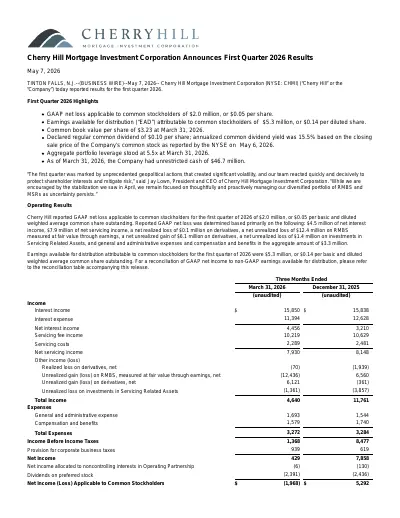
That said, we are monitoring everything closely, as markets will likely remain turbulent until the geopolitical situation has fully settled. For the first quarter, we generated GAAP net loss applicable to common stockholders of 5 cents per diluted share.
Book value per common share finished the quarter at $3.23 compared to $3.44 on December 31st, down 6.1% for the quarter. Economic return for the quarter was -3.2%.
On a NAV basis, which includes preferred stock, NAV was down $7.9 million or 3.3% relative to December 31st. Financial leverage at the end of the quarter remained relatively consistent at 5.5 times as we continue to stay prudently levered.
We ended the quarter with $47 million of unrestricted cash on the balance sheet, maintaining a solid liquidity profile. In addition, our strategic partnership and investment with RealGenius, a Florida-based digital mortgage technology company, continues to progress in line with our expectations.
As we move through the year, we expect the market will remain volatile for at least the near term until there is stability in the Middle East. We remain focused on proactively managing our portfolio through this challenging period while continuing to seek out additional investment opportunities we believe would be accretive to our business.
With that, I'll turn the call over to Julian, who will cover more details regarding our investment portfolio and its performance for the first quarter.
Julian Evans
Thank you, Jay. First quarter portfolio performance was driven by GSE policy signaling, mortgage spread volatility, and changing central bank rate expectations, which were amplified by geopolitical risk late in the quarter.
January performance was strong due to a sharp but temporary mortgage spread tightening, while February and March saw the reversal of mortgage spreads driven by elevated volatility, higher interest rates, and yield curve flattening that more than offset the January gains. Also having a negative impact on the portfolio performance was tighter SOFR spreads.
Escalating volatility and weaker investor sentiment pushed SOFR spreads continuously tighter throughout the quarter. During the quarter, we maintained our portfolio positioning for the most part, but as the spread and rate environment changed in March, we took steps to protect book value in the rising rate environment.
To that end, while increased volatility impacted our portfolio along with most of the industry, we were partially aided by an improved valuation of our MSR portfolio, which speaks to the resilience and the construction of our overall portfolio in a challenging environment. At quarter end, our MSR portfolio had a UPB of $15.6 billion and a market value of approximately $213 million.
The MSR and related net assets represented approximately 41% of our equity capital and approximately 21% of our investable assets, excluding cash, at quarter end. Meanwhile, our RMBS portfolio accounted for approximately 42% of our equity capital.
As a percentage of investable assets, the RMBS portfolio represented approximately 79%, excluding cash, at quarter end. Our MSR portfolio's net CPR averaged approximately 4.5% for the first quarter, down modestly from the previous quarter.
The portfolio's recapture rate remained de minimis, as the incentive to refinance continues to be minimal for this portfolio given the portfolio's low note rate. We continue to expect a low recapture rate and a relatively low net CPR in the near term given our MSR portfolio's characteristics.
The RMBS portfolio's prepayment speeds declined modestly to 8% CPR for the three-month period ending March compared to 8.5% for the prior quarter. Despite first quarter interest rate fluctuations, mortgage rates averaged 6.1% for the three-month period, which was lower than the previous three-month average.
Homeowners moved quickly to take advantage of the lower mortgage rates. That refinancing opportunity quickly vanished at the initiation of the Iran war, and mortgage rates settled near 6.4% to end the quarter.
At this level of mortgage rates, mortgage supply should be reduced, improving mortgage technicals. That, coupled with consistent demand from the GSEs, should support mortgage spreads.
Offsetting the potential improvement in mortgage spreads is volatility driven by geopolitical risk. Mortgages like certainty and clarity, and should improve as the Iran war is resolved.
At current rate levels, the mortgage universe is approximately 14% refinancible. Prior to the start of the war, we were monitoring a mortgage rate of 5.5%.
At a 5.5% mortgage rate, the refinancible universe would have averaged approximately 30%. As of March 31st, the RMBS portfolio, inclusive of the TBAs, stood at approximately $807 million, in line with the previous quarter end as we maintained our mortgage portfolio positioned towards the middle of the coupon stack and higher.
For the first quarter, our RMBS net interest spread was 2.9%, which was higher than the previous quarter. The improvement in NIM was mainly driven by reduction in interest expenses related to repo cost.
Our RMBS financing rate declined to 3.78% from 3.99% at quarter end. The NIM improvement was also aided by improved dollar roll income.
Overall, our hedge strategy remains intact, and we will continue to use a combination of swaps, TBA securities, Treasury futures, and Eur/SOFR futures to hedge the portfolio. Moving forward, we will continue to proactively manage our portfolio and adjust our overall capital structure to add value for shareholders while closely monitoring the macro environment given our expectation for volatility to remain elevated in the near term with geopolitical tensions subsiding.
I will now turn the call over to Apeksha for our first quarter financial discussion.
Apeksha Patel
Thank you, Julian. GAAP net loss applicable to common stockholders for the first quarter was $2 million or 5 cents per weighted average diluted share outstanding during the quarter, while comprehensive loss attributable to common stockholders, which includes the mark-to-market of our available-for-sale RMBS, was $4.4 million or 12 cents per weighted average diluted share.
Our earnings available for distribution, or EAD, attributable to common stockholders were $5.3 million or 14 cents per share. Our book value per common share as of March 31st, 2026 was $3.23 compared to book value of $3.44 as of December 31st, 2025.
We used a variety of derivative instruments to mitigate the effects of increases in interest rates on a portion of our future repurchase borrowings. At the end of the first quarter, we held interest rate swaps, TBAs, Treasury futures, and swap futures, all of which had a combined notional amount of approximately $396 million.
You can see more details regarding our hedging strategy in our 10-Q, as well as in our first quarter presentation. For GAAP purposes, we have not elected to apply hedge accounting for our interest rate derivatives, and as a result, we record the change in estimated fair value as a component of the net gain or loss on interest rate derivatives.
Operating expenses were $3.3 million for the quarter. On March 12th, 2026, our board of directors declared a dividend of 10 cents per common share for the first quarter of 2026, which was paid in cash on April 30th, 2026.
We also declared a dividend of 51.25 cents per share on our 8.2% Series A Cumulative Redeemable Preferred Stock, and a dividend of 59.78 cents on our 8.25% Series B Fixed-to-Floating Rate Cumulative Redeemable Preferred Stock, both of which were paid on April 15th, 2026. At this time, we will open up the call for questions.
Operator?
Operator
Thank you. Our first question comes from Timothy D'Agostino with B.
Riley Securities. Your line is open.
Timothy D'Agostino
Hi. Thanks for taking the questions and congrats on the quarter.
Earlier in the call, you mentioned examining additional investment opportunities. I guess could you just provide some color on how you would go about funding those investment opportunities?
Thank you.
Jay Lown
Hey, Tim. How are you?
Thanks. Anything that we might do from an investment perspective would obviously come at the expense of a different asset class.
Clearly, when we evaluate new opportunities, one of the things that we would think about and evaluate closely is the return profile on a risk-return weighted basis and how that might impact shareholder returns. Given that capital is constrained, that's how we would think about it.
Timothy D'Agostino
Great. Thank you so much.
Then a second question for me. You noted the volatility in March and then the stabilization that we saw in April.
As you think forward, could you just kind of walk us through your general thoughts on the return profile of the portfolio if stabilization persists through the second quarter, or if we do see a spike in volatility again? Just kind of understanding from your perspective that return and how it might be impacted based off the down market.
Thank you.
Julian Evans
Tim, it's Julian. Look, I think currently mortgages from a spread and yield perspective are attractive here.
I think a very simple return on a levered basis is about 15 to let's say mid-teens to high-teens in terms of returns for RMBS, and I'd say probably on the MSR anywhere between 10 to maybe 12 on a levered basis. I think any type of stability that we could get, we can obviously get some spread tightening that would impact the portfolio in a positive situation, or just get rates to stabilize.
I think if you look at kind of some of the scenarios that are in the presentation, it really shows that a parallel shift or a steepening, a bull steepening type of scenario does add some positive returns to the portfolio.
Timothy D'Agostino
Great. Thank you so much for taking the questions today, and congrats on a great quarter.
Julian Evans
All right. Thanks, Timothy.
Operator
Thank you. Our next question comes from Trevor Cranston with Citizens JMP.
Your line is open.
Trevor Cranston
All right. Thanks.
You mentioned expecting some continued volatility in the near term. Could you talk a little bit about what kind of range you expect spreads to trade in kind of over the near future?
I guess in widening scenarios, did you see any behavior in particular I guess from the GSEs or other investors that kind of give you added confidence in kind of where the ceiling is on where spreads could go in widening events? Thanks.
Julian Evans
Currently, I think when we look at mortgage spreads, and this is just versus swaps, well, we can say where we ended the first quarter, call it versus 7-year swaps, we ended around 165. We've kind of retraced ourselves in to 150 at this current point in time.
You probably could go back towards 1 130 on over. If you think about a spread of 90 and swap spreads of 40 on that timeframe, you get the 130.
Then to the high side, we probably could visit the 180 again. So 140 on spread and 40 on the swap spreads.
Any type of stabilization that we've noticed in terms of volatility, if the war has come to some type of resolution in terms of just being calm for a while, we've obviously seen spreads tighten. Obviously, any type of escalation, we've seen volatility pick up.
I think vol remains elevated until we get clarity in some type of certainty that takes place over that timeframe. I think we are going to be at these higher levels for a while until a resolution comes about.
What form that may take, I do not know the answer to that.
Trevor Cranston
Got it. That's helpful.
Do you guys have an update on where book value is today from the end of the quarter?
Julian Evans
Oh, the infamous Mikhail question?
Trevor Cranston
He told me to ask that
Julian Evans
one. No worries.
Go ahead.
Apeksha Patel
Hey, Trevor, it's Apeksha. Our April 30th book value per share has increased nearly 2% from March 31st, and that is excluding any second quarter dividend accrual, as the board hasn't met yet to approve it.
I would like to point out that post-mid-April, spreads have softened.
Trevor Cranston
Yep. Perfect.
Thank you.
Julian Evans
No worries. Good to hear from you.
Operator
Thank you. I'm showing no further questions at this time.
I'd like to turn the call back over to Jay Lown for closing remarks.
Jay Lown
Thank you very much for joining us on our first quarter 2026 call. We look forward to updating you on our second quarter performance in August this year.
Have a great evening.
Operator
Thank you for your participation. You may now disconnect.