Champion Iron Ltd.
Q2 FY2027 · Earnings Call TranscriptOctober 29, 2026
Operator
Good morning, ladies and gentlemen, and welcome to the Champion's Q2 results of the financial year 2027 conference call. At this time, all lines are in a listen-only mode.
Following the presentation, we will conduct a question-and-answer session. If at any time during this call you require immediate assistance, please press star zero for the operator.
This call is being recorded on Thursday, October 29, 2026. I would now like to turn the conference over to Michael Marcotte, Chief Financial Officer.
Please go ahead.
Michael Marcotte
Thank you, operator, and thank you, everyone, for joining this call. Before I turn it over to our speaker, I'd like to highlight that throughout this call, we'll be making forward-looking statements.
If you would like to read about our forward-looking statement risks and assumptions, please visit our website at championiron.com and our MD&A. We'll also be using a presentation for this webcast, which is available under the Investor tab at the website.
Joining me here for this call includes many of our executives. David Cataford, CEO, will do the formal presentation.
Our Chairman, Michael O'Keeffe, will do closing remarks. I'm also joined by Alexandre Belleau, our COO, and other executives.
With that, I'll turn it over to David.
David Cataford
All right, thanks, Michael. Thanks, everyone, for being on the call.
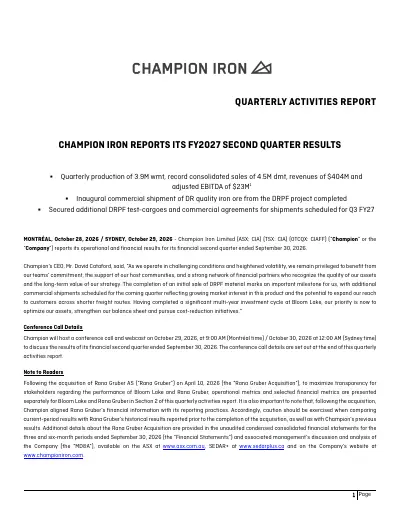
If we dive into the fiscal year 2027 second quarter highlights, we managed to produce roughly about 3.9 million tonnes during the quarter, sold just shy of 4.5 million tonnes during the quarter as well. Cash sat at the end of the quarter at roughly around $267 million.
In terms of operational and sales highlights, if we look at the highlights for this quarter, the increase of 35% quarter-over-quarter on the sales were driven not only by Bloom Lake, but also by Rana Gruber, so that managed to wind down a portion of the inventory. Also completed the inaugural commercial shipment of our DRPF product during the quarter, our first vessel that left the port and that is now arrived at our client's facilities for this new, very high-grade product.
Turning to community, governance, and sustainability, we continue to work closely with our local communities and First Nation partners. Did quite a lot of work during the last quarter to continue to support the various organizations near our operations.
If we dive into the actual operations of Bloom Lake and Rana Gruber, starting with Bloom Lake, in terms of the results of the mine, we managed to produce roughly about 3.3 million tonnes in a quarter that had two major shutdowns for plant number one and plant number two, and also a major shutdown in our flotation plant. Also continued commissioning activities at our DRPF project.
Make sure that we can get the plant as quickly as possible in commercial production. Slight decrease on recovery that is explained mostly due to the fact that we are now commissioning the flotation plant.
When you look at the actual operations in terms of the mine, the mine is very healthy, with a lot of waste material moved, strip ratio of roughly about 1.2, and the head grade at the mine of roughly about 30%. In terms of financial results, cash cost at the mine about $60 Canadian per tonne.
Land transport lower compared to last quarter. Last quarter was roughly about $30 per tonne, this quarter about $24, mostly explained by the fact that we've diluted down the fixed cost at the port by a higher amount of tonnes sold.
In terms of our all-in sustaining cost, also reduced compared to last quarter as we slowly exit seasonal work, and this will continue in the next quarters, and also the higher tonnes that were sold. I think the major highlight for us is really the work that's being done on the flotation plant.
The project was completed within the $500 million budget, and we're continuing the ramp-up, still expect to be able to complete the ramp-up to be in full commercial production at the end of the '27 fiscal year. The volumes, if you look quarter-over-quarter, were fairly flat, but that's due to the fact that we had a major shutdown within our flotation plant.
The positive is really the fact that we're hitting the planned quality, not only on the iron ore units, but also on the contaminant side. We've secured additional test cargoes during the quarter, and also some commercial agreements for this material going into Q3 and going into Q4.
Very happy with the progress that's being done on this flotation plant, and especially the segment that we're entering, which is the DR market. Turning to Rana Gruber, if you remember last quarter, there was quite a bit of headwind in terms of production and also sales, but that really turned around, with an increase of about 40% quarter-over-quarter in terms of production, and about 180% in terms of the actual sales.
That helped reduce the all-in sustaining cost at Rana Gruber to around $97 Canadian per tonne. In terms of the consolidated results, a little bit of noise in terms of our gross realized price.
This is not due to the fact that we're getting hit with much larger discounts, it's really a timing issue during the quarter. If you look at the last quarter, we had roughly about 3.4 million tonnes still on the water as at September 30th, and that really impacted us because if you look at the forward curve in terms of iron ore price, we had to book those tonnes at $103 per tonne.
103 is significantly lower than the actual average, P65 average during the quarter, so that's why you see a big discrepancy between the actual quarter average and the gross realized price. Now, obviously, those tonnes, we have not settled on the price yet, we will settle the price once the material gets to our client's facilities, and we'll see how that impacts the provisional pricing for the next quarter.
We were also hit by a higher freight costs, roughly about $40 per tonne during the quarter. We've since seen those prices come down, but during the quarter, we did see larger impact in terms of freight.
Again, when you look at those results, I think it really highlights why this flotation plant was important for us, because the last thing we want going forward is to sell all of those tonnes into China and be impacted significantly when there's swings on the C3 index. By selling closer to home, to Europe, North Africa, Middle East, we will be able to be less impacted by those freight swings in the future.
In terms of consolidated financial highlights, quarterly revenues of about $400 million and adjusted EBITDA of $23 million for the quarter. In terms of cash, when you look at the company quarter-over-quarter, roughly went from about $200 million to $214 million during the quarter.
Still very well positioned for the next few quarters. In terms of balance sheet and liquidity position, the company is still in very good condition in terms of liquidity, we have access to around $800 million of cash and undrawn loans.
We did go see our financial partners. When you look at the financial partners that we have that have supported us for the past 10 years, went to see them to amend the financial covenants under the senior secured credit facility just to provide additional flexibility during the current market environment and maintain our access to that liquidity.
If we turn towards the market, if you look at the last quarter, pretty abnormal when you look at the C3 freight compared to the actual P65 index. Typically, what we see is iron ore and freight being very well correlated.
When iron ore price goes up, does shipping, and vice versa. What we saw in the last quarter is an abnormal disconnect between the C3 index and the P65 index.
C3 went up mostly due to elements that are a little unrelated to the actual iron ore markets. We saw a lot of tonnes of bauxite leave Guinea to be able to access the Asian market.
There was a lot of weather elements in the Pacific that created congestions at various ports in Asia that also reduced the amount of C3 vessels that were available. A little bit more coal, as well, that was transiting on the seaborne market due to mine closures in China following accidents last year.
When you look at a lot of those elements, well, they seem to be changing in the other direction. The weather has been better now in Asia, and or more importantly in the Pacific, and we've also seen more mines reopen in China on the coal side, which should relieve some pressure on the actual C3 index.
Very easy to see the increase on the C3 and just think that it's due to the conflict in the Middle East, but the conflict in the Middle East accounts for a portion of this increase. The other elements account for the rest.
When you look at the market in general, if you look at the forward curves on C3 over the next year and the next two years, the market does expect that that will turn, and we've already started to see the C3 index come down from the peaks that we saw in the recent weeks. One interesting element as well when you look at our strategy to be able to make DR material, I think it was definitely the right strategy, because when you look in the last year, the DR pellet premium is pretty much one of the only commodities that has risen close to 50% in just 12 months.
When you look at the DR pellet premium, rose from around $40 US per tonne to close to $60 US per tonne in the past year, and that's directly the market that we're targeting. I do think it's the right strategy, a bit of headwind when you look at the pricing environment, the fact that we're finalizing the ramp-up of the flotation plant, but I think we've built the right foundation to be able to be in the right segment of the iron ore space.
Just to close on where our company sits today, when you look at our company, we've invested quite significantly in the past years to create the foundation we have today. Over $6.7 billion have been invested at Bloom Lake to be able to create this foundation now that will allow us to enter the DR market and make sure that we benefit from this higher premium segment.
When you look at the sort of multi-year capex cycle, this is now behind us. We've delivered on our plants, we've delivered on our flotation plant, the construction is finalized, we're just finalizing the ramp-up, but all of this investment is behind us, and now we'll be able to start benefiting from these extra premiums in the coming quarters.
With that being said, I'd like to thank all of our staff for all of the work that they've done to allow us to navigate through these more challenging times, and I'll turn it over to the Q&A portion of the call.
Operator
Ladies and gentlemen, we will now begin the question-and-answer session. If you would like to ask a question, you will need to press star, then the number one on your telephone keypad.
If you would like to withdraw your question, please press star, then the number two. Again, that will be star, then the number one on your telephone keypad to ask questions.
First question comes from Alexander Pearce from BMO. Please go ahead.
Alexander Pearce
All right. How are you, David?
You mentioned in your remarks that you preemptively obtained some of the waivers on some of the debt facilities. Can you just give us a little bit more detail on some of the key metrics that you have now in place with those?
Michael Marcotte
Maybe I can take this one, Alex. This is Michael.
I just want to make sure to reiterate, we sit on very strong financial partners, and I know we've said this many times, but the Government of Canada through EDC is been one of our longest backers, and they're heavily represented in our financial structure. Investissement Québec, Québec government directly, Caisse de dépôt, FTQ.
What we did here is we did a preventive amendment to our financial structure just to make sure that if the situation continues, that we have just some protection. Let me make this clear, we are in compliance with our senior secured facility currently, but what we did is that we secured relief from our financial covenants, for a period of time up to mid-2027 calendar, to make sure that if the ratios don't work, that we can go through the cycle and maintain access to liquidity if we need those.
Again, we're sitting on strong cash, we're sitting on strong inventories. Coming out of a potential relief in mid-'27, if we get there, then we would have new financial covenants that are forward-looking and wouldn't look back to the current low cycle, if you want to call it that.
Hopefully, that provides some color. We're very happy to lean on our partners to be able to provide these potential relief if we need those.
Alexander Pearce
Thanks, Michael. It would be good to know what the covenants are.
I think there's lots of questions in the market at the minute, even if you know that you're well within what's required, I think it would be good to get those. Maybe if I can ask a separate question just around, obviously, cash costs with the DRPF ramp-up, I just wondered if you could just comment on how you're seeing costs shaking out with that ramp-up, and are there any obvious levers that you're seeing at the minute, opportunities to improve things within that part of the processing plant?
David Cataford
Thanks for the question. When you look at the cost structure, so, obviously, we've always invested everything that was required to be able to not only keep the pit healthy, but also all of our infrastructure in extremely healthy condition.
That allows us to potentially push out certain investments in this current, more challenging time. A lot of these things, we started to implement during the summer, but it takes a few months to be able to actually see the results.
We should be able to see in the coming future and in the coming quarters that impact on the reduction of costs that we've started to work on. That's mainly at the mine site, on our sustaining costs as well, that we've now hit more the high seasonal portion.
Q3 and Q4 are typically quarters that have lower sustaining costs just due to the winter element, but also, we've done quite a lot of changes to make sure that we can keep that sustaining lower to make sure that we can navigate through these different times. A lot of work that's being done at the mine to be able to reduce costs, and also on the sustaining part.
Alexander Pearce
Thanks.
Operator
Next question comes from Craig Hutchison from TD Cowen. Please go ahead.
Craig Hutchison
Hi, guys. Can you just comment on how the DRPF ramp is going?
How kind of close are you guys getting to design? I think you guys kind of allowed yourself until early next year, if I recall.
Just how's that going? Then you kind of talked about the DR premiums you're seeing in the market.
Any kind of commentary in terms of what you're seeing for that product. Thanks.
David Cataford
Thanks for the question, Craig. When I look at the actual ramp-up, I think it's going very well.
Even if you see flat production quarter-over-quarter, it's mainly due to the fact that we had a major shutdown in the flotation plant. It was the first one as well.
If you go back to when we started Phase 1 and started Phase 2, the first shutdown always takes a bit more time just because it's the first time that we're actually maintaining all of the equipment. As you can see in the results now, those shutdowns for plant number one and plant number two are much, much more efficient.
We're going to see the same thing on the flotation plant. When you look at the actual design, we're hitting the quality that was expected, we're hitting the volume that was expected as well.
All of our major equipment, we've demonstrated that it can operate at or over design. All of that is going extremely well, and you're going to start to see more and more sales in the coming months/quarters in terms of our results.
Even on the test cargoes, we're getting significant premiums over and above our typical 66% material. When you look at what's happening in the market now, we can see in Germany, they're still moving ahead with DRI facilities.
Two facilities are being built right now, one will be delivered next year, the other one in 2028. Obviously, that's great potential clients for us.
North Africa as well, we're continuing the work and being able to send test cargoes. Same in the Middle East.
Even if Bahrain and UAE are currently shut down for us due to the Hormuz Strait, we still have access to Oman in terms of potential. There's quite a lot of demand for our type of material, and I think the biggest surprise for most of the clients is that we're able to sell full cargoes at the announced quality in terms of contaminants and iron ore units.
I think there was a bit of skepticism in the past that we would be able to reach such a high-grade type material. Now that that's going to be behind us, well, we're going to start to see the benefits of that increased quality in terms of the pricing.
Craig Hutchison
Thank you for that. Then just on Rana Gruber, what do you guys need to see to make that operation free cash flow positive?
I think it's lost money a couple quarters in a row here, and it's burning cash. What do you need to see from an operational perspective, assuming iron ore prices are flat kind of going forward?
David Cataford
There's three things that impacted Rana Gruber. Obviously, the fuel price, the C3 index, they're the two major elements that we've seen an impact.
Iron ore price, it's a little bit lower as well, but when you look at the C3 and the fuel, they're the two main elements that have been impacting the Rana Gruber site right now.
Craig Hutchison
Okay. Prices sort of stay the same, operationally, we can kind of assume a kind of similar quarter-over-quarter performance kind of thing?
David Cataford
We still see areas where we can continue reducing costs at Rana Gruber as well. We're doing the same kind of work over there than we're doing at Bloom Lake.
If you take Rana Gruber as an example, they were able to go through the 2015-2016 cycle and continue to operate during those times. When you look at profitability today in the market, if you take the C3 index and adjusted for inflation iron ore price, we're pretty much at levels that are similar to that 2015 and '16.
Rana Gruber it was not the easiest time, but they managed to go through it. I would expect that we're going to continue to work on reducing costs at the operations there and be able to navigate through these more challenging times.
Craig Hutchison
Great. Thanks, guys.
Operator
Again, if you would like to ask a question, please press star, then the number one on your telephone keypad. Your next question comes from Stefan Ioannou from Cormark.
Please go ahead.
Stefan Ioannou
Thanks, operator, and thanks, guys. Good to see the inventory come down at Bloom Lake.
Just curious, is it safe to assume now that some of the logistical rail and port logistics are behind us now and things are operating well on that front?
David Cataford
In terms of logistics, things are going much better. Obviously, we're getting some help with the productivity of other operations in the region, so that's relieved pressure also on the rail.
Even before that, when the other operations were doing fairly well, we still saw that we were destocking material. I think those hiccups that when we started Phase 2, they're behind us, and now the logistics side is doing much better.
If you look at September, September was a record month in terms of loading vessels at the port. Everything down at the sit-down area and at the actual port operations has been working extremely well.
When I look at the logistics side, definitely, it's something that is in the right trend. What's interesting as well, when you look at the actual logistics, is if you look at the sentiment of the federal government and certain provincial governments in terms of the high-grade iron ore sector in Canada, it's extremely positive.
You've seen announcements by the federal government that are supporting initiatives at the port to increase the tonnage in the future. That's definitely going to help not only on potential volume, but it's going to help also on pricing in the actual region.
There's quite a lot of support in the region to be able to improve the overall logistics chain to make sure that this can not only operate in a good way in the future, but can also accommodate more volume in the future.
Stefan Ioannou
Great. Thanks very much, guys.
Operator
There are no further questions at this time. I'll turn the call back over to Michael O'Keeffe.
Michael O'Keeffe
Thank you very much. Thank you, David and team, for all your work in difficult times.
It's stressful for everyone, but thankfully, we've got a great team of people to be able to work our way through this process. I think the best thing is to reflect back, and people have asked me, would you still make the same decision to go to high grade and spend that capital to get to where we are now?
The answer is most definitely yes. If timing's not always the best.
However, if all the issues in around at the moment and the issues with fuel costs, if that had happened, let's say, a year ago, I'm sure we'd be in a much more difficult situation than what we are today. If I'd prefer this to happen, I'd say in a year's time, because by then, all these test cargoes that David talking about would be with the offtakers.
They would have been tested the material, and our contracts would be in place. The great litmus test for us is that if we were to sell this product tomorrow, and if we were to fulfill all the obligations that customers have required, we're probably 130% sold.
Now, we know that when it comes time to sell, a lot of those people won't be there, but it's a very good indication of the demand for our product, and also the potential premiums we'll get. I think David also mentioned, and we were asked earlier today, how do you see that premium coming to us, and how do we measure it?
We're not going to go out and discuss what our contracts are with everyone, but I think you'll see the price we receive for the product, it will gradually increase, and that's going to be a great benefit for us. By separating ourselves from the market, we don't want to be producing a material at 62% Fe going to a sinter plant going to a blast furnace.
We always knew that, we always believed that we need to be in a different situation. Also with the pricing, you would have seen that there was a lot of spot cargoes that we did which were into China, which is our worst situation, and that was because we didn't want to commit to long-term contracts into China, which is our worst destination.
Obviously, shipping rates being where they are, it was horrible. It was horrible two months ago when our C3 costs were something like $40 to $50 US a tonne, it's now in the $30s.
If we were to sit down tomorrow and start looking at 2027, once we know where our tonnes are finally going, even to China, we can do contracts for C3 in the $20s. That's a huge difference to what we've been paying, and it's going to be very beneficial for us.
The fact that we're looking at site to reduce all the costs that we possibly can, it's a bonus for the group because we have to look at the positive side of this. Now, obviously, there's also diesel costs, the excise on diesel for rail, all of those things, it's worse situation at the moment.
What we do have is we have, as David discussed, we have good cash available to us at the moment. We do have the support of the federal government, which you might have seen recently, they're announcing in excess of a billion dollars to the steel industry in Canada, should we require that support, and we do have very good investors with us, including the Caisse de dépôt.
Look, we have the right people, we have the right product, and I see a very great future for our material going into the market, gaining a premium, and also a lot of these tonnes won't be going to China. I do see the freight rates coming off, and the demand for our product into the Middle East and to Europe and North Africa will be of a premium.
We're seeing some of the big players in the market who actually can't produce a 69 material wanting to buy our tonnes, and you'll see some of these contracts come to light that requires this material because they understand the importance of it. Look, tough period at the moment, but we've been through this when we acquired the asset, these issues are not new to us, and we've weathered the storm before, and we're in a much better position now because of, a, the support we have, the financing we have, and the product that we're going to produce.
I hope that the market supports us, and I hope you see that there is a future for the company, and a great future. Thank you all very much for your support, and thank you very much to David and your team.
On that note, I'll sign off. Thank you very much.
Operator
Ladies and gentlemen, this concludes today's conference call. Thank you all for participating.
You may now disconnect.