Cincinnati Financial Corporation
Q3 FY2026 · Earnings Call TranscriptOctober 27, 2026
Operator
Good morning and welcome to the Cincinnati Financial Corporation third-quarter 2026 earnings conference call. All participants are in a listen-only mode.
After the speakers' remarks, there will conduct a question-and-answer session. To ask a question at this time, you will need to press star, followed by the number one on your telephone keypad.
As a reminder, this conference call is being recorded. I would now like to turn the call over to Andy Gossard, Investor Relations Officer.
Thank you, please go ahead.
Andy Gossard
Good morning and thank you for joining us for our third-quarter 2026 earnings conference call. Late yesterday, we issued a news release on our results, along with our supplemental financial package, including our quarter-end investment portfolio.
To find copies of any of these documents, please visit our investor website, investors.cinfin.com. The shortest route to the information is the quarterly results section near the middle of the investor overview page.
On this call, you'll first hear from President and Chief Executive Officer, Steve Spray, and then from Executive Vice President and Chief Financial Officer, Mike Sewell. After their prepared remarks, investors participating on the call may ask questions.
At that time, some responses may be made by others in the room with us, including Executive Chairman, Steve Johnston, Chief Investment Officer, Steve Soloria, Cincinnati Insurance's Chief Claims Officer, Marc Schambow, and Senior Vice President of Corporate Finance, Andy Schnell. Please note that some of the matters to be discussed today are forward-looking.
These forward-looking statements involve certain risks and uncertainties. With respect to these risks and uncertainties, we direct your attention to our news release and to our various filings with the SEC.
Also, a reconciliation of non-GAAP measures was provided with the news release. Statutory accounting data is prepared in accordance with statutory accounting rules and therefore is not reconciled to GAAP.
Now, I'll turn the call over to Steve.
Steve Spray
Good morning and thank you for joining us today to hear more about our results. We had another quarter of strong operating performance that reinforces our confidence in the long-term direction of our business.
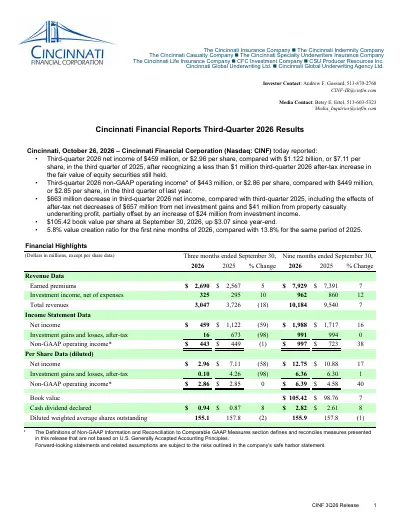
Our insurance operations produced excellent underwriting results, even as the property casualty combined ratio increased from last year's exceptional level. Net income of $459 million for the third quarter of 2026 included recognition of less than $1 million, on an after-tax basis, for the increase in fair value of equity securities still held.
Non-GAAP operating income was $443 million for the quarter, down only $6 million from a year ago, despite catastrophe losses that were $146 million higher on an after-tax basis. The 90.9% third-quarter 2026 property casualty combined ratio increased by 2.7 percentage points compared with third quarter last year, including an increase of 7.0 points for catastrophe losses.
Our current accident year combined ratio before catastrophe losses for the first nine months of 2026 was 86.5%, improving slightly compared with the 86.7% reported through the first nine months of 2025. Moving to premium growth, our consolidated property casualty net written premiums grew 2% for the quarter.
Premium growth moderated as expected, reflecting our commitment to pricing discipline, careful risk selection, and segmentation on a policy-by-policy basis. Estimated average renewal price increases for most lines of business during the third quarter were lower than the second quarter of 2026, but still at levels we believe were healthy.
Commercial lines and excess and surplus lines averaged increases in the low-single-digit percentage range. Our personal lines segment included homeowner increases in the high-single-digit percentage range and personal auto increases in the mid-single-digit range.
Although market conditions continue to be challenging, we remain confident that our diverse product portfolio, exceptional service, and strong relationships with independent insurance agents provide a solid foundation for long-term success. Next, I'll highlight third-quarter performance by insurance segment compared with a year ago.
The commercial lines combined ratio was 92.8%, an increase of 1.7 percentage points, including 4.3 points from higher catastrophe losses. Net written premiums grew less than 1%.
Personal lines grew net written premiums 1%, impacted by lower new business premiums that reflect continued softening market conditions. The combined ratio for personal lines was 90.3%, just 2.1 percentage points higher than last year, despite an increase of 12.1 points from higher catastrophe losses.
Excess and surplus lines grew net written premiums 5% and produced another excellent combined ratio of 89.4%. Cincinnati Re and Cincinnati Global both contributed meaningfully to premium growth and continue to provide diversification benefits for our insurance operations.
Cincinnati Re's third-quarter 2026 net written premiums increased by 34%. Its combined ratio was 94.8%.
Cincinnati Global grew 13% while maintaining an impressive 70.7% combined ratio. Our life insurance subsidiary had another solid quarter, including 11% net income growth.
In addition, term life insurance earned premiums grew 2%. Now, I'll give a summary of our primary measure of long-term financial performance, the value creation ratio.
Our VCR was negative 2.1% for the third quarter of 2026. Net income before investment gains or losses for the quarter contributed 2.7%.
Lower overall valuation of our investment portfolio and other items contributed -4.8%. Before I hand the call to Mike, I wanted to give you an update on our ongoing investments in data, technology, and artificial intelligence.
We continue to prioritize applications of generative and agentic AI that can improve the efficiency and effectiveness of our associates. We want to optimize their efforts, allowing them to add more value to our business, deepening relationships, sharing expertise, and focusing their energy on the most complex insurance and technology decisions.
I'll give you two examples of the AI applications that are in production today that we believe have already and will continue to produce meaningful benefits across the organization. Many other use cases exist in varying stages of development, from design all the way through production.
First, our AI Center of Excellence is harnessing cloud-provider large language models to create reusable, internal capabilities that can be adapted for additional business areas where the use case and supporting evidence are strong. Far, we've developed seven proprietary intelligent assistants for associates to use in areas such as underwriting, claims, and loss control.
These assistants, along with other tools we've deployed, reduce the time spent on information-intensive tasks such as summarizing underwriting and claims files, and understanding internal appetite and risk guidance. Second, we are applying automation and AI-enabled capabilities within selected new business and commercial service workflows.
More specifically, we are using these capabilities to process new business submissions received by email, enabling us to accelerate quote delivery by more than 30% across our commercial lines and excess and surplus lines businesses. Our approach is disciplined.
We establish a baseline, evaluate the operating results, ensure we have strong governance and controls, and then expand a capability only where the evidence supports it. Because our agents tell us that speed to quote is a key variable as we compete for business, we believe reducing the average time to quote will positively support our continued profitable growth.
Now, I'll turn it over to Chief Financial Officer, Mike Sewell, for additional insights regarding our financial performance.
Mike Sewell
Thank you, Steve, and thanks to all of you for joining us today. Investment income growth of 10% in the third quarter of '26 contributed nicely to our operating results, driven by strong cash flow from insurance operations.
Bond interest income grew 11%, and the net purchases of fixed maturity securities totaled $1.1 billion for the quarter and $2 billion for the first nine months of the year. The third-quarter pretax average yield of 5.04% for the fixed maturity portfolio was down 6 basis points compared with last year.
The average pretax yield for the total purchase taxable and tax-exempt bonds during the third quarter of this year was 5.93%. Dividend income was down 4% for the quarter.
Net sales of equity securities totaled $52 million for the quarter and $784 million on a year-to-date basis. Valuation changes in aggregate for the third quarter were slightly favorable for our equity portfolio and unfavorable, due to rising interest rates, for our bond portfolio.
Before tax effects, the net gain was $6 million for the equity portfolio, while the net loss was approximately $1.2 billion for the bond portfolio. At the end of the third quarter, the total investment portfolio net appreciated value was approximately $7.4 billion.
The equity portfolio was in a net gain position of $8.9 billion, while the fixed maturity portfolio was in a net loss position of $1.5 billion. Cash flow continued to benefit investment income growth.
Cash flow from operating activities for the first nine months of 2026 was $2.1 billion, a decrease of less than 1% from a year ago. Moving to expense management, our goal is to balance making strategic investments in our business while also controlling expenses.
The third-quarter 2026 property casualty underwriting expense ratio increased by 0.4 percentage points, due primarily to timing of recognition of certain expenses. Regarding loss reserves, our approach remains consistent and aims in net amounts in the upper half of the actuarially estimated range of net loss and loss expense reserves.
As we do each quarter, we consider new information such as paid losses and case reserves. Then we updated estimated ultimate losses and loss expenses by accident year and line of business.
For the first nine months of 2026, our net addition to property casualty loss, loss expense reserves was $1.26 billion, including $997 million for the IBNR portion. During the third quarter, we experienced $94 million of property casualty net favorable reserve development on prior accident years that benefited the combined ratio by 3.6 percentage points.
For the commercial casualty line of business, there was no material reserve development for any prior accident year during the quarter. On an all-lines basis by accident year, net favorable reserve development for the first nine months of 2026 included favorable $203 million for '25, favorable $70 million for '24, and an unfavorable $56 million in aggregate for accident years prior to '24.
I'll conclude my comments with third-quarter capital management highlights. We paid $142 million in dividends to shareholders.
During the quarter, we repurchased an immaterial number of shares. We believe our strong balance sheet continues to provide substantial flexibility and supports our financial strength.
Parent company cash and marketable securities at quarter end was $6.1 billion. Debt to total capital remained under 10%.
Year-to-date VCR was 5.8%, and our quarter-end book value was $105.42 per share, with $16 billion of GAAP consolidated shareholders' equity, providing plenty of capacity for the profitability growth of our insurance operations. Now, I'll turn the call back over to Steve.
Steve Spray
Thanks, Mike. Before we open the call for questions, I'd like to take a moment to thank and recognize Chief Claims Officer, Marc Schambow, for his nearly 40 years of dedication to Cincinnati Insurance, our agents, and our policyholders.
As most of this is Marc's final earnings call before his January retirement. Since Marc took the reins of our claims operations, we've faced some of the worst catastrophe events in our company's history, including Winter Storm Elliott, Hurricane Helene, and the California wildfires.
Marc has handled it all with unshakable confidence. He has continued to lead with empathy, nurturing our belief in responding person to person, as we've made bad days better for countless families and businesses in their time of crisis.
We are grateful for his contributions and we wish him the best in this next chapter of life. As a reminder, with Marc, Mike, and me today are Steve Johnston, Steve Soloria, and Andy Schnell.
Julianne, please open the call for questions.
Operator
Thank you. As a reminder, to ask a question, please press star, followed by the number one on your telephone keypad.
Our first question today comes from Michael Phillips from Oppenheimer. Please go ahead.
Your line is open.
Michael Phillips
Thank you. Good morning, everybody.
Let me start with the commercial casualty again for the first question. Your loss pick is kind of in line with the first half of the year and maybe kind of where you thought it would be at the end of 2025.
I guess just want to see and you talked about conservative prudence for potential severity rises. Have you seen anything in claims activity that would support that yet?
Or are you still keeping it elevated just in case of, and maybe just being conservative?
Steve Spray
I wouldn't call it conservative, Mike, I'd call it prudent. We've talked about this a lot.
Take a consistent process. We've got a consistent group, and it is management's best estimate of ultimate losses, obviously.
I think I don't think we've seen anything out there on the casualty front that would be a reversal from a lot of the legal system abuse, the challenges that we face, third-party litigation funding, just increased activity there. I think there's enough uncertainty, enough variability.
We're just being prudent. As you've noticed that accident year pick through nine months has stayed pretty consistent throughout the year, and is right there with the pick that we had at the end of 2025.
Michael Phillips
Steve. Thank you.
Maybe stay with commercial lines for a second on the expense ratio side. You've talked about investments and kind of we're going to continue, I guess, with all your AI enhancements, and Mike gave some examples in commercial lines.
It was opening comments. I guess given top-line pressure is probably going to last for at least the next year, is there a ceiling you think we could expect on the expense ratio for commercial lines or just how do you think about the pressure there?
Mike Sewell
Great question. We've worked extremely hard to get the expense ratio under a 30, and I think we're going to continue to do that.
It's a great observation, as the top line is going to be growing. We're still going to do everything we can to control expenses.
We've got to invest in the business, etc. We will be working very diligently to keep it under the 30%.
Michael Phillips
Mike. Thank you and to the rest of you.
Appreciate it.
Steve Spray
Great. Thanks for the question.
Operator
Our next question comes from Gregory Peters from Raymond James. Please go ahead.
Your line is open.
Gregory Peters
Good morning. I'm going to focus on the outlook for growth, lasering in or focusing in on the commercial lines piece.
Just trying to see when we look forward, where you think the growth is going to come from? Is it exposure growth of existing clients?
Is it, do you think new business is going to accelerate or maybe you can also come at it from where are you seeing the most competition in commercial lines and where are the areas that you might be concerned about?
Steve Spray
Thanks, Greg. We're still seeing the most pressure, I'd say, in commercial lines, the larger the premium, okay?
Small to I'd say small to midsize, the way we would define it, business, it's competitive out there, but it still seems rational. Where we're seeing the most aggressive or the most difficulty on the growth side would be in that larger account space.
No real guidance going forward for you, Greg. If you wouldn't mind if I could just maybe expand on it a little bit, it's obvious the industry, there's slowing growth.
There's slowing growth for us as well, but I'd like to kind of put it in context. The new business dollars on an absolute basis for us still remain very strong.
I think what we're seeing, I would characterize as more of a normalization from really exceptionally strong growth. Not a reversal.
We're coming off a very, very hard market over the last few years, especially in personal lines. Just as a reminder, over the last four years, we've doubled our personal lines net written premiums.
We've tripled it over the last 10 years. More broadly, since the end of 2018 to 2025, we doubled the company's net written premium.
Our compounded annual growth rate over the last five years has been at 10.4%. That's for the entire company.
It's been 8.6% over the last 10 years. Our combined ratio over that entire time has been in the mid-90s.
We've not had one year in excess of 100. I know there's a lot of talk about growth.
We're focused on it. I think we've got a great business model, we've got great agents, we've got a great team, we've got a proven track record over a long period of time.
We're just going to keep, I hate to use the cliché, but just the blocking and tackling to get out in front of our agents, keep listening, keep servicing them, keep broadening our product portfolio. That'd probably be my guidance for you on growth in the future.
The one thing I can tell you, is it is profit first. We're not going to just grow for the sake of growing.
Over time, kind of from what I'd shared, I think we've proven that we can grow through all market cycles.
Gregory Peters
Yeah. One of the things that I thought was pretty unique relative to a number of other companies over the last couple years is your usage of multiyear policies.
Can you give us an update on where you are, how that looks inside the book, the total book of business, where it's helping and where maybe it's becoming less of an emphasis?
Steve Spray
I think we've had the three-year policy since I've been with the company for 35 years. I'm a huge fan of it.
If you look at our underwriting results or underwriting performance, our three-year policies outperform the one-year from an underwriting. Our underwriters are the terms, conditions, the pricing, the intuition that they place on that three-year policy, our results are better.
I think if I step up a little higher level, I've always looked at the three-year policy, it's consistent with Cincinnati's long-term approach to everything. We want to make a commitment long term to our agents, we make long-term commitments to the great policyholders that we have.
If you look at the three-year, we write package business. What we do is we're guaranteeing that the rate won't change on the property, the GL, the crime, and the inland marine.
Now, the auto, the work comp, the umbrella, those are all subject to anniversary rate change. We're giving a three-year commitment to that policyholder.
Right now, it's over 50% or it's the majority of our policies in commercial lines package policies are on a three-year basis, and we're committed to it. It'll go up and down, I guess as in policy count or package account based on market conditions.
If our underwriters feel like the pricing is getting a little too thin, they can't get the tighter terms and conditions as they feel like they need, that's when you might see a policy on a one-year, or if we've had some loss issues, but we still believe in the account, we may go year to year on that one just to get it through that period, and then hopefully get them back on a three-year contract.
Gregory Peters
Fun detail. Thanks.
Steve Spray
Hey, Greg, I might add one more thing. It came into my mind is, that three-year policy, it protects us, too, in a down market.
When we've got those rates locked in in a down market, it can protect us on the downside, too.
Gregory Peters
That's what I was thinking of. Yeah.
Great. Thanks for the point.
Operator
Our next question comes from Mike Zaremski from BMO Capital Markets. Please go ahead.
Your line is open.
Mike Zaremski
Oh, hey. Thanks.
I guess the first question is just kind of looking at the reserve release trend line and looking also at IBNR levels which remain very high by kind of recent historical standards if you'd agree with that. Maybe they should stay high for reasons you might elaborate on.
Is lowering IBNR levels a tool to help achieve kind of the value creation ratio goal going forward? Said in other ways, have you guys been a bit too conservative on reserves, you feel?
Mike Sewell
Hey, Mike. That's a good question, and I would say absolutely we do not release reserves, set up reserves based on VCR or where that might end up.
It's an actuarial process. We follow actuarial methods.
It's consistent. It's with the same actuarial folks that are doing the work.
That is totally independent. You kind of mentioned two things in there with the reserve development, IBNR.
I would say for the reserve development for the quarter, 3.6 points. It was just a little higher than our five-year average, which was 3.1 points of favorable development on average.
When you look at it on a full-year basis, we're at 2.8 points on a year-to-date basis so far through the three quarters. If I look back at the last five years, that range has really been kind of in a 2% to 3% range.
Year to date, we are within that average. I'd say for IBNR related to that, we still have uncertainty out there.
You've got legal things going on, this and that. Most of our IBNR is in the commercial casualty, which is not a surprise to you as you've looked at our materials.
We'll stay prudent. We want to be in the upper half of the actuarial range, and you look back at the consistency, for 30 years, we have been extremely consistent with how we reserve, what the process is, and we're very proud of that.
Great question. I appreciate it, Mike.
Mike Zaremski
That's helpful. Maybe pivoting to some of the market dynamics on pricing power versus loss trend, I believe in the remarks earlier you said that there's more pressure on kind of the larger account business.
You guys have been through lots of cycles, but I think that over the last 10 years you guys have grown into large account whereas you didn't have a lot of large account in the past. Just trying to tease out what percentage of the book is kind of what you define as larger and, just in terms of the competitive environment, given the industry's very healthy profitability levels, does this level of competition kind of make sense for pricing to start falling below loss trend from a kind of industry perspective?
Thanks.
Steve Spray
Mike. Now, as far as pricing falling below loss trends, we've been pretty consistent there in that other than workers' compensation, we think, and then I think general liability would be under pressure there, too.
Time will tell. We think that on the other major lines of business, rate is meeting or exceeding loss trend.
We're a package writer. As we underwrite policy by policy, we price policy by policy.
I was just making a general statement as far as where we're just seeing a little more intense competition. Other carriers, and all carriers, I think really, when you get these larger accounts, they just get under more premium pressure.
I wouldn't think about a segment or at an account level that the pricing would fall below loss cost. We're underwriting and pricing policy by policy.
Mike Zaremski
Okay. Understood.
I think I was multitasking. It was Hartford that just said that GL pricing was a bit below loss trends.
Apologies. Thank you.
Good color.
Steve Spray
No, no. Like I said, we're not saying that.
It's just under pressure.
Mike Zaremski
Thank you.
Operator
Our next question comes from Josh Shanker from Bank of America. Please go ahead.
Your line is open.
Josh Shanker
Thank you for taking my question. On that Hartford call, they talked a little about workers' comp margins changing.
I realize you're not a big comp writer, but I was looking at your comp numbers and it reminded me that it seems there's been a change in how you are reserving for comp. Once upon a time, you used to have a accident year loss ratio in the '70s, and there was less favorable development.
Now it's being booked up in the mid-90s with lots of favorable development. Can you talk a little about the transition, about what that accounting means, and how we should understand that in terms of where we are in workers' comp and what not?
Steve Spray
Josh, yeah, no, there's not there's not been any change in the consistency of the process there. I know what I know what you're saying.
It's just I think, we look at frequency and severity, pure premium, on every major line of business, and I I think we've just probably along with the rest of the industry, just been, a a bit surprised in the muted, the frequency and the severity over time. As it's a long-tail line.
It it it it can, as you've seen in prior cycles, it can turn on you pretty quick. We've just maintained, a consistent, prudent process in the in the way we've reserved.
Workers' compensation, Josh, 15 years ago kind of happened to us. We're we're grew up in a monopolistic state here in Ohio.
We don't obviously don't write work comp in Ohio. We don't write work comp in California.
We do not write workers' compensation in Florida. About 15 years ago, we got very deliberate about managing workers' compensation on all underwriting, pricing sophistication, loss control, claims management, and we're confident in our ability to write work comp business for our agents as part of the package.
It's just that that that rate environment has has been difficult over the last few years and and that's that's put, that's just put pressure on our ability to grow it. You mentioned, Josh, workers' compensation is now it's a it's a little less than 5% of our of our total net written premiums in commercial lines.
Josh Shanker
Look, I realize it's not a big writer, but it does give me some insights to how you think about the reserves. I imagine that if you really thought the business had a loss ratio in the 90s, you wouldn't want to write it, or am I thinking about this incorrectly?
Steve Spray
No, if we really thought that the loss ratio, yeah, if it is in the 90s, that's correct. That wouldn't be something that we would be targeting to grow.
Josh Shanker
That's where the accident year loss ratio is right now, no?
Steve Spray
The accident year, yes, our accident year right now is at 95.8.
Josh Shanker
That's your best estimate of where you think the market is right now, yes?
Steve Spray
That is, Josh, where we think we are, but we follow a consistent process. Again, it's our reserving methodology.
There's nothing that you're reading into that. It's a smaller line, it's $1 billion of reserves out of our $12.3 billion total reserves.
It's something that we'll continue to look at when we allocate our capital to the various lines of business.
Josh Shanker
If you'll indulge me with one unrelated question to that. You're appointing a lot of new agents, the growth is slowing.
Is there any indication that the agent appointments you're making today are the same, more, or less efficient than in the past of getting the agents to give you the proportion of their books that you're looking for?
Steve Spray
Thanks, Josh. That's something we monitor very closely.
Matter of fact, we're just having a discussion on that this morning and we're seeing a consistent approach over the long term, including the more recent years when we've picked up the pace of adding agencies. Now, what we're looking for in any community is we're looking for a professional agency, an agency that is kind of a pillar in the community, does things the right way, they're seen as centers of influence.
That's what we're looking at or looking for, regardless of the size of the agency. We'll appoint agencies in some cases that are startups, that are smaller agencies, and we're obviously doing business with the largest brokers in the world, as well.
I think if anything, Josh, maybe the dynamic that's moved around a little bit over the last several years, is just the M&A activity on the agency front. We underwrite each and every agency on its own merits and we want every agency, I think another key point there, is we want every agency that we appoint to get what we call the Cincinnati experience.
They get the entire field team, they just get the same care, services, and relationship-building what we've provided to our agencies for years.
Josh Shanker
Thank you for all the details.
Steve Spray
Thank you, Josh.
Operator
For any additional questions, please press star, followed by the number one on your telephone keypad. Our next question comes from Mike Zaremski from BMO Capital Markets.
Please go ahead. Your line is open.
Mike Zaremski
Oh, great. Thanks.
I guess my follow up, I don't think this was fully covered, was kind of the personal lines competitive environment. Obviously on a multiyear basis, you all have grown meaningfully.
In more recent quarters, we can see the trend, just kind of want to further unpack kind of what the competitive environment looks there, we can better understand how to think about going forward.
Steve Spray
Thanks, Mike. You already mentioned it, and I talked about it earlier.
Just coming off an unprecedented hard market, I think new business and just net written premium growth has normalized from exceptionally high levels versus kind of a reversal. That middle-market personal lines space, think replacement cost of the home, let's just call it under $1 million, and all that goes with that, that marketplace really plays out in the independent agency model, too, through real-time raters or comparative raters.
It's a really competitive marketplace. I think the key in the middle-market space is that you have got to have sophisticated, segmented pricing algorithms, really using the data and the analytics that you have and that we have here at Cincinnati, and other carriers do, too.
That's the key in that market through all market cycles. Then about 60% of our personal lines business now is high net worth.
High net worth is certainly competitive. There are fewer participants there.
I think entry is a little more difficult. You got to really be able to provide the services and the things that that segment needs.
We've proven that if you ask our agents, we would be considered one of the premier private client underwriters in the business and we're capable of writing some of the largest accounts in the United States in that ultra-high-net-worth space, too. I think you've seen our book move more towards that ultra-high-net-worth.
It doesn't take away one bit our commitment in the middle-market space, but I think you'll continue to see that private client or high net worth will become a bigger and bigger portion of what we do.
Mike Zaremski
Great color. Thank you, Steve.
Steve Spray
Thank you, Mike.
Operator
Our next question comes from Meyer Shields from KBW. Please go ahead.
Your line is open.
Meyer Shields
Great. Thanks so much.
I guess first on commercial auto, we've seen progress in the underlying loss ratio pretty much every quarter this year. I'm wondering is that a recalibration of earlier quarters [crosstalk] You
Steve Spray
you broke up there on us, Meyer. It was commercial auto and and I think you said you're we're seeing good results there throughout the year and I think you you mentioned something about a recal Is that a recalibration?
It's not a recalibration. Again, I think one of the keys for us is that we're a package In commercial lines, we're a package writer.
The majority of what we do is small to midsize package business. I think our fleet that we of that we ensure is a little more predictable, a little more consistent.
It's, we we're not into writing large trucking or transportation risks. We've been working hard on auto going back to probably 2016, 2017.
I think we were early to the to the to the game there and seeing some trends and, managed through all of that, including a higher inflationary environment. That book was in a really good spot, and we felt a little pain from inflation, but I think we were able to act upon it pretty quickly, too, and just it's a challenging line.
It it follows legal system abuse as well to an extent. It's something you need to we need to continue to watch, be prudent on.
Obviously, it's shorter tail, but we feel good about where that auto book is and, it's just we'll we'll stay prudent with it and and hopefully keep getting the results we're getting.
Operator
Our last question will come from Fred Nelson, a private investor. Please go ahead.
Your line is open.
Fred Nelson
Everything I see has inflation to it, and particularly regarding healthcare, automobiles. I'm just curious, in your investment portfolio, you seem to be emphasizing fixed income over the equity dividends and rising dividends.
Maybe you could make a comment. It would be helpful.
Thank you.
Steve Spray
Fred. This is Steve.
We continue to play both sides of the marketplace, but there's no doubt with interest rates higher than they've been in the last 15, 16, 17 years, we're trying to take a little bit advantage of that and lock in some longer-term rates. Some of the equity markets, it's traded very well over the last few years, and we've trimmed around some really well-performing stocks and redeployed some of that into the fixed income market.
We're trying to take advantage where we can, take some profits where we can, but continue to kind of build a cash flow driven machine moving forward.
Fred Nelson
Thank you. Thank you.
Steve Spray
Thank you, Fred.
Operator
We have no further questions. I would like to turn the call back over to the company's CEO, Steve Spray, for any closing remarks.
Steve Spray
Okay. Thank you, Julianne, and thank you all for joining us today.
We look forward to speaking with all of you again on our fourth-quarter call.
Operator
This concludes today's conference call. Thank you for your participation.
You may now disconnect.