Cloetta AB Class B
Q3 FY2026 · Earnings Call TranscriptNovember 4, 2026
Laura Lindholm
Very warm welcome, and thank you for joining Cloetta's Q3 interim report presentation. I'm Laura Lindholm, the Director of Communications and Investor Relations.
Our CEO, Katarina, and CFO, Frans, will first go through our results, after which we will move to the Q&A, where you either have the possibility to dial in and ask questions live or, alternatively, post your questions through the chat. It's already possible to add questions in the chat.
Over to you, Katarina.
Katarina Tell
Thank you, Laura. Today, I'm proud to present another very strong quarter.
We executed fully in line with our strategy, and we also continue to deliver against all four of our long-term financial targets. Today, we also share an important milestone related to our midterm and long-term profitability target.
First, over to the agenda. For new listeners on the call, I will start with a short recap of our strategic framework and our long-term financial targets.
After that, I move to our quarterly highlights. This will be followed by our CFO, Frans, who will walk you through the financials, and, as always, we'll wrap up the session with a Q&A.
Next, I briefly talk you through our vision, our key strategic priorities, and our long-term financial targets. Our vision is to be the winning confectionery company, inspiring a more joyful world.
This isn't just a statement on a slide; it's what drive us every day. It means doing great work, continue to innovate, and creating joy for our consumers.
Our vision helps us to keep improving and stay at the forefront of our industry. To help bring our vision to life, we have a strategic framework that guides where we focus and how we drive growth.
Our strategy is about making clear choices. We want to focus our time, energy, and investment on the areas where we can create the biggest impact.
We have five core markets, and that's Sweden, Denmark, Norway, Finland, and the Netherlands. Together, these markets account for around 80% of our sales today.
Our first priority is to win with our 10 Superbrands in these core markets. With an expanding strategy, we can reach more consumers, grow faster, and build even stronger market positions.
The second priority is to grow beyond core markets. We have identified three markets with particular strong potential: it's the UK, Germany, and North America.
I will later in this presentation share an update about our progress in this area. Our third priority is to excel in marketing and innovation.
Consumers are constantly changing, we need to keep listening, stay relevant, and offer products that meet their needs. We also look at acquisition opportunities when it fits our strategy and creates value.
It's important to say that M&A is an opportunity, not a prerequisite. Our plans and financial targets do not depend on acquisitions.
To deliver on all of this, we need, of course, the right foundation. That means efficient ways of working and an operating model that is set up to support our strategy and growth ambitions.
Finally, none of this happens without great people and a strong culture. They are the heart of everything we do.
Our culture shapes how we work together every day, and today we have a strong team, strong capabilities, and an organization filled with energy, passion, and joy. In March 2025, we updated our long-term financial targets to match our strategic priorities and our vision.
With a clearer plan in place, we raised our long-term organic growth target from 1 to 2% to 3 to 4%. Midterm global inflation is still a concern, mainly because of the uncertain political situation.
As a result, we expect the focus on food prices to continue throughout the year. Our long-term adjusted EBIT target is 14%, with the midterm goal to reach at least 12% by 2027.
As you can see from our report, we have now reached the midterm target more than a year ahead of time. Our EBITDA net debt ratio remains well below our long-term target, also including the effect of the increased dividend paid this year.
As I have stated before, if a strong M&A opportunity appears, we may go above our long-term EBITDA over net debt ratio temporarily, but only if it clearly supports our strategy and with a clear deleverage plan in place. Finally, our dividend policy: we are targeting a payout above 50% of profit after tax.
The already mentioned higher dividend paid out this year was in line with this target. As promised, I will today give you an update on the second strategic priority: to grow beyond core markets.
Those of you that attended our Investor Day in March last year might remember that this is about two things: it's about creating a winning portfolio and expanding distribution. This is done in three markets: it's North America, Germany, and UK—markets that all have a high confectionery consumption per capita and where we can see attractive opportunity for growth.
Far this year, we are progressing very well according to plan and have delivered significant milestones. In North America, we are continuing to see strong demand for Swedish candy, where pick & mix plays an important role.
We have therefore done Candyking pilots and opening a New York flagship store. Together, these initiatives are helping us build proof of concept for future expansion of Candyking in the US.
One important milestone is that Candyking became the first concept to bring Swedish pick & mix candy into US retail. Another highlight is the successful launch of Ahlgrens bilar in Target.
The brand is now listed nationwide, giving us access to consumers across the entire country. In the UK, we have strengthening the business with a new local management team.
At the same time, the work to revamp Candyking and expand the Chewits portfolio is continuing. In Germany, we have increased distribution of Red Band portfolio through new retail listings, helping us further strengthening our market presence.
Looking ahead, we will have five Candyking pilots running across three different retail chains before the end of the year. Finally, we continue our collaboration with IKEA, which supports our long-term geographical expansion plan.
Further updates will provided as the agreements allows. I now provide an exciting update about the latest news related to our expansion in North America.
In September, we shared that our iconic Superbrand and Sweden's most sold foam candy, Ahlgrens bilar, is launched in US retail. Four taste varieties were launched exclusively and nationwide in Target stores and on target.com.
The launch has been very successful. As you can see on the slide, the launch was supported by integrated marketing activation through both paid and earned media, including influencers partnerships, social media, and retail media.
The launch generated strong consumer engagement and visibility. The launch campaign reached around 30 million consumers in the US, and we have now generated a meaningful share of voice within the Swedish candy in the US.
I look forward to sharing more about our geographical expansion in the US also in the upcoming interim report, as we will provide further news related to our geographical expansion around year-end. In our previous interim report, we shared that we would launch a Superbrand product novelty in our core markets in the second half of the year.
I will now move over to share more about that ongoing launch. Under our Superbrand Red Band and Malaco, we are now launching Sprinkle Foamies, a multisensory product range.
Most importantly, the launch demonstrate our accelerated innovation in line with evolving consumer trends and behaviors. It also builds on Cloetta's existing portfolio of foam candy, as foam confectionery continues to grow in popularity.
We also know that consumer increasingly seek engaging and memorable consumption experience and that social media amplifies demand for multisensory candy, highlighting texture, colors, and sound when it's consumed. Both flavor varieties of Sprinkle Foamies bring together multiple textures in one bite.
The launch activation are still ongoing, but we already know that it has delivered strong launch performance for a novelty product. Now, a short quarterly update.
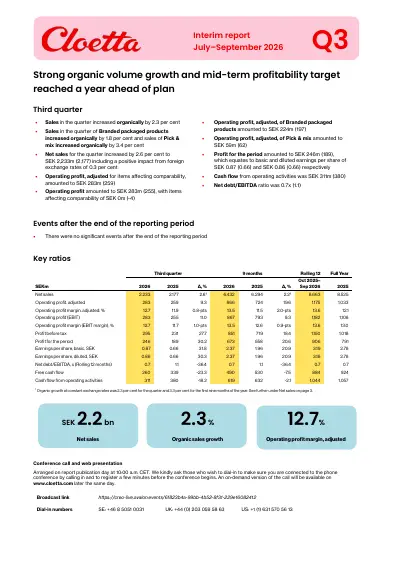
In the third quarter, we delivered accelerated volume growth. The 2.3% organic sales growth reflected the positive consumer response of our fair pricing strategy.
I'm also pleased that we achieved volume as well as sales growth in both business segments. Looking at our year-to-date performance, we delivered 3.3% organic growth, which is in line with our long-term target.
We continue to make progress on all three strategic priorities. We launched Sprinkle Foamies, expanded Ahlgrens bilar in Target in the US, and we are on track to have five Candyking pilots in Germany by the end of the year.
We also deliver a strong EBIT margin of 12.7%, supported by volume growth, a good product mix, and strong execution across the business. Most importantly, we reached our midterm profitability target more than a year ahead of plan, and that is, of course, something we are proud of.
With that, let's turn to the financials. I hand it over to Frans, who is as always ready to walk you through our financial performance.
Frans Rydén
Thank you, Katarina. I'm also very pleased to help present another very strong quarter for Cloetta.
This is a quarter which reflects in a great way the effect of the new strategy we launched last year. There's four points that I want to call out.
The first one is continued strong volume growth. As through our broad portfolio and our strong Superbrands, we have, despite the last couple of years of pretty steep but fair pricing, we've been able to protect our volumes.
Then in the first half of this year, we accelerated the volume growth. Now in Q3, we are continuing that strong volume growth.
You'll actually see some of the effects of that in a later chart. That's number one.
Number two is the strength of our fair pricing policy. Our strong profitability uplift these years have been underpinned by our fair pricing, where both our consumers and our customers win with us.
Now in Q3, these strong volumes are again supported by that pricing policy, and where we have reduced our prices commensurate with the dip in the price of commodities like cocoa earlier this year. Obviously, our prices do not change the same across categories and market, as the change depends both on which commodities goes into a product and when the last change of pricing happened on that product.
Nonetheless, the net sales growth we are reporting is net of such price changes, and the underlying volume growth therefore clearly higher. This means again, that consumers have enjoyed our products more, and our customers have sold our products more.
The third point, after the volume growth and the fair pricing, is the continued strengthening of our profit margin. As Katarina already mentioned, we are very pleased to confirm that we have now reached, more than a year early, our target of at least 12% operating profit margin.
That was a full-year target to be reached by 2027. With the solid margin now also in Q3, bringing year-to-date to well over 12% and rolling 12 months, etc., we are confirming the target as reached.
Then the fourth and final point: we have delivered this solid profit margin while at the same time stepping up investments in the marketing of our Superbrands and in our focused expansion strategy, as we also flagged for earlier this year. This is not a watered-down margin step-up.
A key takeaway is that continued focus on investing in our brands, accompanied by our fair pricing policy, means we're able to deliver stable, organic, volume-driven top-line growth at improved margins. Now, I'll come back to the profit, but just first the net sales figures.
In the quarter, we delivered volume-driven organic growth of 2.3%, bringing year-to-date to 3.3%, which is well in line with our long-term target. Then the Branded Packaged segment grew 1.8% and year-to-date 2.8%, and Pick & Mix grew 3.4% with a year-to-date of 4.3%.
Organic, volume-driven growth for the quarter and year-to-date across both segments. While at the same time we will continue to step up on what we're doing on geographic expansion in both packed and Pick & Mix products, and Katarina mentioned several, and that creates future growth potential and is part of the strategy we launched and part of the long-term target to reach a growth of 3 to 4% on a stable basis.
Now, the reported growth was actually slightly higher than the organic growth in the quarter, a total of 2.6% on account of favorable currency movement. As mentioned in previous earnings releases, we largely sell our products where we make them, and the currency effect is really a translation effect and have limited, let's say, real effect on our financials.
Then moving to the regular page showing the segments over time, I think I pretty much covered this already and what is driving the sales growth and the fair pricing that is softening that a bit. If I had to call something out, that would be that despite that, and I'm looking at the Branded Packaged segment on the top, with exception for the very strong first half of this year, Q3 at 1.8% is still the highest growth we've had in the last 10 quarters.
Now, of course, that fair pricing will also affect the next quarter. If you read Katarina's comments to the result in the report, we also highlight there that quarter four would also be affected by two recent events: one related to an IT incident at one of our customers in Central Europe, and one related to an IT incident with one of our logistics services providers in the Nordics.
Similar but separate incidents, and neither having affected our systems. Actually we haven't had any notable issues in our systems for as long as I'm aware of, at least since I came in 2018.
Still with continued digitalization and also some of these geopolitical uncertainties, the risk can never be eliminated, only mitigated and reduced. We're committed to continue to strengthen our resilience here and protect our track record in this area.
Nonetheless, the two incidents will have a limited and temporary effect on our sales in quarter four, but didn't in quarter three. Now, let's then go back to Q3 and a bit more on the profit.
In the quarter, operating profit adjusted 12.7%, and that is in line with what we shared in the quarter two reporting, which was, number one, that the Q2 result was exceptionally strong, and similar should not be expected for the back half of the year. Two, should also not be expected as we would step up on our investments, both for the geographic expansion and to support our Superbrands with the exciting launch.
This is the result net of investment for that. I can also reconfirm what we said in quarter two, and that is that the investments will span across both quarter three and in quarter four.
Profitability in any quarter can fluctuate a bit up and down, but with these strong improvements in margin versus last year also in Q3, that is also why we're pleased to confirm having reached the mid-year target of 12%. Then what is driving this strong operating profit margin?
It's quite clear here from the table. It's volume and mix both for the quarter and year-to-date, and that's what I opened with as well.
This is partially offset by the investments in our business. We are driving margin not by hiking prices, but on the contrary, we are driving margin by selling products which are well marketed under iconic brands that consumers love.
Now on the mix side, I can also add that with the strong volume-driven growth, we are even stronger in our Superbrands. Between categories, we're also doing really well in both pastilles and gum segments, which we have shared before that we spent a lot of time and effort on.
We had a novelty Läkerol Mor launch, and we took Minto and Siffmint into new markets, etc. Again, our broad portfolio continues to enable our strong results.
Naturally, we have continued also to drive operational efficiencies in supply chain. We have the carryover savings from last year's reorganization, and we've continued the effort by the commercial teams on net revenue management, for example, margin-accretive innovation.
All of this contributes. Looking then at the segments over and under, you can see that both segments are delivering strongly.
For the Branded Packaged segment, the 14.4% is nice, but it's still a bit shy of the exceptional first half of the year, but it's an improvement versus last year, and it's a step closer to the 15% plus pre-pandemic margin levels that we used to generate in the Branded Packaged segment. Then for Pick & Mix on the lower half, we do another strong quarter, and it's well within our targeted range of 7 to 9% of margin in Pick & Mix.
As we've at times tipped over and been above 9%, but then we have also said that the 7 to 9% targeted long-term range in margin is the appropriate range to continue to drive profitable growth in the category, as well as the geographic expansion in line with our strategy. We're also pleased to be in line with that range.
Then moving to SG&A, looking then at the sales, general, and admin costs. In the quarter, you do see the investments I've mentioned, both for the geographic expansion and the support of the Superbrand, including the launches Katarina shared.
You then also have to remember that is an increased cost net of the carryover savings from the reorganization last year. It is a significant amount, just as we flagged for in Q2.
Year-to-date, the change last year is obviously primarily driven by the absence of repeating last year's provisions for that restructuring. If you ignore that, and then you also ignore the upside on the currency effect, the main variance driver is again our investments and the fact that we have continued to invest focused time and money behind arguably the broadest portfolio of iconic brands in Northern Europe.
Moving then on to the free cash flow. In quarter three, we generated 260 million Swedish kronor in free cash flow on 283 million in operating profit.
We're pleased with that. Now, Q3 last year was actually even stronger, but then that was almost a decade-high quarter, had a little bit to do with the phasing also of Easter.
If you compare year-to-date this year to year-to-date last year, then the free cash flows are quite similar, and the variance is largely accounted for by the fact that we've invested more in CapEx this year. That CapEx in the quarter, which is 51 million, is the highest we've had the last two years.
We are moving up, as communicated earlier, to reach a temporary rise of CapEx to an average of 4 to 5% of net sales over the five-year period ending 2030, and that will start to be visible in 2027. That said, the CapEx that we're spending now in 2026 is part of the total expected CapEx and is part of the implementation of the plans that we have.
Then that takes me to my last slide on financial position. If we start with the leverage, we closed the quarter with a net debt over EBITDA of 0.7, well below our target for the leverage to be below 1.5.
It's reduced by .4 versus last year, and this is, of course, driven both by the strong cash flow and the improved earnings. .7 is pretty close to the lowest ever.
Lowest ever was actually in quarter one this year at .6, but then, of course, since then we've also paid our increased dividend in quarter two, and .7 is the lowest we've been for a quarter three. Now, our net debt is also one of the lowest ever at 1 billion Swedish kronor.
In the end, we have plenty of access to additional unutilized credit facilities and commercial paper, which together with cash on hand total 3 billion kronor. I can wrap up and say that for another quarter, we have secured resilience in a changing world, and we do have the financial strength to act on business opportunities.
That said, while we do have strategic financial flexibility, we will not change our selective approach to investing in our business or M&A, as described during the Investor Day last year. On that note, I conclude that our financial position, developing in line with our set targets, remains very strong.
I hand back to you, Laura.
Laura Lindholm
Thank you very much, Katarina, and thank you, Frans. It is now possible to either dial in and ask questions live or, alternatively, post your question through the chat.
George, I think we already have questions from the telephone lines. Is that correct?
Operator
Thank you, Laura. We will now begin the question-and-answer session.
Anyone who has a question may press star and one at this time. Once again, to register for a question, you may press star and one.
Our first question comes from Lundh Anton with SB1 Markets. Please go ahead.
Anton Lund
Hello, guys. Can you hear me?
Frans Rydén
Yes, we can.
Anton Lund
Very good. Congrats to a solid report.
I'm thinking about the recent launches. You've been seemingly active in launching new products.
Is it possible that you can give us any sort of indication of how much these launches, let's say in the past 12 months, have contributed to sales or organic growth here in Q3?
Frans Rydén
Yeah. Good morning, Anton.
It's not something that we disclose, but I would say like this: that our focus is on our Superbrands in line with the strategy, and these brands are historically growing a little bit faster, and they are also more profitable than the brands in average. That trend certainly hasn't been diminished with this stronger focus.
It's an accretive effort, but disclosing it is not something that we're really doing right now.
Anton Lund
Got it. Then I got a question on the marketing spend ahead.
You talked a lot about it in the presentation here. Should we see this level here as a new higher run rate going into '27, or is it a temporary peak tied to these launches that we're talking about?
Frans Rydén
We have over time sort of steadily increased what we're spending, both in terms of the efficiency of the spend, so that more cents per dollar, as they say, goes to what actually a consumer sees and not to the production behind. We have also stepped up.
Specifically now for the back half of this year, it is a, let's say, one-time step-up that has both to do with the geographic expansion, where you have listing costs and bringing bilar to Target, etc., but also organizational costs, plus then this multi-market launch of Sprinkle Foamies and to put enough strength behind that. It is a bit of a peak in these two quarters, but it doesn't mean that we're holding back on the investments going forward.
Anton Lund
Got it. Then one final one from me, please.
Sales outside your core markets appear to have been rather flat. How do you see Germany developing as you roll out Candyking pilots?
Then when should we expect these non-core markets to grow faster than the group? Thanks.
Katarina Tell
Yes, it is a good question. In general, when we do a pilot, it is not show any significant sales in the beginning.
That is really to get the proof of concept. When we have the proof of concept, then we agree with the customers to roll out more stores with the concept.
Of course, we are in dialogue with Germany regarding this. Germany, we have the brand Red Band that is the hero brand, and there we see we are increasing the distribution, especially now later in the year.
When it come to the growth of non-core markets, yes, of course, we are now investing to make it grow on a long term. We have shared during the Investor Days in March one and a half year ago that the plan is that the core markets in the beginning will grow more than the beyond core, and after a few years, then the beyond core market will grow faster.
That is also how we come up with the 3 to 4%. It will start, of course, with the markets beyond core to grow in the coming years.
We also see it happening step-by-step, and we are taking some important milestones also there.
Anton Lund
Very good. That's all for me.
Thank you. Thank you.
Katarina Tell
Thank you.
Operator
As a reminder, if you wish to register for a question, you may press star and one. Our next question comes from Nicklas Skogman with Nordea.
Please go ahead.
Nicklas Skogman
Yes. Good morning.
How do you see the fair pricing policy impacting Q4 compared to Q3? Will we see a bigger impact from having to pass on some lower prices, or do you think it'll be similar to Q3?
Oh,
Frans Rydén
good morning, Nicklas. Thanks for asking your question.
Hey, what also we wrote in the CEO commentary, obviously we have stayed true to our pricing policy and our fair pricing policy, and we have taken pricing down during Q3. All else equal, you would then have a, let's say, full effect of that going into quarter four.
Beyond there, we don't want to be price signaling if we're going to change something going forward. Commodities are constantly changing, but you know that always making a change also takes a little bit of time.
I hope that sort of answers your question within what we've shared.
Katarina Tell
Yeah.
Nicklas Skogman
Yeah. I'm just thinking also that prices for plastics and sugar and now cocoa, too, seems to be moving up, would be a point where you need to raise prices.
Frans Rydén
Sorry, Nicklas, I interrupted you there. No,
Nicklas Skogman
I just said given that many of the raw materials appear to be going up again in price, probably you need to raise prices at some point soon.
Frans Rydén
For example, cocoa now, it dropped earlier this year, and then it's already back up above 5,000. Based on our fair pricing policy, when cost goes up, then we also increase our prices.
We've shown now in Q4 that, sorry, in Q3 that we also take down the prices when they go in the other direction, and it's part of our trust-building relationship with our customers as well.
Nicklas Skogman
Yep. Good.
I guess you don't want to comment on the logistics and the customer IT issues, what the impact will be roughly?
Frans Rydén
No, we haven't given a number for it, but I think I would comment on it just so that it's clear. It was not an issue in our systems.
We've actually have a really strong track record, and we're going to keep investing in our own resilience and keep that track record. Unfortunately, it was in one case with a customer in Central Europe, and it's been in the media and how they were affected by cyberattacks.
The other one was another IT issue relating to a logistics services provider we have in the Nordics that has then in the end both affected our shipments in Q4. We've said it's temporary and it's limited, but we wanted to be transparent about this.
Exactly what that one, that we don't know or we don't want to share exactly that right now. Also on the pricing that you mentioned before, you're right.
There's always a lag, right, when commodities move in a certain direction. There's a lag before we can implement the price change, whether that is up or down.
Nicklas Skogman
Okay. Thank you.
Frans Rydén
Thank you.
Katarina Tell
Thank you.
Laura Lindholm
Thank you very much. I think, George, we do not have any further questions from the lines.
Is that correct?
Operator
This is correct, Laura.
Laura Lindholm
Thank you. We move over to the chat.
The first question comes from Stefan Stjernholm at Handelsbanken: "Is it fair to assume that half of the organic growth year-to-date is price and half volume?"
Frans Rydén
No, I wouldn't say that. I would say it's closer to say that this is volume-driven organic growth.
It's volume-driven growth, and certainly not now after Q3 when we have lowered the prices.
Laura Lindholm
Thank you, Frans. Then I believe we have a question from one of our private shareholders, a growing investor base for us: "Congrats to a good quarter once again.
Any update on the IT'SUGAR pilot in USA that has been running for 3 to 4 months? Thank you."
Katarina Tell
Yes. Thank you, Jan.
We are testing the proof of concept, and this is important to get the learnings and understanding for further geographical expansion in the US. It's part of the plan.
I don't have any detailed update right now to share, but regarding North America, we will come back by the year-end to give you a better update in this area.
Laura Lindholm
Perfect. Now, should you want to add a question in the chat, please do so now.
Also checking the conference lines, but it appears we have answered all the questions. Let's see in the chat here.
No, it seems that everybody is very happy for today, it's time to start to conclude our event. We do take the opportunity, as per usual, to update and remind you of our upcoming IR events.
Our next report, Q4, is published on the 3rd of February. Ahead of that, quite a lot is happening.
Tomorrow, Nordea has kindly invited us for a physical investor roadshow here in Stockholm. Next week, we head to Frankfurt for a roadshow hosted by SEB.
On the 17th of November, we attend the digital Berenberg European Discovery Conference, which is primarily arranged for US-based shareholders and investors. The day after that, we meet our rapidly increasing private shareholder base and attend the Avanza Investor Day, which is held physically here in Stockholm.
We, of course, continue to update our upcoming events in the IR calendar, which is available on cloetta.com. It's now time to conclude our event.
Before we meet again, we, of course, hope that you get the chance to enjoy our very wide portfolio of confectionery products during many joyful occasions. If you are in one of our core markets in Europe, you will be able to get your hands on the Sprinkle Foamies that Katarina already mentioned.
Although it's only the beginning of November, I do take the opportunity to remind you of our Candyking pick & mix holiday calendar, which is also available in many of those markets. Thank you for joining us today.